
Big, sweet strawberries start with the right food. Feed them poorly and you get tiny, tart berries or dense green leaves with no fruit. This guide shows you which plant food for strawberries actually delivers more berries and fixes problems like yellowing leaves.
I’m Rikta — the co-founder and writer behind Lawn Gear Lab. This guide is built by comparing the manufacturers’ published specifications and the patterns across verified customer reviews, so you get each pick’s real strengths and trade-offs instead of marketing spin.
Here is the clearest breakdown of plant food for strawberries focused on what works in your garden or container.
How To Choose The Best Plant Food For Strawberries
Feeding strawberries is not like feeding your lawn or tomatoes. You need a mix that supports flowers and fruit, not just big green leaves. Here are the two key things to look at when you shop.
N-P-K Ratio and Micronutrients
The three numbers on the bottle — Nitrogen (N), Phosphorus (P), and Potassium (K) — tell you what the food emphasizes. For strawberries, you want a balanced or slightly phosphorus-heavy ratio (like 4-3-4 or 5-5-5) to encourage flowering and root growth. Too much nitrogen pushes your plants to grow lots of green leaves instead of berries. You also want micronutrients like calcium (for firm berries), magnesium (for green leaves), and zinc (for overall plant health). Look for these on the label or in the guaranteed analysis.
Liquid vs. Granular
Liquid concentrates mix with water and get absorbed fast — great for correcting a deficiency or giving weekly feedings. Granular, slow-release options like Espoma’s Berry Tone are sprinkled on the soil and release nutrients over weeks or months. Granular is less work once applied, but liquids give you more control over the dose and are easier to adjust if you see a problem.
Quick Comparison
On smaller screens, swipe sideways to see the full table.
| Model | Category | Best For | Key Spec | Amazon |
|---|---|---|---|---|
| HiThrive 16oz Strawberry Fertilizer | Liquid Concentrate | Fast correction of yellow leaves | Makes 16 gallons of feed | Amazon |
| HiThrive 32oz Strawberry Fertilizer | Liquid Concentrate | Long-term value for larger beds | Makes 32 gallons of feed | Amazon |
| TPS Nutrients Strawberry Fertilizer | Liquid Concentrate | Boosting berry production | 1:128 mixing ratio | Amazon |
| Growth Technology GT Fruit Focus | Liquid Concentrate | Hydroponics & container gardens | 12 essential minerals | Amazon |
| Espoma Berry Tone 4-3-4 | Granular | Set-it-and-forget-it feeding | 4 lbs of slow-release granules | Amazon |
In‑Depth Reviews
1. HiThrive 16oz Strawberry Fertilizer
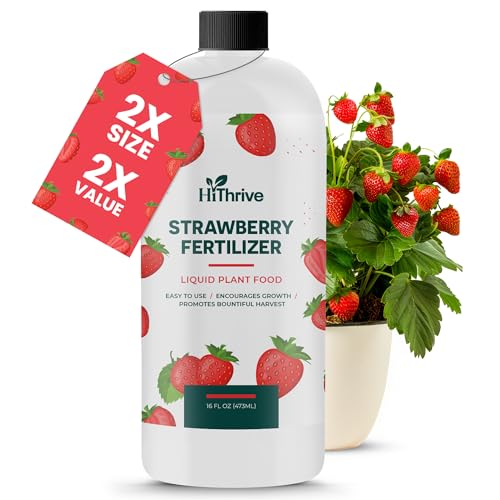
The HiThrive 16oz Strawberry Fertilizer earns the top spot because it tackles yellow, struggling leaves faster than any other pick here — buyers report plants turning dark green within 2 days. This liquid concentrate (a solution you mix with water) delivers calcium, magnesium, and zinc directly to the roots for a rapid boost. Each 16-ounce bottle makes 16 gallons of feed, enough for a small to medium garden bed. The formula works on all common strawberry types (Albion, Chandler, Seascape) with applications every 1-2 weeks. Reviewers consistently note bigger, sweeter berries and stronger runners. Those with large plantings will need a second bottle mid-season. For most home gardeners, this is a straightforward, effective start.
Why it’s great
- Visible results in 48 hours, according to buyers
- Includes key micronutrients calcium, magnesium, and zinc
- Easy to mix and apply with a watering can
Good to know
- A smaller 16-ounce bottle; large beds may need more
- Requires weekly mixing during peak season
2. HiThrive 32oz Strawberry Fertilizer
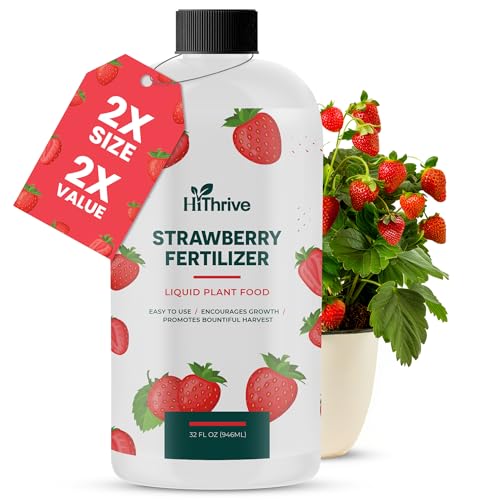
The 32-ounce HiThrive is the same formula as the 16-ounce top pick but in a bottle you will not replace as often — it holds twice the volume (32 ounces vs. 16 ounces) and makes 32 gallons of feed instead of 16. At 2.59 pounds, it weighs exactly twice the 1.3-pound smaller bottle. Owners mention the same fast recovery, with yellow leaves turning dark green within 2 days. If you have a larger garden or multiple containers, this saves you a mid-season reorder. The formula, results, and mixing are identical to the smaller version. You pay less per gallon of feed by buying the larger container up front.
Where it shines
- Twice the feed volume of the 16-ounce bottle
- Same rapid greening and berry-boosting formula
- Better cost per gallon of mixed feed
Worth noting
- Bottle is larger and heavier at 2.59 pounds
- Exact same formula as the smaller size
3. TPS Nutrients Strawberry Fertilizer (32 oz)
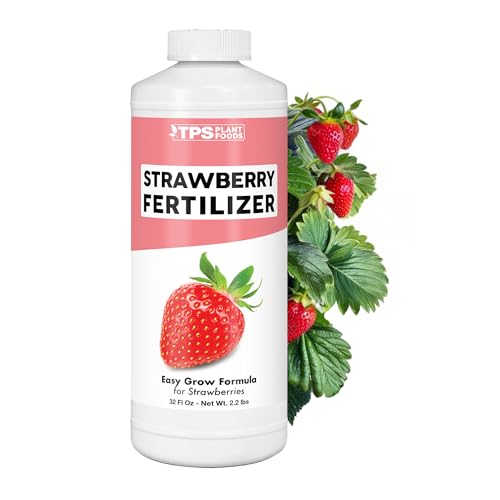
If your goal is more berries, not just greener leaves, the TPS Nutrients liquid is engineered specifically for that — one reviewer noted tripling their berry count compared to the previous year with the same plants and setup. The 1:128 mixing ratio (1 part fertilizer to 128 parts water) makes a 32-ounce bottle go a long way. This US-made formula targets healthy blooms and berry set without pushing excess leaf growth for garden beds, raised beds, and containers. One reviewer with a 4×20-foot raised bed noted a single bottle was barely enough for one application, so consider your bed size. The 1:128 ratio is more concentrated than most competitors, stretching further for routine feeding.
What stands out
- Customers note tripling berry count from one season
- Very concentrated 1:128 mix ratio stretches the bottle
- Supports flowers and fruit without excess leaf growth
The trade-offs
- May need more than one bottle for large raised beds
- Label lacks an explicit N-P-K ratio number
4. Growth Technology GT Fruit Focus (8.45 oz)
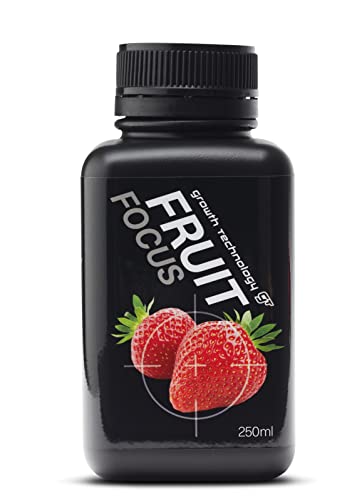
GT Fruit Focus delivers 12 essential minerals including calcium, which is a much wider spectrum than the 5 to 8 nutrients in most strawberry fertilizers. That matters most if you grow in inert mediums like hydroponics (plants in water without soil) or semi-hydro setups where you supply every nutrient. The bottle is small at 8.45 fluid ounces — about one-quarter the volume of the 32-ounce HiThrive — but you only need 3-5 ml per liter of water for soil (or 5-7 ml per liter for hydroponics). One reviewer called it expensive but noted that “you only need a teeny tiny bit, so it lasts forever.” Choose this specialized option for hydroponic systems or containers where water-soluble fertilizer is the plant’s only food source.
The upsides
- 12 essential minerals including calcium for firm berries
- Ideal for hydroponic and semi-hydro growing
- Very small dose per feeding, so bottle goes far
Keep in mind
- Small bottle size of 8.45 fluid ounces
- Higher cost per bottle than standard liquid feeds
5. Espoma Berry Tone 4-3-4 (4 lbs)
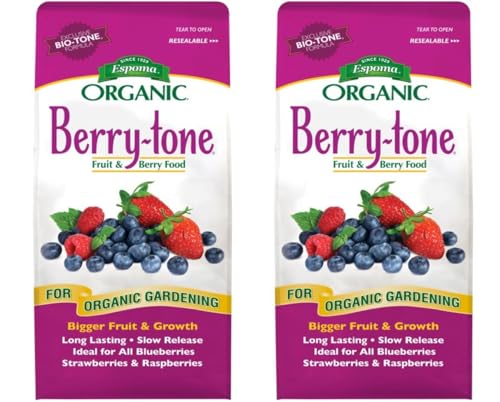
Espoma Berry Tone is granular slow-release fertilizer (tiny pellets you sprinkle on soil) that requires no mixing — apply twice a year (early spring and late spring) and the 4-3-4 analysis with Espoma’s Bio-tone formula feeds your strawberries steadily. One buyer mentioned a dramatic yield increase with blackberries, producing so many they made syrups and desserts. The catch is speed: unlike the HiThrive liquids that can green up leaves within 2 days, granules take longer to break down. This 4-pound bag is certified for organic gardening (meets organic production requirements without synthetic chemicals). It is a hands-off choice for the gardener who wants to feed berries twice a year and let rain and soil microbes do the rest.
Why we’d pick it
- No mixing needed; apply twice per year
- Approved for organic gardening
- Works on all berries: strawberries, blueberries, raspberries
A few caveats
- Slower than liquid feeds for fixing yellow leaves
- Large 4-pound bag, but granular covers area not plant count
Understanding the Specs
N-P-K Ratio
Those three numbers you see on every fertilizer package — Nitrogen (N), Phosphorus (P), and Potassium (K) — tell you the percentage of each major nutrient by weight. For strawberries, you want a balanced ratio like 4-3-4 or one that is slightly higher in phosphorus (the middle number) to support flowering and fruit set. Too much nitrogen (the first number) makes the plant grow lots of leaves at the expense of berries.
Liquid vs. Granular
Liquid concentrates are mixed with water and applied directly to the soil. They work fast because the plant absorbs the nutrients immediately through its roots, making them great for correcting a deficiency like yellow leaves. Granular, slow-release fertilizers are sprinkled on top of the soil and break down slowly over weeks or months, releasing nutrients with each watering. They require less frequent application but take longer to show results.
FAQ
How often should I feed my strawberry plants with liquid fertilizer?
Can I use a general all-purpose fertilizer on strawberries instead of a special strawberry food?
What do yellow leaves on my strawberry plant mean?
Should I use liquid or granular fertilizer for strawberries in containers?
Final Thoughts: The Verdict
For the majority of shoppers, the plant food for strawberries winner is the HiThrive 16oz Strawberry Fertilizer because it fixes yellow leaves fast and contains the key micronutrients strawberries need for big, sweet fruit. If you want more feeding capacity for a larger garden, grab the 32-ounce HiThrive. And for the set-it-and-forget-it gardener who prefers organic granules, the Espoma Berry Tone 4-3-4 is a solid choice.