
A citrus tree that drops its blossoms before setting fruit, or produces leaves that turn a sickly yellow between the veins, is sending a clear signal about its nutrition. The difference between a tree that merely survives and one that delivers a heavy crop of juicy, aromatic fruit is almost always the specific balance of macronutrients and micronutrients in the fertilizer you choose. A formula designed for general landscaping or lawns will not supply the precise ratio of nitrogen to potassium, nor the essential trace elements like zinc, iron, and magnesium, that citrus trees demand for both foliage health and heavy fruiting.
I’m Rikta — the co-founder and writer behind Lawn Gear Lab. I’ve spent countless hours cross-referencing soil science data, analyzing NPK ratios, studying the chelation methods of micronutrients, and sorting through verified owner feedback to isolate which formulas deliver measurable improvements in leaf color, bloom count, and fruit set for plant food for citrus trees.
This guide breaks down the top seven fertilizers on the market, comparing slow-release granules against fast-absorbing liquids, organic options against synthetic blends, and the specific micronutrient packages each includes so you can match the right formula to your tree’s stage of growth and your own gardening style.
How To Choose The Best Plant Food For Citrus Trees
Selecting a citrus fertilizer is not about grabbing the bag with the prettiest label. The chemistry inside must align with the specific metabolic needs of citrus trees, which are heavy feeders that require a particular ratio of nutrients and a steady supply of micronutrients that many general-purpose fertilizers skip entirely.
NPK Ratio — The Foundation
Citrus trees need a balanced or slightly potassium-heavy ratio. Nitrogen drives leafy growth, phosphorus supports root development and flower formation, and potassium is critical for fruit size, sugar content, and cold hardiness. Look for a formula where the middle number (phosphorus) is not excessively high unless you are trying to correct a specific bloom issue. Ratios like 6-4-6, 5-2-6, or 3-5-5 are common; the key is that potassium is at least equal to or higher than nitrogen.
Slow-Release vs. Liquid vs. Spikes — Delivery Method Matters
Granular slow-release fertilizers provide a steady supply of nutrients over several weeks to months, reducing the risk of root burn and requiring fewer applications. Liquid concentrates act faster, giving an immediate boost to a stressed or newly planted tree, but demand more frequent reapplication (weekly or biweekly during the growing season). Fertilizer spikes offer a set-it-and-forget approach but distribute nutrients in a concentrated zone, which can lead to uneven root feeding in larger pots or for wide canopy spreads.
Micronutrients — The Difference Between Good and Great
Citrus trees are especially sensitive to deficiencies in iron, zinc, manganese, and magnesium. An iron deficiency causes interveinal chlorosis (yellow leaves with green veins), while a lack of zinc results in stunted new growth with narrow, clustered leaves. Quality citrus-specific fertilizers always include chelated micronutrients, meaning the minerals are chemically bonded to organic molecules so they remain available to the roots even in alkaline or high-pH soils.
Organic vs. Synthetic — Matching Your Growing Philosophy
Organic fertilizers depend on soil microbes to break down the nutrients into plant-available forms, which means they work more slowly and improve soil structure over time. Synthetic formulas deliver nutrients in instantly available forms, giving faster visible results but doing less to build long-term soil health. Both can produce heavy crops; the choice depends on whether you prioritize immediate correction of a deficiency or gradual, sustained feeding that also feeds the soil food web.
Quick Comparison
On smaller screens, swipe sideways to see the full table.
| Model | Category | Best For | Key Spec | Amazon |
|---|---|---|---|---|
| Jobe’s Organics Fruit & Citrus Spikes | Spikes | Set-and-forget container trees | 3-5-5 NPK with Biozome | Amazon |
| Nelson NutriStar Citrus & Avocado | Granules | Rapid green-up and growth | 12-10-10 high-nitrogen | Amazon |
| Farmer’s Secret Citrus Tree Booster | Liquid | Super-concentrated deep feeding | 1 tsp per gallon ratio | Amazon |
| FoxFarm Happy Frog Citrus & Avocado | Granules | Organic mycorrhizal boost | 7-3-3 plus soil microbes | Amazon |
| GardenWise Professional Citrus | Granules | Balanced NPK with micronutrients | 6-4-6 coated granules | Amazon |
| Espoma Organic Citrus-tone | Powder | Certified organic long-term feeding | 5-2-6 with calcium | Amazon |
| TPS Nutrients Citrus Fertilizer | Liquid | Quick correction for potted trees | 2 tbsp per gallon liquid | Amazon |
In‑Depth Reviews
1. Jobe’s Organics Fruit & Citrus Tree Fertilizer Spikes

The Jobe’s Organics spikes deliver a 3-5-5 NPK ratio through a pre-measured spike system that eliminates guesswork entirely. Each package contains six spikes, and for a container-grown Meyer lemon or dwarf orange tree, inserting two spikes around the drip line provides a steady nutrient flow for roughly six to eight weeks. The inclusion of Jobe’s proprietary Biozome — a blend of beneficial archaea and mycorrhizal fungi — accelerates the breakdown of organic matter in the root zone, making the nutrients biologically available faster than standard organic spikes.
What sets this product apart is its compatibility with organic gardening standards. OMRI listing means no synthetic chemicals are present, and the time-release mechanism prevents the nutrient runoff that can happen with granular applications, especially on sloped or mulched ground. Multiple owners of potted Meyer lemon trees report that after switching from liquid fertilizers to these spikes, they saw denser foliage and a heavier fruit set within a single growing season, with the added benefit of not having to mix or measure anything.
The primary trade-off is the limited coverage of a single package. For in-ground trees with a canopy diameter over six feet, you will need multiple packs to cover the full root zone. Additionally, the spikes must be placed outside the root ball and below the soil surface — if pushed in too close to the trunk, they can cause root burn in young or sensitive trees. Timing is also critical: applying during late winter pre-bloom or early fall produces the best results, while summer applications in extreme heat may stress the tree.
What works
- Zero measuring or mixing required
- Biozome accelerates nutrient availability
- OMRI certified organic
- Excellent for container citrus trees
What doesn’t
- Coverage limited per pack for large in-ground trees
- Requires careful placement to avoid burning roots
- Slightly higher cost per application than granular
2. Nelson NutriStar Citrus Fruit & Avocado Tree Plant Food
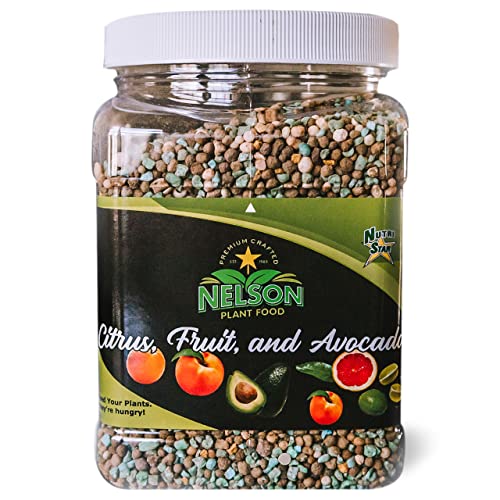
The Nelson NutriStar formula carries a 12-10-10 NPK ratio, making it one of the highest-nitrogen citrus fertilizers on the market. That high first number is deliberate: nitrogen drives rapid leaf expansion and canopy density, which is especially valuable for young trees that need to establish a strong framework before they start fruiting heavily. The formula also includes calcium, which strengthens cell walls and prevents blossom end rot in developing fruit, a common issue in container-grown citrus that fluctuate between wet and dry cycles.
Owners consistently report an immediate visible response after application, with new leaf growth appearing within two weeks and a noticeable darkening of existing foliage. The granules are designed to work with the soil biology, meaning they break down in response to microbial activity and moisture, creating a sustained release over roughly four to six weeks. For in-ground trees with a broad drip line, this granular form allows even distribution across the entire feeder root zone, unlike spikes that concentrate nutrients in small pockets.
The high nitrogen content means this is not the ideal formula for a potted tree that is already pushing excessive leafy growth at the expense of flowers. If your tree is mature and you want to tilt the balance toward fruit production rather than foliage, you would be better served by a formula with a potassium-dominant ratio. Additionally, the product has a strong odor for the first few days after application, and dogs are reportedly attracted to the scent — watering it in thoroughly and keeping pets off the treated area for 24 hours is advisable.
What works
- Rapid leaf green-up and canopy expansion
- Calcium included for fruit strength
- Good coverage for widespread drip lines
- Effective on young trees establishing structure
What doesn’t
- Too nitrogen-heavy for mature potted trees
- Strong smell initially attracts dogs
- Requires monthly reapplication during growing season
3. Farmer’s Secret Citrus Tree Booster Fertilizer

Farmer’s Secret Citrus Tree Booster lives up to the “super concentrated” claim on the label — a single teaspoon diluted in a gallon of water is the standard weekly feed for a mature in-ground tree, and the same 32-ounce bottle yields more than 190 gallons of mixed fertilizer. The concentration level means this is one of the most economical liquid options on a per-application basis, and the liquid form allows immediate absorption through both roots and foliar contact if applied as a soil drench around the drip line.
Reviewers consistently note the speed of recovery in trees that were showing signs of chlorosis or bloom drop. Multiple owners of sick or yellowing lemon trees report that after two to three weekly applications, the foliage turned dark green, new flower buds emerged, and existing fruit began sizing up noticeably. The formula works equally well on indoor container trees when the dose is halved or applied every other week, making it a versatile option for growers who keep a mix of potted and in-ground citrus.
However, the formula does not contain significant amounts of calcium or magnesium, two nutrients that are critical for citrus fruit development and the prevention of leaf curling. Several experienced growers noted that if their soil was already deficient in these secondary nutrients, they needed to supplement with a separate cal-mag product to avoid deficiencies later in the season. The product also requires weekly mixing during the active growing period, which may be less convenient than slow-release granules for absentee gardeners.
What works
- Extremely concentrated — huge value per bottle
- Rapid visible recovery of yellowing trees
- Flexible dosage for container vs. in-ground
- Easy to apply as a root drench
What doesn’t
- Needs weekly mixing during growing season
- No calcium or magnesium included
- May require supplement for deficient soils
4. FoxFarm Happy Frog Citrus and Avocado Fertilizer

The FoxFarm Happy Frog formula uses a 7-3-3 NPK base, which is moderately nitrogen-heavy but includes a proprietary blend of mycorrhizal fungi and beneficial soil microbes. This biological component is the distinguishing feature: the fungi colonize the root system and effectively extend the root surface area, improving the tree’s ability to access water and nutrients locked in the soil. For citrus trees planted in sandy or nutrient-poor soil, this biological boost can make a dramatic difference in how efficiently the fertilizer is utilized.
The feedback from long-term users is remarkable for its consistency. Growers who have used Happy Frog for a decade or more on mixed groves of avocados, oranges, grapefruits, and limes report that the trees maintain deep green foliage and heavy fruit production without the periodic deficiencies they saw with other organic fertilizers. The slow-release nitrogen is derived from feather meal and alfalfa meal, which break down gradually over about six to eight weeks, reducing the risk of nitrogen burn even when applied generously around the drip line.
Recent batches have drawn criticism for a changing texture and composition. Some buyers noted that the product appears to be mostly alfalfa meal, with a coarser grind and less of the concentrated nutrient density that earlier versions had. The odor is also strong and attractive to dogs — multiple owners warn that the smell of the granules draws pets to dig in the treated area, and the product should be watered in immediately and kept away from curious animals for at least 48 hours.
What works
- Mycorrhizae improve root efficiency and uptake
- Proven long-term performance over many growing seasons
- Slow-release formula minimizes burn risk
- Works well on mixed citrus and avocado groves
What doesn’t
- Strong odor attracts dogs to the soil
- Recent batches may have lower nutrient density
- Relatively expensive for the coverage area
5. GardenWISE Professional Citrus Fertilizer
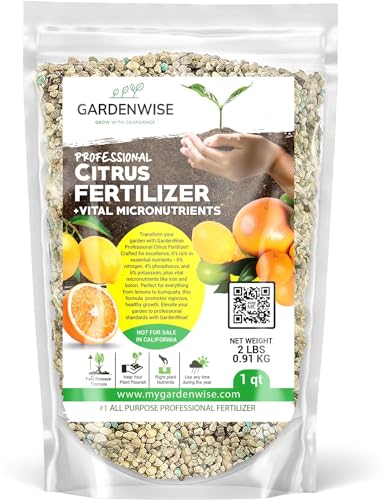
GardenWISE Professional Citrus Fertilizer hits a 6-4-6 NPK ratio, which is arguably the most balanced ratio in this lineup for mature, fruiting citrus trees. The potassium and nitrogen are equal, ensuring that the tree has the energy to drive both new leaf production and the development of high-sugar fruit without one process dominating the other. The formula also includes a full suite of chelated micronutrients — zinc for leaf expansion, iron for chlorophyll synthesis, magnesium for enzyme activation, and boron for flower and fruit set.
The granules are coated for controlled release, and owners report that a single application provides sustained feeding for roughly six to eight weeks, depending on watering frequency. The most impressive owner feedback describes a Meyer lemon tree that was fully covered in blossoms and new fruit within one week of application, and a four-year-old Cara Cara orange tree in a pot that responded with glossy new leaves and a heavy fruit set after being fed with this product alongside a weekly fish emulsion regimen. The 32-ounce bag covers several medium-sized container trees, making it a practical choice for a small home orchard.
The product is relatively new to the market compared to legacy brands, so long-term data on how it performs across multiple seasons is limited. A small number of users noted that the granules can form clumps if the bag is stored in a humid environment, so transferring the contents to an airtight container is recommended. Additionally, the bag size is moderate — for growers with five or more in-ground trees, ordering multiple bags per season will be necessary.
What works
- Balanced 6-4-6 ratio ideal for fruiting trees
- Full micronutrient package includes zinc and boron
- Coated granules provide steady slow release
- Rapid visible results on container citrus
What doesn’t
- Limited long-term track record
- Granules may clump in humidity
- Bag size best for small to medium collections
6. Espoma Organic Citrus-tone 5-2-6

Espoma Citrus-tone has been a staple in the organic citrus community since 1929, and the 5-2-6 NPK ratio reflects a deep understanding of the nutrient demands of citrus and subtropical fruit trees. The ratio is intentionally potassium-heavy, prioritizing fruit quality and cold hardiness over excessive leaf production. The inclusion of 5 percent calcium is a specific advantage for growers dealing with blossom end rot or soft fruit, as calcium strengthens cell walls and improves fruit firmness during development.
Owners of Key lime and Meyer lemon trees report that after switching to Citrus-tone, their trees set fruit more densely and the fruit had noticeably better flavor. The powder form is ready to use and requires no mixing — simply sprinkle around the drip line and water in. Because it is an organic formula that relies on microbial breakdown, the nutrient release is slower and gentler than synthetic fertilizers, making it nearly impossible to burn roots even if you apply generously. The bag is also a usable size for a small citrus collection, covering several in-ground trees or a larger number of container plants.
The most consistent criticism is the odor. The natural ingredients — primarily composted poultry manure and feather meal — produce a strong, barnyard-like smell that persists for several days after application. Multiple reviewers noted that the smell is potent enough that it should be applied only outdoors and that dogs are intensely interested in the treated area. The powder form can also be dusty during application, so wearing gloves and a mask is advisable on windy days. Some users also found that the granular texture clumps if stored in a damp shed.
What works
- Proven organic formula in use for decades
- Potassium-heavy ratio improves fruit quality
- Calcium included for stronger cell structure
- Gentle, low risk of root burn
What doesn’t
- Strong barnyard odor for several days
- Dusty application on windy days
- Slow release may not correct acute deficiencies
7. TPS Nutrients Citrus Fertilizer Liquid
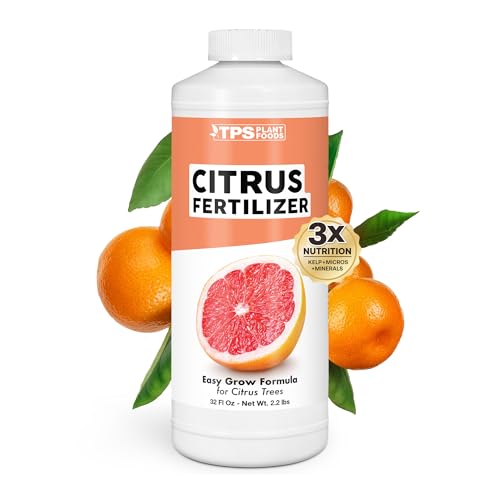
The TPS Nutrients liquid citrus fertilizer uses a fast-absorbing formula designed for growers who need to correct a visible deficiency quickly. The mixing ratio is 2 tablespoons per gallon of water, and the 32-ounce bottle yields 32 gallons of ready-to-use feed. The liquid form means the nutrients are immediately available to the roots, making it a strong choice for potted trees that are showing yellowing leaves or a stalled growth pattern after a cold snap or repotting.
Owner feedback highlights the formula’s effectiveness on stressed container trees. A potted lime tree that had yellowing leaves and stunted fruit responded within two weeks — the leaves returned to a healthy green, the existing limes noticeably enlarged, and new leaf growth emerged. Another reviewer with a mix of lemon and orange trees reported that the liquid feed improved overall leaf color and fruit production, praising the formula as gentle enough for regular use without causing salt buildup in potting mix.
The formula is specifically noted to be low in nitrogen relative to what citrus trees typically require. One detailed review pointed out that the blend contains adequate magnesium, calcium, and iron, but the nitrogen concentration is lower than most dedicated citrus fertilizers. For mature trees in active growth, you may need to supplement with a higher-nitrogen fertilizer during the spring flush or adjust the dosage upward. The product is also on the pricier side per gallon of mixed feed compared to granular options that cover more total applications for the same upfront cost.
What works
- Fast-acting liquid corrects deficiencies quickly
- Gentle formula safe for regular feeding
- Good micronutrient content (Fe, Mg, Ca)
- Excellent for stressed or newly potted trees
What doesn’t
- Low nitrogen for a primary citrus fertilizer
- Higher cost per gallon of mixed feed
- Needs supplementing during spring growth flush
Hardware & Specs Guide
NPK Ratio Decoded
The three numbers on any fertilizer bag — nitrogen (N), phosphorus (P), and potassium (K) — represent the percentage by weight of each macronutrient. For citrus, the ideal middle number (phosphorus) should not exceed potassium, and the first number (nitrogen) should be roughly equal to or slightly lower than potassium. A ratio like 6-4-6 provides a balanced supply of all three, while a 12-10-10 is heavier on nitrogen and better suited for young trees still building canopy mass. Always match the ratio to the tree’s current growth stage: higher nitrogen for establishment, higher potassium for fruiting.
Micronutrient Package
Beyond the three macronutrients, citrus-specific fertilizers include secondary nutrients that are easily overlooked but equally critical. Iron prevents interveinal chlorosis; zinc regulates growth hormones and leaf expansion; manganese supports photosynthesis; and magnesium is the central atom in the chlorophyll molecule. Chelated forms of these minerals — where the metal ion is bonded to an organic molecule — remain available in alkaline soil conditions where unchelated minerals would precipitate out and become inaccessible. If your fertilizer label does not list these elements, you may need a separate supplement depending on your soil chemistry.
Slow-Release vs. Liquid
Granular slow-release fertilizers use a polymer coating or organic matrix (such as feather meal or bone meal) to meter nutrients over weeks or months. This reduces the number of applications per season and lowers the risk of leaching in sandy or frequently watered soil. Liquid fertilizers dissolve instantly and deliver nutrients directly to the root zone within hours, making them ideal for correcting acute deficiencies or jump-starting a tree after transplant shock. The trade-off is that liquids require more frequent application — often weekly — and the total cost per season can be higher if you are covering a large number of trees.
Application Timing and Frequency
Citrus trees have three distinct feeding windows that align with their growth cycle. The first application should occur in late winter to early spring, just before the tree breaks dormancy and begins pushing new growth and flower buds. A second feeding after the fruit has set in late spring provides the energy needed for fruit sizing. A third application in late summer to early fall helps the tree store energy for the next season and improves cold hardiness. For slow-release granules, three feeds per year are typically sufficient; for liquids, feed every one to two weeks during the active growing season and stop when temperatures drop below 60°F at night.
FAQ
Can I use a general-purpose fertilizer instead of a citrus-specific one?
How do I know if my citrus tree has a nitrogen deficiency or an iron deficiency?
Should I stop fertilizing my citrus tree in winter?
How far from the trunk should I apply granular fertilizer?
Final Thoughts: The Verdict
For most gardeners, the plant food for citrus trees winner is the GardenWISE Professional Citrus Fertilizer because its balanced 6-4-6 NPK ratio and complete micronutrient package cover all the bases for both container and in-ground trees without requiring supplemental products. If you want rapid, high-nitrogen growth for a young or recovering tree, grab the Nelson NutriStar. And for the set-it-and-forget organic grower with container trees, nothing beats the ease and consistency of the Jobe’s Organics Spikes.