
Chasing a deep green lawn without the yellow burn patches or the boom-and-bust growth cycle comes down to one thing: the NPK numbers on the bag. With ratios that range from high-nitrogen quick fixes to balanced slow-release blends, picking the right Fertilizer For Grass determines whether your yard thrives or just survives.
I’m Rikta — the co-founder and writer behind Lawn Gear Lab. I spend my days cross-referencing NPK formulations, studying nitrogen release technologies, and analyzing thousands of verified owner experiences to separate science-backed lawn food from marketing hype.
Whether you are patching bare spots, greening up a mature lawn, or feeding new seed without scorching tender roots, the fertilizer for grass you choose must match your specific grass type and soil chemistry.
How To Choose The Best Fertilizer For Grass
A lawn feed that works beautifully on a neighbor’s Bermuda may turn your fescue yellow or push it into top-heavy growth that invites disease. The following four criteria will help you filter the options down to the one formula that fits your specific turf situation.
Match the NPK Ratio to Your Season and Soil
Nitrogen (the first number) drives leaf growth and green color — a 28-0-0 formula leans heavily on this. Phosphorus (the middle number) supports root establishment, making ratios like 20-27-5 ideal for new seed. Potassium (the last number) strengthens cell walls against drought and disease. If a soil test already shows adequate phosphorus, choose a zero-middle-number blend like 10-0-2 to avoid runoff and imbalance.
Understand Nitrogen Release Technology
Quick-release nitrogen gives you a visible green-up within 48 hours but can burn if over-applied. Slow-release nitrogen (often coated or polymer-encapsulated) feeds consistently over 8 to 12 weeks, eliminating surge growth and frequent re-application. Products that advertise “70% quick / 30% slow” aim for immediate visible results with a maintenance tail.
Consider Granular vs. Liquid Format for Your Spreader
Granular fertilizers are the standard for broadcast or drop spreaders, offering even coverage over thousands of square feet per bag. Liquid concentrates require a hose-end or tank sprayer and are better for spot-treating yellow patches or targeting a quick green-up on cool-season grasses during spring transition.
Check for Pet, Kid, and Waterway Safety
Some formulas contain biosolids or synthetic salts that can burn grass if the granular sits wet on the leaf. Plant-based or naturally derived blends (often flagged as “non-burning”) allow immediate re-entry for pets and children. Phosphorus-free products are legally required in some municipalities to protect lakes and streams, so verify local regulations before buying.
Quick Comparison
On smaller screens, swipe sideways to see the full table.
| Model | Category | Best For | Key Spec | Amazon |
|---|---|---|---|---|
| The Andersons PGF 16-0-8 | Granular | Maintenance feeding on established lawns | 16-0-8 with Humic DG | Amazon |
| GreenView Fairway Formula | Granular | Large-lawn spring feeding | 63% slow-release N | Amazon |
| The Andersons New Lawn Starter | Granular | New seed or sod establishment | 20-27-5 + 1% iron | Amazon |
| Purely Organic Lawn Food | Granular | Pet-safe, chemical-free lawns | 10-0-2 soy & grain base | Amazon |
| Petramax Liquid Nitrogen 28-0-0 | Liquid | Rapid green-up correction | 70% quick / 30% slow N | Amazon |
| Safer Brand Lawn Restore | Granular | Organic non-burning recovery | 9-0-2 naturally derived | Amazon |
| Supply Solutions 16-16-16 | Granular | All-purpose garden & lawn use | Balanced 16-16-16 NPK | Amazon |
In‑Depth Reviews
1. The Andersons Professional PGF 16-0-8 Fertilizer with Humic DG (18lb)
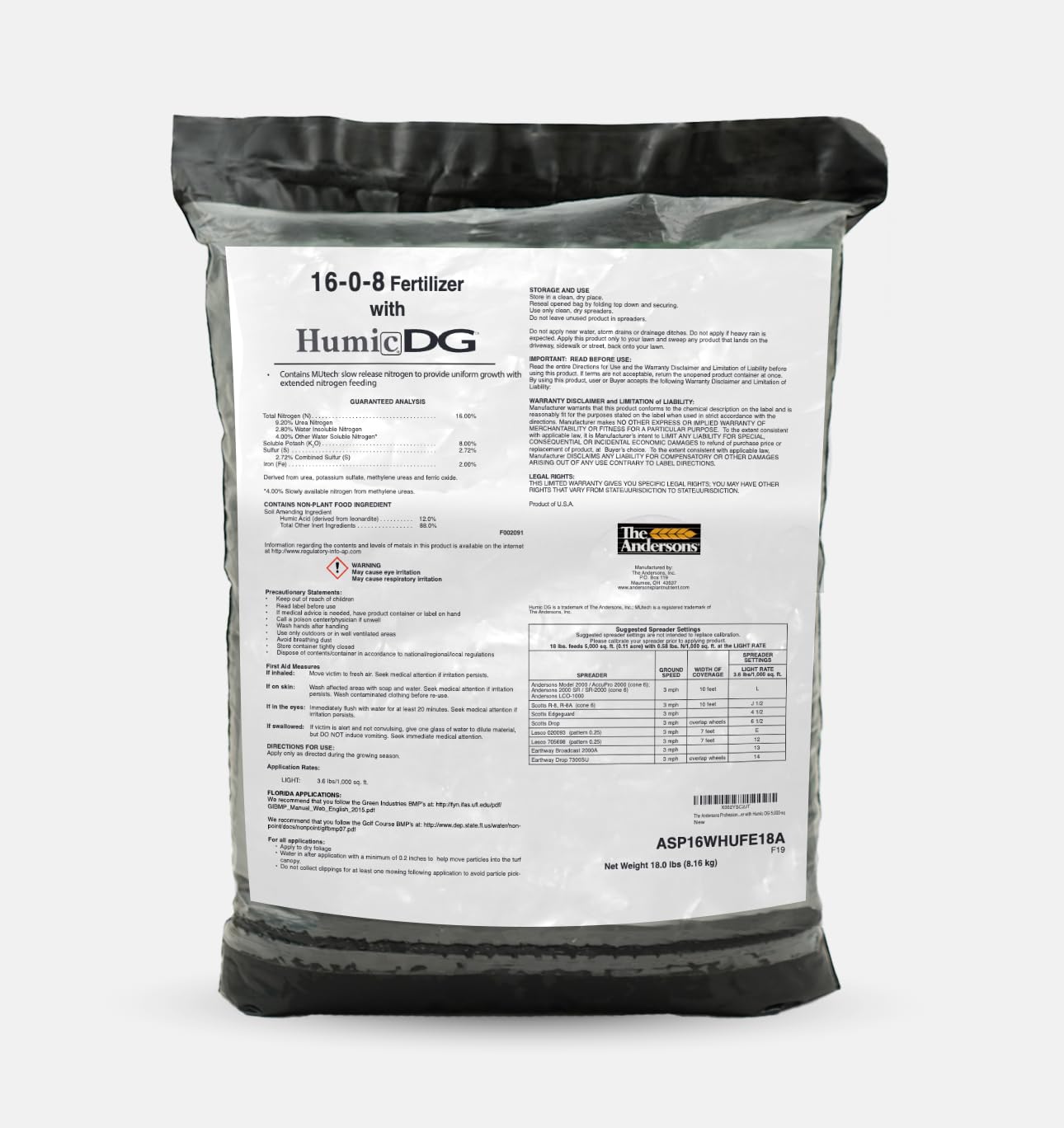
The Andersons PGF 16-0-8 stands apart with its Ultra-Green DG technology that mills particles into a super-fine powder before binding them into dust-free granules. This gives it roughly twice the particle count per square foot compared to standard prills, translating directly to uniform coverage — no more dark green stripes where the spreader wheel passed twice.
The phosphorus-free formula (16-0-8) is deliberate: it targets maintenance feeding on established lawns where a soil test has shown adequate phosphorus levels, preventing runoff into local waterways while still delivering a steady 8-week nitrogen feed. The inclusion of Humic DG improves nutrient uptake by the root zone, which owners consistently report as the factor that pushes grass from “green” to “neighborhood-best” within two weeks.
It is not for sale in California or Oregon due to local phosphorus restrictions, which is actually a compliance strength. The 18-pound bag covers roughly 5,000 square feet at the standard maintenance rate, and the fine particle size means even a basic broadcast spreader will lay it down evenly without clogging the drop gate.
What works
- Ultra-fine granules eliminate streaking and provide unmatched distribution uniformity
- Humic DG compounds improve soil biology and root absorption over standard synthetic blends
- Phosphorus-free formula aligns with environmental regulations and high-P soil conditions
What doesn’t
- Not available for purchase from this retailer in California and Oregon
- Premium price per pound compared to commodity lawn foods
- Over-application or wet-leaf spreading can still cause tip burn despite slow-release nitrogen
2. GreenView Fairway Formula Lawn Fertilizer 33 lb

GreenView Fairway Formula is the go-to for homeowners who want a continuous 12-week feed without re-calibrating the spreader every month. Its high-nitrogen profile delivers a 63% slow-release nitrogen component, meaning only about one-third of the nitrogen hits the grass immediately while the rest unrolls gradually over the entire spring window.
The 33-pound bag covers a full 10,000 square feet, making it the most efficient option here for medium-to-large lot owners. It contains zero phosphate, so it aligns with phosphorus-restricted zones while still pushing deep greening through its nitrogen concentration. Owners of Bermuda, fescue, and Centipede grass all report uniform color within three days of a good rain, with no surge growth that requires extra mowing passes.
Because the nitrogen is largely encapsulated, you avoid the “feast-or-famine” look where grass shoots up after every application then stalls. The granule size is consistent enough to flow through both broadcast and drop spreaders — several owners specifically noted zero clumping in humid conditions.
What works
- 63% slow-release nitrogen provides sustained greening for up to 12 weeks
- Large 33-pound bag covers 10,000 sq ft — excellent value per square foot
- Phosphorus-free formulation protects waterways and works on high-P soils
What doesn’t
- Slow-release profile means the initial visible green-up is less dramatic than quick-release liquids
- Not ideal for new-seed applications — lacks the high-phosphorus starter component
- Bag size may be excessive for small lawns under 2,500 sq ft
3. The Andersons Premium New Lawn Starter 20-27-5 Fertilizer (18 lb)
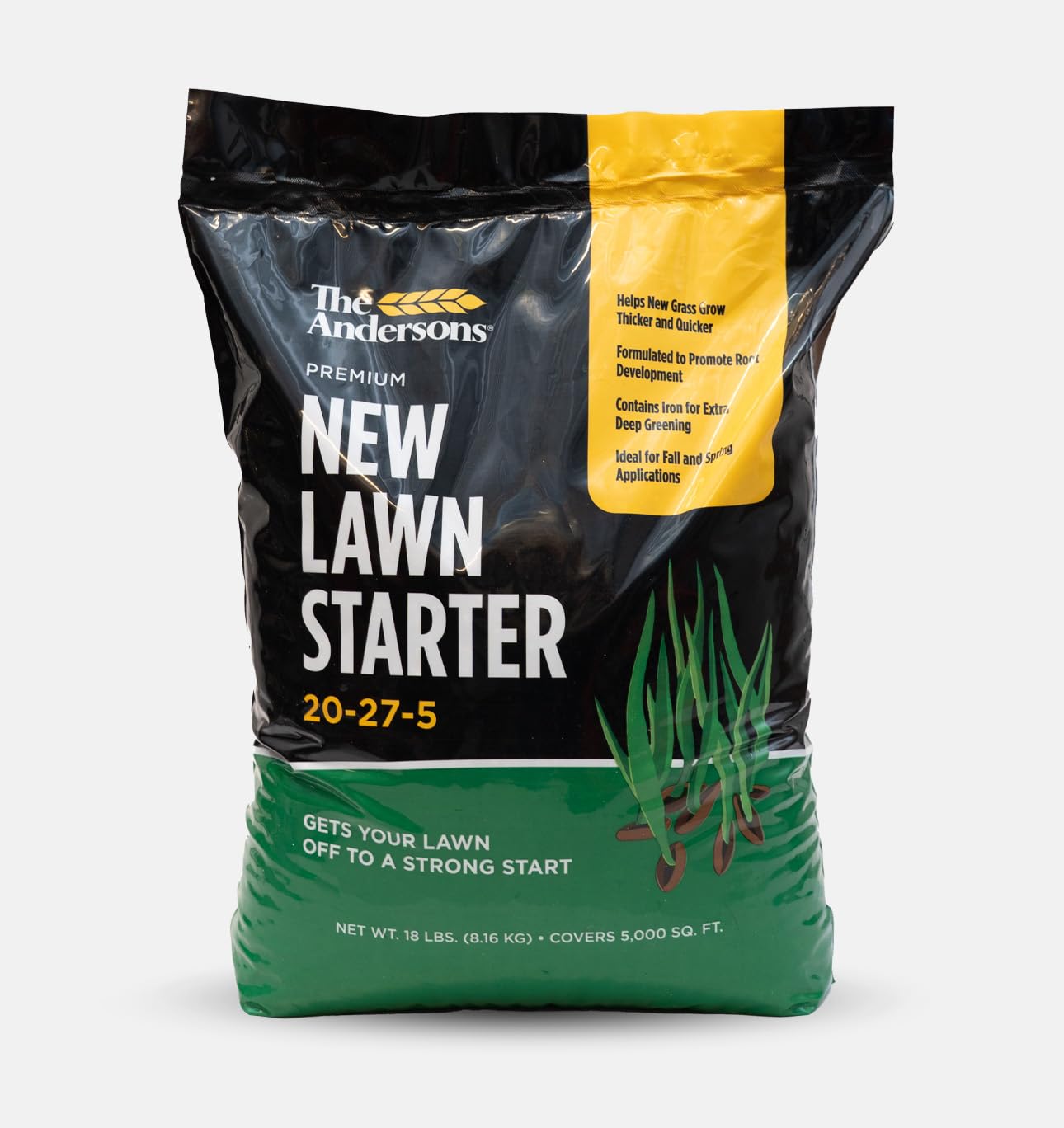
When you are starting from scratch — bare dirt, freshly tilled seedbed, or a newly laid sod roll — you need a high-phosphorus jolt to push root development before the top growth takes off. The Andersons Starter 20-27-5 delivers exactly that, with the middle number (phosphorus) sitting at 27% to drive deep, fibrous root architecture that anchors new grass against summer heat.
The formulation also includes 1% iron, which provides a visual darkening effect within the first week that owners of new lawns often interpret as “working” — and it genuinely is, because iron aids chlorophyll production even when nitrogen is still being allocated to root development. The bag covers up to 5,000 square feet, and both quick- and slow-release nitrogen sources give the new turf an immediate feeding boost plus residual nutrition for the following weeks.
It works on all turf types, but owners of tall fescue and Kentucky bluegrass see the most dramatic response because those cool-season species depend heavily on early phosphorus for tillering. Apply it right after seeding and water it in — several reviewers noted a visible green carpet developing in just over a week.
What works
- High phosphorus (27%) stimulates fast root establishment for new seed and sod
- 1% iron content produces a noticeable deep green tint within days
- Dual nitrogen release provides immediate feeding and sustained support for weeks
What doesn’t
- Not suitable for established lawns that need a phosphorus-free maintenance feed
- 18-pound bag covers only 5,000 sq ft — larger properties need multiple bags
- Over-application on bare soil can lead to nutrient runoff before roots establish
4. Purely Organic Products Lawn Food 10-0-2, 15 LB

Purely Organic Lawn Food is built around a plant-based blend of distillers grains and soybean meal, free from manure, biosolids, and synthetic chemicals. The 10-0-2 ratio provides a moderate nitrogen level that promotes steady greening without the leaf burn risk associated with high-salt synthetic fertilizers. Owners consistently report that yellow or struggling lawns turn dark green within four days, without any re-entry restrictions.
The zero-phosphorus formula satisfies municipal ordinances that restrict phosphate use, while the low potassium (2%) supports general stress tolerance without pushing excessive top growth. It is safe for pets and children immediately after application — a critical feature for households with dogs who love rolling on fresh grass. The granules have a mild, natural odor (slightly like grain feed) that dissipates quickly after watering.
Coverage is rated at 3,000 square feet per 15-pound bag, which positions it as a targeted treatment for front-yard-focused applications rather than whole-acre broadcasting. The slower initial green-up compared to high-nitrogen synthetics is a trade-off, but the absence of chemical salts means you can apply it more frequently without worrying about a burned lawn.
What works
- Completely plant-based with no manure, biosolids, or harsh chemicals
- No re-entry restrictions — safe for children and pets immediately after application
- Non-burning formula allows repeated use without grass damage risk
What doesn’t
- Covers only 3,000 sq ft per bag, requiring multiple purchases for larger lawns
- Moderate nitrogen (10%) produces slower visible green-up than a 28-0-0 liquid feed
- Not ideal for correcting severe nitrogen deficiency — low N concentration per pound
5. Petramax Liquid Nitrogen Fertilizer 28-0-0 NPK – 32 oz

Petramax is a 28-0-0 liquid concentrate designed for one primary job: turning a yellow, nitrogen-starved lawn dark green in a matter of days. The NPK ratio is almost pure nitrogen with zero phosphate and zero potassium, making it a targeted correction tool rather than a complete balanced feed. It uses a 70/30 split between quick-release and slow-release nitrogen so you get that immediate visual pop while maintaining color for several weeks between applications.
One 32-ounce bottle treats up to 12,800 square feet at the maintenance rate or 6,400 square feet for a heavy correction dose. Application requires a sprayer — the manufacturer recommends a PetraTools sprayer, but any standard hose-end or tank sprayer works as long as you agitate the mixture well. Owners report that mixing 5 oz per gallon of water and spraying during active growth produces a visible transformation in about 48 hours.
Because it is phosphorus-free, it is safe on established lawns where soil phosphorus is already sufficient. You do need to be careful with the dilution: too strong a concentration on a hot day can scorch leaf tips, and the liquid requires dry weather for at least six hours after application to avoid wash-off.
What works
- Ultra-high nitrogen (28-0-0) produces the fastest green-up of any product in this list
- Covers up to 12,800 sq ft per 32-oz bottle at maintenance rates — excellent value
- 30% slow-release nitrogen extends the feeding effect beyond a single quick burst
What doesn’t
- Zero phosphorus and zero potassium means it lacks root-building and stress-tolerance nutrients
- Requires a separate sprayer — not compatible with standard broadcast spreaders
- Risk of leaf tip burn if over-applied during high temperatures or drought stress
6. Safer Brand Lawn Restore Natural Lawn Fertilizer – 9335SR – 9-0-2 NPK
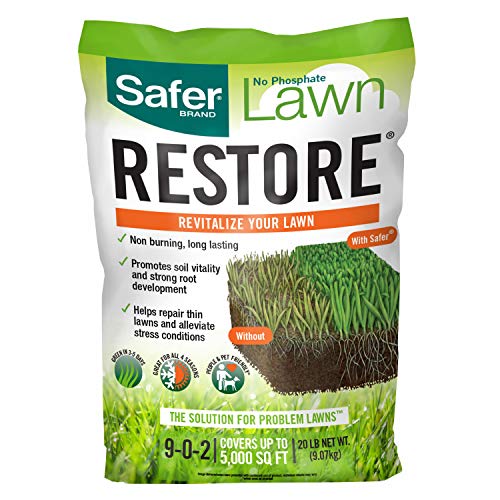
Safer Brand Lawn Restore is formulated specifically for lawns that have been damaged by synthetic fertilizer burn, pet spots, or environmental stress. Its 9-0-2 NPK is deliberately low in nitrogen to avoid further stressing weak grass, and the formula is derived from natural ingredients that feed soil microbes rather than just dumping synthetic salts. Owners report that even lawns with visible dead patches from over-fertilization bounce back within three to five days of application.
The granules contain corn gluten meal, which acts as a pre-emergent weed suppressant by inhibiting root formation on germinating weed seeds. This is a double-edged feature: if you plan to overseed your lawn, you must wait until after the new grass has germinated and been mowed twice, otherwise the corn gluten will also suppress your new seed. The 22-pound bag covers 5,000 square feet and is completely safe for pets and children to walk on immediately after watering.
It works best as a restorative spring and fall treatment, not a high-performance grower for pushing dense turf. The color response is more gradual than synthetic alternatives, but the trade-off is a total absence of leaf burn, even on the most delicate creeping bentgrass lawns.
What works
- Naturally derived formula will not burn grass, even on stressed or damaged lawns
- Contains corn gluten meal that suppresses weed germination while feeding
- Safe for kids and pets with zero re-entry waiting period after watering
What doesn’t
- Corn gluten also suppresses grass seed germination — do not use during overseeding
- Low nitrogen (9%) produces slower greening than high-N synthetic alternatives
- Limited coverage of 5,000 sq ft per bag for the price point
7. Supply Solutions 16-16-16 Complete Lawn & Garden All Purpose Fertilizer (5lbs)
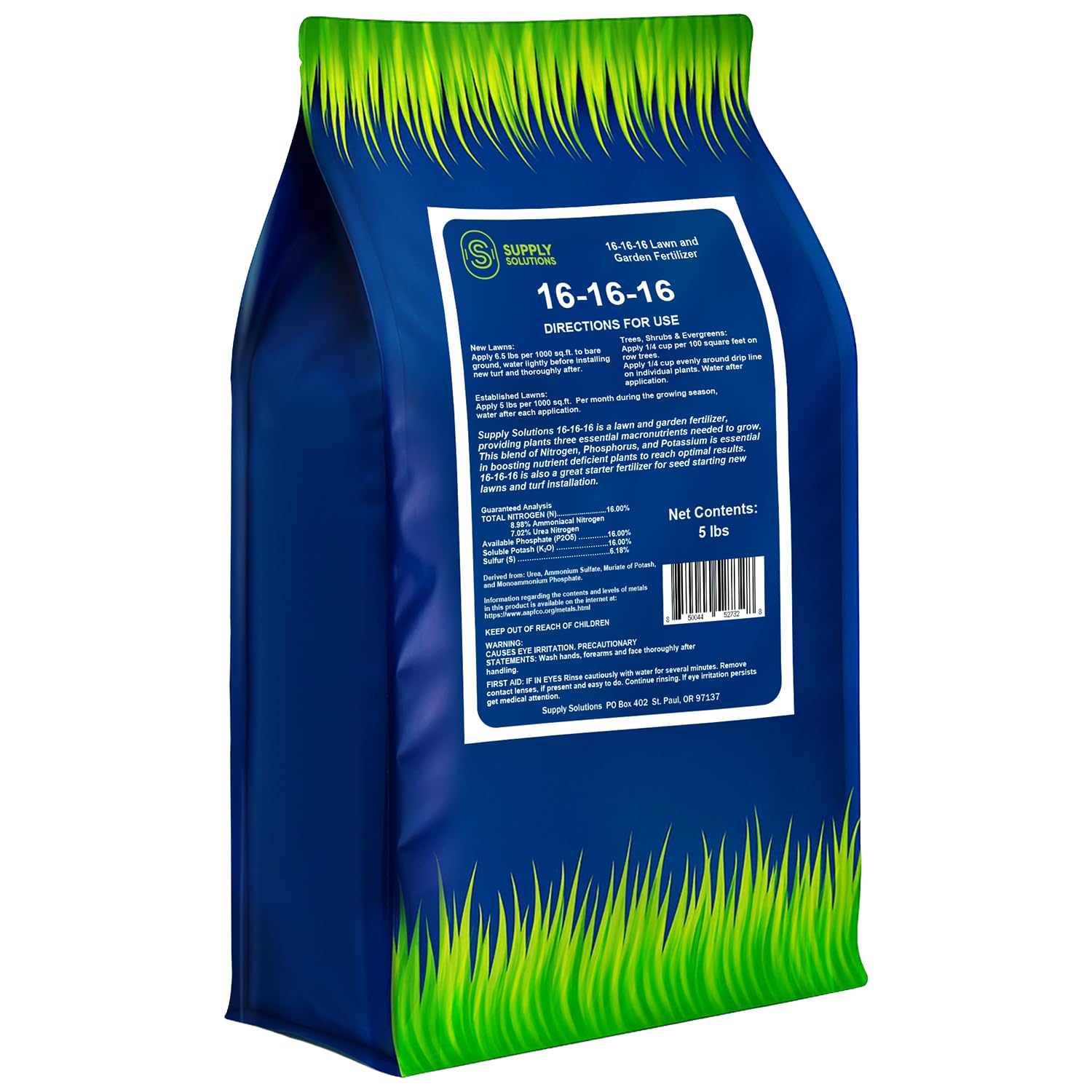
Supply Solutions 16-16-16 is a perfectly balanced, all-purpose granular fertilizer that works equally well on lawn grass, vegetable beds, and flowering perennials. The triple-16 ratio means nitrogen, phosphorus, and potassium are present in equal measure, making it a generalist that performs across multiple garden zones rather than a specialized turf feed. For a homeowner who wants one bag to cover the entire landscape, this simplicity is the core appeal.
The 5-pound bag is compact, which suits small urban lawns, container gardens, or spot-treating specific areas. It dissolves reasonably quickly when watered in, and owners note that tomatoes, peppers, and berry plants show improved growth within five days. On established lawn grass, the moderate nitrogen level provides a steady green appearance without the explosive growth associated with high-nitrogen turf builders.
Because of its balanced NPK, it is less targeted than the other formulas here. If your main goal is a deep-green monoculture lawn, a high-nitrogen product will outperform this one. But for the budget-conscious gardener who feeds the whole yard and garden from one container, this is the most versatile entry-level option available.
What works
- Balanced 16-16-16 NPK works on lawns, gardens, flowers, and fruiting plants from one bag
- Compact 5-pound size is ideal for small yards, balconies, or first-time users
- Rapid visible response on vegetables and ornamentals within 5 days of application
What doesn’t
- Equal NPK is inefficient for lawns that primarily need nitrogen — the phosphorus and potassium are wasted on already-rich soil
- 5-pound bag covers a very small area compared to 30+ pound turf-specific options
- No slow-release technology — frequent re-application is necessary for sustained feeding
Hardware & Specs Guide
NPK Ratio
The three-number hyphenated code on every bag stands for Nitrogen (N), Phosphorus (P), and Potassium (K). N drives visible green growth and leaf density. P supports root architecture and bloom/fruit development. K strengthens cell walls for drought and cold tolerance. For grass, the first number (N) is the priority; the middle number can be zero if your soil already has adequate phosphorus from prior applications or natural deposits.
Slow-Release vs. Quick-Release Nitrogen
Quick-release nitrogen is water-soluble and enters the root zone within hours, giving a visible green-up in 24–48 hours but carrying a risk of leaf burn and requiring more frequent applications. Slow-release nitrogen is coated or chemically bound to break down over weeks (typically 8–12 weeks), providing even feeding without surge growth. Many premium blends combine both: a small percentage of quick-release for immediate results and a larger percentage of slow-release for sustained nutrition.
Coverage Area
Listed in square feet per bag or bottle, coverage assumes the standard recommended application rate on the label. A 10,000 sq ft bag will last one full application on a quarter-acre lot. Always check the nitrogen concentration: a 28-0-0 liquid covering 12,800 sq ft at maintenance rate will run out faster if you need a heavy correction dose (the label usually halves coverage for deficient lawns).
Phosphorus-Free (0 in the Middle)
Many municipalities now ban phosphorus in turf fertilizers to protect local lakes and rivers from algal blooms. A formula with a zero middle number (e.g., 16-0-8 or 10-0-2) meets those regulations and also prevents overbuilding phosphorus in soils that already test high for it. Use a high-phosphorus starter only when establishing new turf or when a soil test confirms deficiency.
FAQ
How often should I apply a high-nitrogen fertilizer like 28-0-0 to my lawn?
Can I use a 16-16-16 all-purpose fertilizer on my lawn year-round?
Will a slow-release nitrogen fertilizer still green up my lawn quickly?
Why would I choose a phosphorus-free lawn fertilizer over one with phosphorus?
Final Thoughts: The Verdict
For most gardeners, the fertilizer for grass winner is the The Andersons Professional PGF 16-0-8 because its ultra-fine particle distribution and humic-acid inclusion deliver consistent, deep greening without the streaking that plagues coarser granules. If you need a fast visible transformation on a nitrogen-starved lawn, grab the Petramax Liquid Nitrogen 28-0-0. And for new seed or sod that demands a powerful root foundation, nothing beats the The Andersons Premium New Lawn Starter 20-27-5.