
Nothing ruins the satisfaction of a homegrown salad faster than finding the leaves riddled with holes or a colony of aphids sucking the life out of your tomato plants. The challenge is that not every spray bottle on the shelf is safe for the produce you plan to eat tonight, and choosing the wrong one can mean either poisoning your harvest or wasting money on something that won’t touch a cabbage looper. This guide separates the effective, crop-safe solutions from the marketing fluff by focusing on active ingredients, application rates, and residual safety windows that matter for edible gardens.
I’m Rikta — the co-founder and writer behind Lawn Gear Lab. I spend my days comparing active ingredient concentrations, studying EPA and OMRI certification data, and cross-referencing thousands of verified owner reports to pinpoint which formulas actually stop outbreaks in vegetable beds without harming pollinators or beneficial soil life.
This is the definitive guide to choosing the best pesticide for a vegetable garden .
How To Choose The Best Pesticide For Vegetable Garden
Selecting a safe yet effective pesticide for edible crops requires balancing three factors: the specific pest you’re fighting, the plant’s development stage, and the harvest interval required by the label. A broad-spectrum kill-everything approach often destroys the beneficial insects your garden needs, while a perfectly targeted formula leaves your bees and ladybugs unharmed.
Match the Active Ingredient to the Pest
Bacillus thuringiensis (B.t.) is a bacterial larvicide that only affects caterpillars and worm-type insects when they ingest treated foliage — it is completely harmless to bees, earthworms, and mammals. Spinosad, derived from a soil bacterium, works on a wider range including thrips, leafminers, and Colorado potato beetles but requires careful timing to avoid pollinators. Neem oil extract functions as both a fungicide and insecticide by suffocating soft-bodied pests like aphids, spider mites, and whiteflies while also suppressing powdery mildew. For a multi-threat vegetable patch, a product combining neem oil with other botanical extracts provides the broadest coverage in a single spray.
Decode the Formulation: Concentrate vs. Ready-to-Use
Concentrate formulas (like the 8-oz Monterey B.t. or the 32-oz Southern Ag Thuricide) require mixing with water and yield many gallons of finished spray, making them far more economical for large gardens or repeated applications. Ready-to-use (RTU) formulas offer convenience for small beds and quick spot treatments — just attach a hose-end sprayer or trigger nozzle and go. However, RTU products cost significantly more per ounce of active ingredient and limit your ability to adjust strength for tougher infestations. If you manage more than 100 square feet of vegetables, the math always favors concentrate.
Check the Harvest Interval and Organic Certification
The pre-harvest interval (PHI) is the legally mandated waiting period between the last spray and the time you can pick and eat the crop. OMRI-listed products can be used up to and including the day of harvest for most vegetables, though always verify the specific crop on the label. Non-organic pesticides often carry a 7- to 21-day PHI, which can ruin a continuous-harvest crop like tomatoes or beans. For gardeners growing year-round or succession-planting, an OMRI-listed product eliminates the guesswork and the risk of chemical residue ending up on the dinner plate.
Quick Comparison
On smaller screens, swipe sideways to see the full table.
| Model | Category | Best For | Key Spec | Amazon |
|---|---|---|---|---|
| Fertilome Spinosad | Spinosad Concentrate | Broad-spectrum worm & thrips control | 4 Tbsp per gallon mix ratio | Amazon |
| Southern Ag Thuricide BT | B.t. Concentrate | Large-scale caterpillar/worm control | 128 fluid oz concentrate | Amazon |
| Bonide Captain Jack’s Neem Oil | Neem RTU | Triple-action fungus & pest protection | 128 oz ready-to-use | Amazon |
| Dr. Earth Yard & Garden Insect Killer | Botanical Spray | Day-of-harvest edible crop safety | 32 oz ready-to-spray | Amazon |
| Organic Insecticide & Fungicide (Evergreen Way) | Bio-Based Concentrate | Indoor/outdoor dual-action defense | 16 oz concentrate | Amazon |
| Garden Safe Fungicide3 | Neem Oil RTU | All-in-one disease & pest prevention | 128 oz ready-to-use | Amazon |
| Monterey B.t. (w/ Measuring Spoon) | B.t. Concentrate | Targeted caterpillar/worm eradication | 8 oz concentrate | Amazon |
In‑Depth Reviews
1. Fertilome Spinosad Insecticide

Fertilome’s Spinosad concentrate earns the top spot because it delivers the widest effective spectrum of any OMRI-listed product in this lineup while remaining gentle on beneficial insects once the spray dries. The recommended mix of 4 tablespoons per gallon of water creates a potent solution that tackles leafminers, borers, thrips, Colorado potato beetles, armyworms, bagworms, tent caterpillars, and loopers — covering practically every chewing pest that attacks tomatoes, peppers, brassicas, and fruiting shrubs. Owner reports from orchards and vegetable beds consistently confirm that a single application stops worm damage within 24 hours, and the 32-ounce bottle treats a substantial area across multiple growing seasons.
The spinosad molecule works by activating the insect’s nervous system through ingestion and contact, causing paralysis and death within one to two days. Unlike neem oil, it remains effective even after light rain once dry, giving you a longer residual window between reapplications. Gardeners who have used this product for years note that it pairs well with a battery-operated sprayer for covering large vegetable patches and that it reliably controls webworms and grasshoppers around the perimeter of the house as well. The concentrate format also lets you dial back the strength for sensitive seedlings or increase it for heavy infestations.
One trade-off is that spinosad is toxic to bees for the first three hours after application, so you must spray in the early morning or late evening when pollinators are not active. The concentrate also requires measuring and mixing, which adds a step compared to ready-to-use bottles. However, for the grower managing a diverse vegetable garden with multiple pest pressures, the versatility and proven efficacy of this Spinosad formulation make it the single most valuable weapon in the shed.
What works
- Controls the widest range of chewing insects including leafminers, thrips, and borers
- OMRI listed and safe for use on edibles up to harvest day when label directions are followed
- Concentrate yields many gallons of spray, making it economical for large gardens
What doesn’t
- Toxic to bees for the first three hours after spraying — requires strict timing
- Must be mixed with water and measured precisely, less convenient than RTU
2. Southern Ag Thuricide BT Concentrate

The Southern Ag Thuricide BT delivers the highest value of any concentrate in this group because its 128-ounce jug — mixed at just 1 to 4 ounces per gallon — provides enough finished spray for several acres of vegetable beds across multiple growing seasons. The active ingredient is Bacillus thuringiensis var. kurstaki, a bacterial protein that specifically targets caterpillars and worm-type insects without affecting bees, earthworms, birds, or mammals. Owners report that a single thorough application eliminates tomato hornworms, cabbage loopers, squash vine borers, and bagworms by the next morning, and the concentrate format keeps the cost per application near zero for the home-scale grower.
B.t. works only when caterpillars ingest treated foliage, so complete coverage — including the undersides of leaves — is critical for success. The bacterial toxin disrupts the insect’s gut lining within hours, causing it to stop feeding almost immediately and die within a couple of days. Because the mode of action is ingestion-based rather than contact-based, it will not harm predators or parasitoids that eat the infected caterpillars. User feedback spanning several years highlights that this jug “will probably outlast me” and that it has completely controlled tomato hornworms, squash borers, and cabbage worms in continuous rotation.
The main limitation is that B.t. is a narrow-spectrum solution — it will not touch aphids, mites, thrips, whiteflies, or fungal diseases. For a garden facing only caterpillar pressure, this specificity is a virtue because it leaves the beneficial insect population intact. The concentrate also requires a separate sprayer and careful measurement, but the sheer volume of coverage per dollar makes it the hands-down choice for large plots, orchard edges, and anyone who wants a single-season supply at a budget-friendly price.
What works
- 128-ounce jug yields dozens of gallons of spray — the best cost-per-gallon of any option
- Completely harmless to bees, earthworms, and beneficial insects when used as directed
- Zero human toxicity and safe for use on edibles up to harvest day
What doesn’t
- Only effective against caterpillars and worms — no action on aphids, mites, or fungus
- Requires thorough coverage of leaf undersides for the bacterial toxin to be ingested
3. Bonide Captain Jack’s Neem Oil RTU
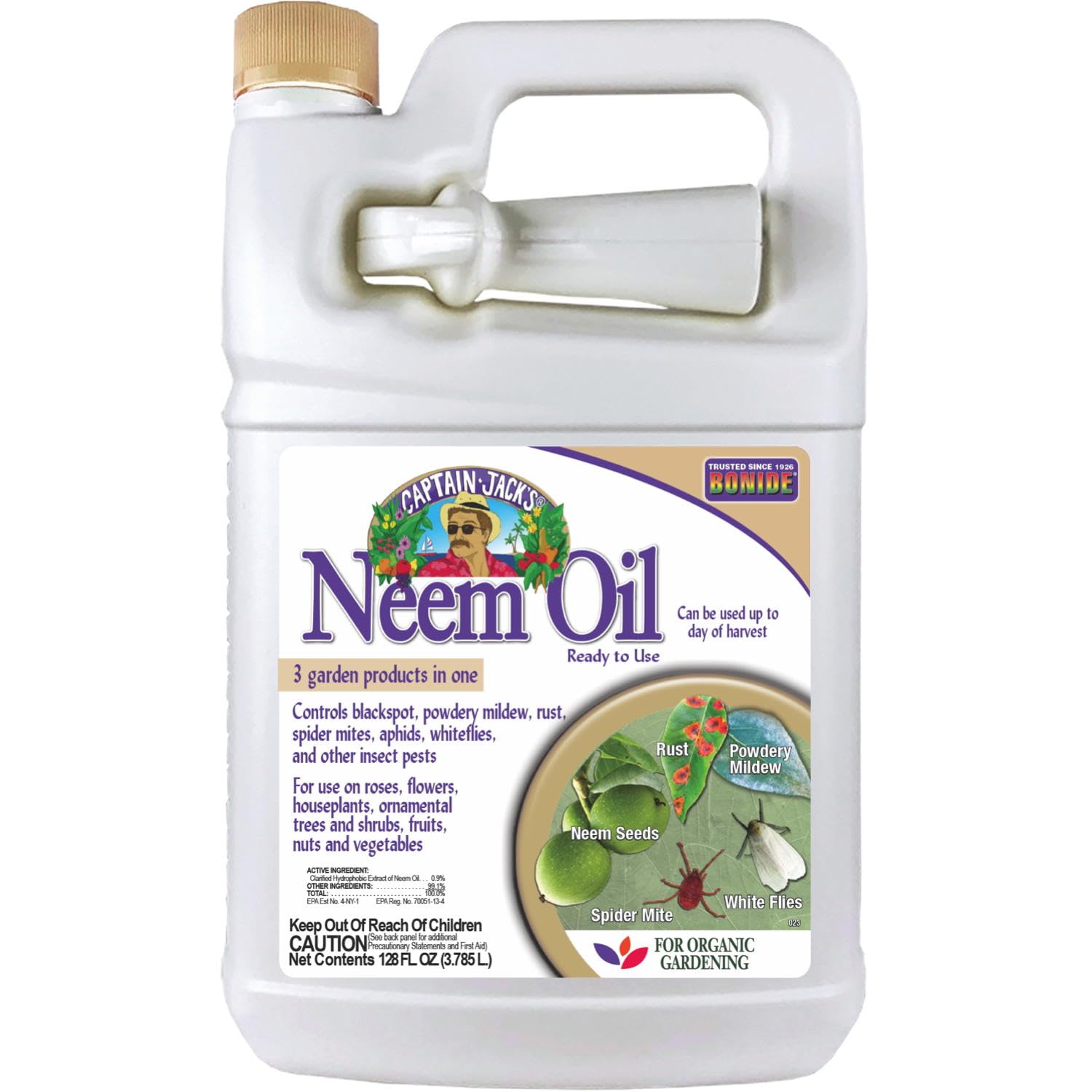
Bonide Captain Jack’s Neem Oil stands apart as the only product in this lineup that legitimately acts as a fungicide, insecticide, and miticide in a single ready-to-use spray, making it the ideal choice for the gardener who wants to prevent powdery mildew while simultaneously suppressing spider mites, aphids, and whiteflies. The active ingredient — clarified hydrophobic extract of neem oil — suffocates soft-bodied insects by coating their breathing pores and disrupts fungal spore germination on leaf surfaces. Owners report that weekly applications (skipping winter) cured stubborn mildew on hibiscus, roses, tomatoes, and blueberries, and that it eliminated scale infestations on indoor plants after just two treatments.
The 128-ounce RTU format arrives with a spray nozzle attached, so there is zero mixing or measuring — you simply shake the bottle, adjust the nozzle, and spray until the foliage is dripping. The neem oil leaves a visible film that provides residual protection for 7 to 14 days, and the product can be used up to the day of harvest on vegetables. Several reviewers noted that the spray has a distinct “eggy” or sulfur-like odor when first applied, but the smell dissipates within a few hours and does not affect the taste of the produce. For indoor plants and greenhouse starts, the light scent is a major advantage over harsher chemical alternatives.
The oil can also burn leaf tissue if applied in direct midday sun, so early morning or late afternoon application is essential. But for the gardener who wants a single, fuss-free bottle that handles fungus, mites, and insects together, Captain Jack’s delivers premium convenience with proven results.
What works
- Triple-action formula controls fungus, insects, and mites with one spray
- Ready-to-use with included nozzle — no mixing or measuring required
- Safe for use on edibles up to harvest day; approved for organic gardening
What doesn’t
- RTU format delivers less coverage per dollar compared to concentrate
- Requires avoidance of direct midday sun to prevent leaf burn
- Initial odor can be unpleasant, though it fades quickly
4. Dr. Earth Yard & Garden Insect Killer

Dr. Earth 8004 stands out for its explicit label allowance for use up to the day of harvest on all edible crops, making it the most forgiving choice for gardeners who pick vegetables continuously throughout the week. The formula combines botanical oils and plant-based ingredients that kill and repel insects on contact while breaking down rapidly in sunlight and rain, leaving no persistent chemical residue on the produce. Owners report effective control of aphids, mites, flies, and soft-bodied insects on strawberries, chard, parsley, beans, tomatoes, cucumbers, and carrots — all without harming dogs, grandchildren, or beneficial insects when timing and coverage are managed correctly.
The ready-to-spray bottle connects directly to a standard garden hose, covering large areas quickly without the need for a pump sprayer. The included instructions recommend applying in the early morning or late afternoon to avoid leaf burn, and the product is formulated with a pleasant botanical scent that does not linger on vegetables. Several reviewers specifically praised its safety in homes with pets, noting that it caused no adverse reactions even when sprayed near play areas. The bottle itself is manufactured from ocean-recovered plastic, adding an environmental benefit that aligns with organic gardening values.
The 32-ounce bottle is relatively small for the price compared to concentrate alternatives, and it must be used at the full hose-end dilution rate, which depletes the product more quickly than you might expect for a one-gallon garden. The botanical oil base also requires reapplication after heavy rain, and some users found it less effective against ants compared to neem-based formulas. However, for the gardener who prioritizes absolute harvest-day safety and wants a product they can trust around kids and pets, Dr. Earth provides unmatched peace of mind.
What works
- Labeled for use up to the day of harvest on all edible crops
- Botanical base breaks down quickly with no persistent chemical residue
- Hose-end sprayer covers large areas fast; bottle made from ocean plastic
What doesn’t
- Smaller 32-ounce bottle depletes quickly with hose-end mixing
- Requires reapplication after heavy rain due to rapid breakdown
- Less effective against ants compared to neem oil formulas
5. Organic Insecticide & Fungicide (Evergreen Way)

Evergreen Way’s bio-based concentrate offers a unique dual-action formula that tackles both leaf disease and chewing or sap-sucking pests in a single pass, making it an excellent choice for greenhouse starts and indoor plant collections where space is tight and problems compound quickly. The plant-safe concentrate mixes at roughly 10 drops per 32 ounces of water for maintenance or a tablespoon per spray bottle for active infestations, and users report that it eliminates fungus gnats, aphids, caterpillars, and spider mites while visibly improving leaf color. Several owners noted that a single soil soaking eliminated severe fungus gnat infestations and that weekly misting kept the problem from returning.
This product is particularly well-suited for gardeners who rotate crops through raised beds, containers, and indoor propagation stations because it works in both soil drench and foliar spray applications. The bio-based chemistry has no strong chemical smell and leaves no oily residue, making it comfortable to use indoors or on a balcony. The 16-ounce concentrate yields multiple refills for weekly care, and the manufacturer provides clear dilution guidelines for different pest pressures. The formula also suppresses powdery mildew and other fungal growth on leaf surfaces, reducing the need for a separate fungicide.
The concentrate is relatively new to the market (released in 2023), so long-term data on resistance development is not yet available. Some users found that heavy infestations required more frequent applications — every 2 to 3 days — compared to spinosad or neem oil. The 16-ounce bottle is also less economical than larger concentrates for extensive vegetable gardens. However, for the indoor/outdoor gardener who needs a single product that safely treats everything from fungus gnats to powdery mildew across multiple environments, this bio-based formula delivers impressive versatility.
What works
- Dual-action formula controls both insects and fungal diseases in one spray
- No strong chemical smell; suitable for indoor and greenhouse use
- Can be applied as a foliar spray or soil drench for maximum versatility
What doesn’t
- Heavy infestations may require applications every 2–3 days for full control
- 16-ounce bottle yields less total spray than larger concentrate options
- Newer formula with less long-term data on pest resistance
6. Garden Safe Brand Fungicide3
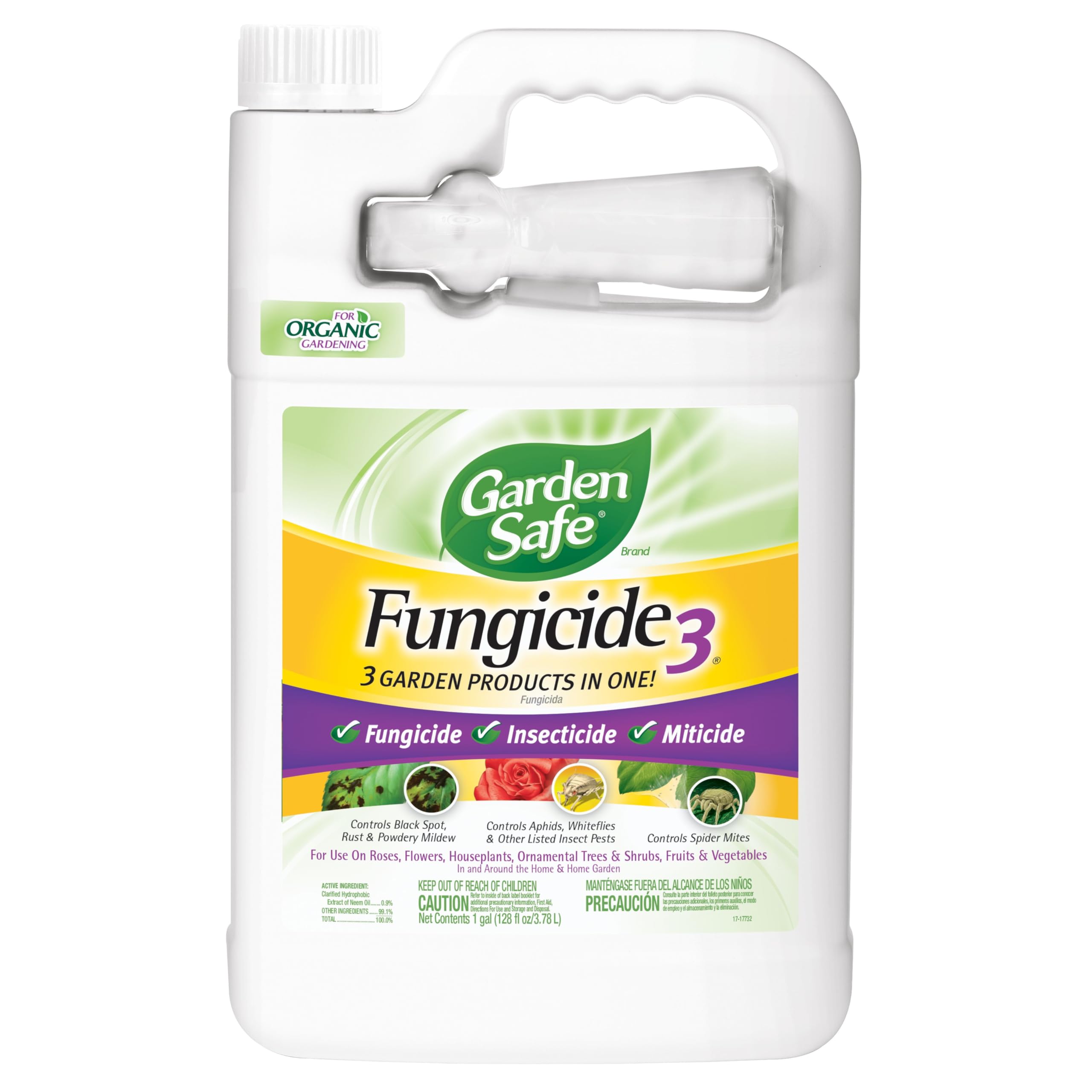
Garden Safe Fungicide3 combines clarified hydrophobic neem oil extract with additional botanical ingredients to create a three-in-one product that functions as a fungicide, insecticide, and miticide — all in a convenient 128-ounce ready-to-use gallon with an integrated spray nozzle. The formula targets black spot, rust, powdery mildew, aphids, whiteflies, and spider mites, making it a comprehensive preventive tool for roses, flowers, houseplants, ornamentals, and vegetables. Owner reports from orchids, hibiscus, tomatoes, and blueberries confirm that weekly use prevents mildew recurrence and boosts overall foliage health and bloom production.
The integrated sprayer hose is the key differentiator here — you simply connect it to the jug, twist the nozzle, and spray without any mixing, measuring, or separate equipment. The 128-ounce volume covers a substantial garden area, and the neem oil base provides residual protection for 7 to 14 days between applications. Several gardeners noted that the product was “life-changing” for managing mildew on their hibiscus and roses, though they cautioned that it does not heal damaged leaves — it prevents new outbreaks. The OMRI-listed formulation is safe for organic use and can be applied up to the day of harvest on vegetables.
The built-in sprayer design drew significant criticism from owners who found the coiled hose too short (about 4 inches) to reach plants comfortably, requiring them to hold the heavy gallon jug awkwardly while spraying. Some users also reported that the formula can burn leaf tissue if applied during the heat of the day or at undiluted strength, and they recommend using half the label’s recommended dose as a starting point. Despite the sprayer frustration, the combination of three active modes in a single large RTU bottle makes Fungicide3 a solid option for gardeners who want maximum ease of use, provided they are willing to swap the spray head for a better one.
What works
- Triple action as fungicide, insecticide, and miticide in one ready-to-use bottle
- Large 128-ounce gallon covers significant garden area without mixing
- OMRI listed and safe for use on vegetables up to harvest day
What doesn’t
- Built-in sprayer has a very short hose that makes application awkward
- Can cause leaf burn if applied at full strength or during hot midday sun
- Some crops require half the recommended dose to avoid damage
7. Monterey B.t. with Measuring Spoon
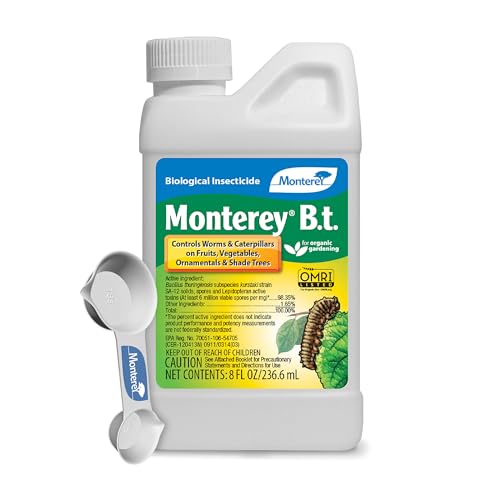
Monterey B.t. with the included measuring spoon is the most accessible entry point for a gardener dealing with a specific caterpillar or worm problem on a small to medium vegetable bed. The OMRI-listed Bacillus thuringiensis concentrate targets cabbage loopers, bagworms, gypsy moths, fall cankerworms, and elm spanworms while leaving bees, earthworms, and ladybugs completely unharmed. The 8-ounce container, mixed at a few teaspoons per gallon of water, treats several hundred square feet of broccoli, celery, cabbage, turnip greens, mustard greens, cauliflower, melons, lettuce, and tomatoes with near-zero risk to the harvest.
The bundled measuring spoon eliminates the most common beginner mistake — imprecise mixing — and the concentrate instantly disperses in water for use with any trigger spray bottle or pressure tank sprayer. Owners in Southern California confirmed that BT “effectively stopped cabbage looper worms from destroying flower and cilantro seedlings” within 24 hours, and that the product is easy enough to use that they “can’t garden without it now.” Multiple reviewers praised its performance on Texas Mountain Laurel and other ornamental trees where bagworms were a persistent problem.
The small 8-ounce size is the obvious limitation for larger gardens or repeated applications across a long growing season — you will need to repurchase more frequently than with the Southern Ag or Fertilome concentrates. B.t. also requires thorough coverage of the leaf undersides because the caterpillar must ingest the bacterial toxin for it to work, and it does not kill on contact. But for the targeted, low-investment introduction to biological pest control, Monterey B.t. delivers unbeatable simplicity and proven results at the lowest entry price.
What works
- Includes a measuring spoon for precise, foolproof mixing
- Zero impact on bees, earthworms, ladybugs, and beneficial soil organisms
- OMRI listed and safe for use on edibles up to harvest day
What doesn’t
- Small 8-ounce container depletes quickly in a large or long-season garden
- Only affects caterpillars and worms — no action on aphids, mites, or fungus
- Requires thorough leaf coverage because the pest must ingest the bacteria
Hardware & Specs Guide
Active Ingredient Type
Bacillus thuringiensis (B.t.) is a bacterial protein that only kills caterpillars and worm-type insects upon ingestion; it is safe for bees, earthworms, and mammals. Spinosad is a fermentation-derived compound that disrupts the nervous system of a wider range of pests including thrips, leafminers, and Colorado potato beetles, but requires careful timing to avoid pollinators. Neem oil extract suffocates soft-bodied insects and suppresses fungal spore germination, making it the only ingredient that works as both an insecticide and fungicide.
Concentrate vs. Ready-to-Use
Concentrate formulas (Monterey B.t., Fertilome Spinosad, Southern Ag Thuricide) require mixing with water at a specified ratio (e.g., 4 Tbsp per gallon) and offer the lowest cost per finished gallon — ideal for large gardens and multi-season storage. Ready-to-use (RTU) bottles (Bonide Neem Oil, Garden Safe Fungicide3, Dr. Earth) attach to a spray nozzle or hose and require no mixing, but cost 3–5 times more per ounce of active ingredient and cover less total area per bottle.
OMRI Listing and Harvest Interval
OMRI (Organic Materials Review Institute) listing verifies that a product complies with USDA National Organic Program standards for certified organic production. All OMRI-listed pesticides in this guide can be applied up to and including the day of harvest on labeled crops — there is no mandatory waiting period. Non-organic pesticides typically carry a 7- to 21-day pre-harvest interval (PHI) that must be strictly followed to avoid chemical residue on edible produce.
Application Equipment
Trigger spray bottles work well for small beds and spot treatments up to 100 square feet. Pressure tank sprayers (1- to 3-gallon capacity) provide consistent pressure for medium-sized gardens and allow you to spray leaf undersides without bending over. Battery-powered backpack sprayers are the most efficient choice for large vegetable patches exceeding 500 square feet, as they maintain constant pressure and reduce operator fatigue during full-coverage applications.
FAQ
Can I use neem oil on all vegetables without harming the plants?
How long after spraying B.t. can I harvest my vegetables?
Will Spinosad kill honeybees if I spray my tomato plants?
Final Thoughts: The Verdict
For most gardeners, the pesticide for a vegetable garden winner is the Fertilome Spinosad Insecticide because it delivers the broadest spectrum of proven efficacy against chewing pests — leafminers, thrips, borers, and worms — in an OMRI-listed concentrate that yields dozens of applications per bottle. If you want zero-risk caterpillar control with maximum economy for a large plot, grab the Southern Ag Thuricide BT Concentrate. And for the gardener who needs a single, no-mix bottle that handles fungus, mites, and insects together on vegetables, ornamentals, and houseplants alike, nothing beats the convenience of Bonide Captain Jack’s Neem Oil RTU.