
Nothing frustrates a meticulous gardener more than watching unwanted grassy weeds—like crabgrass, Bermuda grass, or quackgrass—invade a flower bed or vegetable patch that you’ve carefully mulched and planted. Unlike broadleaf weeds that are easy to spot and pluck, grassy weeds mimic the desirable turf they infiltrate, making selective removal a genuine headache. The wrong spray can devastate your garden, while the right one returns your beds to a pristine, weed-free state without harming your ornamentals or vegetables.
I’m Rikta — the co-founder and writer behind Lawn Gear Lab. I’ve spent months studying herbicide chemistry, comparing active ingredient profiles, and analyzing reams of owner feedback to separate the formulas that deliver genuine selective or non-selective control from those that merely stain the leaves before the weeds bounce back.
Whether you need a fast-acting non-selective scorcher for hardscapes or a selective solution that spares your garden, this guide breaks down the top performers in the grassy weed killer category, ranked by real-world efficacy, coverage value, and ease of use.
How To Choose The Best Grassy Weed Killer
Choosing a grassy weed killer means first understanding whether you need a selective or non-selective formula. A non-selective product like glyphosate will kill everything green it touches—perfect for driveways, fences, and empty beds before planting. A selective product using mesotrione or MSMA, on the other hand, will target grassy weeds while sparing your established turf or ornamentals if applied correctly.
Active Ingredient & Speed of Action
The active ingredient dictates both the kill speed and the safety profile. Glyphosate (41% concentration is standard for value) is a plant-systemic that takes 1–2 weeks but annihilates deep root systems. Mesotrione works by bleaching weeds white over 2–3 weeks and is safe on many warm-season grasses but can stunt cool-season turf if overdosed. MSMA (monosodium methanearsonate) is the go-to for stubborn grassy weeds like dallisgrass and Johnsongrass on established turf but must be measured precisely to avoid stressing the lawn.
Concentrate vs. Ready-to-Use vs. Dual-Action (Kill + Prevent)
Concentrate formulas give you the best cost-per-square-foot, especially if you have a half-acre to manage. Ready-to-use sprayers are convenient for spot-treating a few patches but are far more expensive per ounce. Dual-action products—those that kill existing weeds and then prevent germination for up to four months—are ideal for hardscapes and mulched beds where you want long-lasting barriers. Note that prevention formulas often require you to spray the entire area, not just the visible weeds.
Rainfastness & Reseeding Interval
If you live in a region with unpredictable rainfall, look for a rainfast window of 2–3 hours or less—this is the time needed after spraying before the product bonds to the leaf. For lawn applications, check the reseeding interval: some products allow reseeding in as little as 7 days, while others require waiting one to four months before planting new grass.
Quick Comparison
On smaller screens, swipe sideways to see the full table.
| Model | Category | Best For | Key Spec | Amazon |
|---|---|---|---|---|
| SpeedZone EW | Selective | Fast lawn cleanup (90+ weeds) | Rainfast 3 hours | Amazon |
| Roundup Pro 2.5 gal | Non-Selective | Large-scale total kill | Covers 435,600 sq ft | Amazon |
| Liquid Harvest Mesotrione | Selective | Safe on centipede & St. Augustine | 46 broadleaf & grass targets | Amazon |
| Ferti-lome Over The Top | Selective | Around ornamentals & gardens | Makes 8 gal spray | Amazon |
| Roundup Dual Action | Kill + Prevent | Driveways & mulched beds | 4-month prevention | Amazon |
| Control Solutions Eraser 41% | Non-Selective | Budget all-purpose total kill | 41% Glyphosate | Amazon |
| Target 6 Plus MSMA | Selective | Dallisgrass & Johnsongrass on turf | 48.2% MSMA | Amazon |
In‑Depth Reviews
1. SpeedZone EW Lawn Weed Killer

SpeedZone EW is the product that pro lawn care operators rely on when they need visible results within hours, not days. Its blend of 2,4-D, dicamba, carfentrazone-ethyl, and MCPP-p delivers a multi-pronged attack on over 90 listed weeds, including the tough clover, ground ivy, and spurge that often plaque lawns. The cool-weather performance is a standout feature—most broadleaf herbicides lose efficacy below 60°F, but SpeedZone remains active, making it a fall and early spring staple.
The reseeding interval of just 7 days is remarkably short compared to competitors that keep you waiting weeks. At a mix rate of 1.5 fl. oz. per 1,000 sq. ft. for cool-season grasses, the 20-ounce bottle covers over 13,000 square feet, offering premium value per application. The rainfast window of 3 hours is competitive, though not the fastest on the market.
Some users report that spurge can reappear within two months, requiring a second spot treatment. The label warns against more than two applications per year, so if your lawn has a persistent spurge reservoir, you may need to pair SpeedZone with a pre-emergent barrier.
What works
- Visible results in hours, full kill in 2 days
- Reseed in 7 days—fastest interval in its class
- Remains effective in cool weather below 60°F
What doesn’t
- Spurge may require reapplication within months
- No measuring cup included—cap measures ~0.2 fl. oz.
2. Roundup Pro Concentrate Herbicide (2.5 Gal)
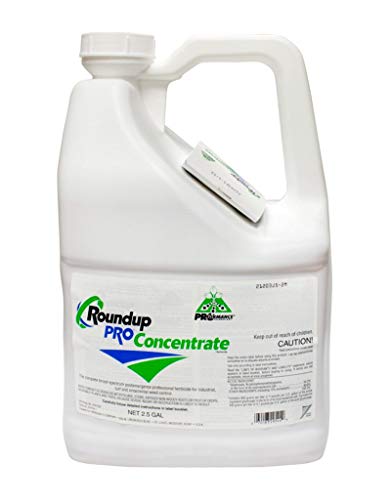
This is the professional-grade version of the consumer Roundup you already know, and the concentration advantage is enormous. At 2.5 gallons, this jug makes roughly 150 gallons of ready-to-use spray at the standard 2.5–3 oz/gal mix rate. That means you can treat large pastures, fence lines, and commercial properties for the same cost as a few consumer quarts. The active ingredient is glyphosate, and while no percentage is explicitly listed on the label, the professional concentration is visibly thicker than the consumer formulations.
Users report visible results starting in 3–4 days, with full root death in 7–14 days. The heavy jug requires a 63mm threaded pump to dispense the concentrate, which is sold separately. The Flying Skull mi254 pump is a common pairing with this jug, dispensing exactly 1 oz per stroke for easy measuring. Protective gear (gloves, goggles, long sleeves) is mandatory with this concentration—it will bleach clothing permanently.
The biggest downside is the logistics: at 2.5 gallons, you are committing to a large volume of herbicide. If you only need to spot-treat a few hundred square feet, this is overkill. Also, this product is not for sale to Wisconsin or New Jersey, so check local regulations before ordering.
What works
- Best cost-per-square-foot value at professional concentration
- Works faster than generic glyphosate brands (3–4 days)
- Makes ~150 gallons of standard strength mix
What doesn’t
- No pump included—requires separate 63mm thread pump
- Not for sale in Wisconsin or New Jersey
3. Liquid Harvest Mesotrione Concentrate (8 oz)

Liquid Harvest Mesotrione is the closest home-user equivalent to the professional product Tenacity, and it delivers the same selective control of over 46 weed species, including barnyard grass, crabgrass, and clover, without harming established centipede, St. Augustine, tall fescue, or Kentucky bluegrass. The mechanism is unique: mesotrione inhibits photosynthesis, causing susceptible weeds to turn white and then die over 2–3 weeks. It is both a pre- and post-emergent, meaning it stops crabgrass seeds from germinating while also killing emerged weeds.
The application process requires attention to detail: you must activate the herbicide with 0.15 inches of water (rain or irrigation) within 10 days. Many users recommend adding a non-ionic surfactant and a blue spray dye to track coverage and avoid overlapping—overdosing will stunt or discolor the turf, especially if applied during heat or drought stress. The bleach effect on weeds is dramatic and satisfying to watch.
Owners of St. Augustine grass should exercise extra caution. While the label permits use on St. Augustine sod, going over the recommended rate will injure or kill it. The 8-ounce bottle is potent—a single teaspoon per 2 gallons of water can knock out crabgrass in 10 days, as many verified reviews confirm. Just be prepared for a slow, steady action rather than a quick burn.
What works
- Safe on centipede, St. Augustine, and fescue when applied correctly
- Pre- and post-emergent action stops crabgrass from germinating
- Highly concentrated—small amount goes a very long way
What doesn’t
- Requires water activation within 10 days for full pre-emergent effect
- Slow action—weeds turn white over 2–3 weeks before dying
4. Ferti-lome Over The Top Grass Killer (8 oz)

Ferti-lome Over The Top is one of the few selective grass killers specifically formulated to be sprayed directly over ornamentals, shrubs, trees, and vegetables without harming them. This makes it an essential tool for flower beds and vegetable gardens where creeping grassy weeds like Bermuda grass and crabgrass take hold. The active ingredient is designed to target the grassy weed’s vascular system while leaving broadleaf plants unscathed.
The 8-ounce bottle makes 8 gallons of spray solution at the standard mix rate, covering about 2,000 square feet per bottle. Users report that the product stops grass growth within two days, though full kill of established Bermuda grass can take up to three weeks, with the first signs of yellowing appearing after one week. Adding a surfactant like Dawn dish soap significantly improves adherence and penetration, as experienced users recommend.
The most critical limitation is grass height: the product works best on grass shorter than 6 inches. Taller, mature grasses may be stunted but not killed outright, requiring additional mechanical cultivation. A small but vocal minority of users report zero efficacy in already-planted garden situations, so timing and the condition of the weed matter. Read the label carefully—this product will kill fescue lawn grass, so do not use it on turf you want to keep.
What works
- Safe to spray over ornamentals, shrubs, and vegetables
- Makes 8 gallons of solution—good coverage per bottle
- Effective on crabgrass and Bermuda in flower beds
What doesn’t
- Will not kill tall grass over 6 inches
- Slow action takes up to 3 weeks for full kill
5. Roundup Dual Action Weed & Grass Killer Plus 4 Month Preventer Concentrate (32 oz)

Roundup Dual Action is a hybrid product that combines a non-selective post-emergent killer with a pre-emergent barrier that prevents new weeds from germinating for up to four months. This dual functionality is ideal for hardscapes (driveways, sidewalks, patios) and mulched beds where you want a clean slate that stays clean. The formula is rainproof in just 30 minutes—among the fastest rainfast windows available—and visible results can appear in as little as six hours.
The 32-ounce concentrate covers 1,600 square feet when mixed at 6 fl. oz. per gallon of water. The prevention mechanism requires you to spray the entire area, not just the emerged weeds, because the barrier must be uniform. This means you will use more product than a simple spot-spray approach. Users confirm it wipes out ivy, Virginia creeper, and stubborn greenbriar completely, making it a go-to for fence lines and wooded edges.
The main trade-off is the long waiting period before replanting: you must wait four months before planting ornamental bedding plants, trees, shrubs, sod, or seed. This makes the product unsuitable for areas you plan to garden in the same season. Also, some users feel the concentrate strength has been reduced compared to older Roundup formulations, though the convenience of the combined kill-and-prevent element justifies the price for many.
What works
- Rainproof in 30 minutes—allows immediate rain without washout
- Visible results in 6 hours on many weeds
- Prevents regermination for 4 months in one application
What doesn’t
- Cannot replant for 4 months—not for active garden beds
- Must spray entire area, not just visible weeds
6. Control Solutions Eraser & Grass Killer Concentrate (32 oz)
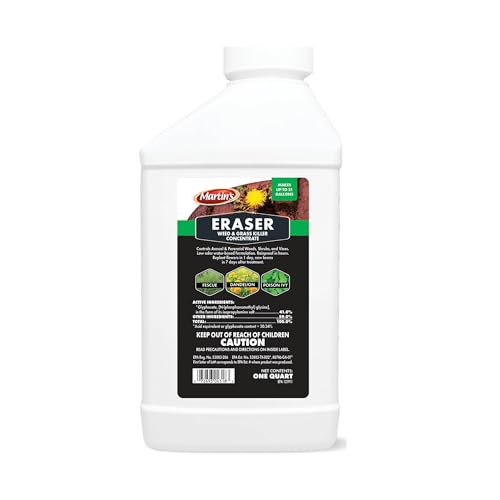
Control Solutions Eraser is a straightforward, no-frills non-selective herbicide that delivers 41% glyphosate—exactly the same active ingredient concentration as the standard Roundup consumer formula—at a fraction of the per-ounce cost. This is the product to grab when you need to clear a large vacant lot, renovate a lawn, or nuke weeds along a fence line without spending a premium on brand marketing. The low-odor, water-based formula is rainproof within hours and has no residual soil activity, meaning you can plant into treated soil after the weeds are dead.
Users have relied on this product for up to 17 years, and the feedback is consistent: mix 8 oz per gallon of water, spray everything green, and wait 1–2 weeks. The first effect is a slow yellowing starting around day 4–7, with full death by day 14. For woody vines and poison ivy, a second application may be necessary. Adding a non-ionic surfactant improves performance on grass with slick leaves, such as Bermuda grass.
The main frustration is the slower visible action compared to consumer Roundup—users switching from name brand are often surprised that the weeds don’t wilt by day 2. This is the nature of the generic glyphosate salt; it works, but patience is required. Also, the 32-ounce bottle is physically smaller than it appears in product images, so check the volume before assuming you’re getting a gallon-sized value.
What works
- Excellent value—41% glyphosate at a budget-friendly price
- No residual soil activity; plant immediately after weeds die
- Effective on annuals, perennials, vines, and shrubs
What doesn’t
- Slower visible action than name-brand Roundup
- 32-ounce bottle is smaller than some expect
7. Target 6 Plus MSMA 48.2% Turf Herbicide (2.5 Gal)

Target 6 Plus is a professional-grade, selective herbicide based on MSMA (monosodium methanearsonate) at a potent 48.2% concentration. This is the go-to weapon for golf courses, sod farms, and serious turf managers who need to eliminate stubborn grassy weeds like dallisgrass, Johnsongrass, and crabgrass without killing their warm-season lawn grasses. The product works fast—users report visible wilting within 24 hours and complete control in under a week—and a single 2.5-gallon jug lasts for years of spot treatment.
The standard mix rate is 2 oz per gallon of water for general applications, but the label should be consulted for specific weed targets. Owners of Japanese zoysia and Bermuda grass report excellent results against dallisgrass infestations, though precise measurement is critical. Overdosing or incorrect mixing can stress Bermuda grass into dormancy, as some users discovered after using too strong a mix during dry weather. The product is manufactured in Israel, and users consistently praise its high viscosity and purity.
The biggest barrier to entry is the quantity and the regulatory landscape. At 2.5 gallons, this is a massive amount of herbicide for a homeowner. Additionally, MSMA is a restricted-use pesticide in many states due to its arsenic content, and it may not be available for non-licensed applicators in your area. Always check your local agricultural extension office before ordering. The product is also not suitable for use on St. Augustine grass or centipede grass—use only on the grasses listed on the label.
What works
- Fastest control available for dallisgrass, Johnsongrass, and crabgrass
- Extremely concentrated—a 2.5-gallon jug lasts years for spot treatment
- Manufactured to high purity standards from Israel
What doesn’t
- Restricted-use pesticide—may require license in many states
- Large 2.5-gallon quantity is overkill for most homeowners
Hardware & Specs Guide
Non-Selective Active Ingredients
Non-selective herbicides contain glyphosate (typically 41% or higher for professional formulas). These compounds bind to the EPSPS enzyme in plants, blocking the production of essential amino acids. The result is a systemic death that travels from the spray point down to the root system. Glyphosate has no soil activity, meaning it binds to soil particles upon contact and becomes inert, so you can plant into treated beds after the weeds die. Choose non-selective formulas for driveways, patios, fence lines, and total lawn renovation jobs.
Selective Active Ingredients: Mesotrione, MSMA & Others
Selective herbicides use active ingredients that target specific enzyme pathways present only in certain weed families. Mesotrione (related to Tenacity) inhibits the HPPD enzyme, bleaching weeds white over 2–3 weeks and is safe on many cool-season and warm-season turf grasses. MSMA (monosodium methanearsonate) targets the synthetic pathway of grassy weeds like dallisgrass and Johnsongrass, but is a restricted-use pesticide in many areas. For flower-bed spraying, Ferti-lome uses a different selective amine that spares broadleaf ornamentals while killing grassy weeds.
Concentrate Dilution & Measuring Accuracy
Concentrate products require precise mixing to avoid turf damage or underperformance. A standard mix for 41% glyphosate is 6–8 oz per gallon of water. Mesotrione is often used at 1 tsp per 2 gallons. MSMA uses 2 oz per gallon. Using a graduated measuring cup or a pump that dispenses exactly 1 oz per stroke (like the Flying Skull mi254 for Roundup Pro) eliminates guessing. Over-concentrating can burn grass; under-concentrating wastes time with no kill. Always add a non-ionic surfactant at 0.25% volume to improve leaf adhesion.
Rainfast Window & Environmental Conditions
The rainfast window is the minimum time a product needs to bond to the leaf surface before rain or irrigation can wash it off. SpeedZone EW requires 3 hours; Roundup Dual Action requires only 30 minutes; most glyphosate formulas need 2–6 hours. Applying in full sun on a warm morning (60–85°F) maximizes the rate of uptake. Cool, overcast days slow metabolism and delay results. Wind speeds under 10 mph prevent drift that can damage neighboring plants. Do not spray if rain is expected within the product’s rainfast window.
FAQ
Can I spray grassy weed killer on my lawn without killing the grass?
How long after spraying can I plant vegetables or flowers?
Why do my weeds turn white after using mesotrione?
Final Thoughts: The Verdict
For most gardeners, the absolute best grassy weed killer winner is the SpeedZone EW because it combines professional-level speed (visible results in hours) with a broad spectrum of 90+ weeds and the shortest reseeding interval in its class. If you need a selective product that is safe on centipede and St. Augustine grass, grab the Liquid Harvest Mesotrione for its pre- and post-emergent action. And for total landscape renovation at the lowest cost per square foot, nothing beats the Roundup Pro Concentrate in the 2.5-gallon jug.