
The frustration of reapplying herbicide every few weeks only to watch stubborn weeds fight back is the primary motivation for seeking total vegetation control. A true permanent solution targets the root system and soil seed bank, not just the visible foliage, requiring a specific chemistry that most general-purpose sprays lack. This guide focuses exclusively on the concentrated formulations and professional-grade chemistries designed to sterilize the ground for an entire season or longer.
I’m Rikta — the co-founder and writer behind Lawn Gear Lab. I’ve spent hundreds of hours analyzing soil-chemistry data, comparing active-ingredient efficacy across top brands, and cross-referencing verified owner feedback to separate the truly long-lasting formulas from fleeting surface killers.
After extensive research, this guide identifies the most effective and best-value options to help you find the ideal permanent weed killer for your property’s unique conditions and your specific tolerance for reapplication.
How To Choose The Best Permanent Weed Killer
Not all weed killers labeled “long-lasting” deliver true permanence. The difference lies in the active ingredient’s soil half-life and the concentration at which it’s mixed. This section breaks down the critical factors that separate a season-long soil sterilant from a short-lived foliar spray.
Active Ingredient Selection: Imazapyr vs. Glyphosate vs. MSMA
Imazapyr-based products (like Hi-Yield Killzall 365) offer the longest residual control, suppressing weed germination in bare-ground areas for up to 12 months. They are non-selective and will kill any vegetation they contact. High-concentration Glyphosate (41% formulations) is non-selective but biodegrades faster in soil — typically offering 3–6 months of control before regrowth begins. MSMA (Monosodium Methanearsonate) is highly selective for grassy weeds like crabgrass, dallisgrass, and nutsedge in warm-season turf, with a moderately long soil residual that stresses targeted species without sterilizing the entire area.
Concentration Per Gallon: The Mixing Ratio Trap
The label mixing ratio is non-negotiable. For bare-ground sterilization with Imazapyr products, the recommendation is often 6–7.4 oz per gallon of water for total vegetation control. Using a lighter mix (like 2 oz per gallon) dramatically shortens the duration of control, turning a 12-month solution into a 2-month temporary fix. Conversely, selective herbicides like SpeedZone EW require precise 1–2 oz per gallon mixes to avoid damaging desirable turf. Always use a measuring cup, never eyeball the ratio.
Selective vs. Non-Selective Application Areas
Define your target area before buying. Driveways, gravel paths, fence lines, and storage yards call for non-selective, high-residual formulas like IMAGE or Hi-Yield Killzall that will keep the ground barren for a year. For lawns infested with clover, wild violet, or nutsedge, selective options like SpeedZone EW or Target 6 Plus MSMA kill the pest without destroying the grass. Using the wrong type — applying non-selective sterilant to a lawn — will result in dead brown patches that take the entire season to recover.
Quick Comparison
On smaller screens, swipe sideways to see the full table.
| Model | Category | Best For | Key Spec | Amazon |
|---|---|---|---|---|
| Roundup Pro Concentrate 2.5 gal | Concentrate | Professional bare-ground spray | Up to 435,600 sq. ft coverage | Amazon |
| PBI Gordon SpeedZone EW | Selective | Clover, wild violet, morning glory in turf | Visible activity in hours | Amazon |
| Target 6 Plus MSMA 48.2% | Selective | Dallisgrass, crabgrass in warm-season turf | MSMA 48.3% concentration | Amazon |
| Hi-Yield Killzall 365 | Non-Selective | Year-long bare-ground sterility | Imazapyr — 12-month residual | Amazon |
| Plus Herbicide 41% Glyphosate | Concentrate | Cost-effective Roundup replacement | 41% Glyphosate + surfactant | Amazon |
| Roundup Weed & Grass Killer₄ | Concentrate | Multi-use flower bed & walkway prep | Rainproof in 30 minutes | Amazon |
| Hi-Yield Killzall II Concentrate | Concentrate | High-volume fence line & driveway control | Visible results in 3 hours | Amazon |
In‑Depth Reviews
1. Roundup Pro Concentrate Herbicide (2.5 gal)
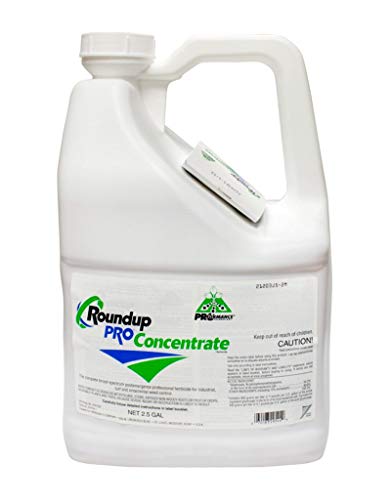
This is the professional-grade super concentrate that service companies rely on for massive bare-ground applications. Its coverage of up to 435,600 square feet per jug — roughly 10 acres — makes it the undisputed volume champion, allowing you to mix it at 2.5–3 oz per gallon for standard knockdown or bump it to extra strength for truly stubborn brush species.
The higher concentration per ounce compared to retail Roundup formulas means you get significantly more active ingredient per dollar. Owners consistently report visible wilting within 3–4 days and complete kill in one week, with residual soil activity lasting long enough to prevent most annual weeds from germinating through the season. The 2.5-gallon container is designed for a 63mm pump spigot, so you’ll want a pump accessory for easy dispensing.
It is not selective — any overspray or drift onto desirable plants will kill them just as efficiently. Given its potency, you must wear protective gear including gloves and eye protection during mixing and application. For anyone managing large driveways, gravel lots, fence lines, or preparing land for construction, this is the most efficient and cost-effective permanent solution available.
What works
- Massive 435,600 sq. ft coverage per jug — best value at scale
- Super concentrate formula delivers professional-grade kill speed
What doesn’t
- Requires separate pump spigot for easy dispensing
- Not for sale in Wisconsin or New Jersey
2. PBI Gordon SpeedZone EW Broadleaf Herbicide (1 gal)

SpeedZone EW is the premier selective herbicide for cool-weather broadleaf weed control in established turf. Its active chemistry was engineered specifically for weeds that resist standard broadleaf herbicides — morning glory, wild violet, clover, and yard onions — with visible curling and spotting occurring within hours of application rather than days.
The 128-ounce bottle treats approximately 2–3 acres of turf when mixed at the standard 1–2 oz per gallon rate. Owners report that it eliminated tenacious field bindweed that gasoline and bleach failed to touch, with full root death observable within 10 days. The formula performs particularly well in spring and fall when temperatures are between 45–75°F, giving it a wider effective window than many summer-only herbicides.
It is banned in many states and requires careful handling — the chemical is potent enough that the treated area should remain wet for hours for maximum absorption. Because of its strength, you should not use it in garden beds or anywhere near edible plants. For turf managers, golf course superintendents, and homeowners battling stubborn broadleaf weeds, this is the most effective fast-acting selective solution.
What works
- Visible results in hours — unmatched speed among selective herbicides
- Kills weeds that resist glyphosate, bleach, and gasoline
What doesn’t
- Banned in many states (check local regulations before ordering)
- Very expensive compared to non-selective alternatives
3. Target 6 Plus (MSMA 48.2%) Turf Herbicide (2.5 gal)

MSMA is the gold-standard active ingredient for selective grassy weed control in warm-season turf, and Target 6 Plus delivers it at a potent 48.3% concentration. This product is purpose-built for golf courses, sod farms, and highway rights-of-way where dallisgrass, crabgrass, johnsongrass, nutsedge, and pigweed threaten manicured grass.
The 2.5-gallon jug dilutes significantly — owners report effective control using only 1.25 tablespoons per 2 gallons of water — so a single purchase can last years for residential applications. Verified users consistently praise its fast knockdown on dallisgrass in zoysia lawns, noting that reapplication is rarely needed within the same season. The thick, high-quality liquid formulation suggests excellent adherence to weed foliage with minimal runoff.
MSMA will stress or brown Bermuda grass and other warm-season turf if mixed too strong or applied during drought conditions, so follow the label ounces-per-gallon guidlines precisely. Because of its arsenic-based chemistry, MSMA is restricted or banned in some regions, and you should never use it near edible gardens. For those with persistent sedge or dallisgrass problems, no other selective herbicide delivers comparable results.
What works
- Highly concentrated — a little goes a very long way
- Selectively kills tough grassy weeds without harming warm-season turf
What doesn’t
- Can burn grass if mixed too strong or applied during dry conditions
- Restricted in some areas due to arsenic content
4. Hi-Yield Killzall 365 (1 gal)
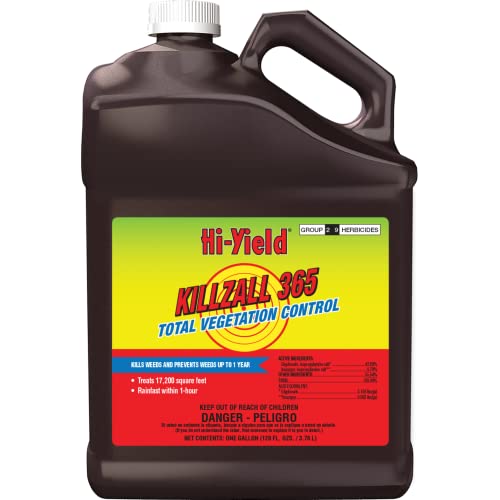
Killzall 365 is explicitly formulated for total bare-ground vegetation control, using Imazapyr as its active ingredient — the same chemistry used by railroads and utility companies to keep rights-of-way sterile for an entire year. The 1-gallon concentrate treats up to 17,200 square feet, making it a strong choice for moderate-sized areas like gravel driveways, storage yards, and long fence lines.
At the maximum bare-ground rate of 7.4 oz per gallon, it suppresses all broadleaf weeds, grasses, brush, and vine species for up to 12 months. Some users needed a second application for particularly stubborn species, but most report that a single spring treatment keeps the area weed-free through the following winter. The product does not discriminate — it kills lawn grass, flowers, and desirable shrubs on contact, so careful drift control is mandatory.
Note that several owners observed it had no effect on moss growth, confirming that this is strictly a vascular-plant herbicide. The 1-gallon size is the sweet spot for residential users: large enough to handle a season’s worth of spraying without the commitment of a 2.5-gallon jug. If your priority is keeping a specific area completely barren with the fewest reapplications, this is the most targeted option.
What works
- Imazapyr provides true year-long soil sterilization
- Covers 17,200 sq. ft — ideal for most residential properties
What doesn’t
- Does not kill moss or algae
- Some stubborn weeds may require a second application
5. Plus Herbicide – 41% Glyphosate with Surfactant (2.5 gal)

This 41% Glyphosate concentrate from Alligare is the closest generic equivalent to Roundup Pro, and it includes a built-in surfactant — meaning you don’t need to add a separate wetting agent for spray adhesion. At the standard mixture rate of 2–3 oz per gallon, the 2.5-gallon jug produces roughly 100 gallons of ready-to-spray solution, dramatically reducing per-gallon cost compared to premixed retail products.
Owner feedback consistently highlights its effectiveness on blackberry bushes, sticker bushes, and invasive grass species when applied correctly. The 41% concentration means it will kill any green plant it touches and has a short soil residual — regrowth can appear 2–4 months after application, so it is not a true soil sterilant. The presence of surfactant improves leaf absorption, leading to visible wilt within 24–48 hours under warm conditions.
Quality control issues have been reported — some jugs arrived with silicone sealant contaminating the concentrate, requiring filtration before use. Additionally, the cap can be difficult to remove due to adhesive. For budget-conscious users who need a reliable, high-concentration glyphosate for spot treatment and don’t require year-long residual control, this delivers exceptional value per gallon of active ingredient.
What works
- Excellent value — 41% glyphosate at a fraction of brand-name cost
- Surfactant pre-mixed improves leaf penetration and kill speed
What doesn’t
- Occasional silicone sealant contamination in the jug
- Short soil residual — does not provide permanent bare-ground control
6. Roundup Weed & Grass Killer₄ Concentrate (1 gal)

Roundup’s Weed & Grass Killer₄ is a multi-active-ingredient concentrate (Triclopyr, Diquat Dibromide, and Fluazifop-P-Butyl) designed for fast visible results and rainfastness within 30 minutes — not residual soil control. Its strength lies in quick knockdown on a broad spectrum including poison ivy, crabgrass, dandelion, and clover, making it ideal for clearing flower beds and walkways before planting or mulching.
The 1-gallon jug mixes at a rate of 3 oz per gallon, covering approximately 300 square feet per mixed gallon. Users appreciate that visible wilting occurs within hours, and the product allows replanting 1 to 30 days after application depending on the target species. The rainproof rating is especially valuable for regions with unpredictable afternoon showers.
This is not a permanent soil sterilant — it kills existing vegetation to the root but does not prevent new weeds from germinating from seed. Some users noted that regrowth appeared within weeks, requiring reapplication. It also requires full protective gear (long sleeves, gloves, respirator) due to the cocktail of active ingredients. Best suited for garden prep and spot treatment rather than long-term bare-ground maintenance.
What works
- Rainproof in 30 minutes — ideal for unpredictable weather
- Visible results within hours due to fast-acting chemistry
What doesn’t
- Does not prevent new weed germination — not a permanent solution
- Requires heavy protective gear during application
7. Hi-Yield Super Concentrate Killzall II (2.5 gal)

Killzall II is the large-volume sibling of the Killzall line, offering 2.5 gallons of super-concentrated non-selective herbicide for users who need to treat large areas like long fence lines, pastures, or industrial lots. Its active ingredient reaches the roots in just 1 to 2 hours, with visible results as early as 3 hours after application — making it one of the fastest-absorbing formulas in this guide.
This product controls annual and perennial grasses, broadleaf weeds, and woody brush, and it is labeled for use in Roundup-Ready crops, flower beds, driveways, and sidewalks (but never on lawns). The 2.5-gallon tote size is convenient for mixing into ATV-mounted 16-gallon tank sprayers, which is exactly how many property owners use it to efficiently blast weeds along miles of fence line.
The concentration is very strong — a little goes a long way — so the 2.5 gallons will last a residential user multiple seasons if used for spot treatment. The non-selective nature means any drift onto grass, flowers, or bushes will kill them, so calm-day application is essential. For large-property owners who prioritize speed of kill and wide coverage area, this is a practical heavy-duty option.
What works
- Absorbs into roots in 1-2 hours — very fast rainfast window
- 2.5-gallon tote lasts multiple seasons for residential spot treatment
What doesn’t
- Kills all vegetation, including grass and flowers, on contact
- Requires wind-free conditions to avoid drift damage
Hardware & Specs Guide
Active Ingredient & Soil Half-Life
The most critical spec for permanence is the active ingredient’s soil residual. Imazapyr (found in Hi-Yield Killzall 365) has a soil half-life of 90–120 days in warm, moist conditions, translating to roughly 12 months of bare-ground control. High-concentration Glyphosate (41%) has a half-life of 30–60 days, offering 3–6 months before regrowth begins. MSMA (Target 6 Plus) targets root systems of grassy weeds with a moderate soil residual of 60–90 days. Always check the label’s “Total Vegetation Control” vs “Spot Treatment” directions — the mixing ratio directly determines residual duration.
Mixing Ratio & Coverage Area
Every product in this guide requires dilution with water in a tank or hose-end sprayer. The label’s ounces-per-gallon ratio is the single most important number: a lower ratio (e.g., 2 oz/gal) provides quick foliar knockdown but shorter residual, while a higher ratio (6–7.4 oz/gal) delivers bare-ground soil sterilization. Coverage is typically expressed in square feet per mixed gallon. For example, Roundup Pro Concentrate covers up to 435,600 sq. ft per 2.5-gal jug at 3 oz/gal, while Hi-Yield Killzall 365 covers 17,200 sq. ft at 7.4 oz/gal. Match the jug size and coverage rating to the actual square footage of your target area.
FAQ
How long does a permanent weed killer actually keep the ground weed-free?
Can I use a permanent weed killer in my flower beds without killing my flowers?
What is the difference between Imazapyr and Glyphosate for bare-ground control?
Final Thoughts: The Verdict
For most gardeners seeking the best permanent weed killer, the winner is the Roundup Pro Concentrate because it provides unmatched coverage and professional-grade concentration per dollar. If you need true 12-month bare-ground soil sterilization without reapplication, grab the Hi-Yield Killzall 365. And for selectively eliminating persistent broadleaf weeds like wild violet or clover without damaging your turf, nothing beats the PBI Gordon SpeedZone EW.