
Every crack in the driveway, every dandelion pushing through the mulch, every patch of crabgrass mocking your borders — the urge to scorch the earth is real, but the cost of harsh synthetic residue on your soil and around your kids or pets is too high. That’s the exact tension this guide resolves: which natural formulation actually burns through broadleaf weeds and stubborn grasses without compromising your garden’s health.
I’m Rikta — the co-founder and writer behind Lawn Gear Lab. I’ve spent many hours cross-referencing active ingredient percentages, acetic acid concentrations, OMRI listings, coverage claims, and verifiable owner results for seven of the most talked-about botanical and vinegar-based herbicides on the market right now.
After comparing contact-speed, rain-fastness, root kill depth, and pet-safe drying windows, I’ve built this clear route to the right organic weed and grass killer for your specific property — whether you need spot-spray precision or gallon-scale path demolition.
How To Choose The Best Organic Weed And Grass Killer
Organic herbicides work through contact burn or dehydration rather than systemic root translocation. That changes how you apply them and what results you can expect. Matching the right chemistry to your specific weed type and surface is the difference between a wilted mess by lunch and a frustrating re-spray two weeks later.
Acetic Acid Concentration vs. Herbicidal Soap
Standard household vinegar sits at 5% acetic acid — too weak to reliably kill mature perennial roots. Effective organic killers use 20% to 45% acetic acid, which burns foliage on contact but may need repeat applications on deep-rooted thistle or bindweed. Herbicidal soap (ammoniated soap of fatty acids) works by dehydrating the plant’s cuticle; it acts faster (20-30 minutes visible wilting) but evaporates quickly and rarely penetrates below the crown. Soap-based formulas are ideal for annual weeds and moss on hardscapes, while high-acid vinegar is better for perennial broadleaf weeds in gravel or along fence lines.
Non-Selective vs. Lawn-Safe Selectivity
Every product reviewed here is non-selective — it kills any vegetation it touches. That is exactly what you want for driveways, patios, and mulched beds, but it also means you cannot spray it over a lawn without killing the grass. If you need to remove broadleaf weeds from within a turf lawn without damaging the grass, you must switch to a selective broadleaf herbicide (often containing dicamba or 2,4-D), which are not organic. Knowing this boundary prevents the single most common application mistake among first-time organic herbicide buyers.
Rain-Fastness and Dew Windows
Contact herbicides rely on staying dry on the leaf surface long enough to burn through the cuticle. Most vinegar-based products require 12-24 hours of dry weather after application; soap-based formulas rain-fast in as little as 3 hours. If you live in a humid region with afternoon thunderstorms, a fast-drying soap-based killer may be more practical even if its long-term root kill is weaker. Apply early in the morning when leaves are dry and temperatures are below 85°F to avoid flash evaporation before the chemistry can work.
Quick Comparison
On smaller screens, swipe sideways to see the full table.
| Model | Category | Best For | Key Spec | Amazon |
|---|---|---|---|---|
| Sunday Weed Warrior Concentrate Kit | Herbicidal Soap | Fast organic spot treatment | 22% ammoniated soap | Amazon |
| Nature’s Freedom 45% Vinegar | High-Acid Vinegar | Deep perennial root burn | 45% acetic acid | Amazon |
| Fertilome Weed Free Zone | Selective Broadleaf | Creeping Charlie control | Dicamba-based | Amazon |
| Belle Chemical 45% Pure Vinegar | Industrial Vinegar | Large-area gravel & path kill | 45% acetic acid | Amazon |
| Energen Vinegar Weed & Grass Killer | Ready-to-Use Vinegar | Convenient 20% acid spray | 20% acetic acid | Amazon |
| Pet’s Pal Natural Weed Killer | Pet-Safe Mix | Pet-heavy household yards | Chloride-based natural | Amazon |
| Bonide Captain Jack’s Deadweed Brew | Broad Spectrum RTU | Entry-level organic spray | 128 oz ready-to-use | Amazon |
In‑Depth Reviews
1. Sunday Weed Warrior Concentrate Kit
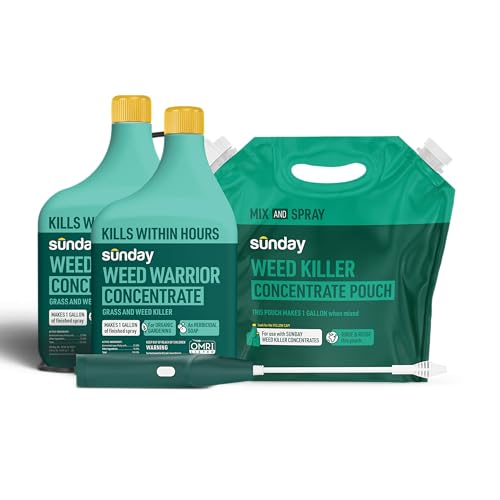
This concentrate kit makes two gallons of finished spray from two 22-ounce bottles — a coverage volume that undercuts most ready-to-use options on a per-gallon basis among premium-tier organic killers. The active ingredient is ammoniated soap of fatty acids at 22%, a contact-dehydrator that shows visible wilting in 20 minutes and full results within hours according to verified users. That speed puts it ahead of even high-acid vinegar formulas, which typically need 24-48 hours for comparable top-growth burn.
The included reusable pouch and battery-powered wand sprayer add genuine convenience for spot-treating driveway cracks, walkway joints, and garden bed perimeters. Owners report that clover in rock beds and moss on concrete respond well, though the soap-based mechanism struggles with deep-rooted perennials like mature thistle — multiple applications are necessary. The product is OMRI Listed for organic gardening and safe for vegetables, fruit trees, and ornamentals once dry, with a three-hour rain-fast window that fits humid climates better than vinegar alternatives.
Downsides center on the applicator design: the hand-pump sprayer lacks a stream setting for precision, the battery screws are difficult to access, and the pouch tube insertion is finicky. Some owners found the small handle uncomfortable for extended use. Despite the hardware quirks, the chemistry itself outperforms many premium synthetic alternatives in visible speed, making this the best choice for anyone who prioritizes rapid organic knockdown and is willing to accept occasional re-sprays on stubborn roots.
What works
- Visible wilting in as little as 20 minutes
- OMRI Listed and safe near edibles once dry
- Two gallons of finished spray from one kit
What doesn’t
- Applicator bag and wand design is awkward to use
- Less effective on deep-rooted perennial weeds
- Small handle can be uncomfortable for larger hands
2. Nature’s Freedom 45% Vinegar (2 Gallon)
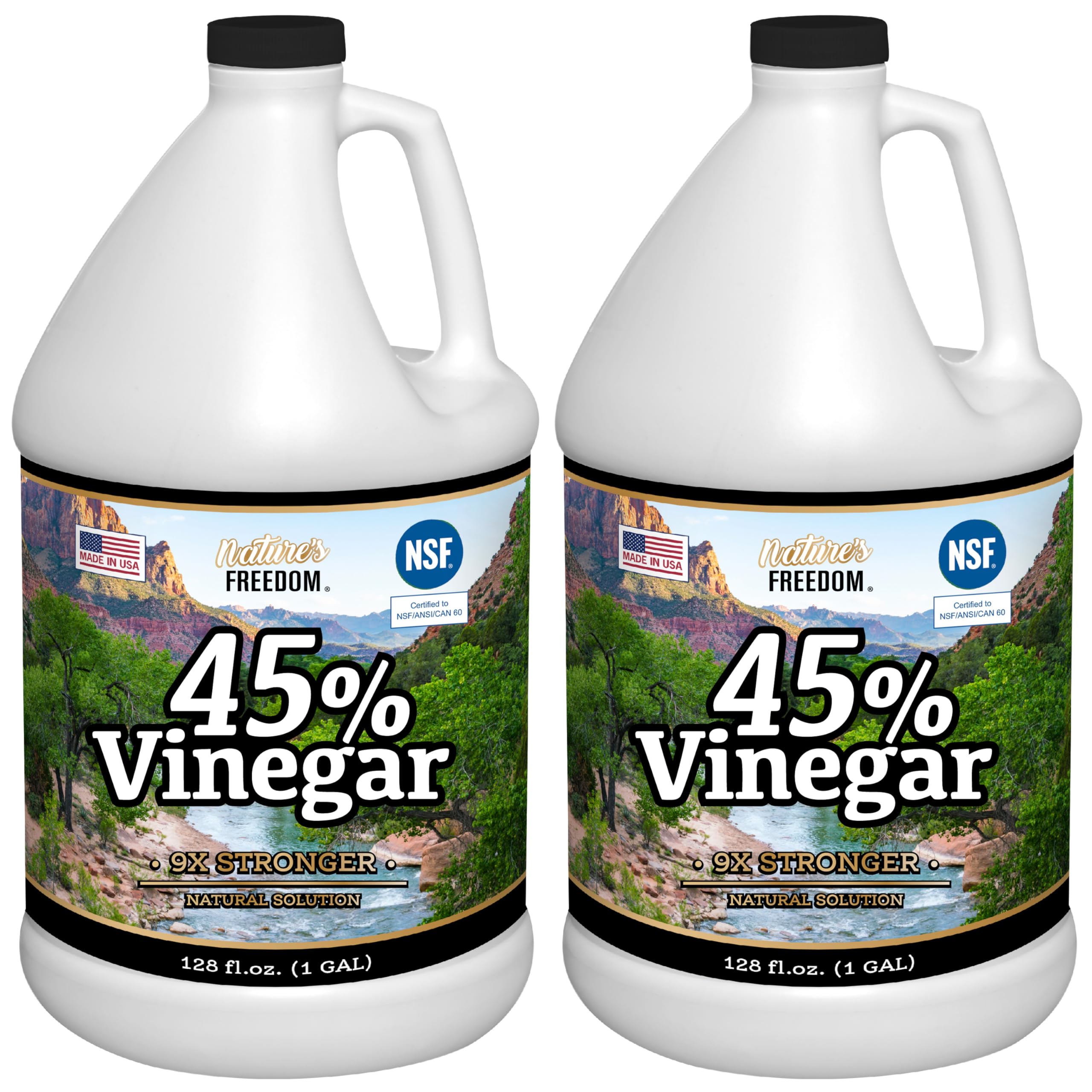
At 45% acetic acid, this industrial-grade vinegar concentrate is nine times stronger than the white vinegar sitting in your pantry and sits at the top of the concentration range available for residential organic weed control. NSF certified to NSF/ANSI/CAN 60, the purity standard matters because lower-grade acetic acid can contain contaminants that affect soil pH more aggressively. Verified owners report that weeds and grass on driveways and gravel turn brown within the same day and stay suppressed for months after a single thorough application.
Two gallons of concentrate provide substantial raw material for large properties. Most users dilute it 1:1 with water and add a surfactant like dish soap to improve leaf adhesion. The product is biodegradable and made in the United States, and owners confirm it is environmentally safe for pets once dry — though the fume intensity during application is strong enough that a respirator and safety glasses are non-negotiable. Many owners also use this concentrate for cleaning, stain removal, and descaling, which adds versatility beyond weed control.
The biggest limitation is that 45% vinegar is a non-selective contact burn with no soil residual effect — it cannot prevent regrowth from roots that survive the foliage burn. Perennial weeds with thick taproots like dandelions and dock will regrow and require reapplication. The strong odor during spraying is also a real consideration for small enclosed spaces. For pure kill power on established vegetation along fence lines, gravel paths, and patios, this concentrate delivers the most aggressive organic burn in the lineup.
What works
- Highest acetic acid concentration available for residential use
- NSF Certified for purity and safe for septic systems
- Sustained weed suppression for months on established plants
What doesn’t
- Extremely strong fumes require ventilation and protective gear
- No residual soil activity — regrowth from roots is possible
- Dilution and surfactant mixing required for best results
3. Fertilome Weed Free Zone (32 oz)
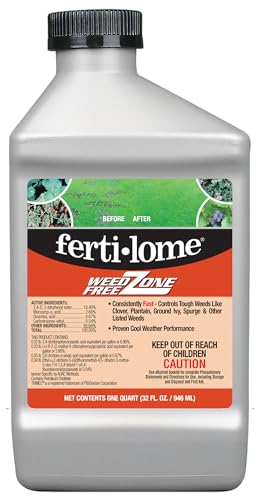
This concentrate is a selective, systemic herbicide built around dicamba — a synthetic auxin that disrupts broadleaf weed growth without harming established turf grasses like Kentucky Bluegrass, Bermudagrass, and Zoysiagrass. While not organic in the strictest sense (dicamba is a synthetic compound), it belongs on this list because it is the most effective solution for creeping Charlie, thistle, clover, and spurge within a lawn where an organic non-selective spray would kill the turf. Verified owners consistently call it the only product that truly kills creeping Charlie overnight.
The 32-ounce concentrate dilutes to cover a substantial lawn area, and users report visible injury within hours and full kill within five days even with rain exposure. Some owners note that the recommended dose struggles with clover and require a double-strength mix for complete control — adding a few drops of dish soap improves leaf adhesion on waxy weed surfaces. The product is safe on ornamentals if applied carefully, making it appropriate for flower beds bordering turf, though overspray on desirable broadleaf plants will damage them.
The trade-off is clear: this is not an organic product. If your goal is purely organic gardening without any synthetic chemistry, this is not your choice. However, if you need to selectively remove deep-rooted broadleaf weeds from within a lawn without killing the grass, Fertilome Weed Free Zone outperforms every organic contact spray because it translocates to the root system. The cost per application is modest since a little concentrate goes a long way, making it a high-value specialist for lawn weed problems that organic contact killers cannot solve.
What works
- Selective — kills broadleaf weeds without harming turf grass
- Systemic action reaches roots for complete kill
- Exceptionally effective on creeping Charlie and thistle
What doesn’t
- Synthetic dicamba — not suitable for organic gardening
- Requires double-strength mix for clover control
- Overspray will damage ornamental broadleaf plants
4. Belle Chemical 45% Pure Vinegar (2-Gallons)
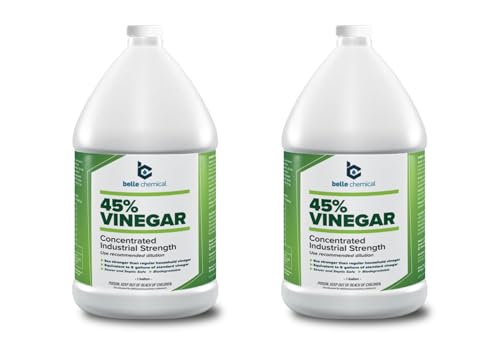
Belle Chemical’s 45% pure vinegar concentrate is the most straightforward value proposition in the high-acid segment: two gallons of industrial-grade acetic acid with no frills, no fancy label, and a price per ounce that undercuts most mid-tier ready-to-use organic sprays. Manufactured in the United States and biodegradable, it serves as a direct alternative to synthetic herbicides for large-surface applications like gravel driveways, stone patios, fence lines, and mulched paths where coverage volume matters more than applicator convenience.
Verified owners consistently report incredibly fast action on blackberries, weeds, and grass — visible kill within hours when applied on a sunny day. The recommended mix ratio is 1:4 concentrate to water with a tablespoon of dish soap as a surfactant. Without dilution, the full-strength acid is powerful enough to kill mature woody vegetation but also poses a significant inhalation hazard; users strongly recommend a respirator and safety glasses. The packaging is secure and leak-free, and the product arrives well-sealed even through rough shipping.
The main drawbacks are identical to other high-acid concentrates: no residual soil activity, strong fumes during application, and the need for careful dilution and surfactant mixing. This is not a grab-and-spray solution. Owners who do not follow the mix and surfactant protocol report disappointing results. For anyone willing to do the prep work and suit up with protective gear, Belle Chemical delivers the most concentrated vinegar-per-dollar ratio on the market, making it the budget-friendly high-strength option for large properties.
What works
- Excellent value per ounce of acetic acid concentrate
- Fast kill visible within hours on sunny days
- Secure packaging and biodegradable formulation
What doesn’t
- Strong fumes require a respirator and goggles
- Must be diluted and mixed with surfactant for best results
- No residual effect — regrowth from roots is likely
5. Energen Vinegar Weed & Grass Killer (1 Gallon with Sprayer)

Energen’s ready-to-use vinegar herbicide sits at a middle-ground 20% acetic acid concentration — stronger than household vinegar but significantly less aggressive than the 45% industrial concentrates. This makes it an accessible entry point for homeowners who want effective organic weed control without handling hazardous concentrates or mixing chemicals. Users confirm it kills creeping Charlie, dandelions, and clover within 24-48 hours, outperforming glyphosate on visible speed while remaining safe for bees, butterflies, and birds once the spray dries.
The built-in sprayer attachment adds convenience for small to medium yards, and the one-gallon size covers fence lines, garden borders, and gravel paths without requiring extra equipment. The product is approved for organic production and contains no glyphosate. Verified reviewers highlight that the vinegar smell dissipates quickly and that the formula performs well on broadleaf weeds in flower beds as long as overspray on desired plants is avoided.
The consistent weak point across multiple owner reports is the sprayer hardware. The nozzle frequently leaks onto the user’s hand during operation, siphons product into the bottle cap during storage creating a strong vinegar odor in the garage, and in some cases fails to spray entirely straight out of the box. The per-gallon cost is higher than buying concentrate and mixing it yourself, and some competitors offer higher acetic acid percentages at a similar price point. For someone who values grab-and-spray simplicity above all else and can tolerate a flimsy applicator, Energen works well as a mid-range organic option.
What works
- Ready-to-use with no mixing required
- 20% acetic acid kills most broadleaf weeds in 24 hours
- Safe for pollinators and pets once dry
What doesn’t
- Sprayer nozzle often leaks or fails to function
- Higher per-ounce cost than concentrate alternatives
- Lower acid concentration than 45% competitors
6. Pet’s Pal Natural Weed Killer (1 Gallon)

Pet’s Pal markets itself specifically to households where dogs, cats, and children share the yard — a positioning backed by a natural chloride-based formula that contains no glyphosate and is labeled pet safe after drying. The ready-to-use one-gallon spray covers approximately 1,000 square feet and is designed for non-selective application on broadleaf weeds and grasses around lawns, flowerbeds, rock beds, and mulched areas. Verified owners appreciate the peace of mind this provides, especially when pets have direct access to treated areas.
Performance reviews are deeply divided. A significant number of owners report fast visible results — weeds dying within hours — and call it the best natural weed killer they have used at this price point. However, a comparable number of verified reviews describe it as completely ineffective, with weeds continuing to thrive or even appearing to grow more vigorously after application. This inconsistency suggests the formula may be sensitive to application technique, sun exposure, or weed maturity at the time of spraying. Users who achieve good results tend to spray heavily until runoff and choose sunny, dry days.
The formulation is non-selective and will kill grass, so it cannot be used to spot-treat weeds within a lawn. Owners who need a universal lawn-safe weed killer should look elsewhere. The mixed performance data means Pet’s Pal is a gamble — it may work brilliantly in your specific conditions or it may waste your afternoon. For pet owners who prioritize nontoxic ingredients above all else and are willing to test their own results, this is a reasonable entry-level organic option, but it lacks the consistency of the higher-acid vinegar or soap-based alternatives.
What works
- Formulated specifically for pet and kid safety
- Ready-to-use with no mixing required
- Some users report fast kill on broadleaf weeds
What doesn’t
- Highly inconsistent results across different yards
- Non-selective — will kill grass and ornamentals
- Not effective for all users despite correct application
7. Bonide Captain Jack’s Deadweed Brew (128 oz)

Bonide Captain Jack’s Deadweed Brew is a 128-ounce ready-to-use non-selective herbicide approved for organic gardening, making it the largest volume budget-friendly entry in this lineup. The formula is fast-acting with results visible in hours, and it becomes waterproof once dry — a practical feature for those who cannot guarantee a long dry window. It works in temperatures as low as 40°F, extending the application season into early spring and late fall when many organic contact killers lose effectiveness. Owners use it successfully along driveways, sidewalk cracks, fence lines, and the base of mature trees.
The customer feedback on this product is the most polarized in the group. A portion of verified buyers report exceptional results — thistle and clover dying within an hour, full gallon coverage on gravel paths, and satisfaction with the battery sprayer’s ergonomics. But another significant group reports complete failure, with some suspecting a batch quality control issue or counterfeit stock after a first successful purchase was followed by a completely ineffective second bottle. The sprayer itself has been flagged as unreliable, with some owners recommending using their own wand sprayer instead.
For the price, the volume is hard to beat, and the organic certification is genuine. However, the inconsistent quality control means this is a riskier purchase than the soap-based or high-acid vinegar options. Owners who buy it from a reliable source and get a fresh batch tend to love it; those who receive a dud bottle are stuck with a gallon of useless liquid. If you need the lowest cost per ounce for organic broad coverage and are willing to return a defective bottle, Captain Jack’s is the best budget-friendly organic option. But if consistency is your priority, the extra few dollars for a vinegar concentrate or soap kit is money well spent.
What works
- Lowest cost per ounce among ready-to-use organics
- Works down to 40°F for early and late season application
- Becomes waterproof once dry on leaf surfaces
What doesn’t
- Significant quality control inconsistency between batches
- Sprayer attachment is unreliable and prone to failure
- Results vary wildly — some users see zero effect
Hardware & Specs Guide
Acetic Acid Percentage
The concentration of acetic acid in vinegar-based herbicides determines burn speed and depth. Household vinegar at 5% is too weak for reliable weed control. Products in this guide range from 20% (Energen) to 45% (Nature’s Freedom and Belle Chemical). Higher percentages burn foliage faster and penetrate deeper into crowns but also require more careful handling, including respirator use and eye protection. Mid-range 20% formulas balance convenience with effectiveness for annual weeds and shallow-rooted perennials.
Herbicidal Soap Concentration
Ammoniated soap of fatty acids works by dissolving the waxy cuticle on plant leaves, causing rapid dehydration. The Sunday Weed Warrior uses a 22% concentration, which is among the highest available in residential organic herbicides. Soap-based killers act faster than vinegar (wilting in 20-30 minutes) and rain-fast in as little as 3 hours, but they have zero translocation to roots and no residual soil activity. They excel on annual weeds, moss, and algae but require reapplication on deep-rooted perennials.
Selective vs. Non-Selective Formulations
Non-selective herbicides kill any plant they touch — all vinegar and soap-based organic products fall into this category. Selective herbicides like Fertilome Weed Free Zone (dicamba-based) target broadleaf weeds without harming most turf grasses, but they use synthetic chemistry and are not organic. Understanding this distinction prevents the single most common mistake: spraying a non-selective killer on lawn weeds and killing the grass, then blaming the product for working as designed.
Concentrate vs. Ready-to-Use Volume Economy
Ready-to-use (RTU) products like Bonide Captain Jack’s and Pet’s Pal are convenient but cost significantly more per ounce of active ingredient. Concentrates like Sunday Weed Warrior (soap) and Nature’s Freedom (vinegar) require mixing but deliver two to four times more finished spray volume per dollar. For large properties or regular applications, concentrate kits and industrial vinegar are the clear economic winners. For a single weekend of small-area spot treatment, an RTU gallon avoids the mixing hassle and storage of extra chemicals.
FAQ
Will organic weed killer kill the roots or just the leaves?
How long after application can pets and kids go on the lawn?
Why did my organic weed killer not work on crabgrass?
Final Thoughts: The Verdict
For most gardeners, the organic weed and grass killer winner is the Sunday Weed Warrior Concentrate Kit because it combines the fastest visible kill speed (20 minutes) with OMRI certification and the coverage economy of a concentrate, all while being truly safe for pets and edibles once dry. If you need deep perennial root burn across large gravel areas or fence lines, grab the Nature’s Freedom 45% Vinegar for its industrial-strength acetic concentration. And for selective broadleaf control within a lawn where killing the grass is not an option, nothing beats the Fertilome Weed Free Zone despite its synthetic chemistry — it solves a problem that no organic contact killer can touch.