
You walk out to check your tomato plants and see leaves full of holes, tiny bugs crawling everywhere, or that powdery white stuff coating your squash. The question is not whether you need to spray something — it is what you can spray that actually works without ruining the vegetables you are about to eat. That is the whole point of finding the right organic insecticide: something that kills the pest but lets you harvest safely the same week.
I’m Rikta — the co-founder and writer behind Lawn Gear Lab. This guide is built by comparing the manufacturers’ published specifications and the patterns across verified customer reviews, so you get each pick’s real strengths and trade-offs instead of marketing spin.
Your vegetable garden deserves a treatment that targets the specific pest you are fighting without leaving toxic leftovers on your food. This roundup of the best organic insecticide for vegetable garden options breaks down exactly which formula works for aphids, which one stops caterpillars, and which controls powdery mildew — all from real buyer experiences.
How To Choose The Best Organic Insecticide For Vegetable Garden
Picking the right organic insecticide comes down to knowing what pest you are fighting and how the treatment works. A spray that smothers aphids will not stop caterpillars, and a powder that dries out slugs can wash away after rain. Here is what to look for.
Match the active ingredient to the pest
Mineral oil (like the Bonide option) works by smothering soft-bodied insects — aphids, mites, scale — and also prevents fungal diseases like powdery mildew. Bacillus thuringiensis or Bt (the Monterey product) is a bacteria that only caterpillars and worm-type pests can digest, so it leaves bees and earthworms untouched. Diatomaceous earth (the RobiGuard option) is a fine powder that cuts through the waxy outer layer of crawling insects, causing them to dehydrate. Bio-pesticide oil blends (the AgroMagen product) use plant-based oils to coat and suffocate mites, whiteflies, and mildew spores.
Check the form: concentrate vs ready-to-use vs powder
A ready-to-spray liquid attaches directly to your garden hose, so you cover large areas quickly — the Bonide comes in a 32-ounce concentrate that makes many gallons of spray. A concentrate you mix yourself (the AgroMagen at 8.5 ounces and the Monterey at 8 ounces) gives you more control over strength and costs less per treatment. A powder (the RobiGuard diatomaceous earth) works best dry but needs reapplication after rain.
Look for OMRI or organic certification
OMRI Listed means the Organic Materials Review Institute has verified the product meets USDA organic standards. The Monterey Bt carries this label. The Bonide mineral oil is approved for organic gardening. Always check that the label says “for organic gardening” or lists the active ingredient as food-grade or plant-based.
Quick Comparison
On smaller screens, swipe sideways to see the full table.
| Model | Category | Best For | Key Spec | Amazon |
|---|---|---|---|---|
| Bonide All Seasons Oil | Ready-to-Spray | All-purpose smothering & disease prevention | 32 Fluid Ounces | Amazon |
| Monterey B.t. | Concentrate | Caterpillar & worm control | 8 Fluid Ounces | Amazon |
| AgroMagen GrowSafe | Bio-Pesticide | Mites, whiteflies, powdery mildew | 8.5 Fluid Ounces | Amazon |
| RobiGuard DE + Peppermint | Powder | Crawling insects & slugs | 16 Ounce | Amazon |
| Evergreen Way Concentrate | Concentrate | Multi-pest & fungus control | 16 oz (makes 48+ gallons) | Amazon |
In‑Depth Reviews
1. Bonide All Seasons Horticultural & Dormant Spray Oil

32 fluid ounces and year-round use make the Bonide All Seasons Horticultural & Dormant Spray Oil the top pick for the gardener who wants a single product that smothers insects and prevents disease from dormancy through active growth.
At 32 fluid ounces, this is the largest liquid volume in this roundup — it holds 4 times the amount of the Monterey Bt concentrate and nearly 3.8 times the volume of the AgroMagen GrowSafe. Buyers report it “took care of the black bean aphids on my Spanish Broom” and it works overnight on cherry aphids, as another reviewer confirmed. The mineral oil coats the pest and blocks its breathing pores, so it kills without toxic residue.
The hose-end sprayer that comes with it is the weak link — several owners mention it is poorly calibrated, messy, and wasteful, so you will get better results by mixing the oil into a standard pump sprayer instead. For most vegetable gardeners, this is the confident verdict: one bottle, year-round coverage, and real results backed by dozens of 4- and 5-star reviews.
Why it’s great
- 32-ounce container gives you many seasons of coverage
- Controls insects, mites, and fungal diseases in one spray
- Approved for organic gardening — leaves no toxic residues
Good to know
- Included hose-end sprayer is inaccurate and messy
- Works best when you switch to a separate pump sprayer
2. AgroMagen GrowSafe Bio-Pesticide
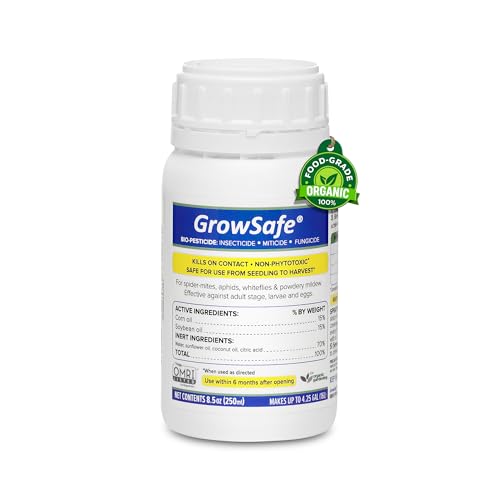
Where the Bonide mineral oil wins on total volume and broad coverage, the AgroMagen GrowSafe beats it on targeted potency against spider mites and powdery mildew — the Bonide controls these, but the GrowSafe was specifically formulated for them, and one reviewer in South Florida reported 97-99% effectiveness against whiteflies on the first application versus neem oil’s roughly 60%. It is the right pick when a specific infestation has taken hold and you need something stronger than a general-purpose oil.
This 8.5-ounce bottle uses a blend of corn oil and soybean oil that mixes easily with water, resists separation, and does not burn leaves the way some neem oil products can. Customers note “after 2 sprays, mildew gone, 95% leaves healthy from thrips/mites” — one reviewer even mentioned the customer service team called back for a 20-minute discussion on how to use it. The oil leaves a visible protective layer on leaves, and plants look healthier after treatment.
Choose the AgroMagen over the Bonide if your primary enemy is spider mites, whiteflies, or powdery mildew on specific plants like tomatoes, peppers, or indoor houseplants. It is also the better choice if you need a formula that is safe for bees and beneficial insects when used as directed.
Where it shines
- 97-99% effective against whiteflies on first application, per reviewer
- Food-grade plant oils with no strong odor or leaf burn
- Safe for bees, ladybugs, and beneficial insects
Worth noting
- Small 8.5-ounce bottle — you will need to buy concentrate for large gardens
- Can burn leaves if mixed too strong, though new growth recovers fine
3. Monterey B.t. Bundled with Measuring Spoon
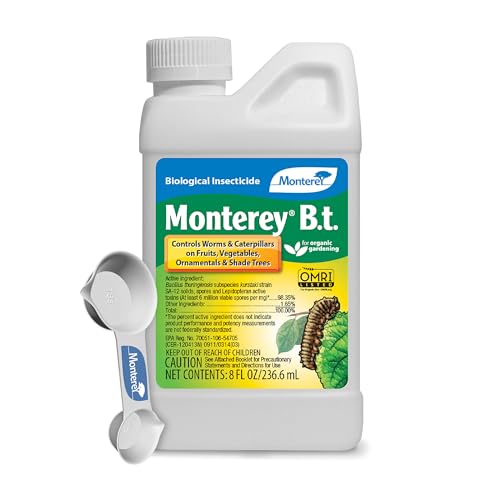
Imagine you planted broccoli, cabbage, cilantro, and wildflowers, and then cabbage looper worms start turning every leaf into lace. That is the exact scenario the Monterey B.t. was made for — it uses Bacillus thuringiensis (a naturally occurring bacteria that only caterpillars and worm-type insects can digest, so it leaves bees, earthworms, and ladybugs completely unharmed).
Reviewers point out “BT effectively stopped cabbage looper worms from destroying wildflower and cilantro seedlings” and note it works on bagworms, gypsy moths, and other leaf-eating caterpillars. The 8-ounce bottle mixes with water instantly — you just add it to a spray bottle or pressure tank and spray the foliage. One reviewer says “I can’t garden without it now.” It is OMRI Listed, meaning it meets USDA organic standards.
The standout spec here is specificity: this is the only product in this roundup that targets only caterpillars and worms, which makes it the safest choice for your pollinator-friendly garden.
What stands out
- OMRI Listed for organic gardening — meets USDA organic standards
- Zero effect on bees, earthworms, birds, or ladybugs
- Fast-acting — caterpillars stop eating within hours
The trade-offs
- Only works on caterpillars and worm-type pests, not aphids or mites
- Small 8-ounce container compared to the Bonide at 32 ounces
4. RobiGuard Diatomaceous Earth & Peppermint Powder

The single most important number in this product is the ounce count: 16 ounces of food-grade diatomaceous earth (a fine powder made from fossilized algae that cuts through insects’ waxy shells, causing them to dry out and die) plus peppermint oil for a repellent scent. It is the only non-liquid option in this list, which means it works differently — instead of spraying, you dust it around plant bases, in cracks, and on soil.
The catch you accept is that this is a powder, not a spray. It needs to stay dry to stay effective, so heavy rain or overhead watering will wash it away and require reapplication. Shoppers say it “reduced gnats almost completely within a week; no flea bites” and one reviewer called it a “humane way to keep squirrels out of your garden.” It also works on ants, roaches, slugs, and silverfish.
At this price point, you get a food-grade product safe around pets and kids — one reviewer uses it on their dog for fleas — with the added bonus of peppermint scent instead of the usual earthy smell of plain DE. For the gardener fighting ants, slugs, and gnats who prefers dusting over spraying, this is the budget-friendly pick.
The upsides
- Food-grade safe around people and pets when used as directed
- Peppermint oil adds a pleasant scent and natural repellent effect
- Effective against ants, slugs, gnats, fleas, and earwigs
Keep in mind
- Washes away after rain — needs reapplication on outdoor gardens
- Strong peppermint smell may be too intense for some users near pets
5. Evergreen Way Organic Insecticide & Fungicide Concentrate

What you actually get at this price is a 16-ounce concentrate that makes multiple gallons of spray — one reviewer used just 10 drops in 32 ounces of water and watched bugs shrivel in 5-10 seconds. This is the best value-to-volume ratio in the list if you have a large vegetable patch or multiple beds to treat weekly.
What you give up is a clear label: this product does not carry an OMRI certification or a stated active ingredient breakdown like the mineral oil or Bt options do. The formula is described as “bio-based” and buyers report it works on aphids, caterpillars, gnats, and fungus, but if you need a USDA-certified organic label for your gardening standards, the Bonide or Monterey picks are more transparent choices.
This is the exact buyer it is perfect for: the gardener with a large mixed garden — tomatoes, peppers, herbs, ornamentals — who wants one concentrate that tackles both insects and powdery mildew in a single pass, and who does not mind relying on buyer reviews for proof rather than an organic seal. One reviewer noted it “eliminated all fungus gnats with one soaking.”
Why we’d pick it
- One 16-ounce bottle makes many gallons of ready-to-use spray
- Works on aphids, caterpillars, gnats, and fungus — two-in-one coverage
- Reviewers report seeing results in seconds on contact
A few caveats
- Not OMRI certified — less transparency on active ingredients
- Fungicide component can be thicker and smellier than insecticide alone
Understanding the Specs
Active Ingredient Type
This is the single most important spec because it tells you exactly which pests the product kills and how. Mineral oil smothers soft-bodied insects and fungal spores. Bacillus thuringiensis (Bt) is a bacteria that only caterpillars and worms can digest — it is the safest choice for bees. Diatomaceous earth is a powder that cuts and dehydrates crawling insects. Plant-based oil blends (corn, soybean) coat and suffocate mites, whiteflies, and mildew without burning leaves like neem oil can.
Liquid Volume vs Unit Count
For liquid concentrates, the bottle size (in fluid ounces) tells you how much concentrated product you get, but the “makes X gallons” number is what really matters for coverage. The Bonide 32-ounce ready-to-spray attaches to your hose and covers a large area. The Monterey 8-ounce and AgroMagen 8.5-ounce concentrates need mixing with water in a sprayer — they go further per treatment but require more effort. For powders, the dry weight in ounces tells you how many square feet you can dust before needing a refill.
FAQ
Can I spray organic insecticide on vegetables right before harvest?
Will organic insecticide wash off in the rain?
What kills caterpillars but does not kill bees?
Can I mix organic insecticides together for stronger results?
Final Thoughts: The Verdict
For most buyers, the best organic insecticide for vegetable garden winner is the Bonide All Seasons Oil because it covers insects, mites, and fungal diseases in one ready-to-spray bottle with year-round use. If you need a targeted caterpillar killer that is completely safe for bees, grab the Monterey B.t.. And for a spider mite and powdery mildew specialist that outperforms neem oil, the standout is the AgroMagen GrowSafe.