
Finding a plant protectant that smothers aphids, halts powdery mildew, and wipes out caterpillars without drenching your vegetable bed in synthetic residuals is the core challenge every organic gardener faces. The wrong bottle leaves your harvest unsafe, while the right concentrate turns a pest-riddled crop into a thriving, productive patch.
I’m Rikta — the co-founder and writer behind Lawn Gear Lab. I spend my time cross-referencing active-ingredient ratios, decoding OMRI listings, and mapping real owner-reported outcomes against label claims to separate truly effective natural formulations from those that just smell botanical.
After deep-diving into the mechanical action, coverage specs, and real-world application notes of seven distinct formulas, this guide cuts through the marketing to deliver the definitive breakdown of the best natural pesticide for every common garden pest scenario.
How To Choose The Best Natural Pesticide
Every natural pesticide works through a distinct mode of action — some smother soft-bodied insects with oil, others disrupt the gut of leaf-eating larvae, and a few lure mollusks to a slow stop using iron compounds. Matching the active ingredient to the specific pest and the stage of plant growth is the single most important decision you will make.
Identify Your Target Pest First
Oils such as mineral oil and neem oil are effective against aphids, spider mites, whiteflies, and fungal spores because they coat and suffocate. For caterpillars, bagworms, and cabbage loopers, products containing Bacillus thuringiensis (B.t.) are far more precise — they stop larval feeding within hours without harming bees. For slugs and snails, iron phosphate granules deliver targeted control near the soil line.
Check the OMRI or NOP Label
A product listed by the Organic Materials Review Institute (OMRI) has been verified to comply with USDA National Organic Program standards. This certification is critical if you are growing produce for market or want to be certain no synthetic residues remain on your edible crops. Not every “natural” label passes this independent review, so look for the seal on the container.
Choose Between Ready-to-Use and Concentrate
Ready-to-use (RTU) formulas are pre-diluted and convenient for small container gardens or spot treatments, but they cost more per application and the bottle goes fast. Concentrates require measuring and mixing with water in a pump sprayer, yet they give you dozens of batches from a single small bottle and let you adjust the strength for heavy infestations.
Quick Comparison
On smaller screens, swipe sideways to see the full table.
| Model | Category | Best For | Key Spec | Amazon |
|---|---|---|---|---|
| Bonide All Seasons Spray Oil | Mineral Oil | Year-round smothering of insects & fungus | 32 fl oz RTU, mineral oil base | Amazon |
| Bonide Captain Jack’s Neem Oil | Neem Oil RTU | Large-scale insect & disease prevention | 128 fl oz RTU, clarified neem oil | Amazon |
| Bonide Bug & Slug Bait | Granule Bait | Slugs, snails & soil-surface insects | 1.5 lb, covers 3000 sq ft | Amazon |
| Garden Safe Brand Fungicide3 | Neem Oil RTU | Combating fungal disease & mites | 128 fl oz RTU, neem oil extract | Amazon |
| Monterey B.t. Caterpillar Killer | B.t. Concentrate | Targeted caterpillar & worm control | 8 oz concentrate, OMRI listed | Amazon |
| Fertilome Spinosad Insecticide | Spinosad Concentrate | Chewing insects on trees & ornamentals | 16 oz concentrate, OMRI listed | Amazon |
| Botanical Tradesman Neem Oil Kit | Neem Oil Concentrate | Refillable indoor/outdoor neem spray | 3.4 oz concentrate, 100% cold-pressed | Amazon |
In‑Depth Reviews
1. Bonide All Seasons Horticultural & Dormant Spray Oil

Bonide All Seasons delivers a 32-ounce ready-to-spray mineral oil formulation that works in both dormant and growing seasons, making it the most versatile single-bottle solution on this list. The mineral oil base smothers adelgids, aphids, scale, mites, and mealybugs by coating their bodies, while also suppressing powdery mildew and rust spores on contact. Owners consistently report visible results within 24 hours on heavy infestations like black cherry aphids and azalea bark scale.
The product attaches directly to a garden hose for broad coverage, though several experienced users note the hose-end sprayer tends to over-apply and recommend decanting into a pump sprayer for precise, cost-efficient application. At a 32-ounce unit count, it covers a generous area without requiring mixing or measuring, which is ideal for gardeners treating shrubs, fruit trees, and ornamental beds across an entire property.
Because mineral oil leaves no toxic residues and is approved for organic gardening, you can use it on edibles such as peppers, corn, and asparagus right up to the day before harvest. The trade-off is that thorough pre-soaking of dense foliage is necessary to prevent the oil from pooling, and some users find the hose-end calibration inconsistent out of the box.
What works
- Effective across dormant, green-tip, and full growing stages.
- Controls both insects and fungal diseases in one application.
- OMRI-compatible mineral oil base safe for edibles.
What doesn’t
- Included hose-end sprayer can be wasteful and messy.
- Requires thorough foliage pre-wetting to avoid pooling.
2. Bonide Captain Jack’s Neem Oil 128 oz Ready-to-Use
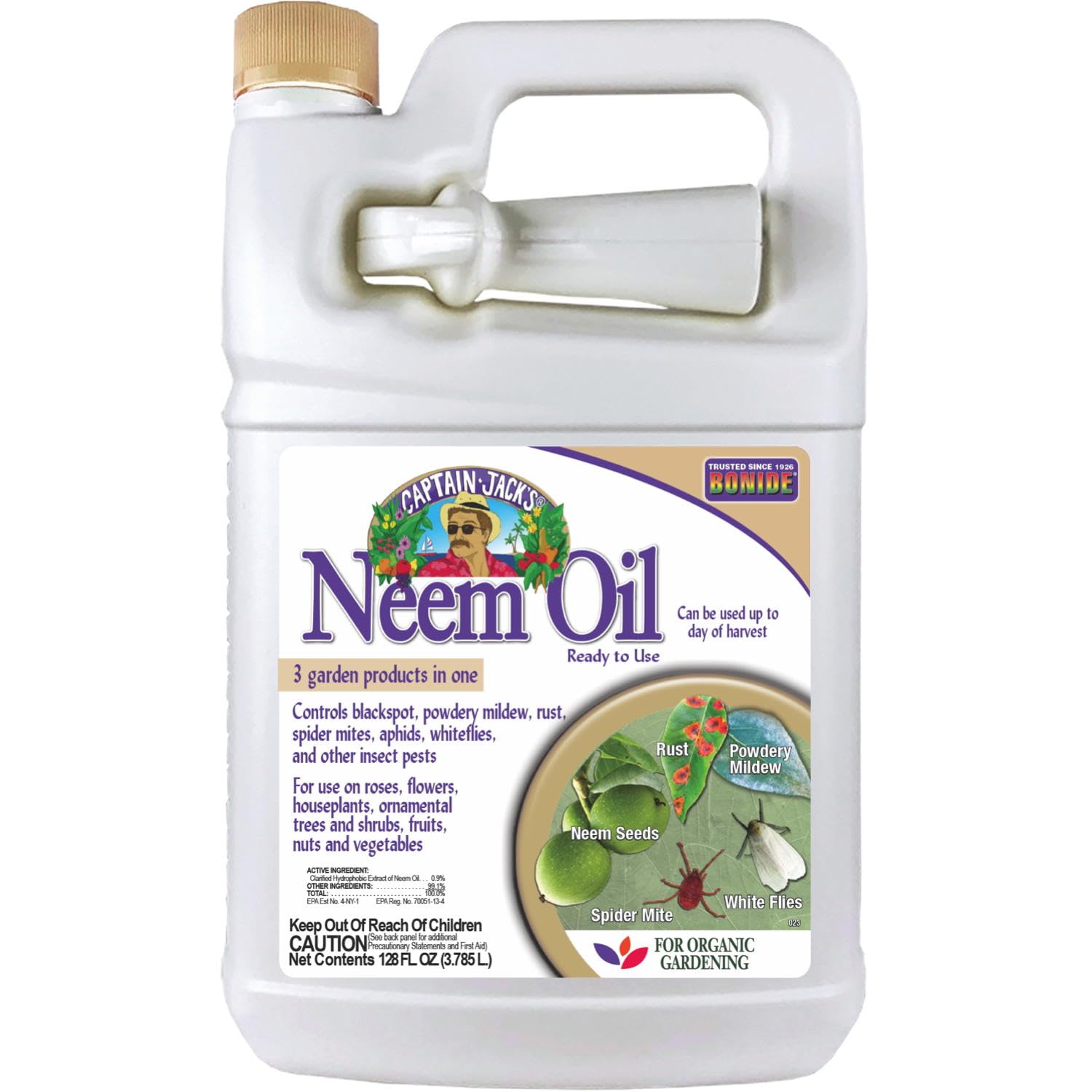
Captain Jack’s Neem Oil arrives as a full 128-ounce ready-to-use gallon with an integrated spray nozzle, giving you one of the highest volume-per-dollar ratios in the neem oil category. The clarified hydrophobic extract of neem oil targets spider mites, aphids, whiteflies, and fungal issues like rust and powdery mildew by coating eggs, larvae, and adults. User reports confirm it eliminated scale from indoor plants after just two sprays and stopped earwigs from shredding herb gardens with consistent weekly reapplication.
The RTU format eliminates mixing errors, making it a strong choice for gardeners who prefer to spray directly from the bottle without measuring. Owners note the sprayer is simple to operate and the 1-gallon supply lasts multiple seasons for a modest-sized vegetable plot and flower bed. The product can be used up to the day of harvest, which is a critical advantage for those growing produce like tomatoes and blueberries.
Where this product truly shines is convenience — you do not need a separate sprayer, and the large reservoir reduces refill trips mid-application. On the downside, the RTU format means you are paying for water weight, and the sprayer tube design (roughly four inches of coiled hose) limits reach on tall plants. The neem scent is also moderately strong, though it fades quickly after drying.
What works
- Massive 128-ounce RTU volume for extensive coverage.
- Three-in-one action: fungicide, insecticide, miticide.
- Safe to use on edibles up to harvest day.
What doesn’t
- RTU format includes significant water weight in the price.
- Short integrated sprayer tube reduces reach on tall plants.
3. Bonide Bug & Slug Bait 1.5 lb Granules

Bonide Bug & Slug Bait takes a completely different approach — instead of spraying leaves, you scatter iron phosphate and spinosad pellets across the soil surface. The iron phosphate lures slugs, snails, earwigs, sowbugs, and cutworms out of hiding, and the dual active ingredients stop them before they reach your seedlings. One 1.5-pound bag covers up to 3,000 square feet, and each application lasts up to four weeks, making this an incredibly efficient option for large raised beds and fruit-tree rings.
Growers report that after scattering the pellets, slug damage on strawberry plants and earwig destruction of seedlings stops almost immediately. Because the product is OMRI-listed and people and pets can re-enter the treated area right after application, you can use it around edible crops without a waiting period. The granules are also rain-resistant once dry, which extends their effectiveness through wet spring weather.
The main limitation is that this product is strictly a soil-surface bait — it will not help with aphids, caterpillars, or fungal diseases on foliage. Some users note that slug populations can rebound after about ten days in heavy pressure areas, so a second application within the four-week window is sometimes necessary. The pellets also need to be placed where they stay dry enough to remain palatable to slugs.
What works
- 3000 sq ft coverage from a single 1.5-lb bag.
- Dual active ingredients target slugs, snails, and soil insects.
- Immediate re-entry allowed — safe around children and pets.
What doesn’t
- Ineffective against aphids, caterpillars, or foliar fungus.
- May require reapplication sooner than four weeks under heavy pressure.
4. Garden Safe Brand Fungicide3 1 Gallon
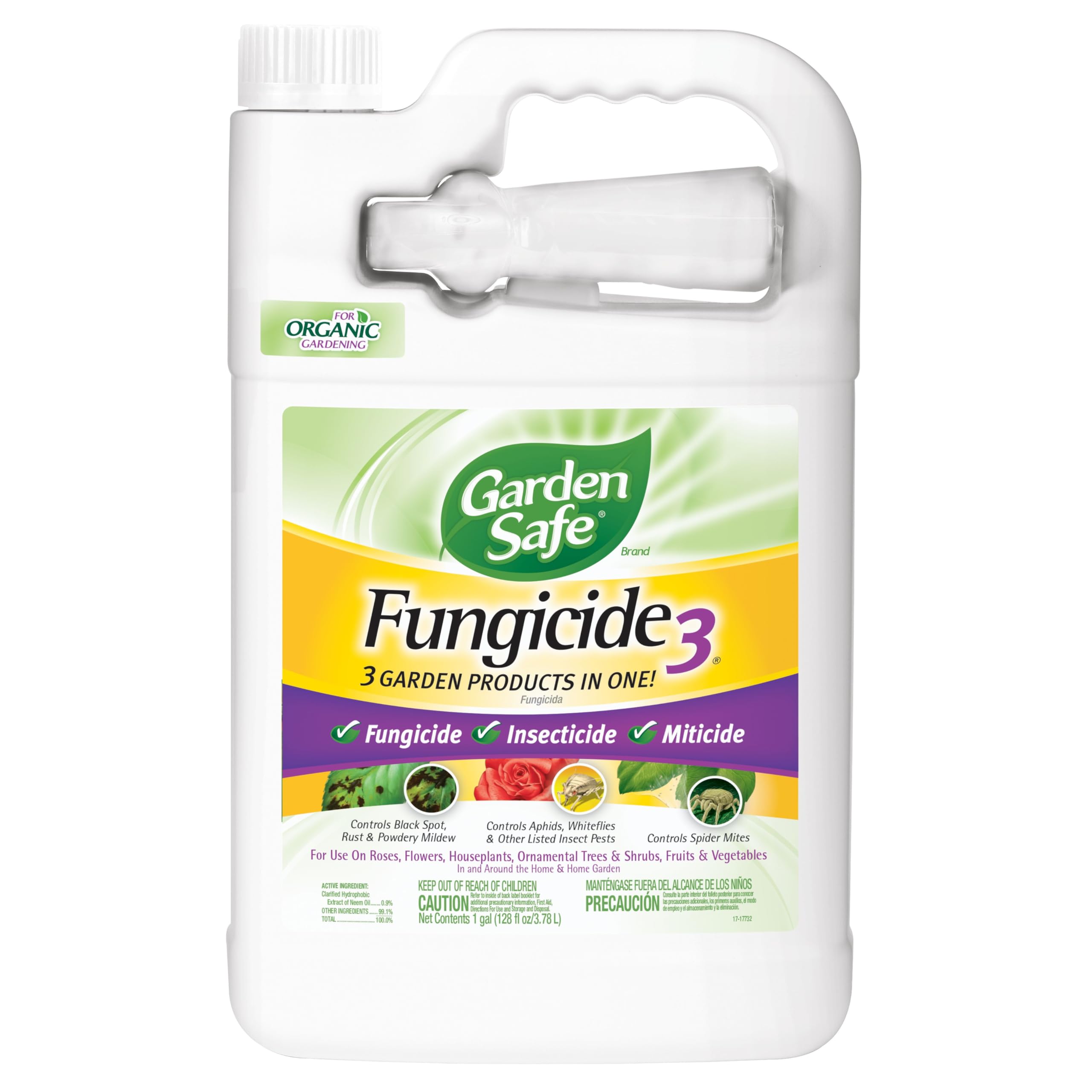
Garden Safe Fungicide3 is a three-in-one ready-to-use formula — fungicide, insecticide, and miticide — built on clarified hydrophobic extract of neem oil. It is designed to prevent black spot, rust, and powdery mildew while simultaneously controlling aphids, whiteflies, and spider mites. The 1-gallon jug with an attached sprayer offers a very accessible entry point for organic gardening, and owners frequently highlight its effectiveness on rose bushes, orchids, and vegetable patches.
Long-term users report that weekly applications eliminated recurring powdery mildew on hibiscus and tomatoes, and the same treatment kept spider mites at bay through the entire growing season. The neem oil extract coats both the upper and lower leaf surfaces, which is essential for disrupting the fungal spore cycle. Several reviewers caution that using the full recommended dose can burn tender foliage, so starting at half strength and avoiding midday sun is wise.
The biggest functional drawback is the integrated sprayer, which owners describe as poorly designed — the short pickup tube and coiled hose make it difficult to reach beyond the first few inches of the jug, and the spray pattern is inconsistent. Decanting into a quality pump sprayer solves this issue completely and is recommended for anything other than small potted plants. The product’s organic credentials and broad-spectrum action make it a solid value despite the sprayer flaw.
What works
- Broad-spectrum control of fungus, insects, and mites.
- Safe for use on orchids, roses, and edibles.
What doesn’t
- Attached sprayer has poor reach and inconsistent output.
- Can burn delicate foliage at full recommended dose.
5. Monterey B.t. Caterpillar & Worm Killer
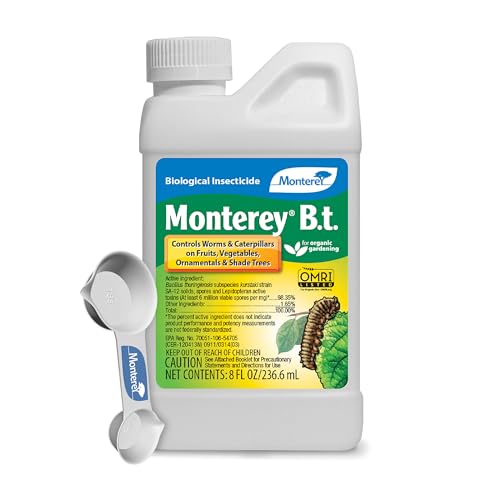
Monterey B.t. is a concentrated biological insecticide that uses Bacillus thuringiensis, a naturally occurring soil bacterium, to target only caterpillar and worm-type larvae such as cabbage loopers, bagworms, gypsy moths, and tent caterpillars. When ingested, the bacteria produces a protein that stops the pest from feeding within hours, yet it has zero effect on honeybees, ladybugs, earthworms, or birds when applied correctly. The 8-ounce bottle mixes with water to produce several gallons of spray, making it an economical choice for targeted larval control.
Gardeners report dramatic results on brassicas — one user noted that cabbage looper damage on broccoli and cilantro seedlings vanished after a single application, and the plants went on to produce a full harvest. Because B.t. is OMRI-listed, it is fully compatible with organic certification standards and can be used on edible crops right up to the day of picking. The concentrate also includes a measuring spoon, which eliminates guesswork during mixing.
The key constraint is specificity: B.t. will not kill aphids, mites, slugs, or any adult insect. It must be ingested by the larval stage, so timing is critical — apply when caterpillars are actively feeding, not after they have pupated. The concentrate also requires a sprayer (trigger bottle or pressure tank), and the small 8-ounce bottle may need to be repurchased mid-season for larger properties with heavy worm pressure.
What works
- Highly selective — safe for bees, earthworms, and birds.
- Stops caterpillar feeding within hours of ingestion.
- Concentrate stretches to many gallons of spray solution.
What doesn’t
- Only effective against actively feeding larval-stage caterpillars.
- Requires a separate sprayer and careful timing.
6. Botanical Tradesman Neem Oil Spray Kit

Botanical Tradesman offers a pure cold-pressed neem oil concentrate kit that includes a 3.4-fluid-ounce bottle of undiluted oil plus a 16-ounce trigger sprayer with an adjustable nozzle. Because the concentrate contains no added water, vegetable oils, or diluents, a single bottle dilutes into roughly 338 fluid ounces of ready spray — enough for twenty full refills of the included bottle. This makes it one of the highest-value neem oil solutions for gardeners who prefer concentrate economics.
The kit is designed for indoor and outdoor ornamental plants, and users confirm its effectiveness against fungus gnats, whiteflies, and powdery mildew when applied weekly over a four-week cycle. Several owners note that the neem oil is noticeably thick, and warming the closed bottle in hot water before measuring significantly improves mixing with water and mild soap. The adjustable sprayer nozzle provides a fine mist that coats leaf surfaces evenly, which is critical for suffocating soft-bodied pests.
The main trade-off is the manual effort required — you must mix each batch fresh, and the oil does not emulsify easily without warm water and thorough shaking. The strong neem odor is also more pronounced with pure concentrate than with pre-diluted RTU products. Nonetheless, for gardeners who want to minimize plastic waste and control their spray concentration, this kit delivers unmatched flexibility and per-ounce value.
What works
- Pure cold-pressed concentrate yields up to 338 oz of spray.
- Refillable kit reduces single-use plastic waste.
- Adjustable nozzle produces fine, even mist coverage.
What doesn’t
- Needs warm water and soap for proper emulsification.
- Strong neem scent — not ideal for indoor use.
7. Fertilome Spinosad Insecticide 16 oz

Fertilome Spinosad is a 16-ounce OMRI-listed concentrate that targets a broad range of chewing insects, including leafminers, borers, thrips, Colorado potato beetles, armyworms, bagworms, and tent caterpillars. Spinosad is derived from fermentation of a naturally occurring soil bacterium, and it works by exciting the nervous system of target pests, causing paralysis and death within one to two days. The concentrate mixes at 4 tablespoons per gallon of water, and a single bottle treats a substantial area of trees, shrubs, flowers, and vegetables.
Orchard owners report that regular spinosad applications on apple trees drastically reduce worm damage and increase fruit yield for cider and baking. The product is also effective against webworms, crickets, and some grasshopper species when applied with a battery-powered sprayer around the perimeter of the house and yard. Because it is OMRI-listed, it fits into an organic management program without losing efficacy against tough pests like borers and leafminers that oils alone cannot control.
Spinosad is not as gentle on beneficial insects as B.t. — it can affect bees if sprayed directly on open blooms, so application should be timed for early morning or evening when pollinators are not active. Some users also note that the concentrate requires precise mixing, and the 16-ounce bottle may seem small until you realize each batch treats many gallons. Overall, it fills the gap between B.t.’s narrow caterpillar focus and neem oil’s generalist action.
What works
- Broad chewing-insect coverage including borers and leafminers.
- OMRI-listed and fits organic production standards.
- Concentrate stretches to many gallons of spray.
What doesn’t
- Can harm bees if sprayed on open blooms during daytime.
- Requires precise dilution and a compatible sprayer.
Hardware & Specs Guide
Active Ingredient Type
Mineral oil (smothering) works by coating insect bodies and fungal spores, making it effective in dormant and growing seasons. Neem oil extract (clarified hydrophobic) provides three-in-one action against fungus, insects, and mites. B.t. uses a bacterial protein that only stops larval-stage caterpillars. Spinosad acts on the nervous system of chewing insects. Iron phosphate lures and stops slugs and snails at the soil line.
Application Format
Ready-to-use (RTU) formulas come pre-diluted with an integrated spray nozzle — convenient for spot treatments and small gardens but heavier to carry and less cost-efficient per application. Concentrates require mixing with water in a pump or trigger sprayer but produce many gallons from a small bottle. Granule baits are scattered dry on soil and activate when ingested by crawling pests.
FAQ
Can I use neem oil and B.t. on the same plants without harming them?
How often should I reapply a natural pesticide after rain?
Final Thoughts: The Verdict
For most gardeners, the best natural pesticide winner is the Bonide All Seasons Spray Oil because its mineral oil base works across dormant and growing seasons, smothers both insects and fungal disease, and is safe for edibles up to harvest day. If you want large-volume convenience, grab the Bonide Captain Jack’s Neem Oil with its 128-ounce ready-to-use gallon. And for targeted caterpillar and worm control that spares honeybees, nothing beats the Monterey B.t. Caterpillar Killer.