
Every gardener knows the sinking feeling of finding wilted leaves after a scorching afternoon or returning from a trip to a brown yard. An automatic outdoor watering system removes that anxiety by delivering consistent hydration whether you are home, at work, or on vacation, turning a neglected chore into a set-and-forget routine that keeps your beds, pots, and lawn thriving.
I’m Rikta — the co-founder and writer behind Lawn Gear Lab. For this guide I’ve analyzed dozens of product spec sheets, compared flow rates and coverage patterns, and cross-referenced hundreds of verified owner experiences to identify the automatic watering systems that actually perform outdoors season after season.
By the time you finish reading you’ll know exactly which setup fits your garden’s dimensions and your personal comfort with technology, because I’ve already done the heavy lifting to help you choose the right automatic plant watering system outdoor.
How To Choose The Best Automatic Plant Watering System Outdoor
Selecting the right outdoor watering system starts with understanding your garden’s layout, the plant types you grow, and how much control you want over the schedule. A basic timer attached to a soaker hose might work for a simple flower bed, while a multi-zone WiFi controller paired with drip emitters gives you precision across a vegetable garden or mixed landscape. The decision hinges on three core factors.
Timer Type: Mechanical vs. Digital vs. Smart
Mechanical timers are the simplest option — you twist a dial to set a duration and they run on batteries with no programming required. Digital timers add programmable start times, watering frequency, and duration settings, making them far more flexible for seasonal adjustments. Smart WiFi timers take automation further by letting you control schedules from your phone, integrating weather data to skip watering when rain is forecast, and even working with voice assistants for hands-free operation.
Delivery Method: Drip Irrigation vs. Soaker Hose vs. Terracotta Spikes
Drip irrigation kits use tubing and emitters to deliver water directly to the root zone of each plant, minimizing evaporation and leaf wetness. Soaker hoses are simpler — they weep water along their entire length, making them good for rows of dense planting. Terracotta spike systems are best for individual container plants — they slowly release water as the soil dries, but they require manual refilling and may crack in freezing temperatures.
Fitting Material and Weather Resistance
Outdoor watering systems live under direct sun, rain, and sometimes frost. The inlet and outlet fittings on hose timers are a common failure point — brass threaded connections resist corrosion and handle higher water pressure (typically up to 116 PSI) far better than plastic ones. The unit’s housing should be UV-resistant to prevent the plastic from becoming brittle after a season in the sun, and many owners choose to bring battery-operated timers indoors during winter to extend their lifespan.
Coverage Area and Number of Zones
A single-outlet timer powers one hose or zone, which is enough for a container garden or a single bed. Two-zone timers let you water different areas on separate schedules — for example, a sunny vegetable bed every morning and a shaded perennial border every other day. Drip irrigation kits are sold by total tubing length and the number of emitters included; measure your garden area in square feet before choosing a kit to ensure you have enough reach.
Quick Comparison
On smaller screens, swipe sideways to see the full table.
| Model | Category | Best For | Key Spec | Amazon |
|---|---|---|---|---|
| RainPoint WiFi Water Timer | Smart Timer | Tech-savvy multitaskers | 2-zone + brass inlet | Amazon |
| Garden In Minutes Grid | Grid System | Raised bed uniformity | 33.5 x 66 inches | Amazon |
| Rain Bird LNDDRIPKIT | Drip Kit | Landscape versatility | 108 pieces | Amazon |
| Bonviee 247FT Kit | Drip Kit | Large garden coverage | 247 feet tubing | Amazon |
| RAINPOINT Sprinkler Timer | Digital Timer | Reliable simple timing | Brass inlet & outlet | Amazon |
| Orbit 62067 2-Pack | Digital Timer | Two-zone budget setup | 2 AA batteries | Amazon |
| SMARTILIVING Terracotta Stakes | Spike System | Individual potted plants | 12 oz per bulb | Amazon |
In‑Depth Reviews
1. RainPoint WiFi Water Timer with Brass Inlet

The RainPoint WiFi Water Timer combines brass inlet and outlet durability with true smart-home integration, giving you independent control over two separate watering zones. Each zone can run up to six different schedules per day, and the three watering modes — normal, interval, and cycle-and-soak — cover everything from seed germination to deep root hydration in a vegetable patch.
Its smart-scene feature can adjust watering duration based on local weather forecasts, which eliminates the guesswork of manual rain-delay buttons. The unit works with Alexa and Google Assistant for voice control, and the RainPoint Home app stores watering history so you can track usage patterns over weeks. Owners report setup taking under three minutes when using a 2.4 GHz WiFi network.
The main tradeoff is that the timer body sits large and slightly awkward on a spigot, and it requires a 2.4 GHz band for WiFi connectivity. Some early reviews noted the weather forecast in the app was occasionally inaccurate, though firmware updates have improved that. Overall, this is the most complete all-in-one controller for a multi-zone outdoor irrigation system.
What works
- Independent programming for two zones with up to six schedules each
- Brass fittings handle up to 116 PSI without corrosion worries
- Smart scenes adjust watering based on local weather forecasts
What doesn’t
- Requires a 2.4 GHz WiFi network — no 5 GHz compatibility
- Physical footprint is large and may feel cumbersome on an outdoor spigot
2. Garden In Minutes 3×6 Garden Grid
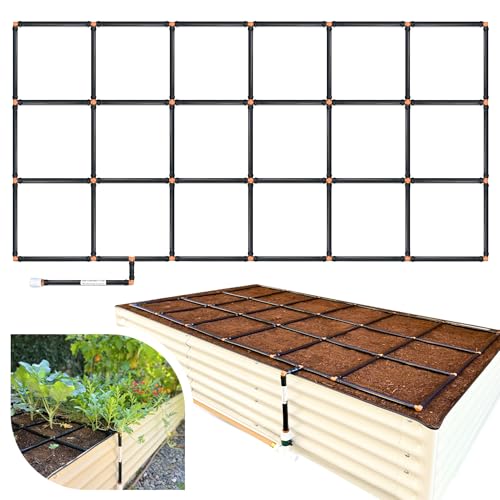
The Garden Grid flips the traditional drip irrigation model on its head by arriving fully pre-assembled for a standard 3×6 foot raised bed. It delivers 16 gentle streams of water per square foot at soil level, which means no dry spots and no wet foliage — a huge advantage for preventing fungal disease in dense plantings like tomatoes, peppers, and leafy greens.
Made from UV-resistant polypropylene and built in the US, the grid system eliminates the most frustrating parts of drip irrigation: tangling tubes, clogging emitters, and uneven watering. Owners report original units from 2013 still functioning, which puts its longevity far ahead of standard soaker hoses that often degrade after a single season. A built-in fine-mesh filter keeps debris out of the stream paths.
The catch is that this is sized specifically for a 3×6 raised bed, and while it fits 4×4 beds with some overhang, it won’t adapt well to irregular or in-ground gardens. You also need to pair it with a hose timer for fully automatic operation. For anyone with a standard raised bed, this is the most time-efficient and reliable watering solution available.
What works
- Pre-assembled and ready in minutes with no tools required
- 16 streams per square foot ensure every plant gets even hydration
- UV-resistant materials last years longer than soaker hoses
What doesn’t
- Only fits standard 3×6 raised beds — limited for irregular shapes
- Premium price point compared to DIY drip kits
3. Rain Bird LNDDRIPKIT

Rain Bird’s LNDDRIPKIT is a 108-piece system that includes three different watering device types — drippers, micro-bubblers, and micro-sprays — so you can tailor the delivery method to each plant. The pressure-compensating technology ensures that every emitter, regardless of its distance from the faucet, receives the same flow rate, which is critical when running a 50-foot main line across a garden bed with varied plant types.
Installation follows a straightforward three-step process: connect the 50-foot main hose to your faucet, insert fittings into the hose, and attach the watering devices. The system covers an average-size landscape garden and saves up to 80% of water compared to hand watering. Owners praise its durability through freezing winters — as long as you check for leaks in spring — and the fact that extra parts are widely available to expand the system later.
The downsides are that instructions are somewhat sparse and the included puncture tool works slowly. A few verified buyers reported receiving one or two non-functioning emitters out of the box, though the overall value remains strong. It is an excellent starter kit for anyone who wants professional-grade flow control without a steep learning curve.
What works
- Pressure-compensating emitters deliver uniform water across long runs
- Mix of drippers, bubblers, and sprays covers diverse plant needs
- Saves up to 80% of water versus manual watering
What doesn’t
- Instruction manual is light on detail for first-time users
- A small percentage of emitters may arrive clogged or faulty
4. Bonviee 247FT Drip Irrigation System
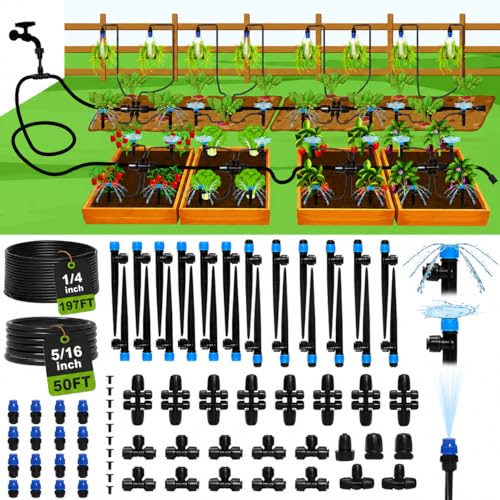
The Bonviee 247FT kit offers the most tubing of any system in this roundup, with 50 feet of 5/16-inch mainline and 197 feet of 1/4-inch distribution tubing — enough to cover up to 160 square feet of garden space. The quick-connect fittings require no tools and create a leak-free seal that beginners and experienced gardeners alike appreciate for its speed of assembly.
It includes 12 vortex sprayers, 12 stream drippers, and 8 mist nozzles, each individually adjustable, so you can switch from direct root watering for tomatoes to overhead misting for seedlings without buying extra parts. Owners consistently report setup in 30 minutes or less for multiple beds, and the system works on standard household water pressure without needing a separate pressure regulator.
The main limitation is that some users noted the vortex sprayers lose spread at lower water pressures, so a strong flow is required for full coverage. The kit also does not include a timer, which means you need to purchase one separately for automation. For the amount of tubing and variety of emitters included, this represents the best coverage-per-dollar in the category.
What works
- 247 feet of total tubing covers up to 160 sq ft of garden space
- Quick-connect fittings need no tools and resist leaks
- Three emitter types with adjustable flow for different plants
What doesn’t
- Vortex sprayers perform poorly at low water pressure
- No timer included for automatic scheduling
5. RAINPOINT Sprinkler Timer with Brass Inlet & Outlet

This RAINPOINT hose timer takes the durability factor seriously with both a brass inlet and brass outlet rated up to 116 PSI, plus built-in metal filter gaskets that trap sediment before it reaches your irrigation system. The heavy-duty UV-resistant housing is built to withstand full-sun exposure across multiple seasons, and the large LCD screen makes programming intuitive with a clear text dial.
You can set watering duration from 1 minute up to 3 hours 59 minutes, with frequency options ranging from every hour to every 7 days. The rain-delay mode pauses your schedule for 24, 48, or 72 hours and automatically resumes, while the manual watering mode runs from 1 minute to 8 hours without interrupting your programmed schedule. Owners consistently report batteries lasting 2 months or more with normal use.
The unit lacks Bluetooth or WiFi connectivity, so all programming is done directly on the device. Some users noted the LCD screen can become hard to read in direct sunlight, though this may be a power-saving feature. For anyone who wants a no-nonsense, mechanical-leaning digital timer with premium fittings, this is the most reliable choice in the mid-range.
What works
- Brass inlet and outlet resist corrosion and handle high water pressure
- Large LCD display with clear programming dial is easy to navigate
- Rain-delay feature pauses and resumes automatically
What doesn’t
- No smart connectivity for remote control or weather integration
- LCD screen can be difficult to read under direct sunlight
6. Orbit 62067 1-Outlet Programmable Digital Timer, 2-Pack
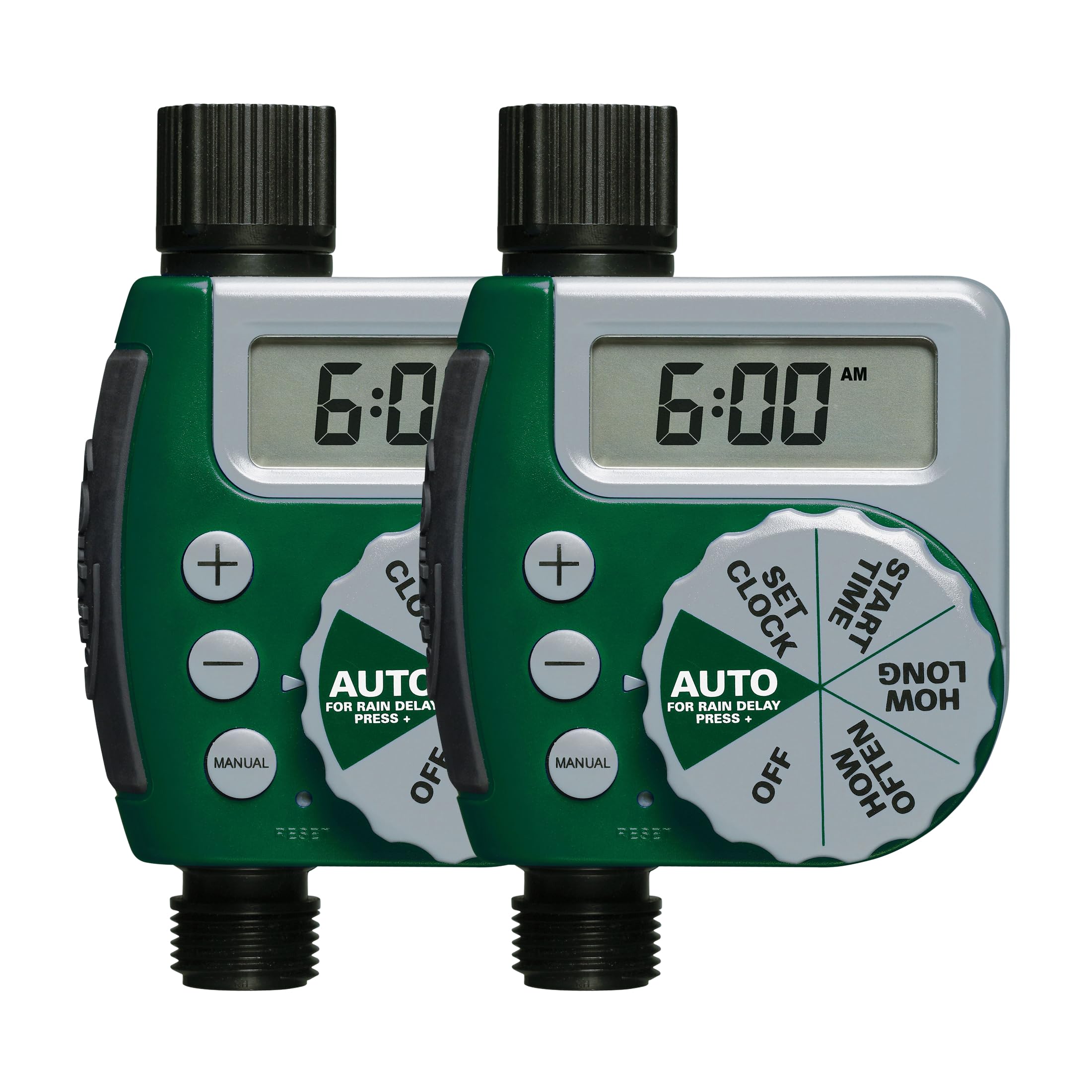
The Orbit 62067 two-pack gives you two single-outlet timers at a price that beats buying them separately, making it an economical way to automate two separate watering zones or to keep a backup unit on hand. Each timer runs on two AA batteries and can hold its programming during battery changes, a feature that saves you the frustration of resetting schedules after every swap.
The large LCD screen displays the current program in just a few steps, and the built-in rain-delay function pauses watering for 24, 48, or 72 hours without losing the underlying schedule. Owners report battery life of roughly two years per set, and the units survive intense heat during Arizona summers as long as they are brought indoors during freezing weather. The 2-pack design is ideal for front-yard and backyard zones that need independent timers.
The tradeoff is that these units cannot be programmed for specific days of the week — they cycle daily — and their average lifespan is about 3 to 4 years before the attachment threads begin to leak. For a straightforward, no-app timer that gets the job done for two separate watering areas, this 2-pack delivers unbeatable value.
What works
- Two timers in one package for dual-zone or backup use
- Retains program during battery changes for hassle-free maintenance
- Large, easy-to-read LCD screen with simple programming steps
What doesn’t
- Cannot be programmed for specific days of the week
- Unit lifespan limited to 3–4 years before potential leaking issues
7. SMARTILIVING Drip Irrigation Terracotta Stakes

The SMARTILIVING terracotta stakes use a simple olla-style mechanism — a porous clay bulb buried in the soil slowly releases water as the surrounding earth dries out, creating a self-regulating system that keeps potted plants hydrated for up to four weeks. Each bulb holds 12 ounces of water and refills from the top through a cork opening, so you never need to dig up the stake to add more water.
The low-profile design allows you to hide most of the body in the soil, leaving only the cork top visible, and the terracotta material gives a natural look that blends into garden beds and container arrangements. Owners report that their outdoor plants look noticeably healthier after switching from standard glass globes to these clay stakes, and the large reservoir reduces refill frequency significantly compared to smaller water bulbs.
The primary concern is fragility — multiple verified buyers reported receiving units with cracks along the side, and the stems can break if the soil is compacted or during insertion. The system also works best for individual containers rather than spreading across a large bed, and the actual water delivery time depends heavily on soil type, sun exposure, and plant species. For targeted hydration of prized potted plants during a vacation week, these stakes are effective but require gentle handling.
What works
- Terracotta natural release mechanism waters plants as the soil dries
- Large 12-ounce reservoir can last up to 4 weeks for some plants
- Low-profile design hides most of the bulb in the soil
What doesn’t
- Terracotta is fragile and prone to cracking during shipping or insertion
- Water delivery speed varies significantly with soil and climate conditions
Hardware & Specs Guide
Brass vs. Plastic Fittings
The material used for the inlet and outlet threads on a hose timer determines how long the unit can withstand outdoor water pressure. Brass fittings tolerate up to 116 PSI without cracking or corroding, while plastic fittings are more prone to stripping and leaking after repeated connection cycles. If you plan to leave your timer connected year-round, brass is the clear long-term choice.
Drip Emitter Type
There are three common emitter designs in outdoor irrigation kits: vortex sprayers produce a fan pattern for ground-level coverage, stream drippers deliver a gentle stream for targeted root watering, and mist nozzles create a fine fog for seed trays or humidity-loving plants. Kits that include multiple adjustable emitter types give you the flexibility to adapt each watering station to the specific crop without buying additional parts.
Pressure-Compensating Technology
Pressure-compensating (PC) emitters maintain a consistent flow rate regardless of variations in water pressure along the hose line. In a system with a 50-foot main hose, the farthest emitter would otherwise output less water than the nearest one. PC emitters eliminate this disparity, ensuring every plant receives the same volume of water, which is critical for uniform growth in vegetable beds and landscaping.
Rain-Delay and Weather Integration
A rain-delay feature temporarily pauses your watering schedule for a set number of hours (usually 24 to 72) before resuming automatically. Smart timers take this further by connecting to Weather Underground or other forecast services, automatically skipping watering cycles when rain is predicted. This prevents overwatering and reduces water bills without requiring you to monitor the weather forecast each day.
FAQ
What is the maximum water pressure my timer’s brass inlet can handle?
Can I use a single timer to water both my vegetable bed and my lawn sprinklers?
How do I winterize a drip irrigation system to prevent freeze damage?
How long do batteries last in an outdoor watering timer?
Final Thoughts: The Verdict
For most gardeners looking to upgrade their irrigation, the automatic plant watering system outdoor winner is the RainPoint WiFi Water Timer because it combines dual-zone brass construction with smart weather integration and an intuitive app. If you want a pre-assembled solution with zero setup frustration for a raised bed, grab the Garden In Minutes 3×6 Grid. And for a straightforward, no-app timer that still feels premium, the RAINPOINT Sprinkler Timer with brass fittings offers the best balance of durability and simplicity.