
Specs are compiled from manufacturer listings and verified buyer reviews and can change over time — please confirm the key details on the product page before buying.
Raspberries hate wet feet but need steady moisture, so picking the right mulch is a tricky balance. A bad choice can smother your canes, invite pests, or drop weed seeds that turn your patch into constant work. You need a material that breathes, breaks down slowly, and keeps the soil cool through summer heat.
I’m Rikta — the founder and writer behind Lawn Gear Lab. This guide is built by comparing the manufacturers’ published specifications and the patterns across verified customer reviews, so you get each pick’s real strengths and trade-offs instead of marketing spin.
Whether you are laying down a fresh layer for new canes or refreshing an established bed, the right mulch for raspberries protects shallow roots, blocks weeds without chemicals, and slowly feeds the soil as it rots.
Quick Picks
- MODELLOR Premium Super Washed, Clean, Coco Chips [10 lb] — Best Overall
- Back to the Roots 100% Organic Mulch, 58 Quart (2 Cubic ft) — Top Performer
- Plantonix Organic Coco Chips for Plants (10lbs) — Best Balance
- Riare 10LBS Coco Chips Substrate for Plants — Best Texture
- HealthiStraw GardenStraw, 3 cu ft (20 lbs) — Cleanest Straw
- Blue Mountain Hay Organic Garden Straw (25 lb) — Bulk Organic Straw
- Premium Garden Straw (4 LBS) by Home and Country USA — Budget Straw
How To Choose The Best Mulch For Raspberries
Raspberry roots are shallow and hate temperature swings. You need a mulch that insulates without packing into a soggy mat. The main choice is between coconut husk chips (coco chips) and natural straw. Each behaves differently in a berry patch.
Water Retention vs Drainage
Raspberries need even moisture, especially when the fruit is growing. Coco chips can soak up to 10 times their weight in water. That means they hold a reservoir near the roots and release it slowly. Straw lets water pass through easily but also lets more evaporation happen from the soil surface.
Seed Contamination Risk
Straw mulches vary a lot in how many weed or grain seeds they carry. Some batches are clean. Others drop unwanted grass sprouts that fight your canes for food and water. Coconut husk chips, a leftover from the coconut industry, carry almost no viable seeds (seeds that can grow).
Longevity and Soil Feeding
Coconut chips break down slowly. They often last a full growing season or more before you need to add more. Straw rots faster and adds carbon to the soil more quickly. That is good for compost but means you might need to reapply the layer mid-season.
Quick Comparison
| Model | Best For | Expanded Volume | Weight | Material Type | Amazon |
|---|---|---|---|---|---|
| MODELLOR Coco Chips | Large beds & heavy coverage | 18 Gallons | 11 Pounds | Coconut Husk Chips | Amazon |
| Back to the Roots Coco Mulch | Organic certified beds | 2 Cubic Feet | 10 Pounds | Coconut Husk Mulch | Amazon |
| Plantonix Organic Coco Chips | Balanced moisture & aeration | 15 Gallons | 10 Pounds | Coconut Husk Chips | Amazon |
| Riare Coco Chips | Entry-level coco mulch | 72 Quarts | 10 Pounds | Coconut Husk Chips | Amazon |
| HealthiStraw GardenStraw | Clean straw for seeding | 3 cu ft | 6.71 kg | Wheat Straw | Amazon |
| Blue Mountain Hay Organic Straw | Organic bulk straw coverage | — | 25 Pounds | Garden Straw | Amazon |
| Premium Garden Straw | Small compost or pet bedding | — | 5.54 Pounds | Straw | Amazon |
In‑Depth Reviews
1. MODELLOR Premium Super Washed, Clean, Coco Chips [10 lb]

A big-value coco chip block with 18 gallons of expanded volume.
You want strong coverage per block for large beds. The MODELLOR block hydrates to 18 gallons of loose chips, while the Plantonix option expands to 15 gallons. The chips are triple-washed and low in salt (salts that can harm soil). That means you won’t add excess minerals that could mess with soil pH around your berry roots.
Buyers report that “this block filled up my 50 gallon tanks and I still had a trash bag filled up of this.” The chunky pieces resist compaction. That is key for raspberries because the roots need air and loose soil to spread. At 11 pounds versus the Premium Garden Straw at 5.54 pounds, that weight comes from the dense compressed block, not from moisture.
One reviewer noted that the chunks can be smaller and dustier than expected. Not all pieces are uniformly large. If you want a medium that stays loose for several seasons without needing to top up, this is your best bet. But be ready to break the block apart with a metal tool, as described by another buyer.
Why it leads the list
- Expands to 18 gallons of chips from one compact block
- Triple-washed and low-salt means safer for sensitive roots
- Chunky texture resists compaction and improves airflow
One limitation to know
- Some chips are smaller and dustier than premium grades
- Dense block requires significant effort to break apart
Who this fits: Anyone with a medium-to-large raspberry patch who wants maximum coverage per dollar and a material that lasts all season.
Who should skip it: If you prefer a finer, more uniform texture for small raised beds, a gentler product may suit better.
2. Back to the Roots 100% Organic Mulch, 58 Quart (2 Cubic ft)
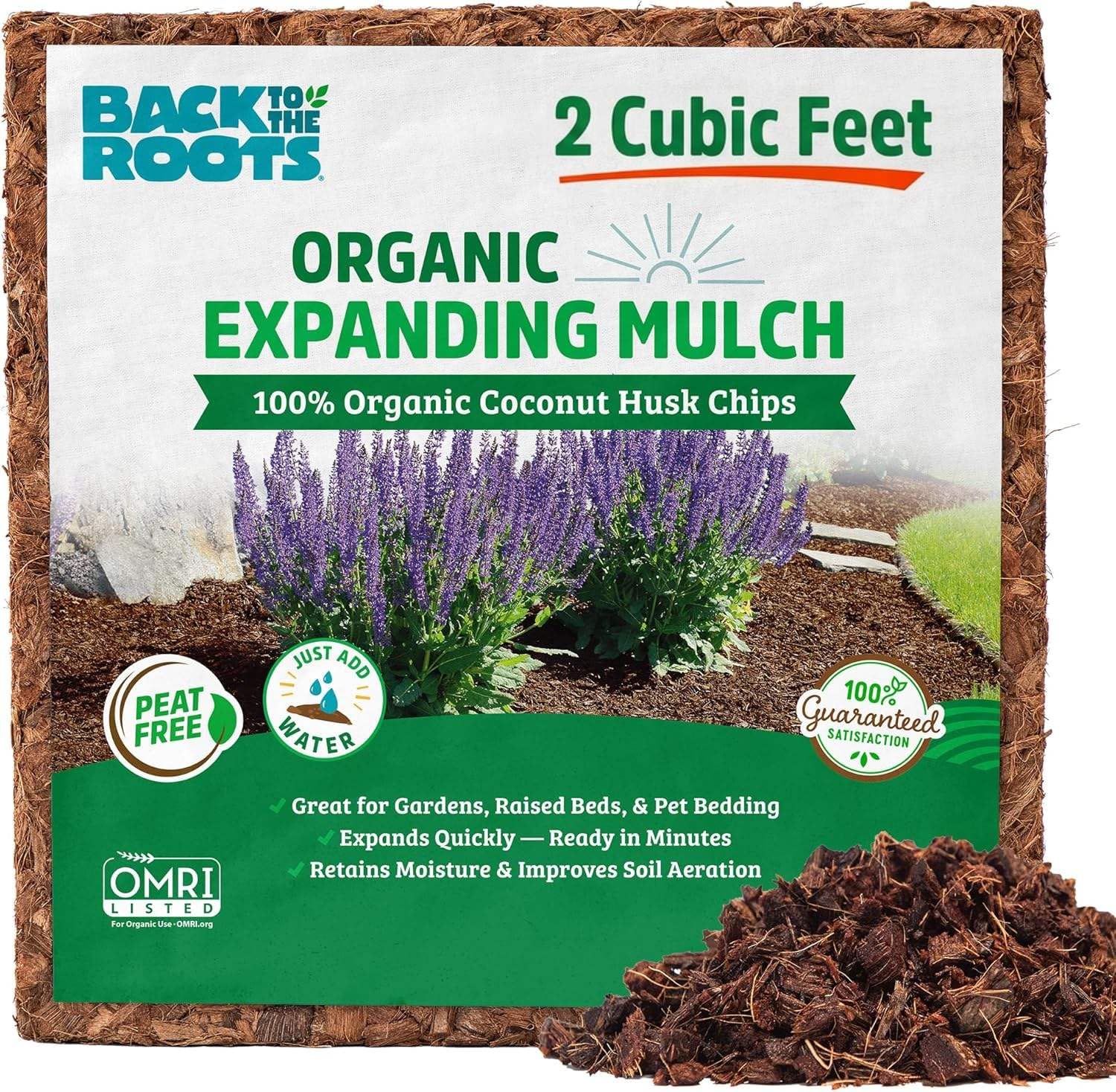
The certified organic pick that pairs expansion with a feel-good giving program.
Organic certification matters to you. This block from Back to the Roots is OMRI-listed (listed by the Organic Materials Review Institute, meaning it meets organic standards). That gives you confidence that no synthetic chemicals touch your berry plants. It expands to over 2 cubic feet, while the MODELLOR is listed at 18 gallons. But this one is specifically labeled as organic mulch, making it the clear choice for strict organic gardeners.
Reviewers consistently mention the dramatic expansion. One buyer mentioned it “fills wheelbarrow 3/4 and kiddie pool.” Another noted that “it expands hugely when soaked.” The chips are on the smaller side. Some gardeners prefer that for fitting into tight spaces between canes and around the base of the plants. The brand also runs a “GrowOneGiveOne” program: share a photo of your garden and they donate a Grow Kit to a classroom.
One trade-off: the smaller chip size means faster decomposition than the chunkier MODELLOR chips. If you want a mulch that breaks down into the soil more quickly to add organic matter, that is a benefit. But it also means you may need to reapply sooner than with large husk pieces.
Organic credentials
- OMRI listed for organic production and handling
- Expands to over 2 cubic feet from 10-pound block
- Nice earthy smell when hydrated, as per reviewers
What to expect
- Smaller chip pieces break down faster than large husk chunks
- Requires significant strength to carry the expanded bucket
Best for organic gardeners: If OMRI certification matters to you and you want a guilt-free buying experience, this is the pick.
Consider elsewhere if: You need exceptionally chunky chips that last multiple seasons without breaking down.
3. Plantonix Organic Coco Chips for Plants (10lbs)

The mid-range pick that nails moisture retention without turning your bed into a swamp.
Plantonix positions itself as a balanced choice between volume and performance. The chips are compressed into a brick that breaks apart cleanly when water is added. Reviewers report “the pieces are much bigger than the coco-coir” and that the brick “creates a lot less dust.”
What sets this product apart is the mention of high CEC (cation exchange capacity). That is a technical term for the material’s ability to hold nutrients and release them to roots. For raspberries, which are heavy feeders, that nutrient-holding ability means your fertilizer applications work better. The neutral pH also prevents nutrient lock-up (a condition where minerals become unavailable to plants), so nitrogen and potassium stay available.
One owner reported the importance of using buffered coco chips (pre-treated to balance calcium and magnesium): “if it’s not buffered you’re setting yourself up for some problems.” Plantonix’s chips are buffered. That means they have been pre-treated to balance calcium and magnesium levels, so you avoid nutrient absorption problems that unbuffered coir (raw coconut fiber) can cause. If you are replacing straw mid-season, this is a drop-in upgrade that causes less shock to your plants.
Smart features
- High CEC retains nutrients in the root zone
- Absorbs water for consistent moisture
- Buffered to prevent bacteria and nutrient lock-up
Room for improvement
- Only 15 gallons expanded, less than the top volume pick
- Some users wish the price per volume was lower
Reach for this if: Nutrient management is your priority—the CEC and buffering make this a smart choice for feeding your raspberries.
Look elsewhere if: You have a very large area to cover and want the absolute most volume per block.
4. Riare 10LBS Coco Chips Substrate for Plants

The budget-entry that punches above its weight with coarse, easy-to-handle chunks.
Riare’s 10-pound block expands to 72 quarts, which is roughly 18 gallons. The MODELLOR is also listed at 18 gallons. Riare’s chips are described by a reviewer as “thick, coarse chunks ideal for chunky soil mix.” That texture makes them especially good for aerating compacted soil, a common issue in established raspberry patches where the ground has been walked on during harvest.
One customer observed that it is “the best mulch ever! It looks good and breaks down very slowly, so you don’t need to replace it often.” That slow breakdown is exactly what you want in a raspberry bed: you lay it once in spring and it protects the roots through summer heat and into fall. The low EC (low electrical conductivity, meaning low salt content) and pH-balanced formulation also mean you are not adding hidden salts that could build up and harm the plants.
The main complaint is that the price feels a bit high for the quantity. One long-time coir user with 30 years of experience said, “I wish it was cheaper.” Another echoed that it is “perceived as overpriced.” If you are covering a very large bed, you may find more volume-per-dollar from the MODELLOR. For small to medium beds and urban gardens where every dollar counts less than ease of use, this is a strong contender.
Texture advantage
- Thick, coarse chunks improve aeration in compacted soil
- Breaks down very slowly, reducing reapplication frequency
- Low EC and pH balanced for sensitive roots
Value concern
- Several owners mention the price feels high for the volume
- Heavy package despite being lightweight when expanded
Ideal for small beds: If you want a thick, long-lasting layer that improves soil texture and you have a modest area to cover, this works great.
Not the best value: For large patches, you get more volume per dollar from other options.
5. HealthiStraw GardenStraw, 3 cu ft (20 lbs)
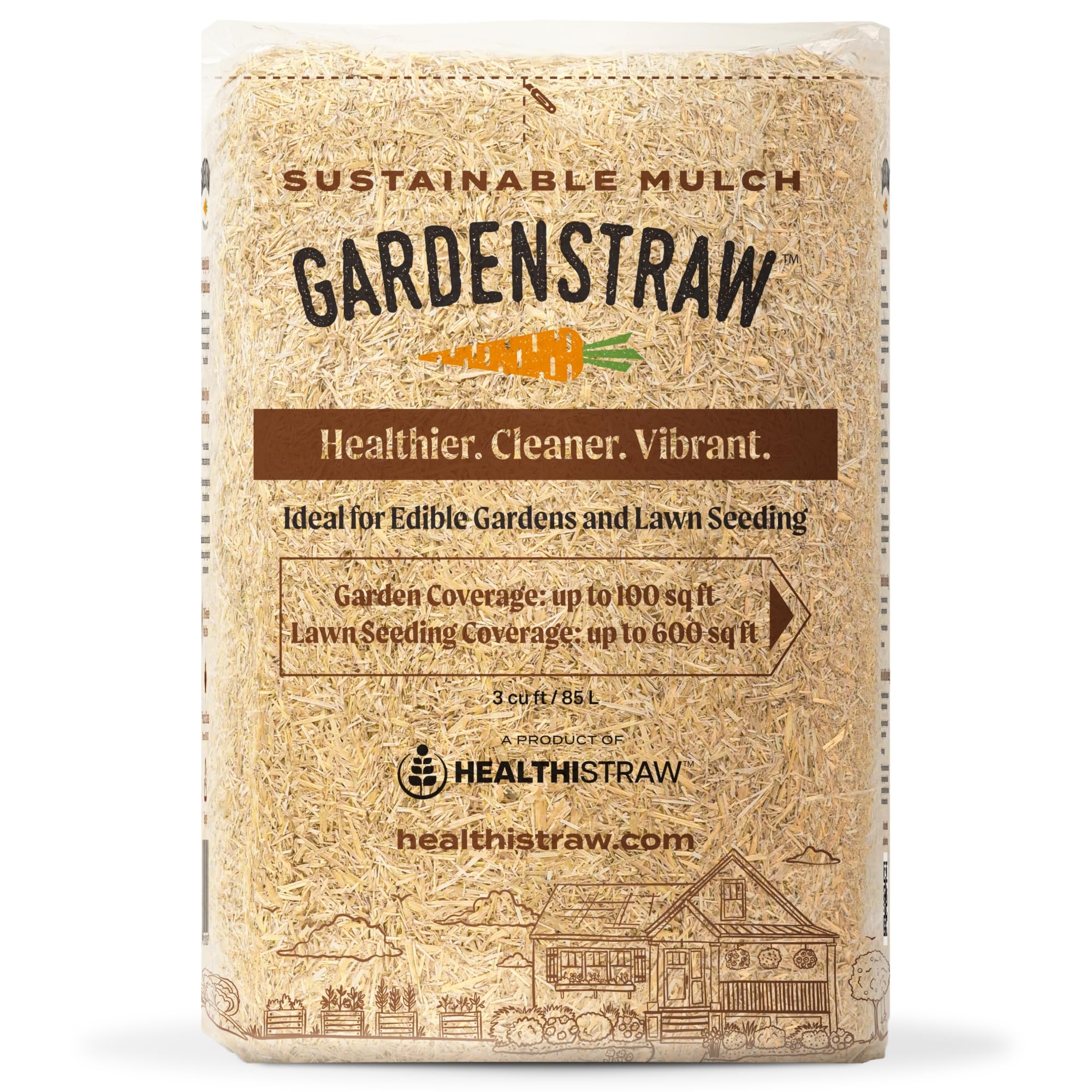
The premium straw that finally solved the seed problem for many gardeners.
You love the look and feel of straw but hate weeding sprouts. HealthiStraw is a strong option for raspberries. The manufacturer says the 100% non-GMO wheat straw is “naturally filtered to remove dust, dirt, and as many seeds as possible.” Reviewers largely agree. One noted that “I’ve had no wheat seeds germinate.” Another said they “haven’t noticed any weed seeds in the package.” By contrast, a buyer of the Premium Garden Straw below said they “had to constantly be pulling up wheat sprouts.”
The 3 cu ft compressed bale covers up to 100 square feet at a 2-3 inch layer. That is plenty for a standard home raspberry patch. The straw fibers interlock when watered, staying put in wind and rain without chemical binders. That matters for raspberries because the light soil around the canes does not anchor loose straw well.
The catch is the price. At 6.71 kg, it is light, but the cost is significantly higher than a bale of straw from a garden center. One reviewer admitted it is “a bit costly” but added that avoiding the mess of “starting the wood chipper, shredding a bale, and cleaning up” makes it money well spent. Another buyer noted that there are “quite a few grass seeds,” so it is not 100% sterile, but the overall seed load is much lower than standard straw.
Why it stands out
- Naturally filtered to remove most weed and wheat seeds
- Covers up to 100 sq ft at a 2-3 inch layer
- Interlocking fibers resist wind and rain without chemicals
Know before you buy
- Costs more per bale than traditional garden center straw
- Some grass seeds still present, per a reviewer
Best for straw purists: If you love the natural look and feel of straw and cannot tolerate weeding sprouts, this is your safest bet.
skip it if: You are on a tight budget or need to cover a very large area where the volume per dollar ratio matters most.
6. Blue Mountain Hay Organic Garden Straw (25 lb)
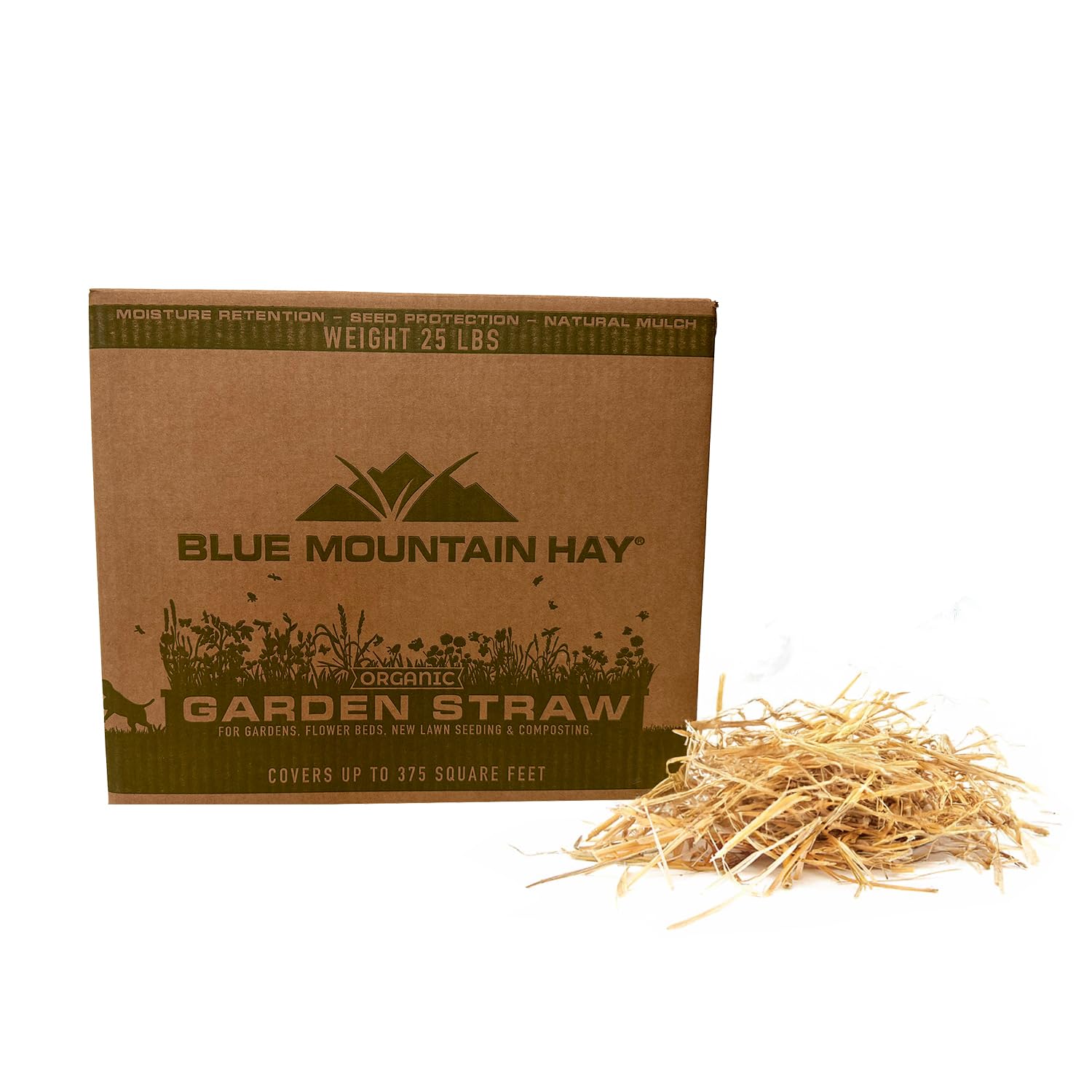
The heavy bale for committed organic growers who buy by the pound.
At 25 pounds, this is the heaviest product in the lineup. You get a large volume of organic garden straw in a single box. The manufacturer says it is “naturally dried and minimally processed.” Reviewers appreciate how clean and soft it is. One noted it is “very clean, soft, no dirt or bugs.” For a raspberry grower, that cleanliness means you are not introducing weed seeds or soil-borne pathogens (disease-causing organisms) into the bed.
The straw comes in sheaves (bundles) that are easy to separate and spread around the base of canes. It is designed to retain moisture and regulate soil temperature. That is exactly what raspberries need during the hot summer months when the soil surface can heat up quickly. However, one reviewer had a bad experience: “straw introduced grass shoots into all raised beds, ruining vegetables and strawberries. Looks like winter wheat.” That reviewer gave 1 star. There is a real seed contamination risk with this product, similar to the Premium Garden Straw but with an organic label.
Another buyer noted that the box covers about 100 square feet at 1 inch depth, not the 300 square feet claimed. If you are planning to apply a thick 2-3 inch layer around raspberries, you will need multiple boxes. It is best suited for smaller organic gardens where the premium price is justified by the organic certification and the convenience of pre-boxed straw.
What works
- Heavy 25-pound box gives substantial coverage area
- Organic certification for strict chemical-free growing
- Clean and soft with minimal dirt or debris
What to watch
- Customer reports of grass seeds germinating in beds
- May require 2-3 boxes for a proper thick mulch layer
For dedicated organic growers: If organic certification is non-negotiable and you have a small to medium raspberry patch, this is a clean, convenient option.
Proceed with caution: History of seed issues means you should inspect the straw carefully before applying around new canes.
7. Premium Garden Straw (4 LBS) by Home and Country USA

The lightest straw option, but be ready for unwanted sprouts.
At 5.54 pounds, this is the lightest product by weight. It is also the cheapest entry point into straw mulching. Some buyers found it clean and dust-free, using it for animal bedding and compost piles. For raspberries, the light weight means you can spread it easily by hand without heavy lifting. The straw is described as “the straw-iest ever” by a satisfied customer who was happy with the quality.
The critical flaw is seed contamination. One reviewer warned that “due to a very large quantity of wheat seeds, it was necessary to constantly be pulling up wheat sprouts.” They strongly advised avoiding it for vegetable gardens unless you enjoy weeding. Another reviewer gave it 5 stars for use with outdoor cats. So the product has legitimate uses, just not for raspberry beds where competition from wheat sprouts would be a constant battle.
If you are looking to use this as a mulch layer under established raspberry canes, the risk of introducing viable wheat seeds is simply too high to recommend. The straw may work fine in a compost pile or as a winter cover for dormant beds. But for active growing season use, the coco chip options above are far safer.
Where it works
- Very light at 5.54 pounds, easy to handle and spread
- Clean and dust-free for non-garden uses
- Affordable entry point for straw users
Not for raspberries
- High wheat seed content causes constant weeding
- Not recommended for vegetable or berry gardens
Fine for compost or pet bedding: If you need clean straw for animal use or compost layering, this is a decent budget buy.
Avoid for your berry patch: The seed problem makes it a poor choice for raspberries—stick with coco chips or the HealthiStraw above.
Understanding the Specs
Expanded Volume
The most practical number on the package: once you add water to a compressed coco chip block, it expands to a certain volume. More expanded volume means more ground coverage from the same-sized brick. For raspberries, you need a layer 2-3 inches deep, so look for at least 15 gallons or 2 cubic feet per block to avoid buying multiple boxes for a standard 4×8 foot bed.
CEC (Cation Exchange Capacity)
This is the material’s ability to hold onto nutrients like potassium and magnesium and release them to plant roots. A higher CEC means your fertilizer stays in the root zone rather than washing away with watering. Coco chips naturally have a high CEC, which is a hidden advantage over straw for heavy-feeding raspberries.
FAQ
Will coco chips lower the pH of my raspberry bed?
How thick should I layer mulch around raspberry canes?
Can I use regular straw from a farm supply store instead of these products?
How long does coco chip mulch last before it needs replacing?
Will coco chips attract ants or termites to my garden?
Do I need to soak coco chip blocks before applying them to the garden?
What happens if I use unbuffered coco chips?
Can I mix coco chips with compost or soil before applying?
Final Thoughts: The Verdict
Across the board, the mulch for raspberries winner is the MODELLOR Premium Super Washed Coco Chips because it delivers the most expanded volume at 18 gallons per block, has triple-washed low-salt chips that are safe for sensitive roots, and the chunky texture keeps the soil aerated through the growing season. If you want OMRI-certified organic material, grab the Back to the Roots Organic Mulch. And for a clean straw option that actually suppresses weed seeds, the standout is the HealthiStraw GardenStraw.
How We Picked
We do not accept paid placement. Every pick is matched to a real buyer and a real use-case; we do not hands-on test units.
Sources & Methodology
Specifications: manufacturer listings and product documentation. Review insights: verified customer reviews, as of July 2026. Pricing: not shown on this page (it changes often); check the current price via the retailer link.
As an Amazon Associate, Lawn Gear Lab earns from qualifying purchases. This does not affect which products we feature.