
Specs are compiled from manufacturer listings and verified buyer reviews and can change over time — please confirm the key details on the product page before buying.
If a squirrel treats your blueberry bushes like its personal buffet, standard bird netting with a wide weave is basically an invitation. The real trick is a mesh opening that is 1/2 inch (about 1.27 cm) across — small enough to block squirrels (they need about a 3/4 inch gap to squeeze through), but big enough to let sunlight and rain reach your plants. This guide picks seven netting options with that exact spec, so you can stop losing your harvest and start eating it yourself.
I’m Rikta, the writer behind Lawn Gear Lab. This guide uses each manufacturer’s published specs and verified customer reviews to show you real strengths and trade-offs, not marketing claims.
Most netting sold as “squirrel-proof” uses mesh that is too wide. Every pick here has a 1/2 inch mesh, which is the verified size that keeps squirrels out. Read on to find your bird netting for squirrels that fits your garden size and budget.
Quick Picks
- 7.5x65ft Bird Netting, 1/2 inch Mesh (POYEE) — Top Performer
- Bird Netting for Garden 15×40 Ft (xihakey) — Big Coverage
- Bird Netting 25×25 Ft, 1/2In Mesh (JUNKOGO) — Best All-Rounder
- Bird Netting for Garden 10×30 Ft (xihakey) — Easy Install
- ATICCA Heavy Duty Bird Netting 13×40 Ft — Nylon Choice
- ATICCA Heavy Duty Bird Netting 7.5×100 Ft — Long Row
- Bird Netting for Garden 7.5×100 Ft (xihakey) — Budget Long Roll
How To Choose The Best Bird Netting For Squirrels
Picking the right netting depends on one non-negotiable spec and a few quality details that decide whether it lasts one season or several. Here is what to look for.
1/2 Inch Mesh — The Only Mesh That Blocks Squirrels
Squirrels are clever and flexible. A 1 inch gap is easy for them to squeeze through. The 1/2 inch mesh is the standard size proven to exclude them while still allowing pollinators and light through. If the product does not state 1/2 inch mesh (or smaller), it is not right for this job.
Fabric Weight (g/m²) — The Real Durability Measure
Light netting around 6-10g/m² (that is 0.18-0.30 ounces per square yard) is cheap but often tears after a season or two. Heavier netting at 28-30g/m² (0.82-0.88 ounces per square yard) is much more tear-resistant and can handle wind, hail, and the occasional raccoon leaning on it. Look for a fabric weight spec; if it is missing, assume it is lightweight.
Material: HDPE vs Nylon
High-Density Polyethylene (HDPE — a stiff, weather-resistant plastic) is the most common material. It is UV-resistant, rot-proof, and generally the best balance of strength and flexibility. Nylon netting is also strong but can absorb water over time and may sag. Both work, but HDPE tends to hold up better in wet climates.
Quick Comparison
| Model | Best For | Dimensions | Fabric Weight | Material | Amazon |
|---|---|---|---|---|---|
| 7.5x65ft POYEE | Strongest HDPE build | 780″L x 84″W | 30g/m² | HDPE | Amazon |
| 15×40 Ft xihakey | Large coverage need | 180″L x 480″W | 28g/m² | HDPE | Amazon |
| JUNKOGO 25×25 Ft | Versatile mid-size plot | 300″L x 300″W | — | HDPE | Amazon |
| xihakey 10×30 Ft | Small beds & pens | 120″L x 360″W | 28g/m² | HDPE | Amazon |
| ATICCA 13×40 Ft | Nylon flexibility | 156″L x 480″W | — | Nylon | Amazon |
| ATICCA 7.5×100 Ft | Long row coverage | 90″L x 1200″W | — | Nylon | Amazon |
| xihakey 7.5×100 Ft | Budget large roll | 90″L x 1200″W | 28g/m² | HDPE | Amazon |
In‑Depth Reviews
1. 7.5x65ft Bird Netting, 1/2 inch Mesh (POYEE)
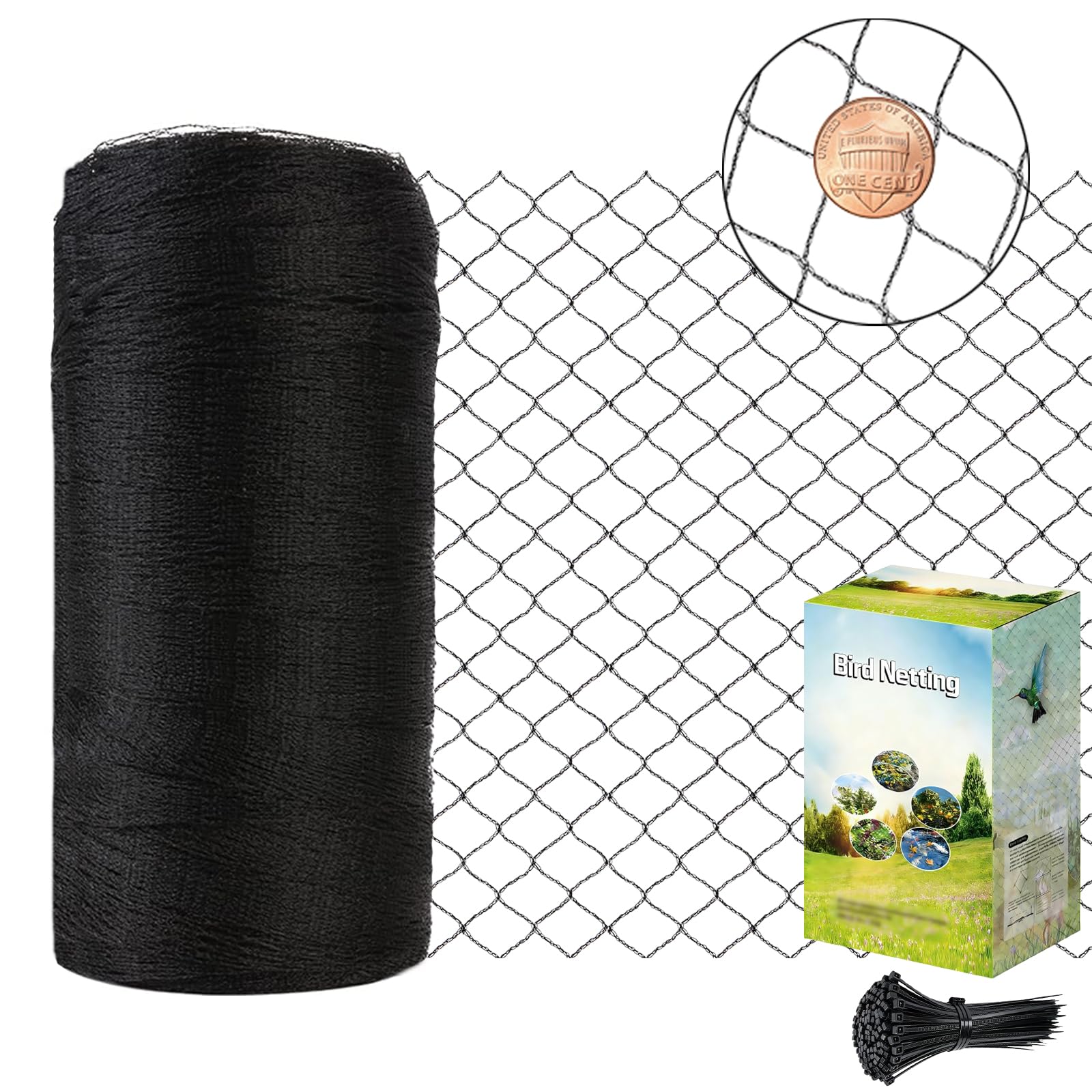
This netting has a 30g/m² fabric weight versus the xihakey 28g/m² options, so it resists tearing better when a squirrel tests a weak spot or a hailstorm hits.
The defining spec on this roll is the 30g/m² fabric weight versus the 28g/m² xihakey options, and a lot more durable than the flimsy 6-9g/m² nets you find at big-box stores. That extra material density makes it noticeably more resistant to tearing, so you can leave it up through a hailstorm and it will hold. It is made from HDPE (High-Density Polyethylene) with UV resistance built in, meaning it can sit outside through a whole growing season and come back for the next one.
Buyers report it works great as a chicken run cover — one user draped it over a PVC arched dome, secured it with zip ties, and says it survived two winters without damage. Unlike the ATICCA nylon options that owners mention “tangle with EVERYTHING,” the POYEE rolls out smoothly and can be cut with scissors. The trade-off is the dimensions: at 7.5x65ft (780″L x 84″W), it is a long but narrow strip — perfect for a row of fruit trees, not ideal for a square garden. Some customers noted the holes run slightly larger than expected, but still found the mesh adequate for stopping squirrels and birds.
Small mesh, large coverage
- Heaviest fabric weight on this list at 30g/m² — resists tears and UV much better than lightweight nets
- Buyers confirm it handles two winters of continuous outdoor use without degrading
- Tangle-free rollout design saves setup frustration compared to nylon options
Thin material
- 7.5ft width is narrow — you may need multiple strips to cover a wide square garden
- A few customers note the mesh holes run a touch larger than a tight 1/2 inch
Reach for this if: you want the single most durable net here and have a long narrow garden bed or tree row to protect.
Look elsewhere if: you need to cover a wide square plot — the narrow 7.5ft width means extra seams.
2. Bird Netting for Garden 15×40 Ft (xihakey)

At 15×40 ft, this gives you 600 square feet of coverage in one single piece — no need to seam together multiple strips like with the POYEE 7.5x65ft.
For a square or rectangular garden, this is the best shape match among the xihakey family. At 15×40 ft, it gives you 600 square feet of coverage without needing to seam multiple strips together — a huge convenience if you are protecting a large raised bed setup or a patch of berry bushes. The 28g/m² HDPE mesh is the same solid build as the smaller xihakey rolls but with much more square footage per roll.
Reviewers point out the netting is “strong” and one reported it survived a hailstorm without tearing, which is a solid real-world test of the 28g/m² fabric. Unlike the POYEE narrow strip, this one is wide enough to drape over a square fruit cage or lay flat over a large strawberry patch. On the downside, it shares the same product images and review pool as the 10×30 ft version, so some reviews may reference the smaller roll — check the ASIN (B0DWSVY38T) to ensure you are looking at the right one.
Generous garden size
- 15×40 ft is the largest square-footage option here — covers big patches in one piece
- 28g/m² fabric weight handles hail and wind well, per buyer reports
- UV-resistant HDPE designed to last multiple growing seasons
Less durable
- Fabric weight is slightly lighter than the POYEE 30g/m² option
- Product page shares reviews with other sizes, which can be confusing
Best for: large garden beds or fruit-tree cages where you want one continuous sheet of netting.
skip it if: you are covering a narrow trellis — the 15ft width will leave a lot of excess.
3. Bird Netting 25×25 Ft, 1/2In Mesh (JUNKOGO)

Shoppers say this net sets up in 20 minutes flat — no tangles, unlike the nylon ATICCA options that reviewers warn “tangle with EVERYTHING.”
At 25×25 ft (300″L x 300″W), this gives you 625 square feet of coverage versus 487.5 square feet for the POYEE 7.5x65ft. But the real story is how buyers describe it: “no tangles, easy install in 20 min vs hours for cheap hardware store net.” Several reviewers used it to cover blueberry bushes and 10×10 ft tomato cages, noting it is strong enough to stop opossums, raccoons, and rabbits. Unlike the ATICCA netting that reviewers warn tangles “with EVERYTHING,” this one rolls out flat and stays that way.
One reviewer noted chipmunks burrow under it but do not chew through it, which is a good sign for squirrel resistance — squirrels are notorious chewers, and HDPE holds up better than nylon against gnawing. The catch is that at 1.62 kilograms versus 1.29 kilograms for the 13×40 ft ATICCA, it is a bit bulkier to handle. The mesh is a diamond shape, which means stretching in different directions changes the width and length slightly — the manufacturer flags this as expected, not a defect.
Square shape, easy install
- True square shape (25×25 ft) minimizes waste for square gardens
- Buyers consistently praise the tangle-free, 20-minute installation
- Strong enough to stop raccoons and opossums, per user reports
Mesh may sag
- No explicit fabric weight listed — may be lighter than the 28-30g/m² options
- Diamond mesh changes dimensions when stretched; requires careful adjustment
Grab it if: you have a mid-size square garden and prioritize fast, frustration-free installation.
Not for you if: you want a stated fabric weight guarantee for heavy-duty long-term use.
4. Bird Netting for Garden 10×30 Ft (xihakey)
One buyer in their 70s installed this 10×30 ft netting solo without a single tangle — a claim the nylon ATICCA rolls cannot match.
This is the smallest and most manageable size in the xihakey lineup — 10×30 ft (120″L x 360″W). It covers 300 square feet versus 520 square feet for the ATICCA 13×40 ft option, but buyers report it punches above its size for durability. One reviewer wrote: “DOES NOT TANGLE! This is very good quality for the price. Lightweight but seems strong enough to cover a peacock pen.” Another noted, “Seems substantial when I put it up. Hope it keeps the squirrels out. 5 for now.”
The 28g/m² fabric weight is the same as the larger xihakey rolls, which means you are getting the same UV-resistant HDPE material in a more compact package. It weighs 1.62 kg — the same as the JUNKOGO 25×25 ft, so the density is comparable. The trade-off is that at 10×30 ft, this covers 300 square feet versus 600 square feet for the 15×40 ft version, so it is best for small raised beds, blueberry patches, or a single chicken run rather than a large orchard.
Compact garden fit
- Buyers call it the easiest-to-install netting here — no tangles even for solo seniors
- Same 28g/m² HDPE build as the larger xihakey rolls
- Small footprint makes it ideal for tight garden spaces
Same brand, smaller
- 10×30 ft may be too small for multiple raised beds or a large fruit tree
- Some owners mention it “seems substantial” but are still testing its squirrel resistance
Perfect for: small gardens, strawberry patches, or a peacock pen where easy handling matters most.
Consider a different size if: you are covering a whole orchard or large vegetable plot — this one runs out fast.
5. ATICCA Heavy Duty Bird Netting 13×40 Ft
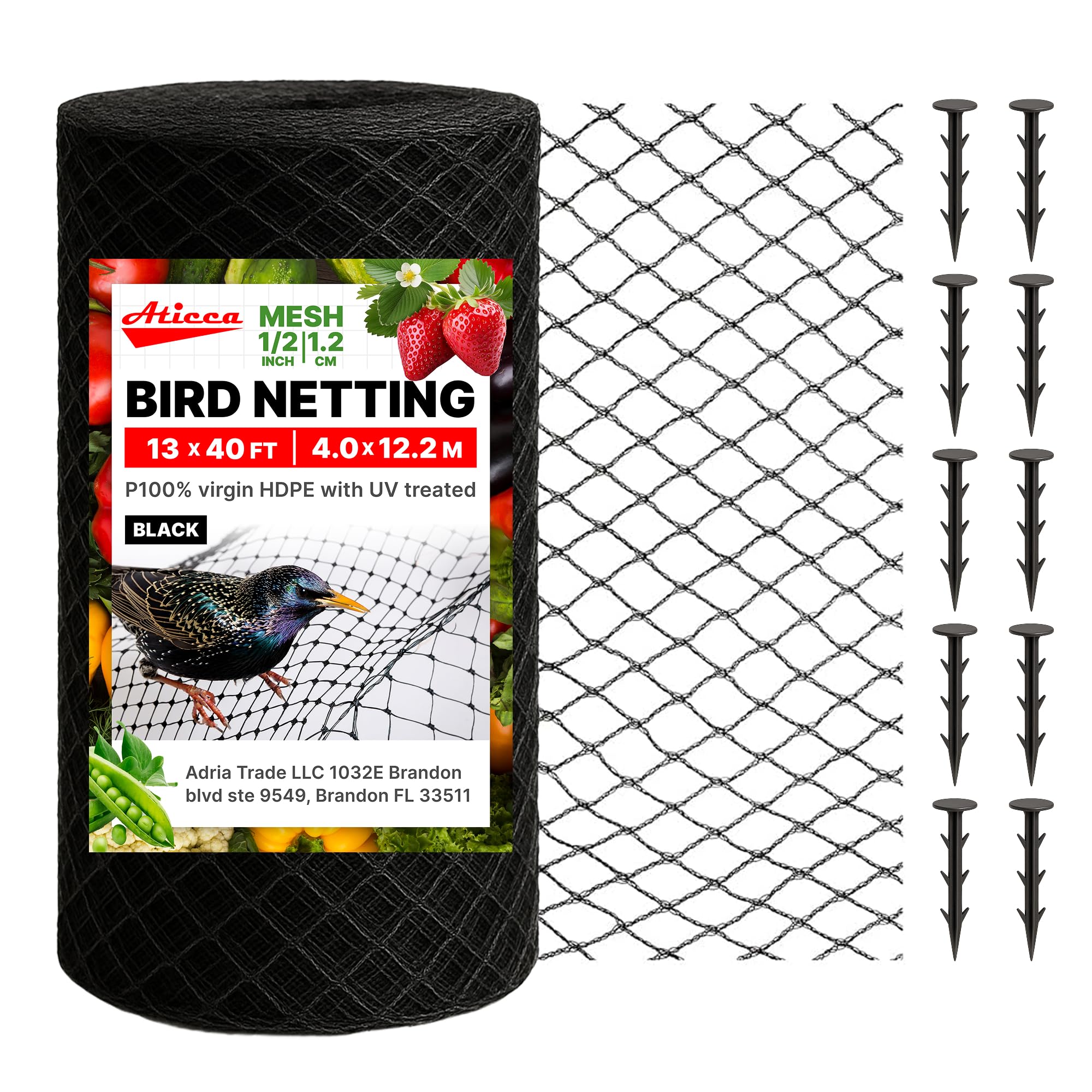
This is the only netting here that includes 10 plastic stakes — a convenience the HDPE options skip, but reviewers warn it tangles easily.
ATICCA takes a different material approach: nylon instead of HDPE. The nylon construction is UV-resistant and designed to withstand multiple seasons, and the package includes 10 durable plastic stakes — a convenience none of the other options offer. At 13×40 ft, it covers a generous area, and customers note it works well on fig trees and raised beds. One buyer mentioned it “solved the groundhog problem” on a 17-acre property, which suggests it is sturdy enough for serious wildlife pressure.
However, the nylon has a catch that buyers flag repeatedly: “it will tangle with EVERYTHING.” Multiple reviewers warn to handle it carefully during installation, which contrasts sharply with the xihakey (HDPE) options where “tangle-free” is the headline feature. At 1.29 kilograms versus 1.62 kilograms for the JUNKOGO 25×25 ft, it is lighter, but the nylon material means it may sag more when wet compared to HDPE. A buyer using it on fig trees confirmed it is “heavy duty” and easy to install — as long as you are patient with the tangling.
Heavy duty, long roll
- Comes with 10 plastic stakes for secure ground mounting — unique to this pick
- Nylon is UV-resistant and reviewers point out it handles tough groundhog pressure
- 13×40 ft is a solid mid-size that fits most gardens
Pricey
- Tangles easily during installation — buyers warn to handle with care
- Nylon can absorb water and sag in wet conditions vs HDPE alternatives
Choose this if: you want included stakes and a flexible nylon material that handles irregular shapes.
Pass if you: value tangle-free installation — the xihakey or POYEE options are much less frustrating to unroll.
6. ATICCA Heavy Duty Bird Netting 7.5×100 Ft
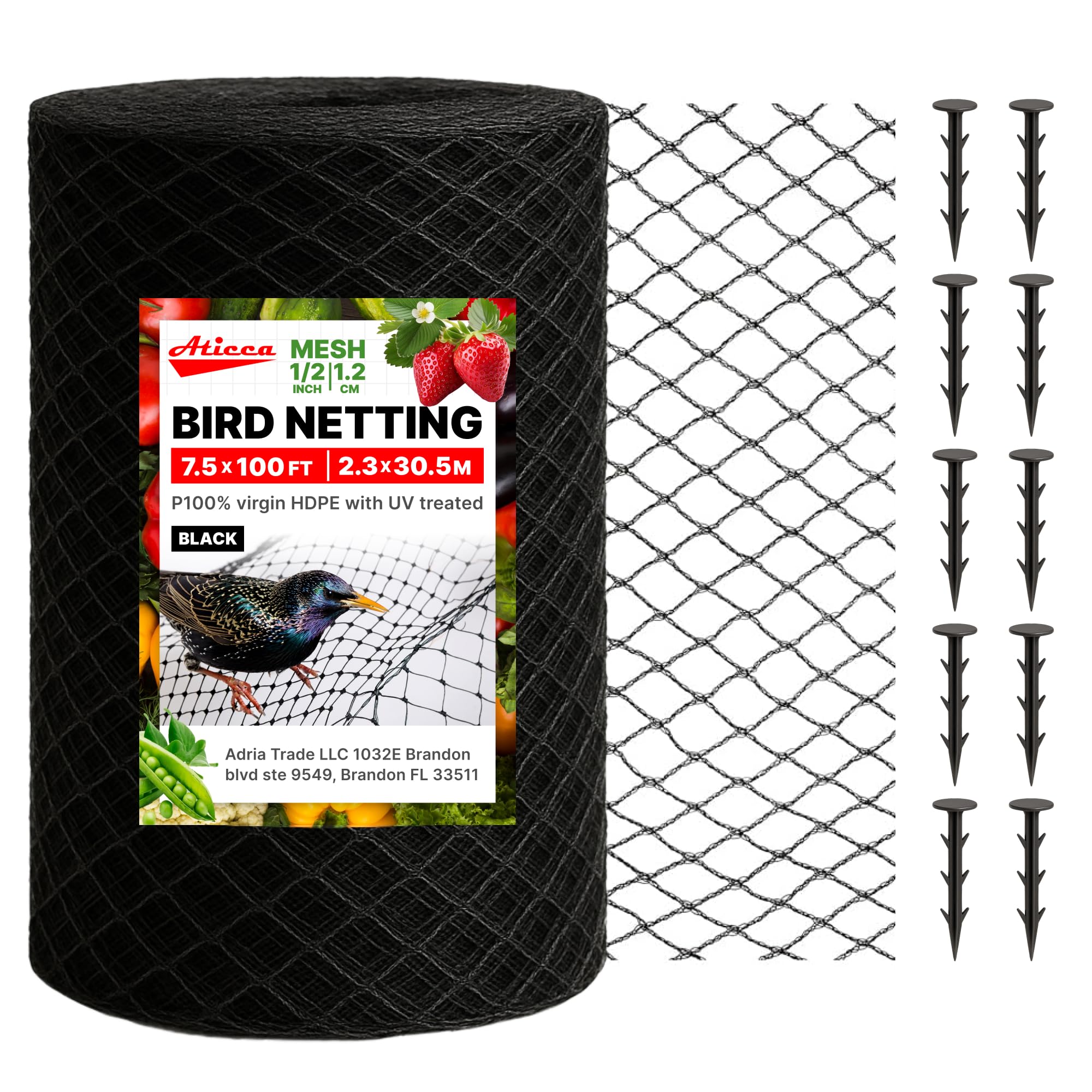
At 100 ft long, it covers long garden rows in one go — but at 1.98 kg, it is heavier than the HDPE equivalent and tangles just as much as the smaller ATICCA roll.
If you have a long garden row — say, a line of blueberry bushes or a long raised bed — this is the length you need. At 7.5×100 ft (90″L x 1200″W), it is 100 ft long versus 40 ft for the 13×40 ft ATICCA, giving you 750 square feet of coverage. It includes 10 plastic stakes just like the smaller ATICCA, so you can pin it down along a long perimeter without buying extra hardware. At 1.98 kilograms versus 1.29 kilograms for the 13×40 ft version, it is heavier simply because there is more material.
The same tangling warning applies here as to the other ATICCA nylon net — reviewers consistently mention it snags on itself. For a 100-foot roll, that could mean a longer setup time. On the plus side, one buyer used it on fig trees and called it “heavy duty, easy to install,” and another confirmed it kept groundhogs out of seedlings. The nylon is UV-resistant, so it should hold up for multiple seasons, though HDPE options like the xihakey 7.5×100 ft (Product 7) offer the same dimensions in a tangle-free material for a similar cost.
Extra long heavy duty
- 100 ft length covers long rows without needing to piece together multiple nets
- Includes 10 plastic stakes for quick ground anchoring
- Buyers confirm it withstands persistent groundhog and squirrel pressure
Overkill for small areas
- Tangle-prone nylon is a real challenge on a 100 ft roll — expect a slower setup
- Heavier than the HDPE equivalent at 1.98 kg, making it bulkier to carry
Ideal for: long garden rows or orchard lines where the included stakes save you a trip to the hardware store.
Think twice if: you hate untangling netting — the HDPE 7.5×100 ft option below is easier to handle.
7. Bird Netting for Garden 7.5×100 Ft (xihakey)
Same 100 ft length as the ATICCA, but made from 28g/m² HDPE instead of nylon — so you get tangle-free deployment without the sag when wet.
This is the HDPE alternative to the ATICCA 7.5×100 ft. Same dimensions (7.5×100 ft), but the material is 28g/m² HDPE instead of nylon — which means you get the UV resistance and rot-proof build of HDPE without the tangling headache that nylon buyers complain about. One xihakey user (commenting on the smaller 10×30 ft version) wrote: “DOES NOT TANGLE! This is very good quality for the price.” That same tangle-free property applies to this 100 ft roll, making it far less frustrating to deploy than its nylon equivalent.
At 28g/m², the fabric is only 2g/m² lighter than the top-tier POYEE (30g/m²), so you are getting very close to the same tear resistance. Buyers also mention it survived a hailstorm without damage and is “sturdy and easy to put up.” The only notable downside is that, unlike the ATICCA, this does not come with stakes — you will need to buy or scavenge your own. For a 100 ft run, that means picking up about 15-20 landscape staples or garden stakes separately.
Budget long roll
- HDPE material is tangle-free — drastically easier to deploy than nylon at 100 ft length
- 28g/m² fabric resists hail and tearing, per buyer reports
- Same large 100 ft coverage for less than the nylon equivalent
Thinner than heavy duty
- No stakes included — budget extra for ground anchors
- Narrow 7.5ft width may require multiple passes for wide square gardens
Go for it if: you need a long 100 ft roll but want the tangle-free, rot-proof advantage of HDPE over nylon.
Look elsewhere if: you want stakes included — the ATICCA nylon option comes with them despite the tangling trade-off.
Understanding the Specs
1/2 Inch Mesh
This is the critical size that stops squirrels. A squirrel can squeeze through anything larger than about 1/2 inch (about 1.27 cm). Smaller mesh sizes like 1/4 inch also work but can block pollinators and reduce airflow. The 1/2 inch strike zone keeps squirrels out while still letting bees, butterflies, sunlight, and rain through — so your plants keep growing normally under the net.
Fabric Weight (g/m²)
Measured in grams per square meter (g/m²), this tells you how dense and strong the netting material is. Light nets around 6-10g/m² (about 0.18-0.30 ounces per square yard) are cheap but tear easily. Mid-range nets at 28-30g/m² (0.82-0.88 ounces per square yard) resist tearing, handle wind and hail better, and last multiple seasons. Some sellers do not list this spec — that usually means it is a lightweight option.
HDPE vs Nylon
High-Density Polyethylene (HDPE) is a plastic that resists UV rays, does not absorb water, and does not rot. Nylon is also strong but tends to absorb moisture, which can cause it to sag over time. HDPE netting generally stays stiffer and holds its shape better in rainy climates. Both materials can work, but HDPE is usually the lower-maintenance choice for outdoor garden use.
UV Resistance
Garden netting sits in direct sun all day. UV resistance means the material has been treated to slow down the breakdown caused by sunlight. Without it, netting can become brittle and crack within one season. Look for “UV-resistant” or “UV-stabilized” in the specs; it is the difference between replacing netting every year versus every three or four years.
FAQ
Will a 1/2 inch mesh stop all squirrels?
Can squirrels chew through bird netting?
What is the difference between bird netting for squirrels and regular bird netting?
How long does HDPE bird netting last outdoors?
Can you cut bird netting to fit a specific garden bed?
Will the netting trap birds or small animals?
How do you install bird netting so squirrels cannot get under it?
Is heavy-duty bird netting safe for fruit trees?
What fabric weight should I look for in bird netting for squirrels?
Can I leave bird netting up all year round?
Final Thoughts: The Verdict
For most people, the best bird netting for squirrels is the POYEE 7.5x65ft because it has the heaviest fabric weight (30g/m²) for maximum tear resistance, it is tangle-free, and it is made from UV-resistant HDPE. If you need to cover a large square or rectangular patch, the xihakey 15×40 Ft gives you 600 square feet of the same solid 28g/m² HDPE material in one single piece. And if you want the easiest install on a small garden, the xihakey 10×30 Ft is the tangle-free winner buyers in their 70s installed solo.
How We Picked
We do not accept paid placement. Every pick is matched to a real buyer and a real use-case; we do not hands-on test units.
Sources & Methodology
Specifications: manufacturer listings and product documentation. Review insights: verified customer reviews, as of July 2026. Pricing: not shown on this page (it changes often); check the current price via the retailer link.
As an Amazon Associate, Lawn Gear Lab earns from qualifying purchases. This does not affect which products we feature.