
A dull mower blade doesn’t cut grass — it tears it, leaving behind frayed brown tips that invite disease and stress the entire lawn. The fix isn’t replacing blades every month; it’s owning a proper sharpening jig that restores the factory edge geometry and keeps your mower running at peak efficiency through the entire season.
I’m Rikta — the co-founder and writer behind Lawn Gear Lab. I’ve spent countless hours analyzing sharpening mechanisms, comparing angle-lock precision, studying blade steel wear patterns, and cross-referencing owner feedback to separate the reliable jigs from the one-use frustrations in this guide.
For any homeowner who wants a healthier lawn without paying for replacement blades every spring, this guide breaks down the best mower blade sharpener options by real-world cutting performance and build integrity.
How To Choose The Best Mower Blade Sharpener
A mower blade sharpener is a precision jig — its job is to lock the blade at a repeatable angle so your grinder removes only what’s necessary. The wrong choice leads to overheated edges, uneven balance, or a tool that wobbles during use.
Angle Adjustment Range & Locking Mechanism
Most residential blades sharpen between 30° and 45°. A jig with a 15°–45° adjustment range covers standard straight, mulching, and high-lift blades. Look for thumb-screw or cam-lock mechanisms that hold the angle without creeping during grinder passes — loose locks create uneven bevels that dull faster.
Blade Width & Length Capacity
Measure your mower blade width before buying. Compact jigs accept 1.65″–2.5″ widths, while heavy-duty models handle up to 3.6″. Length matters too — if your deck uses 30″ blades, ensure the jig’s rail or clamp accommodates the full span without overhang that causes vibration.
Integrated Balancer vs. Separate Tool
A blade that’s sharp but unbalanced will vibrate your spindle bearings to failure within a season. Some sharpeners include a magnetic cone balancer; others require a standalone balancer. The combo units save time, but ensure the balancer’s bearing spins freely and holds the blade level — a stiff bearing masks true imbalance.
Build Material & Mounting Stability
Aluminum alloy jigs resist rust and stay light enough to relocate, but steel-base bench models absorb grinder vibration better. If you clamp the jig to a workbench, check that the mounting bracket uses steel bolts rather than plastic — plastic flexes under repetitive grinder passes and ruins edge consistency.
Quick Comparison
On smaller screens, swipe sideways to see the full table.
| Model | Category | Best For | Key Spec | Amazon |
|---|---|---|---|---|
| SporGain Adjustable Sharpener | Jig | Precision angles on standard blades | 15°–45° angle range | Amazon |
| DPHXF Improved 5005A | Jig + Balancer | Magnetic balancer for quick feedback | 6.38 lbs, magnetic base | Amazon |
| Kimgsoak Sharpener + Balancer | Jig + Balancer | Alloy build with included balancer | Max blade length 30″ | Amazon |
| Sharp Pebble Cordless | Cordless Rotary | On-mower touch-ups | 5,000–30,000 RPM | Amazon |
| SporGain Combo | Jig + Balancer | One-stop sharpening and balancing | 25mm handle, metal build | Amazon |
| VEVOR 2/3HP Bench Grinder | Bench Grinder | High-volume commercial sharpening | 500W, 7″ ceramic wheel | Amazon |
| All American Sharpener 5005 Gen 2 | Jig | Heirloom-quality lifetime jig | 14″L x 10″W, anodized aluminum | Amazon |
In‑Depth Reviews
1. SporGain Lawn Mower Blade Sharpener (15°–45° Adjustable)
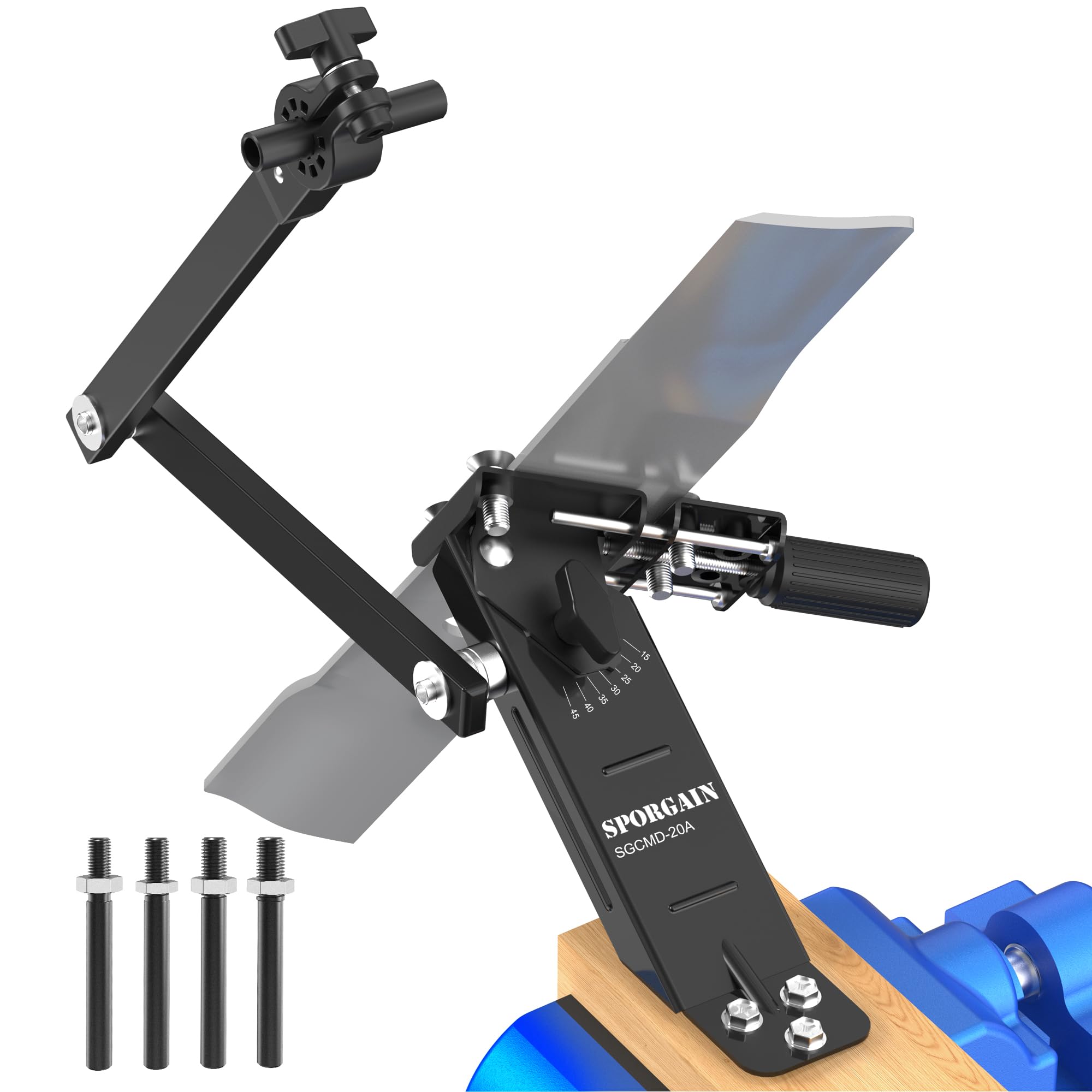
The SporGain jig hits the sweet spot between precision and usability. It includes four guide pins to match different angle grinder spindle sizes, which reduces wobble — a common complaint with universal jigs that force a single bushing on all grinders. The 15°–45° range covers everything from standard push-mower blades to high-lift mulching blades, and the thumb-screw angle lock holds firm during aggressive grinder passes.
Users report that the jig corrected years of freehand sharpening mistakes, restoring factory-edge geometry that reduces turf tear. The 2.46-pound weight stays planted when clamped, though one owner noted a slight wobble in the guide arm — likely fixable by tightening the pivot bolt. For the blend of versatility, build, and repeatable angle control, this earns the top spot for most DIY homeowners.
The 11.26-inch width capacity handles most residential deck blades, and the included mounting hardware lets you bolt it to a workbench or a plywood scrap. If you already own an angle grinder, this jig delivers professional-level consistency without the professional price.
What works
- Four interchangeable guide pins eliminate grinder compatibility guesswork
- Thumb-screw angle lock stays secure without tools
- Wide 1.65″–3.60″ blade width range fits most residential decks
What doesn’t
- Guide arm can feel slightly loose if pivot bolt isn’t snugged
- No integrated blade balancer — requires separate purchase for balancing
2. DPHXF Improved Version 5005A with Blade Balancer
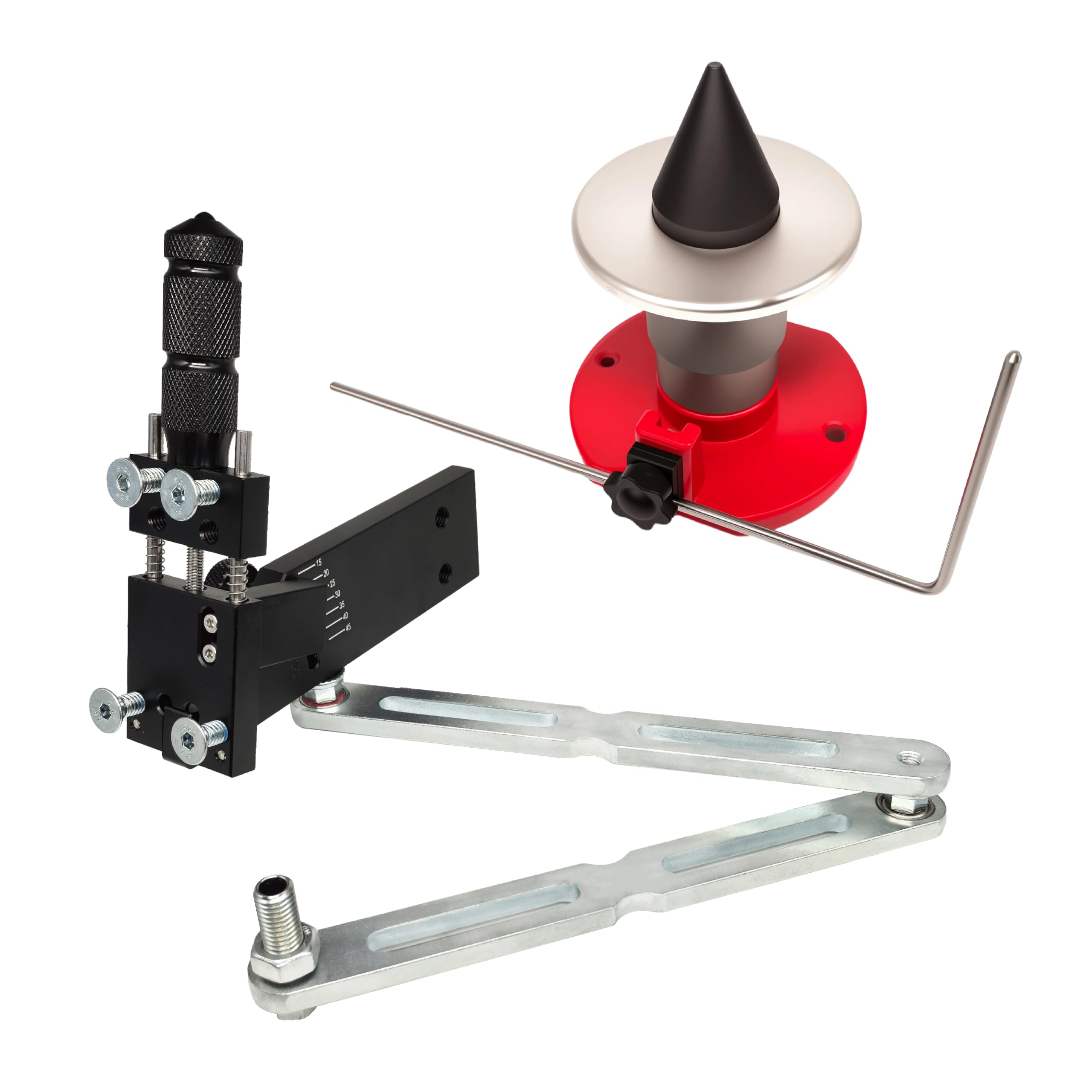
The DPHXF 5005A combines a sharpening jig and a magnetic cone balancer into one package, making it a strong option for anyone who wants to avoid buying separate balancing hardware. The magnetic base holds the blade securely during both sharpening and balancing — a feature that reduces the risk of the blade slipping mid-pass. At 6.38 pounds, it’s heavier than aluminum jigs, which helps dampen grinder vibration.
Owner feedback highlights the balancer’s ability to reveal slightly bent blades that would otherwise cause vibration during mowing. However, some users note that flipping the blade on the cone can show different balance readings — this isn’t a defect but rather a sign that the blade is twisted, not just unevenly weighted. The 15°–45° adjustment works smoothly, and the tool accepts both residential and smaller commercial blades.
For the price of a mid-range jig, you get a functional balancer that saves a separate purchase. If you prefer a two-tool approach for absolute balance accuracy, this is still a solid jig with the balancer as a bonus.
What works
- Magnetic base adds stability during sharpening and balancing
- Heavy build absorbs grinder vibration effectively
- Balancer helps identify bent blades before they damage spindles
What doesn’t
- Balancer cone can give inconsistent readings if blade is twisted
- Angle adjustment thumb screws feel less robust than metal cam-locks
3. Kimgsoak Lawn Mower Blade Sharpener with Balancer

Kimgsoak’s offering stands out for its high-density aluminum alloy construction — it’s lighter than steel jigs but still resists flex when clamped. The four included guide pins match most angle grinder bushings, and the bushings fit snugly over the pins, reducing the play that causes uneven bevels. The blade width range (1.69″–3.54″) and 30-inch max length cover all standard residential blades plus many zero-turn deck blades.
The upgraded zinc alloy balancer is a notable inclusion. Unlike plastic cone balancers that wear down quickly, the zinc alloy provides a smooth, wobble-free spin that makes spotting a heavy side straightforward. Users consistently mention the time savings — sharpening three blades in about 15 minutes, including setup and takedown. One caution: at a 40° angle, the jig removes more metal than a factory 30° edge, so match the angle to your blade’s original grind.
If you want a jig that feels substantial in hand and includes a quality balancer without stepping up to premium pricing, this is the most well-rounded combo in the list.
What works
- Aluminum alloy frame resists corrosion and stays rigid
- Zinc alloy balancer spins smoothly and accurately
- 30-inch blade length capacity suits large deck blades
What doesn’t
- 40° setting removes more metal than needed for some factory edges
- Guide pins are not color-coded — requires trial fitting for grinder compatibility
4. Sharp Pebble Cordless Lawn Mower Blade Sharpener
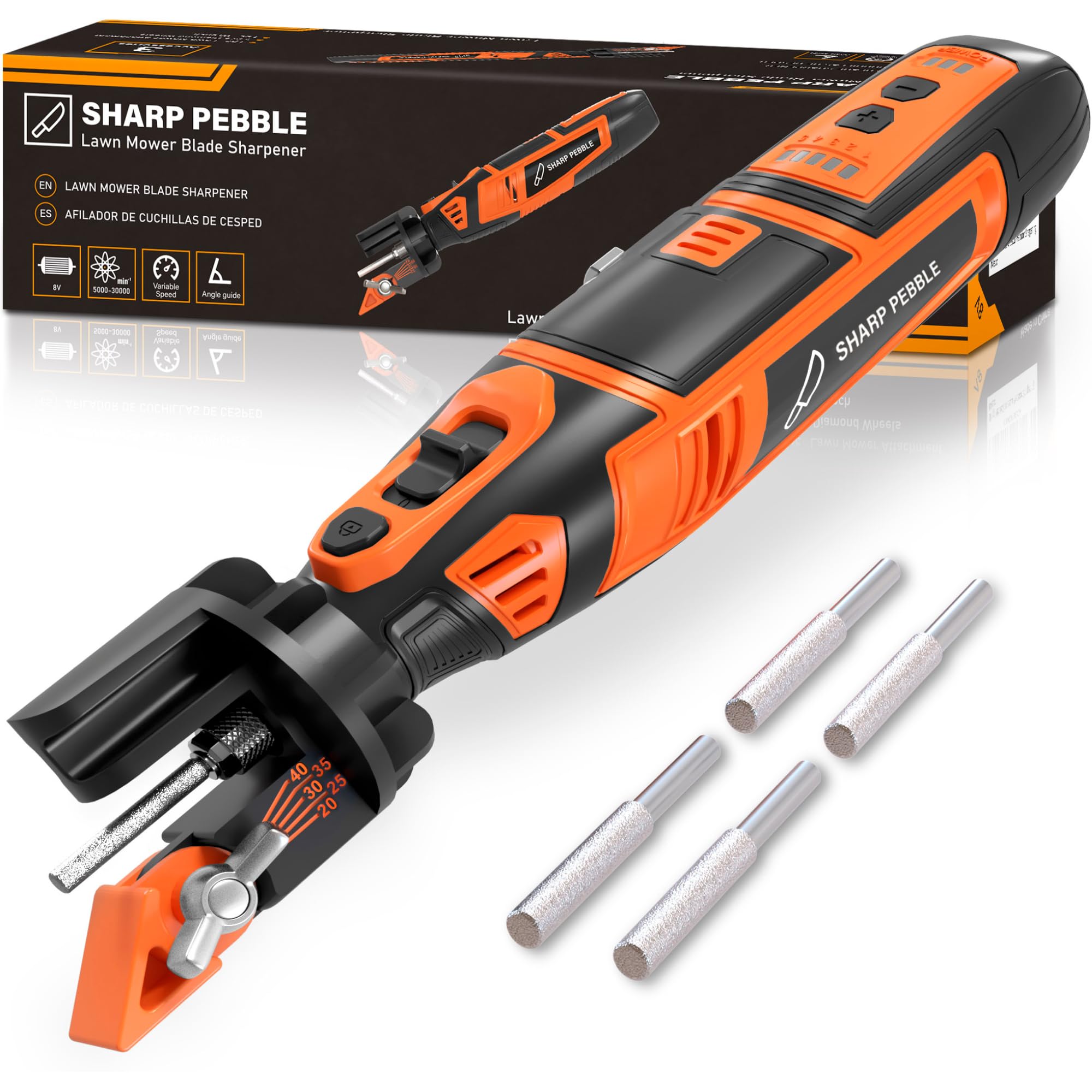
The Sharp Pebble is a cordless rotary tool designed specifically for mower blade touch-ups, not heavy metal removal. Its variable speed range (5,000–30,000 RPM) lets you dial down for precision edge finishing or crank up for faster passes. The standout feature is the ability to sharpen many standard residential blades without removing them from the mower — a time-saver for quick seasonal maintenance.
The adjustable angle guide (20°–40°) is a separate attachment that clamps onto the tool’s neck, providing a consistent reference plane. However, this is not a grinder replacement: the 1.37-pound tool lacks the torque to grind out deep nicks or chips. Owner experiences split between those who find it perfect for light edge restoration and those who expected more aggressive material removal. The included 9V battery delivers enough charge for 1–2 blades per session.
For homeowners who simply want to maintain an already-sharp edge between full sharpenings, this cordless option adds convenience without requiring a workbench or clamps.
What works
- On-mower sharpening eliminates blade removal for light touch-ups
- Lightweight and cordless for easy one-handed operation
- Variable speed suits both finishing and faster passes
What doesn’t
- Not powerful enough to remove deep nicks or chips
- Battery life limits sharpening to 1–2 blades per charge
5. SporGain Lawn Mower Blade Sharpener & Balancer Combo
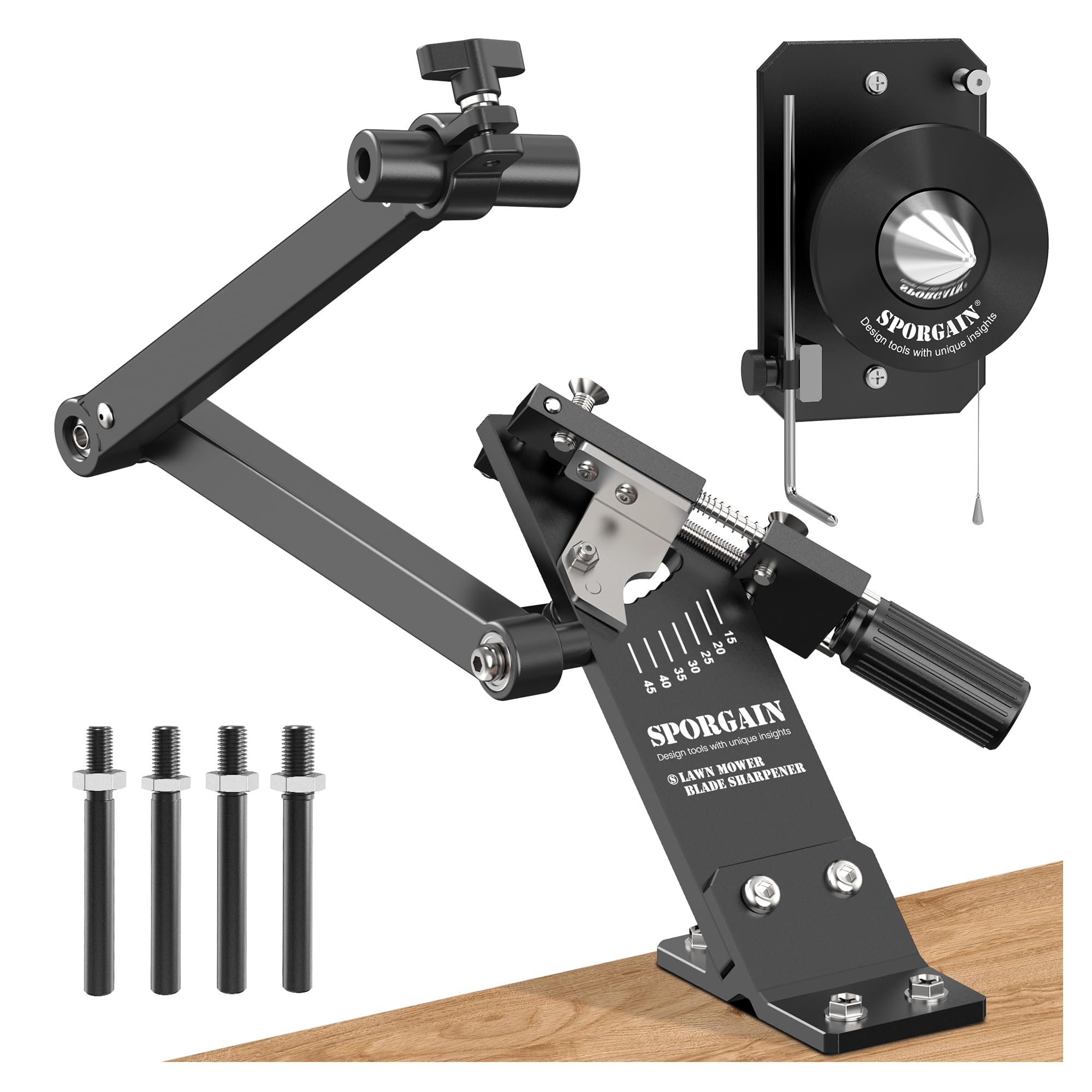
This SporGain combo packs a sharpening jig and a dedicated balancer into one kit, targeting users who want a complete blade maintenance station. The jig features a 25mm diameter handle and thick metal construction with ball bearings — the ball bearings reduce friction when sliding the grinder carriage, leading to smoother passes. The stepless angle adjustment (15°–45°) uses a fine-thread mechanism rather than indexed stops, so you can dial in non-standard angles if needed.
The balancer uses a hidden magnetic design that keeps the cone clean and free of debris. Users report that the balancer effectively identifies heavy sides, though the bearing can feel stiff out of the box — a small drop of light oil resolves this. The jig also handles 32-inch commercial blades, making it one of the few options that crosses into light professional use. One caveat: some components use plastic, which may wear faster with daily commercial sharpening.
For the DIYer who sharpens multiple mowers per season and values having matched tools that work together, this combo eliminates the guesswork of mixing brands.
What works
- Ball-bearing carriage reduces friction for consistent passes
- Fine-thread stepless angle adjustment for custom bevels
- Handles blades up to 32 inches for larger decks
What doesn’t
- Balancer bearing may need lubrication before accurate use
- Some plastic components may not hold up to heavy commercial use
6. VEVOR 2/3HP 500W Bench Mower Blade Sharpener

The VEVOR is a dedicated bench grinder built specifically for mower blade sharpening — not a jig that relies on your own angle grinder. Its 2/3-horsepower (500W) induction motor drives a 7-inch 60-grit ceramic wheel at 1,700 RPM, delivering the torque needed to reshape damaged edges and remove nicks quickly. The integrated steel base and solid blade-fixing brackets keep vibration to a minimum, which translates to smoother, more predictable bevels.
The included 40° brackets align standard blades consistently, but the supplied ceramic grinding wheel is essentially a sandpaper disc — several owners recommend replacing it with an RPG 712 resin-bonded wheel for longer life and faster cutting. The machine handles high-lift, low-lift, gator, and flat blades, making it suitable for landscaping businesses that grind multiple blade types daily. At 33.3 pounds, this is a permanent bench fixture, not a portable tool.
If you’re maintaining multiple mowers or frequently hit rocks that chip blades, the VEVOR’s motor power and rigid frame justify the space it occupies.
What works
- 500W motor removes metal faster than any jig-and-grinder setup
- Steel base and brackets eliminate vibration for clean bevels
- Handles all blade types including gator and high-lift designs
What doesn’t
- Stock ceramic wheel is a sandpaper disc — upgrade recommended for longevity
- Heavy 33-pound weight requires permanent bench space
7. All American Sharpener 5005 Gen 2
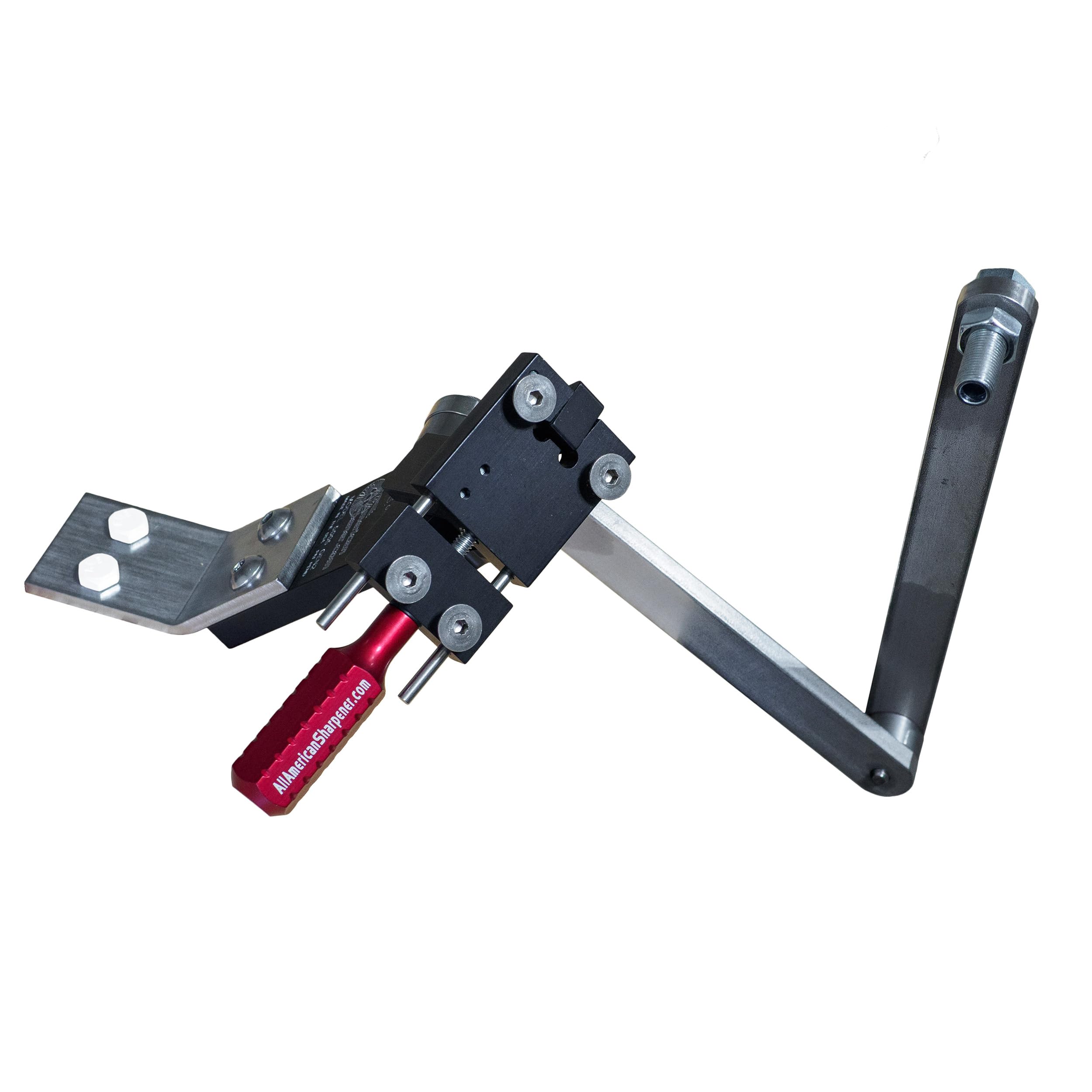
The All American Sharpener 5005 Gen 2 is the benchmark for quality in the category — designed and manufactured in the USA by the original inventor. The body is anodized aluminum with stainless steel arms, which makes it both corrosion-resistant and lightweight (16 ounces) despite its 14″x10″ footprint. It’s completely portable when paired with a cordless grinder, and the 15°–45° adjustment handles standard straight, mulching, and high-lift blades.
The design prioritizes repeatability: the blade clamps securely, and the angle lock holds position without drifting. Owners report sharpening very dull blades to a usable edge in about one minute, which is fast even among premium jigs. The lifetime warranty backs the build confidence, though the plastic thumb screw on the angle adjuster is a weak point. Some users find the price high relative to the simplicity of the design, but the consistent results and USA manufacturing justify the cost for those who value long-term ownership.
For the homeowner who wants to buy one sharpener for life and appreciates domestic production, the All American 5005 Gen 2 is the final word in jig precision.
What works
- Anodized aluminum and stainless steel resist rust indefinitely
- Lifetime warranty protects the investment
- Fast sharpening — dull blades restored in roughly one minute
What doesn’t
- Plastic thumb screw on angle adjuster feels out of place on a premium tool
- No integrated balancer — requires separate purchase
Hardware & Specs Guide
Angle Adjustment Mechanism
Jig sharpeners set the blade bevel angle via a pivoting arm or sliding carriage. Look for a mechanism that locks rigidly — thumb screws should engage a metal thread insert, not plastic threads that strip. Stepless (continuous) adjustment allows fine-tuning to your blade’s original bevel, while indexed stops are faster but may not match non-standard angles. The common residential range is 30°–40°, but a 15°–45° capacity future-proofs for mulching or high-lift blades.
Blade Balancer Types
Two balancer designs dominate this category: cone-style and magnetic. Cone balancers rely on a bearing at the tip of a cone — the blade sits horizontally and spins freely; the heavy side drops. Magnetic balancers use a magnet to hold the blade on a low-friction pivot, offering faster setup since the blade self-centers. Cone balancers are more sensitive to minor imbalances, while magnetic units are easier for quick checks. Stiff bearings on either type mask imbalance, so spin the blade by hand to confirm free rotation.
Blade Width and Length Limits
Residential mower blades typically measure 1.75″–2.5″ wide and 16″–22″ long. Zero-turn and commercial decks often use wider blades (up to 3.6″) and longer spans (up to 32″). Match the jig’s capacity to your specific mower model — a jig that’s too short leaves the blade tip unsupported, causing chatter during grinding. Measure your blade before purchasing; the product dimensions in the listing usually indicate maximum blade length, not the overall tool size.
Grinder Compatibility for Jigs
Jig sharpeners (except all-in-one bench units) require a separate angle grinder. The critical fit is the guide pin diameter versus your grinder’s arbor bushing. Most jigs include multiple guide pins or bushings (common sizes: 3/8″, 1/2″, 5/8″, 7/8″). If the bushing wobbles on the pin, the edge bevel will vary across the blade length. Test-fit the bushing before sharpening — a snug fit with less than 0.5mm play is essential for consistent results.
FAQ
What sharpening angle is best for standard residential mower blades?
Can a jig sharpener fix a blade with deep nicks or chips?
How often should I balance my mower blades after sharpening?
Can I sharpen a zero-turn mower blade with a standard jig?
Final Thoughts: The Verdict
For most gardeners, the mower blade sharpener winner is the SporGain Adjustable Sharpener because it combines a wide 15°–45° angle range, four interchangeable guide pins for grinder compatibility, and a sturdy build at a mid-range price point. If you want an all-in-one kit that includes a blade balancer, grab the Kimgsoak Sharpener with Balancer for its aluminum alloy frame and accurate zinc balancer. And for high-volume sharpening or commercial use, nothing beats the VEVOR 2/3HP Bench Grinder for its 500W motor and 7-inch ceramic wheel.