
Specs are compiled from manufacturer listings and verified buyer reviews and can change over time — please confirm the key details on the product page before buying.
The wood you choose for a raised garden bed determines whether it rots in a few seasons or stands for a decade. The single biggest decision is the species — cedar and redwood resist rot and insects naturally, while untreated pine will break down quickly in damp soil. We compare top-rated cedar lumber and ready-to-assemble kits to match your space, budget, and physical needs.
I’m Rikta — the founder and writer behind Lawn Gear Lab. This guide is built by comparing the manufacturers’ published specifications and the patterns across verified customer reviews, so you get each pick’s real strengths and trade-offs instead of marketing spin.
Whether you are building a ground-level frame or an improve planter, this breakdown of the best lumber for raised beds focuses on rot resistance, thickness, joinery, and real owner experience.
Our Picks at a Glance

How To Choose The Best Lumber For Raised Beds
Focus on three specs: wood species, board thickness, and corner joinery. These determine outdoor lifespan and assembly ease.
Wood Species: Cedar vs. Redwood vs. Treated Pine
Cedar is the crowd favorite because it shrugs off moisture and insects without chemical treatments. North American Western Red Cedar is especially dense and rot-resistant, which is why most premium kits use it. Redwood offers similar longevity but is often pricier and harder to find. Pressure-treated pine lasts a long time too, but many gardeners prefer untreated cedar so they can grow food without worrying about what leaches into the soil.
Board Thickness and Corner Joinery
Thicker boards (1-inch vs. 3/4-inch) resist bowing and last longer. A 3/4-inch board is the common entry point, while 1-inch stock feels noticeably more solid and resists bowing when packed with damp soil. Corner joinery matters: dovetail slots assemble tool-free, bolted corners are strongest, and nailed frames loosen quickly.
Ground Bed vs. improve Planter
Choose between an open-bottom ground bed or a raised planter with legs. Ground beds are cheaper and allow deep root growth, but require bending to maintain. improve planters sit at waist height — usually around 29 to 31 inches — so you avoid back strain and keep rabbits and pets away from your vegetables.
Quick Comparison
| Model | Best For | Wood Type | Thickness | Assembly | Amazon |
|---|---|---|---|---|---|
| Raised Garden Bed with Legs (SoliWood)★ Best Overall | Beginner-friendly improve planter | Cedar | 0.7″ frame / 2.4″ legs | 30 minutes, DIY | Amazon |
| All Eastern Red Cedar BoardsBudget Champion | DIY builders needing raw lumber | Eastern Red Cedar | 3/4″ or thicker | Build it yourself | Amazon |
| 48×24×30 Raised Bed (Wood-Natrl)Value Pick | Lightweight improve planting | Cedar | 2.4″ legs | Easy bolt-together | Amazon |
| Classic Cedar Bed 2’x8′ (Greenes Fence) | Tool-free ground-level frames | Cedar | 1/2″ | Tool-free dovetail | Amazon |
| Original Cedar improve Bed (Greenes Fence) | No-bend patio gardening | Cedar | Rough-cut solid | 15 min, mallet | Amazon |
| Premium Cedar Bed 3’x6′ (Infinite Cedar) | Long-term ground-level beds | Western Red Cedar | 1″ | Screw-free, 5 min | Amazon |
| Premium Cedar Bed 4’x8′ (Infinite Cedar) | Large-scale vegetable gardens | Western Red Cedar | 1″ | Bolt-together | Amazon |
| Gardener’s Supply improve Bed 2’x8′ | Mobility-friendly stand-up garden | Cedar | Solid, metal corners | Bolt-together | Amazon |
In-Depth Reviews
1. Raised Garden Bed with Legs, 48x24x30 (SoliWood)
Our pick — over 4.5★ from 850+ verified ratings; the strongest balance of quality and price.
The waist-high cedar planter that wins over first-time gardeners instantly
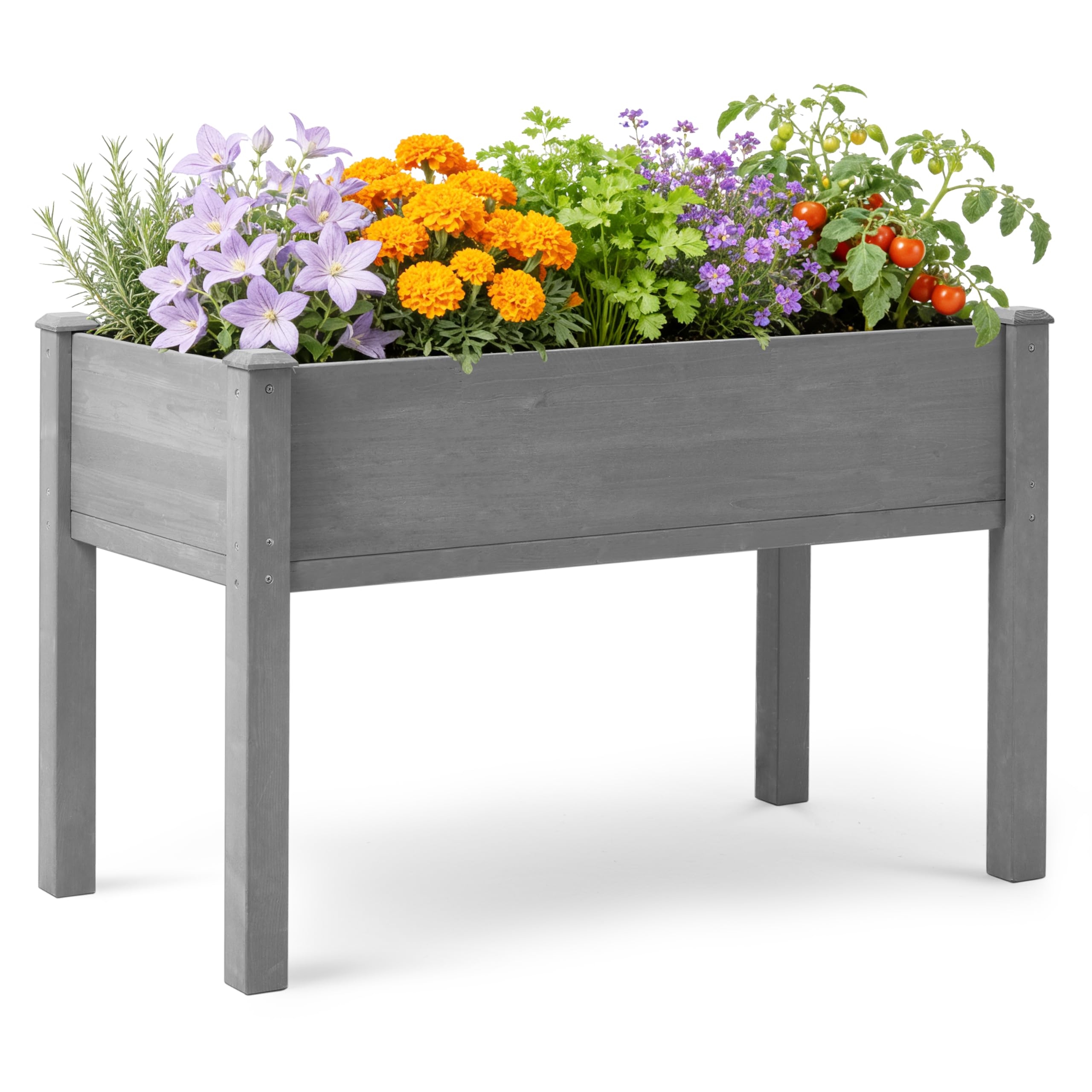
This improve bed lifts your garden to 30 inches off the ground, so you can plant, weed, and harvest without a single bend. The cedar frame uses 2.4-inch-thick legs and 0.7-inch frame panels, and it is built to hold up to 300 pounds of soil and plants — plenty for a serious vegetable patch.
Assembly is the standout here, and the review pages make that obvious: putting the legs and frame panels together takes about 30 minutes, with pre-drilled holes that line up cleanly. A 76-year-old owner found it genuinely easy to build, which tells you the instructions and fit are forgiving. The gray, water-based finish adds a soft, classy look that owners describe as “sturdy and classy looking” — and unlike sealed paints, the water-based eco finishing is meant to keep harmful substances away from your fruits and vegetables.
What wins people over is the assembly — it is the most-praised aspect by a wide margin, with over 140 owners calling it out — followed closely by the build quality and durability. The cedar’s natural rot resistance is a recurring note, and buyers report it holds multiple vegetables and flowers with room to spare. A 4-star review flags one honest caveat: the wood may split a little if you drill screws in carelessly, so gentle hands help. The crowd favorite here sits at 4.7 stars with nearly 900 ratings.
Why beginners love it
- 30-minute tool-friendly assembly with aligned pre-drilled holes
- Ergonomic 30″ height eliminates bending strain
- Water-based eco finish keeps chemicals away from edibles
What to handle gently
- Wood can split if you over-drive screws without care
- Heavy soil bags will need a second person to lift in
Grab it if: you want a sturdy, good-looking improve bed that a beginner can assemble in one sitting.
Note this: pre-drill your screw holes to avoid splitting the cedar.
2. All Eastern Red Cedar 3/4″ Thick Boards (Woodchucks Wood)
A box of fragrant red cedar boards for builders who want to cut their own frame
If you want to build a raised bed from scratch, this box gives you a pile of Eastern Red Cedar boards — the aromatic kind that smells wonderful and resists rot naturally. The full box measures 12″ x 12″ x 6″ and holds between 15 and 20 pounds of wood, with every board 3/4″ thick or thicker and kiln dried to reduce warping.
The catch is the unpredictability, which is part of the charm: boards come in all different sizes to fill the box, and red cedar is typically very knotty, with some boards carrying a crack here and there. One delighted owner expected about 5 pieces and received a large box with roughly 30 — far more than expected. The quality and value are the two most-discussed positives, and the wood’s “nice character” shows up in multiple reviews.
This is not a kit, so there is no assembly to praise or criticiize — it is raw material for the DIY builder. You will need your own saw, screws, and corner hardware. The one sour review concerns the seller’s attitude rather than the product itself, and the phrase “I was very happy with my order” captures the general sentiment. If you want freedom to design your own dimensions, this budget-friendly box of wood delivers.
Buyer reality check: Sizes vary by box, so plan your cuts after weighing what actually arrives.
Choose this for: custom builds where you control the dimensions and finish.
Know before buying: you are paying for a mixed box of scrap-worthy but beautiful wood, not uniform planks.
3. 48×24×30 Inch Raised Garden Bed with Legs (Wood-Natrl)
A featherlight improve cedar planter that still holds a full bed of soil
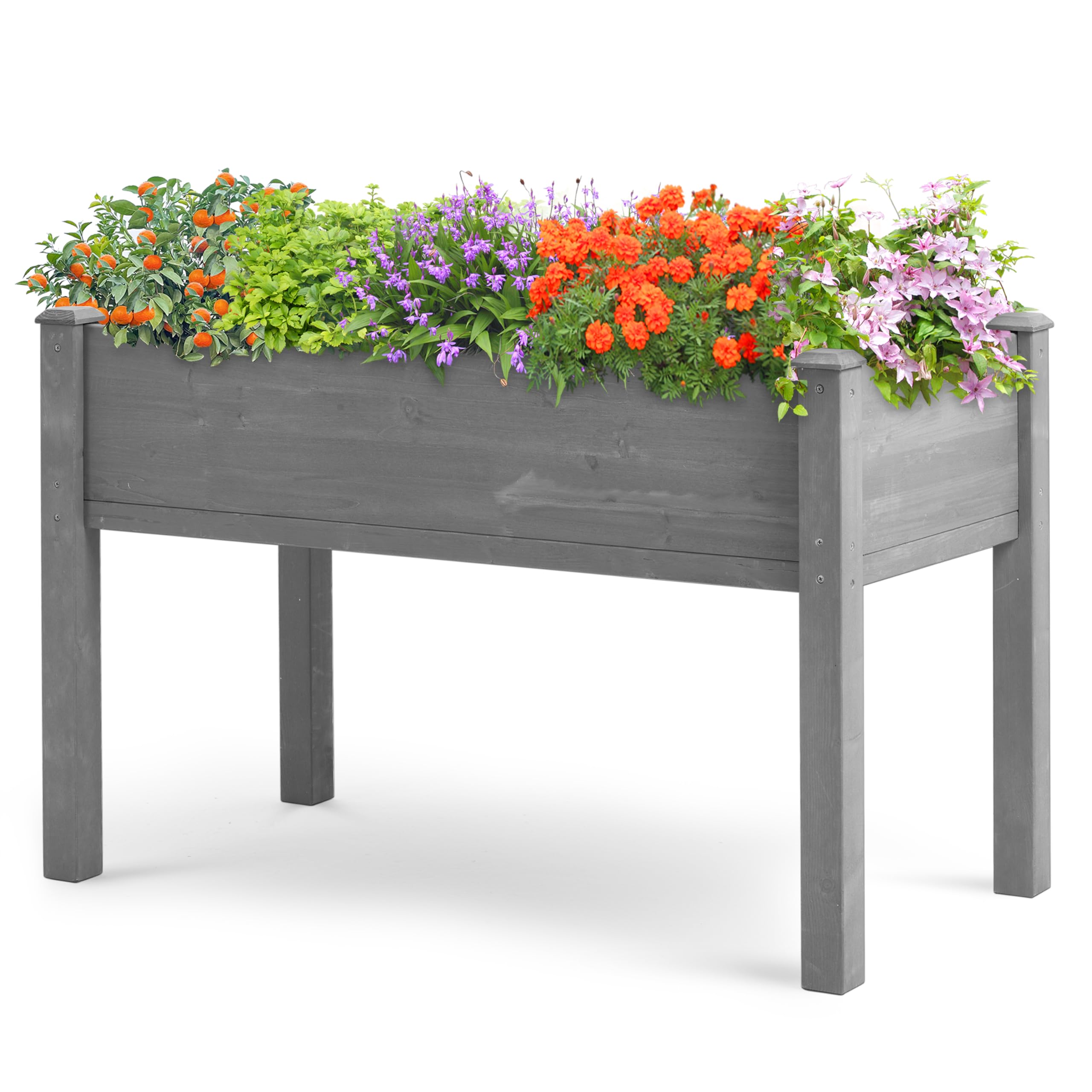
This is the lightweight twin of our top pick: same 48 x 24 x 30 size, same cedar construction and water-based paint, but it weighs just 16.3 pounds versus 38.9 pounds on the SoliWood — a 2.4x gap that makes moving it around your patio easy. The 2.4-inch-thick legs still provide strong support, and the built-in liner keeps soil off the wood while promoting proper drainage.
Assembly is the leading praise point, with 74 owners calling it out, and owners mention that a battery-powered screwdriver is all you need. The quality follows close behind at 54 mentions. Owners describe it as “well designed for looks and function,” and one reviewer expects it to last more than 12 years. The planting depth comes to roughly 9.5 inches once assembled, and drainage runs through two bottom slats.
The gray cedar finish blends well with most house exteriors, and customers note the liner filters water runoff neatly. This planter fits small yards and balconies comfortably, and the light weight means you can reposition it as the sun shifts. Just remember that a light frame needs care when moving it while full of damp soil — the bulk of the weight is in the dirt, not the wood.
What stands out
- 16.3 lb frame is easy to lift and reposition
- Tailored liner filters runoff and protects the wood
- Battery screwdriver assembly with clear instructions
Keep in mind
- Lighter build means less mass holding it steady in high wind
Pick this if: portability matters more than sheer heft, and you garden on a deck or balcony.
skip it if: you want the heaviest, most immovable frame for a ground-level permanent bed.
4. Classic Cedar Raised Garden Bed, 2′ x 8′ x 10.5″ (Greenes Fence)
Tool-free dovetail joinery turns an 8-foot frame into a 10-minute project
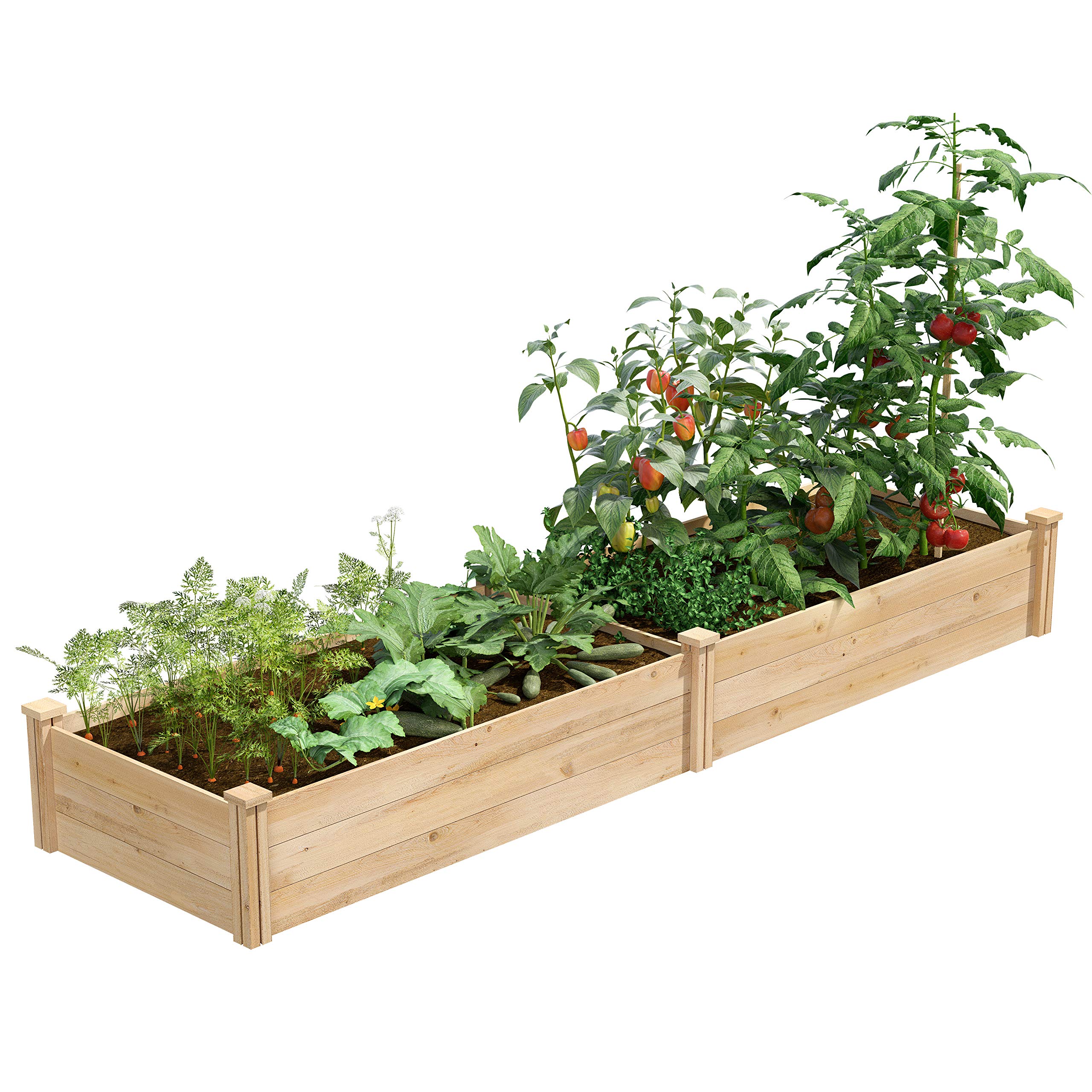
This open-bottom frame lets plants reach deep native soil while keeping the growing zone tidy and defined. The boards slide into routed corner posts with dovetail interlocking joints — no tools, no screws, no hammer — and each corner post routes on all four sides so you can expand and connect multiple beds into a larger garden. The decorative tops attach with a single screwdriver.
The big draw is speed: owners routinely assemble this in about 10 minutes, and the tool-free design earns 183 praise mentions for assembly. Made in the USA from untreated North American Cedar, the wood will weather to a silver-gray over time. You can stack and connect beds to build out a bigger plot, which makes this a flexible building block for a growing garden.
The honest trade-off is the material: at just 1/2 inch thick, the boards are noticeably thinner than premium kits, and this is the most common complaint with 147 mentions around sturdiness. Some reviewers point out poorly cut pieces, warped boards that leave gaps, and corners that break during assembly. For a budget-conscious gardener who wants a huge growing area fast, this is a solid choice — just expect to handle the boards gently and sand any rough edges.
Why it wins on speed
- Tool-free dovetail joints slide together in minutes
- Expandable and stackable with other Classic beds
- Untreated organic-safe cedar for vegetables
The thin-wood caution
- 1/2″ boards are thin and can warp or split
- Warped pieces may leave gaps for soil to escape
Best for: gardeners who want a massive 2’x8′ growing area without any power tools.
Think twice if: you need a heavy, rigid frame that will shrug off rough handling for a decade.
5. Original Cedar improve Garden Bed, 24″ W x 48″ L x 31″ H (Greenes Fence)

Rough-cut cedar with a sauna-like aroma that stands tall so you never bend
Built at 31 inches tall from untreated North American Cedar, this improve bed is engineered for gardeners who want to save their knees and back. The inside growing area measures 47″ L x 23.75″ W x 7.5″ D and holds up to 4.8 cubic feet of soil — enough for a full herb garden or a serious set of vegetables.
Assembly takes about 15 minutes with a rubber mallet to tap the slats into place, and owners love that the drainage works through natural gaps between the slats. The cedar aroma is a recurring delight — one owner compared it to a sauna — and the rustic finish means you get rough, splintery cuts that are easy to sand down. The height keeps bunnies away from your veggies, and the mesh-style gap drainage prevents waterlogging.
The recurring theme across reviews is that the wood is rough-cut and splintery, so wear gloves during setup. The inside depth of 7.5 inches is shallower than ground-level beds, which limits root depth for deep-rooting crops. For growing herbs, lettuce, and shallow-rooted vegetables on a patio or balcony, this is a sturdy, handsome choice that delivers on the no-bending promise.
Owner consensus: The sauna-like cedar smell and the no-bend height win everyone over, but sand the rough edges before planting.
Reach for this if: mobility is a concern and you want a patio garden without kneeling.
Look elsewhere if: you need deep soil for root vegetables like carrots or potatoes.
6. Premium Cedar Raised Garden Bed – 3′ x 6′ x 11″ (Infinite Cedar)

Handcrafted in Maine with 1-inch-thick red cedar and a 5-year warranty behind it
This is the bed you buy when you want it to be the last one you ever replace. It is handcrafted in Maine from 1-inch-thick, rot-resistant North American Western Red Cedar, with no screws or nails to loosen and no dovetail corners that could break. The joinery is simple and solid, and the whole thing assembles in about five minutes per one owner.
The capacity is generous at 16.5 cubic feet, giving you a spacious 3′ x 6′ growing area that fits a small fenced-in backyard perfectly. The cedar arrives pristine — shoppers say no knots, cracks, or warping — and the untreated, natural wood means no chemicals or stains near your food. A 5-year warranty covers workmanship and material quality, which is rare at this level.
The quality is the recurring praise, with 39 owners calling it out and the wood quality adding another 17 mentions. One owner who replaced a cheap bed noted he could snap the old thin boards apart with his hands — a stark contrast to this solid, thick construction. The honest caveats are durability, which is mixed among reviewers, and value for money; a few buyers report warping after a few weeks, though the manufacturer’s customer service responded by sending replacement kits. Assemble it in its final location, because moving the whole frame can cause partial disassembly.
The premium difference
- 1″ thick cedar is dramatically stiffer than 1/2″ boards
- No screws or nails means nothing to loosen over time
- 5-year workmanship and material warranty
Be aware
- Occasional warping reported in long side boards
- Build it in place — moving the frame can pull it apart
Choose this for: a permanent, heirloom-quality bed where you value thickness and a real warranty.
Expect to pay: more for the handcrafted construction, but owners say the solid feel justifies it.
7. Premium Cedar Raised Garden Bed – 1″ Thick Wood (4′ x 8′ x 11″ H) (Infinite Cedar)

A massive 4’x8′ frame with 1-inch solid cedar for serious vegetable production
When you want to feed a family, this is the bed to build. At 96″ L x 48″ W, it offers a huge 4′ x 8′ growing area made from 100% natural Western Red Cedar with 1-inch-thick boards — no added chemicals, no pressure treating, and no worries about what leaches into your vegetables. The whole frame weighs 55 pounds of solid, weather-resistant wood.
Assembly is straightforward because all boards arrive pre-cut and pre-drilled; you simply insert the bolts and tighten the nuts. The quality is a consistent praise point, with 34 owners calling it out and the thickness drawing 6 more mentions. Owners who bought multiple beds for a larger garden report they last 3+ years in New England weather while growing vegetables and herbs.
Several owners note the hole alignment can be slightly off, which is the most common negative at 12 mentions — the fix is simple, as most found the bolts still fit after clearing debris. The locknuts with seal rings may not tighten fully, leaving wobbly gaps unless you swap in standard nuts. The sturdiness is praised at 24 mentions, and one owner with four beds calls the thick cedar boards and heavy-duty bolts “simple to use assembly.” This is the premium choice for the gardener who wants maximum space and isn’t afraid of a little pre-drilled-hole fuss.
The space advantage
- Massive 4’x8′ growing area for serious yields
- 1″ thick boards resist bowing under heavy soil
- Pre-drilled bolt assembly needs no specialty tools
Watch for
- Some holes arrive misaligned — check before tightening
- Included locknuts may leave gaps; standard nuts work better
Best for: gardeners expanding into serious vegetable production who want a durable, chemical-free frame.
Before you build: level the ground first to avoid cracking the corner brace.
8. Gardener’s Supply Company improve Cedar Raised Garden Bed 2′ x 8′

A 29-inch-tall cedar planter with rustproof aluminum corners built for aching backs and knees
This standing planter pairs beautiful cedar lumber with heavy-duty rustproof aluminum legs and corners, creating a frame that holds approximately 13 cubic feet (340 dry quarts) of container mix. At 29 inches high, it eliminates the stoop, bend, and kneel that makes gardening painful, and the slatted base lets excess water drain while side vents circulate air to prevent waterlogging.
The growing space is generous: 96″ L x 24″ W with 10 inches of depth and 16 square feet of planting area. Owners mention fitting 4 tomatoes, 3 cherry tomatoes, 3 cucumbers, 1 squash, and 2 peppers in a single bed. Assembly runs about 30 minutes for the experienced builder, and the stability is a constant theme — the thick cedar and metal supports make this one of the sturdiest improve beds available.
The price is the recurring reservation, with value for money drawing mixed reviews, but the build quality earns 73 praise mentions and durability adds 67 more. One owner who took extra time on the first build finished the second in 20 minutes, and the included instructional planting guide helps new gardeners get started. The hole alignment is the one recurring negative at 17 mentions, so pre-drilling the screw holes is recommended to avoid splitting the cedar. This is the premium pick for anyone with back or knee pain who wants a durable, stand-up garden that will hold up in humid conditions.
Why it stands out
- Rustproof aluminum corners outlast all-wood frames
- 29″ height eliminates bending for mobility-limited gardeners
- Slatted base and side vents prevent waterlogged roots
The premium trade-off
- Higher cost draws mixed value reviews
- Some screw holes misalign — pre-drill to avoid splitting
Worth it if: you are done with bending over and want a heavy-duty frame with metal corners that will last.
Set aside extra time if: you are new to assembly — the first build runs about 2 hours, the second goes in 20 minutes.
Understanding the Specs
Board Thickness
The thickness of the cedar boards determines how stiff and durable the frame feels. A 1/2-inch board is the budget entry point — light and affordable but prone to warping under heavy, damp soil. A 3/4-inch board is the common middle ground, offering noticeably more rigidity. Premium kits use 1-inch stock, which resists bowing for years and feels solid when you lean against it.
Rot Resistance & Chemical Safety
Cedar and redwood contain natural oils that resist moisture, rot, and insects without chemical treatment. This makes them ideal for growing food because nothing leaches into your soil. Pressure-treated pine lasts a long time but introduces chemical concerns for edible gardens. Untreated Western Red Cedar from North America is the gold standard for organic vegetable growing.
FAQ
Is cedar or redwood better for raised garden beds?
How thick should lumber be for a raised bed?
How long will cedar raised beds last outdoors?
Can I use pressure-treated lumber for vegetable gardens?
What is the difference between a ground bed and an improve planter?
Do I need to seal or stain cedar raised beds?
How many cubic feet of soil does a 4′ x 8′ bed need?
What is the best joinery for a raised garden bed?
Is tool-free assembly better than bolt-together construction?
Final Thoughts: The Verdict
Across the board, the lumber for raised beds winner is the Raised Garden Bed with Legs by SoliWood because it pairs a simple to use 30-minute assembly with a sturdy, ergonomic 30-inch height and a water-based eco finish that keeps chemicals away from your food. If you want a lightweight portable option for a patio, the Wood-Natrl 48×24×30 delivers the same size at a fraction of the weight. And for the serious gardener building a permanent plot, the Infinite Cedar 4’x8′ offers class-leading 1-inch thick Western Red Cedar that will stand up to years of harvests.
How We Picked
We do not accept paid placement. Every pick is matched to a real buyer and a real use-case; we do not hands-on test units.
Sources & Methodology
Specifications: manufacturer listings and product documentation. Review insights: verified customer reviews, as of August 2026. Pricing: not shown on this page (it changes often); check the current price via the retailer link.
As an Amazon Associate, Lawn Gear Lab earns from qualifying purchases. This does not affect which products we feature.