
Spider plants signal stress fast—leaf tips brown, colors fade, and stolons stop sending out pups when light levels fall short. These resilient houseplants tolerate low light but need consistent, moderate indirect brightness to maintain variegation and produce offsets. Choosing a targeted grow light prevents the etiolation and washed-out foliage that plague spider plants in dim corners, dark offices, or north-facing rooms with limited natural light.
I’m Rikta — the co-founder and writer behind Lawn Gear Lab. My approach to indoor lighting combines deep market research, side-by-side comparison of spectral output and coverage data, and aggregation of thousands of owner experiences to identify the fixtures that deliver measurable results for specific houseplant genera.
This guide evaluates fixtures with appropriate brightness, spectrum, and timer functionality to sustain healthy spider plant growth. Whether your goal is to revive a struggling specimen or encourage more runners, the right light for spider plants makes the difference between a plant that merely survives and one that actively thrives.
How To Choose The Best Light For Spider Plants
Spider plants (Chlorophytum comosum) are adaptable but respond best to bright, indirect light. Choosing a fixture means balancing spectrum, coverage area, and control over the daily photoperiod. Pay attention to the following factors to avoid leggy leaves or scorched tips.
Full Spectrum vs. Blurple LEDs
Full-spectrum LEDs emit light across the visible range (380–800 nm), producing white light that mimics natural sunlight. These fixtures make spider plant foliage look vibrant and green under normal room lighting. Blurple fixtures (red+blue) work for flowering plants but cast an unnatural pinkish-purple glow that makes it harder to spot pests or discoloration on spider plant leaves. For houseplant aesthetics and healthy growth, choose full spectrum.
Brightness and Coverage
Spider plants need moderate light — roughly 150–300 µmol/m²/s PPFD at the leaf surface. Since most grow light brands specify output in watts or lumens rather than PPFD, use brightness settings and distance as a proxy. A clip-on light with 10W per head works for one or two small pots, while a floor-standing unit with 60–80 LEDs covers multiple spider plants grouped together. The ability to dim (25%–100%) lets you dial in the intensity without moving the fixture.
Timer and Photoperiod Control
Spider plants grown indoors need a consistent day/night cycle of 12–16 hours of light. A built-in auto timer eliminates the need to manually switch the light on and off every day. Look for fixtures offering 6/8/12/16-hour cycles so you can adjust based on the season — longer cycles in winter when natural light is scarce, shorter during summer if the plant receives some window light.
Mounting Type: Clip, Stake, or Floor Stand
Clip-on lights work well for small spider plants in pots that sit on a shelf or desk, but the clamp must be wide enough to grip the pot rim securely without wobbling. Stake-in designs insert directly into the soil and work for medium pots. Floor-standing lights with an extendable pole (up to 60–70 inches) are best for large, mature spider plants that sit on the floor or in a plant caddy. Consider the mature height of your plant — spider plant leaves can reach 18 inches — and ensure the light can be positioned 6–12 inches above the foliage.
Quick Comparison
On smaller screens, swipe sideways to see the full table.
| Model | Category | Best For | Key Spec | Amazon |
|---|---|---|---|---|
| GLOWRIUM Dual Heads | Premium | Large floor plants, app-guided care | 70.9″ height, 4 timer modes | Amazon |
| JESLED 2FT Strip | Strip Light | Seedlings, shelf setups, high humidity | IP65 waterproof, 48W total | Amazon |
| Plant Lights 3 Pack Halo | Multi-Pack | Multiple small spider plants on shelves | 3 lights, stake & clip included | Amazon |
| LBW Floor Stand | Floor Stand | Tall, large spider plants on the floor | 68″ max height, 80 LEDs | Amazon |
| SANSI Dual Gooseneck | Clip-on | Premium 2-head setup, replacement bulbs | 300W equiv, 20W actual | Amazon |
| yadoker Floor Lamp | Floor Stand | Decorative, low-voltage safety | 61″ height, 10 brightness levels | Amazon |
| SANSI Clip-on 10W | Clip-on | Single mid-sized pot, budget entry | 10W, 4 dimming levels | Amazon |
In‑Depth Reviews
1. GLOWRIUM Grow Lights for Indoor Plants, Dual Heads
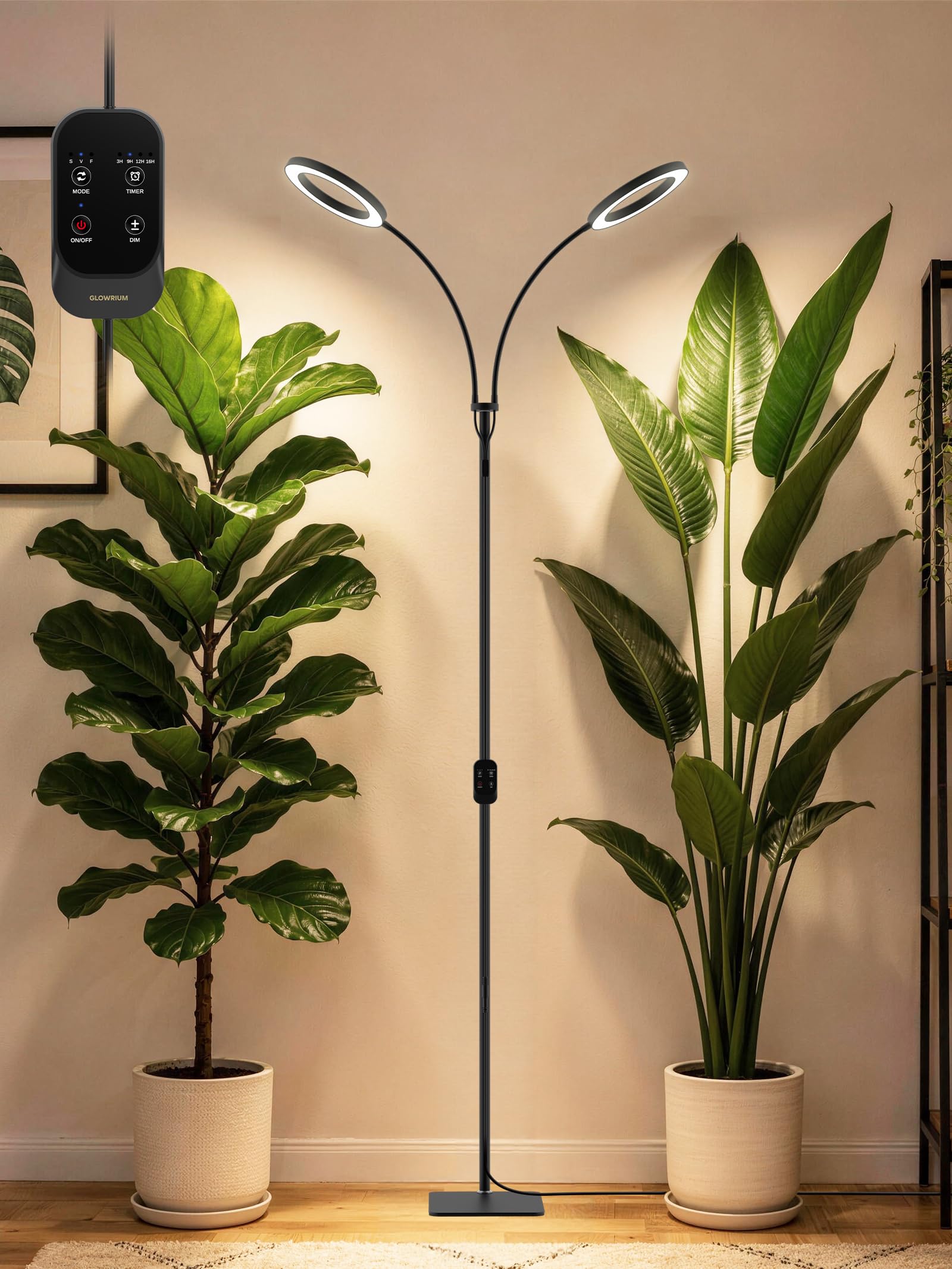
The GLOWRIUM dual-head fixture stands out for its 70.9-inch maximum pole height, making it one of the tallest floor-standing options on this list. The 4-section pole adjusts to keep the enlarged lamp head 6–12 inches above mature spider plant foliage, and the 360° flexible goosenecks allow you to direct each head independently — useful when you have two spider plants at different distances from the base. Stepless dimming means you can fine-tune brightness from a soft glow up to full intensity without preset steps, matching the moderate PPFD spider plants prefer.
The built-in timer offers 3, 9, 12, and 16-hour cycles, which covers the full range of photoperiods a spider plant might need depending on ambient window light. A 24V low-voltage adapter keeps the fixture cool during 16-hour runs and safe around pets or children. The frosted diffuser softens the light output, reducing the risk of leaf burn even when the fixture is positioned close to the foliage. Reviewers consistently note that spider plants perked up within days and that African violets and cherry tomatoes also responded well, indicating the spectrum is broad enough for vegetative growth and flowering stages.
One minor trade-off — the base is relatively lightweight, so for very top-heavy plants you may need to set the pot on the base for stability, as some owners discovered. The dual heads produce noticeable heat over extended use, so maintain at least 6 inches of clearance from leaves. Overall, this fixture delivers premium flexibility in height, angle, and brightness for any spider plant configuration from a single large specimen to a cluster of smaller pots.
What works
- 70.9-inch pole accommodates tall floor plants through all growth stages
- Stepless dimming gives precise control over light intensity
- Frosted diffuser prevents hot spots and leaf scorch
- 4 timer cycles cover every photoperiod need
What doesn’t
- Base may require placing a pot on it for extra stability
- Lamp heads generate noticeable heat at close range
2. JESLED Waterproof Plant Grow Lights, 2FT 2-Pack
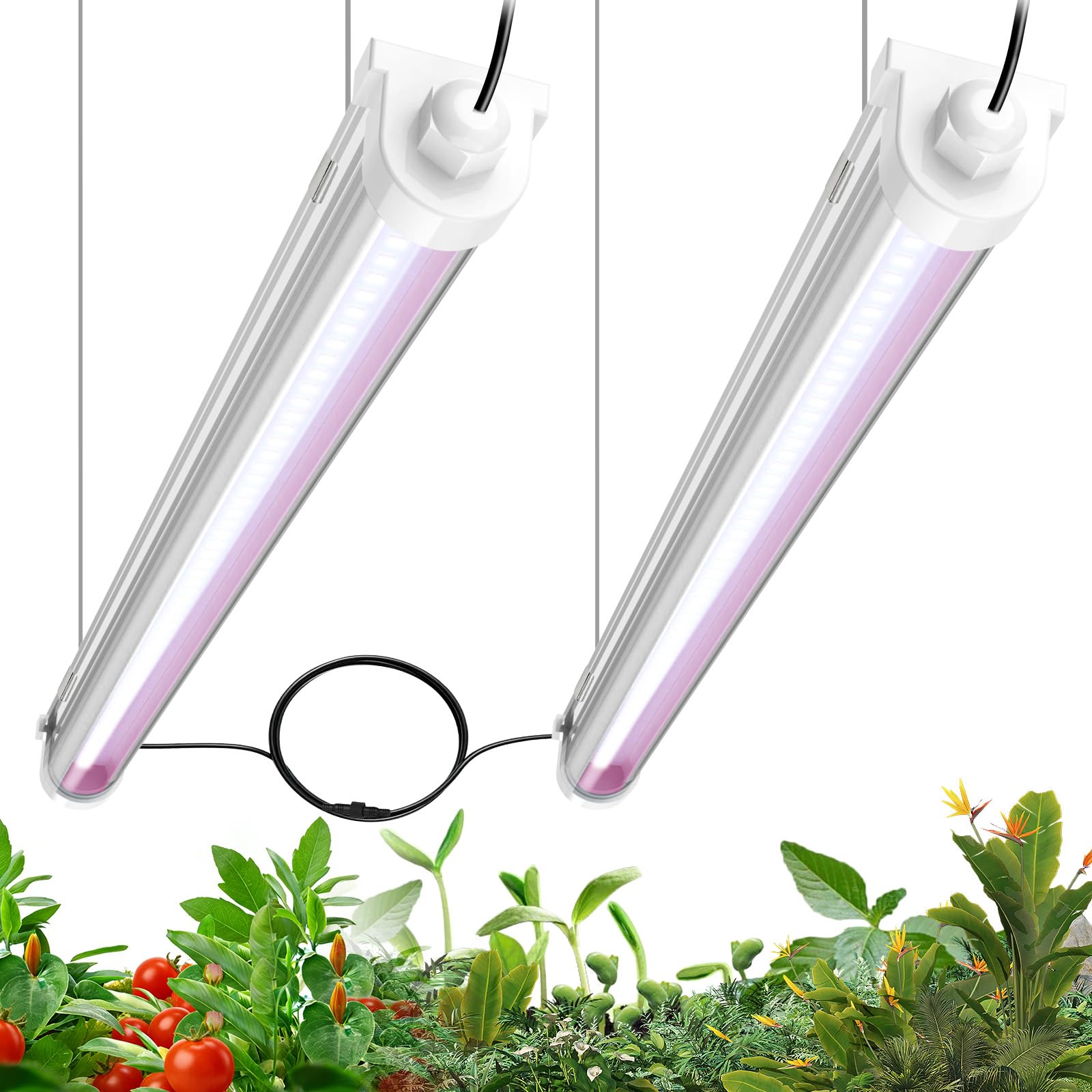
The JESLED 2-foot strip light serves a different role than the floor-standing units: it is designed for shelf, greenhouse, or under-cabinet setups where horizontal coverage matters. Each 24W strip (48W total for the pair) produces 4800 lumens of pinkish-white light, with a spectrum balanced for seedling, vegetative, and fruiting stages. The integrated reflector boosts PPFD by roughly 30% compared to bare strips, meaning the light penetrates deeper into a cluster of spider plant leaves rather than scattering off to the sides.
IP65 waterproofing is a rare feature in indoor grow lights and makes this pair suitable for high-humidity environments like an enclosed terrarium or a greenhouse cabinet where spider plants sit among moisture-loving ferns. The linkable design lets you connect multiple strips end-to-end from a single power cord, covering a long shelf or a row of pots without daisy-chaining separate adapters. Installation is straightforward — you can hang them with the included zip ties or surface-mount with brackets — and the separate power cord includes an on/off switch for quick control.
Owners report that plants in dark rooms respond rapidly: spider plant pups develop deeper variegation and overall growth is denser. The trade-off is the fixed length — you cannot angle individual sections like a gooseneck — so the strip must be positioned directly above the plant canopy. The pinkish-white glow is less natural-looking than pure full-spectrum white light, but the results for vegetative growth are consistently positive. For spider plant propagation on a multi-shelf stand, this is a efficient, space-saving solution.
What works
- IP65 waterproof rating tolerates greenhouse humidity
- Linkable strips cover long shelves from one outlet
- Reflector design boosts PPFD by 30% for deeper canopy penetration
- Bright 4800-lumen output for multiple plants
What doesn’t
- Fixed orientation — no adjustable arm for angled coverage
- Pinkish-white tint less natural than full white spectrum
3. Plant Lights for Indoor Growing, 144 LED 3 Pack Halo
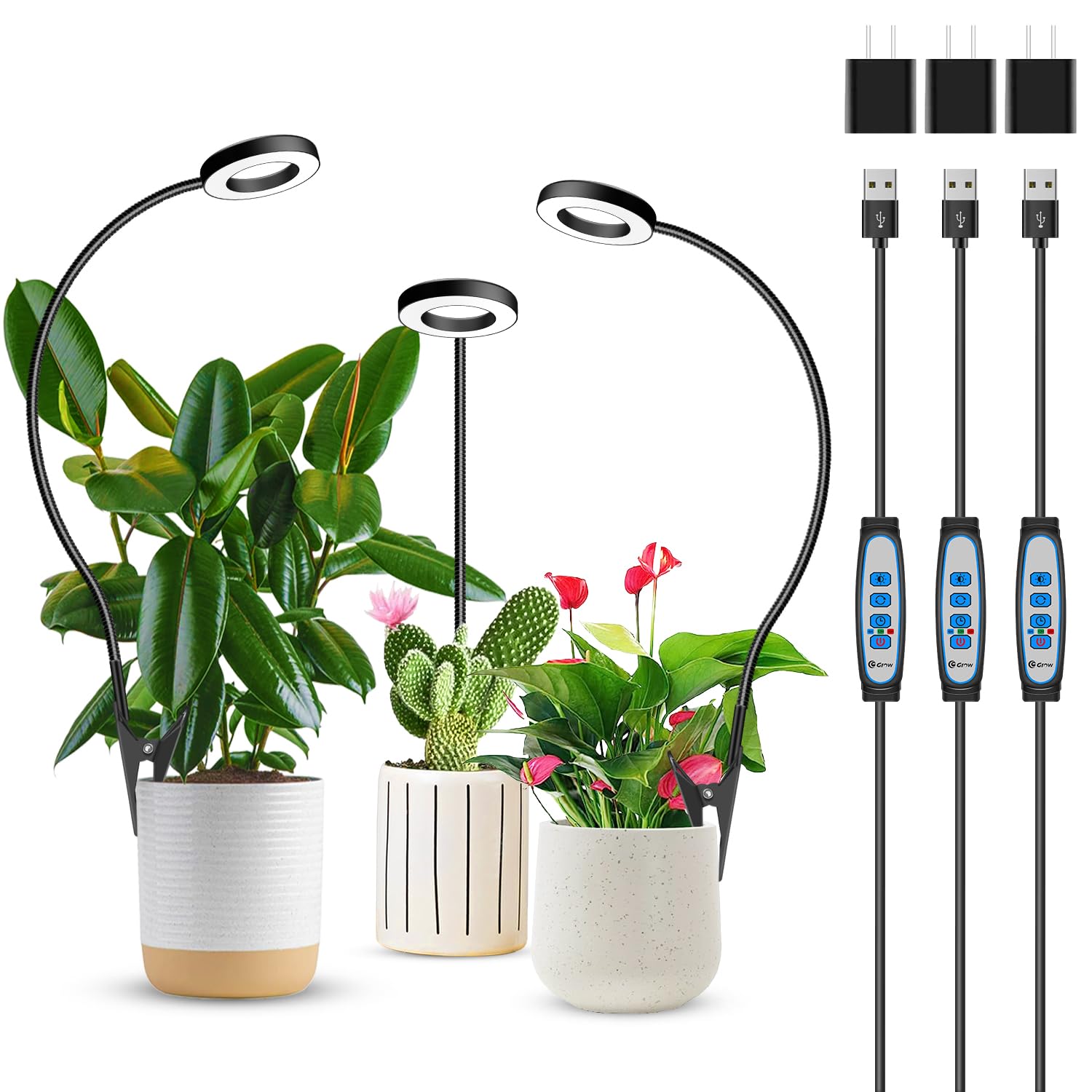
This three-pack of halo-style grow lights offers exceptional coverage value if you have multiple spider plants scattered across shelves, desks, or a plant stand. Each 144-LED head includes red 660 nm, warm 3500K, and white 6000K diodes, which together simulate sunlight more broadly than a single-color grow light. The combination supports strong vegetative growth and helps maintain the white and green variegation of spider plant leaves.
Each light comes with both a clip and a ground stake, so you can clamp to a pot rim or insert directly into the soil — no mounting hardware needed. The flexible gooseneck arm lets you angle the halo ring over the plant canopy, and the included USB adapter powers each unit via a standard wall plug. Three lighting modes (full spectrum, mixed red/blue, and warm white) let you switch based on growth stage, while five brightness levels from 20% to 100% allow you to gradually acclimate a spider plant that has been in low light for months.
The 6/12/16-hour timer cycles are straightforward and retain their setting even after unplugging. Reviewers praise the sturdy aluminum construction and the lack of excessive heat — the halo runs cool enough to place close to leaves. The only recurring drawback is the clip itself, which some owners find too small to grab thick pot rims; in those cases the ground stake is a better option. For anyone managing three spider plants in different locations, this kit delivers independent, customizable lighting at a cost that is hard to beat.
What works
- Three independent lights with clip and stake mounting options
- Triple spectrum (red, warm, white) supports variegation and growth
- Cool-running LEDs safe for close placement
- 5 dimming levels and 3 timer cycles per unit
What doesn’t
- Clip may not fit thick or wide pot rims securely
- Each light requires its own USB port and adapter
4. LBW Grow Light with Stand for Indoor Plants
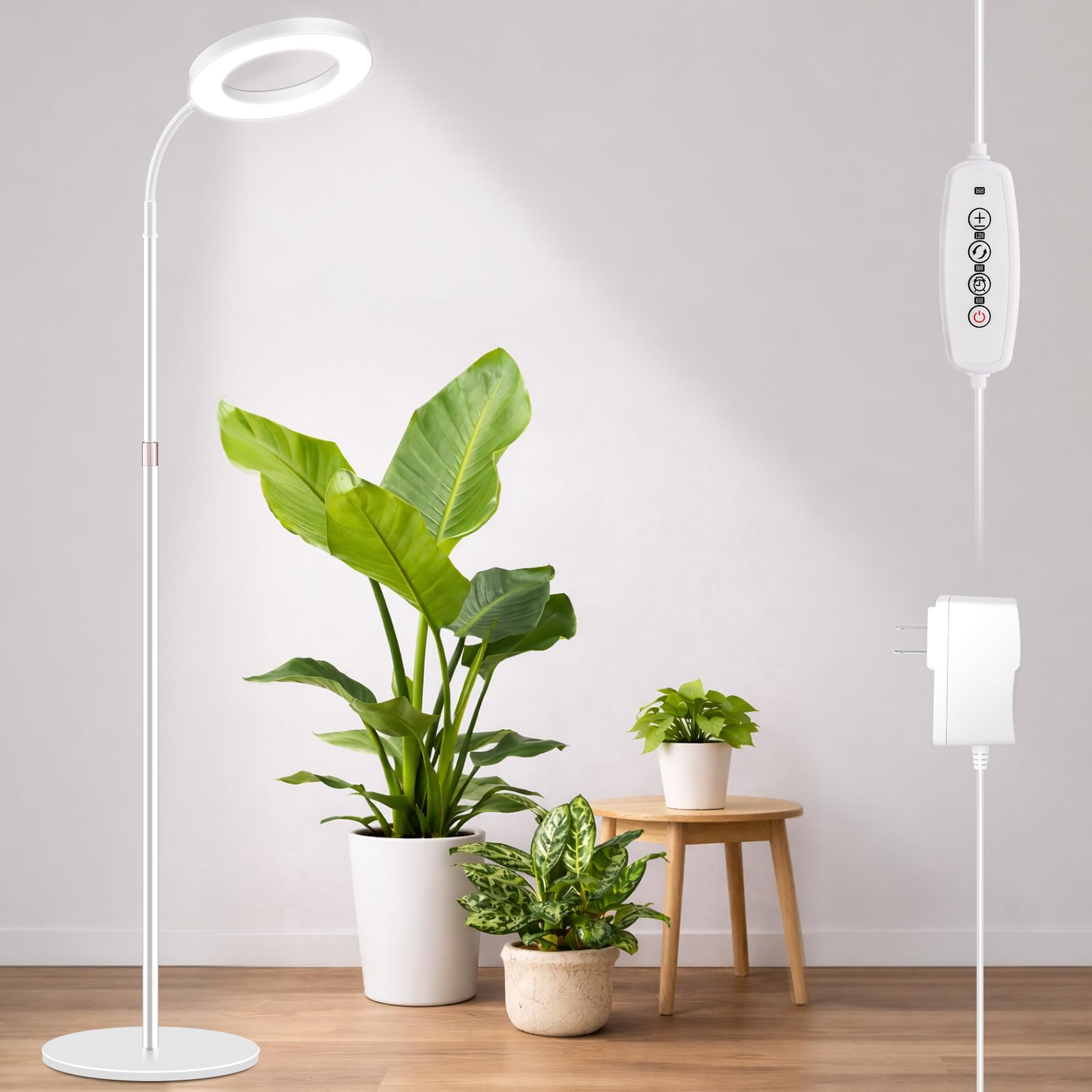
The LBW floor stand light strikes the best balance across height, brightness, and timer versatility for spider plant owners. Its telescoping pole extends from 20 to 68 inches, covering everything from a small pot on a side table to a mature floor specimen with arching leaves that reach 2 feet. The heavy-duty metal base with non-slip pads measures 6.3 inches square and keeps the unit stable even when the pole is fully extended — no wobbling on hardwood or tile.
Eighty high-output full-spectrum LEDs (380–800 nm) produce white light that supports all growth stages without the purple cast of blurple fixtures. The three lighting modes let you choose a neutral white, a warmer tone, or a mixed balance, while five brightness levels (25%–100%) give you granular control. The 6/8/12/16-hour auto timer is genuinely set-and-forget — once you select the cycle, the light turns on and off at the same time daily without resets, ideal for consistent photoperiods during work trips or busy weeks.
Assembly requires no tools — just screw the pole sections together, attach the gooseneck head, and plug in. The 8-inch-wide light panel provides even coverage over a single large spider plant or a cluster of medium pots placed within a 2-foot radius. Owners confirm zero heat output from the LED panel, so there is no risk of leaf burn even when the light is positioned within inches of foliage. The LBW is the definition of a versatile, no-compromise fixture for anyone growing spider plants indoors.
What works
- Telescoping pole from 20 to 68 inches fits any plant size
- 80 full-spectrum LEDs with zero heat emission
- Set-and-forget timer with 4 cycle options
- Stable metal base with non-slip pads
What doesn’t
- Single light head — cannot aim two directions independently
- Gooseneck is not as rigid as heavy-duty metal arms on premium models
5. SANSI LED Grow Lights for Indoor Plants, Dual Gooseneck Clip

SANSI’s dual-head clip light delivers the unique advantage of replaceable bulbs with a lifetime free replacement policy — if a bulb fails, SANSI sends a new one without requiring a full fixture replacement. Each head uses a 10W PAR20 bulb that outputs the equivalent of 300W traditional lighting, driven by SANSI’s ceramic heat-dissipation technology. The light spans 380–800 nm and produces a bright white light that looks natural in a living room setting.
The auto timer offers 4, 8, and 12-hour cycles on a 24-hour repeat. The sturdy clip grips shelves, desktops, and pot rims up to about 1.5 inches thick, and the two independent goosenecks let you angle one head toward a spider plant’s crown and the other toward a stolon with pups rooting nearby. At 2000 lumens total output, this fixture provides ample light for two medium-sized spider plants positioned side by side.
A few owners note that the goosenecks are not quite strong enough to hold the 10W bulb heads perfectly steady — they may droop slightly over time. Additionally, the bulbs can get hot enough to burn leaves if placed within 3 inches, so maintain adequate distance. The clip is also somewhat heavy for very thin or flimsy shelves. Despite these caveats, the build quality, output, and unparalleled bulb-replacement warranty make this a strong choice for spider plant owners who want a long-term lighting investment.
What works
- Lifetime free bulb replacement reduces long-term cost
- 2000-lumen output from two heads covers multiple plants
- White light spectrum looks natural in home decor
- Sturdy clip with dual independent goosenecks
What doesn’t
- Goosenecks may droop under the weight of the bulbs over time
- Bulbs run hot — must keep at least 3 inches from foliage
6. yadoker Grow Light for Large Indoor Plants
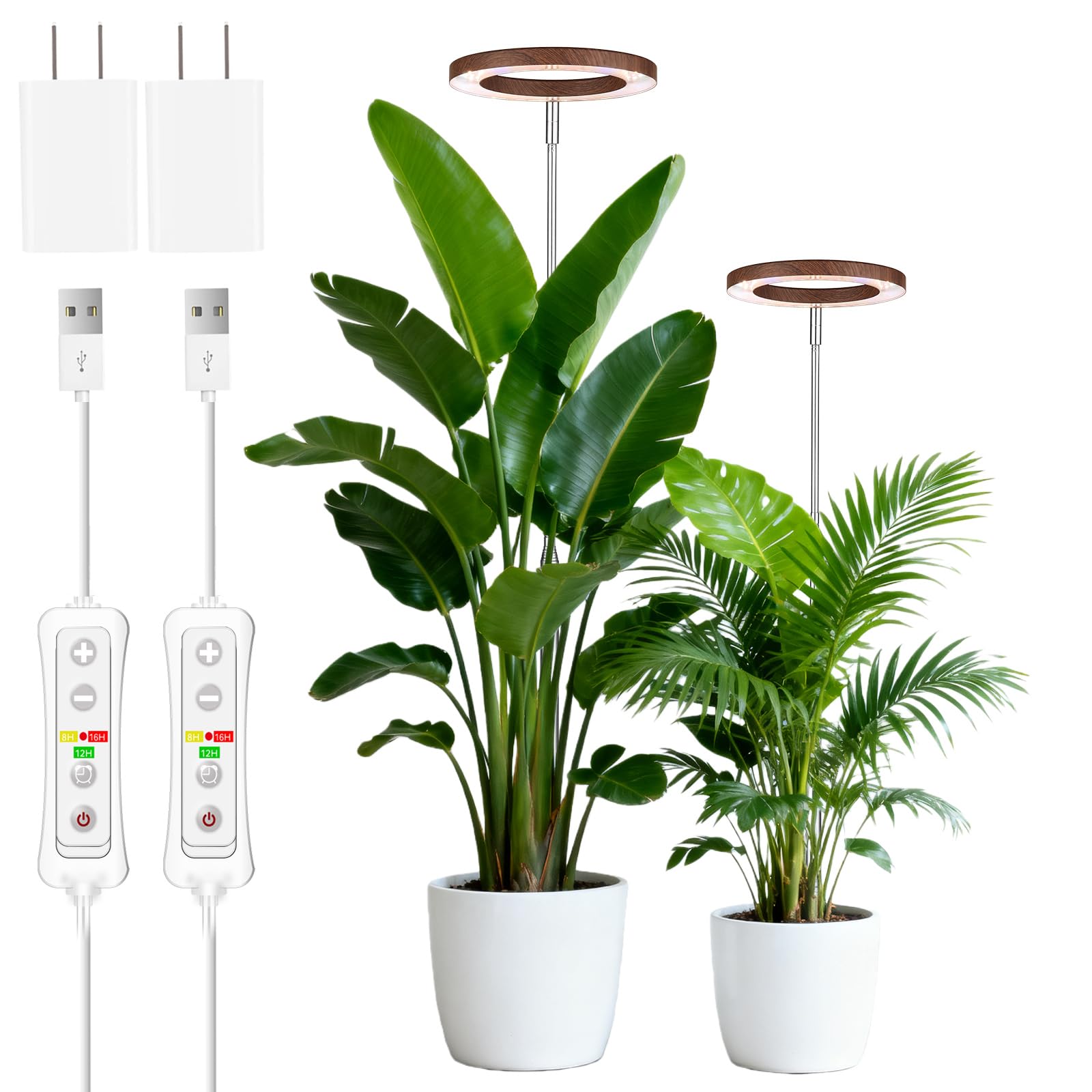
The yadoker floor lamp combines the functionality of a grow light with the aesthetics of a furniture-grade accent lamp. The pole is crafted from aluminum with a wood-grain finish that mimics walnut, and the white aluminum shade has an art-deco profile that blends into living rooms, offices, and reading nooks without screaming “plant light.” This matters for spider plant owners who want supplemental lighting that doesn’t clash with interior design.
The pole extends from 13.7 to 61 inches, covering small to large floor plants. It delivers full-spectrum light (380–800 nm) with 10 stepless brightness levels controlled by a dimmer switch. The built-in timer offers 8-, 12-, and 16-hour cycles — all set via a simple interface on the pole. The 5V low-voltage system keeps the fixture cool and safe, making it ideal for homes with curious pets or small children who might touch the shade.
Downsides include the plastic lens cover, which a few owners report beginning to separate from the aluminum housing after 2–3 months of daily use. The fixture also lacks a gooseneck — the lamp head is fixed at an angle, so you must adjust the entire pole height and rotate the base to direct light. For a single large spider plant in a stationary spot, this is not an issue. For repositioning frequently or aiming at multiple pots, the fixed head is limiting. As a decorative, low-voltage solution for one statement plant, it works beautifully.
What works
- Walnut wood-grain finish and art-deco design enhance room decor
- 5V low-voltage system runs cool and safe around pets
- 10 brightness levels for precise light adjustment
- 61-inch max height accommodates large floor plants
What doesn’t
- Plastic lens cover may separate from housing over extended use
- Fixed lamp head — no gooseneck for angle adjustment
7. SANSI Grow Light for Indoor Plants, Clip-on 10W

The single-pack SANSI clip-on light is the most affordable dedicated fixture in this guide, but its performance disproves the assumption that budget-tier lights are ineffective. SANSI’s ceramic-based LED technology delivers 169.7 μmol/m²/s PPFD at 6 inches — roughly 4.7 times higher than generic 10W grow lights at the same distance. That intensity is sufficient for a single mid-sized spider plant sitting on a desk, shelf, or kitchen counter.
The flexible gooseneck and pot clip attach to rims up to about 1 inch thick, and the clamp is strong enough to hold the light steady without slipping. Four brightness levels (25%, 50%, 75%, 100%) let you start low for a plant adjusting to artificial light and gradually increase intensity. The timer offers 3, 6, and 12-hour cycles with a 24-hour repeat. For a spider plant owner who just wants to supplement a dim corner with a few hours of extra light, this setup is minimal and effective.
Owners report visible results within 2–4 weeks — new leaves, improved variegation, and more stolon production. The main limitation is coverage: the single 10W bulb only illuminates a 1- to 2-foot diameter area. For multiple spider plants or a large specimen with leaves spreading wider than 18 inches, you would need two units or a larger fixture. The cord is also relatively short at around 5 feet, so proximity to an outlet is required. For entry-level supplemental lighting with proven output, this is the smartest budget investment.
What works
- High PPFD output (169.7 μmol/m²/s) for its wattage class
- Ceramic heat sink extends LED lifespan and maintains brightness
- Compact clip-on design fits tight shelf and desk spaces
- 4-level dimming and 3 timer cycles offer flexible control
What doesn’t
- Limited coverage area — best for a single medium pot
- Power cord is short, restricting placement options
Hardware & Specs Guide
PPFD and Distance
PPFD (Photosynthetic Photon Flux Density) measures the usable light that actually reaches the plant surface. Spider plants need roughly 150–300 μmol/m²/s for healthy growth. General rule: a 10W LED at 6 inches delivers about 170 μmol/m²/s, while a 20W unit at 12 inches produces around 100–150 μmol/m²/s. If a fixture lacks published PPFD data, use the wattage and distance as a rough proxy — 10W for close-up single plants, 20W or more for coverage over a 2-foot radius.
Color Temperature and CRI
Full-spectrum white lights typically carry a color temperature of 4000K–6500K (daylight) with a CRI above 80. This range produces a neutral white that shows spider plant variegation accurately. Lights marketed as “warm” (3000K) or “cool” (6500K) are still full-spectrum but tilt the color balance. For spider plants, 4000K–5000K gives the best balance of leaf color accuracy and photosynthetic coverage across blue and red wavelengths.
FAQ
Can spider plants get too much artificial light?
Should I use a clip-on or a floor-standing light for spider plants?
Does the color of the grow light matter for spider plant variegation?
Final Thoughts: The Verdict
For most gardeners, the light for spider plants winner is the LBW Floor Stand Light because it combines 68-inch adjustable height, a stable base, and a set-and-forget timer in a single affordable package that works for spider plants of any size. If you want maximum coverage for a multi-plant shelf setup, grab the Plant Lights 3-Pack Halo Kit. And for a premium single-specimen solution with app-like smart features, nothing beats the GLOWRIUM Dual Heads.