
Your houseplant is stretching toward a window, dropping leaves, or just barely hanging on. The fix is a single bulb you screw into any lamp. A good LED grow bulb delivers the specific light wavelengths plants use for photosynthesis (the process of turning light into energy) without flooding your room with the harsh purple glow that made old grow lights look like a disco for aliens. This guide walks through five options that range from simple screw-in bulbs to smart ones that mimic sunrise, so you can match one to your plant collection, your decor, and the amount of effort you want to put into setup.
I’m Rikta — the co-founder and writer behind Lawn Gear Lab. This guide is built by comparing the manufacturers’ published specifications and the patterns across verified customer reviews, so you get each pick’s real strengths and trade-offs instead of marketing spin.
Once you understand a few key specs like wattage, spectrum (the range of light colors a bulb emits), and how many hours a day you need to run it, picking the right led grow bulb becomes a simple yes-or-no decision per plant.
How To Choose The Best LED Grow Bulb
Match what your plant needs (vegetative growth or flowering) to where you put the bulb (a lamp, a ceiling fixture, or a pendant). The wrong spectrum or insufficient power leaves you with a bulb that lights up a room but does nothing for your monstera.
Spectrum: Full, White, or Targeted Red/Blue
A “full spectrum” bulb includes all wavelengths from about 380nm to 800nm (nanometers — a unit of light wavelength). That range covers what plants use for both leafy growth and flowering. White-light full spectrum bulbs — like the ones in most of our picks — look natural to your eye while still giving plants the red and blue peaks they need. Specialized bulbs like the 660nm deep red option are for flowering stages only; they produce a visible red glow and should supplement, not replace, a white full-spectrum source.
Wattage and Equivalent Wattage: Real Power vs. Marketing
The “wattage” printed on the box tells you how much electricity the bulb actually draws — 9W, 10W, 18W. The “equivalent wattage” like 100W or 150W compares its brightness to an old incandescent bulb. For grow bulbs, the actual wattage matters because it relates to the amount of usable light (measured in micromoles) the bulb produces. A 9W bulb is fine for a single low-light plant in a desk lamp; an 18W bulb can handle a small shelf of plants or a plant that needs medium light.
Form Factor and Base: Does It Fit Your Fixture?
Nearly all standard grow bulbs use an E26 base (the same screw-in size as a regular household bulb in the US). But the bulb shape — A19 (the classic pear shape), PAR20 (a short, wide floodlight shape), or R20 (a reflector shape) — affects how the light beam spreads. A PAR20 bulb like the SANSI focuses light in a narrower 60-degree beam, good for spotlighting a single plant. An A19 or A21 bulb spreads light more evenly, better for a shelf or a room with multiple plants.
Quick Comparison
On smaller screens, swipe sideways to see the full table.
| Model | Category | Best For | Key Spec | Amazon |
|---|---|---|---|---|
| Miracle LED 9W Spectrum Grow Lite | Value Pick | Budget-friendly full-spectrum boost | 9W, CRI 100 | Amazon |
| SANSI Dimmable PAR20 | Best Overall | Single-plant spotlight with timer control | 10W, 150W equiv, 60° beam | Amazon |
| GE Grow LED A19 2-Pack | Versatile Pair | Multiple plants, discreet white light | 16 µmol/s PPF, CRI 90 | Amazon |
| Necgemlex Smart A21 4-Pack | Smart Sun Simulation | Automated sunrise-to-sunset lighting | 9W, 4500K, remote/timer | Amazon |
| HIGROW 660nm Red Light Bulb | Flowering Specialist | Boosting blooms and fruits | 18W, 660nm deep red | Amazon |
In‑Depth Reviews
1. SANSI Dimmable Grow Light Bulb, Full Spectrum with Remote Control
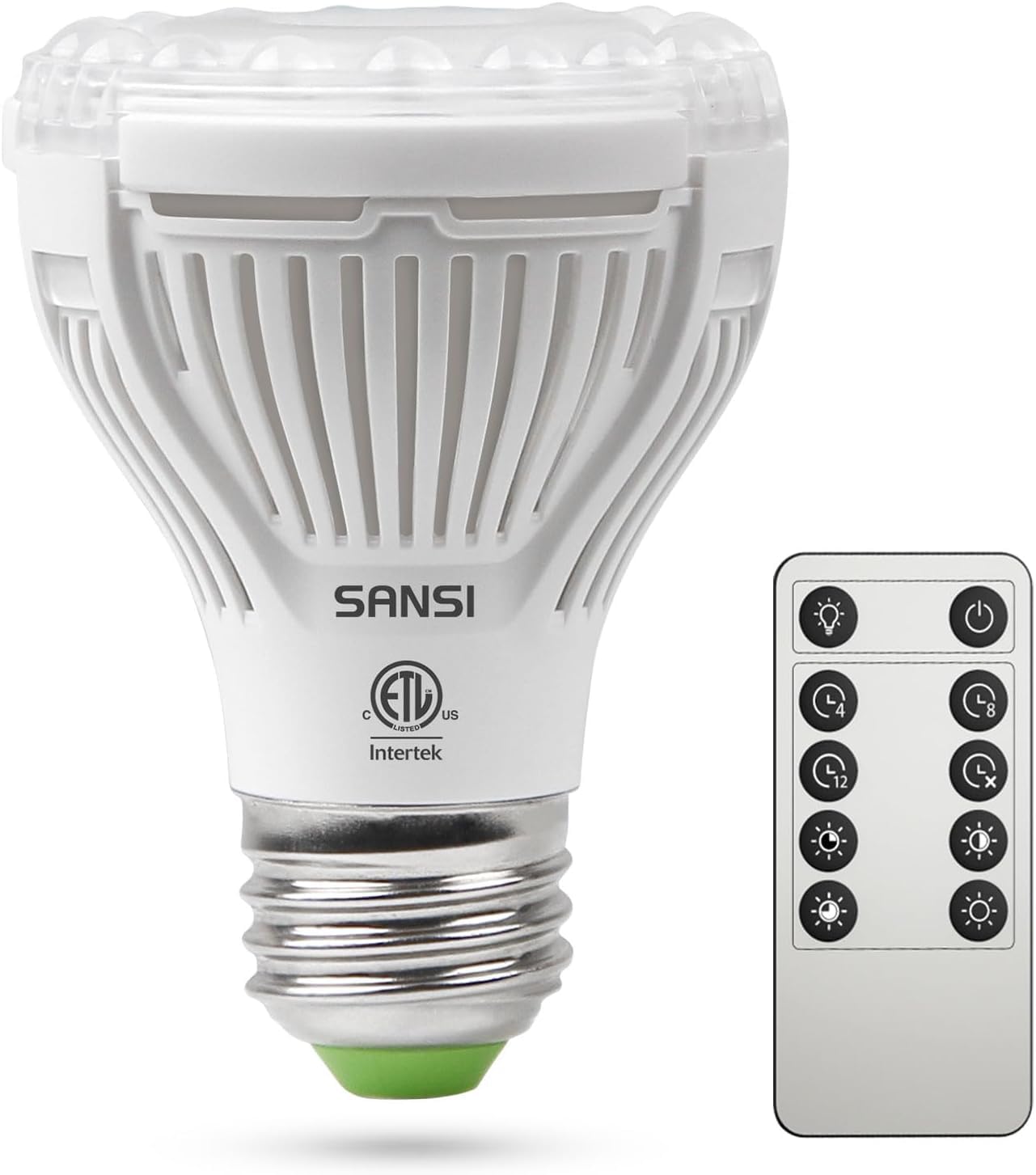
97.91 µmol/s/m² PPFD at 1 foot and a remote-controlled timer make the SANSI dimmable bulb the top pick for anyone who wants a set-and-forget grow light for one or two medium-light plants. It packs four dimming levels (25%, 50%, 75%, 100%) and an 8-hour auto cycle into a compact PAR20 floodlight shape, so you set it for your snake plant and never think about it again. Buyers report their plants are “thriving” on the 8-hour auto setting, and the remote makes adjusting brightness trivial without moving the bulb or the plant.
At a 10W actual draw, it replaces a 150W incandescent equivalent — a 4.2x efficiency gap over a standard red-only bulb. It delivers a measured PPFD of 97.91 µmol/s/m² at 1 foot, which is strong for a single-plant spotlight. The 60-degree beam angle focuses light directly downward so you do not waste photons on the surrounding room. The 4000K color temperature (a warm white, like a cozy desk lamp) makes it pleasant to use as a reading light too.
The catch: with a CRI of 80, it is not as color-true as the GE (CRI 90) or the Miracle LED (CRI 100). The PAR20 shape throws a narrow beam that will not cover a wide shelf of plants well. This is the pick for someone with one or two medium-light plants in a lamp or pendant who wants the most convenient, effective screw-in option available. skip it if you need to light a whole shelf of succulents — the narrow beam will leave the outer plants dark. For a single-plant spotlight with effortless automation, this is the best screw-in bulb you can buy.
Why it’s great
- Built-in timer (4/8/12 hrs) with remote control means no plugging/unplugging
- Four dimming levels let you fine-tune light intensity per plant stage
- 60-degree focused beam delivers high PPFD directly to your plant
Good to know
- CRI of 80 is lower than some full-white bulbs, so colors look slightly less vivid
- Narrow beam angle covers only one plant well — not for shelves or groups
2. Miracle LED Almost Free Energy 9W Spectrum Grow Lite

Where the SANSI beats it on features and focused power, the Miracle LED wins on sheer value and color accuracy. It delivers a CRI of 100 (the absolute maximum, meaning colors look exactly as they would under sunlight) compared to the SANSI’s 80. Owners mention the “excellent neutral white light (not blue/yellow)” that feels like real daylight.
The 9W actual draw replaces a 100W incandescent equivalent. The R20 reflector shape spreads light in a wider pattern than the SANSI’s PAR20, making it a better fit for a small shelf or a cluster of low-light plants like pothos and spider plants. One reviewer reports a “spider plant in dark area has explosive new growth.” The bulb runs for roughly a dollar per year in electricity with virtually no heat output.
So if you are on a budget and want a bulb that simply works — no remote, no timer, no dimming — but offers the most natural-looking light for both you and your plants, choose the Miracle LED. It lacks the smarts of the SANSI but matches it on efficacy for a fraction of the complexity. This is for the buyer who puts one bulb in a lamp over a pothos and wants it to look like a normal light. pass on it if your plant needs more than 9W of actual power — the SANSI at 10W or the GE pair (16 µmol/s PPF) will drive stronger growth.
Where it shines
- Perfect CRI of 100 makes indoor light look exactly like natural daylight
- Extremely energy-efficient, costing about a dollar per year to run
- R20 shape spreads light wider, good for small plant clusters
Worth noting
- No timer, dimming, or remote — you have to unplug to turn it off
- 9W power is sufficient for low-light plants only; won’t drive high-light species
3. GE Grow LED Light Bulb for Plants Seeds and Greens, A19 (2 Pack)

The GE has a PPF (photosynthetic photon flux — the total amount of plant-usable light the bulb emits) of 16 µmol/s. That is solid for a 40W-equivalent A19 bulb, and a CRI of 90 puts it between the Miracle LED’s perfect 100 and the SANSI’s 80 for color accuracy. The classic A19 pear shape is 11% smaller than the A21 form factor of some smart bulbs, so it fits easily under a standard lamp shade without sticking out.
Customers note that “since I started using this my monstera has gotten huge in an otherwise dark room.” The white light does not look like a grow light at all — it blends into your existing decor. The 2-pack gives you two bulbs for the price of one premium smart bulb, making it easy to cover a pair of floor lamps or a multi-arm ceiling fixture.
The standout spec here is the balanced spectrum: GE claims their bulb provides both blue and red light peaks within a white-light envelope. That supports all growth stages from seed to flower without the purple tint that many competitors produce. Just note that the recommended distance is 9 inches from the plant, so you cannot hang it high in a vaulted ceiling and expect results. This is the one to pick if you have two medium plants in separate lamps and want a natural-looking bulb. The SANSI is better for a single plant with auto-timer; the GE pair is better for covering two spots without any smart features.
What stands out
- Natural white light — looks like a regular bulb, fits any decor
- 2-pack provides instant coverage for two plants or two lamps
- High CRI of 90 keeps plant and room colors looking accurate
The trade-offs
- No timer or remote — you need an external smart plug for automation
- Best at 9 inches distance; loses effectiveness the farther it is from the plant
4. Necgemlex Smart LED Grow Light Bulbs A21 (4 Pack)
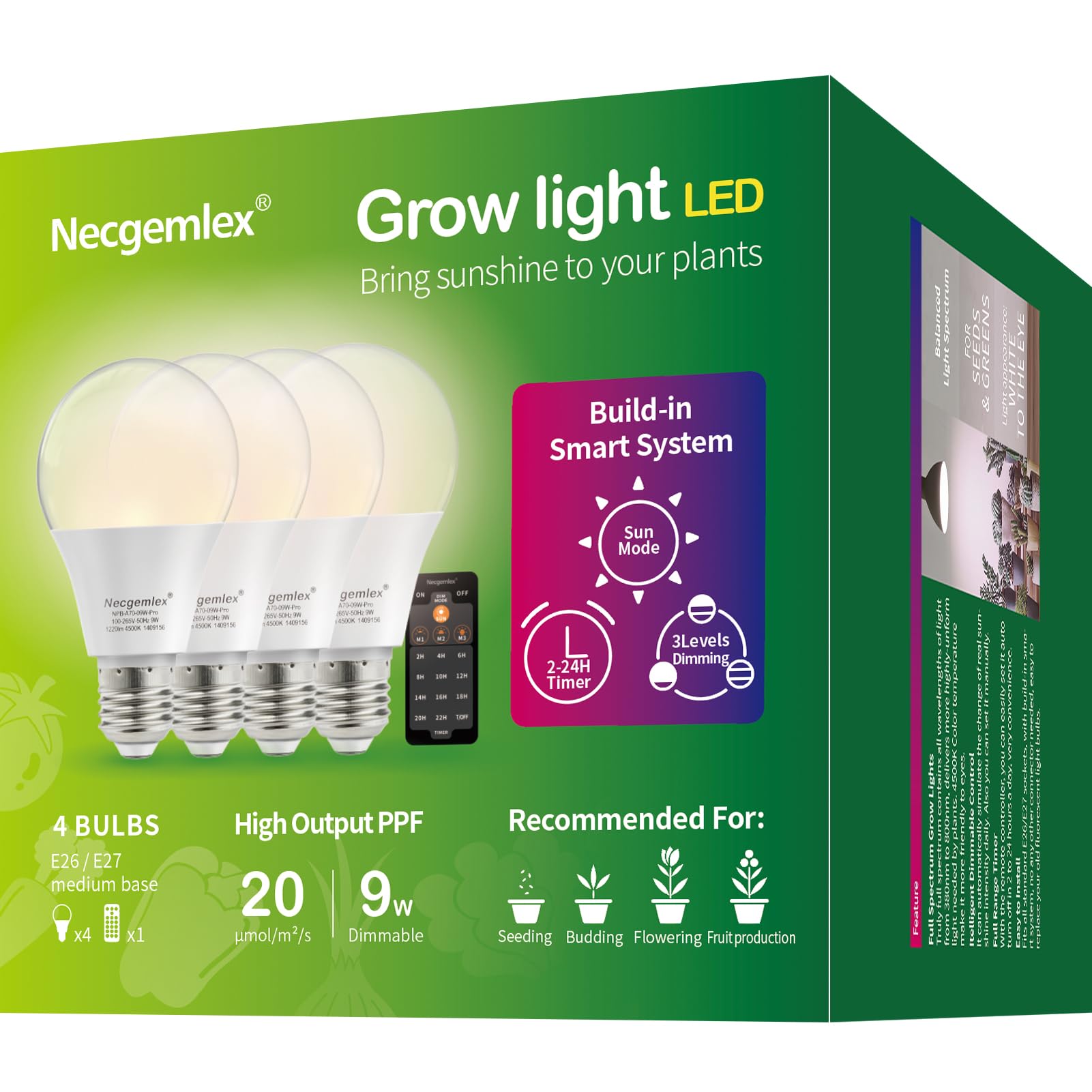
The single number that matters most in this category for anyone who travels or forgets to turn lights on and off is the built-in timer. The Necgemlex pack lets you set each bulb to run for 2 to 22 hours per day once, and it repeats that schedule every day automatically — no app, no Wi-Fi, just a remote. At 4500 Kelvin, it has a 12% higher color temperature than the SANSI’s 4000K, meaning a slightly cooler, more “daylight” white that reviewers point out makes ivy plants on mantels “THRIVING.”
The downside you accept is that the “Sun Simulation Mode” auto-adjusts brightness throughout the day, but a reviewer notes the timer “drifts earlier over time,” shifting from a 7am start toward 6am. It is a minor inconvenience, but if absolute precision matters, you might prefer a simpler bulb with an external timer plug. The A21 shape is slightly larger than a standard A19, so check your lamp shade depth before buying.
At this pack price, you are paying for convenience and coverage — four bulbs that look like elegant sconce lights while feeding your plants. If you have multiple low-to-medium light plants in different rooms and want a set-and-forget solution that also dims to mimic a sunset, this is the best mix of automation and value among the premium picks.
The upsides
- Sun Simulation mode gradually changes brightness to mimic real daylight
- 4-pack covers multiple plants or rooms at a per-bulb price that beats comparable smart bulbs
- Remote control lets you adjust brightness and timer from anywhere in the room
Keep in mind
- Timer drifts slightly over weeks, requiring occasional reset
- A21 form factor is larger than standard A19 — may not fit tight lamp shades
5. HIGROW 660nm Red Light Bulb, 18W

At 18W actual draw (twice the wattage of the 9W Miracle LED) with a 36W incandescent equivalent, this red-only bulb delivers a targeted 660nm deep red spectrum. That specific wavelength triggers flowering and fruiting in plants. If you are growing flowering orchids, tomatoes, or cannabis, this is the supplementary boost that pushes buds — shoppers say “pink-leaved plants respond very well, growing flower buds for first time.”
What you give up: it emits a visible red glow (not the white light of the other picks), so it looks like a grow light and will tint your room red. It also lacks any timer or dimming — it is on when plugged in, off when unplugged. One reviewer notes it “seems weak” as a standalone source for bigger blooms, which is fair: it is designed to supplement a white full-spectrum bulb, not replace it.
This is the exact buyer it is perfect for: someone who already has a white full-spectrum bulb like the GE or Miracle LED for general growth and needs a dedicated red boost during the flowering phase. The 120-degree beam angle is wider than the SANSI’s 60 degrees, so it covers more area, and the aluminum heat sink keeps it running cool even after 24 hours. it’s not for you if you want a single bulb for all-around plant health — pick the SANSI or GE instead.
Why we’d pick it
- Deep 660nm red spectrum is scientifically proven to trigger flowering and fruiting
- Aluminum heat sink allows 24/7 continuous operation without overheating
- 120-degree wide beam covers more plant canopy than focused spotlights
A few caveats
- Red-only light gives a visible glow that may not suit living room decor
- Needs to be paired with a white full-spectrum bulb for complete plant health
Understanding the Specs
PPFD and PPF — How Much Light Actually Reaches the Plant
PPFD (photosynthetic photon flux density) measures the amount of usable light that lands on a specific area — think of it as “sunlight hitting one leaf.” It is measured in µmol/s/m², and a higher number at the same distance means more effective growth. PPF (photosynthetic photon flux) is the total light emitted by the bulb in all directions. For a single plant in a desk lamp, look for a PPFD above 50 µmol/s/m² at 1 foot; for seed starting or higher-light plants, you want over 100.
Color Rendering Index — How Natural the Light Looks
CRI (Color Rendering Index) measures how accurately a light source shows colors compared to natural sunlight, which scores 100. A bulb with a CRI of 90 or above will make your red flowers look red and your green leaves look green — instead of washed out or tinted. High-CRI bulbs are especially important if the grow light is in a visible part of your home, like a living room or bedroom, because they double as pleasant ambient lighting.
Color Temperature — Warm vs. Cool White
Measured in Kelvin (K), color temperature affects how the light feels to your eye. Lower numbers like 2700K produce a warm, yellowish glow (like an old incandescent lamp), while higher numbers like 6500K produce a cool, bluish daylight. For grow bulbs, a color temperature around 4000K to 5000K — neutral white — is ideal because it balances plant needs with comfortable room lighting. The Necgemlex at 4500K and SANSI at 4000K both fall in this sweet spot.
Equivalent Wattage and Actual Wattage
The “equivalent wattage” (e.g., 150W) tells you how bright the bulb appears compared to an old incandescent, but it has almost nothing to do with the energy it uses or its effectiveness for plants. The “actual wattage” (e.g., 10W) tells you the real power draw. For grow bulbs, actual wattage loosely correlates with light output, but efficiency varies between brands. A well-designed 9W bulb can outperform a cheap 15W bulb, so trust PPFD numbers over wattage alone.
FAQ
How many hours a day should I run my LED grow bulb?
Can I use a regular white LED bulb instead of a grow bulb?
How close should the bulb be to my plant?
What is the difference between red and blue light for plants?
Final Thoughts: The Verdict
When it comes down to it, the led grow bulb winner is the SANSI Dimmable Grow Light Bulb because it combines a remote-controlled timer, four dimming levels, and a focused beam that delivers high usable light directly to your plant — all in a compact bulb that also works as a reading light. If you want the most natural-looking light with a perfect CRI of 100 at the lowest price, grab the Miracle LED 9W Spectrum Grow Lite. And for a set-and-forget solution that covers multiple plants with automatic sunrise simulation, the Necgemlex Smart A21 4-Pack offers convenience and coverage on a per-bulb budget.