
Your outdoor plants can look fantastic and pest-free without using harsh chemicals that harm bees or your family. The key is finding a spray that kills the bugs on contact but leaves the rest of your garden ecosystem safe.
I’m Rikta — the co-founder and writer behind Lawn Gear Lab. This guide is built by comparing the manufacturers’ published specifications and the patterns across verified customer reviews, so you get each pick’s real strengths and trade-offs instead of marketing spin.
Here are the specs and realities of the top bug spray for plants outdoor choices on the market.
How To Choose The Best Bug Spray For Plants Outdoor
Picking the right spray depends on what you’re fighting, how badly they’ve infested, and how much effort you want to put into application. Here are the three biggest things to check before you buy.
Contact Killers vs. Systemic Sprays
A contact killer (like a horticultural oil or traditional malathion) kills bugs when it hits them. It works fast on an active infestation but washes off with rain or when the plant grows new leaves. A systemic spray (like Bonide Systemic) is absorbed by the plant and travels through its tissues. Sucking insects (aphids, scale) feed on the plant and die. Systemic sprays last longer (up to a month or more) but they take time to spread through the plant. Choose a contact killer for a quick knockdown on a bad outbreak; choose a systemic for season-long prevention.
Safety: Organic, OMRI Listed, and Bee-Safe
If you have kids or pets near the garden, you want an “OMRI Listed” product like the Grower’s Ally. OMRI stands for Organic Materials Review Institute — a strict review that confirms the product contains no synthetic pesticides. “Bee-safe” means it won’t harm honeybees when applied correctly (usually spraying early morning or evening when bees aren’t active). Products with mineral oil (like Bonide All Seasons) break down quickly in sunlight, lowering risk to pollinators. If you use a harsh chemical like malathion (Hi-Yield), you must follow the label directions exactly and keep all people and pets away until the spray is dry.
Ease of Application: Ready-to-Use vs. Concentrate
Ready-to-use sprays (like the Ortho Rose and Flower) come in a trigger bottle. You just aim and spray — no mixing. They are perfect for small gardens a few roses or a row of bushes. Concentrates (like Bonide Systemic or Hi-Yield Malathion) require you to mix the product with water in a pump sprayer or hose-end sprayer. They give you a lot more coverage per bottle and are cheaper per dose. If you have a large yard or many plants, a concentrate is a better deal. If you just want to treat a single potted plant or two, a ready-to-use spray is simpler and less wasteful.
Quick Comparison
On smaller screens, swipe sideways to see the full table.
| Model | Category | Best For | Key Spec | Amazon |
|---|---|---|---|---|
| Grower’s Ally Crop Defender 3 | Organic | Organic growers & seedlings | 24 oz Ready-to-Use | Amazon |
| Bonide All Seasons Horticultural & Dormant Spray Oil | Year-Round | Large gardens & trees | 32 oz Ready-to-Spray | Amazon |
| Ortho Rose and Flower Insect Killer | Systemic | Roses & flowers | 24 oz Ready-to-Use | Amazon |
| Bonide Systemic Insect Control | Concentrate | Prevention & large areas | 16 oz Concentrate | Amazon |
| Hi-Yield 55% Malathion Spray | Heavy Duty | Stubborn pests | 32 oz Concentrate | Amazon |
In‑Depth Reviews
1. Grower’s Ally Crop Defender 3
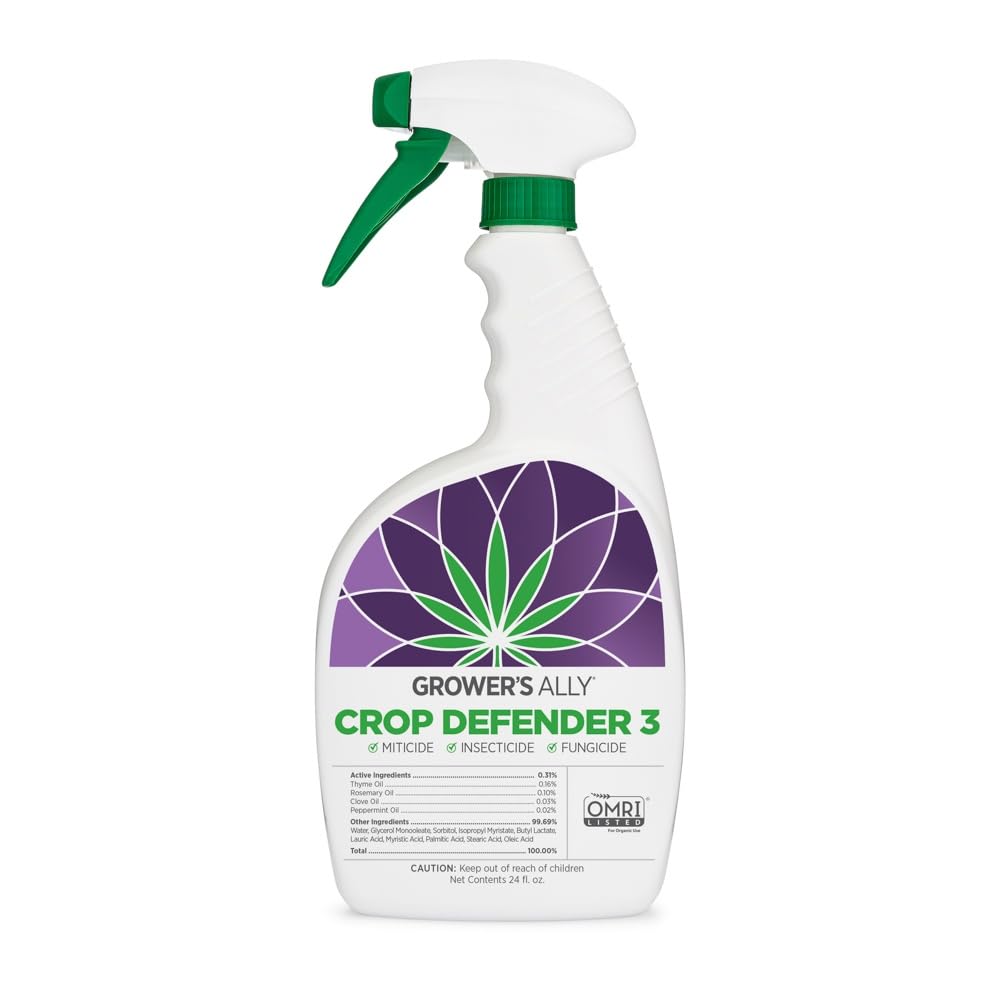
The Grower’s Ally Crop Defender 3 earns the top spot because it works as a miticide (kills mites), insecticide (kills bugs), and fungicide (kills fungus) all in one bottle, yet it’s OMRI Listed (independently approved for organic gardening) — so you can spray it right up to harvest day with zero synthetic residue. Buyers call it the “best spray for aphids and mites” and report it “does not burn the leaves, even on seedlings.”
This 24-ounce ready-to-use bottle goes straight to work on spider mites, russet mites, aphids, and powdery mildew. The triple-action formula uses a blend of botanical oils and a built-in surfactant (a soap-like agent that helps the spray spread evenly across the leaf surface instead of beading up).
The main limit is the bottle size: at 24 oz, you’ll use it up quickly on a medium-sized garden, and there is no concentrate option to mix larger batches. If you grow vegetables or herbs and want a simple, safe spray that won’t burn tender leaves, this is for you. skip it if you have a large yard full of trees — the Bonide All Seasons covers more area faster. For a worry-free, harvest-day-safe spray that tackles bugs, mites, and fungus in one bottle, this is the clear top pick.
Why it’s great
- Triple-action (kills bugs, mites, fungus)
- OMRI Listed for organic gardening
- Safe on seedlings; won’t burn leaves
Good to know
- Only comes in a 24 oz ready-to-use bottle
- No concentrate available for large gardens
2. Bonide All Seasons Horticultural & Dormant Spray Oil

Compared to the top pick Grower’s Ally, the Bonide All Seasons Spray Oil comes in a 32 oz bottle that connects directly to your garden hose, covering tall trees and large bushes far more easily than the Grower’s Ally’s trigger bottle. It uses mineral oil (a simple petroleum-based oil) that smothers insects and their eggs on contact, and it works year-round, including during the dormant season when plants have no leaves.
Buyers report it “took care of the black bean aphids on my Spanish Broom” and “worked overnight on cherry aphids.” The mineral oil is approved for organic gardening and leaves no toxic residue. The hose-end sprayer attaches to your hose, mixes the oil with water automatically, and you just walk across the garden. At 32 fluid ounces, it holds 33% more product than the Grower’s Ally’s 24-ounce bottle, but the real advantage is the continuous hose-feed system — you treat a large property without refilling.
Choose this over the Grower’s Ally if you have tall shrubs, large rose bushes, or fruit trees — the hose-end sprayer makes the job much faster. The catch is that the hose sprayer can be tricky to calibrate: one reviewer noted it “empties the container fast” and is “wasteful” compared to a pump sprayer.
Where it shines
- Covers large areas via hose-end sprayer
- Works year-round, including dormant season
- Approved for organic gardening
Worth noting
- Hose sprayer calibration can be finicky
- Mineral oil may need repeat applications
3. Ortho Rose and Flower Insect Killer

If you have a few prized rose bushes or flowering shrubs and you want a spray you can use without mixing or connecting a hose, the Ortho Rose and Flower Insect Killer is your match. It has a dual-action formula that kills insects by contact (when you spray it on them) and by systemic action (the plant absorbs it, so bugs that chew the leaves die later). It promises to protect for up to 4 weeks per application against over 100 listed insects, including aphids, caterpillars, and whiteflies.
At 24 ounces, this ready-to-use trigger bottle is lighter than the Bonide All Seasons (1.5 lbs vs 2 lbs) and is designed for spot-treating individual plants. Buyers confirm “I use this on all my roses” and that it stopped Japanese Beetles from destroying their blooms. For maintenance on established flowers, it’s a quick, no-mess option.
One buyer mentioned it has “weak systemic” action and “struggles with even small mealybug infestations,” so it’s best as a maintenance spray, not a last-resort cure for serious outbreaks. Skip this if you have a heavy infestation of scale or spider mites — the Hi-Yield Malathion is a stronger match.
What stands out
- Ready-to-use trigger sprayer, no mixing
- Dual-contact and systemic action
- Protects roses for up to 4 weeks
The trade-offs
- Weak systemic action on stubborn pests
- Better for maintenance than heavy infestations
4. Bonide Systemic Insect Control

The single number that matters most in this category is 16 — one 16-ounce bottle of Bonide Systemic Insect Control concentrate mixes with water to make 16 gallons of ready-to-use spray, which is 2.0x larger total volume than the Hi-Yield Malathion concentrate (which makes about 8 gallons from its 32 oz bottle). This makes it the most cost-effective choice for treating a large garden, flower beds, and shrubs season after season.
The active ingredient is acephate, a systemic insecticide (a chemical that travels through the plant’s vascular system) that targets thrips, mealybugs, scale, whiteflies, and spider mites. Owners mention it is “effective immediately against fungus gnats” and stopped “bagworms on arborvitae trees.” Because it’s a concentrate, you control the strength: mix it stronger for a bad infestation or lighter for regular maintenance.
The big trade-off is the smell. Multiple reviewers describe it as “like a dumpster that’s been baking in the sun for a week.” It’s also not for use on vegetables or fruit plants — only on ornamental flowers, shrubs, and roses. For the sheer volume of spray per dollar, it delivers outstanding coverage.
The upsides
- Makes 16 gallons of spray from one bottle
- Systemic control lasts for weeks
- Targets tough pests like scale and whitefly
Keep in mind
- Very strong, unpleasant odor
- Not for use on vegetables or fruit
5. Hi-Yield 55% Malathion Spray
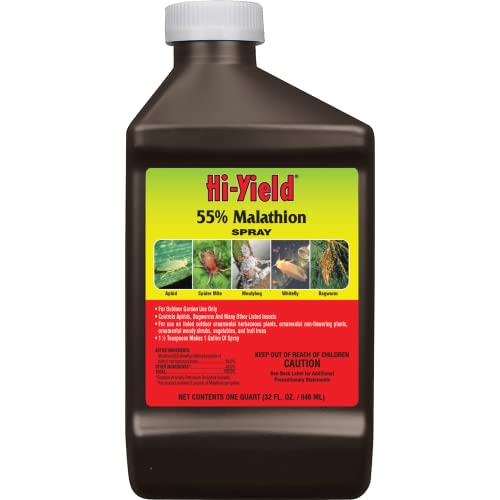
What you actually get at this lower price is a 32-fluid-ounce bottle of Hi-Yield 55% Malathion Spray, the heaviest product here at 2.5 pounds — 67% heavier than the Ortho Rose and Flower (1.5 lbs) — because the concentrated, broad-spectrum organophosphate insecticide requires sturdy packaging. With a 55% malathion concentration, it is the most potent option, designed as a last resort for stubborn pests that other sprays cannot touch.
Customers note it is “effective on stubborn scale and red spider mites” and call it a “miracle cure for mosquitoes.” It works on aphids, thrips, spider mites, lace bugs, and many more. One reviewer says a single summer application “keeps the pests under control all summer.” You mix it with water in a pump sprayer or hose-end sprayer and apply it to herbaceous plants, shrubs, vegetables, and fruit trees.
The serious catch: Malathion is a strong chemical. One reviewer warns it is a “strong suspected carcinogen” and insists you wear full protective gear (long sleeves, gloves, goggles, mask) during application. It is not safe around kids, pets, or bees. If you have a massive infestation that organic sprays won’t fix, this is your nuclear option — but respect the label instructions, or hire a professional for first-time use. This is the exact budget buyer it is perfect for: someone facing a severe, persistent pest outbreak who needs the most aggressive chemical solution available at the lowest price point.
Why we’d pick it
- 55% malathion kills toughest pests
- Effective on scale, spider mites, mosquitoes
- Works on vegetables, fruit, and shrubs
A few caveats
- Requires full protective gear
- Not safe for organic gardens
Understanding the Specs
Active Ingredient
This is the chemical or compound that actually kills the bugs. Common outdoor plant sprays use mineral oil (smothers insects), pyrethrins (natural flower-derived nerve toxin), malathion (strong synthetic organophosphate), or botanical oils (neem, rosemary, clove). Organic options like Grower’s Ally use a blend of oils; chemical options like Hi-Yield Malathion use a single high-concentration pesticide. Choose according to how much strength you need and how careful you have to be around kids, pets, and bees.
Concentrate vs. Ready-to-Use
A “Ready-to-Use” spray (like the Ortho Rose and Flower) comes in a trigger bottle with no mixing required — you just aim and spray. It’s convenient for small jobs. A “Concentrate” (like Bonide Systemic or Hi-Yield Malathion) requires you to mix a small amount of liquid with water in a pump sprayer or hose-end sprayer. Concentrates are cheaper per dose and give you many more applications per bottle, but they require extra effort and caution during mixing.
Systemic vs. Contact Action
Contact killers (like Bonide All Seasons Oil) kill only the bugs that get sprayed directly. They are good for quick knockdown of visible infestations, but they wash off with rain and don’t protect new growth. Systemic insecticides (like Bonide Systemic Insect Control) are absorbed by the plant. When a bug sucks the plant’s sap or chews a leaf, it ingests the poison and dies. Systemics last longer (weeks) and protect new growth, but they take a few days to spread fully through the plant.
OMRI and Organic Certification
OMRI (Organic Materials Review Institute) Listed means the product has been independently reviewed and approved for use in organic gardening under USDA National Organic Program standards. It does not guarantee the product is harmless to pets or bees, but it means it doesn’t contain synthetic pesticides, GMOs, or heavy metals. If you grow vegetables, herbs, or food that you plan to eat, you want an OMRI Listed spray like Grower’s Ally Crop Defender 3.
FAQ
Can I spray bug spray on my outdoor plants on a sunny day?
How often should I apply a bug spray to outdoor plants?
Is it safe to use bug spray on vegetable plants I will eat?
Final Thoughts: The Verdict
For most gardeners, the top bug spray for plants outdoor is the Grower’s Ally Crop Defender 3 — it kills bugs, mites, and fungus in one safe OMRI Listed spray that works on seedlings and vegetables without burning them. If you have large trees or bushes, grab the Bonide All Seasons Horticultural Oil for its easy hose-end coverage. And for a stubborn infestation of scale or red spider mites, the Hi-Yield 55% Malathion delivers the most punch — but wear your gloves and goggles.