
Specs are compiled from manufacturer listings and verified buyer reviews and can change over time — please confirm the key details on the product page before buying.
Yellow spots in the lawn, tomatoes that won’t set fruit, grass that stays thin no matter how much you water — every one of those frustrations points back to one thing: you don’t actually know what is happening under the surface. A lawn soil tester takes the mystery out of the ground by giving you hard numbers on moisture, pH, and nutrients so you stop guessing and start fixing the real problem.
I’m Rikta — the founder and writer behind Lawn Gear Lab. This guide is built by comparing the manufacturers’ published specifications and the patterns across verified customer reviews, so you get each pick’s real strengths and trade-offs instead of marketing spin.
Below you will find seven different ways to read your soil, from a simple moisture-only probe that works in one second to a Bluetooth-enabled digital meter that tracks pH around the clock from your phone — seven of the best lawn soil tester options on the market right now.
Quick Picks
- Luster Leaf Rapitest 4-Way Digital Soil Analyzer — Best Overall
- HSLGOVE Soil Test Kit, 7-in-One — Most Features
- YINMIK Digital pH Tester for Soil — Smart Tech Pick
- Dewilde Trading Co Premium Soil Test Kit — Nutrient Specialist
- Soil Test Kit 140 Tests — High Volume
- 2 Pack Soil Tester, 3-in-1 — Budget Duo
- XLUX Soil Moisture Sensor Meter, 2 Pack — Entry Level
How To Choose The Best Lawn Soil Tester
Most beginners grab the cheapest moisture probe and call it done — then wonder why their lawn still looks bad six weeks later. The reality is that soil problems rarely come down to water alone. Picking the right tester starts with understanding what you are actually trying to measure.
Moisture-Only vs Multi-Parameter Meters
A single-function moisture probe tells you wet or dry in about one second, and that is all it does. If your only worry is root rot from overwatering a potted houseplant, that is enough. For a whole lawn or vegetable garden you need pH and nutrient data — alkaline soil locks up iron even if the ground is soaked, and nitrogen deficiency looks identical to thirst from the surface. Multi-parameter meters that measure pH, fertility, light, and temperature save you from chasing the wrong problem.
Chemical Test Kits vs Electronic Probes
Chemical kits use colored tablets, powders, and test tubes to react with a soil sample, and you match the resulting color to a chart. They take 30-60 minutes per test but they give you separate readings for nitrogen, phosphorus, potassium, and ammonia — numbers a general-purpose probe cannot touch. Electronic probes are faster (seconds to minutes) and easier to repeat across many spots in the yard, but they rarely break nutrients down into individual elements the way a chemical kit does.
Digital Screens and App Connectivity
A simple dial meter with no battery is bulletproof but you have to bend over, read the needle, and remember the number. Digital meters add a backlit LCD screen that shows soil temperature and air humidity alongside moisture and pH. A few premium models connect to a smartphone app via Bluetooth and log readings over time, so you can spot trends across weeks — a feature worth considering if you are managing a large lawn or a greenhouse with multiple zones.
Quick Comparison
| Model | Best For | Test Type | Parameters Measured | Batteries | Amazon |
|---|---|---|---|---|---|
| Luster Leaf Rapitest 4-Way | Digital precision on four key factors | Digital probe | pH, Moisture, Temp, Light | — | Amazon |
| HSLGOVE 7-in-One | One tool for a full soil readout | Dual analog/digital probe | Moisture, pH, Fertility, Temp, Light, Air Temp, Humidity | 3 AAA | Amazon |
| YINMIK Digital pH Tester | Smartphone monitoring and water testing | Digital probe + app | pH (soil & water) | 3 LR44 | Amazon |
| Dewilde Trading Co Premium Kit | Complete nutrient breakdown | Chemical tablet kit | pH, N, P, K | None | Amazon |
| Soil Test Kit 140 Tests | High-volume testing on a budget | Liquid chemical kit | pH, N, P, K, Ammonia | None | Amazon |
| 2 Pack 3-in-1 Tester | Two probes for multiple beds | Analog probe | Moisture, Light, pH | None | Amazon |
| XLUX Soil Moisture Sensor | Ultra-fast moisture-only reading | Analog probe | Moisture | None | Amazon |
In‑Depth Reviews
1. Luster Leaf Rapitest 4-Way Digital Soil Analyzer
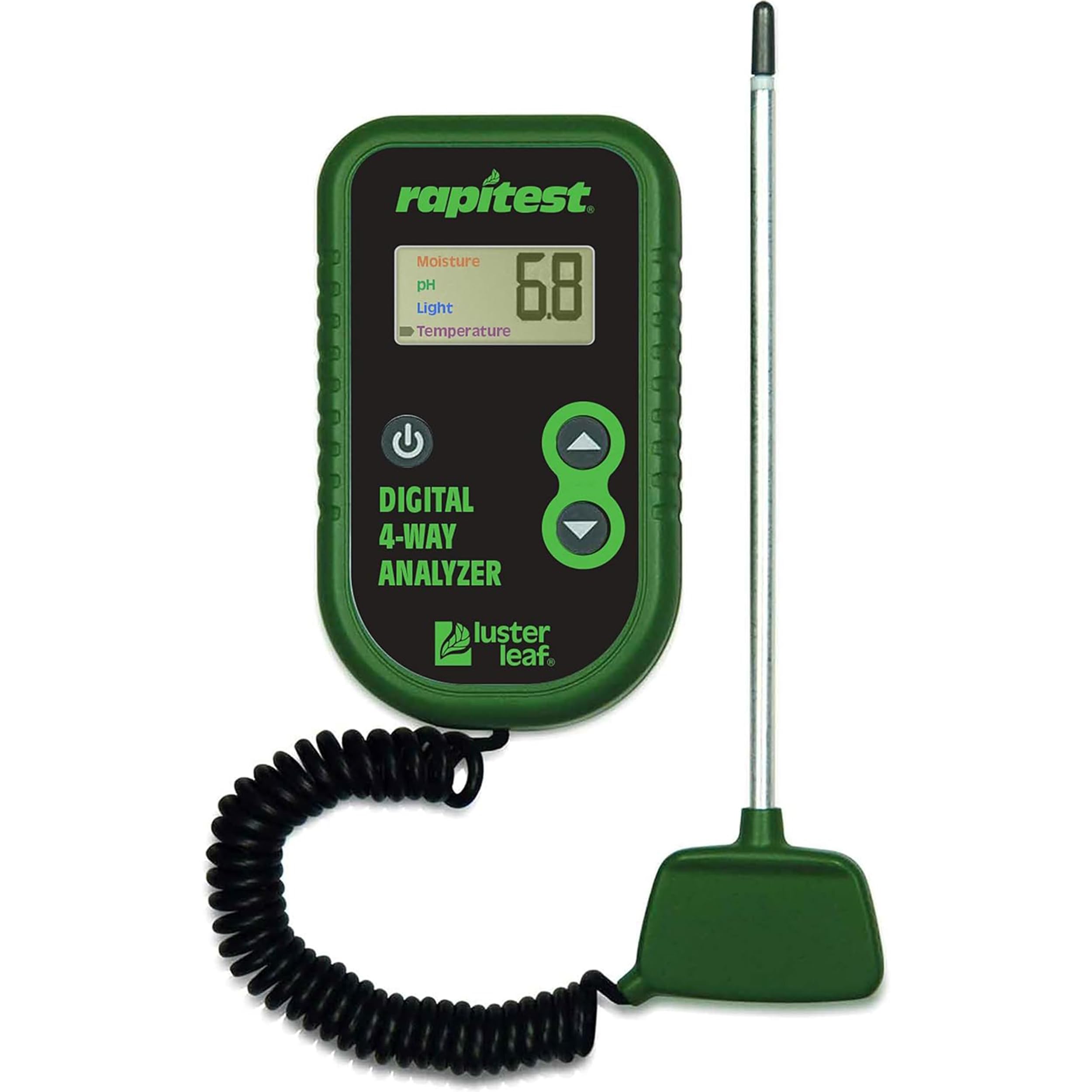
A digital workhorse that checks four soil factors at once with a corded probe for easy reading.
Most lawn problems start with one of four things — pH being too high or too low, soil that is bone dry or waterlogged, ground temperature that is wrong for the season, or light levels that trick you into planting shade grass in full sun. The Luster Leaf Rapitest covers all four with a modern digital output and a corded probe that lets you hold the screen at eye level while the sensor stays in the ground. That may sound minor, but anyone who has bent over trying to read a dial buried in the soil will appreciate the difference immediately.
It measures pH, moisture, temperature, and light, and it includes a full pH plant list for 450+ plants from Rapitest. At 7 ounces and 12 x 7 x 2 inches, it is larger than a pocket probe but still portable enough to move across the lawn. Buyers report that the simple and thorough instructions combined with the full guidelines and gardening tips make it easy for anyone to get started without a soil science degree. The trade-off is that this unit does not break out individual nutrients like nitrogen or potassium — for that you would need a separate chemical kit.
Why it leads
- Four parameters (pH, moisture, temp, light) in one digital tool
- Corded probe means you read the screen without crouching
- Includes 450+ plant pH preferences for cross-referencing
The one gap
- Does not measure individual nutrient levels (N, P, K)
- Larger than a basic single-probe stick
Reach for this if: you want one reliable digital tool that covers pH, moisture, temperature, and light for a whole lawn or garden.
Look elsewhere if: you need a breakdown of nitrogen, phosphorus, and potassium — this analyzer skips nutrients entirely.
2. HSLGOVE Soil Test Kit, 7-in-One
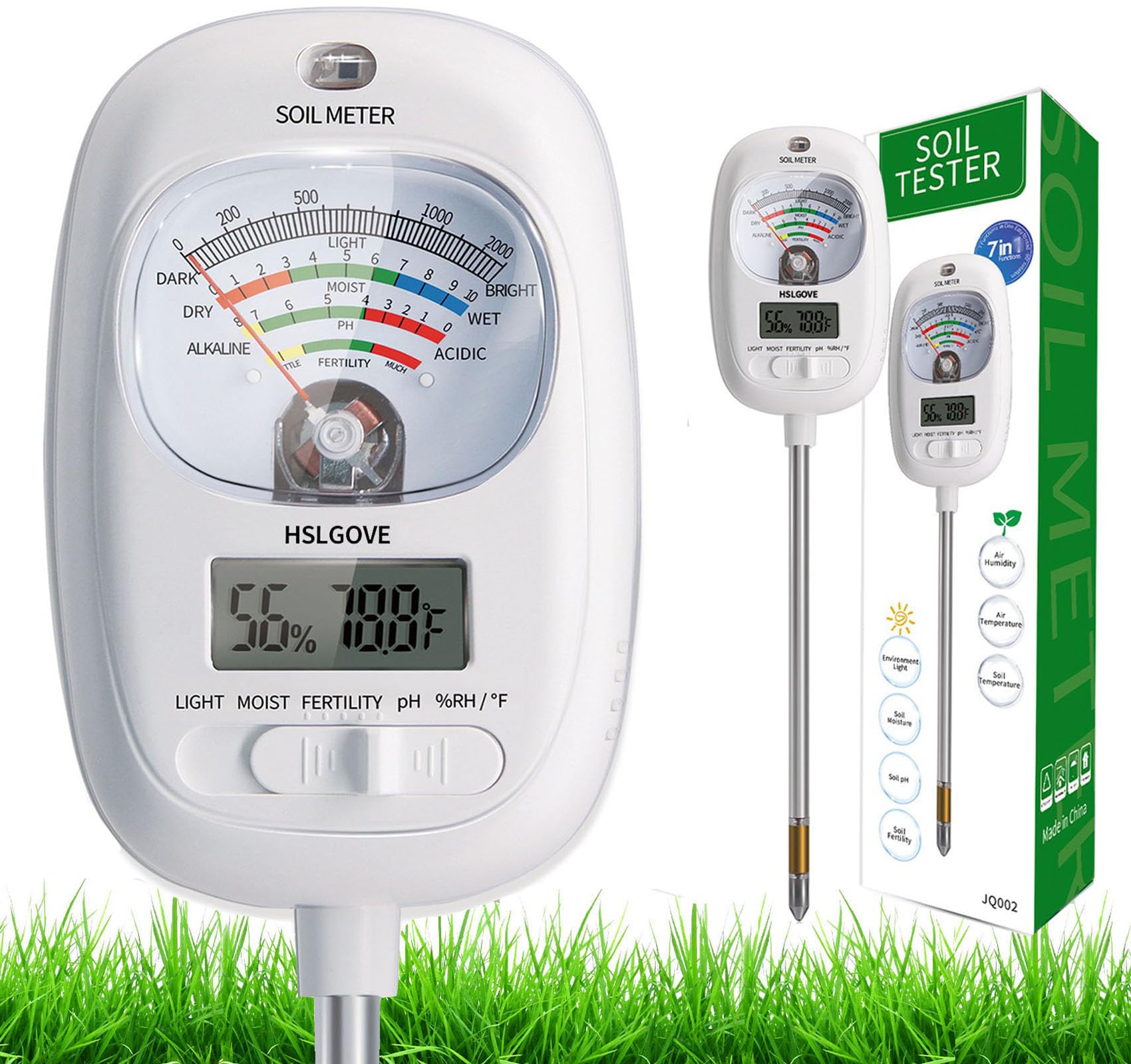
A seven-function dual-screen meter that tracks everything from soil pH to the air humidity above the grass.
The HSLGOVE 7-in-One packs a dial for analog readings alongside an LCD screen that shows soil temperature, air temperature, and air humidity, all on one 11.5-inch body. That is a wider set of measurements than any other all-in-one meter in this lineup — moisture, pH, fertility, soil temperature, sunlight, air temperature, and air humidity. It uses a single probe design based on three metal materials, which is less harmful to plant roots than double-probe meters. The maker claims the 1.6-inch chips board and button-based mode switching give you results in 3-5 minutes for the digital sensors.
Buyers describe it as a very useful tool for plant lovers that delivers quick, stable readings on moisture, pH, and temperature. However, one reviewer — an agronomist — reported that the light sensor failed and the pH readings were inaccurate (too acidic), saying only moisture and temp/humidity were reliable. That split in feedback is worth noting: if you need precise pH data for a high-stakes lawn, you may want to double-check against a chemical kit. At 4.8 ounces, it is heavier than the XLUX (3.5 ounces) but still light enough to carry around the yard.
Verdict at a glance: The widest feature set of any tester here, but buyer reports on pH accuracy are mixed — plan to verify critical pH readings.
Best suited for: hobbyists who want one tool that measures soil and air together, and who are comfortable cross-checking pH with a secondary method.
Not ideal if: you need lab-grade pH accuracy on a large lawn where every tenth of a point matters.
3. YINMIK Digital pH Tester for Soil

A digital pH meter that talks to your phone so you can track soil acidity trends over time.
Where most testers give you a snapshot and make you write it down, the YINMIK stores its data inside a free smartphone app and lets you set up automatic data storage for 24-hour monitoring. Just stick the probe into the ground — or remove the tapered stainless steel dibber (the pointed sleeve that protects the glass electrode) and test water too, including hydroponic nutrient solutions and well water. That dual soil-and-water capability makes it the only pick here that works on both the lawn and the watering can.
The package includes one soil pH meter, a tapered stainless steel dibber, a clean brush, three 1.5V LR44 batteries, six calibration buffer powder packets, a dropper, and a plant pH card. At 10.6 ounces, it is the heaviest tester in this lineup — the extra weight comes from the stainless steel dibber and the electronics. Buyers like that it eliminates the mess of mixing slurries and the frustration of dial pointers that never move. One caveat: the app and automatic storage represent a premium feature that you pay for, so if you only plan to test a single flower bed twice a year, the app adds complexity without much benefit.
The standout spec: Bluetooth-linked 24-hour monitoring lets you see how pH changes after rain, fertilizer, or irrigation — something no analog probe can do.
Grab this for: serious gardeners managing multiple zones or a greenhouse who want pH history on their phone.
skip it if: you just need a quick wet/dry check for a few houseplants.
4. Dewilde Trading Co Premium Soil Test Kit
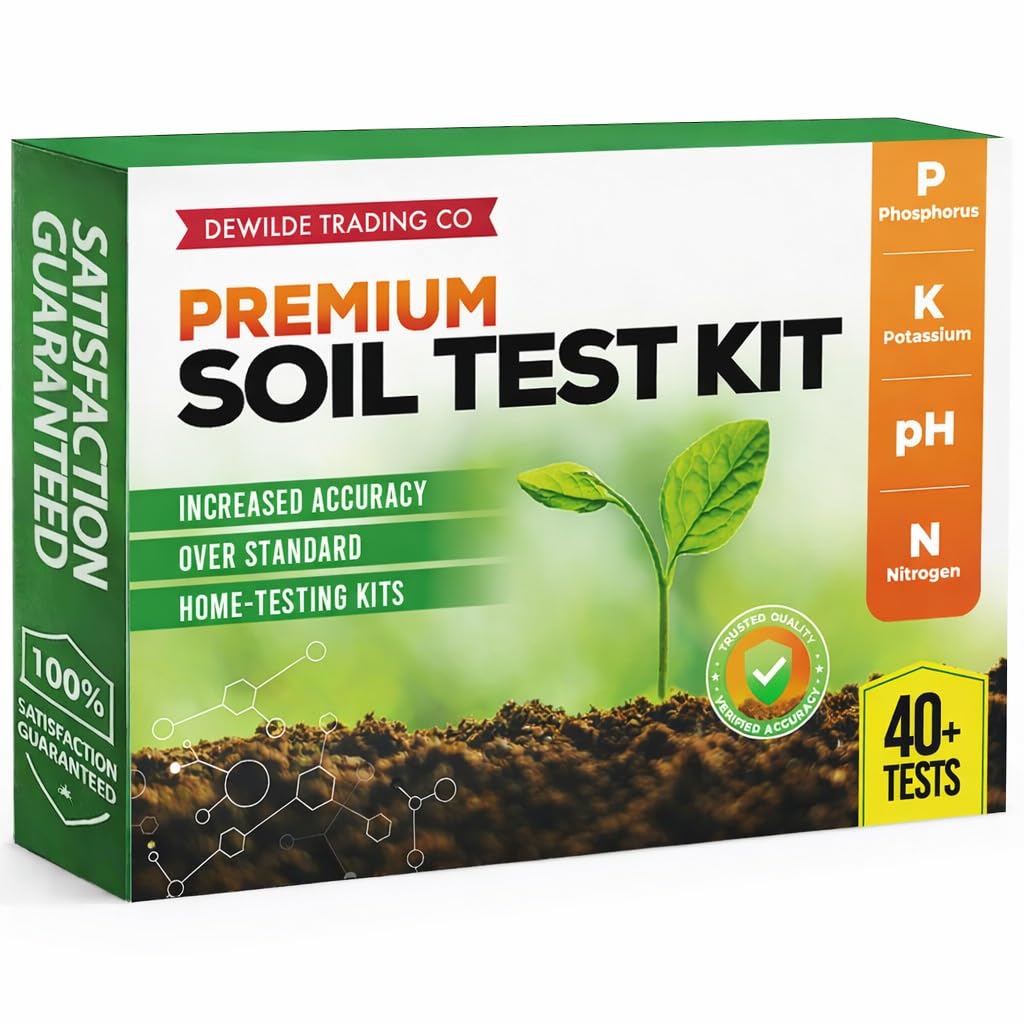
A 40-test chemical kit that splits pH, nitrogen, phosphorus, and potassium into separate tablet reactions.
Probe meters like the XLUX and the HSLGOVE can estimate fertility, but they cannot isolate nitrogen from phosphorus. The Dewilde Trading Co Premium Kit solves that with 40 individual tests — 10 each for pH, nitrogen, phosphorus, and potassium — using tablets, test tubes, and a color card. You mix a soil sample with the reagent, wait for the color change, and match it to the chart. That process takes longer than sticking a probe in the ground, but it gives you four separate numbers instead of one vague fertility reading.
At 6.4 ounces and 7 x 2 x 5 inches, the kit comes with two bottles of test strips, two test tubes, 40 tablets, a dropper, a stick, and a color card. The maker says it is suitable for indoor and outdoor use and works for houseplants, flowers, herbs, trees, shrubs, fruits, and vegetables. Unlike the Soil Test Kit 140 Tests below, this kit uses tablets rather than liquid reagents — some gardeners find tablets easier to handle without spills. The trade-off is 40 total tests versus 140, so if you plan to test your lawn in 20 different spots, you will run out of tablets faster.
What you get
- Separate N, P, K, and pH readings — not a single blended number
- Tablet format is cleaner than liquid drops
- All tools included (tubes, dropper, color card, stick)
What you give up
- 40 tests means fewer retests per season than the 140-test option
- Requires mixing and waiting — not instant like a probe
Choose this for: home gardeners who want actual numbers for N, P, K, and pH and are willing to spend ten minutes per test.
Pass if: you need to test dozens of spots or want instant results without mixing.
5. Soil Test Kit 140 Tests
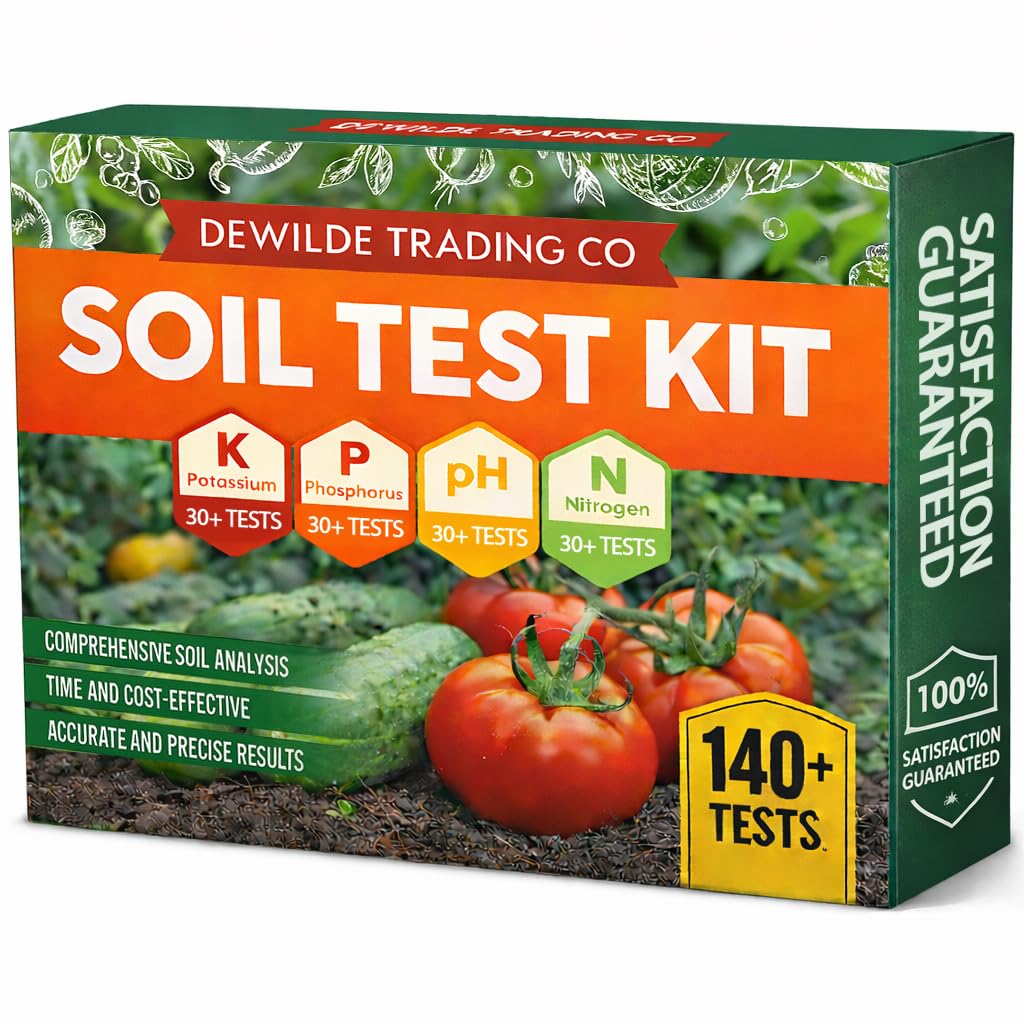
A liquid-based kit that runs 140 tests on pH, nitrogen, phosphorus, potassium, and ammonia.
This is the kit you want when your lawn covers a half-acre and you need to test every section before applying fertilizer. The maker provides about 140 tests total: 40 tests for each parameter and about 20 or so specifically for nitrogen. That is more than triple the testing capacity of the Dewilde Trading Co Premium Kit, and it adds an ammonia reading that most other kits skip. The liquid reagents require careful measuring and clean beakers between tests — owners mention that washing thoroughly between each test is essential for accurate results.
One reviewer noted the kit worked great for their garden, delivering results for N, P, K, and pH in under one hour with easy instructions and a helpful video. Another reviewer mentioned using it alongside an API aquarium testing solution for cross-checking pH accuracy, which suggests the liquid format can produce slightly subjective color-matching results. The whole package weighs just 3.52 ounces and measures 3 x 1 x 4 inches — smaller than the Premium Kit even though it holds far more tests. Unlike the YINMIK digital meter, there are no batteries, no apps, and no screens to break.
Plain take: More tests per dollar than any other option here, but each test takes patience and clean technique — not a grab-and-go solution.
Best for: big lawns and gardens where you need to test many separate zones across a season.
Not for: anyone who wants a two-second reading without mixing liquids or cleaning tubes.
6. 2 Pack Soil Tester, 3-in-1

Two probes in one package that measure moisture, light, and pH without a single battery.
At 2.37 x 1.3 x 10.24 inches and 3.68 ounces per unit, these are slim analog sticks that you push into the soil and read instantly. They cover three parameters — moisture, light, and pH — which puts them ahead of the moisture-only XLUX while costing about the same per unit. The lack of batteries means they will never die mid-season, and you can leave one in the flower bed and one in the vegetable patch without walking back and forth.
The 3-in-1 design stops guesswork on three fronts: whether the soil is dry enough to water, whether the light level matches the plant tag, and whether the pH is in the right range for grass or tomatoes. The trade-off versus the more expensive digital meters is that you read a dial needle instead of a precise number — the pH scale is color-coded but approximate. If you need tenth-of-a-point pH accuracy for a finicky lawn, the YINMIK or Luster Leaf digital units are better. But if you just want two cheap, reliable testers you can leave in the dirt all season, this pair fits.
In short: Simple, battery-free, and cheap enough to have two — but the analog dial means approximate readings, not lab precision.
Reach for this if: you have multiple garden beds and want a no-maintenance tester for each one without buying two separate kits.
pass on it if: you need a digital readout or individual nutrient breakdowns (N, P, K).
7. XLUX Soil Moisture Sensor Meter, 2 Pack
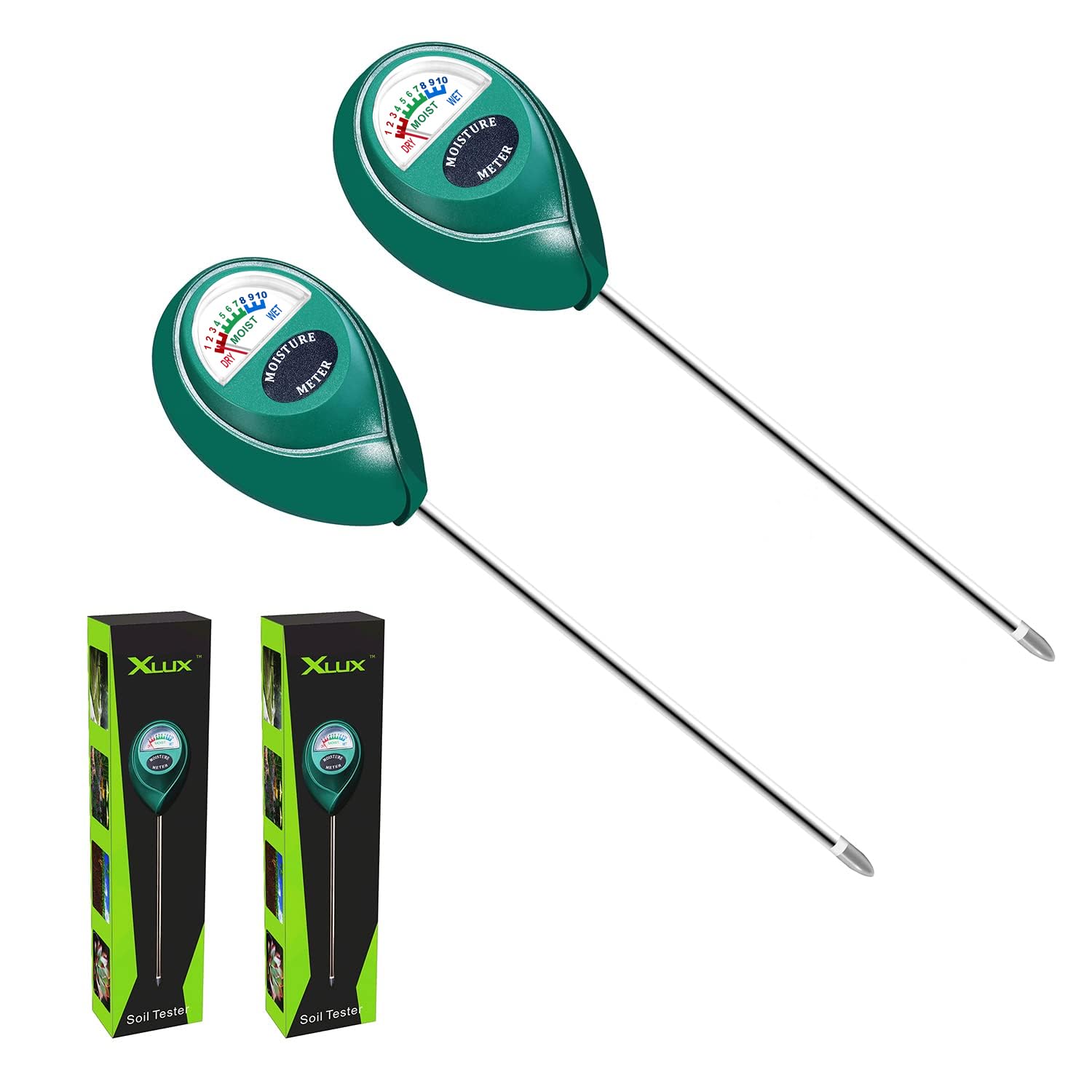
A two-pack of moisture-only probes that give you a reading roughly one second after you push them into the ground.
Sometimes you want to know one thing: is the soil wet or dry? The XLUX does exactly that, with no extra dials for pH, light, or nutrients. One buyer wrote that “it literally takes 1 second to read the moisture in the soil,” and the large dial with three zones and ten scales makes it easy to see at a glance where your soil sits. Each meter is individually packaged in retail boxes, which makes the two-pack a natural gifting option for a gardening friend.
At 3.5 ounces each, these are the lightest testers in the lineup — and smaller than the HSLGOVE (4.8 ounces). The single-probe design causes less damage to plant roots compared to double-probe meters, and when you pull it out, it does not bring up much soil. The catch is that you should not leave it in the soil for more than 5 minutes because the metal tip will gradually corrode. If your lawn has granular fertilizer or hard-packed clay, the manufacturer warns against using it in very hard soil. And unlike the 2 Pack 3-in-1 tester, this one gives you zero information about pH or light levels — it solves overwatering and nothing else.
What works
- Nearly instant moisture reading — customers note about 1 second
- Two meters for the price, individually boxed
- Single probe is gentler on roots than multi-probe designs
What is missing
- No pH, light, or nutrient measurement at all
- Metal tip corrodes if left in soil over 5 minutes
- Not suitable for very hard soil
Ideal for: potted plant owners and small gardens where overwatering is the main concern and you want a fast, cheap fix.
Not enough for: lawn care, vegetable patches, or any situation where pH or nutrient levels are unknown.
Understanding the Specs
pH Measurement Method
Analog probes give you a rough pH range from a dial needle — they compare the electrical conductivity between two metal probes in the soil. Digital meters use a glass electrode that produces a more precise voltage, giving you readings to the tenth of a point. Chemical kits use a dye that changes color when it reacts with the soil solution, and you match the color to a chart. No method is wrong, but digital and chemical tend to be more repeatable than analog dials for the same soil.
Nutrient Testing (N, P, K, Ammonia)
Most probe-style testers label one setting “fertility” and give you a generic low/medium/high reading. That tells you the total salt concentration in the soil, but it does not split it into nitrogen (green growth), phosphorus (root and flower development), potassium (overall plant health), or ammonia (a nitrogen source). Chemical kits are the only reliable way to get those four separate numbers, and they are the reason a kit like the Soil Test Kit 140 Tests still outperforms a probe on nutrient detail.
FAQ
Can I leave a soil moisture probe in the ground permanently?
Will a lawn soil tester work in hard clay soil?
What is the difference between analog and digital soil testers?
How many tests do I get from a chemical soil test kit?
Do I need to calibrate a digital soil pH meter?
Can I use a lawn soil tester to check water or hydroponic solution?
Why does my soil tester show the wrong pH compared to a lab test?
Do soil testers work in frozen ground?
Final Thoughts: The Verdict
For most people, the best lawn soil tester is the Luster Leaf Rapitest 4-Way Digital Soil Analyzer because it balances four critical measurements (pH, moisture, temperature, light) in a digital format with a corded probe that makes reading easy. If you want individual nutrient breakdowns for nitrogen, phosphorus, and potassium, grab the Dewilde Trading Co Premium Soil Test Kit. And for smartphone-connected pH monitoring that works in both soil and water, the standout is the YINMIK Digital pH Tester.
How We Picked
We do not accept paid placement. Every pick is matched to a real buyer and a real use-case; we do not hands-on test units.
Sources & Methodology
Specifications: manufacturer listings and product documentation. Review insights: verified customer reviews, as of July 2026. Pricing: not shown on this page (it changes often); check the current price via the retailer link.
As an Amazon Associate, Lawn Gear Lab earns from qualifying purchases. This does not affect which products we feature.