
If you are reading this, your mower’s motor has either seized, lost compression, or started making a sound that no amount of hoping will fix. The only question now is which replacement motor delivers the power your deck needs without forcing a full custom rewire. The real difference between a good swap and a nightmare install comes down to three numbers: the shaft diameter, the mounting bolt pattern, and the type of oil lubrication it uses. This guide breaks down six of the most popular lawn mower motors on Amazon right now, explaining exactly which one fits your tractor, your tiller, or your log splitter — and which spec you cannot afford to guess on.
I’m Rikta — the co-founder and writer behind Lawn Gear Lab. This guide is built by comparing the manufacturers’ published specifications and the patterns across verified customer reviews, so you get each pick’s real strengths and trade-offs instead of marketing spin.
After looking at displacement, horsepower, shaft dimensions, and real owner feedback, one motor consistently comes out ahead as the most versatile and reliable lawn mower motor for the widest range of replacement jobs.
How To Choose The Best Lawn Mower Motor
Replacing a lawn mower motor is different from buying any other part — you are essentially swapping the heart of your machine. Get the shaft size wrong by an eighth of an inch, and your blade or pulley will not spin. Get the horsepower too low, and your mower will bog down in thick grass. Get the lubrication wrong, and the engine seizes after one season. Here are the four specs that separate a weekend bolt-on from a two-week headache.
Shaft Diameter and Keyway
This is the single most common reason a new motor does not fit. The shaft (the metal rod sticking out of the motor) must match the diameter of the pulley or blade adapter on your equipment. A riding mower typically uses a 1-inch shaft, while smaller walk-behind mowers or tillers use a 3/4-inch or 7/8-inch shaft. The keyway (the slot cut into the shaft where a small metal key locks the pulley in place) must also match. For example, the maXpeedingrods 212cc motor uses a 3/16-inch keyway on its 3/4-inch shaft, which is common for smaller equipment. Meanwhile, the Briggs & Stratton 17.5 HP INTEK uses a 1/4-inch keyway on a 1-inch shaft — a setup typical for riding mowers. Measure your original motor’s shaft before ordering anything.
Vertical vs. Horizontal Shaft Orientation
This is a make-or-break distinction. Vertical shaft motors (where the crankshaft points downward) are used on standard walk-behind mowers where the blade sits directly under the engine. Horizontal shaft motors (where the shaft sticks out sideways) are used on equipment like log splitters, tillers, go-karts, and some commercial mowers with belt-driven decks. The Briggs 33S877 is a vertical shaft motor designed for a riding mower. The BILT HARD 420cc is a horizontal shaft motor designed for a log splitter or tiller. Putting the wrong type into your machine will not work without extensive fabrication.
Displacement and Horsepower
Displacement (measured in cubic centimeters, or cc) tells you the size of the engine’s combustion chamber. A larger displacement generally means more torque (twisting force) to handle thick grass or heavy equipment. Horsepower (HP) is the engine’s peak output. A 19 HP Briggs motor has a 540cc displacement and delivers enough power for a large riding mower with a 50-inch or larger deck. A 7 HP maXpeedingrods motor has a 212cc displacement and is better suited for a small tiller or a go-kart. As a rule, you want your replacement motor to have displacement and HP at least equal to your original engine — going slightly bigger (like replacing an 18.5 HP with a 19 HP) is fine and often gives you a performance boost.
Oil Lubrication System
Cheaper, smaller engines use a splash lubrication system where a rotating dipper flings oil around inside the crankcase. This is simple and reliable for light-duty use. More expensive, larger engines use a full-pressure lubrication system with an oil pump that actively pushes oil to critical bearings and components. Pressure-lubricated engines (like the Briggs Professional Series) have an oil filter and last much longer under heavy continuous loads — the catch is higher cost and more complexity. If you are replacing a motor on a commercial mower or a machine that runs for hours at a time, pressure lubrication is worth the premium.
Quick Comparison
On smaller screens, swipe sideways to see the full table.
| Model | Category | Best For | Key Spec | Amazon |
|---|---|---|---|---|
| Briggs & Stratton 33S877 | Premium | Riding mower replacement | 540cc / 19 HP / Vertical Shaft | Amazon |
| BILT HARD 420cc | Mid-Range | Log splitters and tillers | 420cc / 15 HP / Horizontal Shaft | Amazon |
| Briggs & Stratton 17.5 HP INTEK | Premium | Tractor replacement | 500cc / 17.5 HP / Vertical Shaft | Amazon |
| maXpeedingrods 212cc | Value | Tillers and go-karts | 212cc / 7 HP / Horizontal Shaft | Amazon |
| Briggs 725EXi | Mid-Range | Walk-behind mower swap | 160cc / Pull Start / Vertical Shaft | Amazon |
| Briggs & Stratton 49T877 | Premium | Zero-turn commercial mowers | 810cc / 27 HP / V-Twin | Amazon |
In‑Depth Reviews
1. Briggs & Stratton 33S877-0019-G1 Professional Series 19 HP 540cc
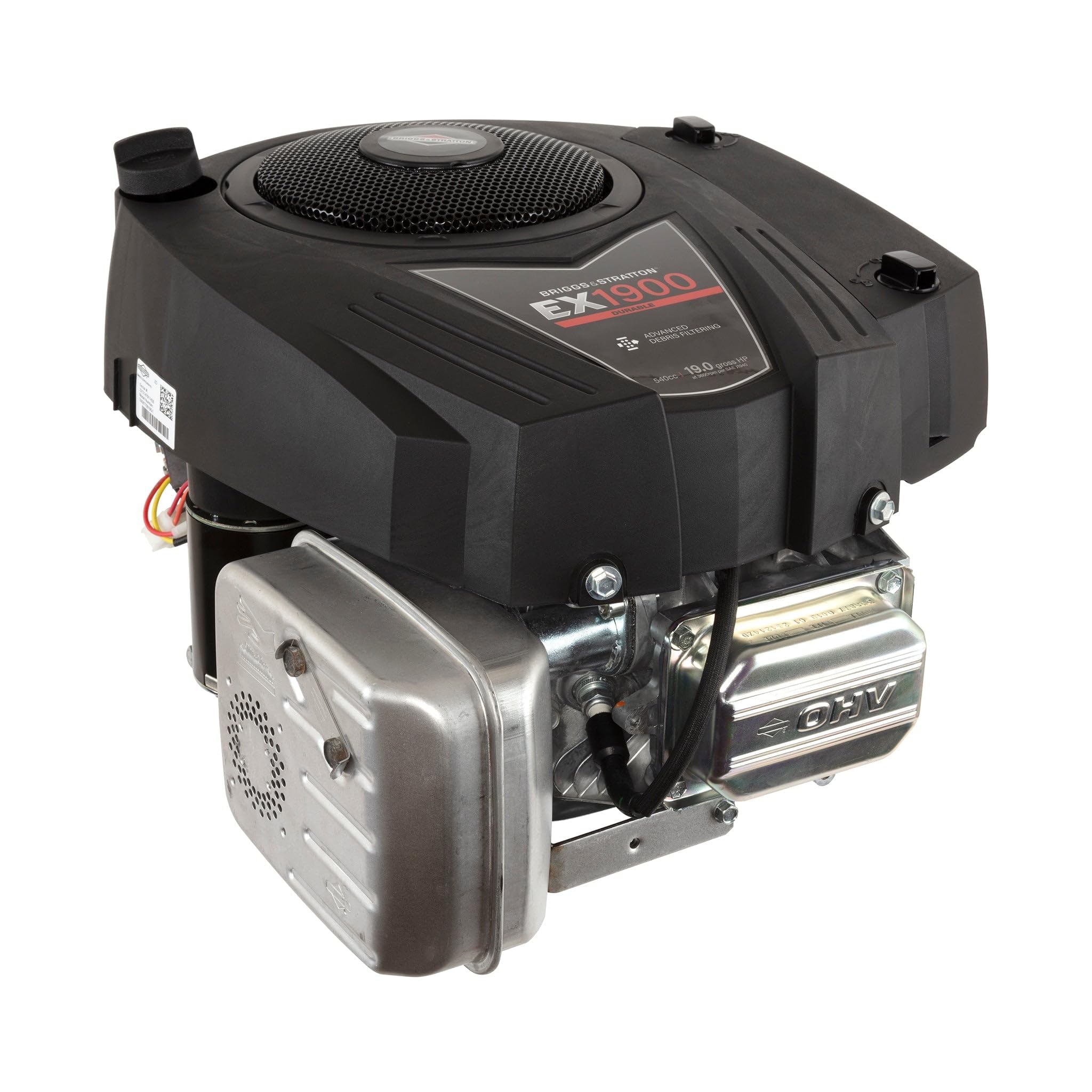
The 540cc vertical-shaft motor is the top pick for anyone who needs to bring a riding mower back to life — whether a Husqvarna, Snapper, or Exmark — because its full-pressure lubrication system with an oil filter is the same spec you find on commercial engines, and it delivers a measured 3400 RPM at peak speed.
With an iron cylinder sleeve cast into the block, buyers report it often outlasts the chassis it is bolted into. One verified owner replacing an 18.5 HP Briggs in a Husqvarna YTH18524 said it was a “plug and play” swap with mount holes that aligned perfectly, needing only self-tapping bolts and a side-muffler kit. The 19 HP rating gives you a 0.5 HP boost over the 33R777 it replaces — enough to feel the difference on a 50-inch deck.
At 77 pounds, this is a heavy motor, so you will want a helper or a hoist for the install. It also ships without the mounting bolts pre-threaded — you must run a tap through the holes or buy new bolts. If your old riding mower needs a durable, pressure-fed heart that will run for years, this is the confident choice.
Why it’s great
- Full pressure lubrication with replaceable oil filter
- 540cc displacement clears heavy grass without bogging
- Rated 19 HP matches or exceeds most original motors
Good to know
- At 77 lbs, it is 54.1 lbs heavier than the lightweight Briggs 725EXi
- Mounting holes require threading — not pre-threaded from factory
- No muffler included; must reuse or buy separately
2. BILT HARD 420cc 15HP Gas Engine with Electric Start

Against the top-pick maXpeedingrods, the BILT HARD 420cc delivers 15 HP and 3800 RPM—more than double the 7 HP and 212cc of the maXpeedingrods, and 400 RPM faster than the Briggs Professional Series’ 3400 RPM. This extra torque and speed suit heavy jobs like log splitting, tillers, or cement mixers where high pressure is critical.
One owner replacing a 30+ year old Briggs on a log splitter reported it “starts first pull” and runs “with power to spare.” The electric start adds convenience on cold mornings, while the cast-iron cylinder sleeve and splash lubrication keep it running cool. The 1-inch diameter shaft with a 1/4-inch keyway fits most industrial and agricultural attachments.
Two caveats: the 3.48-inch shaft is shorter than some older Honda GX390 replacements, so check pulley alignment; one unit arrived with a broken exhaust manifold (Amazon support resolved it). Choose this over the top pick if you need a horizontal-shaft motor with substantially more power for heavy-duty equipment—not for a riding mower, which requires a vertical shaft like the Briggs 33S877.
Where it shines
- Electric start for zero-pull convenience
- 420cc / 15 HP handles tough log splitters and tillers
- 3800 RPM max speed is 12% faster than premium vertical engines
Worth noting
- Ships without oil or gas — requires manual filling
- Reported quality inconsistency with shipping damage
- 30-day warranty is short compared to brand-name engines
3. maXpeedingrods 7HP 212cc 4 Stroke OHV Horizontal Shaft Engine

If you are swapping a tired 5 HP motor on a small tiller, mini bike, or go-kart, this 212cc engine gives you the most bang for your buck. Its 3/4-inch shaft diameter with a 3/16-inch keyway is a direct fit for many older Roper and Cub Cadet tillers. One buyer confirmed it was a “direct fit on 5 hp Roper tiller, no mods needed” and started on the second pull. At 33 pounds, it is easy for one person to maneuver into place without a hoist.
The low-oil sensor protects it from self-destruction if you skip a refill, and the OHV design improves fuel efficiency compared to older flathead engines. The bore and stroke measure 70mm x 55mm, giving it an 8.5:1 compression ratio that provides solid torque for its size.
The downside is that this is a pull-start only motor — no electric start option — and at 7 HP, it will not be enough for a large riding mower or a commercial log splitter. The 3/16-inch keyway is smaller than the 1/4-inch keyway found on larger motors like the Briggs 17.5 HP, so confirm your equipment’s pulley before ordering. For small-scale equipment where budget matters most, this is a superb replacement. With an 8.5:1 compression ratio and a 70mm x 55mm bore and stroke, this 33-pound engine delivers solid torque while staying affordable.
What stands out
- Direct bolt-on for many Roper and Cub Cadet tillers
- Low oil shut-off protects against accidental damage
- 33 lbs is easy for one person to install
The trade-offs
- No electric start option
- 7 HP is underpowered for large riding mowers or log splitters
- 3/16″ keyway may not match older equipment without adapters
4. Briggs & Stratton 49T877-0004-G1 Commercial Turf Series 27 HP 810cc V-Twin
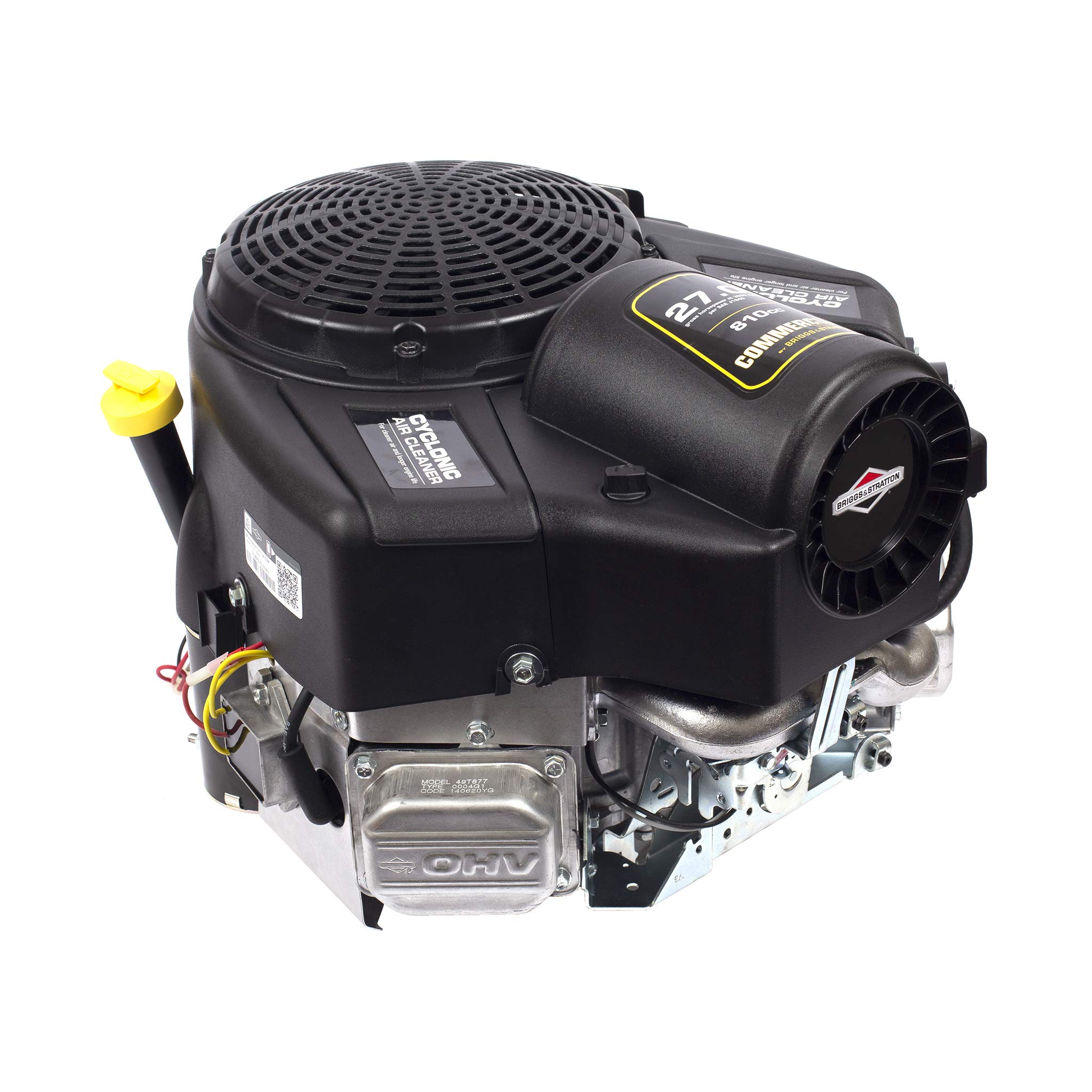
The single number that matters most in this category is displacement: at 810cc, this V-Twin motor is the largest and most powerful of the six picks. The cyclonic air filter (a pre-filter that spins heavy debris out of the air before it reaches the main filter) lasts twice as long as a standard panel filter, which matters when you are mowing dusty properties all day.
One owner who repowered a 2006 Bob-Cat ZT227 zero-turn confirmed it had “plenty of power” and fit under a low hydraulic oil cooler with no modifications. Another swapped it in for a Kohler 25 HP on a Bad Boy zero-turn, noting it was a “direct fit” with the same electrical connector and correct crankshaft. The full-pressure lubrication system with a spin-on oil filter keeps the V-Twin running reliably even under sustained high loads.
The trade-off is that this is an expensive motor, and you are paying for premium features like a specific-fit design. The shaft is 1-1/8 inches by 4-5/16 inches, which is a larger diameter than standard 1-inch shafts — verify your existing pulley’s bore before purchase. For high-end zero-turn mowers, this motor delivers professional-grade longevity, making its price-to-value read as a premium investment for those who need maximum displacement and durability.
The upsides
- 810cc V-Twin delivers 27 HP for demanding commercial mowing
- Cyclonic air filter lasts 2x longer than standard filters in dusty conditions
- Full pressure lubrication with spin-on oil filter for extended life
Keep in mind
- High price limits it to serious upgrades or replacements
- 1-1/8″ shaft is non-standard for many residential mowers
- Shipped weight is heavy — requires a hoist or helper for install
5. Briggs and Stratton Vertical 17.5 HP 500cc INTEK Engine 9amp

What you actually get at this lower price is a direct bolt-in vertical shaft replacement for mid-sized riding mowers like a Toro Timecutter or Craftsman LT1000, with a 1-inch shaft, 1/4-inch keyway, and tapped 7/16-inch-24 threaded end that matches the most common riding mower standard. One owner who replaced a 16 HP engine in a Toro Timecutter 1642z said it was “plug and play” with no wiring splicing needed and started instantly.
The cast-iron cylinder sleeve and dual-element air filter give it a longer service life than cheaper aluminum-bore engines, and the patented linear balancing system reduces vibration noticeably compared to the older 16.5 HP motors it often replaces. The 500cc displacement produces 17.5 HP at 3400 RPM, which is the same peak speed as the larger 540cc Briggs, meaning your blades will spin just as fast on a standard deck.
A few owners noted that it does not include a wiring harness or muffler, so you must reuse your old components. One reviewer noted a failed ignition coil after 50 minutes of run time, though they were able to swap in the old coil to get it running again. For a smooth, drop-in upgrade on a residential riding mower, this is a top contender. If you need more power for a 50-inch or larger deck, the 19 HP Briggs 33S877 is the better bet. This engine is perfect for the budget buyer who wants a reliable, no-frills replacement for a standard 42-inch or 46-inch residential deck without paying for extra power they won’t use.
Why we’d pick it
- Plug-and-play electrical connectors for most Toro and Craftsman models
- Patented linear balancing system reduces handle vibration
- Cast-iron cylinder sleeve for long-term durability
A few caveats
- No wiring harness or muffler included
- 0.01 oz listed weight is clearly wrong — unit is actually heavy
- Some owners mention ignition coil issues shortly after install
6. Briggs and Stratton 725EXi Series 4-Cycle Gas Engine
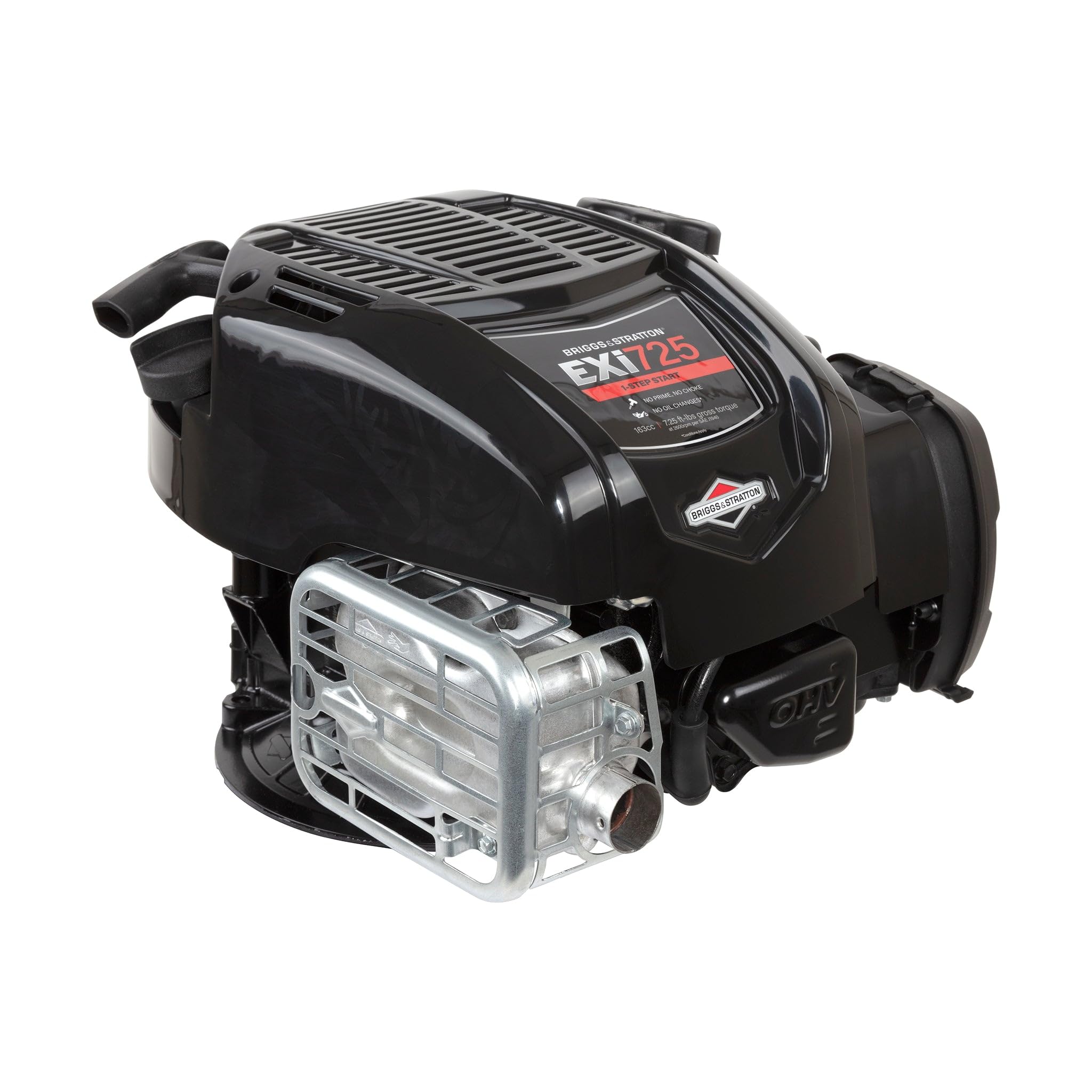
This 160cc motor is perfect for anyone swapping the engine on a walk-behind mower — an old Craftsman, Toro, or Snapper — because it is the lightest and simplest option here at only 22.9 pounds. That is 4.9 pounds lighter than the maXpeedingrods 212cc motor and dramatically easier to lift onto a mower deck. The Ready Start system (a technology that eliminates the need to choke or prime the engine) means you just pull the cord and it starts, no fuss.
The 725EXi uses a Magnetron electronic ignition (a computer-controlled ignition module that fires the spark plug at the exact right moment without any points to adjust), which eliminates routine maintenance. One owner who replaced a 6.75 HP motor on a 30-year-old Craftsman said it “bolted up with old hardware” and started on the first pull. The fuel tank has an angled neck designed to reduce spills when filling, and the aluminized muffler keeps it quieter than older engines.
If you want a lightweight, no-fuss engine for a walk-behind mower you plan to use for a few seasons, this fits the bill. If you need a motor for a riding mower or expect to service it for many years, choose the Briggs 33S877 or the INTEK instead. Just be aware that this motor has no oil drain plug — the manufacturer designed it to be disposable rather than serviceable, so once the oil wears out, you cannot change it without tipping the engine over.
Strong points
- Lightest motor on this list at 22.9 lbs — easy one-person install
- Ready Start needs no primer or choke, just pull the cord
- Magnetron electronic ignition removes routine maintenance
Before you buy
- No oil drain plug — not designed for long-term oil changes
- No throttle linkage or on/off switch included
- Requires 15 oz of 10W30 synthetic oil before first start
Understanding the Specs
Displacement (cc) and Horsepower
Think of displacement as the size of the engine’s digestive system — a larger number means it can burn more fuel and air per revolution, producing more torque to push through thick grass. Measured in cubic centimeters (cc), a 540cc motor has 2.5 times the volume of a 212cc motor. Horsepower (HP) is the peak output you feel at the blade or pulley. A 19 HP motor is 2.5 times more powerful than a 7 HP motor, so choose your HP based on the deck size and job. For a 42-inch riding mower, 17.5 HP is enough. For a 60-inch zero-turn, you need at least 24 HP.
Shaft Diameter and Keyway
The shaft is the metal rod that spins your blade, pulley, or axle. If the diameter is wrong, the blade adapter will not fit. Most walk-behind mowers use a 7/8-inch or 3/4-inch shaft, while riding mowers use a 1-inch shaft. The keyway is a small slot cut into the shaft where a tiny metal key locks the pulley in place so it does not slip. A 1/4-inch keyway is common on larger motors, while a 3/16-inch keyway is found on smaller ones. Always measure your original motor’s shaft — a 1/16-inch difference means nothing fits.
Vertical vs. Horizontal Shaft
Vertical shaft motors have the crankshaft pointing down, spinning the blade directly. These are used on standard walk-behind mowers and riding mowers where the engine sits on top of the cutting deck. Horizontal shaft motors have the crankshaft pointing sideways, driving a belt or pulley. These are used on log splitters, tillers, go-karts, and water pumps. Putting the wrong type on your machine requires a custom adapter plate and a complete re-engineering of the drivetrain — it is almost never worth the hassle.
Oil Lubrication Type
Splash lubrication uses a rotating dipper inside the crankcase that splashes oil onto moving parts. It is simple, cheap, and adequate for light-duty engines under 10 HP. Full-pressure lubrication uses an oil pump to actively push oil to bearings, the crankshaft, and the camshaft through internal passages — plus it passes through a replaceable oil filter. Pressure-lubricated engines (like the Briggs Professional and Commercial Turf series) last significantly longer under heavy use because every moving part gets a continuous oil supply.
FAQ
Can I replace a vertical shaft motor with a horizontal shaft motor?
How do I know if a new motor will bolt onto my mower deck?
What does the low oil sensor do on a lawn mower motor?
Is a V-Twin motor always better than a single-cylinder motor?
Final Thoughts: The Verdict
For most riding mower owners, the best lawn mower motor is the Briggs & Stratton 33S877 because its 540cc displacement, full-pressure lubrication system, and reliable electric start offer a perfect blend of power and durability for mid-to-large residential decks. If you need a horizontal-shaft motor for a log splitter or tiller, grab the BILT HARD 420cc — its 15 HP and electric start make it a powerhouse for heavy jobs. And for a budget-friendly swap on a small tiller or go-kart, the standout is the maXpeedingrods 212cc, which buyers confirm is a direct fit on vintage Roper and Cub Cadet equipment.