
Specs are compiled from manufacturer listings and verified buyer reviews and can change over time — please confirm the key details on the product page before buying.
Every fall weekend you fill another paper lawn bag, only to watch it dissolve in the first rain before pickup day arrives. That sinking feeling when you hoist a soggy collapsed mess is the exact moment many people start looking for a better large compost bag — something that actually holds leaves, grass clippings, and garden debris until the truck comes, then breaks down without a trace. The good news is that a new generation of 30-to-55-gallon plant-based bags delivers exactly that: real durability during use and real compostability after.
I’m Rikta — the founder and writer behind Lawn Gear Lab. This guide is built by comparing the manufacturers’ published specifications and the patterns across verified customer reviews, so you get each pick’s real strengths and trade-offs instead of marketing spin.
Seven options dominate the conversation right now, from budget-friendly 100-packs to premium certified performers, and each solves a slightly different problem. if you need bags that survive a Florida downpour or giant 55-gallon liners for a massive yard-cart full of clippings, here is my breakdown of the best large compost bags on the market today.
Our Picks at a Glance


How To Choose The Best Large Compost Bags
The first thing to look at is the bag’s thickness — measured in mils (thousandths of an inch) or microns (millionths of a meter) — because that determines whether wet grass clippings or pointy twigs will punch through it. Thinner bags (around 1 mil) handle leaves and general yard waste fine, while heavier-duty options (1.57 mil) are better if you regularly pack dense food scraps or sharp garden prunings, so the bag won’t tear open on the way to the curb. Pair that with the right gallon size for your outdoor bin: most standard yard carts work with 30-to-33-gallon bags, but if you use a large commercial-style can, 55-gallon flat-top bags prevent overfill by providing extra capacity for large yard carts..
Certification — what the labels actually prove
A bag labeled “compostable” should carry one or more recognized certifications: ASTM D6400 (the U.S. standard for municipal composting), BPI certification (which verifies ASTM compliance), or OK Compost HOME/INDUSTRIAL from TÜV Austria. These matter because your local waste processing facility may require them to accept the bag. A plain “biodegradable” bag without those stamps meets no standard and may not break down in a reasonable timeframe. Stick to certified compostable bags if you need confidence that they’ll actually decompose.
Quantity vs. frequency — how many bags do you really need?
This is where your seasonal workload changes the math. A 100-count box of 33-gallon bags (like the Reli. Biodegradable option) will last most households an entire season or more, making it a budget-friendly buy. On the flip side, a 12-count box of 55-gallon bags is perfect if you only need a few giant liners per month for a once-a-week yard cart dump. The catch with larger counts is storage: plant-based compostable bags have a shelf life of about 10 to 12 months before they start breaking down on the roll, so don’t stock up more than you’ll use in a year.
Quick Comparison
| Model | Best For | Capacity | Thickness | Count | Amazon |
|---|---|---|---|---|---|
| Reli. Biodegradable 33 Gal★ Best Overall | Budget value per bag | 33 gal | 0.6 mil | 100 | Amazon |
| Simply Bio 50-55 GalHeavy Duty | Heavy-duty yard waste | 55 gal | 1.57 mil | 12 | Amazon |
| BIOGRN 50-55 Gal | Triple-certified compostability | 55 gal | 1.57 mil | 12 | Amazon |
| Reli. Compostable 33 Gal | Certified 33-gallon composting | 33 gal | 28 mic | 40 | Amazon |
| ECOLipak 33 Gal | Mid-count certified value | 33 gal | 1 mil | 50 | Amazon |
| Stout by Envision 30 Gal | Premium reliability | 30 gal | 1.10 mil | 48 | Amazon |
| SUPERBIO 33 Gal | Top-rated certified performance | 33 gal | 1 mil | 40 | Amazon |
In‑Depth Reviews
1. Reli. Biodegradable 33 Gallon Trash Bags, 100 Count
Our pick — 4.5★ from 668 verified ratings; the strongest balance of quality and price.
The 100-count workhorse that makes each bag cost pocket change.
If your main requirement is high volume at a low per-bag cost, this is where the math gets easy. At 100 bags per box, you are looking at an entire season or more of yard work covered in one purchase. The bags measure 33 inches by 39 inches, which fits standard 30-to-35-gallon cans and even compactor bins comfortably. Designed with a 0.6 mil thickness, they are certified biodegradable under ASTM D6954 — meaning they break down when exposed to moisture, oxygen, and soil — so they meet the landlord or city checklist for eco-friendly disposal.
Buyers report that the bags are “good quality, no tears or leaks” and hold up for six months or more under normal use. That said, the plastic is thinner than non-biodegradable alternatives — the data is clear: 0.6 mil is a light-duty construction. Sharp twigs and renovation debris will poke holes easily, and odor can permeate if you store filled bags too long. One owner summed it up: “Good for leaves, just careful if any twigs or small sticks get in the bag, they can easily poke a hole.” A Florida buyer noted they work better than paper bags in heavy rain, since they decompose slowly only if left out in the sun for weeks.
The real trade-off is that these bags are biodegradable, not certified compostable — they lack the ASTM D6400 or BPI stamps that some municipal composting programs require. Use them for yard waste bound for the landfill (where they’ll eventually degrade) or for curbside green bins that accept biodegradable plastics. They are not the right pick if your city insists on certified compostable liners for industrial processing.
What wins people over
- 100 bags per roll — lowest cost per bag in the lineup
- Holds up well with leaves and grass under normal conditions
- Biodegradable under ASTM D6954, better for landfill than standard plastic
The honest limitations
- 0.6 mil — thinner than many compostable options, punctures from sharp items
- Not certified compostable (ASTM D6400 / BPI) — not accepted at all facilities
Who this bag fits: Large households or landscapers who go through dozens of bags each season and want maximum value per bag without sacrificing basic eco-friendliness.
Think twice if: Your local waste program requires certified compostable (ASTM D6400) bags, or you regularly pack sharp kitchen waste and twigs that will puncture thin plastic.
2. Simply Bio 50-55 Gallon Compostable Trash Bags, 12 Count
The 1.57 mil wall that keeps wet grass where it belongs.
When you fill a yard cart the size of a small car, a standard 33-gallon bag just won’t cut it. These Simply Bio bags open to a massive 42 inches by 48 inches with a 55-gallon capacity — 67 percent more room than the 33-gallon Reli. bag above, all in a single liner. The 1.57 mil thickness is the thickest you’ll find on this list, built with a star-sealed bottom that resists leaks. That construction makes them a practical choice for heavy yard waste, food scraps, and restaurant kitchen debris where a tear would mean a messy cleanup.
The thing everyone raves about is the durability — 53 separate owner comments single it out as the top reason to buy. The bags are made from plant-based PLA and PBAT materials and carry BPI, OK Compost HOME, OK Compost INDUSTRIAL, and Seedling certifications, meeting both U.S. ASTM D6400 and EU EN 13432 standards. That’s a full suite of certifications that most municipal composting facilities will recognize on sight. The flat-top design also makes filling and tying easier than drawstring models when the bag is packed to the brim.
The 12-count box is smaller than the 100-count Reli., but at 55 gallons each, the total volume is comparable. If you want a single bag to handle a whole weekend’s worth of garden cleanup, this is the one.
The standout strengths
- Thickest construction in the list — 1.57 mil resists tearing and punctures
- Four certifications (BPI, OK Compost HOME/INDUSTRIAL, Seedling) — universally accepted
- 55-gallon size fits large yard carts and commercial bins
Know before you buy
- Only 12 bags per box — high per-bag cost
- Wet contents cause the bag to degrade quickly — about 10 days before the bottom may fail
Reach for this when: You need a giant 55-gallon liner for heavy, wet yard waste that must be picked up within a week, and you want every certification your city could demand.
Look elsewhere if: You compost slowly or need bags that can sit wet for two weeks or more — the plant-based material will break down first.
3. BIOGRN 50-55 Gallon Compostable Trash Bags, 12 Count
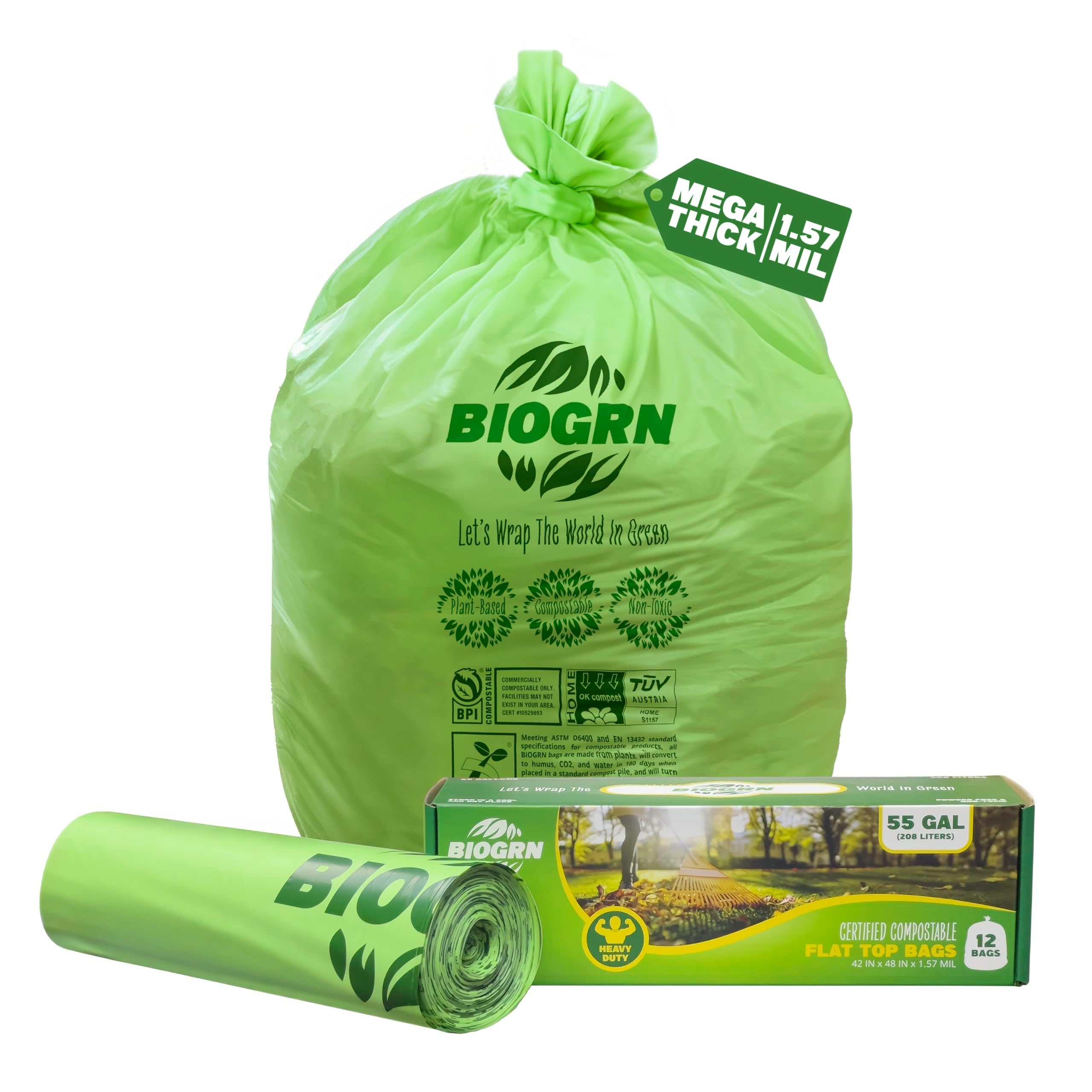
Triple-certified compostability that feels just like heavy-duty plastic.
These BIOGRN bags match the Simply Bio on capacity (55 gallons) and thickness (1.57 mil), sharing that same tough construction for wet leaves and heavy garden waste. The key difference is a complete certification stack: BPI certified, OK Compost HOME and INDUSTRIAL certified by TÜV Austria, plus Seedling certification — all backing the ASTM D6400 and EN 13432 standards. That means these bags are verified to break down not only in industrial composting facilities but also in a well-managed home compost pile, which gives them a versatility edge over bags that only hold commercial certification.
Owners describe them as having a “thick, soft texture” that is still durable for compostable bags. The drawstring works well for cinching closed a heavy load, unlike some flat-top bags that require a knot. One builder noted the bags hold 2 to 3 days of waste for two people without issue, and multiple buyers called them “well made” and “best price among competitors.” The thickness helps with the main pain point of compostable liners: bottom blowouts. While a few reports mention occasional tearing from sharp trash, that is a universal trait of plant-based plastic — no bag this thick will outperform conventional plastic on puncture resistance.
Between the Simply Bio and the BIOGRN, the decision depends on certification depth (BIOGRN edges ahead with OK Compost HOME) and brand trust. Both are essentially tied on spec. If your composting service requires home-certified liners, this is the safer bet.
The call for this pick: Same 1.57 mil thickness as the Simply Bio, but with the added OK Compost HOME certification — meaning these break down in backyard piles, not just industrial facilities. A minor premium on price buys that extra confidence.
4. Reli. Compostable 33 Gallon Trash Bags, 40 Count

The same Reli. brand, now with real ASTM D6400 compostable certification.
If the 100-count Reli. bags above caught your eye but you need certified compostability for a municipal program, this is the direct upgrade. Made with 30 percent plant-based materials and certified to ASTM D6400, these 33-gallon bags (33 inches by 39 inches) are designed to break down fully in commercial composting facilities. The 28-mic thickness — which the manufacturer calls tear-resistant — is a meaningful step up from the 0.6 mil biodegradable version, giving you better leak protection for kitchen scraps and wet yard waste.
The consensus among owners is clear: these bags “hold up to some fairly sharp edges of trash” and make it “out to the dumpster without breakage every time.” A common use case is lining outdoor compost bins to keep them clean — one reviewer noted they “eliminate compost bin washing” by holding kitchen scraps, leaves, and paper without tearing. The film is thicker than many grocery-store compostable bags, so you don’t get the flimsy feel that makes you double-bag everything.
The honest trade-off is that these are certified for municipal and industrial composting only, not for home compost piles. If you backyard-compost, they may not break down quickly enough in the lower heat. Also, the bag may break if left in the rain for long periods — one owner solved this by storing filled bags in a lidded bin until pickup day.
Best for this buyer: Anyone who needs certified compostable (ASTM D6400) bags in a standard 33-gallon size — perfect for city green bins that require the stamp, at a reasonable per-bag cost.
5. ECOLipak 33 Gallon Compostable Trash Bags, 50 Count
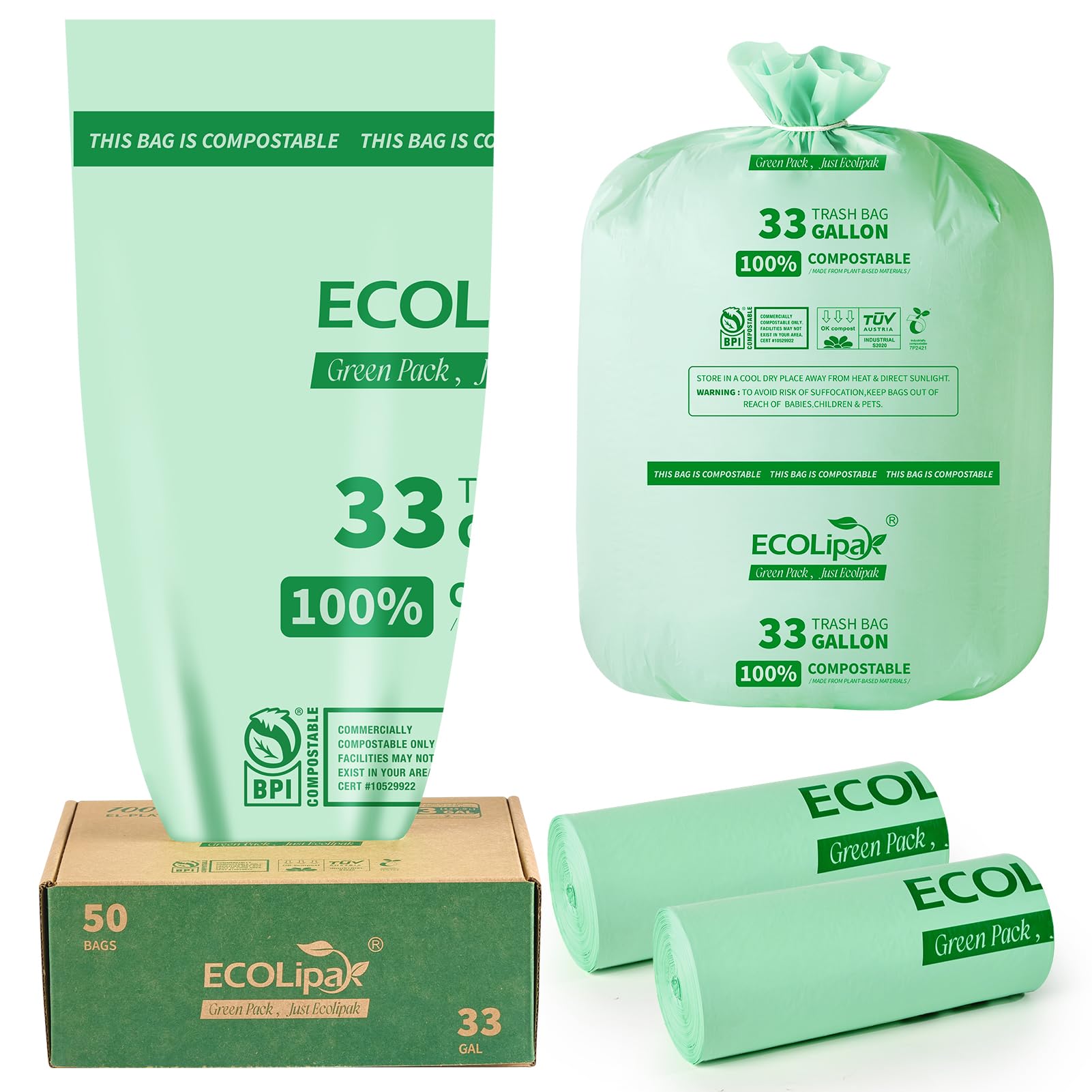
A 50-count box that splits the difference between budget and certification.
If 12 giant bags is too few and 100 biodegradable bags is too many, this 50-count box of 33-gallon compostable liners hits the balance. Each bag measures 33.08 inches by 38.98 inches with a 1-mil thickness — noticeably thicker than the 0.6 mil Reli. biodegradable bags, and built from PLA corn-based materials. The bags are BPI certified (ASTM D6400) and OK Compost INDUSTRIAL certified, so they meet the standard for commercial composting programs in most cities. The 2-roll packaging makes storage easy, and the bottom seal is engineered for sturdy handling.
Owner feedback consistently points to surprising durability. One review called them “surprisingly durable” for yard waste, saying they “hold up really well without tearing” even with heavy loads. Another buyer uses them for pet waste in the yard and found them easy to grab and separate from the roll. The thick PLA material produces a faint corn-based scent, which some notice when the bag is fresh — it fades quickly and is harmless.
The recurring criticism is the perforation: the bags are hard to separate from the roll without ripping the lip of the next bag, with one owner reporting they “ripped easily when detaching from roll” and wasted two bags. A few also note the 1-mil thickness is adequate for leaves but not for sharp kitchen waste like bones or woody prunings. The shelf life is 10 to 12 months, so buy within that window and store bags in a cool, dry place to prevent premature degradation.
Why owners like it
- 50-count box — a practical middle ground between bulk and small quantities
- Durable PLA material holds up well under heavy yard waste loads
- BPI and OK Compost INDUSTRIAL certified, city-program friendly
The pain points
- Perforation tears easily, wasting the occasional bag as you detach one from the roll
- 1 mil is moderately thick but vulnerable to sharp objects and heavy kitchen waste
Reach for this if: You need a certified compostable 33-gallon bag for a season or two — the 50-count won’t expire before you use it, and the per-bag cost is lower than premium small-count options.
Think twice if: You tend to pack dense, sharp kitchen scraps — the 1-mil wall is less forgiving than the 1.57-mil heavy-duty alternatives above.
6. Stout by Envision Compostable Trash Bags, 30 Gallon, 48 Count

A socially-conscious brand that has earned a loyal following for good reason.
Stout by Envision operates with a dual mission: make reliable compostable bags and provide employment for people who are blind or visually impaired. That purpose resonates with many buyers, but the real reason people come back is the bag quality. Certified to ASTM 6400, these are engineered specifically for composting and organic waste collection.
Long-term owners mention using them for years without a single bottom blowout. The feedback loops back to durability praise: “most durable compostable bags found” is a common refrain, with one buyer noting they tested the bags in their own compost pile and confirmed they broke down completely. The leak-resistant design holds wet kitchen waste reliably, and the green color makes them easy to spot in a bin. At 48 bags per case, this is a premium-count option for households that need a steady supply of certified liners.
The honest limitation is that 1.10 mil is thick enough for everyday waste but not for razor-sharp debris — a few owners wrap sharp kitchen scraps in paper before tossing them into the bag. The 30-gallon capacity is also a step down from the 33- and 55-gallon options on this list, so double-check your bin dimensions. The price per bag is higher than the economy picks, which is the trade-off for the brand’s social mission and proven reliability.
The final word: If you prioritize a company’s social impact alongside product quality, and you need a 30-gallon certified compostable bag that owners swear by for leak-free performance, this is the pick. Not the biggest or thickest, but arguably the most trustworthy.
7. SUPERBIO 33 Gallon Compostable Yard Waste Bags, 40 Count

The highest-rated bag in the lineup, and owners say it earns every star.
With a rating that tops the entire list, the SUPERBIO 33-gallon bags have built a reputation for consistent strength. Each bag opens to 33 inches by 40 inches at a 1-mil thickness, constructed from PLA (a plant-based plastic) and possibly PBAT (a biodegradable binder). The certification suite is sturdy: BPI certified for commercial composting, plus OK Compost INDUSTRIAL and Seedling from TÜV, all meeting ASTM D6400 and EN 13432 standards. The flat-top design works well for tying off overstuffed loads, and the 40-count box (two rolls of 20) gives a solid season’s supply for most households.
The thing that wins people over is the all-around reliability. Durability is the most-discussed positive aspect, with owners noting these bags “hold heavy loads without stretching or tearing” and are “strong and durable while environmentally friendly.” Multiple repeat buyers confirm the consistency — same performance box to box. The bags are sized appropriately for large kitchen bins and standard yard waste carts, and they handle the weight of wet grass clippings without splitting.
There are two real caveats. First, size complaints: several buyers found the bags too short for their totes — measure your bin’s height before ordering, because 33 inches may not cover a tall commercial cart. Second, wet waste is a vulnerability. One owner cautions: “It does shred when it gets wet. I use this as my liner for the large kitchen garbage bin. I’ve learned not to put wet trash in it.” That is the nature of plant-based compostable plastic — moisture starts the breakdown process. If your compost bin sits uncovered in the rain, these bags may degrade before pickup day.
What makes it the highest-rated
- Consistent, reliable build — customers note same quality box after box
- Holds heavy wet loads like grass clippings without splitting
- Full certification suite — BPI, OK Compost INDUSTRIAL, Seedling
Before you buy
- 33-inch height may not fit tall bins — measure your can’s depth first
- Wet contents cause fraying and shredding; avoid storing damp waste for more than a few days
Best for this buyer: Anyone who wants the reassurance of a top-rated, BPI-certified 33-gallon bag for dry to moderately wet yard waste and kitchen scraps, and values consistent quality over box size.
skip it if: Your waste is consistently wet (rain-soaked leaves, soggy kitchen scraps) — the shredded bag effect will frustrate you, and you’d be better off with the 1.57 mil heavy-duty options.
Understanding the Specs
Mils vs. Microns — bag thickness explained
Bag thickness is measured in mils (thousandths of an inch) or microns (millionths of a meter). One mil equals about 25.4 microns. A 0.6 mil bag (like the Reli. Biodegradable) is thin and best for dry leaves and lightweight waste. A 1.57 mil bag (like the Simply Bio or BIOGRN) is noticeably heavier and resists punctures from sharp twigs and wet grass. For most heavy yard work, aim for at least 1 mil for reasonable tear-resistance. The thicker the bag, the better it handles wet, heavy loads — but the less flexible it feels.
ASTM D6400 vs. ASTM D6954 — what the certification means
ASTM D6400 is the U.S. standard for bags that will fully break down in a municipal or industrial composting facility within a set timeframe. Bags meeting this standard carry BPI or OK Compost stamps and are accepted by most city green-waste programs. ASTM D6954 (used by the Reli. Biodegradable bags) covers “degradable” plastic — it breaks down under certain environmental conditions over a longer period. That is fine for a landfill but not fast enough for a composting facility. Always check which standard your local waste service requires before choosing a bag.
FAQ
Can I put compostable bags in my home compost pile?
How long do large compost bags last before they start breaking down?
What happens if I use a compostable bag in a landfill?
Will a 55-gallon bag fit my standard yard waste cart?
Are compostable bags stronger than standard black plastic bags?
Do compostable bags smell different from regular trash bags?
Can I use large compost bags for kitchen food scraps?
Will a city composting program accept bags without BPI certification?
Why are compostable bags more expensive than regular garbage bags?
Final Thoughts: The Verdict
The large compost bags that deserve your money come down to the volume you move each week. The large compost bags winner for most households is the Reli. Biodegradable 33 Gallon 100-Count because it delivers the lowest per-bag cost and holds up reliably for leaves and grass — the crowd favorite with over 650 owners backing it. If you pack a giant yard cart and need certified compostable bags that won’t tear under wet weight, grab the Simply Bio 55-Gallon. And for the highest customer satisfaction with full BPI certification, the SUPERBIO 33-Gallon is the one to reach for. Choose based on your bin size, your city’s certification requirements, and how long the filled bag will sit before collection day.
How We Picked
We do not accept paid placement. Every pick is matched to a real buyer and a real use-case; we do not hands-on test units.
Sources & Methodology
Specifications: manufacturer listings and product documentation. Review insights: verified customer reviews, as of July 2026. Pricing: not shown on this page (it changes often); check the current price via the retailer link.
As an Amazon Associate, Lawn Gear Lab earns from qualifying purchases. This does not affect which products we feature.