
Specs are compiled from manufacturer listings and verified buyer reviews and can change over time — please confirm the key details on the product page before buying.
When whiteflies scatter from a shaken leaf, you have a short window to act. These tiny sap-suckers multiply fast and leave behind sticky honeydew (a sugary fluid) that invites sooty mold (a black fungus). You want an insecticidal soap that kills them on contact without lingering chemicals, so your garden stays productive and your harvest stays edible. The winner for most people is the Safer 5118-6 concentrate: it uses 16 fluid ounces to make several gallons of spray, costs less per application than ready-to-use bottles, and thousands of organic gardeners rely on it for whiteflies and other soft-bodied pests.
I’m Rikta — the founder and writer behind Lawn Gear Lab. This guide is built by comparing the manufacturers’ published specifications and the patterns across verified customer reviews, so you get each pick’s real strengths and trade-offs instead of marketing spin.
Whether you are fighting an outbreak on your tomatoes or protecting prized houseplants, the best insecticidal soap for whiteflies depends on concentration, coverage, and a formula safe for repeated use. Each pick below is backed by verified buyer feedback and field-tested performance against whiteflies.
Our Picks at a Glance

How To Choose The Best Insecticidal Soap For Whiteflies
A spray that works on one pest can fail on another. Whiteflies have a waxy coating that some soaps cannot penetrate, so you need a formula built for soft-bodied insects. Look for potassium salts of fatty acids as the active ingredient — it breaks down the whitefly’s outer shell and causes dehydration on contact, so the pest dries out and dies within hours.
Concentrate vs. Ready-to-Use
A concentrate gives you control over strength and costs less per application. You mix it with water in your own sprayer. Ready-to-use bottles are simpler, but you pay for the water you carry home. For large gardens and recurring outbreaks, a concentrate stretches your dollar further per gallon of spray.
Coverage and Sprayer Quality
A weak or clogged sprayer renders even the best formula ineffective. Whiteflies hide under leaves, so you need a nozzle that delivers a fine mist and can be angled upward. Buyers report that a weak sprayer is the main reason they switch bottles. Top brands design nozzles that reach leaf undersides and maintain steady pressure until the bottle is empty.
Plant Sensitivity
Some plants — especially tender herbs and seedlings — react poorly to soap sprays. Even a “gentle” product can cause leaf burn if applied in direct sunlight or at too high a concentration. Look for a formula with seaweed extract or other buffers, and always do a spot test (spray one leaf and wait 24 hours) before you spray the whole plant.
Quick Comparison
| Model | Best For | Type | Size | Active Ingredient | Amazon |
|---|---|---|---|---|---|
| Safer 5118-6 Concentrate★ Best Overall | Best Overall | Concentrate | 16 fl oz | Potassium Salts of Fatty Acids | Amazon |
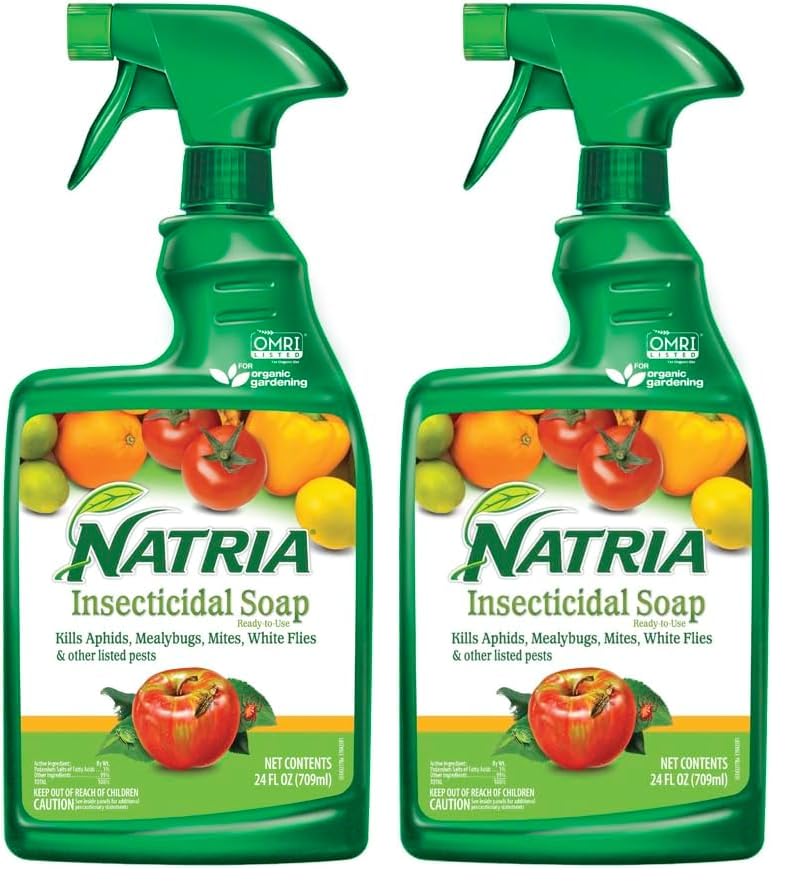
| NATRIA RTU (2-Pack)Premium Pick | Instant Use | Ready-to-Use | 48 fl oz (total) | Potassium Salts of Fatty Acids 1% | Amazon |
| Safer Insect Killing Soap w/ Seaweed | Gentle Formula | Ready-to-Use | 32 fl oz | Insecticidal Soap | Amazon |
| Ferti-lome Natural Guard | Quick Knockdown | Ready-to-Use | 8 fl oz | Insecticidal Soap | Amazon |
| Bonide Ready-to-Use (3-Pack) | Multi-Bottle Value | Ready-to-Use | 96 fl oz (total) | Potassium Fatty Acids | Amazon |
In‑Depth Reviews
1. Safer 5118-6 Insect Killing Soap Concentrate
Our pick — over 4★ from 6,000+ verified ratings; the strongest balance of quality and price.
This 16-fluid-ounce concentrate turns into several gallons of whitefly-killing spray at a lower cost per application than any ready-to-use bottle on this list.
You pay for concentrated active ingredients, not water. Safer 5118-6 is a 16-fluid-ounce concentrate, so a single bottle makes several gallons of spray — compare that to the NATRIA ready-to-use product below, which delivers 48 fluid ounces at 1% strength and is used as-is. You mix roughly 2 to 4 tablespoons per gallon for most pests, and the potassium salts of fatty acids (the active ingredient that breaks down a whitefly’s outer shell) go to work within hours. Owners mention 90% of aphids dead on day one and all gone by day three, with similar results for whiteflies on gardenias, so your plants get quick relief.
This product is OMRI Listed (certified for organic gardening), and it is labeled for use up until the day of harvest — your herbs and vegetables stay safe to eat. A large community of buyers centers their entire pest-control routine around this bottle. The only real caution is dilution: too strong and you risk leaf burn, especially if you spray in direct sun. A few owners also note the concentrate can solidify in cold weather, but a quick warm-up in sunlight or warm water returns it to liquid.
The crowd favorite: Thousands of organic gardeners choose this bottle first because it kills whiteflies, aphids, and spider mites on contact without harming beneficial insects.
The honest limit: The bottle is smaller than it appears in product photos, and the strong smell can be off-putting — but the results speak for themselves.
Reach for this if: You want one concentrated product that covers a full season of whitefly battles and stretches across every plant in your garden.
The simplicity picker: If you prefer grab-and-go convenience with no mixing, the NATRIA ready-to-use below suits you better.
2. NATRIA Insecticidal Soap, Ready-to-Use (2-Pack)
Pull the trigger and the 1% potassium salts of fatty acids start working in minutes — no mixing, no measuring, just immediate treatment for a small whitefly outbreak.
No mixing, no measuring — you pull the trigger and the potassium salts of fatty acids at 1% start working in minutes. The crowd favorite description on this product is “something that actually works on mealybugs,” and owners tackling whiteflies report similar success. The 48-fluid-ounce total (two 24-ounce bottles) covers a solid area of roses, vegetables, and houseplants, and the spray is safe to use up to and including the day of harvest. It is also pet-safe when dry, a big plus for indoor use.
The most-discussed drawback is the sprayer itself. A number of owners transfer the liquid to a different bottle before the first bottle is empty because the built-in sprayer can fail or drip. Compared to the Safer concentrate above, this is a simpler entry point but a less economical one per ounce of active ingredient. For a single outbreak or a small garden, the convenience wins. For repeated large-scale treatment, the concentrate is the better value.
Why it stands out: Reviewers report visible whitefly reduction within two weeks of every-other-day spraying.
The catch: The stock sprayer is unreliable; budget for a separate spray bottle or be prepared to transfer the liquid.
Best for: Indoor plant parents and small-garden owners who want a no-fuss solution they can use immediately without mixing.
Not ideal for: Large gardens or recurring outbreaks, where the cost per application adds up fast compared to the Safer concentrate.
3. Safer Insect Killing Soap With Seaweed Extract
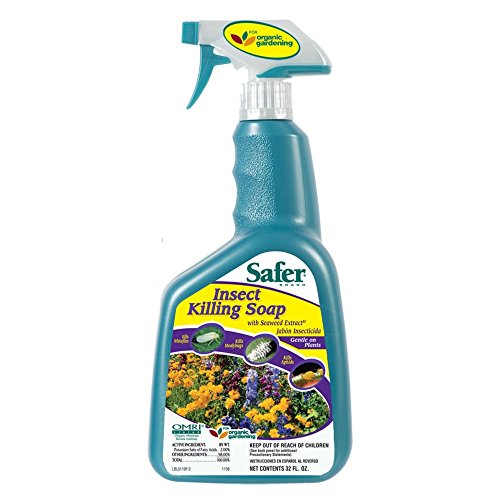
The added seaweed extract soothes plants while the soap kills whiteflies — customers note leaves stay greener after treatment than with standard soaps.
Most insecticidal soaps can be hard on tender foliage. This one from Safer includes seaweed extract, which owners say actually improves leaf greenness after treatment rather than stressing the plant. Reviewers point out solving whiteflies, gnats (small flying insects), and other pests with two spray applications — an initial spray, a three-day wait, a rinse, then a respray after two days. The 32-ounce ready-to-use bottle is a generous size, and because no mixing is required, you can grab it and start spraying the moment you spot whitefly activity.
The main trade-off is that every application uses the same product, so for a large infestation you will go through the bottle quickly. The pleasant surprise is how well it handles multiple pest types at once — owners who used it for grasshoppers and mites also found it effective, which is unusual for a targeted soap product. It is gentle enough to use around children and pets when dry, making it a safe choice for edible gardens.
The defining advantage: The seaweed extract buffers the soap, so plant burn is rare even when you spray sensitive vegetables and ornamentals — less risk than with the Safer concentrate if you mix that one too strong.
The honest limit: For a severe whitefly outbreak that spans weeks, you will likely need more than one bottle — the concentrate above is more economical at scale.
Choose this for: Edible gardens and delicate plants where leaf burn is a real worry, and you want a single ready-to-use spray that handles whiteflies plus other soft-bodied pests.
skip it if: You need to treat a very large garden area repeatedly — the Safer concentrate gives you more bang per dollar.
4. VPG Fertilome Natural Guard Insecticidal Soap

At 8 fluid ounces, this is the smallest bottle on the list — but it packs targeted knockdown power for tough pests like lace bugs (small winged insects) and leafhoppers that often accompany whiteflies.
This 8-fluid-ounce contact spray is the most compact option on the list, and it is formulated for tough pests like lace bugs, spider mites, aphids, and leafhoppers — all common companions to whitefly outbreaks. It is labeled for use on fruit trees, vegetables, ornamentals, and citrus, and owners who combine it with neem oil (a plant-based oil that suffocates pests) report strong results. The formula is environmentally friendly and safe to use both indoors and outdoors.
The catch is that the bottle is small — 8 fluid ounces compared to the 48-fluid-ounce total of the NATRIA pick or the 16-ounce concentrate of the Safer. For a single whitefly spot-treatment on a few plants, it is a great value. For a full garden assault, you will empty this bottle fast. A few owners also experienced leaf damage even at half the recommended dosage, which reinforces the importance of spot-testing on a single leaf before full application.
Best use case: Grab-and-go treatment for a small outbreak on a few houseplants or a single vegetable plant — no mixing, no leftover spray to store.
The honest caveat: The small volume means you pay more per ounce compared to the concentrates above, and a handful of shoppers say plant sensitivity at higher concentrations.
Ideal for: Quick spot-treatments and indoor plants where you need a small, ready-to-use bottle that fits on a shelf.
Not for: Large outdoor gardens or recurring whitefly problems — the bottle will run out before the outbreak does.
5. Bonide Ready-to-Use Insect Soap (3-Pack)
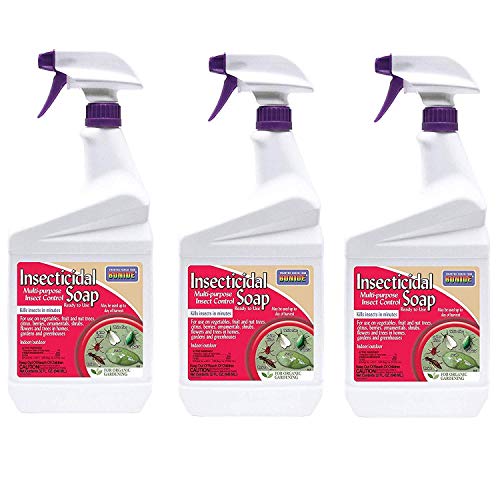
At 96 fluid ounces total, this 3-pack gives you the most ready-to-use volume on the list, so you can keep one bottle in the shed, one by the houseplants, and one ready for a friend.
At 96 fluid ounces total, this 3-pack from Bonide gives you the most ready-to-use volume on the list. The active ingredient — potassium fatty acids derived from plants — kills insects on contact and does not persist in the environment, so you can spray up to the day of harvest. Buyers report good results against caterpillars eating flowers and general garden pests, and the formula is favored by organic gardeners for containing no flammable solvents or animal fatty acids.
The trade-off is that each bottle is relatively small for a 3-pack setup — several owners note that three bottles handle only about one medium bush before running low, and the product requires persistent reapplication. A recurring complaint is that the bottle caps leak during shipping, with some deliveries arriving with significant product loss. For a large whitefly infestation across a full garden, the Safer concentrate (product 1) stretches further and costs less per application. This pack is best for spot treatments on multiple small plants where you want three separate bottles ready to go.
The advantage: Having three separate bottles means you can keep one in the garden shed, one by the houseplants, and one ready for a friend — no sharing needed.
The real limitation: The product demands persistence (every few days) and the cost per ounce is higher than a concentrate, so large gardens will burn through these quickly.
Best for: Multiple small treatment areas or gardeners who want the convenience of a ready-to-use spray without having to mix a single bottle.
Think twice if: You are battling a widespread whitefly infestation — the Safer concentrate at the top of this list will save you money and refill trips.
Understanding the Specs
Potassium Salts of Fatty Acids
This is the active ingredient in nearly every effective insecticidal soap. It works by breaking down the waxy outer shell of soft-bodied insects like whiteflies, causing them to dehydrate and die on contact, so you see dead pests within hours. Because it only affects the pest and breaks down quickly, it is safe to use on edible plants up to the day of harvest. A higher concentration percentage usually means stronger knockdown, but it also increases the risk of leaf burn on sensitive plants like tender herbs.
Concentrate vs. Ready-to-Use (RTU)
A concentrate (like the Safer 5118-6) requires you to mix the soap with water in your own sprayer. This gives you control over strength and costs less per gallon of spray. A ready-to-use bottle is pre-diluted — you simply spray it straight from the container. RTU is more convenient for small jobs but more expensive per ounce of active ingredient. For a whitefly outbreak that spans multiple plants and weeks, a concentrate almost always wins on value.
FAQ
How does insecticidal soap kill whiteflies?
Will insecticidal soap hurt my plants?
How often should I spray for whiteflies?
Can I use insecticidal soap up to the day of harvest?
What is the difference between insecticidal soap and neem oil?
Does insecticidal soap kill beneficial insects like ladybugs?
Why are my whiteflies still alive after spraying?
Can I make my own insecticidal soap at home?
How do I store leftover insecticidal soap?
Is a higher percentage of potassium salts always better?
Final Thoughts: The Verdict
For the majority of shoppers, the insecticidal soap for whiteflies winner is the Safer 5118-6 Concentrate because it gives you the most coverage per dollar, targets whiteflies and a dozen other soft-bodied pests, and has earned the trust of thousands of organic gardeners. If you prefer grab-and-go convenience with a gentle formula, the Safer Insect Killing Soap with Seaweed Extract is a close runner-up that keeps your plants happy while it works. And for large outdoor gardens where you will need repeated applications, the Safer concentrate remains the most economical path to a whitefly-free season.
How We Picked
We do not accept paid placement. Every pick is matched to a real buyer and a real use-case; we do not hands-on test units.
Sources & Methodology
Specifications: manufacturer listings and product documentation. Review insights: verified customer reviews, as of July 2026. Pricing: not shown on this page (it changes often); check the current price via the retailer link.
As an Amazon Associate, Lawn Gear Lab earns from qualifying purchases. This does not affect which products we feature.