
Specs are compiled from manufacturer listings and verified buyer reviews and can change over time — please confirm the key details on the product page before buying.
Standing over a weed-packed flower bed, you face a choice: get on your knees and wrestle each invader out, or find a tool that makes the fight easy. A Japanese weeding hoe — with its sharp, angled blade and precise cutting motion — turns that back-breaking chore into a satisfying glide through the soil. The right one saves your knees, lower back, and weekend hours.
I’m Rikta — the founder and writer behind Lawn Gear Lab. This guide is built by comparing the manufacturers’ published specifications and the patterns across verified customer reviews, so you get each pick’s real strengths and trade-offs instead of marketing spin.
if you need a long-handled version to weed without bending or a compact hori-hori knife for detailed work, this roundup of the top japanese weeding hoe options will help you find the right blade for your garden.
Our Picks at a Glance


How To Choose The Best Japanese Weeding Hoe
Japanese weeding hoes all share a mindset — cut the weed at or just below the soil surface with a sharp, slicing motion rather than a heavy chop. But within that philosophy, the variations are huge. Here is what separates a tool you reach for every day from one you regret.
Blade Shape and Its Job
The Nejiri Kama (twisted sickle) has a blade that twists so it sits almost parallel to the ground. You sweep it through the top inch of soil and it severs weed stems cleanly without disturbing the roots of nearby flowers. A triangular hoe uses a pointed, three-sided blade to slice through soil and cut roots just below the surface with a straight push. A Hori-Hori knife looks more like a digging tool — a concave blade with one serrated edge — and works best for prying out deep roots, dividing perennials, and digging planting holes.
Steel Quality and Hardness
Most quality Japanese blades use high-carbon steel or stainless steel. Hardness is measured on the Rockwell scale (HRC). The Nisaku Hori-Hori line hits HRC58, the hardest in Nisaku’s Hori series. That extra hardness means the blade holds a sharp edge longer when you are cutting through roots and rocky soil. Stainless steel resists rust, but high-carbon steel often takes a sharper edge — neither is “better,” just a trade-off between easy maintenance and maximum sharpness.
Handle Length Determines How You Work
A short handle (10 to 13 inches total) keeps you close to the work — ideal for raised beds, container gardening, and detail weeding around delicate plants. A semi-long handle (around 17 inches) lets you reach further without bending much. A full-length handle (41.5 inches, like on the Nisaku NJP1010) lets you weed entire beds from a standing position, saving your knees entirely. The catch: longer handles are less precise between tight rows of vegetables.
Single Edge vs. Serrated vs. Both
A plain, single-bevel edge gives the cleanest cut and slides through soil with the least resistance. A serrated edge grips stems rather than slicing them, which is helpful for sawing through woody roots or thick weed stems. Some Hori-Hori knives combine both — one side sharpened like a knife, the other side serrated like a saw. That dual-edge design makes the tool more versatile (cutting branches, sawing roots) but the serrated side is harder to sharpen at home.
Quick Comparison
| Model | Best For | Blade Material | Blade Length | Handle Length | Amazon |
|---|---|---|---|---|---|
| Nisaku NJP651 Hori-Hori★ Best Overall | All-around gardening & digging | HRC58 Stainless Steel | 7.25 inches | 12.5 inches (knife) | Amazon |
| GrowTech Josi Nejiri KamaPremium Pick | Raised bed weeding | High Carbon Tool Steel | ~4 inches | 12 inches | Amazon |
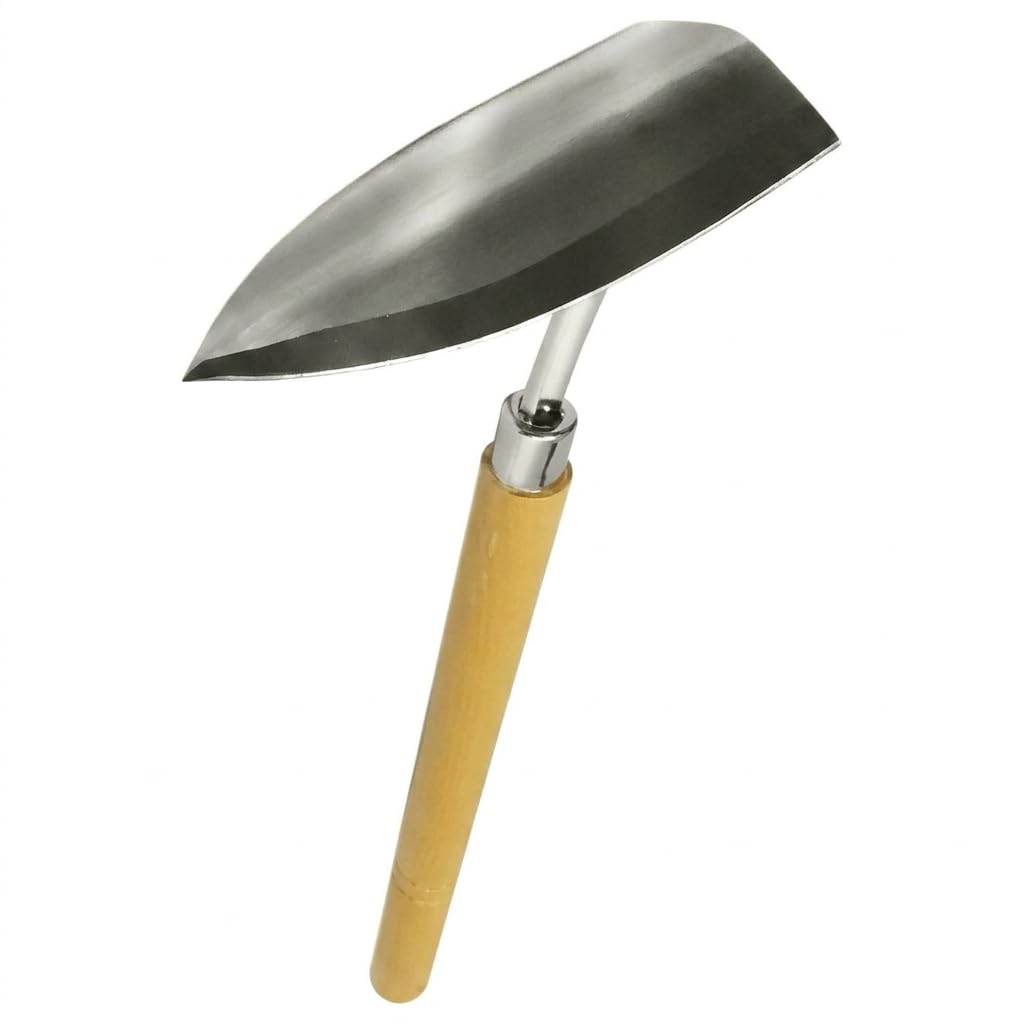
| Japanese Triangle HoeBest Value | Slicing through soil & roots | Japanese Stainless Steel | ~5.5 inches | 13 inches | Amazon |
| Nejiri Kama Sharp Edge (Long) | Standing reach & precision | Stainless Steel | 4.8 inches | 17.3 inches | Amazon |
| HACHIEMON Left-Handed Nejiri Gama | Left-handed gardeners | Special Steel Composite | 4.8 inches | 13.7 inches | Amazon |
| HACHIEMON Long Nejiri-Gama | Deep reach without bending | Special Steel Composite | 4.8 inches | 17.3 inches | Amazon |
| Haliaeetus Bent Angle Weeding Sickle | Clearing tough weeds in tight spaces | Thick Stainless Steel | ~4.8 inches | 13 inches | Amazon |
| TONMA Hori Hori Knife | Heavy-duty digging & cutting | Japanese AUS-8 Steel (HRC58) | 7.2 inches | 12.5 inches (knife) | Amazon |
| Nisaku NJP1010 Semi-Long Hoe | Standing up, weeding large beds | Stainless Steel | 4.5 inches | 41.5 inches | Amazon |
In‑Depth Reviews
1. Nisaku NJP651 Hori Weeding & Digging Knife
Our pick — over 4.5★ from 450+ verified ratings; the strongest balance of quality and price.
The garden knife that does everything — weed, dig, cut, pry, plant.
This is the single most versatile tool in this lineup. The Nisaku NJP651 is a Hori-Hori knife — a Japanese gardening staple that weeds, digs, and cuts roots. The blade is hardened to HRC58 in a concave shape: one side beveled for slicing, the other serrated for sawing. That serrated edge is what separates it from the pure sickle-style hoes above — when you hit a woody root or a tree sucker, you can actually saw through it instead of just chopping.
It weighs just 10.6 ounces, light enough for a tool belt. It includes a premium leather sheath for safe storage. At 12.5 x 2 x 0.75 inches, the Nisaku slips easily into a crowded garden bag. The inch markers engraved on the blade also let you plant bulbs and seeds at the correct depth without guessing. Buyers report: “Excellent steel stays sharp and glossy after a year of heavy use (rock lifting, root cutting, digging).” The durability feedback is mixed — some find it very solid, while a few note that the wood handle can crack if not treated with mineral oil before winter storage.
Why It Owns The #1 Spot
- Dual-edge blade (smooth + serrated) handles roots and stems differently.
- HRC58 steel is the hardest in Nisaku’s Hori series, edge retention is exceptional.
- Leather sheath included — no separate purchase.
The Fine Print
- Wood handle requires seasonal mineral oil treatment to prevent cracking.
- Not a pure “sweep” weeder — you use it more like a knife than a sickle.
Reach for it if: you want one tool that weeds, digs, transplants, and cuts roots — the Hori-Hori replaces a trowel, a weeder, and a small saw in one 10.6-ounce package.
Look elsewhere if: you want a dedicated surface-sweep weeder that stays at ground level; the Hori-Hori is more of a dig-and-cut tool than a gliding sickle.
2. GrowTech Josi Nejiri Kama Weeding Sickle
The gold standard for the classic Japanese weeding sickle.
This is the design most people picture when they hear “Japanese weeding hoe” — a short-handled, twisted-shank sickle with a super sharp blade that skims just below the soil surface. The twisted shank (unique to the Nejiri Kama shape) rotates the blade so it sits parallel to the ground, letting you slice through shallow weed roots with a sweeping motion. The blade is high-carbon tool steel — the same material used for fine wood chisels — and owners confirm it holds a sharp edge even in rocky soil.
The handle is a comfortable wooden grip, and the total tool is just 12 inches long. Unlike the HACHIEMON left-handed version below, this is a right-handed tool; the blade angle is forged specifically for a right-handed sweep. Owners mention that the blade and neck are forged as one piece, not welded, which is the main reason it stays straight under pressure. The crowd favorite at 4.6 stars from over 800 owners is well-earned: quality and weeding ability are the top praise, with sharpness close behind. The one recurring note is that it requires cleaning and light oiling after use — high-carbon steel rusts if left wet — but that’s true of any traditional Japanese garden tool.
Why It’s A Standout
- One-piece forged blade and neck — no weld to snap under pressure.
- High-carbon tool steel takes and holds a very sharp edge.
- The classic Nejiri Kama twisting motion cuts with minimal effort.
The Trade-Off
- Right-handed orientation only — lefties need the HACHIEMON version.
- High-carbon steel must be dried and oiled after use; not stainless.
Ideal for: the traditionalist who wants the exact tool that Japanese gardeners have used for generations — the Nejiri Kama shape is purpose-built for raised beds and tight spaces.
Think twice if: you want something stainless steel that you can toss in a bucket wet; this blade needs care to stay rust-free.
3. Japanese Triangle Hoe
A razor-sharp triangle that destroys weeds in half the time.
Instead of a twisted sickle shape, this tool uses an ultra-sharp triangular blade made of Japanese stainless steel. The three sharp edges cut through soil and roots from any angle, which makes it effective for both right-handed and left-handed users — no dedicated handedness needed. The triangle tip lets you slice into dense or clay-heavy soil with a push motion, unlike the GrowTech sickle’s sweeping arc.
At 9.1 ounces, it is the lightest of the hand-held options (the Haliaeetus is 13.4 ounces), so forearms don’t fatigue as quickly during long sessions. The handle is ergonomically shaped and the balance is weighted toward the blade, which gives the push-slice motion more authority. The top praise is around its gardening utility — owners call it their favorite gardening tool. Sharpness and functionality come close behind. The one honest limit: the blade tip is so pointed and sharp that you need to be careful around drip irrigation lines, though owners say the point is perfect for trenching. A few note the durability is mixed — the blade can chip if you hit a large rock edge-on.
What Wins People Over
- Triangular blade cuts on push and pull, both hands welcome.
- Lightweight at 9.1 ounces — less arm fatigue than a 13.4-ounce sickle.
- Japanese stainless steel resists rust better than high-carbon options.
What To Watch
- Tip is very sharp — not ideal for careless users near drip tape.
- Durability is mixed; hitting rocks directly can chip the thin triangle point.
Grab this for: a versatile, ambidextrous weeder that works in clay soil, raised beds, and around flower borders without needing to learn a specific sickle angle.
skip it if: you need a tool for deep root removal — the triangular blade excels at surface slicing, not prying.
4. Japanese Weeding Sickle Sharp Edge Nejiri Kama (Long Handle)

Reaches the back of the bed without you having to lean in.
This is the same Nejiri Kama sickle concept as the GrowTech above, but stretched out to a total length of 17.3 inches. That extra handle reach — from 12 inches to 17.3 inches — makes a meaningful difference when you want to weed without kneeling or leaning over your raised bed’s edge. The “Nejiri Kama” name means “twisted sickle” in Japanese, and the design places the blade almost horizontal to the ground so you slide it just below the soil surface to sever weed stems.
The blade is 4.8 inches across — the same width as the HACHIEMON versions — and weighs just 8.1 ounces, which is significantly lighter than the Haliaeetus sickle’s 13.4 ounces. The crowd approves: this tool holds a 4.5-star average from over 900 owners, the highest review volume in this entire list. Quality and functionality are the top praise, and owners say it “cuts through weeds like butter.” The recurring note is that the edge is very sharp from the start but can chip if you hit a stone, and a few owners found the handle a bit too long for tight spaces between plants.
What You Get
- 17.3-inch handle reaches further, saves your knees.
- Weighs only 8.1 ounces — no arm fatigue.
- Massive owner approval from nearly a thousand buyers.
The Catch
- Blade can chip on hidden rocks — not a heavy-duty tool for rocky soil.
- Longer handle means less precision in tight rows.
Perfect for: anyone with raised beds or larger garden areas who wants to weed from a standing or slightly bent position — the extra length is a genuine back-saver.
Swap it for: the short-handled GrowTech if you mostly weed ground-level flower beds where you need to crawl.
5. HACHIEMON Left-Handed Nejiri Gama

Finally, a weeding sickle that turns left.
Most Japanese Nejiri Kama sickles are forged with a blade angle that assumes a right-handed sweeping motion. That makes them awkward — and less effective — for left-handed users. The HACHIEMON Left-Handed version solves that by mirroring the entire blade geometry for left-hand dominance. The blade is 4.8 inches (120mm), the handle is 10.2 inches (260mm), and the total length is 13.7 inches (350mm). It is made from a specially formulated steel composite that the maker specifically describes as perfect for edged tools.
At just 6.4 ounces, it is among the lightest tools here — lighter even than the 8.1-ounce long-handled Nejiri above. The lightness makes it feel like an extension of your arm during long weeding sessions. Owners rave about the effectiveness of cutting weeds just below the surface with minimal pressure, and the pointy tip is praised for popping out big roots. The only consistent note is that the handle is not as ergonomically padded as some modern Western tools — it is a traditional wooden handle that can feel slim in larger hands.
Why It Matters
- Dedicated left-handed blade geometry — no “making do” with a right-handed tool.
- Weighs only 6.4 ounces — the lightest sickle in this list.
- Made in Japan by HACHIEMON, a known forging house.
The Trade-Off
- Traditional handle is slim; might feel small for larger grip sizes.
- Edge is very sharp but some customers note it dulls faster than thicker blades.
If you are left-handed: this is not just a “nice to have” — the blade angle genuinely makes the sweeping motion more effective, and right-handed sickle users who try it notice the difference immediately.
Right-handed readers: buy the standard HACHIEMON or GrowTech version instead — the mirrored geometry will feel wrong in your hand.
6. HACHIEMON Long Nejiri-Gama

The reach version of the left-handed tool, built for right-handers.
Think of this as the HACHIEMON brand’s equivalent of the long-handled Nejiri Kama above, but with the same special steel composite and traditional forging. The blade is again 4.8 inches (120mm), but the handle stretches the total length to 17.3 inches (440mm) — a full 3.6 inches longer than the left-handed version. This extra handle length shifts your center of gravity backward, so the tool feels like a natural extension when you are standing at the edge of a garden bed.
It weighs 10.2 ounces — heavier than the 8.1-ounce Token long-handled sickle above — which gives the blade more authority when slicing through tougher weeds. Owners highlight that the blade is forge-welded (not stamped), and the hardwood handle is built to last decades. The top-positive aspects are weeding performance and effectiveness, rated positively by the owner crowd. The catch: this is a right-handed tool only, and the blade is prone to rust if left wet, though owners say it still cuts well even when lightly rusted.
What Stands Out
- Forge-welded construction is stronger than stamped blades.
- Long handle enables standing reach — a true back-saver.
- Heavier than other sickles at 10.2 ounces, which helps slice through tough weeds.
The Downside
- Right-handed only — lefties need the shorter HACHIEMON left-handed version.
- Blade can develop surface rust if not dried after use.
Get this if: you want a HACHIEMON-built tool with extended reach — the forge-welded blade and hardwood handle are a step up in quality from budget-tier sickles.
Consider the long-handled Token instead if: you prefer a lighter sickle (8.1 ounces) or want a blade that is easier to sharpen at home.
7. Haliaeetus Gardening Sickle Hoe, Bent Angle

The budget bent-angle that punches above its weight.
This is the only tool in the list with a “special elbow angle” — the blade is bent at an angle that the maker says makes it easier to scrape shallow weeds with a flat blade. The tip is sharp enough to chop down to deeper roots when needed. The handle is 13 inches long and made from solid wood, and the blade is thicker stainless steel than what you typically find at this price tier — it does not bend when you push against compacted dirt.
The Haliaeetus is also the heaviest hand-held option here at 13.4 ounces; the Token sickle weighs 8.1 ounces. That extra heft can help in rocky soil where you need weight to drive the blade, but it also makes it less nimble for precise detail work. Reviewers point out: “Excellent short-handled weeder; effectively gets under root systems and scrapes weeds up.” The top praise is quality and weeding performance, and the handle is noted as solid and well-built. Some owners find the blade not sharp enough from the start, and the head angle takes a bit of practice to get used to — it is a unique shape that works differently from a pure Nejiri Kama.
Why It Makes The List
- Thicker stainless steel blade that resists bending in compacted soil.
- Unique bent angle gives a different slicing arc than the twisted sickle.
- Lifetime warranty — rare at this price point.
Where It Falls Short
- Heaviest hand option at 13.4 ounces — less precise for detail work.
- Blade sharpness is inconsistent; some units arrive dull.
Choose this for: clearing tough, compacted areas where you need a thick blade that won’t bend — the elbow angle and 13.4-ounce weight give you leverage that lighter sickles lack.
Skip it for: precise weeding between delicate plants; the bulkier head is harder to control in tight spaces.
8. TONMA Hori Hori Garden Knife
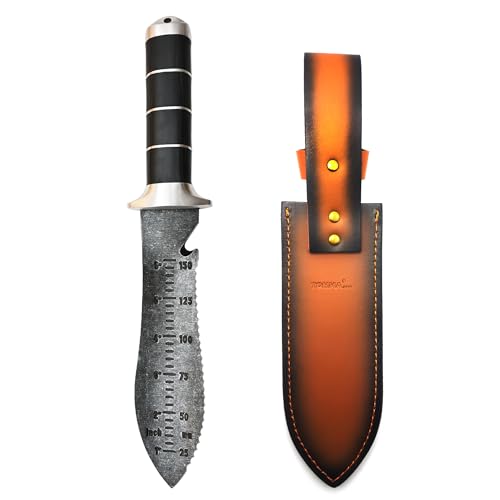
Commercial-grade Japanese steel hewn into an heirloom knife.
This is the premium upgrade to the Nisaku Hori-Hori. The TONMA uses Japanese AUS-8 stainless steel (hardened to HRC 58±1) — a steel grade more commonly found in high-end kitchen knives than garden tools. The blade is 7.2 inches long, slightly shorter than the Nisaku’s 7.25 inches, and uses a traditional Japanese quenching process for maximum wear resistance. One side is a plain, beveled edge for slicing, the other is serrated for sawing, and inch markers are engraved on the blade for depth measurement.
The handle is Pakkawood — a high-strength composite with permanent corrosion resistance — instead of the Nisaku’s bare wood. That makes a real difference if you leave your tools in a damp shed or forget to oil the handle. The leather sheath is made from cowhide and is thick and secure. Owners rate it 4.9 stars out of 106 ratings, making it the highest-scoring tool in this lineup by a clear margin. The crowd says it is “hefty and solid,” and that the “sharp edge holds up well in tough soil.” The mixed feedback is on weight — at 12.5 inches overall, it has substantial heft, so it feels more like a small pry bar than a featherlight sickle.
What Makes It Premium
- AUS-8 stainless steel (HRC58) — kitchen-knife grade metallurgy.
- Pakkawood handle resists moisture and rot permanently.
- Thick cowhide leather sheath gives belt-carry security.
The Honest Trade-Off
- Hefty weight is not ideal for one-handed detail weeding over long sessions.
- No clip on the sheath — you need a belt to slide it onto.
Pick this for: a “buy it for life” Hori-Hori — the AUS-8 steel and Pakkawood handle mean it could easily outlast a decade of heavy garden work.
Stick with the Nisaku if: you want a lighter Hori-Hori (10.6 ounces vs. the TONMA’s heavier feel) at a lower cost.
9. Nisaku NJP1010 Nejiri Hoe Semi-Long Handle

The only long-handled hoe in the bunch that keeps you completely upright.
Every other tool in this list requires you to at least bend or kneel — this one has a 41.5-inch polished wood handle that lets you weed entire garden beds from a full standing position. The blade is the same Nejiri-style shape (4.5-inch stainless steel, straight shank rather than twisted), but mounted on a semi-long handle that is “long enough to avoid kneeling but short enough for easy storage.” The shank is forged in one piece with the blade, then secured to the handle with steel rivets — no welding, no weak point.
At 1.06 pounds, it is heavier than the hand tools, but the long leverage means you are using your core and arm momentum instead of wrist strength. Owners say it is “razor sharp” and “cuts weeds at ground level without bending.” The sharpness and effectiveness are the top praise. The standout buyer quote: “sliced through 5-foot-tall, 3/8-inch-thick woody stems.” The obvious negative is handle length — 24 owners mention it as too short for very tall users, so if you are over 6 feet tall, the 41.5-inch handle may still require a slight bend.
What You Get
- 41.5-inch handle saves your back completely — true stand-up weeding.
- One-piece forged shank + steel rivets = no handle separation.
- Light enough to swing one-handed, sharp enough to cut woody stems.
The Reality Check
- Handle length is “semi-long” — very tall owners may find it too short.
- Straight shank (not twisted) means the slicing angle is different from a true Nejiri Kama.
Choose this if: you have large garden beds and no desire to kneel — the 41.5-inch handle is the most back-friendly option here by a large margin.
pass on it if: you need precise, close-to-the-ground weeding in tight rows; the long handle trades precision for reach.
Understanding the Specs
HRC (Rockwell Hardness)
This number measures how hard the steel is — higher means the blade stays sharp longer but is also more brittle. Most quality Japanese garden tools fall between HRC 56 and 60. The Nisaku NJP651 and the TONMA Hori-Hori both hit HRC 58, which is toward the higher end for garden tools. That means the edge will resist dulling when you cut through roots and rocky soil, but you should avoid prying or twisting hard against stone, as the blade can chip if struck at a bad angle.
Nejiri Kama vs. Hori-Hori vs. Triangle Hoe
Each name tells you the blade’s intended action. A Nejiri Kama (twisted sickle) has a blade that twists up to 90 degrees so it sits parallel to the ground — you sweep it sideways through the top inch of soil to sever weed stems. A Hori-Hori knife has a concave, spear-shaped blade with one serrated edge for digging, prying, and cutting thick roots — you use it more like a small trowel/knife combo than a sweep tool. A Triangle Hoe uses a three-sided pointed blade that slices through soil with a push-pull motion — the triangle shape cuts from multiple angles without needing a specific handedness.
Forged vs. Stamped vs. Welded Construction
These terms describe how the blade meets the handle. “Forged in one piece” (like the Nisaku NJP1010 and GrowTech Josi) means the blade and the neck (the shank) are cut from a single piece of steel — no join, no weak point — and then attached to the handle with rivets. “Stamped” blades are cut from a sheet of steel and bent into shape — cheaper, lighter, but less durable under heavy prying. “Welded” means the blade is attached to a separate shank with a weld — functional, but the weld is the first point to snap under heavy leverage. For a tool you plan to use hard on roots, go with forged construction.
Handle Length and Your Posture
Short-handled tools (10 to 13 inches total) force you to work close to the ground — excellent for raised beds and container gardens where you are already sitting or kneeling. Semi-long handles (17 to 18 inches) let you stand with a slight bend, which is the balance for many gardeners. Full-length handles (41+ inches) let you weed entirely upright, but the longer shaft reduces control around delicate plants. There is no “wrong” length — it depends entirely on if you want to kneel, bend, or stand.
FAQ
What is the difference between a Japanese weeding hoe and a regular Western hoe?
Can a left-handed person use a right-handed Japanese weeding hoe?
How do I sharpen a Japanese weeding hoe?
Will a Japanese weeding hoe work in clay or rocky soil?
How do I clean and store a Japanese weeding hoe?
What is the best handle length for a Japanese weeding hoe?
Can I use a Japanese weeding hoe for cutting roots or branches?
Which Japanese weeding hoe is best for large garden beds?
How long does a Japanese weeding hoe last before it needs replacing?
Is a Japanese weeding hoe worth the price compared to a standard weeder?
Why do some Japanese weeding hoes cost more than others?
Final Thoughts: The Verdict
For most gardeners, the japanese weeding hoe winner is the Nisaku NJP651 Hori-Hori Knife because its HRC58 stainless steel blade handles everything from slicing through weed stems to digging bulbs and cutting small roots — all in one tool that weighs just 10.6 ounces. The crowd speaks loud about it: over 400 owners give it 4.7 stars. If you want a dedicated standing weeder that saves your back completely, grab the Nisaku NJP1010 Semi-Long Hoe with its 41.5-inch handle. And for the traditionalist who wants the purest Nejiri Kama sickle experience with near-perfect owner approval, the GrowTech Josi Weeding Sickle is the one to reach for.
How We Picked
We do not accept paid placement. Every pick is matched to a real buyer and a real use-case; we do not hands-on test units.
Sources & Methodology
Specifications: manufacturer listings and product documentation. Review insights: verified customer reviews, as of July 2026. Pricing: not shown on this page (it changes often); check the current price via the retailer link.
As an Amazon Associate, Lawn Gear Lab earns from qualifying purchases. This does not affect which products we feature.