
If your lawn or garden is struggling with yellowing patches, wilting plants, or mysterious root damage, the culprit is often invisible to the naked eye. Plant-parasitic nematodes and the larvae they host can devastate root systems before you even know they’re there, making targeted intervention critical for recovery.
I’m Rikta — the co-founder and writer behind Lawn Gear Lab. I’ve spent dozens of hours cross-referencing soil biology data, analyzing active ingredient concentrations, and studying hundreds of owner reports to find the most effective insecticide for nematodes that balances root protection with environmental safety.
Whether you’re battling grubs, root-knot nematodes, or fungus gnats, the right biological or chemical solution depends on matching the active ingredient to your specific pest and application method. This guide breaks down the top seven products by their mode of action and real-world performance.
How To Choose The Best Insecticide For Nematodes
Selecting a nematode control product requires matching the active ingredient to the pest’s life cycle. Biological options like beneficial nematodes or bacterial spores target larvae in the soil, while botanical extracts like neem oil or saponins suppress adult nematode populations. Your choice also depends on whether you need preventive, long-term suppression or immediate curative action.
Active Ingredient and Mode of Action
Bacillus popilliae (milky spore) infects Japanese beetle grubs and persists in soil for years, making it a strong preventive tool. Bacillus thuringiensis (Bt) targets caterpillars and some fly larvae but degrades in sunlight within days. Live beneficial nematodes hunt soil-dwelling pests within hours of application but require refrigeration and moist conditions. Saponins from Quillaja saponaria disrupt nematode cell membranes and offer season-long suppression with repeated applications.
Application Method and Coverage
Granular powders like milky spore require spot placement every four feet, while liquid concentrates mix with water for spray or drench application. Beneficial nematodes need a hose-end or pump sprayer for uniform distribution, and soil temperatures above 50°F for activity. Coverage rates vary dramatically — some 10-ounce bags treat 2,500 square feet, while liquid concentrates may cover only 100 square feet per batch if mixed incorrectly.
Pest Specificity and Non-Target Safety
Most biological insecticides spare earthworms, pollinators, and pets when used as directed. Neem oil and saponins can harm beneficial insects if sprayed directly on blooms, so apply as a soil drench away from flowers. Beneficial nematodes (Hb and Sc species) are host-specific to pests and harmless to mammals, birds, and plants, making them the safest choice for organic gardens.
Quick Comparison
On smaller screens, swipe sideways to see the full table.
| Model | Category | Best For | Key Spec | Amazon |
|---|---|---|---|---|
| BioLogic Ecomask | Live Nematodes | Flea & grub control | 5M Sc nematodes + hose-end sprayer | Amazon |
| Monterey Nematode Control | Botanical Extract | Plant-parasitic nematodes | 8.6% Saponins of Quillaja saponaria | Amazon |
| Dr. Pye’s Scanmask | Live Nematodes | Grubs & fungus gnats | 10M live Hb nematodes | Amazon |
| Bug Sales Beneficial Nematodes | Live Nematodes | General soil pest control | 50M live Hb nematodes | Amazon |
| Fertilome Triple Action | Multi-Purpose | Insect, mite & fungus control | Neem oil 70% concentrate | Amazon |
| St. Gabriel Milky Spore | Bacterial Spore | Japanese beetle grub prevention | Bacillus popilliae, 10 oz powder | Amazon |
| Valent USA Dipel Pro DF | Bacterial Insecticide | Caterpillar & loopers control | 54% Bacillus thuringiensis powder | Amazon |
In‑Depth Reviews
1. BioLogic Ecomask Beneficial Nematodes, 5 Million

The BioLogic Ecomask delivers 5 million Steinernema carpocapsae nematodes, a species that actively hunts near the soil surface for flea larvae, cutworms, chinch bugs, and iris borers. The included hose-end sprayer simplifies mixing and uniform application across large lawns or gardens, and the insulated packaging with cold packs ensures live delivery even in hot weather.
Users consistently report dramatic flea reduction within two weeks, with effects lasting six months or more after a single application. The nematodes require evening application, pre-watering, and thorough soil saturation to reach target pests, but the effort pays off with non-chemical control that spares pets and pollinators.
The sprayer attachment has drawn occasional criticism for leaking or clogging, but the nematodes themselves perform reliably when proper storage — refrigeration until use — is maintained. For homeowners seeking a single-dose solution for flea and grub pressure, this is the most complete package on the market.
What works
- Fast knockdown of fleas and surface soil pests within two weeks
- Integrated hose-end sprayer simplifies large-area application
- Non-GMO and safe for pets, plants, and beneficial insects
What doesn’t
- Sprayer nozzle can leak or malfunction on some units
- Requires refrigeration and specific soil moisture for viability
2. Monterey Nematode Control Bundled with Garden Spoon
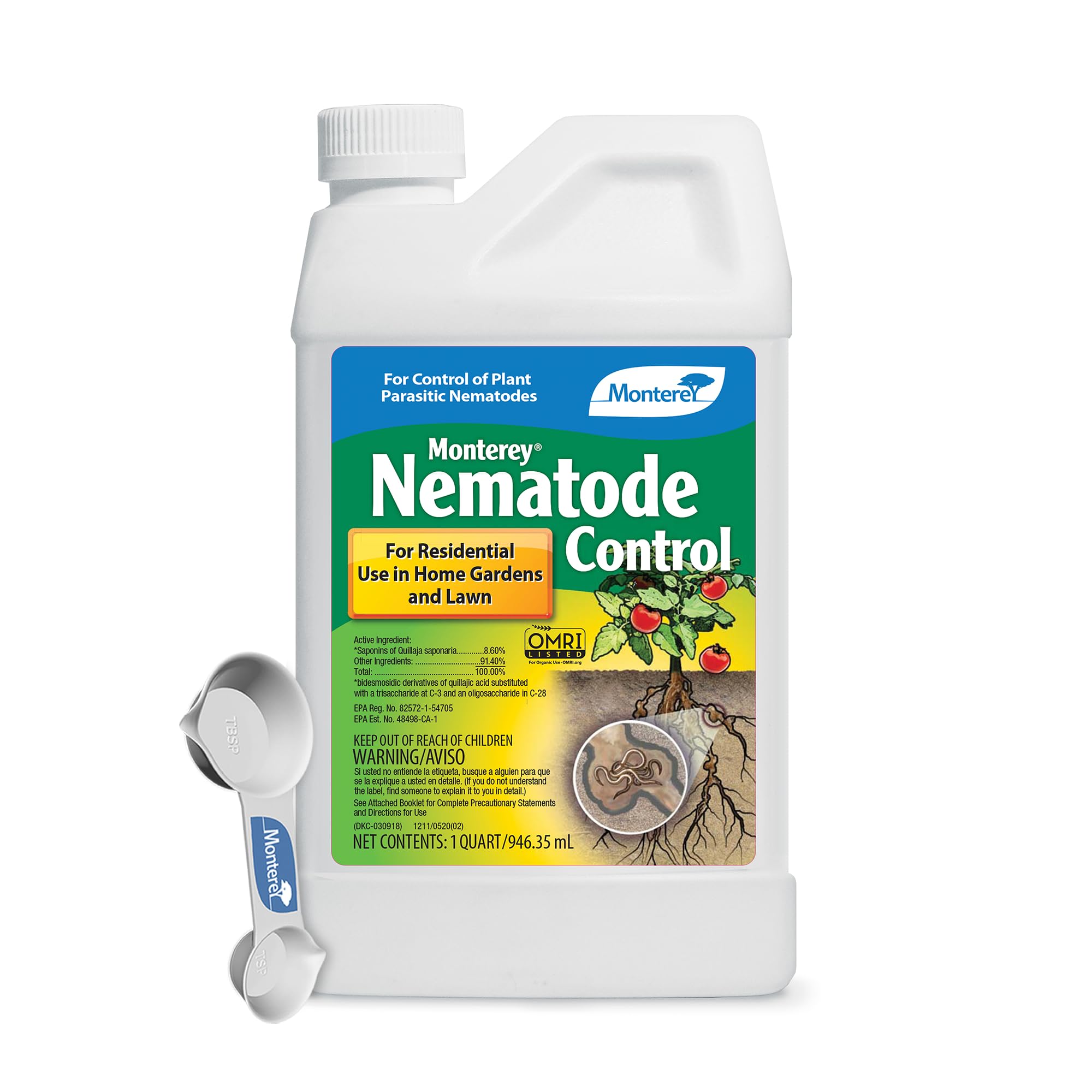
The Monterey Nematode Control leverages 8.6% saponins derived from Quillaja saponaria, a natural botanical extract that disrupts the cell membranes of plant-parasitic nematodes without harming earthworms or beneficial insects. This liquid concentrate can be applied with band or broadcast sprayers as a soil drench, targeting root-knot, lesion, and cyst nematodes that attack vegetables, fruits, and ornamentals.
Applications every 7 to 14 days for up to ten weeks provide season-long suppression, and users have noted tangible improvement in root health and yield for crops like daikon radish and tomatoes. The formula mixes easily with water and does not require a respirator or commercial applicator license for residential use.
Some buyers have questioned the product’s viscosity and odor, with a minority suggesting it resembles soy sauce in appearance and smell. While the majority of verified purchasers report effective nematode reduction, the higher price point per quart makes it a strategic investment for gardeners with persistent soil-borne nematode pressure rather than a casual preventive.
What works
- Targets plant-parasitic nematodes without harming soil biology
- Flexible 7-14 day schedule for season-long protection
- OMRI-listed botanical with EPA registration
What doesn’t
- Higher cost per application compared to biological alternatives
- Some users report unusual appearance and odor
3. Dr. Pye’s Scanmask 10 Million Live Beneficial Nematodes

Dr. Pye’s Scanmask contains 10 million live Heterorhabditis bacteriophora nematodes, microscopic hunters that penetrate and kill over 230 soil-dwelling pest species including white grubs, fungus gnat larvae, and root weevils. Unlike chemical insecticides, these beneficial nematodes actively seek hosts in moist soil and continue reproducing as long as prey is available, providing sustainable control.
Verified users have eliminated severe fungus gnat infestations in houseplants and dramatically reduced white grub populations in Florida lawns within three to four weeks. The product also showed a side-effect reduction in fire ant activity, a bonus for warm-climate gardeners. Application via watering can or sprayer must be precise to achieve the claimed coverage of 2,000 square feet.
Coverage claims have frustrated some buyers who found the 2-gallon mix covered only 100 square feet at effective concentrations. The instructions lack small-batch mixing ratios, and the price per application is higher than some competing nematode products. For targeted use on high-value garden beds or container plants, the 10-million count offers a potent dose that gets results.
What works
- Effective against a broad spectrum of soil pests including fungus gnats
- Self-replicating in soil for ongoing control
- Safe for indoor use around pets and children
What doesn’t
- Directions unclear for small-batch mixing ratios
- Actual coverage often falls short of advertised 2,000 sq ft
4. Bug Sales 50 Million Live Beneficial Nematodes Hb

The Bug Sales Beneficial Nematodes pack 50 million Heterorhabditis bacteriophora per container, making this one of the highest-count biological options for the price. These nematodes target soil-dwelling larvae of beetles, weevils, and grubs, and can be applied with a watering can or sprayer after mixing with water. Complete instructions are included, and the manufacturer guarantees live delivery.
Seasonal users report that annual applications prevent grub damage and restore lawn health without chemical inputs. In one detailed case, a lawn that had declined over three years despite grub control products recovered fully after switching to nematodes combined with organic fertilizer. The high count provides generous coverage for larger properties.
Some deliveries have arrived with clumped or dead nematodes due to temperature stress during shipping, and the product requires immediate refrigeration upon arrival. A small number of buyers found the live concentration lower than expected. For those who can commit to proper storage and application timing, the per-nematode cost is exceptional value.
What works
- Highest nematode count per dollar in this lineup
- Effective against grubs, weevils, and beetles in lawns
- Easy mixing with standard watering equipment
What doesn’t
- Viability can be compromised in hot shipping conditions
- Requires strict refrigeration and timely use
5. Fertilome Triple Action 32 oz
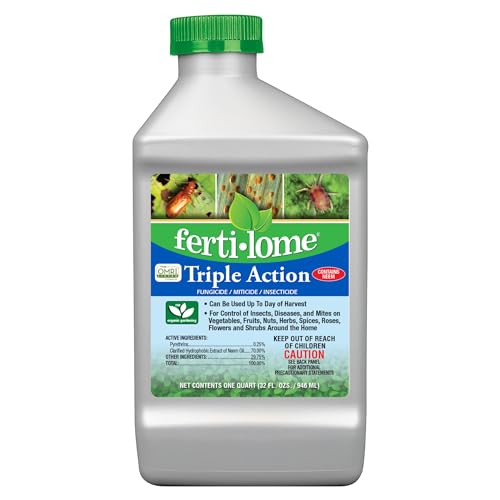
Fertilome Triple Action combines neem oil as its active ingredient to function as an insecticide, miticide, and fungicide in one bottle. While not a dedicated nematode-control product, neem oil suppresses plant-parasitic nematode populations by disrupting feeding and reproduction, and simultaneously controls aphids, spider mites, leafminers, and fungal diseases like powdery mildew and rust.
Long-time users rely on this concentrate for fruit trees, vegetables, and roses, reapplying every 7 to 14 days. The versatility reduces the number of products needed in a shed, and the neem oil base is acceptable for organic gardening. Coverage of a 32-ounce bottle depends on dilution rate but typically supports several spray sessions across a medium garden.
The price has risen noticeably over recent years, and some buyers find it difficult to justify for nematode-specific control alone. Neem oil also poses a risk to pollinators if applied when blooms are wet, requiring careful timing. For gardeners already managing multiple pests and fungal pressures, this product offers broad-spectrum utility alongside modest nematode suppression.
What works
- Triple function reduces separate insecticide, miticide, and fungicide purchases
- Organic neem oil formulation safe for edibles
- Proven effectiveness on fruit trees and ornamentals
What doesn’t
- Not specifically formulated for nematode-only infestations
- Rising price makes repeated applications costly
6. St. Gabriel Organics Milky Spore Powder, 10oz
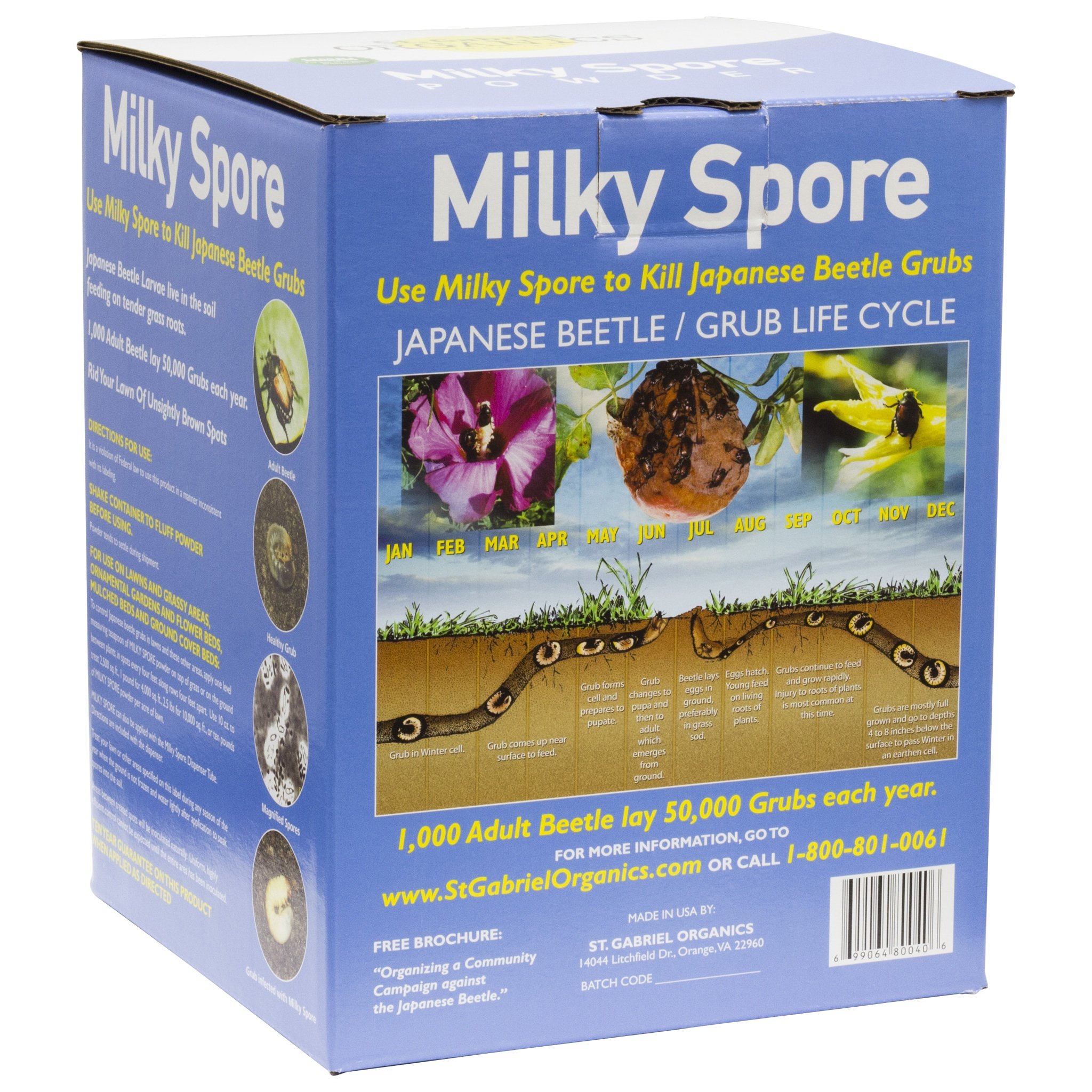
St. Gabriel Organics Milky Spore Powder uses Bacillus popilliae, a natural bacterium that specifically infects and kills Japanese beetle grubs in the soil. Once established, the spores multiply and persist for years, providing continuous preventive control without reapplication. The 10-ounce bag covers up to 2,500 square feet when applied at one teaspoon every four feet in rows.
Users confirm that brown patches caused by grub damage recover within one to two weeks after the spores take effect. The powder is safe for pets, earthworms, and beneficial insects, making it a strong choice for chemical-free lawn care. Application is straightforward — spread by hand or with a dispenser tube and water in — though soil temperature must remain above 50°F for the bacteria to activate.
The powder is fine and can become airborne if handled carelessly, and the instruction sheet is sometimes missing from the packaging. A common complaint is the small volume — 10 ounces looks deceptively tiny for the price. It is also limited to Japanese beetle grubs, so it will not address other nematode species or pest larvae.
What works
- Single application provides multi-year grub suppression
- Safe for earthworms and beneficial garden insects
- Proven effectiveness on Japanese beetle grub damage
What doesn’t
- Only targets Japanese beetle grubs, not other nematodes
- Small package size relative to the moderate cost
7. Valent USA Dipel Pro DF Biological Insecticide BT 54%, 1lb

Valent USA Dipel Pro DF contains 54% Bacillus thuringiensis var. kurstaki, a biological insecticide that targets caterpillars, loopers, and bagworms. While Bt does not directly control plant-parasitic nematodes, it is effective against second-stage larvae that feed on roots after hatching, and it is widely used as a complementary treatment in integrated pest management programs.
The powder mixes economically — a single pound goes a long way when diluted in water for spray application. Commercial growers rely on it to keep acreages of cole crops clean from cabbage loopers, and home gardeners use it annually to protect cedar trees from bagworms. Bt breaks down in sunlight within three to four days, requiring reapplication every few days during active infestations.
This product is not a standalone solution for nematode-infested soil and will not eliminate grubs or root-knot nematodes. Its OMRI listing makes it acceptable for organic production, but the short environmental persistence and narrow target range mean it works best as part of a broader arsenal. For caterpillar-specific outbreaks, it is a fast, affordable tool.
What works
- Fast knockdown of caterpillars, loopers, and bagworms
- Very economical per application at 54% concentration
- OMRI listed for organic farming and gardening
What doesn’t
- Does not target nematodes or grub larvae
- Degrades in 3-4 days of sunlight, needing frequent reapplication
Hardware & Specs Guide
Active Ingredient Selection
Bacillus popilliae (milky spore) and Bacillus thuringiensis are bacterial agents that infect specific pests through ingestion. Live beneficial nematodes (Steinernema and Heterorhabditis) are macroscopic organisms that actively hunt hosts. Saponins and neem oils work by contact and ingestion, disrupting cell membranes and feeding behavior. Choose based on whether you need long-term soil colonization (milky spore), immediate predation (nematodes), or broad-spectrum suppression (neem).
Coverage and Concentration
Coverage claims vary widely: 10 ounces of milky spore powder treats 2,500 sq ft, while 10 million beneficial nematodes may cover only 100-400 sq ft depending on application density. Liquid concentrates like Monterey Nematode Control require dilution at specific rates for soil drench or band spray. Always calculate based on the area of affected root zone rather than total property square footage to avoid underdosing.
FAQ
Can I use milky spore and beneficial nematodes together?
How long do beneficial nematodes survive after application?
Does neem oil kill plant-parasitic nematodes in soil?
Final Thoughts: The Verdict
For most gardeners, the insecticide for nematodes winner is the BioLogic Ecomask because it delivers a proven nematode species with a practical sprayer, offering fast flea and grub reduction with verified owner results. If you want botanical extract targeting plant-parasitic nematodes, grab the Monterey Nematode Control. And for preventive, long-term Japanese beetle grub suppression, nothing beats the St. Gabriel Milky Spore.