
The adult gnats buzzing around your houseplant soil are just the visible symptom. The real battle is underground, where larvae feed on root hairs and turn your prized Monstera into a wilting mess. Most store-bought sprays only target adults, missing the colony hidden in the potting mix, which means the swarm returns within days. A targeted plan that interrupts the entire gnat life cycle is the only way to end the cycle for good.
I’m Rikta — the co-founder and writer behind Lawn Gear Lab. I spend my days comparing biological controls, chemical concentrates, and physical traps, cross-referencing active ingredients like BTI, azadirachtin, and beneficial nematodes, and analyzing hundreds of verified owner reports to determine exactly which formulations actually break the gnat reproduction loop.
Whether you are dealing with a mild indoor annoyance or a full-blown hydroponic infestation, this guide cuts through the marketing noise to identify the most effective insecticide for fungus gnats based on biological efficacy, application ease, and real-world results from growers just like you.
How To Choose The Best Insecticide For Fungus Gnats
Selecting the right product hinges on understanding that fungus gnats have four life stages: egg, larva, pupa, and adult. Most effective controls target the larval stage in the soil because that is where the plant damage occurs and where breaking the cycle is easiest. A product that only kills flying adults will never solve the problem alone.
Active Ingredient: Biological vs. Chemical
Biological insecticides containing Bacillus thuringiensis subspecies israelensis (BTI) or Bacillus amyloliquefaciens are specific to gnat and mosquito larvae and do not harm beneficial insects, pets, or humans. Chemical options like pyrethrins offer quick knockdown of adults but degrade rapidly and require repeated applications. For ongoing infestations, a biological soil drench is generally more effective and safer for indoor use.
Application Type: Soil Drench vs. Spray vs. Systemic
Soil drenches (BTI granules or liquid concentrates) are poured directly into the potting mix so the active ingredient reaches the larvae where they feed. Foliar sprays mostly kill adults on contact and provide little long-term protection. True systemic products, such as those containing azadirachtin or certain biologicals, are absorbed by the plant and make the entire tissue toxic to chewing and sap-sucking pests, including gnat larvae feeding on roots.
Duration and Reapplication Schedule
Some products provide control for a single watering cycle, while others last up to four weeks. BTI-based products need reapplication every 5 to 7 days during active infestations because the bacterium does not persist in dry soil. Beneficial nematodes, once established, can provide control for several weeks as they reproduce and hunt larvae. Understanding the persistence window helps you choose a product that matches your willingness to maintain a treatment schedule.
Quick Comparison
On smaller screens, swipe sideways to see the full table.
| Model | Category | Best For | Key Spec | Amazon |
|---|---|---|---|---|
| BioLogic Scanmask Nematodes | Biological | Long-term prevention | 10 million Sf nematodes | Amazon |
| Southern Ag Bio Fungicide 16oz | Biological | Root-health add-on (not a gnat treatment) | B. amyloliquefaciens D747 | Amazon |
| Arber Organic Insecticide & Fungicide | Dual-Action | Gnat + fungus control | Bio-based concentrate 16oz | Amazon |
| Sierra Natural Science 209 | Systemic | Indoor plant prevention | Azadirachtin concentrate 1.25oz | Amazon |
| MAXGUARD Yellow Sticky Traps | Physical | Adult monitoring & reduction | 30 dual-sided stakes | Amazon |
| Earth’s Ally Disease Control | Citric Acid | Leaf fungus control (not a gnat treatment) | Citric acid concentrate 32oz | Amazon |
| Summit Mosquito Bits (BTI Granules) | Biological | Entry-level BTI soil drench | 2.86% Bti, 30oz, EPA registered | Amazon |
In‑Depth Reviews
1. BioLogic Scanmask Beneficial Nematodes

This is not a spray or a powder — it is a living biological weapon. Steinernema feltiae nematodes are microscopic roundworms that actively hunt and penetrate fungus gnat larvae in the soil, releasing bacteria that kill the host within 48 hours. Each package contains 10 million organisms, enough for about 2,000 square feet of garden beds or 25 to 40 six-inch pots. The nematodes arrive dormant in a clay carrier and must be mixed with water and applied immediately via watering can or sprayer.
What sets this product apart from every chemical option is its self-sustaining potential. If the soil remains moist and temperatures stay between 55°F and 85°F, the nematodes can reproduce inside the dead larvae, providing weeks of ongoing protection. Verified buyers report seeing a dramatic drop in adult gnats within 5 to 7 days after application, with noticeable improvement even against stubborn infestations that resisted neem oil and sticky traps. The nematodes also target thrips, leaf miners, and grubs, making this a multi-pest solution for serious indoor and outdoor growers.
The biggest adjustment for new users is timing: nematodes have a short shelf life and must be used promptly after delivery. You also need to keep the soil consistently damp for at least two weeks after application. But for anyone tired of playing whack-a-mole with chemical sprays, this biological approach offers the most complete, long-term relief available.
What works
- Live organism actively hunts larvae in soil, not just on contact
- Self-reproducing population extends protection for weeks
- Safe for edible crops, pets, and beneficial insects
What doesn’t
- Requires immediate use after arrival; cannot be stored long-term
- Soil must stay consistently moist for nematodes to survive and hunt
- Slightly more expensive upfront compared to standard liquid sprays
2. Southern Ag Garden Friendly Biological Fungicide 16oz

This 16-ounce concentrate packs 98.85% Bacillus amyloliquefaciens strain D747, a beneficial bacterium that colonizes the root zone and out-competes pathogenic fungi responsible for root rot and other soil-borne plant diseases. Growers in the hydroponic community have long used it as a cost-effective root-health additive. A typical soil drench uses only 2 to 4 ml per gallon of water, meaning this single bottle treats hundreds of gallons of potting mix over an entire growing season.
To be direct about what this product is and isn’t: it is registered and marketed strictly as a biofungicide for plant disease control. Its label and Amazon listing make no fungus gnat claim, and we found no verified evidence that it affects gnat larvae or adults. We include it here because gnat larvae thrive in soggy, decaying organic matter, and growers frequently pair a root-health product like this with a dedicated larvicide (BTI or beneficial nematodes) to correct the excess moisture and root rot that invite gnats in the first place. Verified buyers report it reliably controls root rot and algae growth in hydroponic reservoirs. The concentrate is USDA-certified for organic use and can be applied up to the day of harvest on vegetables and herbs.
One common critique is that the bottle opening design encourages a messy dribble when pouring, and the liquid has a mildly unpleasant sulfur-like odor during mixing. The smell dissipates quickly after application. This is not an insecticide of any kind — it is a root and soil disease strategy that works over a few days to a week. If fungus gnats are your primary problem, pair this with the BTI or nematode picks above rather than relying on it alone.
What works
- Highly concentrated bacterial culture treats hundreds of gallons of water
- Colonizes root zone for ongoing protection against fungal pathogens
- USDA-certified for organic gardening and safe for hydroponics
What doesn’t
- Bottle pour spout makes measuring messy without a separate syringe
- Mild sulfur odor during mixing, though it dissipates rapidly
- Not an EPA-registered insecticide; label makes no fungus gnat claim — pair with a BTI or nematode product for larval control
3. Arber Organic Insecticide & Fungicide

This dual-purpose concentrate, made by Arber Plant Wellness, targets both the insect and fungal sides of a plant stress event. The bio-based formula — made from beneficial soil microbes and fermented organic compounds — is labeled for use against powdery mildew along with spider mites, aphids, whiteflies, thrips, and fungus gnats. It is applied with a pump, hose-end, or battery sprayer to both foliage and the root zone, and the label directs reapplication every 7 to 10 days.
Growers dealing with concurrent issues — powdery mildew on leaves plus fungus gnats in the soil — find this particularly useful because one product addresses both problems in a single pass. The concentrate has a mild scent that dissipates quickly and is formulated for use on houseplants, vegetables, ornamentals, shrubs, and lawns. Reapplying on the labeled 7-to-10-day schedule as a preventative measure helps keep indoor plants gnat-free while also suppressing leaf spots and blights on ornamentals and vegetables.
Some users note that the product performs best as a maintenance tool rather than a nuclear option for severe infestations. Heavy infestations may require combining this with yellow sticky traps to capture adult populations while the soil drench works on larvae. The bottle yields multiple refills, making it an economical choice for a consistent spray routine across a medium-sized indoor or patio garden.
What works
- Label explicitly lists fungus gnats alongside powdery mildew, mites, aphids, whiteflies, and thrips
- Dual function as both insecticide and fungicide saves money and time
- Mild scent that dissipates quickly, per the manufacturer’s own listing
What doesn’t
- Requires reapplication every 7 to 10 days; less effective as a standalone for severe infestations
- Concentrate measurement instructions require careful reading
- Works best as part of a broader IPM plan with traps for adults
4. Sierra Natural Science SNS 209 Concentrate

SNS 209 takes a fundamentally different approach: it is a systemic insecticide derived from neem seed extract (azadirachtin) that is absorbed by the plant and distributed throughout its vascular system. When fungus gnat larvae feed on the roots, they ingest the active compound, which disrupts their feeding behavior and molting cycle. This is not a contact spray — it works from the inside out, protecting the entire plant from roots to leaves against a wide range of pests including thrips, spider mites, and aphids.
The product arrives as a 1.25-ounce concentrated oil pouch that makes approximately 32 ounces of ready-to-use solution. Users report mixing a small amount into every watering as a preventative measure, with results becoming noticeable after two to three weeks as the compound builds up in the plant tissue. Verified buyers appreciate that it has a pleasant, mild herbal scent and has not triggered any adverse reactions in pets or children when used according to directions. Many use it as a routine additive alongside regular fertilization to keep a wide range of pests at bay without ever needing a foliar spray.
A notable distinction from true systemic pesticides: some experienced growers point out that SNS 209 functions more as a systemic deterrent than a systemic killer. It disrupts feeding and reproduction rather than providing a lethal dose immediately. This makes it excellent for prevention and low-level infestations but less ideal for an active, heavy outbreak where you need immediate mortality. The small pouch size also means you will need to reorder frequently if you are treating a large collection of plants.
What works
- Systemic action protects entire plant from roots to new growth
- Pleasant mild scent and safe for use around pets and children
- Excellent as a long-term preventative added to regular watering
What doesn’t
- Functions as a deterrent rather than a fast-killing systemic insecticide
- Small pouch size requires frequent repurchases for large plant collections
- Takes two to three weeks to build up effective concentration in plant tissue
5. MAXGUARD Yellow Stake Sticky Traps (30 Pack)

Sticky traps serve a specific role in fungus gnat management: they are excellent for monitoring population levels and reducing adult numbers, but they will never solve the root problem because they do not affect eggs or larvae in the soil. The MAXGUARD 30-pack delivers 5 by 3-inch dual-sided yellow stakes with an industrial-grade adhesive that stays tacky for up to six months. The yellow color specifically attracts adult gnats, whiteflies, and leaf miners, making these a visual indicator of whether your treatment plan is working.
Verified buyers consistently note that these traps catch gnats immediately upon insertion into potted soil, providing satisfying visual proof of the problem. The dual-sided design means that as long as the trap is not completely covered, it remains effective for weeks. Users who combine these sticky stakes with a BTI-based soil drench report that the combination cuts a severe infestation down to zero adult sightings within ten days. The traps are sturdy enough to be removed and repositioned without the glue losing its hold.
The main limitation is size — at 5 by 3 inches, the stakes can look bulky in small 4-inch nursery pots. Many buyers cut them lengthwise with scissors to fit smaller containers. These are not a standalone solution for gnat control, but as a complementary tool for monitoring and adult suppression, they are nearly indispensable for anyone serious about breaking the gnat cycle.
What works
- Immediately captures adult gnats for visual confirmation of infestation levels
- Industrial-grade glue stays effective for months even in humid conditions
- Dual-sided design maximizes surface area without needing to replace frequently
What doesn’t
- Does not affect larvae or eggs in soil; must be paired with a soil treatment
- Full-size stakes look oversized in small pots; require cutting to fit
- High-volume infestations fill traps quickly, requiring frequent replacement
6. Earth’s Ally Disease Control Concentrate 32oz
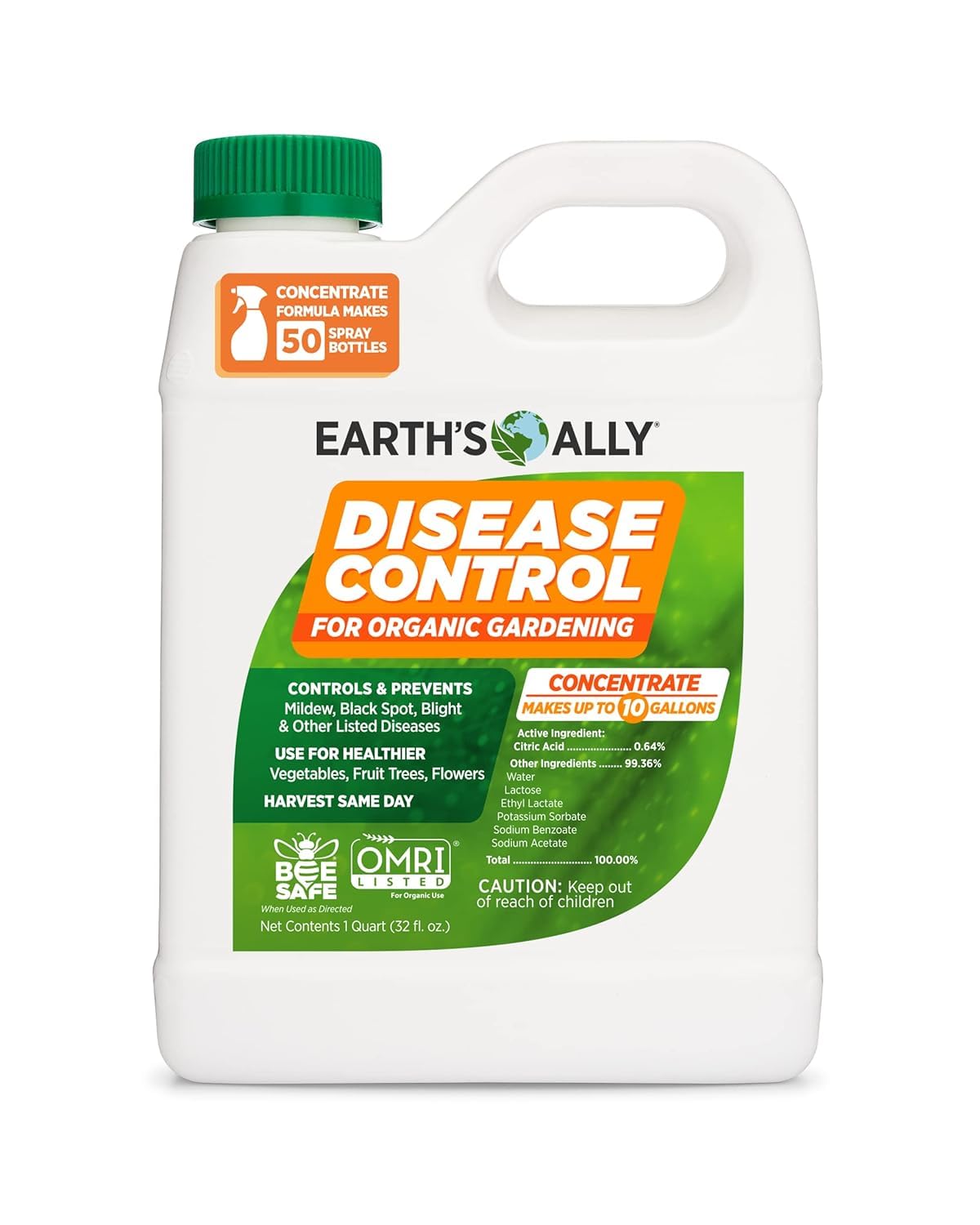
Earth’s Ally uses citric acid as its active ingredient — a contact fungicide that alters the pH on leaf surfaces to inhibit fungal spore germination. It is registered and marketed exclusively as a disease-control product for powdery mildew, downy mildew, blight, canker, and black spot. The concentrated formula mixes 6 tablespoons per gallon of water and yields 10 gallons of ready-to-use solution, making it one of the most economical options by volume in this guide.
To be direct: neither Earth’s Ally’s label nor its own Amazon listing makes any claim about fungus gnats, and we found no verified evidence that it affects gnat larvae or adults. We include it here strictly as a companion product for growers dealing with fungal leaf disease alongside a gnat problem — treating the fungal issue won’t kill gnats, but it addresses a common contributing factor (excess moisture and organic decay) and keeps foliage healthy while a dedicated larvicide like BTI or nematodes does the actual gnat control. The OMRI-listed formula breaks down quickly and leaves no harmful residues, meaning it can be applied to vegetables, herbs, and ornamentals up to the day of harvest.
Because citric acid is a contact fungicide rather than an insecticide, it requires thorough coverage of the leaf and soil surface and regular reapplication every 5 to 7 days for disease control. It is not labeled for gnat control at all — if fungus gnats are your primary problem, choose a BTI larvicide or beneficial nematodes instead. For growers managing fungal leaf disease alongside a gnat issue, this concentrate offers excellent value as a companion treatment.
What works
- Very economical concentrate yields 10 gallons of ready-to-use formula
- OMRI-listed and safe for use on edible crops up to harvest day
- Effective, EPA-recognized citric acid fungicide for common leaf diseases
What doesn’t
- Citric acid requires thorough soil coverage and frequent reapplication
- Not labeled or evidenced for gnat control — use alongside a dedicated larvicide, not instead of one
- Some users find mixing instructions require precise measuring for best results
7. Summit Mosquito Bits (30oz)

Mosquito Bits are corn-cob granules coated in Bacillus thuringiensis subspecies israelensis (BTI), the same larvicidal bacterium referenced throughout this guide. The product is EPA registered in all 50 states, and its label and manufacturer listing explicitly state that it is labeled to control fungus gnats in plant beds and pots, using the same mode of action it uses against mosquito larvae in standing water.
For houseplants, growers soak the granules in water for 20 to 30 minutes to steep a BTI “tea,” then pour it directly onto the potting soil as a drench, or sprinkle the granules on the soil surface and water them in. Verified buyers report that it kills fungus gnat larvae within a day or two of application when used consistently, though — like all BTI products — it needs to be reapplied every few days during an active infestation because the bacterium does not persist once the soil dries out.
Because BTI only kills larvae that ingest it in the top layer of moist soil, thorough, repeated soil coverage matters more than any single application. Reviewers who saw the best results combined it with yellow sticky traps to catch adults while the Bits worked on the next generation of larvae in the soil. At under $15 for a 30-ounce bag treating dozens of pots, it is the most affordable EPA-registered larvicide in this guide.
What works
- EPA registered and explicitly labeled to control fungus gnats, not just mosquitoes
- Very affordable per application compared to nematodes or systemic concentrates
- Simple to use as a soak-and-pour soil drench or dry granule application
What doesn’t
- Needs reapplication every few days during an active infestation
- Does not persist in soil that is allowed to dry out between waterings
- Some users report a musty smell if the granules aren’t used fresh
Hardware & Specs Guide
Biological Fungicides (BTI & Bacillus)
BTI (Bacillus thuringiensis israelensis) and Bacillus amyloliquefaciens are bacterial agents that produce proteins toxic specifically to the larval stage of fungus gnats, mosquitoes, and black flies. BTI is available as granular dunks or liquid concentrate and needs to be applied every 5 to 7 days because the bacterium does not persist in dry soil. B. amyloliquefaciens colonizes the root zone and provides ongoing protection by out-competing pathogens. Both are USDA-certified for organic use and safe for beneficial insects when used as directed.
Beneficial Nematodes (Steinernema feltiae)
These microscopic roundworms actively seek out and penetrate fungus gnat larvae in the soil. They release symbiotic bacteria that kill the host within 24 to 48 hours. One application of 10 million nematodes covers roughly 2,000 square feet of soil. Nematodes require moist soil and temperatures between 55°F and 85°F to survive and hunt. They can reproduce inside host larvae, providing weeks of control. They have a short shelf life and must be used promptly after delivery.
Systemic Insecticides (Azadirachtin)
Azadirachtin, derived from neem seed extract, is absorbed by the plant and distributed throughout its vascular system. When fungus gnat larvae feed on roots, they ingest the compound, which disrupts feeding behavior and prevents molting. Systemic products take one to three weeks to build up effective concentrations in plant tissue. They function as feeding deterrents rather than fast-killing agents, making them ideal for prevention and mild infestations rather than severe outbreaks.
Physical Traps & Monitoring Tools
Yellow sticky traps attract adult fungus gnats because the insects are drawn to the yellow wavelength. The traps use a dual-sided industrial-grade adhesive that remains effective for up to six months. Traps serve as both a monitoring tool to gauge infestation levels and a control measure to reduce adult populations. They do not affect eggs or larvae and must be used in conjunction with a soil drench treatment for complete lifecycle control. Smaller traps or cut-down versions are recommended for small pots.
FAQ
Why do fungus gnats keep coming back after I spray the leaves?
How long does it take for beneficial nematodes to work on fungus gnats?
Can I use BTI and sticky traps together?
Final Thoughts: The Verdict
For most gardeners, the insecticide for fungus gnats winner is the BioLogic Scanmask Nematodes because it attacks the root of the problem with a self-sustaining biological predator that keeps working for weeks. If you want the most affordable EPA-registered larvicide for a soil drench, grab Summit Mosquito Bits, which is explicitly labeled to control fungus gnats. And for a budget-friendly monitoring and adult-reduction tool that proves whether your treatment is working, nothing beats the MAXGUARD Yellow Sticky Traps. Note that the Southern Ag Biological Fungicide and Earth’s Ally Disease Control featured above are root-health and fungal-disease products, not gnat insecticides — use them alongside, not instead of, a BTI or nematode treatment.