
Bagworms are destructive pests that can strip evergreens and deciduous trees of their foliage, leaving behind brown, skeletal branches and weakening the tree over time. The key to stopping bagworms is timing your application to catch young larvae before they build their tough, protective bags and cause irreversible damage.
I’m Rikta — the co-founder and writer behind Lawn Gear Lab. I’ve spent countless hours analyzing pest control formulations, cross-referencing active ingredients against bagworm life cycles, and studying thousands of verified owner reports to separate the truly effective sprays from the rest.
This guide breaks down the top-performing formulations, explains how each active ingredient targets bagworms differently, and helps you match the right product to your tree size and treatment philosophy. Read on for the definitive best insecticide for bagworms recommendations based on real-world efficacy data.
How To Choose The Best Insecticide For Bagworms
Selecting the right insecticide for bagworms depends on the life stage of the pest, the size of the tree, and your preference for synthetic vs. organic control. Below are the critical factors to weigh before buying.
Active Ingredient: B.t., Spinosad, and Pyrethroids
Bacillus thuringiensis (B.t.) is a biological bacterium that only kills caterpillars after they ingest treated foliage, making it safe for bees and earthworms. Spinosad is another biological option, derived from soil bacteria, that also works by ingestion but breaks down faster. Pyrethroids like permethrin, bifenthrin, and cyfluthrin deliver fast contact knockdown and leave a residual film on foliage, but are broad-spectrum and can harm beneficial insects. All of these options work on actively feeding larvae and are substantially less effective against mature bagworms that have already sealed their bags.
Application Timing — The First Two Weeks Matter Most
Bagworm eggs hatch in late spring to early summer, typically from mid-May through June depending on your region. The larvae emerge to spin their bags and begin feeding immediately. Insecticides — especially B.t. — are most effective when applied during this window, before the caterpillars retreat into their bags. Once the bag is fully formed and sealed, contact and ingestion insecticides can no longer reach the larva inside, and hand-picking or pruning out the bags becomes the only reliable control.
Concentrate vs. Ready-to-Spray vs. Hose-End
Concentrates offer the best value for large properties and multiple spray events — you mix the exact ratio needed for each application. Ready-to-spray bottles attach to a garden hose and are ideal for treating tall trees without carrying a heavy tank sprayer. Hose-end applicators are the most convenient but provide less control over coverage uniformity on densely foliated trees.
Residual Activity and Rainfastness
A fast-drying, rainfast formulation within one to two hours is crucial during humid summer months when afternoon thunderstorms are common. Products with longer residual activity, such as those containing permethrin or bifenthrin, can provide protection for two to four weeks on the foliage, reducing the need for reapplication. Biological products like B.t. degrade faster in direct sunlight and may require more frequent sprays at 7- to 10-day intervals during hatch season.
Quick Comparison
On smaller screens, swipe sideways to see the full table.
| Model | Category | Best For | Key Spec | Amazon |
|---|---|---|---|---|
| Monterey B.t. 32 oz | Biological | Large-scale organic treatment | 32 oz concentrate, OMRI listed | Amazon |
| Ortho Bug B Gon | Broad-Spectrum | Perimeter defense & lawn safety | 32 oz ready-to-spray, 6-month protection | Amazon |
| Hi-Yield 38 Plus Permethrin | Synthetic | Long residual against mature bagworms | 38% permethrin concentrate, 16 oz | Amazon |
| BioAdvanced Tree & Shrub | Residual Contact | Residual protection for ornamentals | 32 oz ready-to-spray, rainproof in 1 hour | Amazon |
| Southern Ag Thuricide BT | Biological | Small garden & targeted spot spray | 8 oz concentrate | Amazon |
| Bonide Eight Insect Control | Synthetic | Broad-range contact & residual kill | 32 oz concentrate, 4-week residual | Amazon |
| Ferti-lome Spinosad Bagworm Control | Biological | Named bagworm & tent caterpillar control | 32 oz spinosad ready-to-spray | Amazon |
In‑Depth Reviews
1. Monterey B.t. Bundled with Measuring Spoon — 32 oz
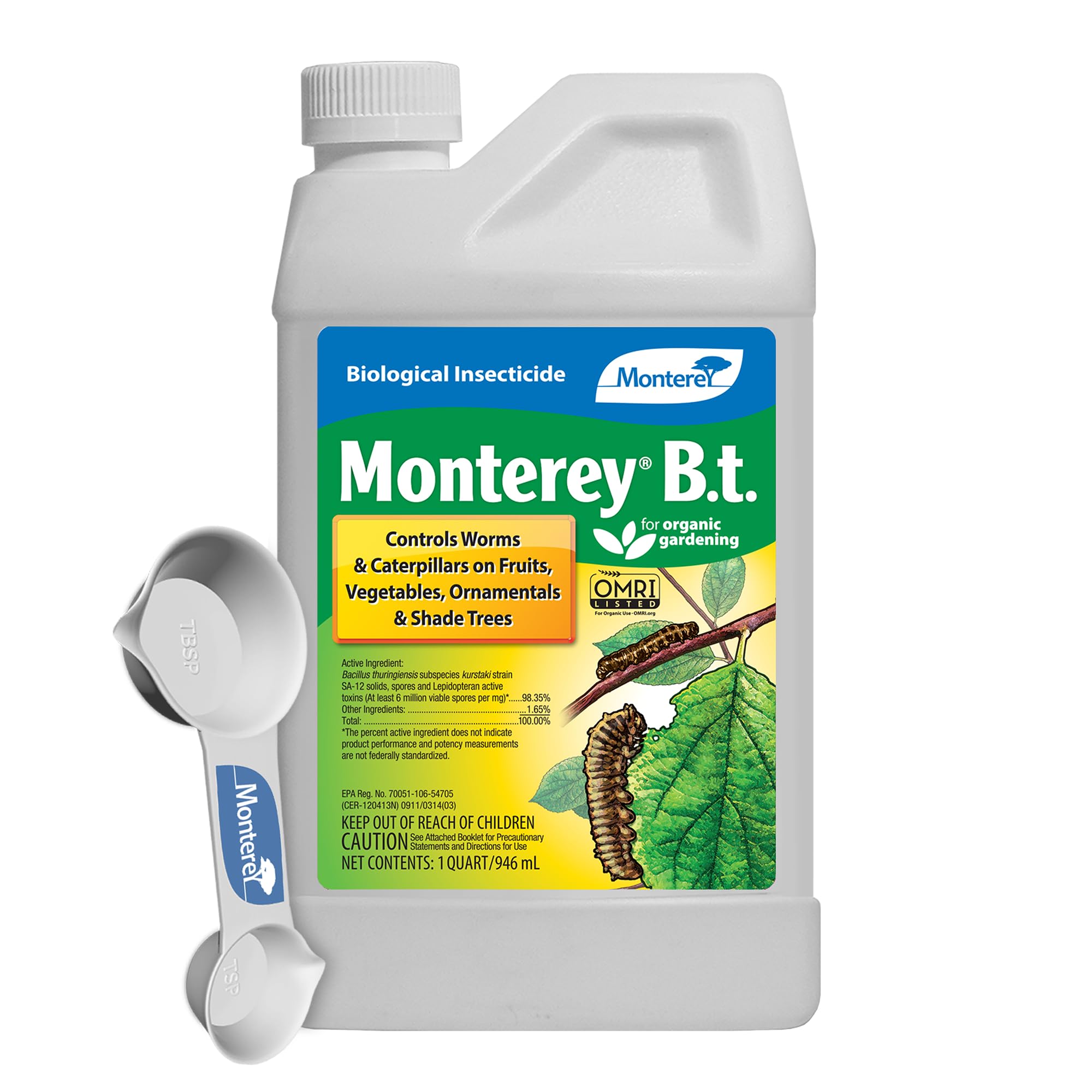
The 32-ounce Monterey B.t. concentrate represents the gold standard for organic bagworm control. This biological insecticide contains Bacillus thuringiensis var. kurstaki, a naturally occurring soil bacterium that produces a protein toxin fatal to young caterpillars after ingestion. Because bagworms are susceptible to B.t. only during their early larval stage before they seal their bags, this product is the ideal first-line defense when applied at the first sign of hatch in late spring.
The included measuring spoon simplifies mixing, and the concentrate treats a substantial area — the label lists bagworm, gypsy moth, fall cankerworm, and elm spanworm as target pests. Users consistently report seeing dead caterpillars on treated foliage within two to three days, and the formulation is gentle enough to use on vegetables, ornamentals, shade trees, and fruiting plants alike. Its OMRI listing ensures compliance with organic gardening standards under the USDA National Organic Program.
For homeowners managing multiple trees or a large landscape, the 32-ounce size offers the lowest per-application cost among biological options. The product mixes instantly with water and works best with a pressure tank sprayer for reaching the upper canopy where bagworm feeding is concentrated. Reapplication every 7 to 10 days during peak hatch season is recommended for full coverage as new larvae emerge.
What works
- Highly selective — targets only caterpillars, harmless to bees and earthworms
- Comes with a measuring spoon for accurate mixing
- OMRI listed for organic gardening
- Kills bagworm larvae within days of ingestion
What doesn’t
- Ineffective against mature bagworms that have sealed their bags
- Degrades in direct sunlight; requires timely reapplication every 7-10 days
- Bottle design can be difficult to open without cutting
2. Ortho Bug B Gon Insect Killer for Lawns and Gardens Ready-to-Spray 32 oz

Ortho Bug B Gon is a broad-spectrum synthetic insecticide that delivers immediate knockdown of bagworms on contact, making it a strong option when an infestation is already visible and growing. The ready-to-spray hose-end bottle covers up to 5,300 square feet and attaches directly to your garden hose, eliminating the need for mixing or carrying heavy sprayers. Its active ingredients, bifenthrin (0.3%) and zeta-cypermethrin (0.07%), provide residual protection on treated foliage for up to six months against spiders and several weeks against other listed insects.
Where this product separates itself is convenience for tall trees. With a standard hose, the spray reaches a significant height, and the formula is rainfast in about an hour — critical for spring applications when afternoon showers are unpredictable. Verified users report a dramatic reduction in mosquitoes, flies, and Japanese beetles after a single treatment, and many long-term users rely on just two applications per year: one in spring and one in late fall.
The trade-off is ecological impact. Both bifenthrin and zeta-cypermethrin are highly toxic to bees, butterflies, fish, and aquatic invertebrates. Ortho’s label explicitly warns against spraying open blooms or allowing drift onto flowering plants visited by pollinators. For bagworm control on ornamental trees away from flowering understory plants, this product is exceptionally effective, but it should be used as a targeted salvage treatment rather than a blanket preventive spray.
What works
- Immediate contact kill against bagworm larvae and many other pests
- Hose-end design is effortless for large trees
- Rainfast in one hour
- Long residual — up to 6 months for some pests
What doesn’t
- Extremely toxic to bees, butterflies, and aquatic life
- Kills blooms on contact; avoid spraying flowering plants
- Rain reduces longevity; may need reapplication after heavy storms
3. Hi-Yield 38 Plus Permethrin Turf, Termite & Ornamental Insect Control — 16 oz

Hi-Yield 38 Plus is a 38% permethrin concentrate — the highest permethrin percentage the EPA allows in a residential product — designed for heavy-duty, long-residual pest control on lawns, ornamentals, and trees. Permethrin works by disrupting the nervous system of insects on contact, and at this concentration, a small amount goes a long way. The label specifically lists bagworms among the pests it controls on ornamental trees and shrubs, alongside borers, bark beetles, and aphids, with residual control for up to four weeks on treated foliage — useful for bagworms that emerge over a staggered hatching window.
This product is the strongest chemical option in this lineup for mature bagworm suppression. While no contact spray can reach larvae that have already sealed themselves inside their bags, permethrin’s staying power on foliage means that newly hatched larvae that emerge days after the initial spray will still encounter a lethal dose. The label directs users to apply while larvae are young and before they’ve built their bags, then reapply at labeled intervals through the hatch window for season-long suppression.
The downside is the chemical odor, which multiple reviewers describe as similar to paint thinner — strong enough that indoor use is not recommended, and the label restricts it to outdoor use only. The formulation also contains petroleum distillates, which can stain clothing and synthetic materials. For outdoor bagworm applications on trees far from living areas, the odor dissipates quickly, but users sensitive to strong chemical smells may prefer a biological alternative for smaller jobs.
What works
- 38% concentration offers exceptional value per gallon mixed
- Bagworms are explicitly named on the label for ornamental trees and shrubs
- Four-week residual protects against staggered bagworm hatches
What doesn’t
- Strong chemical odor that persists on the bottle
- Not safe for use on flowering plants visited by pollinators
- Contains petroleum distillates; can stain clothing; outdoor use only
4. BioAdvanced Tree & Shrub Insect Killer Ready-to-Spray 32 oz

BioAdvanced Tree & Shrub Insect Killer Ready-to-Spray uses cyfluthrin (0.75%) as its active ingredient — a synthetic pyrethroid that kills on contact and leaves a residual film on treated foliage, rather than a root-absorbed systemic. Bagworm is explicitly named on the EPA label’s registered pest list, alongside gypsy moth larvae, caterpillars, and dozens of other foliage-feeding and crawling insects. Any bagworm larva that contacts or feeds on treated leaves is exposed to a lethal dose.
The ready-to-spray formulation connects directly to a garden hose and is rainproof within one hour, a meaningful advantage for spring applications during unpredictable weather. Users report noticeable improvement in their dogwood, red maple, and ornamental tree health within days, with leaves regaining full color and no sign of the pest returning. The formula continues killing listed insects on treated foliage for up to two weeks per application.
The major caveat is standard for this class of chemistry: like other pyrethroids, cyfluthrin is highly toxic to bees and aquatic life on direct contact, and the label warns against spraying open blooms or allowing drift onto flowering plants visited by pollinators. For non-flowering evergreens like spruce, juniper, and arborvitae — common bagworm targets — this is less of a concern. For any tree that blooms, apply only after flowering has finished and avoid spraying open blossoms altogether.
What works
- Bagworm is explicitly named on the EPA label
- Rainproof in one hour; no worry about afternoon storms
- Kills insects by contact, with residual activity on foliage
- Easy hose-end application
What doesn’t
- Cyfluthrin can harm bees and aquatic life if applied to flowering trees or near water
- Not effective against bagworms that have fully sealed their bags
- Some users report limited control against heavy, established infestations
5. Southern Ag Thuricide HPC Concentrate — 8 oz

This 8-ounce bottle of Southern Ag Thuricide is the entry-level biological option for homeowners with a small number of trees or a limited area to treat. It uses the same Bacillus thuringiensis active ingredient family as our top pick, with low toxicity to humans and pets, and label directions covering use on vegetables, citrus, nuts, shrubs, trees, and ornamentals. The smaller size is ideal for gardeners who want to test B.t. before committing to a larger volume or who only need enough for a single season of spot treatments on a few trees.
Mixing is straightforward at a labeled rate of 2 to 4 teaspoons per gallon of water. Because it targets only actively feeding caterpillars, it has no effect on birds, earthworms, or beneficial insects such as honeybees and ladybugs when used as directed. It mixes instantly and is compatible with trigger sprayers, making it an easy choice for precise spot sprays on young bagworm clusters.
The trade-off is the higher per-ounce cost compared to the 32-ounce bottle of our top pick. Additionally, because B.t. degrades in sunlight, users managing a long hatch window will need multiple applications, which the 8-ounce bottle may not cover across an entire season if applied broadly.
What works
- Low toxicity to humans and pets
- Labeled for use on trees, shrubs, and ornamentals
- Perfect for small-scale, targeted bagworm control
- Non-toxic to bees, earthworms, and birds when used as directed
What doesn’t
- Higher per-ounce cost than a larger concentrate bottle
- Ineffective on mature bagworms with sealed bags
- Requires frequent reapplication during peak hatch
6. Bonide Eight Insect Control Concentrate 32 oz

Bonide Eight Insect Control uses permethrin (0.125%), a synthetic pyrethroid, to deliver both fast contact knockdown and up to four weeks of residual control against a broad range of insects. Bagworms are explicitly named on the EPA label’s tree and shrub use section, alongside aphids and other foliage feeders on species like azalea, birch, and other ornamentals. The concentrated 32-ounce bottle mixes to produce many gallons of spray solution for lawns, trees, shrubs, and vegetables.
This product is especially useful when you have identified bagworm clusters on specific branches and want a treatment that keeps working after it dries. Reviewers use it effectively on aphids, beetles, and other listed pests on ornamentals, roses, and fruit trees. Because it leaves a residual film on foliage, newly hatched larvae that emerge after the initial spray also pick up a lethal dose, unlike faster-breaking-down botanical options.
Because it’s a synthetic pyrethroid rather than a botanical extract, it persists longer in the environment and carries the same precautions as other pyrethroids: avoid spraying open blooms or allowing drift onto flowering plants visited by pollinators, and keep it away from ponds and waterways. For bagworm control on ornamental trees away from flowering understory plants, this product is a reliable, budget-friendly option.
What works
- Bagworm explicitly named on the EPA label for trees and shrubs
- Dual action — contact kill plus up to 4 weeks of residual control
- Budget-friendly cost per application
What doesn’t
- Toxic to bees and aquatic life; avoid blooms and waterways
- Synthetic — not suited for organic-certified gardens
- Chemical odor stronger than botanical options
7. Ferti-lome Spinosad Bagworm, Tent Caterpillar & Chewing Insect Control, RTS Quart

Ferti-lome’s Spinosad Bagworm, Tent Caterpillar & Chewing Insect Control is, as the name states, labeled by name for bagworms — the product’s own label lists bagworms, tent caterpillars, armyworms, sod webworms, loopers, and other chewing insects on lawns, ornamental trees, shrubs, and flowers. Its active ingredient, spinosad, is derived from a soil bacterium and is approved for organic gardening use (OMRI listed). It works by ingestion and contact, attacking the insect’s nervous system and typically causing death within a day or two — faster than B.t.
The ready-to-spray quart bottle connects to a garden hose for easy coverage of taller trees and shrubs. Spinosad also controls leafminers, borers, leafrollers, thrips, and Colorado potato beetle on vegetables, fruits, and citrus, making it a versatile choice for gardeners who want one product that covers both ornamental and edible plantings.
The label recommends applying while larvae are young, and reapplying as needed if new hatching is observed, since — like every other contact or ingestion product in this guide — it will not penetrate a bagworm that has already sealed itself inside its bag. Spinosad is more toxic to bees while wet, so the label advises applying in the evening after bees have stopped foraging.
What works
- Bagworms named directly in the product’s title and label
- OMRI listed for organic gardening
- Faster kill speed than B.t. — often within 24-48 hours
- Also controls tent caterpillars, armyworms, and other chewing insects
What doesn’t
- More toxic to bees than B.t.; apply at dusk, not mid-day
- Not effective against bagworms with fully sealed bags
- Pricier per application than concentrate-based options
Hardware & Specs Guide
Bacillus thuringiensis (B.t.)
B.t. is a selective biological insecticide that targets only caterpillar-stage larvae. It must be ingested by the pest and works best on young, actively feeding bagworms within the first two weeks after hatch. It breaks down in UV light and is rain-sensitive, requiring reapplication every 7-10 days. It is certified OMRI for organic use and poses no threat to bees, earthworms, or beneficial insects when applied according to label directions.
Permethrin & Pyrethroid Concentrates
Synthetic pyrethroids like permethrin and bifenthrin deliver fast, broad-spectrum contact kill and provide residual protection for weeks on treated foliage. Concentrates in the 10-13% range give the lowest cost per gallon mixed but require careful mixing math and protective gear during application. These chemicals are highly toxic to fish and aquatic invertebrates — never allow runoff into ponds, streams, or storm drains.
FAQ
How soon after hatch should I apply insecticide for bagworms?
Can I use B.t. on bagworms after they have built their bags?
Will rain wash off bagworm insecticide before it dries?
What is the difference between B.t. and spinosad for bagworm control?
Final Thoughts: The Verdict
For most gardeners, the insecticide for bagworms winner is the Monterey B.t. 32 oz because it combines organic safety with unmatched selectivity for the critical early larval stage. If you need a wide-reaching, fast-acting salvage tool, grab the Ortho Bug B Gon. And for long-lasting residual protection on non-flowering evergreens, nothing beats the BioAdvanced Tree & Shrub.