
Coco coir has become the backbone of modern hydroponics, offering the moisture retention of peat with far superior drainage and aeration. But not all coco coir is equal — the difference between a thriving root zone and a salt-stunted disaster comes down to buffering, EC levels, and fiber consistency. Navigating the dozens of bricks and loose-fill bags on the market requires understanding exactly what your setup demands.
I’m Rikta — the co-founder and writer behind Lawn Gear Lab. I’ve spent countless hours cross-referencing lab test results, comparing expansion ratios, analyzing customer feedback on salt content and particle size, and identifying which coco coir brands deliver consistent, repeatable results for serious hydroponic growers.
Whether you are starting seeds or running a recirculating deep water culture system, finding the right substrate is critical. This guide breaks down the seven most compelling options to help you choose the best coco coir for hydroponics based on your specific grow style and budget.
How To Choose The Best Coco Coir For Hydroponics
Hydroponic systems expose roots directly to the growing medium, so impurities and inconsistent buffering can cause immediate problems. Here are the three specs every hydroponic grower should verify before buying.
Electrical Conductivity (EC) and Salt Content
Unwashed coco coir contains naturally occurring sodium and potassium salts that can raise the EC of your nutrient solution, locking out calcium and magnesium. Look for coir that is explicitly labeled as “triple-washed” or “low EC” — ideally below 0.5 mS/cm. Brands that provide actual tested EC values offer far more reliability than vague marketing claims.
Buffering Against Calcium and Magnesium
Raw, unbuffered coco coir has a high cation exchange capacity (CEC) and will grab calcium and magnesium ions from your nutrient solution, leaving your plants deficient. Professionally buffered coir has been pre-soaked in a calcium and magnesium solution so that it releases these ions rather than stealing them. Always confirm the coir is “buffered” or “pH balanced” before using it in a hydroponic reservoir.
Particle Size: Fine vs. Chunk
Hydroponic coco coir comes in three main textures: fine dust (coco pith), medium fibers, and chunky chips. Fine pith retains more water but compacts easily, reducing oxygen to roots. Coarse chips provide better drainage but dry out faster. Most successful hydroponic growers choose a blend — either a pre-mixed bag or a mix of pith and chips — to achieve 30–40% air porosity.
Quick Comparison
On smaller screens, swipe sideways to see the full table.
| Model | Category | Best For | Key Spec | Amazon |
|---|---|---|---|---|
| CANNA Coco Brick | Hydroponic Brick | High-performance hydroponic setups | 40L expanded, 8L dry | Amazon |
| Mother Earth Coco + Perlite | Pre-Mixed Bag | Ready-to-use container gardening | 70% coir / 30% perlite | Amazon |
| Happy Trees Coco & Perlite | Pre-Mixed Loose Bag | Clean, low-dust seed starting | Triple-washed, pH balanced | Amazon |
| Plantonix Coco Bliss (6-Pack) | Compressed Brick | Budget hydroponic seed starting | Pre-screened, OMRI listed | Amazon |
| GROW!T Organic Coco Chips | Planting Chips | Top-dressing and drainage additive | Chunky chip texture | Amazon |
| Vivlly Coco Coir Brick 10lb | Compressed Brick | Large-scale budget expansion | 75 quarts expanded from 10 lb brick | Amazon |
| MagJo Naturals Coco Coir 4-Pack | Bulk Brick Set | High-volume organic gardening | 44 lbs total, low EC & pH balance | Amazon |
In‑Depth Reviews
1. CANNA Coco Brick

CANNA’s Coco Brick is the gold standard for hydroponic growers who demand consistent, low-salt coir. Each 8-liter dry brick expands to a full 40 liters of buffered, ready-to-use medium — an impressive 5:1 expansion ratio that outperforms most competitors. The coir is pre-buffered with calcium and magnesium, meaning you can plant directly without worrying about the medium stealing nutrients from your reservoir.
Hydroponic users consistently report faster root development and zero issues with fungal gnats or salt burn after switching from unbuffered bricks. The texture strikes a careful balance between fine pith and short fibers, providing both moisture retention and structural aeration without needing perlite. CANNA’s reputation for quality control means every batch is tested for EC and pH, so you get the same result bag after bag.
This is the brick that experienced growers recommend most often. The only real friction point is the price, which sits above standard unbuffered alternatives — but the lack of calibration headaches and the elimination of pre-rinsing steps make it a net time saver for serious hydroponic operations.
What works
- Pre-buffered with calcium and magnesium, reducing nutrient lockout risk
- Exceptional 5:1 expansion ratio yields 40 liters from a compact brick
- Consistent, low EC (<0.5) ensures no salt burn in sensitive seedlings
- Reusable after rinsing and de-rooting, offering excellent long-term value
What doesn’t
- Premium price per brick vs. unbuffered budget options
- Requires full hydration and fluffing before use, which takes 15–20 minutes
2. Mother Earth Coco + Perlite Mix

Mother Earth has engineered a 70/30 coco coir and perlite blend that eliminates the guesswork of mixing your own aeration amendments. The 1.8 cu. ft. bag comes pre-expanded and ready to use straight out of the bag — no bricks to soak, no perlite to measure. This is ideal for growers who run multiple containers and want consistent drainage from pot to pot without the labor of rehydrating bricks.
The perlite component ensures the mix stays light and resists compaction over time, which is critical for container gardens that go through multiple wet-dry cycles. Users transitioning from traditional peat-based potting soils report a noticeable reduction in fungus gnat populations and better oxygen penetration to the root zone. The coir itself is triple-washed and buffered, with an EC low enough that you can feed nutrients immediately.
For indoor container gardeners, this is the closest thing to a plug-and-play hydroponic medium. The downside is that the pre-mixed format offers less flexibility — you cannot adjust the coir-to-perlite ratio for specific crops. Additionally, the bag size is bulky, making it less convenient to store than compressed bricks.
What works
- 70/30 coir-perlite ratio provides excellent drainage and aeration out of the bag
- No hydration step required — ready to use immediately
- Triple-washed and buffered coir prevents salt-related issues in seedlings
- Large 1.8 cu. ft. volume offers strong value for multi-pot gardeners
What doesn’t
- Bulky bag takes up significant shelf space compared to bricks
- Fixed coir-to-perlite ratio limits customization for specialized crops
3. Happy Trees Coco Coir and Perlite 70/30

Happy Trees enters the pre-mixed market with a strong focus on cleanliness and user experience. Their 50-liter bag of 70% coco coir and 30% perlite is triple-washed and pH balanced, with a fluffy, low-dust texture that makes it a pleasure to handle. The loose-fill format means zero preparation — you open the bag and plant directly, which is a significant time saver during busy transplant days.
Customer feedback highlights the absence of wood chips, plastic bits, and visible pests — a common complaint with less processed bulk coir. The buffering is effective enough that nutrient-sensitive plants like peppers and cannabis show no signs of calcium deficiency after transplant. The perlite is evenly distributed throughout the bag, preventing the hot spots of drainage that sometimes occur with hand-mixed batches.
The main trade-off is the price per liter, which runs higher than compressed bricks. Some users note that while the quality is excellent, a –15 price reduction would make it more competitive with Mother Earth. However, for growers who prioritize zero-prep convenience and pristine quality, Happy Trees delivers a premium experience that justifies the cost.
What works
- Pre-buffered and pH balanced for immediate nutrient uptake
- Exceptionally clean — no visible debris, dust, or pest contamination
- Soft, fluffy texture ideal for delicate seed starting and propagation
- Consistent 70/30 blend ensures uniform drainage throughout the bag
What doesn’t
- Higher per-liter cost compared to expanding bricks
- Loose-fill bag is heavy and less compact to store than brick formats
4. Plantonix Coco Bliss 6-Pack

Plantonix’s Coco Bliss 6-pack delivers six 650-gram bricks of pre-rinsed, pre-screened coco coir at a price point that undercuts most single-brick alternatives. The multiple screening process removes sand, fiber shards, and rocks — impurities that can clog drip lines in hydroponic systems. Each brick expands to roughly 2 gallons of medium, giving you a total of 12 gallons across the pack, which is enough to fill a 4×4 seedling tray or several 3-gallon pots.
The coir is OMRI listed for organic use, and the low salt content makes it suitable for direct seeding without additional washing. Users report significantly faster germination compared to unbuffered brands, with roots growing dense and white rather than brown or stunted. The 6-pack format is especially convenient for growers who rotate crops frequently and prefer small, manageable bricks over one massive block.
Where this pack falls short is the buffering — while the coir is pre-rinsed, it is not explicitly buffered with calcium and magnesium. Growers in recirculating hydroponic systems should add a cal-mag supplement to prevent deficiency during the first week. Additionally, the bricks are labeled by weight rather than expanded volume, so actual yield can vary slightly depending on hydration technique.
What works
- Multiple screening removes sand and debris that clog hydroponic systems
- Excellent value per brick compared to single-pack competitors
- OMRI listed, making it suitable for certified organic operations
- Small, manageable bricks are easy to hydrate one at a time as needed
What doesn’t
- Not explicitly buffered with calcium and magnesium for hydroponic use
- Expanded volume per brick is slightly smaller than premium Dutch brands
5. GROW!T Organic Coco Coir Planting Chips

GROW!T takes a different approach with a chunky coco chip format rather than fine pith. The 9-pound compressed block expands into rough-cut chips that act more like rockwool cubes than traditional coir — providing excellent drainage and air porosity while resisting compaction over multiple grow cycles. This makes it a strong candidate for hydroponic media beds where oxygen to the root zone is the primary concern.
The coarse texture also makes the chips mold and fungus resistant compared to powdery pith, a significant advantage for growers in humid environments. Users report that the chips hold moisture evenly without becoming waterlogged, and the large particle size creates natural air channels that benefit deep root systems. The OMRI organic certification ensures no synthetic wetting agents or chemical buffers are present.
This product is not designed for seed starting or fine root propagation — the chips are too large for delicate seedlings to anchor into. It works best as a base layer in fabric pots, a top-dressing for tropical plants, or a mixed component with finer coir to improve overall drainage. Some users note a small amount of plastic debris in early batches, though quality control seems to have improved.
What works
- Chunky texture provides superior aeration and resists compaction in media beds
- Mold and fungus resistant due to coarse particle size and good airflow
- OMRI organic listed, safe for certified organic hydroponic use
- Reusable for multiple grow cycles after rinsing and sterilizing
What doesn’t
- Too coarse for seed starting or fine-root propagation without mixing
- Small amount of plastic debris reported in some batches
6. Vivlly Coco Coir Brick 10 LB

Vivlly’s 10-pound compressed brick is one of the most economical ways to buy coco coir, expanding to a remarkable 75 quarts (2.5 cubic feet) of medium from a single block. The triple-washed, low-salt processing gives it an EC below 0.5, making it suitable for hydroponic use right after hydration. The neutral pH range of 5.5–6.5 places it squarely in the sweet spot for most nutrient formulations.
This brick is a favorite among mycology cultivators and large-scale seed starters who value volume over particle consistency. The coir breaks apart easily with warm water (3–4 gallons), producing a fluffy medium that retains moisture while maintaining roughly 30% air porosity. Users report strong germination rates and vigorous early growth in both tray and pot applications.
The primary limitation is dust — some users report powdery coir that requires careful hydration to avoid airborne particles. The brick also lacks explicit calcium buffering, so hydroponic growers using RO water should supplement cal-mag from the first feeding. For budget-conscious gardeners who need massive volume, this brick delivers utility at a compelling price-per-quart ratio.
What works
- Massive 75-quart expansion from a single 10-pound brick
- Triple-washed with low EC (<0.5), safe for direct hydroponic use
- Neutral pH 5.5–6.5 aligns with standard nutrient solution targets
- Excellent value for high-volume seed starting and soil amendment
What doesn’t
- Powdery dust can be an issue during hydration without careful technique
- Not buffered with calcium and magnesium — cal-mag supplement required
7. MagJo Naturals 100% Pure Coco Coir 4-Pack
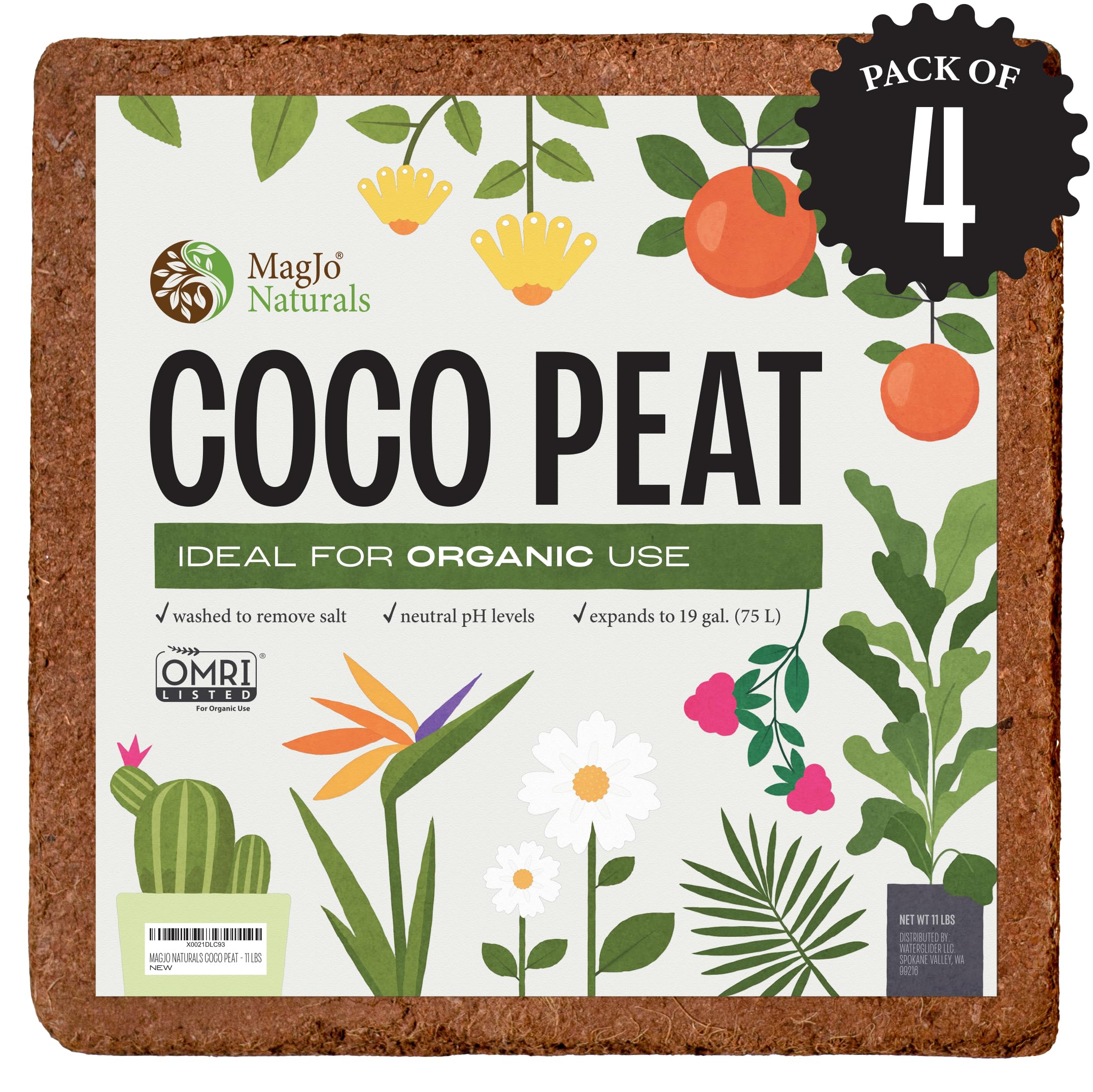
MagJo Naturals’ 4-pack bundles four 11-pound bricks (44 pounds total) of coco coir sourced from OMRI registered manufacturers, making it a strong contender for large-scale organic growers. Each brick is washed to reduce salt content, with users measuring TDS as low as 200 ppm after hydration. The bricks expand significantly — one 11-pound block fills a 5-gallon container with room to spare — providing enough medium to support a substantial grow operation.
The coir’s low EC and pH balance make it suitable for direct use in organic hydroponic systems, and the large brick format means fewer rehydration cycles for high-volume growers. Users report the coir lightens heavy soil mixes and retains moisture effectively, reducing watering frequency in both containers and raised beds. The 4-pack is also popular among reptile and worm farmers who need bulk coir for bedding and substrate.
The main drawback is the density of the bricks — they are compressed extremely hard, requiring patience during hydration. Attempting to break the brick before soaking is nearly impossible; the most effective method is to submerge the entire brick in warm water and let it expand naturally. Some users also note a faint tea tree oil-like smell, which dissipates after the first watering cycle.
What works
- Massive 44-pound total volume provides months of medium for serious growers
- Low salt content (200 ppm TDS) suitable for organic hydroponic feeding
- OMRI registered source ensures compliance with organic certification standards
- Excellent moisture retention reduces watering frequency in hot environments
What doesn’t
- Bricks are extremely hard-packed and require full submersion to hydrate efficiently
- Faint tea tree oil smell reported by some users during initial hydration
Hardware & Specs Guide
Electrical Conductivity (EC)
EC measures the salt concentration in the coir after processing. Hydroponic coir should have an EC below 0.5 mS/cm to prevent nutrient lockout and root burn. Triple-washed and buffered bricks typically hit this target, while unbranded or cheap bricks can exceed 1.0 mS/cm, requiring extensive pre-rinsing.
Buffering Status
Buffered coir has been pre-soaked in a calcium and magnesium solution to satisfy the coir’s natural cation exchange capacity. Unbuffered coir will absorb Ca and Mg from your nutrient solution during the first week, causing deficiency symptoms. Always verify the product is “buffered” for hydroponic use, or plan to supplement with cal-mag.
Expansion Ratio
The expansion ratio tells you how much hydrated medium you get from a dry brick. Premium bricks like CANNA achieve a 5:1 ratio (8L dry → 40L wet), while standard bricks range from 3:1 to 4:1. Higher expansion ratios generally indicate finer grinding and more consistent processing, which translates to better water distribution.
Particle Size Distribution
Hydroponic coir ranges from fine dust (coco pith) to coarse chips. For most systems, a blend of 70-80% fine pith and 20-30% chips provides ideal water retention and aeration. Pre-mixed bags like Mother Earth and Happy Trees use this ratio, while pure chip products like GROW!T are best used as drainage amendments rather than standalone media.
FAQ
Can I reuse coco coir after a hydroponic grow cycle?
Do I need to add perlite to coco coir for hydroponics?
What is the ideal pH for coco coir in hydroponic systems?
Final Thoughts: The Verdict
For most hydroponic gardeners, the best coco coir for hydroponics winner is the CANNA Coco Brick because it delivers professional-grade buffering, a 5:1 expansion ratio, and consistently low EC that removes all guesswork from your grow. If you want a ready-to-use, pre-mixed bag, grab the Mother Earth Coco + Perlite Mix for its ideal 70/30 ratio and zero-prep convenience. And for large-scale growers who need bulk volume without sacrificing low salt content, nothing beats the MagJo Naturals 4-Pack.