
Armyworms attack in waves, stripping turf and vegetable leaves down to the stems within days. Finding a fast-acting, targeted insecticide that won’t harm your soil biology or beneficial insects is the only way to stop them before the damage becomes irreversible.
I’m Rikta — the co-founder and writer behind Lawn Gear Lab. I spend my time comparing active-ingredient concentrations, studying residual control windows, and analyzing hundreds of verified buyer reports to determine which products truly deliver on their label claims across different infestation levels and garden types.
Whether you need organic caterpillar control for a vegetable patch or broad-spectrum granules for a large lawn, this guide breaks down the most dependable chemistry and application strategies available today. This is your complete resource for finding the best insecticide for armyworms.
How To Choose The Best Insecticide For Armyworms
Armyworms are surface-feeding caterpillars that emerge in large numbers, often overnight. Choosing the right chemistry depends on your crop type, the level of infestation, and whether you need immediate contact kill or season-long prevention. The table below and the deeper reviews will walk you through the key differentiators.
Active Ingredient: Spinosad vs Bt vs Pyrethroids
Spinosad, derived from a soil bacterium, kills armyworms on contact and through ingestion, and it remains effective for up to two weeks on leaf surfaces. Bacillus thuringiensis (Bt) is a narrower biological that only works when caterpillars eat treated foliage, making it slower but extremely safe for bees and predatory insects. Pyrethroids like lambda-cyhalothrin provide fast knockdown and longer residual activity on turf, but they can disrupt non-target insect populations.
Formulation: Liquid Concentrate vs Granules
Liquid concentrates (Spinosad or Bt) must be mixed with water and sprayed directly onto leaf surfaces where armyworms are feeding. This provides immediate coverage but requires reapplication after heavy rain. Granules with lambda-cyhalothrin are spread over turf and watered in, creating a protective barrier in the soil and grass canopy that kills on contact for up to three months. For vegetable gardens, liquids are safer; for large lawns, granules save time.
Organic Certification and Beneficial Insect Safety
If you grow edibles or maintain a pollinator-friendly garden, verify the OMRI listing. Spinosad and Bt are both approved for organic use, but Spinosad has a shorter residual on flowers and is safer for bees if sprayed at dusk. Avoid broad-spectrum synthetic options on flowering crops unless you can mow the blooms before application.
Quick Comparison
On smaller screens, swipe sideways to see the full table.
| Model | Category | Best For | Key Spec | Amazon |
|---|---|---|---|---|
| Bonide Captain Jack’s Deadbug Brew | Concentrate | Organic gardens with active caterpillar infestations | Active Ingredient: Spinosad | Amazon |
| Monterey B.t. with Measuring Spoon | Concentrate | Bee-safe control on flowering vegetables | Active Ingredient: Bacillus thuringiensis | Amazon |
| BioAdvanced Season Long Grub Control | Granules | Season-long prevention on turf lawns | Active Ingredient: Lambda-cyhalothrin | Amazon |
| Bonide Diatomaceous Earth | Powder | Dry dust barrier around garden beds and indoors | Non-chemical abrasive dust | Amazon |
| SUMMIT Caterpillar and Webworm Control | Hose-End | Quick hose-end coverage of shrubs and small trees | Active Ingredient: Bt (hose-end spray) | Amazon |
| Hi-Yield Dusting Wettable Sulfur | Granules/Dust | Suppressing thrips and chiggers alongside armyworms | Active Ingredient: Sulfur | Amazon |
| GH Armor Si | Nutrient | Strengthening plant stems against pest stress | Silica and potassium supplement | Amazon |
In‑Depth Reviews
1. Bonide Captain Jack’s Deadbug Brew

Captain Jack’s Deadbug Brew uses 0.5% Spinosad as its active ingredient, a naturally occurring bacterium that attacks the nervous system of caterpillars on contact and ingestion. It controls armyworms, bagworms, borers, loopers, and leaf miners across a broad range of fruiting vegetables, cole crops, and stone fruits. The concentrate mixes instantly with water, requiring roughly 1 teaspoon per liter for spot treatments.
Verified buyers consistently report that one or two weekly applications stop active infestations on kale, collards, and citrus trees without harming spiders or predatory mites. The Spinosad breaks down quickly in sunlight, so evening spraying maximizes efficacy. A single 32-ounce bottle goes a long way for larger plant collections, though the measuring cap tends to trap bubbles that make precise dosing slightly tricky.
For organic gardeners facing an aggressive armyworm outbreak, this is the most reliable contact-and-ingestion option available. It works fast enough to save damaged leaves and is gentle enough on soil biology to use throughout the growing season. Just avoid spraying open flowers during bee foraging hours.
What works
- Kills on contact and ingestion for rapid knockdown
- Approved for organic gardening with minimal non-target impact
- Concentrate stretches far for large gardens
What doesn’t
- Bubbles in the measuring cap make accurate dosing annoying
- Requires weekly reapplication during wet weather
2. BioAdvanced Season Long Grub Control
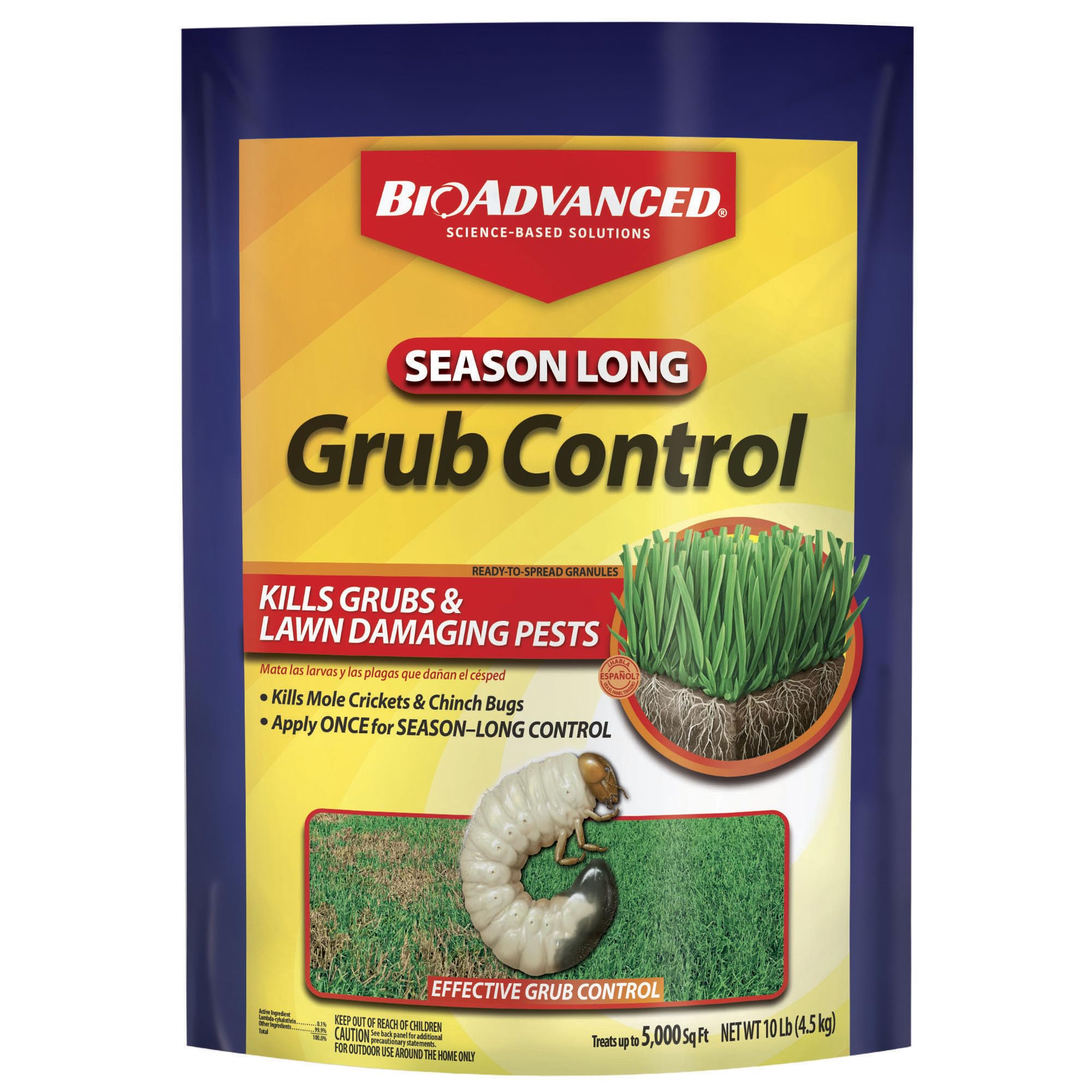
This granular insecticide delivers 0.08% lambda-cyhalothrin, a synthetic pyrethroid that kills armyworms, grubs, mole crickets, chinch bugs, and more than 40 listed lawn insects on contact. A single 10-pound bag covers up to 5,000 square feet of turf when applied with a rotary or drop spreader, then watered in lightly to activate the barrier.
Buyers report complete elimination of grub damage and a reduction in hidden cockroaches and ants within days of application. The barrier effect lasts the entire growing season, meaning one treatment protects against overlapping generations of armyworms. The granules are easy to apply, though you need to keep pets off the lawn until the product dries after watering.
This is the best choice for large lawn areas where armyworms have returned year after year. It eliminates the need for repeated sprays and provides broad-spectrum protection far beyond caterpillars alone. However, because it is a broad-spectrum synthetic, it can harm beneficial insects if applied heavily near flower borders.
What works
- Single application provides season-long residual protection
- Kills over 40 types of lawn pests including grubs and ants
- Quick broadcast application for large turf areas
What doesn’t
- Broad-spectrum action reduces beneficial insect populations
- Not suitable for vegetable gardens or edible crops
3. Monterey B.t. with Measuring Spoon
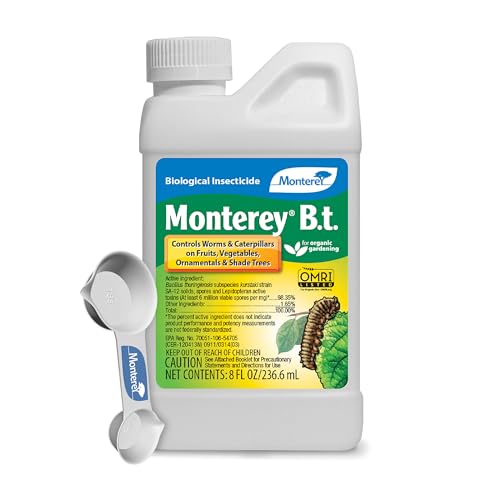
Monterey B.t. relies on Bacillus thuringiensis, a biological bacterium that armyworms ingest while feeding and which subsequently paralyzes their digestive system. It controls cabbage loopers, bagworms, gypsy moths, fall cankerworms, and the specific caterpillar species that devastate broccoli, cabbage, turnip greens, and ornamental trees.
Customers using this on Texas Mountain Laurel and vegetable crops confirm that loopers stop feeding within 24 hours and die off over the following days. The product mixes instantly with water and works with either a trigger sprayer or a pressure tank. Because Bt only affects caterpillars that eat treated foliage, it has zero impact on honeybees, earthworms, or ladybugs.
The 8-ounce concentrate includes a measuring spoon for accurate mixing, which eliminates the bubble-measuring frustration of some competing brands. For bee-safe control on flowering crops where armyworms attack leaves, this is the most targeted option you can buy. The only catch is that Bt degrades in UV light within 3-5 days, so reapplication is necessary after rain or heavy dew.
What works
- Completely safe for bees, earthworms, and beneficial insects
- Included measuring spoon simplifies mixing ratios
- OMRI listed for use on organic vegetable gardens
What doesn’t
- Slower kill time compared to Spinosad or pyrethroids
- Needs reapplication every 5-7 days in wet conditions
4. SUMMIT Caterpillar and Webworm Control

This ready-to-use Bt formulation connects directly to your garden hose, eliminating the need for mixing or measuring. It targets caterpillars and webworms on ornamentals, shrubs, and trees, making it ideal for treating tall bushes or large hedges where a pump sprayer would be tedious. The hose-end dial adjusts the spray rate as you move.
Reviews highlight immediate results against bagworms on juniper bushes and webworms on shade trees. One application on 50 feet of bushes stopped cocoon growth entirely. The product is described as environmentally friendly and odorless, which matters in residential settings near patios or play areas.
For homeowners who need a fast, no-mess solution for armyworms on foundation plants, this is the simplest option available. The coverage is surprisingly broad for a hose-end sprayer, though the powerful stream means you need to start with a low water flow to avoid blasting leaves off delicate plants. It works best applied in early spring before caterpillars reach large sizes.
What works
- No mixing required — attaches directly to a garden hose
- Covers large bushes and hedges quickly
- Safe and odorless for use near play areas
What doesn’t
- Powerful spray can damage tender seedlings if too close
- Bt breaks down faster in full sun than concentrate alternatives
5. Bonide Diatomaceous Earth Crawling Insect Killer

Diatomaceous earth is a physical abrasive, not a chemical poison. Microscopic sharp edges cut through armyworm exoskeletons and absorb their moisture, killing them within 48 hours. This 5-pound bag works as a dry dust around garden beds, in greenhouses, or as a wettable slurry sprayed onto foliage for targeted caterpillar control.
Users report effective suppression of slugs, fleas, and crawling insects while keeping the product safe around dogs and children when applied according to directions. It is USDA listed and can be applied directly to crops and stored grain. The powder remains effective as long as it stays dry, but rain requires reapplication.
This is the right choice for gardeners who want to avoid any chemical actives at all. It works well as a barrier dust around the perimeter of raised beds or as a light dusting on soil surfaces where armyworms crawl. The bag lacks a resealable zipper, so you will need binder clips or a storage container to keep the powder dry between uses.
What works
- Zero chemical ingredients — safe for organic gardens and pets
- Insects cannot develop resistance to mechanical action
- Versatile as a dust or wettable spray
What doesn’t
- Requires reapplication after every rain or heavy dew
- Clogs sprayers if not mixed thin enough as a slurry
6. Hi-Yield Dusting Wettable Sulfur
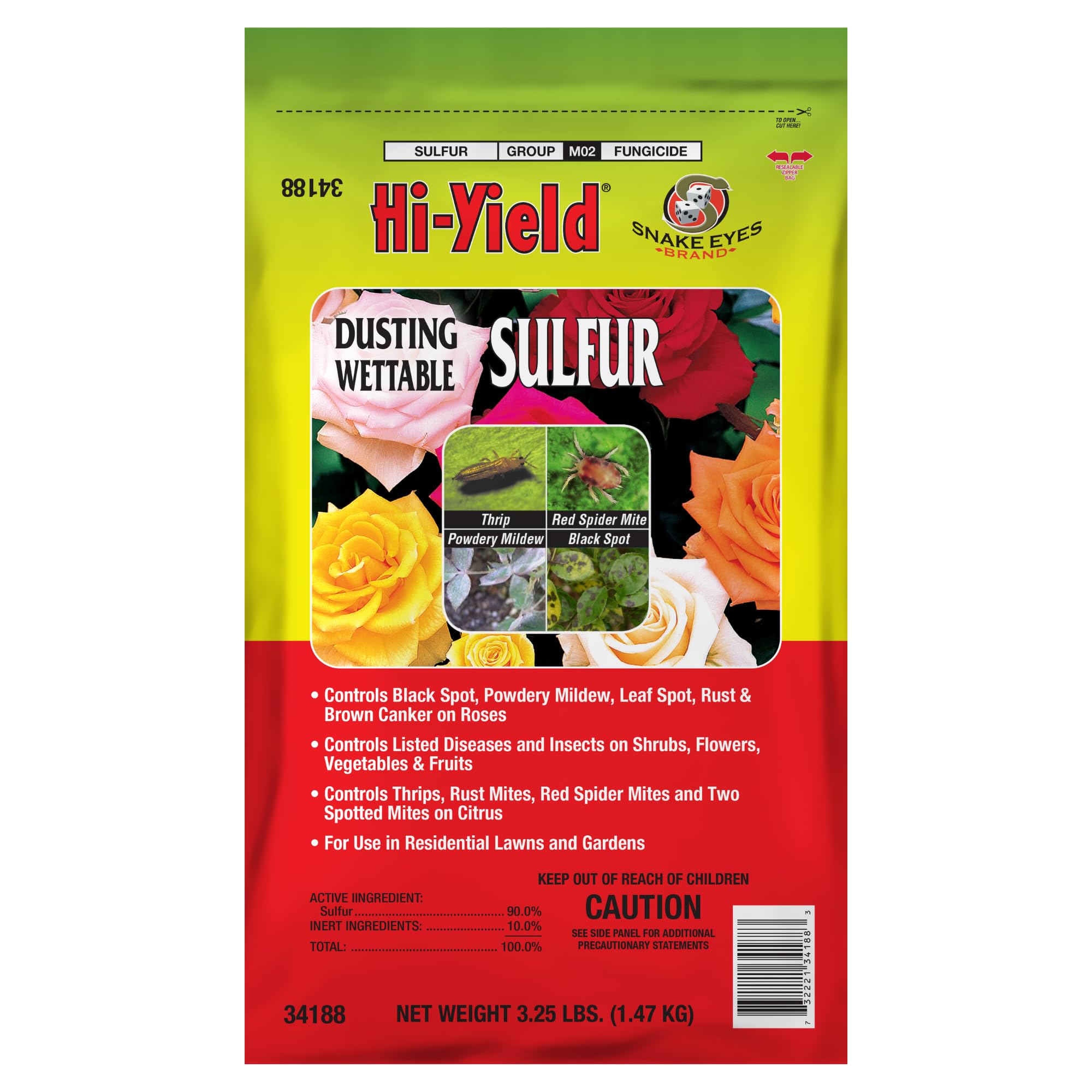
Hi-Yield Dusting Wettable Sulfur is a dual-purpose product that controls both fungal diseases and soft-bodied insects like thrips and rust mites, and it can also suppress chiggers in grassy areas. It can be applied as a dry dust using a sock tied to your pant leg, or mixed into a wettable spray at 4 tablespoons per gallon of water for broader coverage on flower gardens and shrubs.
Buyers in rural Texas rely on this for keeping chiggers and ticks off themselves while walking tall grass, and it also works as a dormant-season spray on cannas and dahlias. A 3.25-pound bag covers between 1,500 and 2,000 square feet of lawn. The sulfur odor is mild and dissipates quickly.
While not a dedicated armyworm killer, wettable sulfur provides supplementary suppression in mixed pest situations where armyworms coexist with thrips or mite outbreaks. It should be used as part of a rotation, not as a stand-alone solution for heavy caterpillar pressure. The main frustration is that fine sulfur particles can clog standard garden sprayers if not kept in constant agitation.
What works
- Dual-action as a fungicide and insect suppressant
- Long shelf life — a single bag lasts multiple seasons
- Simple dust application for chiggers and ticks on clothing
What doesn’t
- Not a primary solution for active armyworm infestations
- Clogs sprayer nozzles if not mixed and agitated properly
7. GH Armor Si

GH Armor Si is a water-based silica and potassium supplement that strengthens plant cell walls. Thicker stems and tougher leaf tissue make it harder for armyworms to chew through and give plants better resilience after defoliation. It is not a pesticide, but it is a widely used complementary product in integrated pest management routines.
Users report noticeable improvement in stem strength and overall plant health within weeks. The formula is concentrated — a quart lasts a long time at typical feeding schedules. It blends well with other nutrient solutions, though the manufacturer advises waiting a few minutes after adding it before mixing in other products to avoid precipitation.
If you are already using Spinosad or Bt to control armyworms but want to reduce the stress on your plants, Armor Si is a smart addition to your spray schedule. It does not kill caterpillars directly, but it reduces the damage they cause and helps plants recover faster from feeding pressure. It is most useful for high-value vegetable crops or ornamentals where appearance matters.
What works
- Strengthens plant cell walls to reduce caterpillar feeding damage
- Highly concentrated formula lasts many applications
- Compatible with most nutrient and pesticide spray programs
What doesn’t
- Does not directly kill armyworms or any insect pest
- Requires careful mixing order to avoid nutrient lockout
Hardware & Specs Guide
Spinosad vs Bt Contact Speed
Spinosad (used in Bonide Captain Jack’s) penetrates the caterpillar nervous system on contact, causing paralysis and death within 1-2 days. Bacillus thuringiensis (Bt, used in Monterey and SUMMIT) must be ingested and then disrupts the gut, taking 3-5 days for full effect. For heavy armyworm pressure where immediate damage cessation is critical, Spinosad is the faster option. For light infestations near flowering plants, Bt’s bee-safety profile makes it the better choice.
Granular Barrier vs Foliar Spray
Granular products like BioAdvanced Season Long Grub Control create a chemical barrier in the thatch and soil that kills armyworms when they crawl through treated grass. This approach works for lawns where irrigation can activate the granules, and protection lasts 3-4 months. Foliar sprays (concentrates and hose-end formulations) only protect the leaf surface they land on, so thorough coverage of the entire plant canopy is essential. Sprays require reapplication after more than 0.5 inches of rain.
FAQ
How do I know if I have armyworms and not another caterpillar?
Can I use Spinosad and Bt together against armyworms?
Is it safe to spray insecticide on vegetables right before harvest?
Will rain wash away my insecticide application?
Final Thoughts: The Verdict
For most gardeners, the insecticide for armyworms winner is the Bonide Captain Jack’s Deadbug Brew because Spinosad delivers fast contact kill, has OMRI organic certification, and controls a broad range of caterpillars without destroying beneficial soil life. If you need season-long prevention on a large lawn, grab the BioAdvanced Season Long Grub Control for its one-and-done granular barrier. And for bee-safe control on flowering vegetable gardens, nothing beats the Monterey B.t. with Measuring Spoon.