
Specs are compiled from manufacturer listings and verified buyer reviews and can change over time — please confirm the key details on the product page before buying.
Finding the right insecticidal soap for outdoor plants is about more than just picking the first bottle you see on the shelf. You need something that kills the bugs attacking your tomatoes, roses, and fruit trees without burning the leaves or leaving a nasty chemical residue. The best options hit pests on contact and break down fast, so you can spray right up to the day you harvest.
I’m Rikta — the founder and writer behind Lawn Gear Lab. This guide is built by comparing the manufacturers’ published specifications and the patterns across verified customer reviews, so you get each pick’s real strengths and trade-offs instead of marketing spin.
Whether you are battling aphids on your kale or spider mites on your Meyer lemon tree, the right insecticidal soap for outdoor plants is the difference between a thriving harvest and a disappointing one.
Our Picks at a Glance


How To Choose The Best Insecticidal Soap For Outdoor Plants
Not every spray works the same way. Some rely on plant oils to smother bugs, while others use potassium salts of fatty acids to dissolve an insect’s protective layer. Understanding the difference helps you pick the right weapon for your garden.
Look at the active ingredient first
Potassium salts of fatty acids are the classic insecticidal soap ingredient. They work by penetrating the soft bodies of pests like aphids and spider mites, causing them to dehydrate. Soybean oil or other plant-oil formulas do the same job by smothering the bugs. Either approach is effective, but soap-based sprays tend to be gentler on delicate leaves.
Consider the spray bottle quality
A great formula is useless if the trigger sprayer jams or drips. Many buyers find that a poor nozzle makes the product hard to use, especially when you need to reach the undersides of leaves. Look for an adjustable nozzle that offers a mist setting for broad coverage and a stream setting for targeted hits.
Quick Comparison
| Model | Best For | Volume | Active Ingredient | Form | Amazon |
|---|---|---|---|---|---|
| Natural Guard Spinosad Soap★ Best Overall | Broad garden protection | 32 fl oz | Spinosad + Soap | Ready-to-Spray | Amazon |
| Safer Garden Insect Control SG5110Best Value | Quick knock-down on contact | 24 fl oz | Natural Oils | Ready-to-Spray | Amazon |
| Dr. Killigan’s Doom & BloomSmart Design | Houseplant & small infestations | 16 fl oz | Soybean Oil | Ready-to-Spray | Amazon |
| Natria Insecticidal Soap | Mealybug & aphid control | 48 fl oz (2 pack) | Potassium Salts 1% | Ready-to-Spray | Amazon |
| Safer Insect Killing Soap w/ Seaweed | Gentle treatment with plant benefits | 32 fl oz | Insecticidal Soap + Seaweed | Ready-to-Spray | Amazon |
| Ferti-lome Natural Guard INSECTICIDAL SOAP | Fruit trees & ornamentals | — | Insecticidal Soap | Ready-to-Spray | Amazon |
| Arber Organic Insecticide & Fungicide | Dual pest & disease control | 16 fl oz (concentrate) | Bio-based Concentrate | Concentrate | Amazon |
| Bonide 652 Ready-to-Use Insect Soap | Small area & spot treatment | 96 fl oz (3 pack) | Potassium Fatty Acids | Ready-to-Spray | Amazon |
| Trifecta Crop Control | Serious infestation & mildew | 64 fl oz (2 pack) | Essential Oil Formula | Concentrate | Amazon |
In‑Depth Reviews
1. Natural Guard Spinosad Soap
Our pick — over 4★ from 900+ verified ratings; the strongest balance of quality and price.
The garden workhorse that handles everything from cactus beetles to powdery mildew.
This is a crowd favorite for good reason, with a strong 4.4-star score from nearly a thousand owners. It uses a powerful combination of two active ingredients that kills spider mites and other foliage-feeding insects the moment they are sprayed. What makes it stand out from the pack is its dual action — it also controls powdery mildew when sprayed directly, so you get pest control and disease prevention in one bottle.
It is specially formulated for vegetables, crops, lawns, and outdoor ornamental plants. The ready-to-spray formula works fast, starting to kill within minutes after application. Buyers report that a single spray eliminated a cactus beetle infestation and that the beetles stayed gone for days. Another owner found it did great work on aphids that had invaded a Dracena plant. It is also more effective than neem oil, according to several users. The 32-fluid-ounce bottle gives you a full 2x volume compared to the 16-ounce Dr. Killigan’s spray, so you get more coverage per bottle.
Why It Wins
- Kills a wide range of pests on contact within minutes
- Also tackles powdery mildew, a common garden disease
- Good value for money — the 32-ounce size covers more ground
Heads Up
- Some bottles arrive with leaky caps during shipping, so check the seal
- Can burn sensitive plants if you apply too heavily, so start with a small test area
Reach for this if: You want a single product that kills bugs and fights powdery mildew on your vegetables and ornamentals.
Consider another if: You have a very large garden — you might need multiple bottles for regular weekly coverage.
2. Safer Brand Garden Insect Control SG5110
A gentle-on-plants formula that drops aphids and spider mites dead on the spot.
This 24-ounce spray from Safer Brand uses natural oils to kill a long list of garden pests, including aphids, beetles, boxelder bugs, caterpillars, earwigs, spider mites, and stink bugs. Owners mention that it sprays green aphids straight away — dead, dead, dead — with no nasty film residue or smell. It is formulated to be gentle on plants, so you can use it on roses, flowers, fruits, vegetables, trees, and shrubs without worrying about leaf burn.
Safety around children and pets is a big draw here. The spray is made with natural oils and has no unpleasant odor, making it a comfortable choice for the family garden. You can use it right up until the day of harvest, spraying every 5 to 7 days as long as insects are present. It takes a slightly different approach than the Natural Guard above — instead of a dual-action spinosad formula, this is a straight natural-oil contact killer. That 50% more volume than the 16-ounce Dr. Killigan’s bottle means you get better coverage per purchase for the same job.
Instant knock-down: The formula kills on contact, and owners love that it works fast without a lingering odor. The main limit is that it may not fully control whitefly, so heavier infestations might need more persistence.
Grab this for: Quick, safe treatment of common garden pests on edibles and flowers with zero harsh smell.
skip it if: You are dealing with a persistent whitefly problem — you may need a stronger specialized spray.
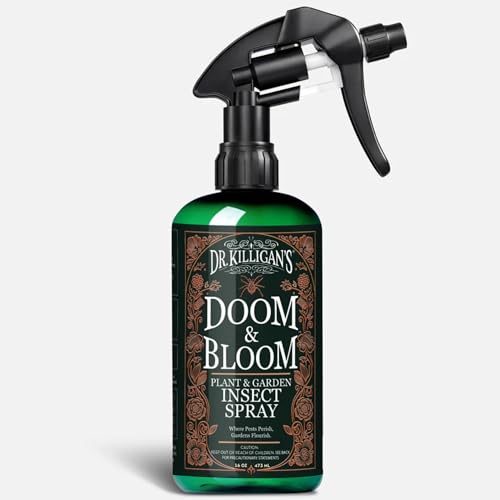
3. Dr. Killigan’s Doom & Bloom House Plant Pest Spray
A soybean-oil based spray with an adjustable nozzle that earns praise for its scent.
Dr. Killigan’s takes a “mechanical mode of action” approach. Instead of targeting the bug’s nervous system, the soybean oil physically breaks down the pest’s protective outer layer, leading to dehydration and disrupted respiration. This method means pests cannot build up resistance over time. It targets aphids, spider mites, thrips, broad mites, russet mites, and two-spotted mites. It also kills fungus gnats if you spray them directly.
The adjustable trigger sprayer is a standout feature — you can switch from a mist for broad coverage to a stream for targeted hits. Customers note it is effective against thrips when used 1 to 2 times daily for 1 to 2 weeks. However, it is a temporary fix rather than a permanent solution, and some note that it leaves an oily residue on leaves. The scent is a recurring positive, described as mild and pleasant — a nice change from harsh chemical smells. Effectiveness gets mixed feedback overall, so it works best for small-bodied, soft-shell pests.
Great for small jobs: Works well on small-bodied pests like aphids and thrips. The spray nozzle is excellent. Just understand that it is mainly soybean oil with inert ingredients — it drowns bugs rather than poisoning them, so persistence is key.
Pick this if: You want a non-toxic, pleasant-smelling spray for indoor and outdoor houseplants with a superior nozzle.
Look elsewhere if: You need a long-lasting residual effect or have a large garden to cover — it wears off and the 16-ounce size is small.
4. Natria Insecticidal Soap
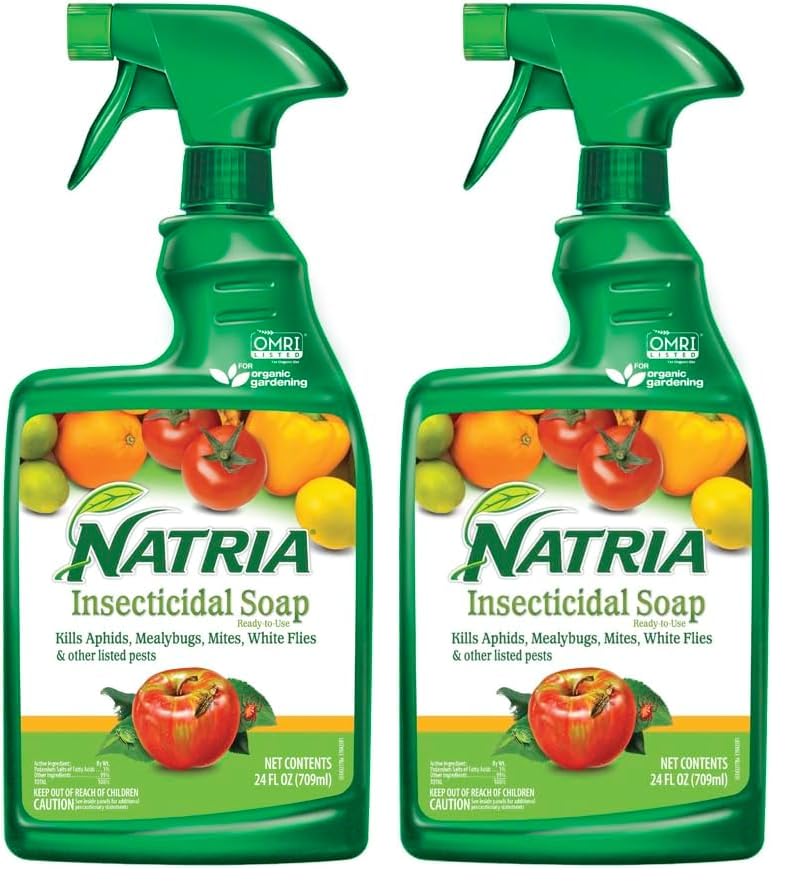
A two-pack of classic insecticidal soap that mealybug victims swear by.
This is the classic stuff — potassium salts of fatty acids at 1% concentration, the traditional insecticidal soap formula that kills on contact by breaking down bug shells. It targets aphids, mealybugs, mites, and whiteflies, and can be used on indoor and outdoor plants including roses, flowers, fruits, and vegetables. It is ready-to-use with no mixing required, and you can spray up to the day of harvest.
The two-pack gives you a total of 48 fluid ounces, which is generous for the price tier. Reviewers point out that it works where other pesticides failed on mealybugs — one user sprayed every other day and saw visible bugs gone in 2 weeks, with full clearance in a few months. However, the sprayer bottle gets consistent criticism. A few owners find the trigger terrible and end up transferring the liquid to a different bottle midway through. The formula itself works, but the hardware can let it down.
Solid formula, weak sprayer: The active ingredient is proven and effective, especially against mealybugs. The big caveat is the nozzle — plan to use your own spray bottle for a frustration-free experience.
Choose this for: A proven soap formula in a large quantity that is safe for organic gardening right up to harvest day.
Be aware: The trigger sprayer is widely called out as poor quality — you might need to decant it.
5. Safer Insect Killing Soap With Seaweed Extract
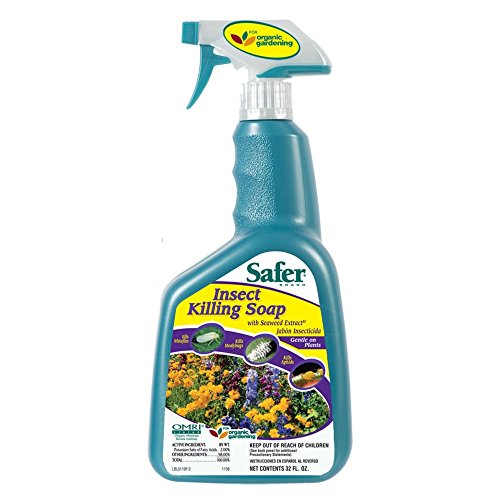
An insecticidal soap with added seaweed extract that boosts plant greenness while killing bugs.
This is not just a pest killer — it includes seaweed extract, which owners say improved the greenness of their foliage after application. The active ingredient is an insecticidal soap that targets a wide range of insects on contact, including whiteflies, gnats, and grasshoppers. It is suitable for use on houseplants, vegetables, and ornamentals both indoors and out, and is safe for use around children and pets when used as directed.
You get a 32-ounce bottle with a spray nozzle already attached, so you can start spraying right away without mixing anything. The fresh rose scent is a standout — your garden smells nice after use instead of like chemicals. One buyer says it wiped out whiteflies and gnats after two sprays (first spray left on for 3 days then rinsed, second spray 2 days later). Another reviewer notes it works well on grasshoppers, but a heavy infestation takes persistence. No plant burn was reported, which matters for delicate ornamentals like ferns or petunias.
Gentle and effective: The seaweed extract is a nice bonus that seems to help plants look better. It needs a couple of applications to fully work, but it does not harm the foliage. The rose scent is a genuine highlight.
Get this for: A gentle, pleasant-smelling soap that nourishes plants as it treats light to moderate pest problems.
Not ideal if: You need a one-and-done spray — it works best with follow-up treatments for full control.
6. VPG Fertilome Natural Guard INSECTICIDAL SOAP

A powerful contact spray from a trusted brand, but a few owners found it harsh on tender crops.
Ferti-lome’s Natural Guard is a straightforward insecticidal soap that targets lace bugs, spiders, mites, aphids, leafhoppers, and earwigs. It is designed for use on fruit trees, vegetables, nut trees, ornamentals, shrubs, berries, flowers, and citrus. The active ingredient is gentle on plants but tough on the listed insects, making it a go-to for many organic gardeners.
It holds a 4.5-star rating from over 130 owners, but the feedback is split. Many find it effective on leaf-type pests, yet a few shoppers say plant damage even at half the recommended dosage — one owner says it severely damaged a crop of spinach, and another noted grass around a plant turned brown. This shows that even “gentle” soaps can cause phytotoxicity (leaf burn) on sensitive plants, especially under hot sun. It is an environmentally-friendly contact spray safe for indoors and outdoors, but always test a small patch on any new plant first.
Powerful but handle with care: Works well on a broad range of pests and is great for citrus and ornamentals. The catch is that a few owners experienced plant damage, so dilute cautiously and avoid spraying in direct heat.
Choose this for: Tough pests on established fruit trees and shrubs where you need a strong contact killer.
Think twice if: You are treating delicate, tender seedlings or leafy greens — test a small area first to avoid leaf burn.
7. Arber Organic Insecticide & Fungicide

A bio-based concentrate that tackles both insects and fungal diseases in one pass.
This is a different beast from the ready-to-use sprays above. Arber is a concentrate that you mix with water, which makes it far more economical for large gardens. It uses an advanced bio-based formula that coats leaves and soil zones to disrupt pest life cycles while also suppressing powdery growth. It is effective on mites, aphids, whiteflies, thrips, and fungus gnats while protecting pollinators when used as directed.
Buyers report incredible speed — one owner saw bugs shrivel and die within 5 to 10 seconds of application. Another says a single soaking eliminated a severe fungus gnat problem, and weekly soaks kept the plants gnat-free. The 16-ounce concentrate yields multiple refills — at 2 tablespoons per gallon, you get about 8 gallons of spray. It also works as a fungicide, making it a true two-in-one solution for gardeners dealing with both bugs and mildew. Odorless and easy to apply via hose-end or pressure sprayer, it earns high marks for convenience.
Reach for this if: You have a large garden or recurring fungus issues and want a concentrated, odorless, dual-action solution.
pass on it if: You are dealing with Japanese beetles — this product will not touch them.
8. Bonide 652 Ready-to-Use Insect Soap
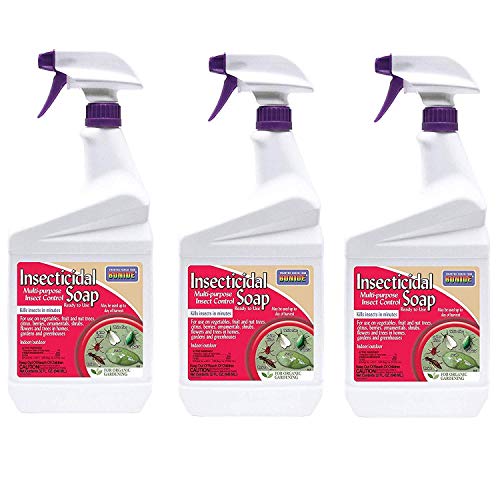
A three-pack of classic insect soap that is great for spot treatments on flowers and vegetables.
Bonide’s insect soap uses potassium fatty acids from plants to kill insects on contact, and it does not persist in the environment. It is preferred by organic gardeners and can be used up to the day of harvest. The three-pack gives you 96 total fluid ounces, making this a solid option for covering multiple small garden areas or for keeping a bottle in different zones of your yard.
Owners find it works well on caterpillars eating flowers and general bugs on plants. One buyer sprays every few days and reports that their flowers are now lush and gorgeous. Another says it has helped with any bugs on their plants. The catch is the packaging — all three bottles can leak during shipping if they are not packed well. The caps can come loose, soaking the box. Also, it takes persistence — you need to spray repeatedly, and it may not kill mealybugs effectively. It is best for small area treatment rather than whole-garden coverage.
Good for the price: A large total volume for the cost, and the formula is organic and harvest-safe. Just be ready for possible shipping leaks and the need for persistent application.
Get this for: Spot-treating flower beds and small vegetable patches with an organic soap that works with repeated use.
Not for you if: You want a one-time fix or have a huge garden — you will go through these bottles quickly on extensive beds.
9. Trifecta Crop Control Insecticidal Soap

The concentrated essential-oil formula that is a go-to in grow rooms for spider mites and mildew.
Trifecta Crop Control is a plant-based concentrate that targets spider mites, aphids, whiteflies, fungus gnats, and other soft-bodied pests. It also acts as a fungicide against powdery mildew, giving you dual protection. The formula is made with natural essential oils, dries quickly, and leaves no residue or odor — a big deal for indoor growers and anyone who dislikes chemical smells.
Owners praise it as “the gold standard in my grow room.” It cleans dust and grime from leaves, dries fast, and prevents mold and mildew. Owners mention that it worked great on butterfly bushes and black cherry sunflowers, stopping infestations in their tracks. However, it comes with a few important caveats. It kills live spider mites but not their eggs, so you need to spray daily for at least the 3-day egg hatch cycle to fully eliminate them. The 2-pack gives you 64 total fluid ounces, but the concentrate uses 2 to 4 ounces per gallon, so a 4-ounce bottle alone is not enough for a full week-long treatment on many plants. It is effective but expensive to use across a large collection.
Top-tier for serious infestations: The formula is excellent and trusted by serious growers. But it demands persistent daily spraying to break the pest life cycle, and the cost adds up quickly if you have many plants.
Choose this for: Stubborn spider mite and mildew problems where you are willing to spray daily for results, especially in a grow room or greenhouse.
Pass on this if: You are on a tight budget or need a simple spray-and-forget solution — this requires commitment and multiple applications.
Understanding the Specs
Volume
The size of the bottle matters more than you might think. A 32-ounce bottle covers a decent vegetable patch, while a 16-ounce spray is better for a few houseplants. Concentrates go much further by mixing with water, giving you gallons of spray from a small bottle. Bigger is not always better if you only have a few pots, but for outdoor gardens, larger volumes save you from running out mid-job.
Active Ingredient
You will see two main types: potassium salts of fatty acids and plant oils like soybean oil. Both work by smothering or dehydrating soft-bodied insects on contact. Soap-based sprays are generally gentler on leaves, while oil-based sprays can leave a residue. The active ingredient determines what pests it kills and how fast, so match it to your specific bug problem.
FAQ
How does insecticidal soap kill pests?
Is insecticidal soap safe for fruits and vegetables?
Can I use insecticidal soap in direct sunlight?
Will insecticidal soap hurt bees or other pollinators?
How often should I spray insecticidal soap on outdoor plants?
Can I mix insecticidal soap with other pesticides or fungicides?
Does insecticidal soap prevent future bug infestations?
What is the difference between a concentrate and a ready-to-use spray?
Final Thoughts: The Verdict
Across the board, the insecticidal soap for outdoor plants winner is the Natural Guard Spinosad Soap because it combines a powerful two-active-ingredient formula with mildew control at a reasonable price. If you want a quick knock-down spray with a pleasant scent, grab the Safer Brand Garden Insect Control SG5110. And for concentrated coverage across a large garden with dual insect and fungus protection, the Arber Organic Insecticide & Fungicide is the one to reach for.
How We Picked
We do not accept paid placement. Every pick is matched to a real buyer and a real use-case; we do not hands-on test units.
Sources & Methodology
Specifications: manufacturer listings and product documentation. Review insights: verified customer reviews, as of July 2026. Pricing: not shown on this page (it changes often); check the current price via the retailer link.
As an Amazon Associate, Lawn Gear Lab earns from qualifying purchases. This does not affect which products we feature.