
Specs are compiled from manufacturer listings and verified buyer reviews and can change over time — please confirm the key details on the product page before buying.
Tomato plants attract hornworms, aphids, whiteflies, and leaf miners — all hungry pests. You need a spray that stops them without ruining your harvest, and the right choice depends on the active ingredient. Here are five effective insect sprays for tomatoes, matched to your garden’s pest pressure and how much mixing you want to do.
I’m Rikta — the founder and writer behind Lawn Gear Lab. This guide is built by comparing the manufacturers’ published specifications and the patterns across verified customer reviews, so you get each pick’s real strengths and trade-offs instead of marketing spin.
If you are fighting caterpillars or a broad range of bugs, the best insect spray for tomatoes depends on which pests you have and how much effort you want to spend applying it. The quick comparison section below shows your options at a glance.
Quick Picks
- Monterey – Spinosad Insecticide – Garden Insect Spray Concentrate — Best Overall
- Monterey B.t. – Caterpillar & Worm Killer — Targeted Pick
- Garden Safe Fungicide3 – 1 Gallon Ready-to-Spray — Best Value
- Organic Insecticide & Fungicide for Plants — Concentrate — Fast Knockdown
- Garlic Block Insect Repellent – Ready to Spray Concentrate — No-Mix Convenience
How To Choose The Best Insect Spray For Tomatoes
Three active ingredients dominate this category — spinosad, Bacillus thuringiensis (BT), and neem oil. Each targets a different set of pests and behaves differently in the garden. Here is what you need to know before you buy.
Active Ingredient: Match It to Your Pest
Spinosad is a broad-spectrum bacteria-based killer that works on caterpillars, leaf miners, thrips, and fire ants. It is fast and odorless. BT is more specific — it only kills caterpillars and worms like the cabbage looper and tomato hornworm. It leaves bees and earthworms alone when used correctly. Neem oil is a triple-threat fungicide, insecticide, and miticide that smothers soft-bodied pests like aphids, whiteflies, and spider mites. If you have a mixed pest problem, you may need a combination approach across the season.
Concentrate vs Ready-to-Use: Size and Effort
An 8-ounce concentrate can make many gallons of mixed spray — economical for a large garden, but you must mix and measure each time. A ready-to-spray hose-end bottle like Garlic Block skips all measuring but is heavier and costs more per ounce. For four to six tomato plants, a mid-size concentrate is usually the best value.
Organic Certification: What OMRI Means
An OMRI (Organic Materials Review Institute) listing means the product meets USDA organic standards — important if you avoid synthetic chemicals on food crops. All five picks here carry OMRI listing or use naturally derived active ingredients, so they fit organic gardening.
Quick Comparison
On smaller screens, swipe sideways to see the full table.
| Model | Best For | Active Ingredient | Unit Size | Form | Amazon |
|---|---|---|---|---|---|
| Monterey Spinosad | Leaf miners & general pests | Spinosad | 8 fl oz | Concentrate | Amazon |
| Monterey B.t. | Caterpillar & worm control | Bacillus thuringiensis | 8 fl oz | Concentrate | Amazon |
| Garden Safe Fungicide3 | Fungal + insect control | Neem oil | 128 fl oz | Ready-to-spray | Amazon |
| Organic Insecticide & Fungicide | Fast knockdown concentrate | Bio-based concentrate | 16 fl oz | Concentrate | Amazon |
| Garlic Block | No-mix repellent barrier | Garlic extract | 32 fl oz | Ready-to-spray (hose-end) | Amazon |
In‑Depth Reviews
1. Monterey – Spinosad Insecticide – Garden Insect Spray Concentrate
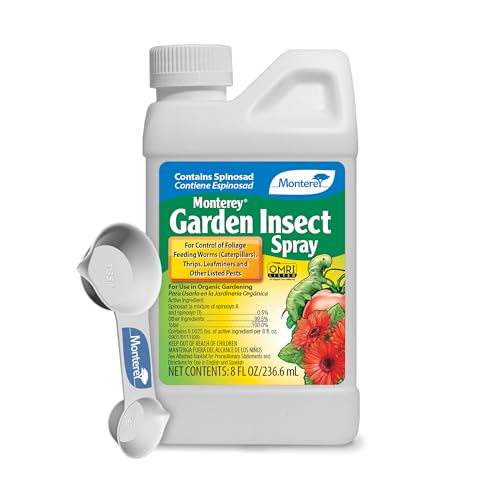
The broad-spectrum answer for tomato pests that runs beyond just caterpillars.
This 8-ounce concentrate covers a wide net — caterpillars, leaf miners, codling moths, thrips, borers, and even fire ants. Because it is made with spinosad (a naturally occurring bacteria produced through fermentation), it acts fast and leaves zero odor on your plants. You can use it on vegetables, citrus, fruit trees, and ornamentals, which makes it a versatile addition to any garden shed.
Buyers report it is “the only thing that gets rid of leaf miners” — a pest that often laughs off gentler treatments. The catch is that spinosad is broad-spectrum, so spraying during bloom can harm bees. One reviewer noted they only reapply about once a week and have seen no new leaf miners for months. At 8 fluid ounces, you need to mix each batch yourself, but the concentrate goes a long way.
Compared to the Monterey B.t. below, this spinosad version kills a much wider range of insects but is less selective around beneficial bugs. If you have a single pest like cabbage loopers, the B.t. is more targeted. For a general invasion, this is the smarter reach.
Spray-and-walk-away power: Kills leaf miners, thrips, caterpillars, and borers in one bottle — fast, odorless, and OMRI-listed for organic use.
The fine print: Broad-spectrum action means you should avoid spraying open flowers to protect pollinators. Requires mixing.
Reach for this if: you have a mix of leaf miners, caterpillars, and thrips on your tomatoes and want one concentrate that handles them all.
Look elsewhere if: you only need caterpillar control — the B.t. option below is more bee-friendly for that single job.
2. Monterey B.t. – Caterpillar & Worm Killer
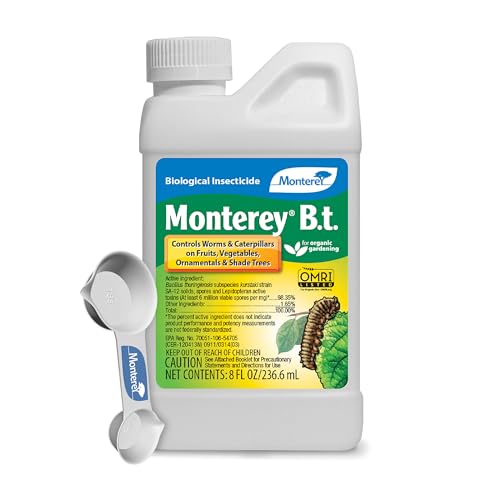
A surgical strike against caterpillars that spares bees and earthworms.
Bacillus thuringiensis (BT) is the go-to when tomato hornworms and cabbage loopers are your primary problem. This liquid concentrate mixes instantly with water and works by disrupting the gut of caterpillar-type insects after they eat treated leaves. It is OMRI-listed and safe on tomatoes, broccoli, lettuce, melons, and ornamentals when used as directed.
One buyer shared that “BT effectively stopped cabbage looper worms from destroying flower and cilantro seedlings in Southern California.” That precision is the reason gardeners with a known caterpillar problem reach for this over spinosad. It has no effect on birds, earthworms, or honeybees — a major advantage during tomato bloom when bees are active on your plants.
Where it falls short is coverage. It does not touch aphids, whiteflies, spider mites, or thrips. If your tomato problem is exclusively caterpillars, this is your match. If you have a broader pest spectrum, the Spinosad above or the neem-based Garden Safe below will serve you better.
Bee-safe caterpillar control: Kills only worms and caterpillars — tomato hornworm, cabbage looper, bagworm — without harming pollinators or earthworms.
The trade-off: Useless against aphids, thrips, leaf miners, or any non-caterpillar pest. Narrow-target-only.
Perfect for: gardeners who have confirmed caterpillars or hornworms on their tomatoes and want to leave bees and ladybugs alone.
Not for: anyone fighting sucking insects like aphids or whiteflies — you need a broader active like spinosad or neem oil.
3. Garden Safe Fungicide3 – 1 Gallon Ready-to-Spray
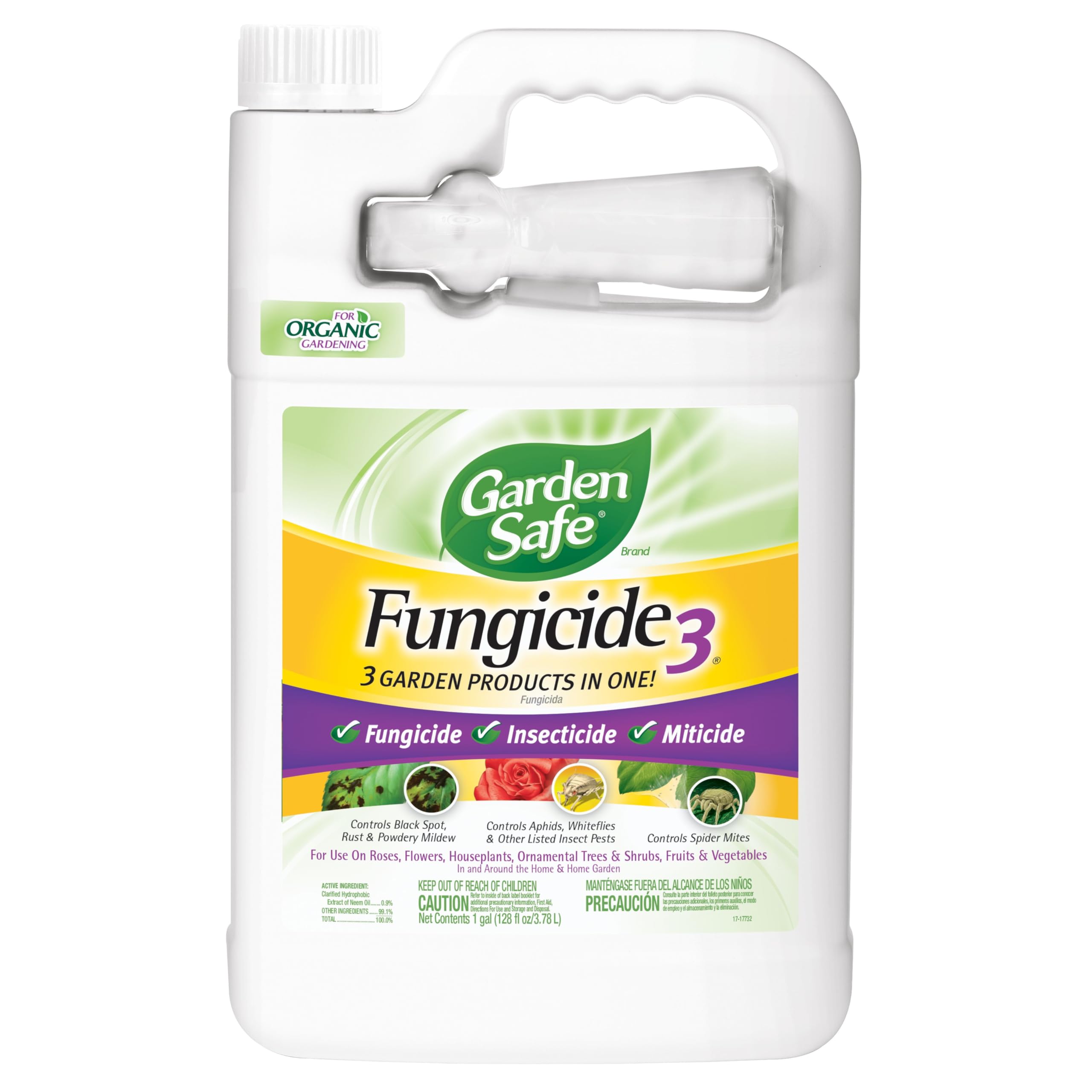
The triple-threat jug that fights bugs, mildew, and mites in one pass.
This gallon-sized ready-to-spray bottle contains clarified hydrophobic extract of neem oil — a fungicide, insecticide, and miticide combined. That means one product controls black spot, rust, and powdery mildew while also handling aphids, whiteflies, and spider mites. It is EPA-listed and suitable for vegetables like tomatoes, plus roses, houseplants, and fruit trees.
Owners mention it is “effective against mildew on hibiscus, roses, tomatoes, blueberries” and that weekly use promotes greener foliage and more blossoms. The built-in sprayer attaches directly to the bottle, so no measuring or mixing is needed. At 128 fluid ounces, this gives you much more product than the 8-fluid-ounce Monterey concentrates above — a serious advantage if you have a large garden with many plants.
The downside revealed in reviews is the sprayer design: users say it only has about four inches of reach from the bottle, making it awkward for bushy tomato plants. Several reviewers recommend buying a separate sprayer.
What you gain
- Three-in-one: fungicide, insecticide, and miticide for complete coverage
- Ready-to-spray with no mixing — attach and go
- 128-ounce jug lasts many seasons for an average tomato patch
What slows it down
- Built-in sprayer has very short reach — buyers recommend a separate sprayer
- Can burn plants if applied during daytime heat or at higher doses
Grab this for: large gardens where you need an all-in-one solution for bugs and fungus on tomatoes, flowers, and shrubs.
skip it if: you want a precise caterpillar-only treatment — the neem oil is less targeted and may need a separate spray tool.
4. Organic Insecticide & Fungicide for Plants — Concentrate

A bio-based concentrate that one buyer says kills bugs in seconds.
This 16-ounce concentrate from Evergreen Way Inc. is designed for both indoor and outdoor use. It controls powdery mildew, spider mites, aphids, whiteflies, thrips, and fungus gnats all in one formula. You dilute it with water and apply with a pump, hose-end, or battery sprayer. The instructions are straightforward: a few drops in water and you are ready to spray.
One reviewer tested it immediately and found that “10 drops in 32oz water; bugs shriveled in 5-10 seconds.” That kind of rapid knockdown stands out in this category. Another buyer noted that nightly application eliminated aphids, caterpillars, and gnats, while the fungicide component visibly improved leaf color. At 1.1 pounds versus the Garlic Block at 2.36 pounds, this bottle is also lighter and more compact — a noticeable difference if you carry it around the garden.
The concentrated formula yields multiple refills, making it economical for weekly spot treatments. However, it lacks the targeted specificity of BT or spinosad. If you are fighting a single pest like leaf miners, the Monterey Spinosad is a more proven solution. For a mixed indoor-outdoor scenario where speed matters, this bio-based option earns its spot.
Speed you can see: Customers note visible bug shriveling within seconds of contact — among the fastest-acting concentrates here.
Room for caution: Less established track record versus the Monterey spinosad and neem oil formulas. Follow dilution rates carefully to avoid plant stress.
Best for: indoor and outdoor gardeners who want a fast-acting, multi-purpose concentrate that handles both insects and fungi without a strong smell.
Avoid if: you need a highly specific caterpillar-only treatment — the BT option is more precise and proven for that job.
5. Garlic Block Insect Repellent – Ready to Spray Concentrate
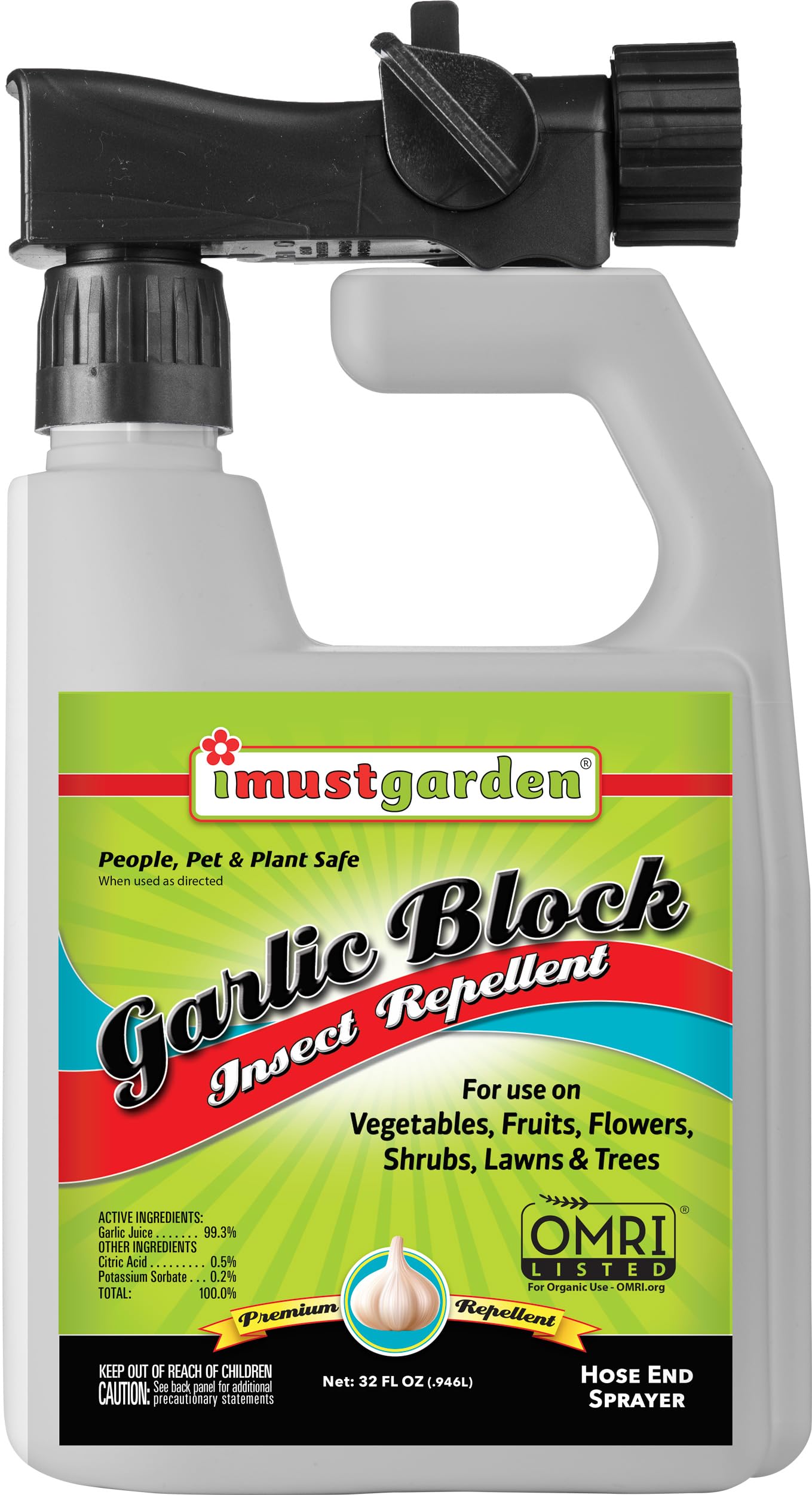
The only option here that requires zero measuring — just attach and spray.
Garlic Block uses pure garlic extract to create an invisible barrier that repels aphids, mites, whiteflies, beetles, caterpillars, grasshoppers, mosquitoes, and ticks. It is OMRI-listed and safe to spray directly on tomatoes, fruits, herbs, and flowers. The 32-ounce hose-end bottle mixes the concentrate with water at the perfect ratio as you spray, so there is no measuring, no mixing, and no cleanup.
One long-time garlic juice user called this “by far the best and easiest way to go” and highlighted that you just hook it up, spray what you need, and store the rest. Another buyer appreciated that the spray dries clear with no residue and the garlic smell disappears in about 30 minutes. The product dimensions (5 x 5 x 10 inches; 2.36 pounds) make it a compact addition to a shelf or shed.
The trade-off is mechanical reliability — one buyer mentioned the spray nozzle clogged right away. Unlike the Monterey or Garden Safe formulas which kill on contact, Garlic Block works as a repellent. That means you need to start spraying before the bugs arrive and reapply regularly. For an existing heavy infestation, a contact killer like spinosad or neem oil will give faster results.
easy application: Hose-end design eliminates all mixing and measuring — attach, spray, and walk away.
The catch: Repels rather than kills on contact, so it works best as a preventive. Sprayer nozzle reliability is inconsistent based on buyer reports.
Perfect for: gardeners who hate measuring and want a spray-and-store solution that keeps bugs away all season.
Not ideal for: an active infestation where you need immediate kill — choose the spinosad or neem-based options instead for that scenario.
Understanding the Specs
Active Ingredient: Spinosad vs BT vs Neem Oil
Spinosad is a bacteria-based compound that attacks the nervous system of a wide range of insects — caterpillars, leaf miners, thrips, and more. It is fast and odorless. BT (Bacillus thuringiensis) is a different bacteria that only targets caterpillars and worm-type insects by disrupting their gut after they eat a treated leaf. It spares bees, ladybugs, and earthworms. Neem oil is a pressed oil from neem tree seeds that suffocates soft-bodied pests and also works as a preventive fungicide against powdery mildew and black spot. Your pest type determines which active fits best.
Unit Size and Form: Concentrate vs Ready-to-Spray
The unit count tells you the bottle size, but the real story is how much mixed spray you get. An 8-ounce concentrate like the Monterey Spinosad yields several gallons of diluted spray — very cost-effective for a medium garden. A ready-to-spray gallon like the Garden Safe Fungicide3 requires zero mixing but is bulkier and costs more per ounce. The hose-end Garlic Block is the easiest application method: attach, spray, and store. For tomato patches with 4-6 plants, a concentrate is usually the most economical choice. For large gardens with many beds, the ready-to-spray gallon saves time.
FAQ
Can I use Monterey Spinosad on tomatoes right up to harvest?
Does BT harm honeybees or ladybugs?
Will neem oil burn my tomato plants?
How often should I reapply insect spray on tomatoes?
What is the difference between spinosad and BT for tomato hornworms?
Can I mix insect spray with fungicide in one tank?
Does Garlic Block affect the taste of my tomatoes?
How long does a 128-ounce Garden Safe bottle last for a small tomato patch?
Is the Monterey B.t. effective against cabbage loopers?
What should I do if the sprayer on my Garden Safe bottle is faulty?
Final Thoughts: The Verdict
For most tomato gardeners, the best insect spray for tomatoes is the Monterey Spinosad because it covers the widest range of pests — leaf miners, caterpillars, thrips, and borers — while remaining OMRI-listed and odorless. If you specifically need caterpillar-only control that spares bees, grab the Monterey B.t. instead. And for a preventive, no-mix solution that stops bugs before they arrive, the Garlic Block hose-end sprayer offers unbeatable convenience for the lazy gardener.
How We Picked
We do not accept paid placement, and we did not hands-on test every unit. Instead, we match each pick to a real buyer and use-case by comparing the manufacturers’ published specifications against the patterns in verified customer reviews — so you get each pick’s real strengths and trade-offs instead of marketing copy.
Sources & Methodology
Specifications: manufacturer listings and product documentation. Review insights: verified customer reviews, as of July 2026. Pricing: not shown on this page (it changes often); check the current price via the retailer link.
As an Amazon Associate, Lawn Gear Lab earns from qualifying purchases. This does not affect which products we feature.