
Specs are compiled from manufacturer listings and verified buyer reviews and can change over time — please confirm the key details on the product page before buying.
That sinking feeling when you walk in the front door after a week away and the leaves are crispy? It is the exact moment you realize the you saved on a watering can just cost you a whole season of peppers. A real hydroponic watering system keeps your roots fed, your sanity intact, and your vacation guilt-free — but the right one depends entirely on whether you grow in soil, coco, or water itself.
I’m Rikta — the founder and writer behind Lawn Gear Lab. This guide is built by comparing the manufacturers’ published specifications and the patterns across verified customer reviews, so you get each pick’s real strengths and trade-offs instead of marketing spin.
The best way to sort through the options is to look for three things: how many plants it supports, how it gets water to the roots, and whether it needs electricity or runs on its own. The right best hydroponic watering system for you depends on which trade-offs you can live with.
Our Picks at a Glance


How To Choose The Best Hydroponic Watering System
You do not need an engineering degree to pick a winner here, but a few specs separate the systems that thrive from the ones that drip your floor. Focus on how the water moves, how many plants it can reach, and how hands-off you want it to be.
Pump vs. Gravity: The Power Decision
Some systems use a pump to push water through tubes to each pot. Others rely on gravity — the reservoir sits higher than the plants, and water flows downhill using pressure. The pump-based systems (like the VIVOSUN or Moistenland models) give you more control over timing and flow, but they need electricity and make noise. Gravity-fed systems (like the Spider Farmer) run completely silent and use no power at all, but the water pressure is lower and the reservoir must stay above the plants.
Drip Emitters and Pot Count
The number of emitters matters more than the length of tube. Some kits include stakes that plug into each pot individually. If you have 15 plants, look for a system with at least 15 drippers so you are not splitting a line across two pots. A 16-emitter kit like the VIVOSUN drip system gives each pot a dedicated feed line without you having to buy extra elbows.
Timer Types and Anti-Siphon
A programmable timer turns a watering kit into a true vacation system. Many solar-powered and app-controlled models let you set intervals from hours to days. One catch — if the pump sits lower than the outlet line, water can siphon back into the reservoir even when the pump is off, flooding the container. Look for an anti-siphon valve (the Rain Bird kits have pressure-compensating emitters that naturally resist this, and the LetPot specifically includes one).
Quick Comparison
| Model | Best For | Emitters/Drippers | Water Delivery Type | Power Source | Amazon |
|---|---|---|---|---|---|
| Rain Bird LNDDRIPKIT★ Best Overall | Entry-level landscape drip | 108 total (drippers, bubblers, sprays) | Pressure-compensated drip | Faucet pressure (no electricity) | Amazon |
| Moistenland WPS015Best Value | Indoor houseplant vacation kit | 15 | Drip with programmable timer | Batteries or USB-C | Amazon |
| HEKIWAY Solar DripSolar Pick | Off-grid balcony gardens | 15 | Solar-powered drip with 25 timer modes | Solar panel + Type-C backup | Amazon |
| VEVOR DWC + Top Drip | Single-bucket deep water culture | 1 top drip ring | DWC + top drip recirculation | Electric air pump (8W) | Amazon |
| VIVOSUN A10 Drip Kit | App-controlled multi-pot setups | 16 | Fast-flow drip (4mm emitters) | Electric 15W pump | Amazon |
| Rain Bird GARDENKIT | Raised bed vegetable gardens | 70 built-in emitters (6″ spacing) | Pressure-compensated emitter tube | Faucet pressure (no electricity) | Amazon |
| LetPot LP-D3-GN | Wi-Fi controlled indoor/outdoor | 10 adjustable drippers | App-controlled drip with anti-siphon | Electric (German silent pump) | Amazon |
| VIVOSUN DWC-0001 | A single bucket for fast hydro growth | 1 top drip ring | DWC + top drip recirculation | Electric air pump (8W) | Amazon |
| Spider Farmer SF-Self-Water 4Kit | Large gravity-fed fabric pot grows | 4 wicking bases + 13 gal reservoir | Gravity-fed wick lines | None (no power needed) | Amazon |
In‑Depth Reviews
1. Rain Bird LNDDRIPKIT Drip Irrigation Kit
Our pick — 4.5★ from 900+ verified ratings; the strongest balance of quality and price.
The 108-piece master set that turns a beginner into a confident gardener in one trip to the faucet.
This is the kit that most closely resembles a “buy it once and stop worrying” purchase for an average landscape or garden area. The 108 pieces include three different types of watering devices — drippers for slow root soaking, micro-bubblers for broader ground coverage, and micro-sprays for flower beds — so you can mix watering styles in the same run. Buyers report being able to get a full setup for five rose bushes running in about 20 minutes, which is faster than most comparable systems.
The secret to its consistency is pressure-compensating technology, which ensures every emitter delivers the same amount of water regardless of how far it sits from the faucet. That means the last dripper on the 50-foot hose line gets the same volume as the first. The maximum pressure rating of 50 psi (pounds per square inch, the standard measure of water force) gives it enough headroom for most residential faucets. The trade-off is that the instructions are not completely clear — several owners turned to YouTube for assembly guidance, though the actual 3-step installation was still straightforward.
Fast drip setup
- Installation is the most-praised feature by a strong margin — dozens of owners mention how fast it goes together
- The all-in-one kit spares you from buying separate drippers, connectors, and tubing; one package does the job
- The kit claims up to 80% water savings vs. hand watering, potentially paying for itself in one dry season.
Small tubing limits
- A few emitters arrived non-functional in rare cases; the general owner advice is to order a few extra drippers as backup
- The kit includes only one hose connector — if you need to split across two garden zones, you will need to buy a second adapter separately
Easy starter kit: you want a one-box solution that covers flower beds, shrubs, and small gardens with no electrical outlet needed — just a faucet.
Large gardens: your watering area is larger than a typical residential yard; the 50-foot hose hits its limit and Rain Bird advises against extending the line.
2. Moistenland Automatic Watering System (WPS015)
The travel-ready kit that brought 13 plants back alive after a two-week trip.
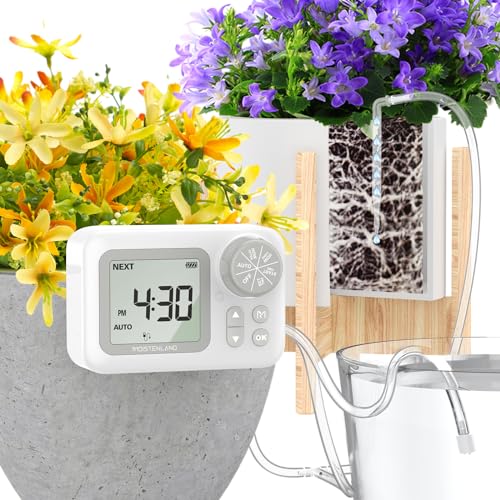
Moistenland’s system is built around a single question: how do I keep my houseplants alive while I am gone? It comes with a digital programmable timer that runs on either batteries or USB-C power, meaning you do not need a nearby outlet to make it work. The 33-foot hose length feeds up to 15 potted plants, and The drip design delivers water directly to the root zone, cutting water use by up to 70% vs. top-watering, per the maker..
The reviews back up the “vacation confidence” promise. One owner came back after a 3-week trip to find seven plants watered efficiently and consistently with no issues. Another reported that the system kept all 13 of their plants hydrated for two weeks straight. The catch is that the inner pump does not have an anti-siphon feature — the water source must sit lower than all the plants, or the water will keep dripping even after the timer shuts off. It is a simple positioning rule, but forgetting it means a flooded floor.
Smart watering control: the elegant design and simple UI get consistent praise; the digital display with an analog knob makes programming feel like setting a microwave, not a laboratory instrument.
Tech‑savvy users: you primarily have indoor houseplants and want a system that runs on batteries so you are not tethered to an outlet.
No‑WiFi homes: your plant setup includes a water source that sits higher than your potted plants — the siphon issue becomes a real nuisance.
3. HEKIWAY Solar Drip Irrigation System
The off-grid answer for a south-facing balcony with no outdoor outlet in sight.
This 36-piece kit uses a solar panel to power the pump, making it an ideal choice for gardeners who have sun but no electricity near their plants. The flow rate of 900ml/min (about a quart per minute) is high enough to handle outdoor flower beds and vegetable rows, not just a few pots. With 25 programmable timer modes, you can set watering durations from 3 to 20 minutes and intervals from 12 to 96 hours — so the system waters exactly as much as each plant type needs.
The system includes a 50-foot tubing roll (the same model also uses 15 meters depending on the regional variant), 15 watering stakes, 15 T-joints, and a filter. The buzz is that the fittings can feel fragile and may become brittle if left in direct sun for months. Owners who stuck with it report that after a full year, it became their most reliable unit — but the smart alarm (a buzzer that sounds if the filter clogs or the container runs empty) is loud enough to be heard indoors, which some find annoying. A handful of owners note that the pump impeller is prone to calcium buildup that triggers false low-water alarms.
Solar powered
- Solar panel keeps the system running all day without wiring or battery swaps
- Steady flow with no leakage from the start, according to multiple owners
- The Type-C port allows indoor charging during winter when sunlight is scarce
Weak pump pressure
- The fittings are small and can crack if overtightened; handle them gently
- The smart alarm buzzer is effective but loud — a few owners found it disruptive enough to disconnect the sensor
Sunny small plots: your garden is on a sunny balcony or greenhouse with no nearby power outlet and you want a self-sufficient system.
Shaded areas: you need absolute silence or have hard water that will trigger the sensor alarm frequently.
4. VEVOR DWC Hydroponics Grow System
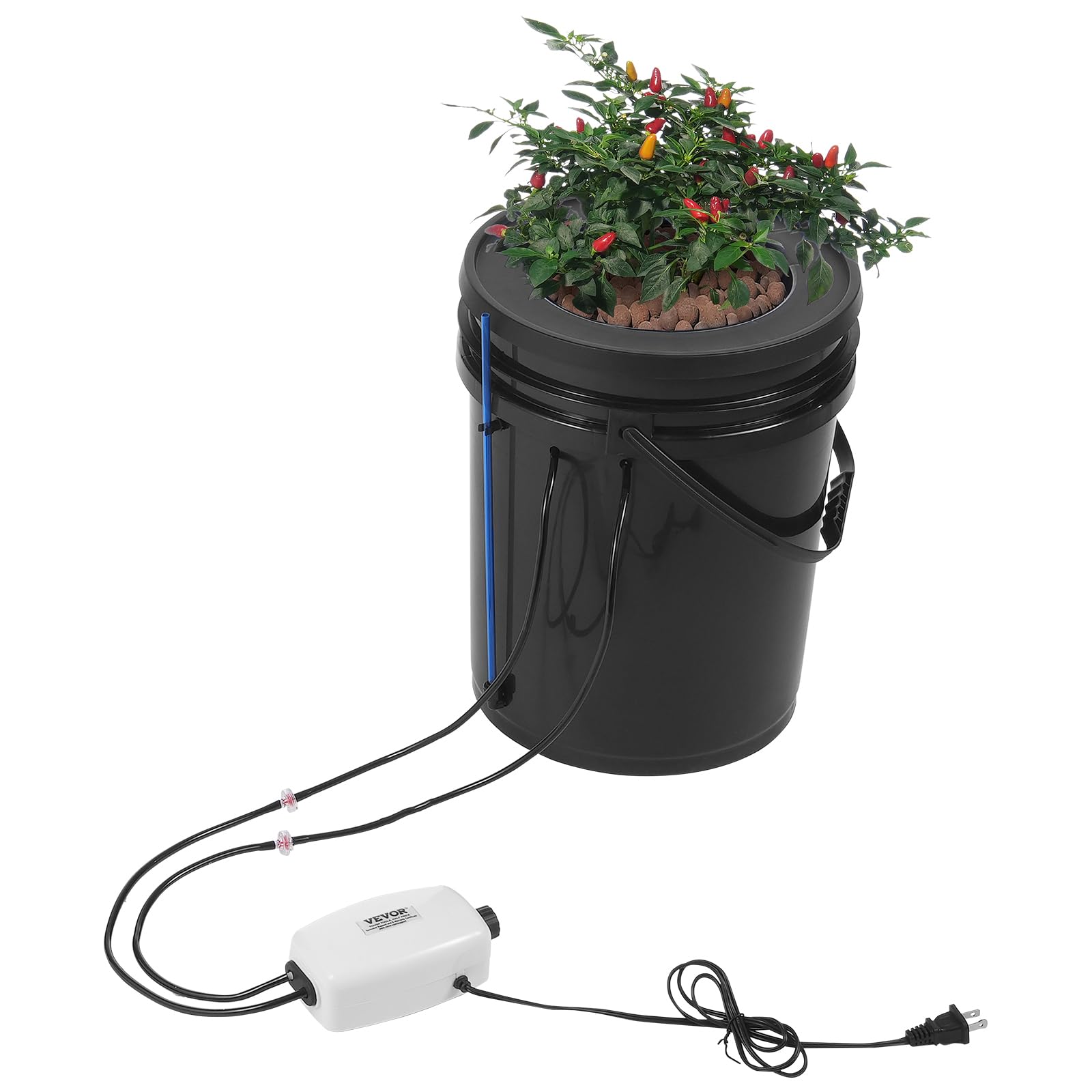
The one-bucket deep water culture setup that teaches you the real meaning of “root zone oxygen.”
VEVOR combines two methods in one bucket: deep water culture (DWC — roots hang into oxygenated nutrient water below the net pot) and a top drip kit that recirculates nutrient solution over the grow medium during the early growth stage. The 5-gallon PP (polypropylene) bucket is thick, corrosion-proof, and temperature-resistant, making it suitable for long-term use without warping. The included air pump and air stone keep the water oxygenated, which speeds up root development compared to soil alone.
The kit includes a check valve to prevent backflow, pre-cut water level tubes, sealing rings, and a bag of expanded clay pebbles for the grow basket. Owners mention excellent growth for leafy greens, though the air pump is noticeably loud — described as audible through walls by several buyers. The assembly instructions are sparse, and you will need separate pH and EC (electrical conductivity) meters to manage nutrient levels, which are not included. The high side at 6.6 pounds and the maximum weight capacity of 41.7 pounds tells you this is a solid unit, but moving it around once filled takes effort.
Deep water culture: the bucket construction is praised as “well-made” with perfect water level holes and grommets, and the price-to-performance ratio is widely considered exceptional for a DWC starter kit.
Hydroponic beginners: you are transitioning from soil to hydroponics and want a single-bucket system that lets you learn deep water culture without a big investment.
Soil growers: noise is a deal-breaker — the air pump hum is loud enough to bother housemates in an adjacent room.
5. VIVOSUN Automatic Drip Irrigation Kit (A10)

The 16-pot drip system that talks to your phone and runs quiet enough to forget it is there.
VIVOSUN’s A10 kit upgrades the typical drip setup with 4mm fast-flow drippers that the company says increase flow by 30% over standard sizes. The 15W pump delivers up to 1000 L/H while running at just 30-40 dB — about the noise level of a library. That quiet operation comes from the electric pump design, and it makes the system suitable for bedrooms, offices, or living rooms where a buzzing pump would be distracting. It waters up to 16 plants simultaneously through flexible tubing that can be routed around obstacles.
The key differentiator here is the smart control. By connecting to VIVOSUN’s A10 GrowHub and app, you can set custom schedules from your phone, choose Cycle Mode for automatic intervals, or use Recipe Mode for precise daily timing and amount. That means you are never guessing whether the plants got watered while you were on a work trip. The anti-siphon connector prevents backflow and flooding, and a built-in filter cotton catches dirt before it reaches the drippers. The reality check is that the injection-molded splitters can be inconsistent — a small number of customers note that after a month, only a fraction of the nozzles flowed properly, which can stress a plant collection if not caught early.
Reliable timer
- The 30-40 dB noise level means you can run it in a bedroom without sleep disruption
- App-based scheduling gives you remote control from anywhere with an internet connection
- The fast-flow 4mm drippers and 15W pump handle multiple large pots without struggling
Drippers clog
- A few units have suffered from splitter clogging after weeks of use; checking and cleaning the filter cotton monthly is wise
- Some owner experiences suggest that negative reviews may stem from initial quality issues that have since been addressed — but the evidence is mixed
Consistent schedules: you want app-based control over a 16-plant setup and value quiet pump operation for an indoor grow space.
Hard water areas: you prefer mechanical simplicity over smart features — the added complexity of an app and Wi-Fi connection introduces a potential failure point.
6. Rain Bird GARDENKIT Raised Bed Kit

The purpose-built 74-piece kit for exactly one raised bed — no guesswork on spacing.
Rain Bird designed this kit specifically for a 4-foot by 8-foot raised bed, which is the most common home vegetable garden dimension. The 35-foot coil of emitter tubing has 70 built-in drippers spaced every 6 inches, so there is no punching holes or guessing where to insert emitters — the spacing is already perfect for leafy greens, tomatoes, and peppers. A second 25-foot coil of 1/4-inch distribution tubing gives you flexibility to branch off to more distant plants or containers.
The system runs on standard outdoor faucet pressure and includes a regulator that limits the pressure to 25 psi, which is ideal for drip — high enough to push water through the line but low enough to prevent the tubing from bursting. The pressure-compensating emitters ensure that the tomato plant at the far end of the row gets the same amount as the basil at the spigot end. The biggest fan feedback is how easy the installation is: many owners needed only a pair of scissors and about 20 minutes to have the whole bed running. The catch is that Rain Bird explicitly warns against extending the kit with additional 1/4-inch tubing — doing so will reduce water flow and ruin the even distribution. If your garden is larger than a 4×8, you need a second kit rather than a simple extension.
Raised bed fit
- The pre-spaced emitter tubing eliminates the most tedious step in drip installation — measuring and punching
- Professional-grade components that can be buried or left on the soil surface for multiple seasons
- It delivers up to 80% water savings vs. overhead sprinklers by targeting water directly to the root zone.
Short hose reach
- The kit is designed for exactly one 4×8 bed; you cannot extend it without buying a whole second kit
- Some owners found the instructions vague, and a few units had emitters that did not function from the start
Small garden beds: you have one standard raised bed and want the fastest installation possible with no measurement guesswork.
Large layouts: your garden is larger than a single 4×8 bed or if you plan to expand the system over time — the non-extendable design will frustrate you.
7. LetPot Automatic Watering System (LP-D3-GN)

The Wi-Fi connected pump that waters 20 pots from a bucket while you watch from the beach.
LetPot leans hard into the smart-home lifestyle: this system supports Wi-Fi and mobile app control, allowing you to set up to five separate watering tasks with customized schedules, durations, and frequencies. The app also sends low-water alerts, meaning you get a notification before the reservoir runs dry. The included 10-meter water pipe (about 33 feet) feeds up to 10 adjustable drippers, and the maker says it supports 10-20 pots depending on the spacing and flow needs. The upgraded 2.0 chip promises faster connectivity than previous models, and the anti-backflow valve prevents the siphon effect that plagues cheaper systems.
What makes this a premium pick is the German-imported silent water pump and the IP66 waterproof rating, which means the control unit can handle rain, hose splash, and outdoor balcony conditions without failing. Owners consistently praise the reliability — the top aspect mentioned by owners is the overall reliability, followed by easy setup and watering efficiency. The tubing, however, is relatively stiff and arrives coiled, which makes threading it through a dense plant arrangement slightly tricky. Some owners also note that the emitters are difficult to adjust physically once installed, so you will want to set the flow rate before you commit to the final layout.
Large water tank
- The IP66 rating means this system can live on a balcony year-round without electrical worries
- Up to 5 simultaneous watering tasks via the app gives you the flexibility to water a basil seedling differently than a full-grown ficus
- The anti-backflow valve is a genuine upgrade — it stops the gravity-fed leak problem that many owners discover the hard way with other systems
No backup battery
- The stiff tubing holds its coil shape and can make layout positioning a small chore
- Adjusting dripper flow after installation is fiddly; get it right during the test run
Weekend gardeners: you want the full smart-app experience with remote alerts and multiple programmable schedules, and you do not mind a slightly tighter assembly process for the tubing.
Power outages: you prefer a simple mechanical timer that does not require a phone, an account, or a Wi-Fi password — the app is part of the deal here, not an optional extra.
8. VIVOSUN DWC Hydroponics Grow System (DWC-0001)
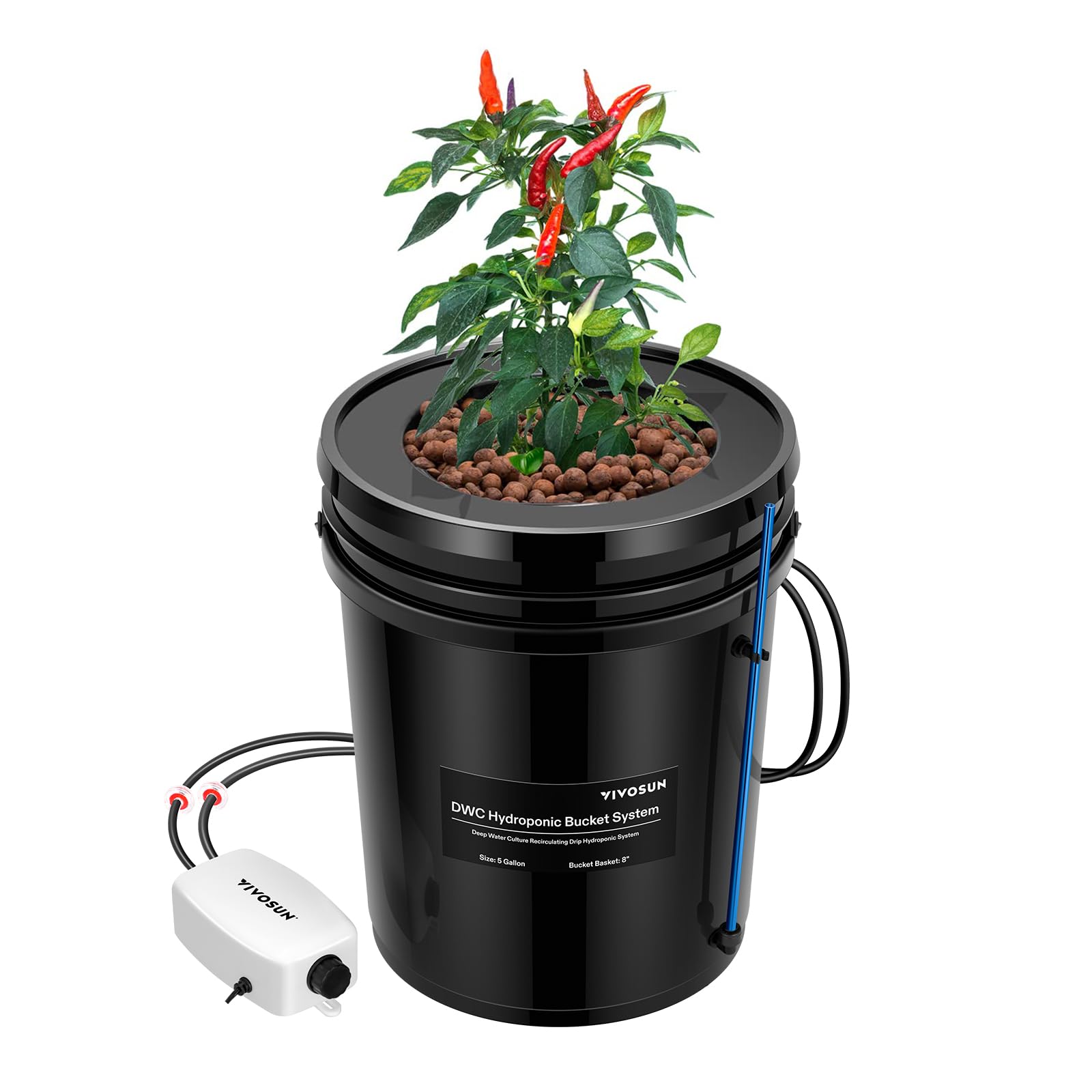
The DWC bucket that delivers a full oxygen bath to roots while you watch the canopy explode.
VIVOSUN’s take on the deep water culture bucket pairs a standard 5-gallon PP container with an 8W air pump that pushes 7L/min of air through the included air stone. The top drip kit recirculates nutrient solution over the grow medium during the first few weeks, which is crucial for seedlings that have not yet developed roots long enough to reach the reservoir below. The package includes an 8-inch grow basket, 2 meters of air tube, clay pebbles, and a visual water level indicator — everything except a light source.
What separates this from the similar VEVOR bucket is the reputation for quality: VIVOSUN scores a 4.3 rating from over 800 owners, with quality and performance as the top two most-mentioned positive aspects. Reviewers point out that the system is “super easy to set up” and that the bucket construction is leak-free when assembled correctly. The air pump noise, however, is a recurring topic. While some owners say it is “silent once everything is plugged in,” others find the hum audible through walls. The air stones (1-inch ball style) are smaller than some growers prefer; several owners replaced them with 4-inch disc stones for better oxygen distribution.
Compact bucket design: the external water level tube doubles as a drain, which is convenient, but the bucket must be raised slightly above the collection container to drain fully. A few owners added their own stainless tube and small pump to simplify pH testing and drainage.
Single plant focus: you want a well-reviewed DWC starter that comes with more confidence from an established brand with a large owner community.
Multiple plants: the air pump noise is critical to you — this is not a silent system, and you may want to budget for a replacement pump if you need whisper-quiet operation.
9. Spider Farmer Gravity-Fed Self-Watering System
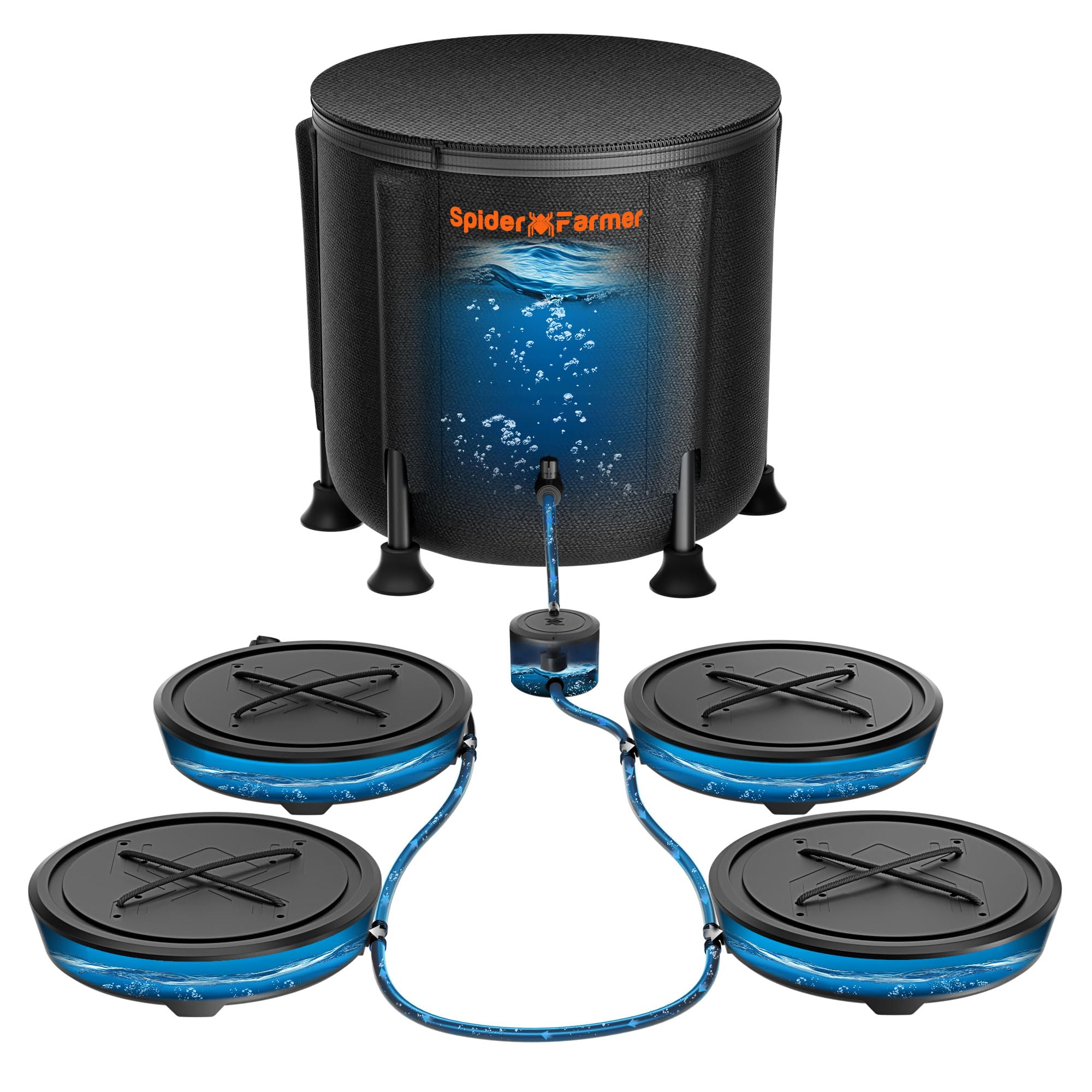
The wick system that feeds four fabric pots for weeks off a single tankful — pump optional.
Spider Farmer takes an entirely different approach from the pump-and-timer crowd: it uses gravity and wick lines. A large 13-gallon reservoir sits above four wicking bases, and water moves downward through tubes without any electricity, timer, or pump. The system supports up to 100 pounds total and comes with 5-gallon fabric grow bags, wick lines, a shut-off valve box, and water tubes. The maker claims a single fill can last up to 4 weeks, and owner reports confirm the reservoir holds enough for a 12-day trip with plants coming back “happy and healthy.”
The beauty of a gravity-fed system is the absolute silence — no pump hum, no timer clicks, no alarm buzzers. It is perfect for indoor grow tents, bedrooms, and living areas where noise is a problem. The trade-off is that the natural wicking action is slower than a pumped drip, and the design can get “a lil nasty” if you mix nutrients directly into the reservoir without periodic cleaning. One owner recommends a thorough cleaning every 3 weeks if you are adding nutrients to the water. The leakage and water capacity aspects receive mixed reviews — the reservoir does empty eventually, and a few owners swapped the included tank for a larger trash can to extend the interval.
Gravity fed
- No power requirement means zero electricity cost and zero noise — the system sits silently in any room
- The 13-gallon reservoir genuinely supports multi-week trips; shoppers say 12 days with water to spare
- Easy setup and excellent root development in the fabric pots are common praise points
Slow water flow
- The upgraded water outlet position (lowered by 4cm) improves water utilization, but the reservoir still leaves about 5 liters of unusable water at the bottom
- Nutrient mixes can create residue in the reservoir; a monthly cleaning schedule is recommended
No‑power zones: you want the simplest possible system that runs on gravity alone — no electricity, no noise, no apps, no programming.
Fast watering: your watering schedule requires precise per-plant control; the gravity-fed wick system delivers the same amount to every base with minimal adjustability.
Understanding the Specs
Pressure-Compensating Emitters
This is the single most important spec in a drip kit that uses faucet pressure. A pressure-compensating (PC) emitter delivers the same water volume per hour regardless of how far the emitter is from the water source. Without PC, the dripper closest to the faucet floods the soil while the one at the far end of the hose only dribbles. Both Rain Bird kits in this list use PC technology — that is why every plant in the same bed gets equal water.
DWC vs. Drip vs. Gravity-Wick
Deep water culture (DWC) means the plant roots hang directly into nutrient-rich, oxygenated water below a net pot. Drip irrigation drips water onto the grow medium or soil surface at a slow, controlled rate. Gravity-wick systems use capillary action — a wick or tube draws water from a raised reservoir into the growing medium without any moving parts. Your choice depends on if you want the fastest possible hydro growth (DWC), the simplest setup for soil pots (drip), or zero-electricity operation (gravity-wick).
FAQ
Can I leave a hydroponic watering system unattended for two weeks?
What is the difference between a drip kit and a DWC kit?
How do I prevent water from siphoning back into the reservoir?
Can a solar-powered watering system work in winter?
How many plants can a typical drip irrigation kit water?
Will a watering system work with tap water or do I need filtered water?
What is a “water level indicator” and do I need one?
Why do some kits say “do not extend the tubing”?
Is a gravity-fed system as effective as a pumped system?
What does “pressure-compensating” mean in a drip emitter?
Final Thoughts: The Verdict
If you want one dependable pick, the best hydroponic watering system winner is the Rain Bird LNDDRIPKIT because it covers a full garden with 108 pieces, pressure-compensating emitters, and faucet-pressure operation — no electricity, no app fuss, just consistent watering that buyers praise above nearly everything else in this category. If you want a dedicated smart system you can control from your phone, grab the LetPot LP-D3-GN. And for the ultimate hands-off, no-power-needed setup that handles up to four large fabric pots for weeks at a time, the Spider Farmer Gravity-Fed System is the one to reach for.
How We Picked
We do not accept paid placement. Every pick is matched to a real buyer and a real use-case; we do not hands-on test units.
Sources & Methodology
Specifications: manufacturer listings and product documentation. Review insights: verified customer reviews, as of July 2026. Pricing: not shown on this page (it changes often); check the current price via the retailer link.
As an Amazon Associate, Lawn Gear Lab earns from qualifying purchases. This does not affect which products we feature.