
Specs are compiled from manufacturer listings and verified buyer reviews and can change over time — please confirm the key details on the product page before buying.
If the phrase “poison ivy breakout” or “dandelion invasion” sends a chill down your spine, you are in the right place. A hose end weed killer is your shortcut to a clean yard without the back-breaking labor of hand-pulling every invader — just screw it onto your garden hose, pull the trigger, and let the water do the mixing and spraying for you. The trick is picking the right formula for your specific weeds and lawn type.
I’m Rikta — the founder and writer behind Lawn Gear Lab. This guide is built by comparing the manufacturers’ published specifications and the patterns across verified customer reviews, so you get each pick’s real strengths and trade-offs instead of marketing spin.
The right hose end weed killer depends on whether you are fighting broadleaf weeds in your turfgrass, or woody brush like poison ivy along your fence line, and we have broken down the top performers to help you decide.
Quick Picks
- Scotts Liquid Turf Builder with Plus 2 Weed Control — Best Overall
- Roundup Poison Ivy Plus Tough Brush Killer₂ Concentrate — Brush Buster
- Southern Ag Lawn Weed Killer with Trimec — Lawn Protector
- Sunday Weed & Green — Greener Approach
How To Choose The Best Hose End Weed Killer
A hose end weed killer is only as good as its match to your lawn. Grab the wrong one, and you could kill your grass along with the weeds, or waste hours on a solution that won’t touch woody vines. Here is what to check before you buy.
Know your enemy: broadleaf versus brush
Broadleaf weeds like dandelion, clover, and chickweed need a selective herbicide that targets them without harming your turfgrass. Woody plants like poison ivy, poison oak, blackberry, and kudzu need a much stronger brush-killer formula. There is no one-size-fits-all — buying a general lawn weed killer for poison ivy will leave you disappointed, and using brush killer on your whole lawn will wreck your grass.
Coverage per bottle
A 32 oz bottle of concentrate covers anywhere from 1,250 square feet to 6,000 square feet depending on the dilution rate. Check the square footage printed on the label before you buy — a small bottle doesn’t mean small coverage if the concentrate is potent, and a large number is meaningless if you have to use half the bottle per application.
Safety for your turf type
Not every weed killer is safe for every grass. Some formulas specify they work on only certain turf types (Bermuda, fescue, Zoysia), while others are non-selective and kill any plant they touch. Always match the product to your lawn’s grass type to avoid a brown yard.
Speed of results
Some formulas claim visible results in hours, while others take a couple of weeks to fully kill the root system. Fast-acting is satisfying to watch but often means the chemical is harsher, and you still need to reapply for stubborn deep-rooted weeds. Slower options tend to give a cleaner kill with less regrowth.
Quick Comparison
| Model | Best For | Coverage | Active Ingredients | Target Weeds | Amazon |
|---|---|---|---|---|---|
| Scotts Liquid Turf Builder with Plus 2 | Lawn feeding + weed control | 6,000 sq ft | Nitrogen | Broadleaf weeds + dandelions | Amazon |
| Roundup Poison Ivy Plus Tough Brush Killer₂ | Woody brush & vines | 1,500 sq ft | Triclopyr 2.50%, Fluazifop-P-Butyl 2.00%, Diquat Dibromide 1.50% | Poison ivy, oak, sumac, kudzu, blackberry | Amazon |
| Southern Ag Lawn Weed Killer with Trimec | Selective broadleaf control on lawns | 5,000 sq ft | Herbicide (Trimec blend) | Clover, dandelion, spurge, chickweed, onion grass | Amazon |
| Sunday Weed & Green | Pre-emergent + post-emergent + greening | 1,250 sq ft | Chelated iron (FeHEDTA) | Dandelion, oxalis, white clover, chickweed, thistle | Amazon |
In‑Depth Reviews
1. Scotts Liquid Turf Builder with Plus 2 Weed Control

Feeds your lawn and knocks out broadleaf weeds in a single hose-end spray.
This is the 2-in-1 solution most homeowners actually want: a weed killer that also fertilizes your grass. The 32 oz bottle covers up to 6,000 sq ft on warm-season lawns (or 4,000 sq ft on cool-season lawns), so you get a quick boost of nitrogen — the nutrient that greens up grass — while it targets dandelions, clover, chickweed, ground ivy, and poison ivy. The hose-end applicator is built right into the bottle, meaning you simply attach it to your garden hose and spray; no mixing concentrate, no separate sprayer.
Unlike the brush-killer formulas below, this one is designed for use on established turfgrass, so it kills the listed broadleaf weeds without harming your lawn. It does not, however, tackle woody plants like poison oak or kudzu the way the Roundup concentrate does — this is strictly for the weeds growing inside your lawn, not the vines creeping along your fence line. If your yard needs a green-up and a cleanup at the same time, this is the most efficient route.
The do-it-all lawn fix: If you are tired of spraying weed killer separately and then waiting a week before you can fertilize, this bottle collapses those steps into one simple hose-end pass. The catch: with a 32 oz ready-to-spray bottle, you are paying for the convenience rather than a concentrated chemical, so if you have a very large property (well over 6,000 sq ft), you will need multiple bottles to cover the whole yard.
Reach for this if: you want one product that both feeds your lawn and kills broadleaf weeds, and you value the convenience of a ready-to-spray hose-end applicator.
Look elsewhere if: you are exclusively battling woody brush like poison ivy along a tree line, or you need to maximize gallons of spray per dollar on a larger property.
2. Roundup Poison Ivy Plus Tough Brush Killer₂ Concentrate

The heavy artillery for poison ivy, kudzu, and blackberry that laughs at weaker sprays.
This is a targeted attack on the woody, tough-stemmed plants that ruin a property line. The 32 oz concentrate covers 1,500 sq ft, and its three active ingredients — Triclopyr 2.50%, Fluazifop-P-Butyl 2.00%, and Diquat Dibromide 1.50% — work together to kill poison ivy, poison oak, poison sumac, wild blackberry, and kudzu. It claims visible results in hours, and it becomes rainproof in as fast as 30 minutes, so you do not lose your work to an unexpected shower. One reviewer with an acre and a half noted they wished the concentrate came in a bigger size — a good sign that it works, but a hint you may need several bottles for a large property.
This formula is non-selective on brush, meaning it kills any plant it touches, so you must spot-treat rather than broadcast over your lawn. It is designed for use around fences, foundations, cabins, campsites, and on vines growing up trees or poles. You can also apply it to freshly cut woody stumps. It does not have the built-in hose-end applicator that the Scotts product has, so you will need to mix it in a tank or a hose-end sprayer yourself. Compared to the Southern Ag Trimec, which is a selective lawn weed killer, this Roundup is a total scorched-earth approach for brush — it will not discriminate between a weed and a flower bed.
Buyers report that it kills most plants with one application, though tough plants need a few passes. A volunteer who works on habitat restoration noted it is effective on poison oak, kudzu, and blackberry. The catch is that it does not have lasting residual control — one reviewer noted it keeps weeds killed back for about a month before regrowth starts. Plan for reapplication if you have a persistent infestation.
What works
- Visible wilting in hours, rainproof after just 30 minutes
- Specifically formulated for tough woody vines and brush that general weed killers cannot touch
- Buyers confirm it kills poison oak, kudzu, and blackberry with one or two applications
What to know
- You need to mix it yourself in a hose-end or tank sprayer — no built-in applicator
- Kills any plant it contacts, so it is for spot-treating brush, not broadcasting over your lawn
- One buyer mentioned regrowth after about a month, requiring reapplication
Your go-to for brush: If you have poison ivy, blackberry, or kudzu taking over your fence line, this is the most effective concentrate for the job. The trade-off: you must manage the mixing yourself and avoid over-spraying onto desired plants.
3. Southern Ag Lawn Weed Killer with Trimec

The selective broadleaf killer that targets weeds without touching your grass.
This 32 oz concentrate is built for the homeowner who wants to wipe out dandelions, clover, spurge, chickweed, and onion grass without turning their lawn into a brown wasteland. It covers 5,000 sq ft, and it is safe for use on 9 different turf types. The patented combination of 3 weed killers (the Trimec blend) works systemically — it gets absorbed into the plant and kills the root, not just the leaves. This is a notable advantage over contact killers that only burn the visible top growth.
One owner reported it killed their dandelion invasion in 2 weeks with no harm to the lawn. Another mentioned it effectively kills spurge, chickweed, and clover at a 2 oz per gallon dilution, but noted you should avoid rain for 24 hours after application. The formula has directions for use in both conventional sprayers and hose-end sprayers. The manufacturer recommends using a surfactant (a soap-like additive that helps the herbicide stick to weed leaves) for increased performance — this is an extra step the Scotts ready-to-spray product does not require. Compared to the Roundup brush killer above, this Southern Ag option is much more targeted: it is designed to spare your grass while killing broadleaf weeds, making it the smarter choice for a lawn that is otherwise healthy.
The selective specialist: If dandelions and clover are your main headache, and you have a grass lawn you want to keep alive, this Trimec blend is a proven solution with thousands of happy buyers. The one honest catch: owners mention regrowth can happen relatively fast, requiring reapplication every few weeks — it is not a season-long single-application fix.
Best for: homeowners who need a selective broadleaf weed killer that is safe on their turfgrass and want the most coverage per ounce (5,000 sq ft from a 32 oz bottle).
skip it if: you are fighting woody brush, or if you want the all-in-one fertilizer-plus-weed-killer combo that the Scotts product offers.
4. Sunday Weed & Green
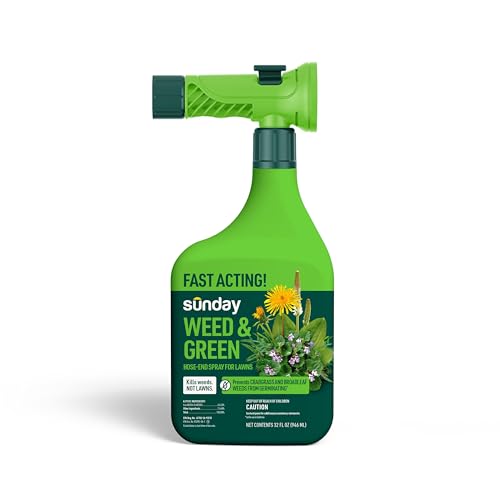
A modern dual-action formula that greens your grass while killing weeds before and after they sprout.
Sunday Weed & Green is a 5-in-1 spray that acts as both a pre-emergent (stops weed seeds from sprouting) and a post-emergent (kills weeds that have already popped up). The 32 oz bottle covers 1,250 sq ft. Instead of using a traditional harsh chemical like Triclopyr or 2,4-D, it relies on chelated iron (FeHEDTA) — a form of iron that feeds the grass a deep green color while disrupting weed growth. The bottle comes with its own hose-end sprayer included, so there is zero mixing or measuring: just attach it to your hose and spray the lawn.
Its target list includes dandelion, oxalis, white clover, chickweed, thistle, and plantain. The manufacturer notes that for best results, apply when weeds are just sprouting — larger, established weeds may require multiple applications. This is a notable difference from the Southern Ag Trimec and the Roundup brush killer, which are more potent on mature weeds but require separate mixing and surfactant steps. If you want an extremely simple process and prefer a lower-chemical, iron-based approach to lawn care, this Sunday product is the cleanest option on this list. The trade-off in coverage (1,250 sq ft is the smallest coverage area here) and potency on established, tough weeds.
Strengths
- Includes hose-end sprayer — no extra equipment or mixing needed
- High-iron formula greens up the lawn while controlling weeds
- Works as both a pre-emergent and post-emergent for broader season-long coverage
Limitations
- 1,250 sq ft coverage per bottle is the smallest on this list, so large lawns need multiple bottles
- Less effective on large, established weeds compared to the Roundup or Trimec concentrates
- No customer review data available yet to verify long-term field performance
For the convenience-first buyer: If you want to skip mixing chemicals and prefer a gentler, iron-based weed suppressor that also greens the lawn, this is the simplest path. The catch: you will cover less ground per bottle than any other option here, so budget for multiple units if your lawn exceeds 1,250 sq ft.
Understanding the Specs
Active Ingredients & Selectivity
The active ingredient determines what a weed killer actually does. Triclopyr kills woody brush like poison ivy. The Trimec blend (a mix of 2,4-D, MCPP, and Dicamba) targets broadleaf weeds in turfgrass without harming the lawn. Chelated iron (FeHEDTA) is a gentler, iron-based alternative that greens grass while stressing weeds. If you spray a non-selective brush killer across your whole lawn, you will kill the grass too.
Coverage Per Bottle
This is the total square footage one bottle treats. A 32 oz bottle of Scotts Liquid Turf Builder covers 6,000 sq ft. A 32 oz bottle of Sunday Weed & Green covers 1,250 sq ft. The difference is dilution rate and application method. Higher coverage numbers mean the concentrate is more diluted per gallon of spray, or simply that you are applying it at a lighter rate per square foot. Always check this number against your actual yard size before buying.
Hose-End vs Concentrate
A ready-to-spray bottle (like the Scotts Liquid Turf Builder) has a sprayer built into the cap — you attach it to a hose, turn on the water, and go. A concentrate (like the Roundup or Southern Ag) requires you to mix the liquid into a separate hose-end sprayer or tank sprayer before applying. Ready-to-spray is more convenient but typically costs more per ounce of active ingredient.
Rainfast & Visible Results Timing
“Rainfast” means the time the product needs to dry on the leaf before rain will wash it off. The Roundup brush killer becomes rainproof in 30 minutes — a big advantage if you live in a rainy area. Most other products recommend 24 hours without rain. “Visible results” can mean leaf wilt in hours (Roundup) or full root kill in 2 weeks (Southern Ag Trimec). Faster visible results do not always mean a more thorough kill.
FAQ
Can I use a hose end weed killer on my entire lawn?
How often do I need to reapply a hose end weed killer?
What is the difference between pre-emergent and post-emergent weed killers in a hose-end sprayer?
Will a hose end weed killer kill poison ivy?
How do I attach a hose end weed killer to my garden hose?
Can a hose end weed killer damage my grass if I use too much?
What does “rainproof in 30 minutes” actually mean?
Is it safe to apply a hose end weed killer near flower beds or vegetable gardens?
How long after spraying can I let my kids or pets on the lawn?
Which hose end weed killer covers the most area per bottle?
Final Thoughts: The Verdict
For most people, the hose end weed killer winner is the Scotts Liquid Turf Builder with Plus 2 because it combines a nitrogen boost for your grass with broadleaf weed control in a single, ready-to-spray bottle that covers up to 6,000 sq ft — the most convenient chemistry for a typical home lawn. If you are fighting woody brush and poison ivy along a fence line, grab the Roundup Poison Ivy Plus Tough Brush Killer₂ for its fast, rainproof results and proven effectiveness against stubborn vines. And for a newer, low-chemical iron-based option that also works as a pre-emergent, the Sunday Weed & Green offers the simplest hose-end setup of the bunch.
How We Picked
We do not accept paid placement. Every pick is matched to a real buyer and a real use-case; we do not hands-on test units.
Sources & Methodology
Specifications: manufacturer listings and product documentation. Review insights: verified customer reviews, as of July 2026. Pricing: not shown on this page (it changes often); check the current price via the retailer link.
As an Amazon Associate, Lawn Gear Lab earns from qualifying purchases. This does not affect which products we feature.