
Walking your lawn only to spot another dandelion or a patch of stubborn clover is a frustration every homeowner knows. The wrong spray wastes your weekend, leaves ugly yellow spots on your turf, or fails to kill the root, letting the same weeds return within weeks. A home weed killer must balance fast visible action with root-level destruction and, ideally, lawn safety — and that balance defines the products worth your money.
I’m Rikta — the co-founder and writer behind Lawn Gear Lab. Over many hours, I’ve compared active-ingredient concentrations, coverage rates, rainfast windows, and verified owner results across dozens of herbicide formulations to find which mixtures actually deliver on their label promises.
Whether you need a spot treatment for flower beds or a full-yard concentrate for broadleaf invaders, this guide breaks down the top contenders to help you pick the most effective home weed killer for your specific situation.
How To Choose The Best Home Weed Killer
Picking a herbicide isn’t about grabbing the brightest bottle. You need to match the chemistry to the weed type, the location (lawn vs. hardscape), and your tolerance for reapplication. Focus on three key factors to avoid wasting money on a formula that won’t solve your problem.
Active Ingredient & Concentration
Glyphosate is the standard for non-selective total vegetation control — it kills everything it touches. Dicamba and triclopyr are selective systemic herbicides that target broadleaf weeds like clover, dandelion, and poison ivy without harming most turfgrasses. Diquat dibromide is a fast-acting contact killer that shows results in hours but doesn’t always destroy the root system. Check the percentage of active ingredient on the label: a 41% glyphosate concentrate is far more potent than a 2% ready-to-use spray for tough perennial weeds.
Selective vs. Non-Selective
If you want to kill weeds growing inside your lawn without killing the grass, you need a selective herbicide like Ortho Weed B Gon or Bonide Chickweed, Clover & Oxalis Killer. These formulas typically contain 2,4-D, dicamba, or triclopyr. If you’re treating cracks in the driveway, patio edges, or fence lines where no desirable plants exist, a non-selective option like Spectracide Weed and Grass Killer (diquat) or Control Solutions Eraser (glyphosate) will clear the area completely.
Rainfast Window & Application Timing
A short rainfast window — the time needed before rain won’t wash the chemical off — is critical for busy schedules. Spectracide’s diquat formula is rainfast in 15 minutes, while glyphosate-based products typically require 2 to 6 hours. Apply when temperatures are above 60°F and weeds are actively growing. Spraying in extreme heat or before a frost can dramatically reduce efficacy, regardless of the brand you choose.
Quick Comparison
On smaller screens, swipe sideways to see the full table.
| Model | Category | Best For | Key Spec | Amazon |
|---|---|---|---|---|
| Roundup Dual Action | Concentrate | Kill + Prevent Regrowth | 4-month pre-emergent | Amazon |
| Roundup Poison Ivy Plus | Concentrate | Poison Ivy & Brush | Triclopyr + Fluazifop | Amazon |
| Bonide Chickweed, Clover & Oxalis Killer | Ready-to-Use | Large Lawn Spot Treatment | 128 oz, 10,000 sq ft | Amazon |
| Ortho GroundClear Super Concentrate | Concentrate | Hardscape & Fence Lines | 15-minute rainfast | Amazon |
| Spectracide Weed and Grass Killer | Concentrate | Fast-Action Hardscape | 3-hour visible results | Amazon |
| Ortho Weed B Gon | Ready-to-Use | Lawn-Safe Broadleaf Control | Won’t harm grass | Amazon |
| Control Solutions Eraser | Concentrate | Budget Total Vegetation Kill | 41% Glyphosate | Amazon |
In‑Depth Reviews
1. Roundup Dual Action Weed & Grass Killer Plus 4 Month Preventer

Roundup Dual Action stands apart because it doesn’t just kill what’s visible — it layers a pre-emergent barrier that stops new weeds from germinating for up to four months. The 32-ounce concentrate treats up to 1,600 square feet, and visible wilting begins as fast as six hours after application, which is remarkably quick for a systemic formula. Owners consistently report that stubborn invaders like greenbriar and Virginia creeper die within 24 hours and don’t return the same season.
Rainfast in just 30 minutes, this formula suits unpredictable weather better than glyphosate-only products that need hours of dry time. The dual-action chemistry — a fast-contact diquat component combined with a root-destroying systemic — ensures you see proof of knockdown the same day while the plant dies completely underground. Users note it works especially well on fence lines, driveways, and mulched beds where bare ground is acceptable.
The trade-off is that you cannot use this near desirable ornamental plants, as the non-selective action will kill anything green it touches. The concentrate also costs more per bottle than simpler formulas, though the prevention aspect can reduce total annual sprays. For a clean slate that stays clean, this is the most complete solution available.
What works
- Fast knockdown visible in 6 hours
- 4-month pre-emergent prevention
- Rainproof in 30 minutes
What doesn’t
- Non-selective — kills all plants
- Higher cost per bottle than basic concentrates
2. Bonide Chickweed, Clover & Oxalis Killer

Bonide’s ready-to-use spray packs a triple-active punch — dicamba, triclopyr, and herbicide — specifically formulated to wipe out chickweed, clover, and oxalis while leaving lawn grass untouched. The 128-ounce jug covers an impressive 10,000 square feet, making it the best value per square foot among selective lawn weed killers on this list. Owners report visible wilting within 24 hours on chickweed and dandelions, with complete root death in about a week.
Unlike many selective sprays that smell strongly of petroleum, this formula is nearly odorless, which makes it more pleasant for treating large areas near the house. Several experienced users noted that adding a surfactant (like liquid Castille soap) improves adhesion on waxy-leafed clover, and that application during active growth with no rain for 48 hours yields the highest success rate. It’s also cheaper per 1,000 square feet than Ortho Weed B Gon, according to owner calculations.
The main complaint is that the included hand-sprayer trigger is awkward for large lawns — most owners transfer the liquid to a pump sprayer for better reach. There’s also no pre-emergent action, so it won’t stop new weeds from germinating. For targeted removal of broadleaf weeds without harming your turf, this is the most cost-effective option.
What works
- Excellent coverage at 10,000 sq ft
- Nearly odorless formula
- Selective — safe for lawn grass
What doesn’t
- Hand sprayer is weak for large areas
- No pre-emergent prevention
3. Ortho GroundClear Weed and Grass Killer Super Concentrate
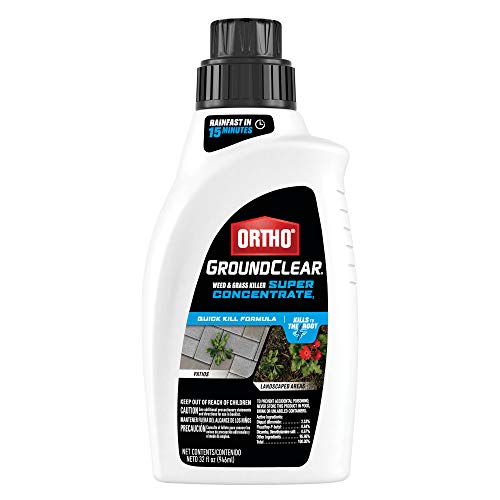
Ortho GroundClear Super Concentrate delivers fast, non-selective kill with an ultra-short 15-minute rainfast window — the tightest on this list. The 32-ounce bottle makes up to 1,120 square feet of solution, and owners consistently report seeing results on tough grasses and broadleaf weeds within 24 hours. One user described spraying foot-tall grass along a fence line and watching it yellow in three days, immediately ordering a second bottle.
The super-concentrate format means a little goes a long way: several buyers noted they stretched the bottle to five gallons of mixed spray, treating large gravel driveways and sidewalk cracks with leftover solution. The formula has minimal odor compared to older glyphosate-heavy products, making it tolerable for use near outdoor living spaces. It’s labeled for hardscapes, fences, and around established trees and shrubs, but be careful — it’s non-selective and will kill flowers and turf on contact.
Some owners found that Silverleaf Nightshade and other deep-rooted perennials required a second application 10-14 days later, especially in hot Arizona conditions. The bottle also lacks a measuring cap, so you must use a separate measuring tool. For a fast-acting, low-odor concentrate that handles most weed types on fences and patios, this is a solid mid-range workhorse.
What works
- 15-minute rainfast window
- Low odor formula
- Concentrate stretches to 5 gallons
What doesn’t
- May need reapplication for deep-rooted perennials
- No built-in measuring cap
4. Spectracide Weed and Grass Killer Concentrate
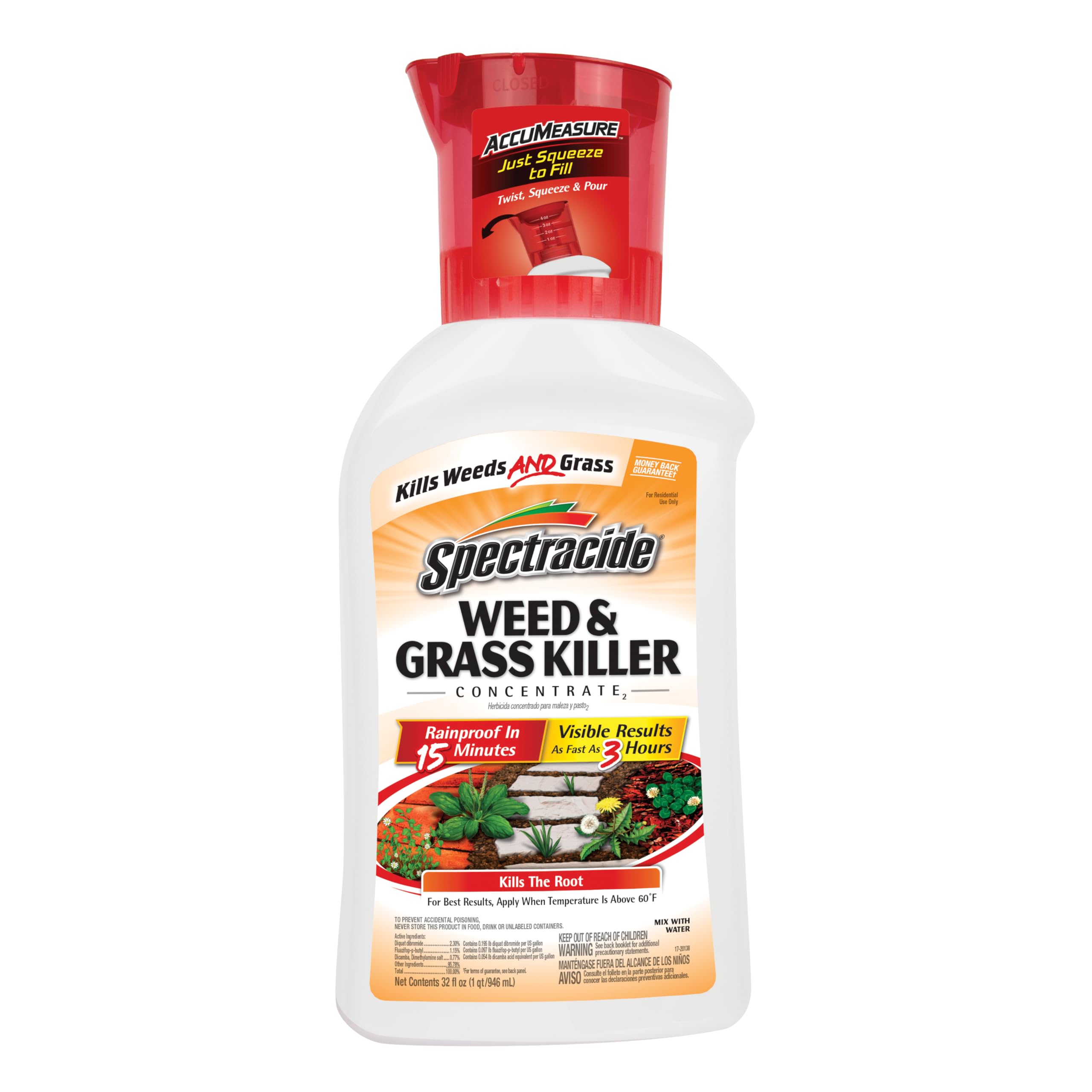
Spectracide uses diquat dibromide as its active ingredient, a contact herbicide that produces visible browning in as fast as three hours — much quicker than systemics that take days. The Accumeasure cap simplifies measuring: twist, squeeze, and pour directly into your tank sprayer without a separate cup, reducing handling of concentrated chemicals. Owners consistently praise this speed, with one noting that weeds along his curb were visibly dead the same day.
With a 15-minute rainfast claim, this concentrate is among the most weather-resistant options for homeowners who can’t guarantee a dry forecast. The 32-ounce bottle covers about 1,350 square feet, and many users report that a single application handles most annual grass and broadleaf weeds on driveways and walkways. The price point sits competitively below Ortho and Roundup equivalents, making it a logical choice for budget-conscious buyers who prioritize speed.
Because diquat is a contact killer, it doesn’t travel systemically to the roots the way glyphosate or triclopyr does. Perennial weeds with extensive root networks — like bindweed or quackgrass — will resprout and need reapplication. The Accumeasure cap is also finicky; some owners replace it with the lid from an old bottle. For immediate knockdown on annual weeds in hardscape areas, this is an exceptional value.
What works
- Visible results in 3 hours
- Accumeasure cap reduces mess
- 15-minute rainfast
What doesn’t
- Contact killer — roots may survive
- Reapplication often needed for perennials
5. Roundup Poison Ivy Plus Tough Brush Killer Concentrate

This Roundup concentrate targets the woody, waxy-leafed monsters that standard weed killers refuse to touch: poison ivy, poison oak, wild blackberry, kudzu, and sumac. The triple-active blend of triclopyr, fluazifop, and diquat penetrates bark and thick cuticles, killing the entire root structure. Owners with large properties report using a “hack and squirt” method — cutting the stem and applying concentrate directly — to eliminate mature poison ivy vines climbing up trees.
Rainfast in 30 minutes and showing visible results in hours, this is the fastest-working brush killer available without a professional license. Users emphasize that the formula is incredibly potent: one reviewer mentioned mixing cooking oil into the solution as a sticking agent to improve adhesion on glossy poison ivy leaves. The concentrate treats up to 1,500 square feet per bottle when mixed properly, and most residential brush patches require just one thorough application.
The formula is non-selective and will kill any plant it contacts, including grass and shrubs, so it’s best reserved for fence lines, wooded edges, and vacant lots. Some owners noted that very large brush (cane thickets, mature kudzu) needed a second pass after two weeks. Use a respirator and cover skin thoroughly — the chemicals are strong and the poison ivy oils remain active even after spraying.
What works
- Kills poison ivy, oak, and sumac
- Fast visible results in hours
- Rainproof in 30 minutes
What doesn’t
- Non-selective — kills everything
- Strong chemical requires protective gear
6. Ortho Weed B Gon Weed Killer Ready-to-Use

Ortho Weed B Gon is the most trusted name in selective lawn weed control, formulated to kill over 250 listed broadleaf weeds — including dandelions, clover, and chickweed — without harming your turf when applied as directed. The 24-ounce trigger spray bottle treats up to 5,000 square feet and provides visible results in hours, not days. Buyers consistently praise its reliability on clover patches, with one owner noting his wife uses it exclusively to maintain a weed-free lawn.
The ready-to-use format means zero mixing, no measuring cups, and no tank sprayer required. Simply twist the nozzle and spot-spray individual weeds as you walk the yard. The formula is systemic, meaning it travels to the root system to prevent regrowth, unlike contact-only sprays. For homeowners who don’t want to dilute concentrates or manage heavy equipment, this is the most convenient option on the list.
The main drawback is cost per square foot: ready-to-use trigger bottles are significantly more expensive than concentrates on a per-gallon basis. Heavy infestations requiring full-yard coverage will drain the bottle quickly, making it a poor value for large properties. The spray pattern can also be inconsistent, sometimes dripping off waxy leaves before the chemical absorbs. For small lawns and spot treatment, however, this is the simplest effective solution.
What works
- Kills 250+ broadleaf weeds
- No mixing required
- Safe for lawn grass
What doesn’t
- Expensive per square foot
- Poor value for large infestations
7. Control Solutions Eraser 41% Glyphosate Concentrate
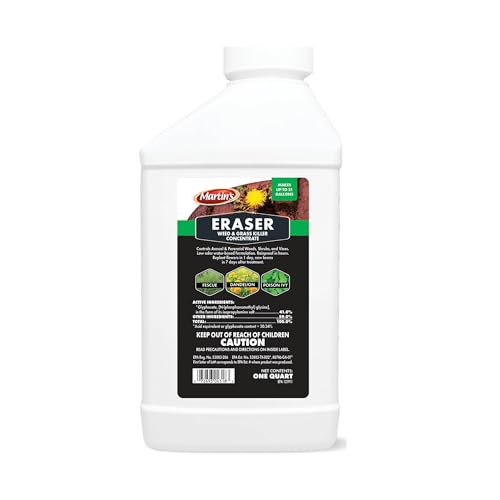
Control Solutions Eraser delivers 41% glyphosate — the same active ingredient concentration found in premium Roundup concentrates — at a fraction of the price. A single 32-ounce bottle mixes to cover a surprisingly large area, and owners who have used it for 17 years describe it as a “killer for sure” that eliminates everything green from Bermuda grass to poison ivy. The water-based, low-odor formula makes mixing and spraying less unpleasant than older glyphosate products.
This is a non-selective systemic herbicide with no residual soil activity, meaning you can replant in treated areas after the weeds die without worrying about lingering chemicals. Users recommend mixing 8 ounces per gallon for general weed control and adjusting to 10 ounces for woody plants like blackberry vines. Results take 7 to 14 days — noticeably slower than diquat-based killers — but the root kill is total, preventing regrowth of annual and perennial weeds alike.
The slow action can be frustrating for impatient users, and the label instructions are vague about mixing ratios for specific weed types. The product also lacks any pre-emergent protection, so bare soil is immediately vulnerable to new weed seeds. For budget-conscious homeowners who need to clear large areas of mixed vegetation and are willing to wait two weeks, this is the most economical choice.
What works
- 41% glyphosate — same as premium brands
- Excellent value per mix
- Low odor, no residual soil activity
What doesn’t
- Slow action — 7 to 14 days
- Vague mixing instructions
Hardware & Specs Guide
Active Ingredient Systems
Glyphosate remains the gold standard for non-selective total vegetation control, with the Eraser and Roundup Dual Action relying on its systemic root-kill. Diquat dibromide, found in Spectracide, offers faster visible results but weaker root penetration. Triclopyr and dicamba blends (Bonide, Ortho Weed B Gon, Roundup Poison Ivy) are selective against broadleaf weeds while leaving grass unharmed. High-concentration formulas (41% glyphosate) should be diluted per label — over-concentrating wastes money and risks off-target damage.
Coverage & Rainfast Timers
Coverage ranges from 1,120 square feet (Ortho GroundClear) up to 10,000 square feet (Bonide RTU). Rainfast windows vary from 15 minutes (Spectracide, Ortho GroundClear) to several hours (Eraser glyphosate). Shorter rainfast windows are critical for homeowners in afternoon thunderstorm zones. For systemic products like glyphosate or triclopyr, 6-12 hours of dry weather post-spray ensures maximum chemical absorption into the root system.
FAQ
Can I use Roundup Dual Action near my flower beds?
Why do some weed killers smell stronger than others?
How long should I wait before mowing after applying weed killer?
Final Thoughts: The Verdict
For most gardeners, the home weed killer winner is the Roundup Dual Action because it combines fast knockdown with a four-month pre-emergent barrier, saving you from repeated applications all season. If you want a selective formula safe for your lawn, grab the Bonide Chickweed, Clover & Oxalis Killer. And for clearing poison ivy and woody brush from fence lines, nothing beats the Roundup Poison Ivy Plus Tough Brush Killer.