
Oxalis, with its clover-like leaves and persistent yellow flowers, is one of the most frustrating weeds to banish from a lawn. It spreads through underground bulbs and seeds, meaning a simple surface spray rarely delivers a lasting kill — you need a chemistry approach that targets the root system.
I’m Rikta — the co-founder and writer behind Lawn Gear Lab. I’ve spent hundreds of hours analyzing manufacturer labels, cross-referencing active-ingredient performance data, and studying aggregated owner feedback to identify the formulations that truly eliminate oxalis without destroying your turfgrass.
This guide breaks down the top-performing selective herbicides on the market so you can confidently choose the best herbicide for oxalis based on your grass type, infestation level, and budget.
How To Choose The Best Herbicide For Oxalis
Oxalis reproduces via both seeds and underground bulbs, so a herbicide that only burns the foliage will result in regrowth within weeks. You need a formulation that translocates through the leaves into the root system effectively. The following criteria are the most important to evaluate before making a purchase.
Active Ingredients That Work Against Oxalis
Look for products containing triclopyr, dicamba, MCPA, or fluroxypyr. These compounds are systemic post-emergent herbicides that move through the plant’s vascular system. Triclopyr, in particular, has a strong track record against oxalis when applied during active growth. Products with just 2,4-D alone may suppress it but rarely eliminate the bulbs.
Grass Type Compatibility
Oxalis grows in nearly every turf type, but not all selective herbicides are safe for all grasses. Bermudagrass, St. Augustinegrass, and Zoysiagrass tolerate different active ingredient profiles. Always check the label for your specific grass species — products like Atticus Azion XP target St. Augustine and Bermudagrass only, while Nufarm Change Up covers both cool-season and warm-season varieties widely.
Formulation and Coverage
Concentrates offer better value per square foot compared to ready-to-use spray bottles, especially if you have a large lawn. Measuring in ounces per gallon gives you more control over dosing. Granular formulations are less common for oxalis-specific control because they require water activation and don’t adhere to the broad leaves as effectively as liquid sprays.
Quick Comparison
On smaller screens, swipe sideways to see the full table.
| Model | Category | Best For | Key Spec | Amazon |
|---|---|---|---|---|
| Monterey Spurge Power | Premium Concentrate | Broad oxalis & wild violet control | MCPA + Triclopyr + Dicamba | Amazon |
| Quali-Pro Negate 37WG | Premium Granule | Warm-season lawns with Poa issues | Rimsulfuron + Metsulfuron 20% | Amazon |
| Ortho Weed B Gon | Premium RTU | Homeowner spot treatment | Triclopyr concentrate 2-pack | Amazon |
| Nufarm Change Up | Mid-Range Concentrate | 200+ broadleaf weed control | MCPA 51% + Fluroxypyr + Dicamba | Amazon |
| Select Source Triad TZ | Mid-Range Concentrate | Broadleaf & nutsedge suppression | 2,4-D + Dicamba + Triclopyr + Sulfentrazone | Amazon |
| Bonide Chickweed, Clover & Oxalis Killer | Mid-Range RTU | Immediate small-area application | Dicamba + Triclopyr RTU 128oz | Amazon |
| Atticus Azion XP MSM | Budget Granule | Bahiagrass control in Bermuda | Metsulfuron Methyl 60% | Amazon |
In‑Depth Reviews
1. Monterey Spurge Power Post Emergent Selective Herbicide Concentrate (16 oz, Pack of 2)
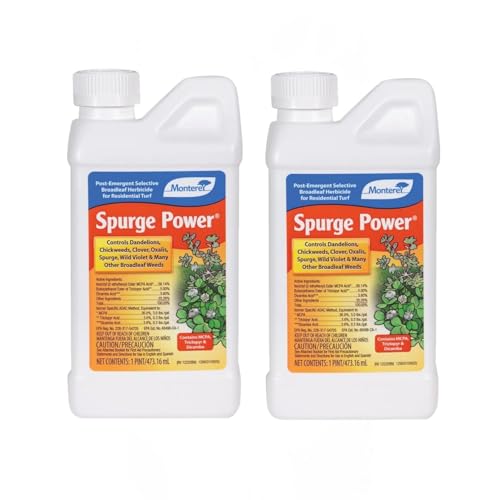
Monterey Spurge Power packs a three-pronged systemic punch with MCPA, triclopyr, and dicamba — a combination that attacks oxalis through both leaf absorption and root translocation. The 16-ounce concentrate treats up to 16,000 square feet, giving you enough chemistry for several seasonal applications across a medium-to-large lawn.
This formulation is labeled for bluegrass, fescue, rye, bahia, bermuda, and zoysia, making it one of the most grass-type tolerant options on the shelf. Real users report visible wilting within 48 hours on oxalis and spurge, with full bulb die-off occurring over the following two weeks. The two-pack bundle provides strong long-term value for anyone fighting a recurring oxalis problem.
Be prepared for a noticeably strong chemical odor during mixing. The concentrate must be measured precisely with a surfactant to ensure even coverage. Some users with dense wild violet infestations report needing two applications spaced a month apart, though this is consistent with oxalis’s deep root system.
What works
- Three active ingredients provide systemic root kill
- Safe on the widest range of warm- and cool-season grasses
- Concentrate format delivers excellent coverage per dollar
What doesn’t
- Strong odor during mixing and application
- Requires surfactant for maximum leaf adhesion
2. Quali-Pro Negate 37WG Herbicide

Quali-Pro Negate 37WG is a dual-action sulfonylurea herbicide that combines rimsulfuron and metsulfuron methyl. It is specifically engineered for warm-season turf like bermudagrass and zoysia, and it targets not just oxalis but also poa annua, ryegrass, and clover. The granular powder dissolves into a suspension that can be sprayed over large areas.
This product earns its professional reputation through its ability to clear oxalis and poa simultaneously with one mixing session. Users report weed decline beginning within a week and complete die-off by the second week. The low-odor formulation is a practical advantage for residential applications near pets and children.
The 1.5-ounce bottle must be mixed entirely into 1 gallon of water and used within 30 days, which limits its appeal for spot treatments. The per-treatment cost is noticeable for smaller lawns, and a small amount of temporary stunting on bermudagrass has been noted after heavy application.
What works
- Dual active ingredients for broad weed spectrum control
- Very low odor compared to 2,4-D based formulas
- Effective poa annua knockdown alongside oxalis
What doesn’t
- Entire bottle must be mixed and used within 30 days
- Relatively high cost per square foot
3. Ortho Weed B Gon Chickweed, Clover & Oxalis Killer for Lawns (32 oz, Pack of 2)

Ortho Weed B Gon is a familiar brand for homeowners, and this specific variant is formulated with triclopyr to target oxalis, chickweed, and clover without harming established lawns. The two-pack provides 64 total ounces of concentrate, which mixes with water in a standard hose-end sprayer for simple broadcast application.
The formulation is rainproof within 6 hours, giving you flexibility with unpredictable weather. Users with zoysia and fescue lawns report effective oxalis suppression with a single application. The triclopyr component penetrates the waxy leaf surface of oxalis effectively, reducing the need for a separate surfactant in most cases.
Some deep-rooted oxalis plants may require a second application after 3–4 weeks, especially if the initial treatment was applied during cooler weather. The ready-to-mix concentrate is slightly more expensive per square foot than professional-grade concentrates, but the convenience factor remains high for casual users.
What works
- Rainproof in 6 hours for flexible scheduling
- Triclopyr formulation penetrates oxalis leaf wax effectively
- Easy hose-end mixing for quick application
What doesn’t
- May need follow-up application for deep oxalis bulbs
- Lower concentration per ounce than professional products
4. Nufarm Change Up, Premium Selective Herbicide (32 oz)

Nufarm Change Up combines MCPA, fluroxypyr, and dicamba into a premium selective herbicide that controls over 200 broadleaf weeds including oxalis, thistle, and chickweed. It is labeled for both cool-season and warm-season turfgrass, including creeping bentgrass, centipedegrass, and St. Augustinegrass — a rare breadth of tolerance.
Users report visible oxalis shriveling within days, with full root kill occurring within one to two weeks. The fluroxypyr component offers strong activity against oxalis even when applied after the weed has flowered. The concentrate mixes at a rate of 0.46 to 1.1 ounces per 1,000 square feet, giving you fine control over dose strength.
This product demands careful handling due to its high MCPA concentration. Overspray onto ornamentals or vegetable beds can cause damage, so shield application is recommended. Some users note that the product works best on actively growing oxalis during spring and early fall rather than during summer dormancy.
What works
- Exceptional broad-spectrum control for oxalis and thistle
- Tolerated by both warm-season and cool-season turf types
- High MCPA concentration delivers fast visible results
What doesn’t
- High potency requires precise measuring to avoid damage
- Not suitable for application near ornamental gardens
5. Select Source Triad TZ | 4-Way Combination Herbicide (Quart)

Triad TZ from Select Source uses four active ingredients — 2,4-D, dicamba, triclopyr, and sulfentrazone — to create a highly robust post-emergent formula. The inclusion of sulfentrazone adds suppression of yellow nutsedge, which often accompanies oxalis in lawns with poor drainage. The quart treats residential lawns, athletic fields, and commercial sites.
Users with heavy clover and oxalis infestations in fescue and bluegrass report 95% clearance after a single application when mixed with a non-ionic surfactant. The weed growth cessation occurs within hours, and full death follows in one to four weeks depending on temperature and weed maturity. The 4.4-star average rating from 300 reviews reflects consistent performance.
The product has a strong chemical odor that persists during application. The bottle also has a risk of leakage during shipping due to the cap design. Users with St. Augustinegrass should verify turf tolerance before broadcast application, as sulfentrazone can cause minor discoloration on some warm-season varieties.
What works
- Four active ingredients cover a huge weed spectrum
- Sulfentrazone adds nutsedge suppression
- Fast-acting — visible results within hours
What doesn’t
- Strong chemical odor during application
- Shipping packaging may leak
6. Bonide Chickweed, Clover & Oxalis Killer, 128 oz Ready-to-Use Spray

Bonide’s product name says exactly what it does, and the ready-to-use 128-ounce bottle is designed for the homeowner who wants to spray directly from the container without mixing. The active ingredients — dicamba and triclopyr — are well-established for systemic oxalis control, and the bottle covers up to 10,000 square feet.
Users consistently report effective knockdown of chickweed, clover, and small oxalis plants within a day or two. The ready-to-use formulation eliminates measuring errors and works well with the included trigger sprayer for spot treatment. The larger volume means you have enough product for several touch-up passes throughout the season.
The pre-diluted format is less economical than concentrates for large infestations. The hand sprayer is also not ideal for covering a full lawn — most reviewers recommend transferring to a pump sprayer for broader coverage. Some users with well-established oxalis bulbs report needing a second application to stop regrowth.
What works
- No mixing required — spray directly from bottle
- Large 128-ounce volume covers 10,000 sq ft
- Dicamba and triclopyr provide systemic translocation
What doesn’t
- Pre-diluted format costs more per square foot than concentrate
- Trigger sprayer is slow for large lawn applications
7. Atticus Azion XP MSM Turf Herbicide (8 oz)
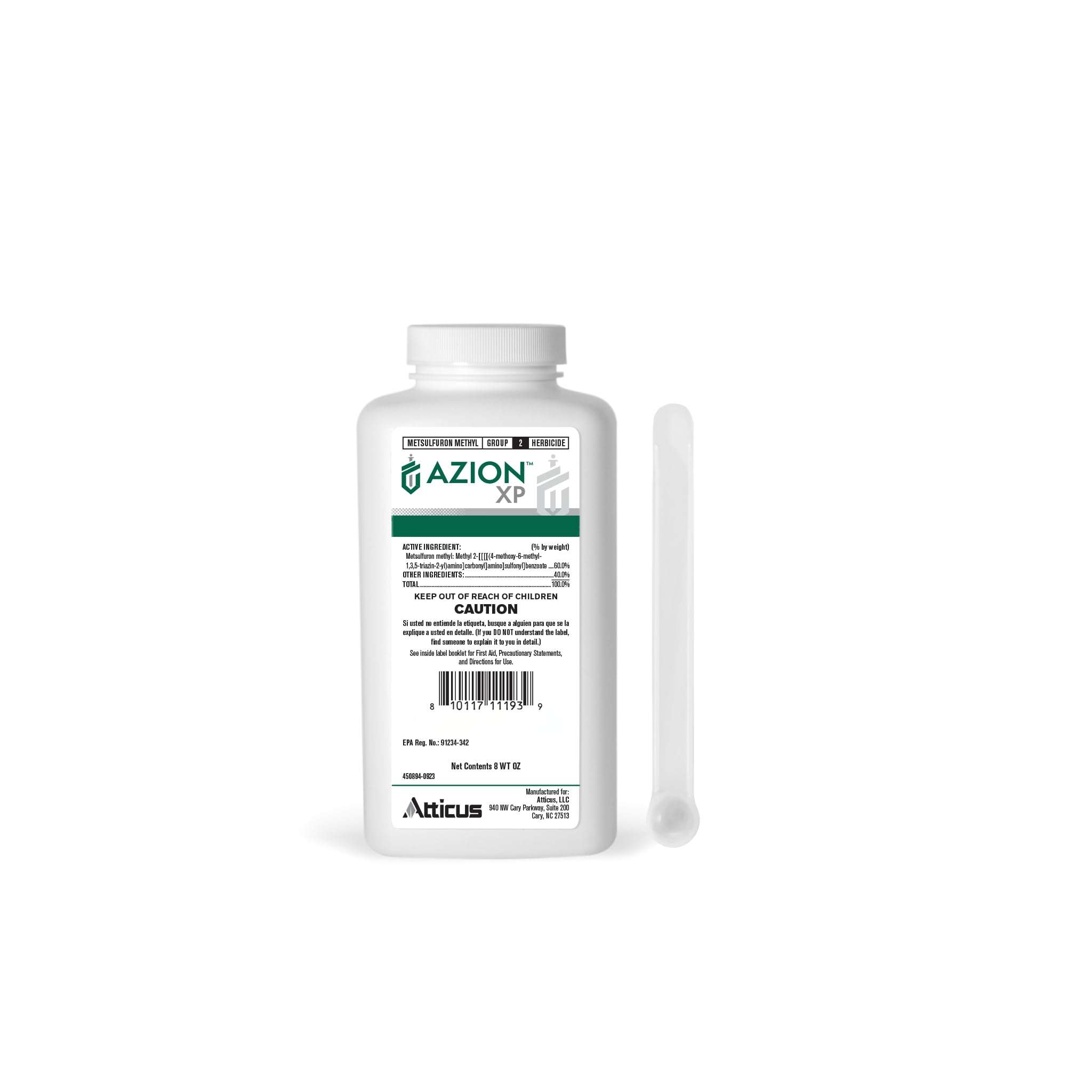
Atticus Azion XP contains 60% metsulfuron methyl, the same active ingredient as the professional Manor herbicide, but at a significantly lower entry cost. This selective herbicide is labeled exclusively for bermudagrass and St. Augustinegrass, making it a precision tool for warm-season lawns. The 8-ounce granular bottle dissolves in water to create a powerful spray solution.
This product excels at eliminating bahiagrass and oxalis growing in bermudagrass lawns without injuring the desirable turf. Users report that oxalis begins to decline within 1–2 weeks. The concentrated granules require very small dose rates — roughly 0.28 grams per gallon — meaning one bottle lasts multiple seasons for spot treatments.
The active ingredient can cause temporary yellowing or stunting on bermudagrass during spring green-up, so application timing is critical. This product is not labeled for cool-season grasses and is restricted from sale in California, New York, and Vermont. Beginners should read the entire label before mixing to avoid off-target injury.
What works
- Very concentrated — one bottle lasts years for spot use
- Same metsulfuron methyl as professional Manor herbicide
- Effective on oxalis and bahiagrass in warm-season turf
What doesn’t
- Restricted in CA, NY, and VT
- Can temporarily discolor bermudagrass during spring transition
Hardware & Specs Guide
Translocated Chemistry
Systemic herbicides rely on the plant’s vascular system to move the active ingredient from the leaves to the underground bulbs. Triclopyr and dicamba are the most effective translocated compounds specifically for oxalis because they travel through both phloem and xylem. Products containing these ingredients consistently outperform contact-only formulas that leave the root system intact.
Surfactant Synergy
Oxalis leaves have a waxy cuticle that repels water-based sprays. Adding a non-ionic surfactant at 0.25% to 0.5% of the spray volume dramatically improves droplet adhesion and active ingredient absorption. Many concentrated herbicides recommend surfactant use, and skipping this step is the most common reason for poor field results.
Application Temperature Window
Oxalis responds best to herbicide application when daytime temperatures are between 60°F and 85°F and the plant is actively growing. Applications made during heat-stressed summer conditions or cold dormancy result in slower uptake and higher regrowth rates. Early spring and early fall are the prime windows for systemic herbicide success.
Grass-Specific Tolerance Thresholds
Not all selective herbicides are safe across all turf species. St. Augustinegrass is sensitive to triclopyr at high rates, while centipedegrass can be injured by 2,4-D. Always cross-reference the turf tolerance table on the product label. The Nufarm Change Up and Monterey Spurge Power have the broadest grass-type compatibility in this lineup.
FAQ
Why does oxalis keep coming back after I spray it?
Can I use a herbicide for oxalis on my St. Augustine lawn?
How long does it take for oxalis to die after spraying?
Is it safe to use these herbicides around vegetable gardens?
Final Thoughts: The Verdict
For most gardeners fighting oxalis in established warm-season or cool-season lawns, the herbicide for oxalis winner is the Monterey Spurge Power because its triclopyr and dicamba combination delivers reliable systemic root kill across the widest range of grass types. If you need professional-grade control specifically for bermudagrass with poa annua, grab the Quali-Pro Negate 37WG. And for quick, no-mix spot treatment in a small lawn, nothing beats the Bonide Chickweed, Clover & Oxalis Killer.