
Few things are more frustrating than cutting down a relentless tree, only to have a thicket of sprouts emerge from the stump weeks later. Tackling invasive brush, fast-growing saplings, or resilient hardwoods demands a chemical solution that penetrates deep into the vascular system, ensuring the root mass dies completely and never returns. The wrong choice wastes time and money while the targeted tree simply shrugs it off.
I’m Rikta — the co-founder and writer behind Lawn Gear Lab. I’ve spent countless hours breaking down the active ingredients, surfactant systems, and label instructions of the most potent woody-plant herbicides on the market, cross-referencing them with thousands of verified owner reports to help you avoid costly re-treatments.
Whether you are clearing fence lines or eradicating a single stubborn oak, this guide cuts through the noise to deliver the definitive list of the best herbicide for killing trees available right now.
How To Choose The Best Herbicide For Killing Trees
Selecting a tree-killing herbicide is fundamentally different from picking a general-purpose weed killer. Trees have deep, energetic root systems that can shrug off weak formulations. You need to match the active ingredient, concentration, and application method to the specific woody species and the environmental context of your property.
Active Ingredient: Glyphosate vs. Triclopyr
Glyphosate (like the 41% concentration in Albaugh Gly Star Plus) is a non-selective, systemic killer that moves from foliage to roots, effective on a huge range of annual and perennial weeds and trees. However, it can harm any green plant it touches. Triclopyr (found in ALLIGARE Agri Star and Crossbow) is a selective herbicide that targets broadleaf woody plants and brush while sparing grasses, making it a top choice for pasture and fence-line use. For pure tree-killing power, a high-concentration triclopyr formulation often tops glyphosate on tough woody species like black locust, multiflora rose, and honey locust.
Concentration & Surfactant System
The percentage of active ingredient dictates how much concentrate you need per gallon of water. A 41% glyphosate concentrate is extremely potent for the price, while a 61.6% triclopyr product (like Garlon 4) is the gold standard for cut-stump applications. Also critical is the surfactant package — a built-in surfactant (like the one in Gly Star Plus) ensures the chemical sticks to waxy leaves and bark, improving absorption. Without it, rain will wash away your effort.
Application Method: Foliar, Cut-Stump, or Basal Bark
Foliar spraying works on small saplings and actively growing brush where you can hit the leaves. The cut-stump method is best for larger trees: make a fresh cut, then apply full-strength or a high-concentration mix within 30 minutes. Basal bark application involves spraying the lower trunk with a mixture of triclopyr and oil, which penetrates the bark to kill the root system. Your choice determines which product and mix ratio to use. For example, Remedy Ultra and ALLIGARE Agri Star are excellent for basal bark treatment when mixed with diesel or vegetable oil.
Quick Comparison
On smaller screens, swipe sideways to see the full table.
| Model | Category | Best For | Key Spec | Amazon |
|---|---|---|---|---|
| Alligare Agri Star Triclopyr 4E | Triclopyr Concentrate | Cut-stump & broadleaf woody brush | 61.6% Triclopyr (Garlon 4 equivalent) | Amazon |
| Remedy Ultra Specialty Herbicide | Triclopyr Concentrate | Pasture restoration & fence lines | Low-odor triclopyr for basal bark | Amazon |
| Roundup Pro Herbicide | Glyphosate Concentrate | Large-scale industrial & tree stumps | 50.2% Glyphosate, 2.5 Gal | Amazon |
| Southern Ag Crossbow | Triclopyr + 2,4-D | Vines, ivy, and small trees | 2.23 acres coverage per gallon | Amazon |
| Crossbow Herbicide (Tenkoz) | Triclopyr + 2,4-D | Fence row brush & poison ivy | 16.5% Triclopyr, 1 Gal | Amazon |
| Albaugh Gly Star Plus | Glyphosate Concentrate | Budget large-area non-selective use | 41% Glyphosate + Surfactant | Amazon |
| Crossbow Herbicide (Helena) | Triclopyr + 2,4-D | Grass-safe woody brush control | Rainfast in 2 hours | Amazon |
In‑Depth Reviews
1. ALLIGARE Agri Star Triclopyr 4E Herbicide
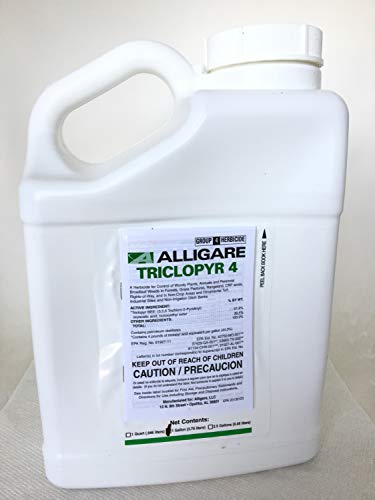
The ALLIGARE Agri Star Triclopyr 4E is chemically identical to the industry-standard Garlon 4, carrying a potent 61.6% triclopyr concentration that devastates woody plants without harming grass. Owner reports consistently confirm its effectiveness on black locust, multiflora rose, and even aggressive vines like Lamium galeobdolon. For the cut-stump method, users apply it full strength to a fresh cut, and sprouts wither in one to two days with complete root death within a month.
Its volatile ester formulation means it produces a strong oily smell that persists after spraying, and it can damage desirable trees if vapors drift onto their foliage. Several buyers recommend mixing it with an oil-based carrier like diesel or vegetable oil for basal bark applications, and a tank sprayer with a wand is preferred over a standard Roundup sprayer to handle the viscous mix. The value is exceptional when compared to brand-name equivalents that cost significantly more per gallon.
For anyone serious about eradicating tough brush and unwanted trees on pasture or fence lines, this concentrate delivers professional-grade performance at a fraction of the price. It is not intended for lawn use and requires careful handling, but for its target audience — landowners battling invasive woody species — it is the most cost-effective heavy hitter on this list.
What works
- Matches Garlon 4 specs at a much lower cost per gallon.
- Excellent on tough woody species like locust and multiflora rose.
- Highly effective for both cut-stump and basal bark treatments.
What doesn’t
- Strong chemical odor that lingers after application.
- Volatile ester can drift and damage non-target trees.
- Too viscous for basic pump sprayers; needs a tank sprayer.
2. Remedy Ultra Specialty Herbicide
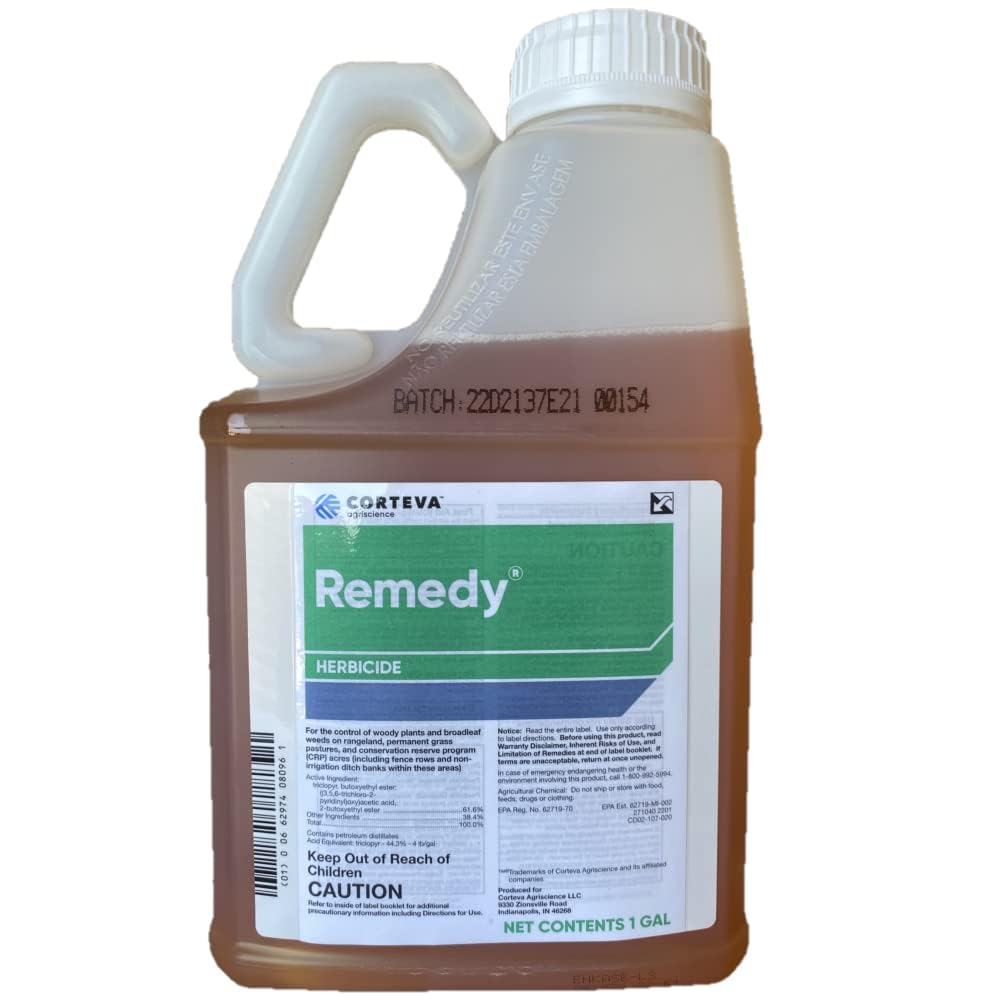
Remedy Ultra is the go-to premium triclopyr for rangeland, pasture restoration, and fence-line maintenance. Its low-odor formulation is a major upgrade over the harsh chemical smell of other ester-based herbicides, making large-scale application more tolerable. Users report outstanding results on invasive species like honey locust, cogon grass, and wild pear, especially when mixed with diesel for basal bark application — a single treatment stops resprouting permanently.
The price per gallon is steep, placing it firmly in the premium tier. Some owners noted that while it annihilates brush and small trees, it did not perform as well on general weeds and unwanted grass, meaning you may need a separate product for broadleaf lawn weeds. It is also slow-acting on some species, taking a couple of weeks to fully kill small trees that kept coming back before finally succumbing.
If your primary goal is to clear invasive woody plants from pasture or fence rows without the overpowering odor that makes application unpleasant, Remedy Ultra justifies its cost through superior user experience and reliable, lasting results. It is safe around children and pets once dry, as long as label instructions are followed.
What works
- Low odor makes large-area spraying much more pleasant.
- Basal bark mix with diesel is deadly on honey locust.
- Safe for use around children and pets after drying.
What doesn’t
- Very expensive compared to triclopyr alternatives.
- Ineffective on grassy weeds; not a total vegetation killer.
- Can be slow on some tree species, requiring patience.
3. Roundup Pro Herbicide 2.5 Gal.

The Roundup Pro formulation packs a powerful 50.2% glyphosate concentration, which is significantly higher than standard consumer-grade mixes. This extra potency is designed for industrial, forestry, and utility right-of-way use. Owner reports describe it browning cottonwood leaves within a single day and killing deep driveway-root systems without the need for re-treatment. It is water-soluble and mixes easily, covering up to 140,000 square feet per container.
Because it is such a high-strength non-selective herbicide, drift is a major risk — it will kill any green plant it touches, including your lawn and ornamentals. Users stress the importance of wearing full safety gear (gloves, long sleeves, eye protection, and a mask) and checking the expiration date on the container, as one buyer received a jug that expired in 60 days. It also provides no residual soil activity, so seeds will continue to germinate after the spray dries.
For anyone needing to eradicate large trees, extensive brush, or tough perennial vines on non-crop land, Roundup Pro delivers fast, definitive results unmatched by lower-concentration glyphosate products. Its coverage area per dollar is excellent for big properties.
What works
- Very high 50.2% glyphosate concentration for fast action.
- Excellent coverage — up to 140,000 sq ft per container.
- Visible results on tough trees in just 1-2 days.
What doesn’t
- Non-selective; drift will kill desirable plants instantly.
- Requires careful safety gear due to high potency.
- No residual control; seeds will germinate after spraying.
4. Southern Ag Crossbow Specialty Herbicide

Southern Ag’s Crossbow formula combines triclopyr and 2,4-D to create a mix that is especially effective on vines, ivy, and small trees. Owner reviews highlight its ability to kill heavy overgrowth — including 8-foot weeds and woody bushes — within 48 hours, with full visible results in about a week. It is considered a safer alternative to glyphosate by some users, as it has a soil half-life of roughly three days and does not contain neonicotinoids.
Performance varies significantly by soil type and climate. One detailed review noted excellent results on brown Ohio soil, moderate results on Indiana soil, and poor results on rich Illinois soil due to rain and snow interference. It also has a strong odor that requires gloves for handling. While it annihilates jewelweed and pokeweed quickly, it struggles with wild violets and can show inconsistent results depending on recent rainfall.
For its price point, Southern Ag Crossbow offers tremendous value for general brush and vine control. It works best when applied at a 1% solution for foliar spraying or as a stem-paint for ivy. If you need a reliable, affordable option for mixed woody and broadleaf control, this is a solid choice.
What works
- Kills heavy overgrowth and vines within 48 hours.
- Short soil half-life (3 days) reduces environmental persistence.
- Excellent coverage — 2.23 acres per gallon.
What doesn’t
- Performance varies greatly by soil type and climate.
- Ineffective on some tough weeds like wild violets.
- Strong odor requires gloves and careful handling.
5. Crossbow Herbicide Brush Killer (Tenkoz) 1 Gal.
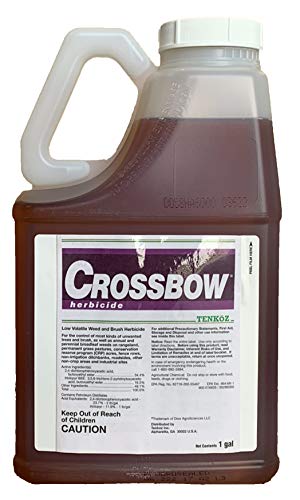
This Tenkoz formulation of Crossbow is a triclopyr and 2,4-D blend that sits at a lower 16.5% triclopyr concentration compared to the Garlon alternatives. Despite that, farmers and landowners swear by it for rapid knockdown of poison ivy, brush, and weeds in fence rows. Users report that it kills anything sprayed within one to two days, and the effect lasts for months — even up to two years in some cases. It eliminates the need to weed-whack first, saving significant labor.
The low triclopyr percentage is a limitation for very heavy woody brush and blackberries. One experienced reviewer had to supplement it with pure Garlon (61.6% triclopyr) to boost strength, noting that without the boost, the product works but takes much longer on tough species. It also has a strong chemical smell similar to other ester-based herbicides and is best applied on non-windy days to prevent drift.
For the price, this is a fast-acting general brush killer that is excellent for routine maintenance along fence lines. It is less suited for large-diameter tree stumps or extremely woody invasive species unless you are willing to mix in a higher-concentration additive.
What works
- Kills poison ivy and brush within 1-2 days of spraying.
- Long-lasting residual effect, up to 2 years.
- Highly recommended by farmers for fence-row maintenance.
What doesn’t
- Only 16.5% triclopyr; weaker on heavy woody brush.
- Strong chemical smell during and after application.
- May need a booster like Garlon for tough blackberries.
6. Albaugh Gly Star Plus Herbicide 2.5 Gal.

Gly Star Plus is a generic glyphosate concentrate that mirrors the active ingredient profile of Roundup Ultra, but with a crucial advantage: it already contains a fully loaded surfactant system. This means you do not need to buy and mix a separate surfactant, which saves both money and guesswork. Users report visible effects on annual weeds within 2-4 days and on perennial trees and brush within 7-14 days when mixed at 2.5 oz per gallon of water.
The 2.5-gallon jug provides a massive supply that will last a long time for most homeowners. However, there is a significant caveat: this product is not labeled for residential use and is intended solely for commercial applications. It also has geographic restrictions and is not for sale in California, Montana, Nevada, Oregon, Washington, or Wyoming. Safety is a serious concern — one reviewer warned about the risks of glyphosate exposure, stressing the need for boots, masks, gloves, and goggles.
If you have a large property and can legally purchase and apply commercial-grade herbicides, Gly Star Plus delivers outstanding value per gallon. The built-in surfactant ensures reliable adhesion to waxy leaves and bark, making it a dependable option for non-selective tree and vegetation control.
What works
- Built-in surfactant eliminates need for separate purchase.
- Excellent value — 2.5 gallons covers a huge area.
- Works as effectively as name-brand Roundup formulations.
What doesn’t
- Not labeled for residential use; commercial only.
- Banned for sale in several western states.
- Requires full safety gear and careful handling.
7. Crossbow Herbicide (Helena) 128oz

This Helena-branded Crossbow is a post-emergent triclopyr and 2,4-D ester blend that is rainfast in just two hours, making it ideal for unpredictable weather. It targets woody plants and brush such as blackberries and poison oak while leaving grasses unharmed — a key feature for pasture owners. A bulk 128 oz jug is cheaper per ounce than the same product at big-box stores, and users confirm the ingredients are identical.
Mix rate is typically 4 oz per gallon of water. Users report that it kills dandelions, chickweed, and wild violets in under a week, though one reviewer found it was only effective on low-growth brush and new stump sprouts; larger stumps required a few applications over the course of a year. There are no grazing restrictions for non-lactating dairy animals, and it can be applied with anything from a hand-held sprayer to a tractor-mounted rig.
For anyone needing a grass-safe brush killer that works fast and resists being washed away by rain, this Crossbow formulation is a reliable mid-range option. It will not scorch your lawn, but it may require repeated applications on established tree stumps.
What works
- Rainfast in just 2 hours for reliable application.
- Safe for grasses — kills brush without ruining pasture.
- Bulk jug offers significant savings over retail bottles.
What doesn’t
- May require multiple applications on large stumps.
- Less effective on very dense woody brush without re-treatment.
- Price is higher per gallon than some generic alternatives.
Hardware & Specs Guide
Glyphosate 41% vs Triclopyr 61.6%
The active ingredient concentration defines potency. A 41% glyphosate herbicide (like Gly Star Plus or Roundup Pro) provides broad-spectrum non-selective control suitable for general tree and weed killing. A 61.6% triclopyr concentrate (like ALLIGARE Agri Star) is specifically formulated for woody brush and tree stumps, offering superior penetration of bark and root systems for species like locust and multiflora rose.
Cut-Stump Application Method
For large trees, the cut-stump method is the most effective technique. Make a fresh horizontal cut within 30 minutes of applying the herbicide. Use full-strength (60%) triclopyr or a high-concentration glyphosate mix. This direct application ensures the chemical enters the vascular system immediately, preventing the stump from resprouting. Always apply within 30 minutes of cutting for maximum absorption.
FAQ
Can I use Roundup to kill a large tree?
What is the difference between Crossbow and Garlon for tree killing?
How long does it take for a tree to die after applying herbicide?
Final Thoughts: The Verdict
For most landowners and property managers, the herbicide for killing trees winner is the ALLIGARE Agri Star Triclopyr 4E because it delivers professional-grade 61.6% triclopyr concentration at a fraction of the brand-name cost, making cut-stump and basal bark treatments highly effective. If you want a low-odor option for pasture restoration, grab the Remedy Ultra. And for rapid, non-selective knockdown of large trees and stumps, nothing beats the Roundup Pro Herbicide.