
Nothing stops a leaf-blowing session faster than a battery that gives up halfway through the yard. When you’re up against wet leaves, stubborn gravel, or a long driveway, every amp-hour of capacity directly translates to real minutes of clearing power — and a dead battery means a dead afternoon.
I’m Rikta — the co-founder and writer behind Lawn Gear Lab. I’ve spent countless hours cross-referencing voltage platforms, comparing Ah ratings against real-world runtime feedback, and reading through thousands of owner reports to separate the packs that deliver steady power from the ones that sag under load.
Whether you need to revive an old 18V trimmer or double the runtime of your 40V blower, this guide walks you through the most reliable cordless leaf blower battery options and the specs that actually matter for real yard work.
How To Choose The Best Cordless Leaf Blower Battery
Selecting the right battery for your cordless leaf blower means matching voltage to your existing tool, picking a capacity that fits your yard size, and understanding the difference between OEM-style replacements and universal kits. Here’s what to look at before you buy.
Voltage Compatibility Is Non-Negotiable
A 20V battery won’t power a 40V blower, and a 40V pack won’t fit an 18V tool bay. Every battery here specifies its exact voltage platform — check your blower’s manual or existing battery label before ordering. Mixing voltages risks tool damage or complete incompatibility.
Capacity (Ah) Determines Real-World Runtime
Amp-hour (Ah) ratings tell you how long a battery can sustain a current draw. A 4.0Ah pack typically runs a medium-sized blower on high speed for 15–25 minutes; a 6.0Ah or 7.0Ah pack can push that to 30–45 minutes. If you’re clearing a half-acre lot, prioritize higher Ah numbers. If you’re tidying a patio, a 3.0Ah or 4.0Ah pack is plenty.
Replacement vs. Complete Kits
Pure replacement batteries (like the BATWAYPRO or Bonacell packs) assume you already own the charger and blower. Kits (like the SUNCHERS or PILENTO bundles) include their own tool, batteries, and charger — perfect if you need a new blower anyway. Know which path you’re on before clicking “add to cart.”
LED Indicators and Safety Protections
A battery that shows its remaining charge level (via 3 or 4 LEDs) saves you from guessing mid-job. Over-voltage, over-current, and over-temperature protection prevent the pack from damaging itself or your tool — especially important when running high-draw blowers on high speed for extended periods.
Quick Comparison
On smaller screens, swipe sideways to see the full table.
| Model | Category | Best For | Key Spec | Amazon |
|---|---|---|---|---|
| SUNCHERS 20V Blower Kit | Blower + Battery Kit | First-time cordless buyers | 2 x 3.0Ah / 650 CFM blower | Amazon |
| PILENTO 20V Blower Kit | Blower + Battery Kit | Medium yards needing runtime | 2 x 4.0Ah / 580 CFM blower | Amazon |
| Bonacell 40V 7.0Ah | Replacement Battery | 40V long-session clearing | 7.0Ah / 40V platform | Amazon |
| GERIT BATT 40V 6.0Ah | Replacement Battery | Reviving old Ryobi 40V tools | 6.0Ah / 40V platform | Amazon |
| Nicetoro 18V 5.0Ah (2-Pack) | Replacement Battery | Ryobi 18V ONE+ system users | 5.0Ah / 18V platform | Amazon |
| BATWAYPRO 20V 4.0Ah (2-Pack) | Replacement Battery | B&D 20V Max tool owners | 4.0Ah / 20V platform | Amazon |
| SnapFresh 20V 4.0Ah | Replacement Battery | SnapFresh tool owners only | 4.0Ah / Fast 110-min charge | Amazon |
In‑Depth Reviews
1. SUNCHERS 20V Cordless Blower Kit (2 x 3.0Ah)

This complete blower kit lands at the top because it bundles the tool, two 3.0Ah batteries, and a charger at a price that undercuts most battery-only replacements. The 650 CFM peak airflow and 280 MPH nozzle speed put it in serious contention with mid-range gas blowers, while the two-speed switch lets you drop to low for dusting patios or car interiors. Owners consistently report that both batteries arrive partially charged and deliver over 30 minutes of high-speed runtime combined — enough to clear a standard suburban yard without breaking stride.
The ergonomic rubber-coated handle and lightweight 5.5 lb total weight reduce fatigue noticeably during full-yard passes. The dual-tube design includes a standard nozzle for open areas and a more concentrated tube for targeting debris in flower beds or along fence lines. Assembly is tool-free and takes under a minute. A small number of users noted the battery latch feels tight initially, but that eases after a few insertion cycles. On wet leaves, the blower keeps up admirably, though truly soaked piles may still require a second pass.
Customer service responsiveness is a strong point: several owners who experienced defects reported replacements shipped within 48 hours. The kit is also O-ring sealed against dust ingress, so the battery contacts stay clean even when blasting gritty driveway debris. For someone entering the cordless leaf blower ecosystem without existing batteries, this kit delivers the best balance of power, runtime, and value on the list.
What works
- High 650 CFM airflow rivals gas blowers at this price tier
- Two included 3.0Ah batteries enable continuous swap-and-go work
- Lightweight build (5.5 lbs) reduces arm fatigue on long jobs
What doesn’t
- Battery removal can be stiff until the locking tabs break in
- Advertised 280 MPH speed feels overrated in real-world use
- Not powerful enough for deep wet leaf piles
2. PILENTO 20V Cordless Blower Kit (2 x 4.0Ah)
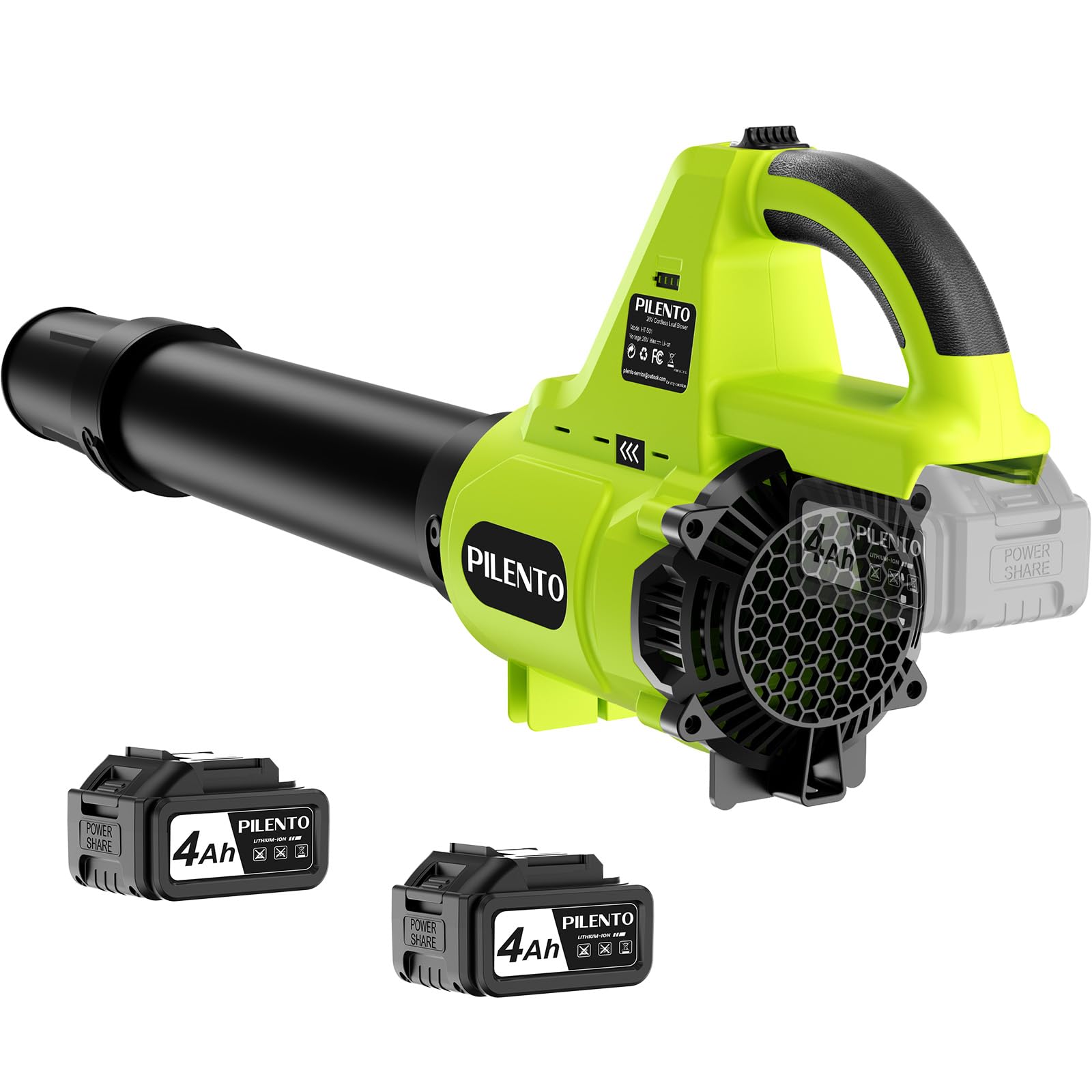
Where the SUNCHERS focuses on raw airflow, the PILENTO kit prioritizes extended runtime by packing two 4.0Ah batteries instead of 3.0Ah packs. That extra amp-hour per battery translates to roughly 40% more high-speed blow time per swap — expect about 30 minutes per battery on the highest of three speed settings. The 580 CFM and 180 MPH figures are a notch below the SUNCHERS, but the three-speed trigger gives you infinitely variable control between gentle sweeping and full-power clearing, which is genuinely useful when switching between a mulched flower bed and a gravel driveway.
The sliding rubber grip handle is a nice ergonomic touch; it lets you adjust hand position for balance without breaking your grip. Assembly is a true 5-second affair — snap the two-piece tube together, click in a battery, and flip the switch. The charger refills a dead 4.0Ah pack in about 2 hours, which is adequate for swapping between batteries on a full yard day. Owners highlight the quiet operation compared to gas blowers, making early-morning or evening use much more neighbor-friendly.
A unique behavior noted in owner reports: the batteries self-discharge noticeably if left unused for more than 24 hours, dropping about 10 minutes of runtime per day of storage. This means you should charge them the same day you plan to use them. On the positive side, the variable-speed trigger gives you fine control that fixed-speed blowers can’t match, and the 4.0Ah packs hold enough charge to handle wet leaves and small gravel mixed into grass without bogging down.
What works
- Two 4.0Ah batteries offer class-leading runtime for kit bundles
- Variable-speed trigger provides infinite control between light and heavy clearing
- Quiet enough for use without disturbing neighbors
What doesn’t
- Batteries self-discharge noticeably if not used within 24 hours of charging
- 580 CFM spec is lower than some competing budget blowers
- No battery level indicator on the tool itself
3. Bonacell 40V 7.0Ah Replacement Battery
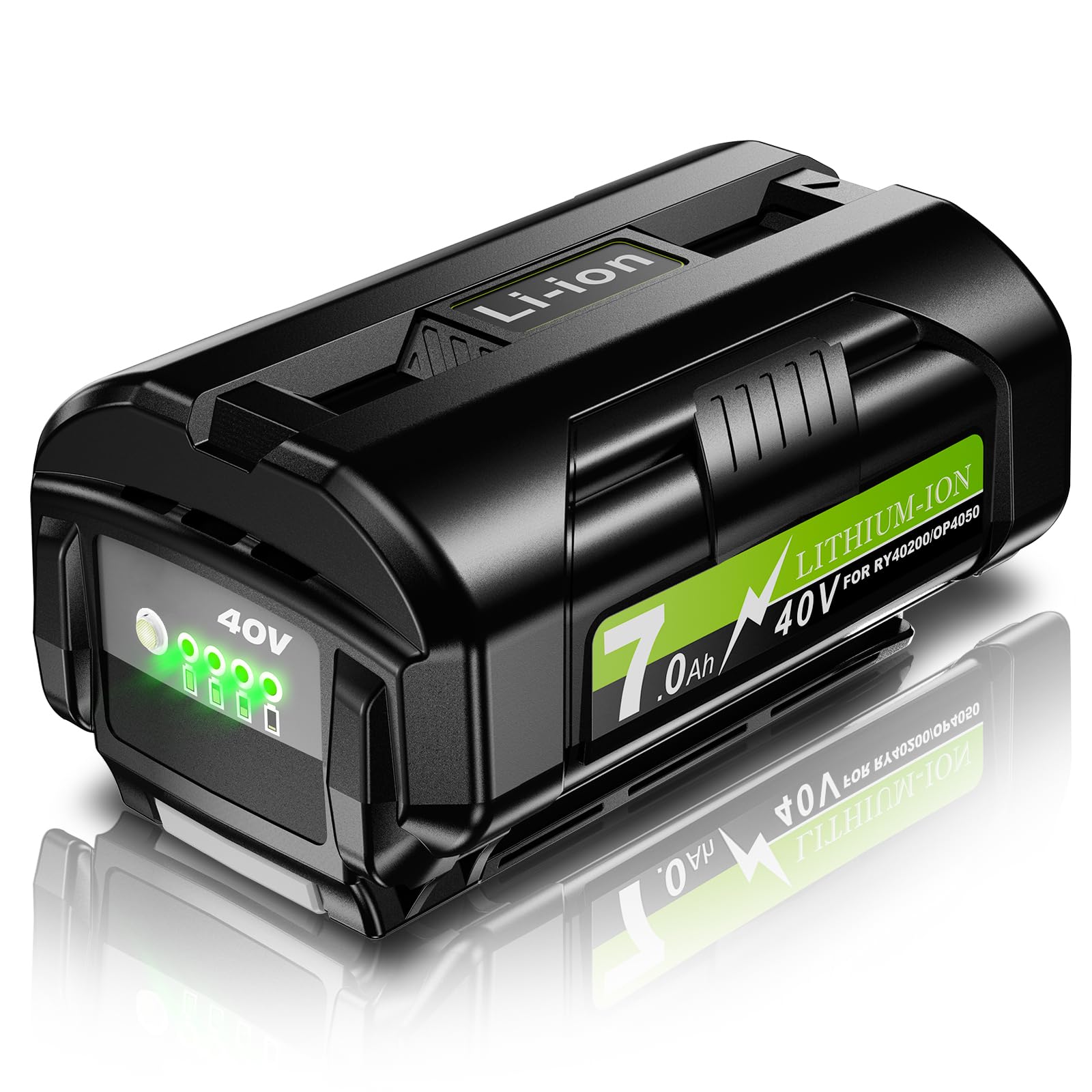
For Ryobi 40V platform users — especially those running power-hungry blowers like the RY40200 or RY40460 — the Bonacell 7.0Ah pack is a straight capacity upgrade over the typical 4.0Ah or 5.0Ah OEM battery. The 7.0Ah rating means roughly 75% more runtime at the same load, which is the difference between clearing a large lawn on one charge versus carrying a spare. The 40V system delivers higher torque to the blower motor, translating to sustained airspeed even as the battery drains toward empty. Four LED indicator lights give you precise remaining charge feedback, so there’s no guesswork about when to swap.
Build quality is a step above bargain-basement replacements: the casing uses a slightly thicker plastic that resists deformation under the heat of fast charging, and the internal BMS includes over-voltage, over-current, over-temperature, and short-circuit protection. A few owners noted that the battery body is marginally thicker than the original Ryobi pack, requiring a firm push to seat fully into the tool bay — but once seated, the fit is snug and wobble-free. The 240 watt-hour rating puts it in the high-capacity class, and the cells handle prolonged high-draw use without thermal throttling as long as ambient temps stay under 95°F.
Customer service responsiveness earns consistent praise: one reviewer received a defective unit that wouldn’t charge, and the seller shipped replacements immediately upon contact. The main tradeoff is that at 7.0Ah, this pack is heavier than a 4.0Ah equivalent — about 0.4 lbs more — which shifts the balance point on top-heavy blowers. But for anyone who values clearing a full property without stopping to swap batteries, the weight trade is more than worth it.
What works
- 7.0Ah capacity provides the longest runtime among 40V replacements in this guide
- Four-segment LED indicator gives precise charge status
- Robust BMS with multi-layer protection for safe operation
What doesn’t
- Thicker casing may require extra force to seat into tool bay
- Heavier than OEM packs, altering tool balance slightly
- No charger included; must have existing Ryobi 40V charger
4. GERIT BATT 40V 6.0Ah Replacement Battery
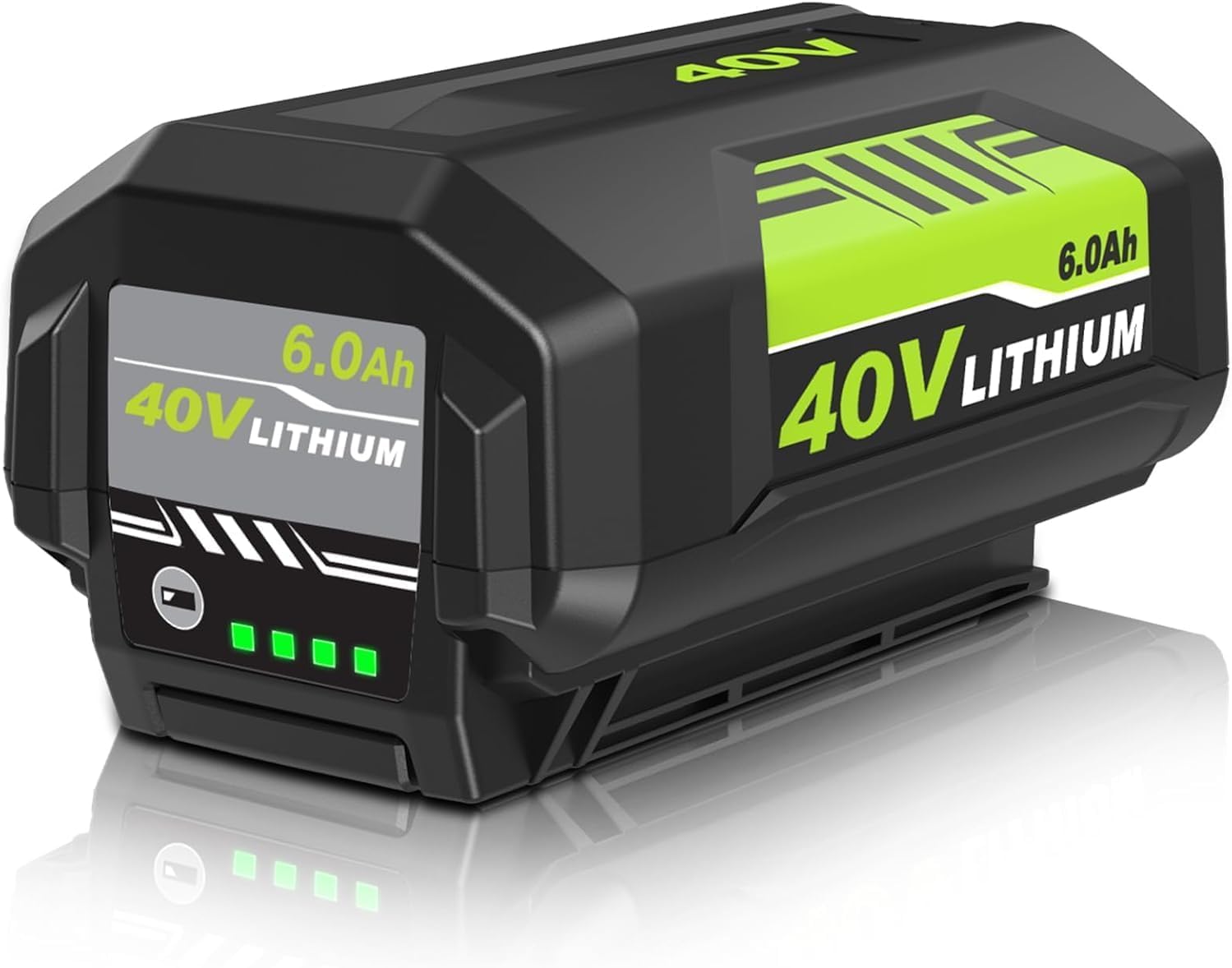
The GERIT BATT 6.0Ah pack sits one step below the Bonacell in capacity but also sits at a noticeably lower price, making it the ideal pick for Ryobi 40V owners who want extended runtime without paying for the highest-tier capacity. The 6000mAh rating doubles the runtime of a standard 3.0Ah OEM pack, so a blower that previously died after 12 minutes on high speed now runs for over 20 minutes. Four LED indicator lights mirror the OEM layout, and the pack slides into Ryobi 40V tools (OP4026, OP4050A, OP40601, and many others) without modification. The included lithium-ion cells support fast charging with no memory effect, so you can top off at any state of charge without degrading capacity.
Owner feedback is largely positive, with many users reporting that older Ryobi tools like the RY40202 blower and RY40403 mower “feel new again” after swapping in this battery. The weight is comparable to a standard Ryobi 4.0Ah pack, so balance isn’t adversely affected. The charger is not included, so you must have a Ryobi 40V charger on hand. A small but notable subset of owners reported the battery stopped charging after 5–6 months of use — the seller’s support team is reportedly responsive to replacements, but the failure rate is higher than with the Bonacell pack.
If you’re breathing life into a collection of 40V Ryobi tools and don’t want to invest heavily in brand-new batteries, this is the budget-conscious sweet spot. The 6.0Ah capacity gives you a meaningful runtime upgrade, and the price per amp-hour is among the best in the category. Just be prepared for the possibility of a warranty replacement claim within the first year.
What works
- Excellent price per amp-hour for the Ryobi 40V platform
- Doubles runtime of standard 3.0Ah OEM batteries
- Four LED indicators match OEM layout for easy charge reading
What doesn’t
- Some units fail to hold charge after 5–6 months of use
- No charger included; requires existing Ryobi 40V charger
- Customer support response varies in speed
5. Nicetoro 18V 5.0Ah (2-Pack) Replacement for Ryobi ONE+
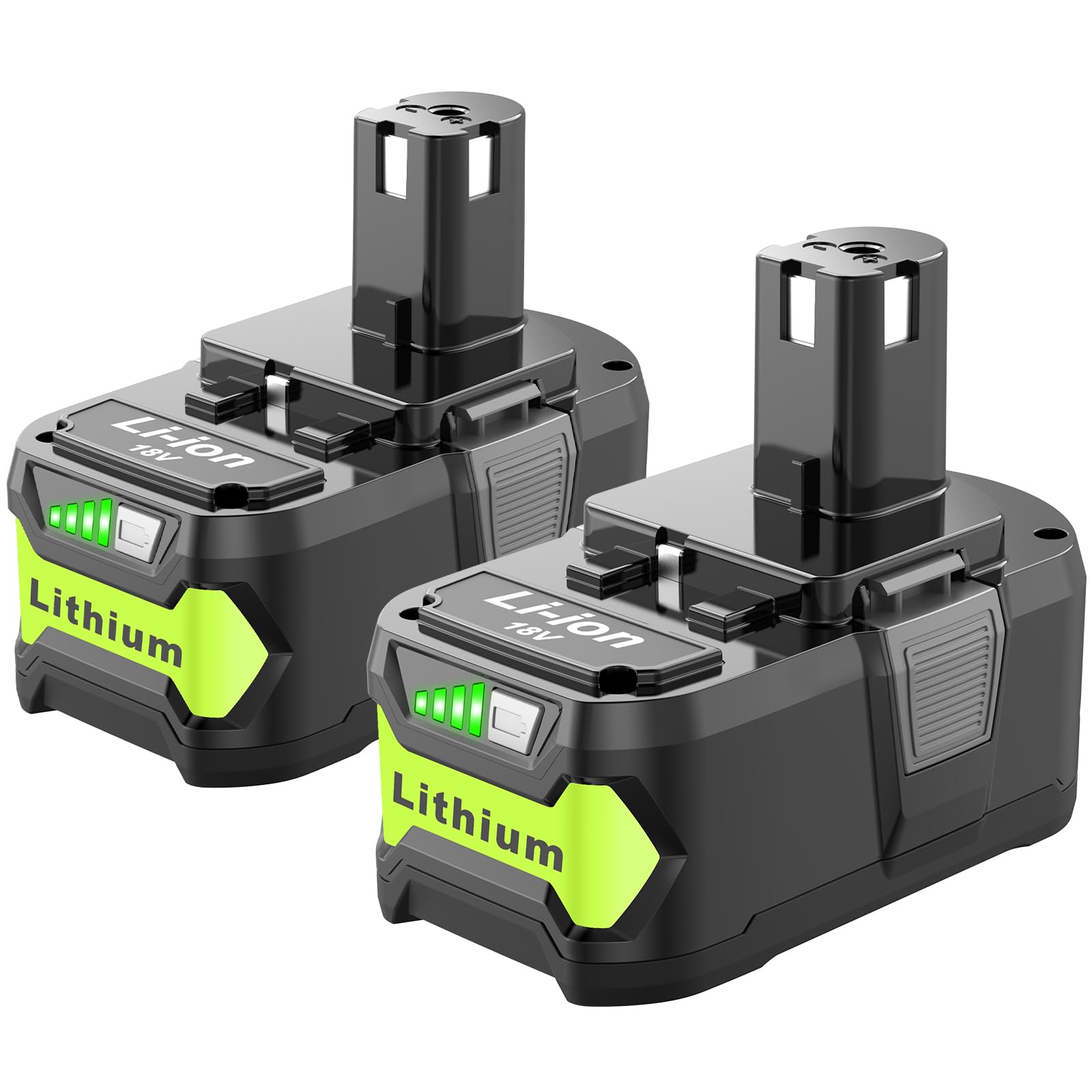
If you’re invested in the Ryobi 18V ONE+ system — which powers everything from leaf blowers (model PCL206B, PCL660B) to trimmers, drills, and chainsaws — the Nicetoro 5.0Ah 2-pack is the most cost-effective way to double your fleet’s runtime. Each 5.0Ah pack delivers about 40% more capacity than the standard 3.0Ah Ryobi battery, so a blower that previously ran 15 minutes on high now pushes past 20 minutes per pack. With two packs in the box, you effectively get 40+ minutes of continuous blow time with hot-swapping, which covers most residential lots without a single recharge pause.
The batteries fit all Ryobi 18V ONE+ chargers (models P118B, P117, PCG002) and tools using the classic slide-in interface. Owners consistently note that the Nicetoro packs charge quicker than Ryobi’s own P108 batteries — about 20% faster from empty to full. The casing is slightly bulkier than OEM, but the tight tolerance ensures no rattling during use. The integrated LED indicator uses four bars to show remaining charge, and the colors are slightly brighter than the Ryobi originals, making them easier to read in direct sunlight.
One buyer reported a charger overheating after five weeks of daily use; the seller immediately offered a replacement or refund, demonstrating strong post-purchase support. The main caveat is that these are 18V packs, so they won’t power higher-voltage tools (like 40V blowers or mowers). But for the massive installed base of Ryobi 18V ONE+ users, this 2-pack delivers the best price-to-capacity ratio in this guide.
What works
- Two 5.0Ah packs offer combined 10Ah capacity at a low per-pack cost
- Faster charging than comparable Ryobi OEM batteries
- Bright LED indicators are easy to read outdoors
What doesn’t
- 18V platform only; incompatible with 40V Ryobi tools
- Charger quality reported as inconsistent by some users
- Casing is slightly bulkier than OEM, increasing tool weight
6. BATWAYPRO 20V 4.0Ah (2-Pack) for Black+Decker
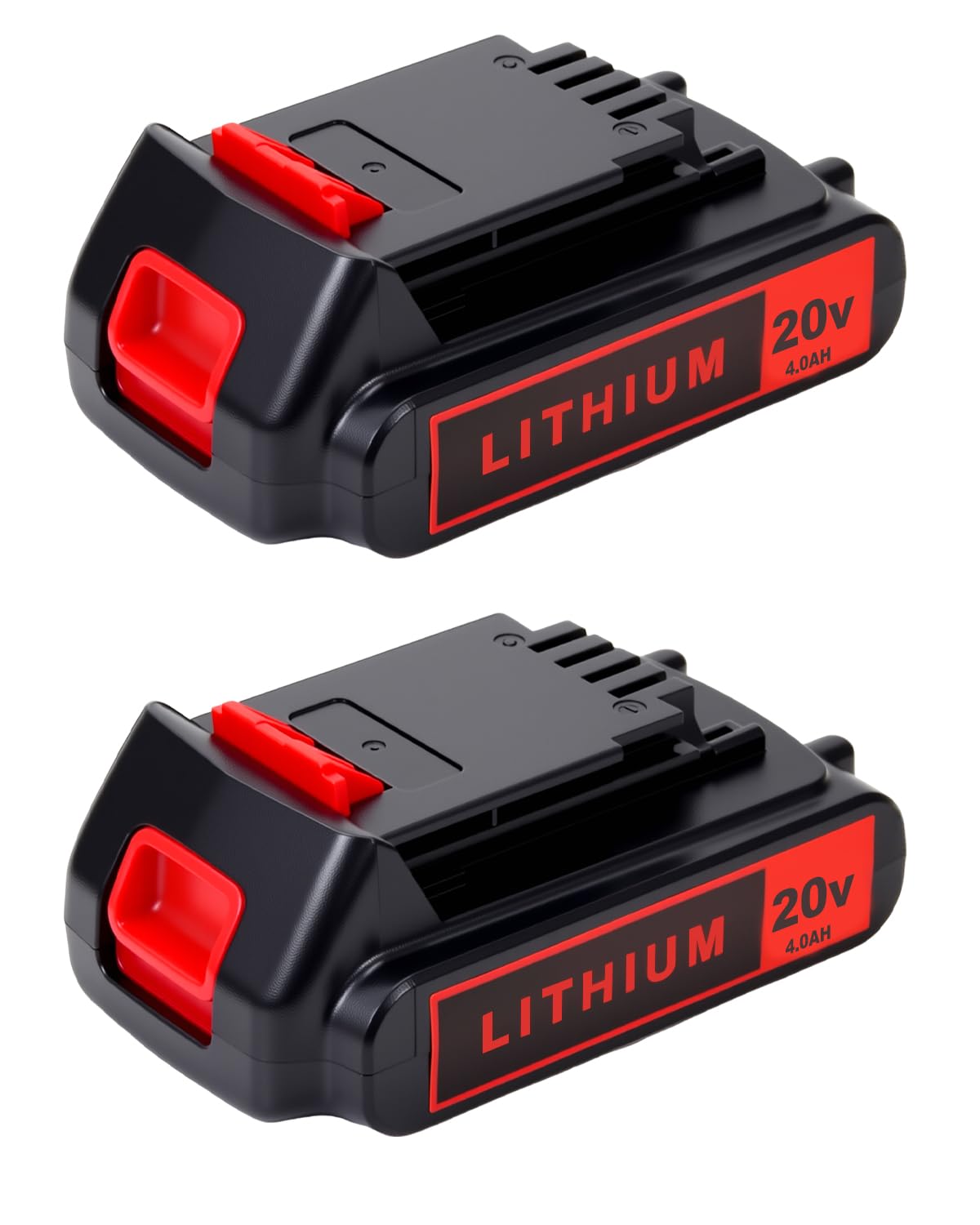
Black+Decker 20V Max owners — especially those with blower models like the LSW20 or LST220 — have long complained about the limited availability and high cost of OEM replacement packs. The BATWAYPRO 2-pack directly addresses both issues by pairing two 4.0Ah lithium-ion batteries at a per-pack price that undercuts the official LBXR20 replacement. Each pack uses high-quality cells with CE, FCC, and RoHS certification, and the built-in protection circuit guards against over-voltage, over-current, over-heat, and over-charge damage. The result is a drop-in replacement that matches OEM fit and often exceeds OEM runtime — the 4.0Ah rating is 33% higher than the standard 3.0Ah Black+Decker pack.
Compatibility is broad: these batteries work with all Black+Decker 20V Max tools and chargers, covering drills, blowers, hedge trimmers, weed eaters, sanders, and vacuums. Owners report that the packs charge quickly on the standard Black+Decker charger and hold consistent power through the full discharge cycle — no sudden drop-off when the bars get low. The weight is slightly higher than a 3.0Ah OEM pack (about 0.3 lbs more), but not enough to throw off tool balance. Several users specifically noted that these packs run longer than the original battery in their LBXR20-powered blower, a claim supported by the higher capacity rating.
The only functional complaint is that the battery unlock tabs feel a bit tighter than OEM, requiring more thumb pressure to release. But that also means the pack stays locked during high-vibration use. A 12-month warranty covers manufacturing defects, and the seller’s support team is responsive to inquiries. For Black+Decker owners looking to refresh a pile of dying 20V packs, this 2-pack is the most sensible financial move.
What works
- Two 4.0Ah packs cost less than a single OEM replacement from Black+Decker
- Higher capacity than standard 3.0Ah B&D packs provides 33% more runtime
- Broad compatibility with all B&D 20V Max tools and chargers
What doesn’t
- Unlock tabs stiffer than OEM, requiring more effort to release
- No battery level indicator on the pack itself
- Slightly heavier than comparable 3.0Ah OEM batteries
7. SnapFresh 20V 4.0Ah Battery (BBT-DC40A)
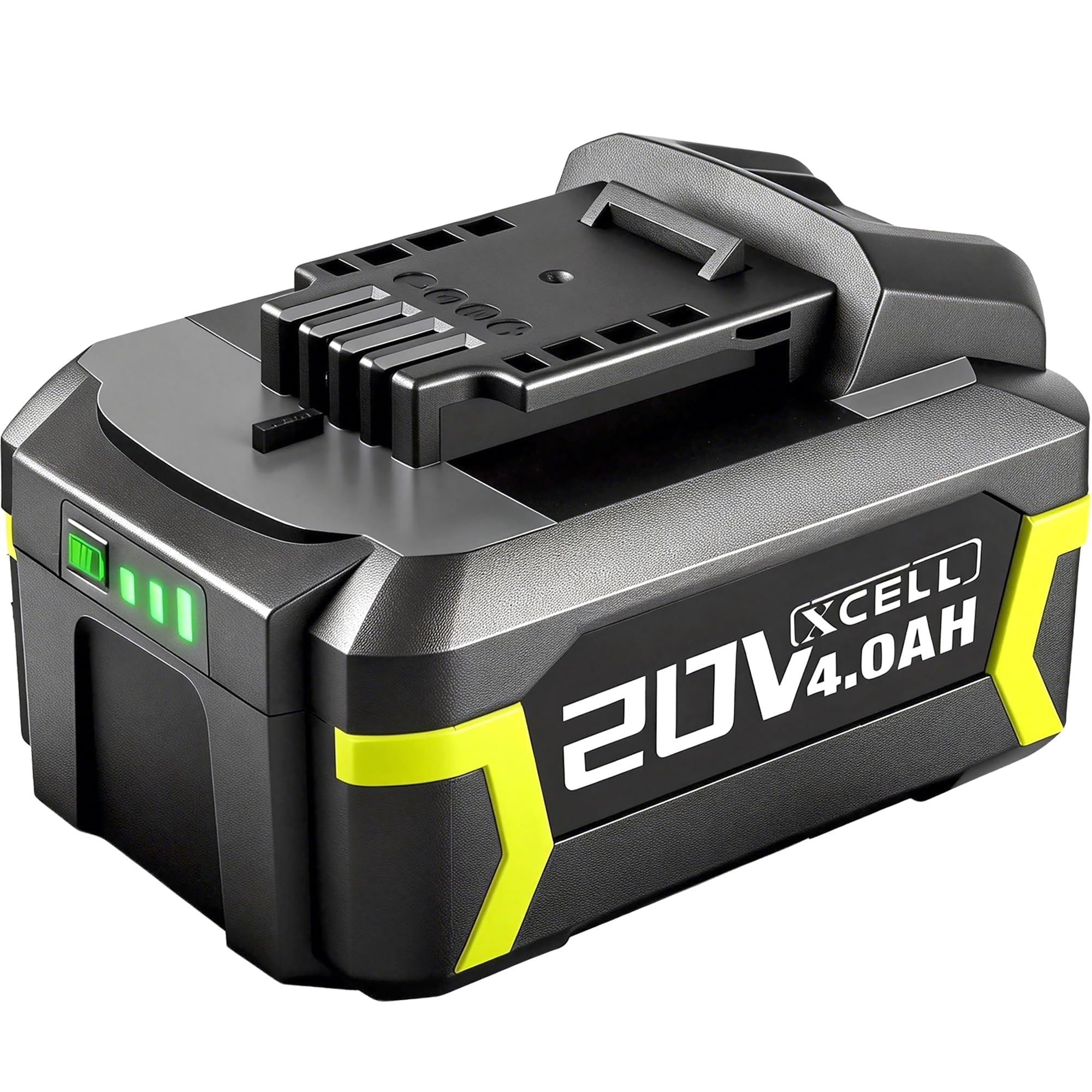
The SnapFresh BBT-DC40A is the only battery on this list that is strictly locked to a single brand’s ecosystem — it only works with SnapFresh 20V cordless tools and chargers. If you own a SnapFresh blower (like the BBT-YOR01 or BBT-ZE20BW01), this 4.0Ah pack is the official upgrade path from the 2.0Ah battery that typically ships with the tool. The 4.0Ah capacity effectively doubles the runtime, taking a SnapFresh blower from about 15 minutes of high-speed use to 30 minutes. The 3-LED fuel gauge gives a clear visual at a glance: three solid LEDs means fully charged; one blinking LED means under 25% remaining.
The standout feature is the fast charging capability: SnapFresh claims a 110-minute full charge from empty, and real-world owner tests confirm that a depleted pack reaches full capacity in about two hours. That’s roughly twice as fast as the standard SnapFresh charger, so you can actually recharge during a lunch break and get back to finishing the yard. The pack itself is compact and lightweight — about 1.0 lb — which doesn’t upset the balance of SnapFresh’s handheld blowers. Owners consistently praise the runtime extension vs. the included 2.0Ah battery, with many saying the upgrade made their blower “actually usable” for full-yard tasks.
The obvious limitation is the total lack of cross-compatibility: this battery won’t work with any other 20V tool brand (Black+Decker, Ryobi, DeWalt, etc.). If you ever leave the SnapFresh ecosystem, this battery becomes e-waste. But for SnapFresh owners committed to the platform, this 4.0Ah upgrade is the single most impactful accessory they can buy.
What works
- Doubles the runtime of SnapFresh’s standard 2.0Ah battery
- Fast 110-minute charge cycle minimizes downtime
- Compact and lightweight, preserving tool balance
What doesn’t
- Only compatible with SnapFresh 20V tools — no cross-brand use
- Higher price per amp-hour than third-party alternative packs
- Requires owning the SnapFresh tool platform to be useful
Hardware & Specs Guide
Amp-Hour (Ah) Capacity
Ah is the primary metric for runtime. A 4.0Ah battery stores 4 amp-hours of energy, which typically powers a 20V blower on high speed for 15–25 minutes. A 7.0Ah pack stores 75% more energy, pushing runtime past 30 minutes on the same load. The higher the Ah, the heavier and more expensive the pack, so match capacity to your yard size without overbuying.
Voltage Platform (18V, 20V, 40V)
Voltage determines the power ceiling for your tools. 18V and 20V packs are electrically identical (20V Max is the same nominal voltage as 18V under load) and suit handheld blowers, trimmers, and drills. 40V systems deliver higher torque for mowers, heavy blowers, and chain saws. Never mix voltages — a 20V battery cannot power a 40V tool.
BMS (Battery Management System)
Every quality lithium-ion pack includes a BMS that cuts power during over-current, over-voltage, over-temperature, and short-circuit events. This protects both the battery cells and your tool’s motor. Budget packs may omit or cheapen the BMS, leading to reduced lifespan or sudden failure under high load.
Charge Time and Charger Compatibility
Standard lithium-ion cells charge in 1–2 hours per pack. Fast-charging compatible packs (like the SnapFresh 4.0Ah) can refill in 110 minutes, while budget packs may take 2–3 hours. Always use the charger designed for your battery’s voltage and chemistry — mismatching can cause overheating or reduced cell life.
FAQ
Can I use a higher Ah battery than my blower came with?
Do third-party replacement batteries damage my leaf blower?
How many amp-hours do I need for a typical quarter-acre yard?
Why do some battery packs have LED indicators and others don’t?
Final Thoughts: The Verdict
For most gardeners, the cordless leaf blower battery winner is the Bonacell 40V 7.0Ah because it delivers the highest capacity on the 40V platform with reliable safety protections and strong build quality. If you need a complete blower-plus-battery setup, grab the SUNCHERS 20V kit for its exceptional airflow and two-battery system. And for the best value on the Ryobi 18V ONE+ platform, the Nicetoro 5.0Ah 2-pack gives you the most runtime per dollar spent.