
Canada thistle isn’t a typical broadleaf weed — it’s a perennial thug armed with an extensive, deep root system that laughs at surface-level spraying. Getting rid of it requires a systemic herbicide that translocates into the rhizomes to stop regrowth at the source. This guide breaks down the concentrated chemistry, active ingredients, and application strategies that actually kill Canada thistle down to the root.
I’m Rikta — the co-founder and writer behind Lawn Gear Lab. I’ve spent hundreds of hours comparing herbicide labels, analyzing active ingredient ratios like triclopyr, dicamba, and glyphosate concentrations, and cross-referencing real owner feedback to find the products that reliably stop deep-rooted perennials like Canada thistle.
After careful analysis of concentration levels, coverage area, and proven field results, I’ve narrowed the field to the most effective options you can buy. Here is my complete guide to the best herbicide for canada thistle available today.
How To Choose The Best Herbicide For Canada Thistle
Canada thistle (Cirsium arvense) spreads through a creeping root system that can extend 15 feet horizontally and 20 feet deep. A herbicide that only burns foliage without translocating down to the rhizomes will leave you spraying the same patch all season. Choosing the right product starts with one question: do you need selective grass-safe control or total vegetation elimination?
Active Ingredients That Reach the Root
The most reliable active ingredients for Canada thistle are triclopyr, dicamba, and high-concentration glyphosate (41% or higher). Triclopyr is the backbone of pasture and brush killer formulations — it moves systemically into the root mass of woody perennials. Dicamba, commonly paired with 2,4-D, offers excellent broadleaf activity in lawn-safe mixes. Glyphosate is non-selective but deadly when applied during the bud-to-flower stage, when the plant is pulling nutrients down into its roots.
Concentrate vs. Ready-to-Use
For Canada thistle, concentrates almost always outperform ready-to-use formulas. Concentrates let you adjust the mix ratio for hard-to-kill targets — many owners report success with double-strength mixes of 6 to 8 ounces per gallon on established thistle patches. A single 32-ounce bottle of concentrate can treat hundreds of square feet, making it more cost-effective over a growing season.
Timing Is Everything
Apply systemic herbicides in early fall when Canada thistle begins moving sugars from its foliage to its root system for winter storage. This natural root-directed flow carries the active ingredient deep into the rhizomes. Spring applications are less effective because the plant is sending energy upward. Regardless of the season, always apply when air temperatures are above 60°F and no rain is forecast for at least 24 hours.
Quick Comparison
On smaller screens, swipe sideways to see the full table.
| Model | Category | Best For | Key Spec | Amazon |
|---|---|---|---|---|
| Southern Ag Crossbow | Selective / Non-Selective | Thistle in pastures & fence lines | Triclopyr + 2,4-D blend | Amazon |
| Albaugh Gly Star Plus | Non-Selective | Total vegetation control on large areas | 41% glyphosate w/ surfactant | Amazon |
| Roundup Poison Ivy Plus | Tough Brush Killer | Thistle in mixed brush & poison ivy | Triclopyr + Fluazifop + Diquat | Amazon |
| Hi-Yield Killzall 365 | Non-Selective | Bare-ground & spot control | Glyphosate 43.68% + Imazapyr | Amazon |
| Ortho GroundClear Super Concentrate | Non-Selective | Paths, patios & driveways | Diquat + Fluazifop + Dicamba | Amazon |
In‑Depth Reviews
1. Southern Ag Crossbow Specialty Herbicide

Southern Ag Crossbow blends triclopyr (16.5%) and 2,4-D (34.4%) into a potent concentrate labeled for Canada thistle control in pastures and rangeland. Note that the EPA label lists Canada thistle for top-growth control — it knocks back foliage reliably at a 1% solution (about 1.3 ounces per gallon), but re-treatment is often necessary to keep the deep rhizomes from resprouting, so don’t expect a single application to finish the job.
This product is labeled for use on fence lines, pastures, rangeland, and rights-of-way where you want to keep desirable grass species alive. Crossbow is not a lawn weed killer for residential turf, but it excels when you need selective broadleaf control in larger spaces. One gallon makes up to 96 gallons of spray solution, covering over two acres at standard mix rates.
Owner reports confirm it annihilates creeping Charlie, poison ivy, wild blackberry, and multiflora rose alongside Canada thistle. A few users noted that efficacy drops if rain falls within 48 hours, so timing your application to a dry window is critical. The strong odor demands gloves and eye protection during mixing.
What works
- Selective for grass — won’t kill your pasture
- Label permits reseeding after a 3-week wait
- Covers over two acres per gallon
What doesn’t
- Strong chemical odor during mixing
- Label lists Canada thistle for top-growth control only — repeat treatment likely
2. Albaugh Gly Star Plus Herbicide

Albaugh Gly Star Plus delivers 41% glyphosate with a built-in surfactant system — the same active ingredient concentration as Roundup Ultra but at a fraction of the cost per gallon. For Canada thistle, the recommended approach is to apply a 2% to 3% solution (roughly 2.5 to 4 ounces per gallon) when the thistle is in the early bud stage. The surfactant helps the droplets adhere to the waxy thistle foliage, improving uptake.
Visible effects appear within 2 to 4 days on annual weeds, but the EPA label lists Canada thistle under weeds this product suppresses rather than fully controls — expect knockback and stunted regrowth, with a repeat application likely needed for season-long results on established patches. The 2.5-gallon jug treats a huge area, making this the most cost-effective option for landowners facing large-scale infestations. Gly Star Plus has no soil residual activity, so you can plant into treated areas almost immediately after the vegetation dies.
This product is not labeled for residential use, so it is meant for commercial farms, ranches, and industrial vegetation management. Users caution that proper PPE — boots, gloves, goggles, and a respirator — is non-negotiable given the high glyphosate concentration.
What works
- Exceptional value per gallon of concentrate
- Built-in surfactant improves leaf adhesion
- No soil residual — plant immediately after
What doesn’t
- Not for residential lawn application
- Label lists Canada thistle as suppressed, not fully controlled
3. Roundup Poison Ivy Plus Tough Brush Killer

Roundup Poison Ivy Plus combines triclopyr, fluazifop-P-butyl, and diquat dibromide for a double-action approach: diquat provides rapid desiccation of foliage within hours, while triclopyr moves systemically into the root system. This makes it one of the faster visible-result options for Canada thistle. Users spraying in residential fields, trails, and around building foundations report seeing wilt in 24 hours.
The formula is rainproof in 30 minutes, giving you a much shorter application window than most concentrates. It is labeled for use on woody stems, poison ivy, poison oak, kudzu, and wild blackberry — all of which share the same root-hardiness as Canada thistle. The hack-and-squirt method works well for large patches: cut the stem and spray directly into the wound.
The primary trade-off is the small bottle size. At 32 ounces, the concentrate treats roughly 1,500 square feet, which may require multiple bottles for heavy infestations. Owners who bought in bulk during sales found it worth stocking up.
What works
- Rainproof in 30 minutes
- Visible results within hours
- Effective on woody stems and brush
What doesn’t
- Small bottle covers limited area
- Higher cost per square foot than generic options
4. Hi-Yield Killzall 365

Hi-Yield Killzall 365 is a bare-ground total vegetation killer built on 43.68% glyphosate plus 0.78% imazapyr — not a lawn-safe selective product. The imazapyr component is what gives it season-long soil activity, and Canada thistle is explicitly listed on the EPA label as a controlled broadleaf weed. The label calls for a 6-ounce-per-gallon mix for spot control of brush, vines, and tough perennials.
This product is not for use on lawns. It is designed for fence rows, driveways, patios, and gravel areas where total vegetation elimination is the goal. One 32-ounce bottle treats up to 4,300 square feet at standard mix rates, making it one of the most coverage-efficient options in its size class.
Users note that stubborn weeds, including Canada thistle, may require a second application. Because the label states this product remains active in soil for up to a full year (heavier in clay soils), do not plan to replant treated ground on a “couple of months” timeline — budget for the full year the product name implies before seeding or landscaping there.
What works
- Covers up to 4,300 square feet per bottle
- Canada thistle is explicitly named on the EPA label
- Up to a full year of soil-residual control
What doesn’t
- Non-selective — kills everything, including turf and ornamentals
- Soil stays active for up to a year, so don’t replant sooner
5. Ortho GroundClear Super Concentrate
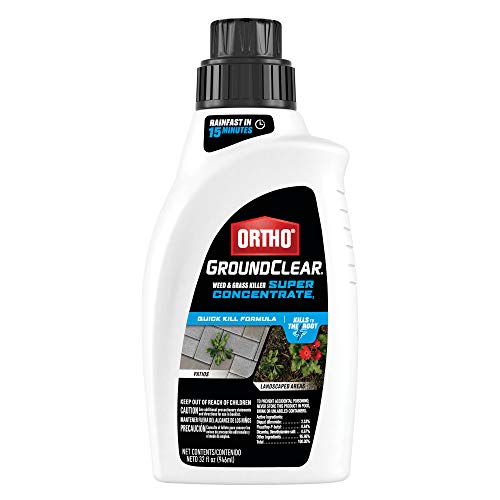
Ortho GroundClear Super Concentrate is a familiar residential weed killer, but its active ingredients are diquat dibromide (2.53%), fluazifop-P-butyl (0.84%), and a small amount of dicamba (0.67%) — not 2,4-D. Diquat gives it fast contact burn-down, fluazifop adds grass-selective activity, and the modest dicamba fraction provides some broadleaf systemic action. It works well on dandelion, clover, oxalis, and crabgrass, but Canada thistle’s deep rhizome system is a tougher target for a formula this light on systemic dicamba — established patches with deep rhizomes often survive the standard mix rate and need repeat spot treatment.
The formula starts working immediately and is rainfast in 15 minutes, which is the fastest rainproof claim in this comparison. It is safe to use around perennial landscape plants, trees, and shrubs when applied carefully, making it a decent choice for thistle growing in flower beds. One 32-ounce bottle treats up to 1,120 square feet at the standard dilution.
Multiple owners noted that they added extra concentrate to the mix for tough weeds, which reduced total coverage. Fluazifop and dicamba can both be more prone to volatilization and drift in hot weather, so application timing matters.
What works
- Rainfast in just 15 minutes
- Safe around established landscape plants
- Fast desiccation of foliage
What doesn’t
- Standard mix rate often underwhelms on mature thistle
- Only a small dicamba fraction (0.67%) for root-level activity
Hardware & Specs Guide
Active Ingredient Ratios
Canada thistle requires systemic active ingredients at specific concentrations. Triclopyr in the 2.5% to 16.5% range is common across brush and perennial weed formulas. 41% glyphosate is the benchmark for non-selective total kill, and imazapyr is often added to glyphosate blends for extended soil-residual control. Dicamba percentages vary widely between products — from under 1% in some residential blends up to several percent in dedicated pasture herbicides — so always check the label for the exact percentage; not all concentrates are equal, and the percentage on the label is the only number that matters.
Mixing Ratios per Gallon
For spot treatment of Canada thistle, most concentrates recommend 2 to 6 ounces per gallon of water. Higher rates are for dense brush or established patches. A surfactant (already included in many premium formulas) helps the droplets stick to the waxy thistle leaf surface. Without a surfactant, much of the spray beads up and rolls off before being absorbed.
FAQ
What is the best time of year to spray Canada thistle?
Can I use a broadleaf lawn weed killer on Canada thistle?
Final Thoughts: The Verdict
For most gardeners, the best herbicide for canada thistle winner is the Southern Ag Crossbow because it combines triclopyr and 2,4-D for reliable top-growth knockdown while remaining selective enough for pasture grasses — just plan on a repeat application for full control of established stands. If you want maximum value for large infestations, grab the Albaugh Gly Star Plus — the 2.5-gallon jug of 41% glyphosate covers acres without breaking the bank. And for fast visible results in mixed brush along fence lines, nothing beats the Roundup Poison Ivy Plus.