
Specs are compiled from manufacturer listings and verified buyer reviews and can change over time — please confirm the key details on the product page before buying.
Vegetables that get enough usable light stay short, sturdy, and deep green. Without it, seedlings stretch tall and pale, and you get weak stems that cannot support fruit. The number to watch is PAR (photosynthetically active radiation — the light your plants can actually use for growth), not just wattage. At the right distance from a good light, your basil, tomatoes, and peppers stay stocky and ready to move outdoors.
I’m Rikta — the founder and writer behind Lawn Gear Lab. This guide is built by comparing the manufacturers’ published specifications and the patterns across verified customer reviews, so you get each pick’s real strengths and trade-offs instead of marketing spin.
Whether you are starting seeds on a wire shelf or growing vegetables to full harvest indoors, the right grow lights for vegetables keep plants strong enough to support fruit instead of snapping.
How To Choose The Best Grow Lights For Vegetables
Vegetables need more intense light than houseplants. They require full-spectrum light (a blend of blue, red, and far-red wavelengths that mimics sunlight) for 12 to 16 hours a day to grow fruit or dense leaves. A weak light gives you pale, leggy seedlings and a poor harvest. Focus on these three things.
PAR Output & Coverage Area
PAR (photosynthetically active radiation) is the part of light your plants can actually use for photosynthesis. It is measured in µmol/m²/s (micromoles per square meter per second — a standard unit for plant-light intensity). A good vegetable light delivers at least 300-400 µmol/m²/s at the top of the canopy. Look for the manufacturer’s stated coverage at a specific height — “fits a 2×2 ft tent” or “works for a 3×3 ft tent” — and match it to your space.
Full Spectrum & Dimmability
Vegetables grow best under white “full spectrum” light that includes blue, red, and far-red wavelengths. Avoid old-style “blurple” fixtures (which only emit red and blue light) if you start seeds, because their purple glow hides nutrient problems and pest damage. A dimmer lets you lower the light for young seedlings and increase it for fruiting plants without moving the fixture.
Heat Management & Lifespan
LEDs run cooler than HID (high-intensity discharge) bulbs, but a fixture still needs a good aluminum heatsink (a metal plate that pulls heat away from the LEDs) to prevent overheating. Too much heat stunts vegetable growth. A lifespan of 50,000 hours or more means you will not replace the light every few seasons. Some budget panels claim 100,000 hours but may use lower-quality diodes.
Quick Comparison
On smaller screens, swipe sideways to see the full table.
| Model | Best For | Actual Power Draw | Coverage | Dimensions (L x W x H) | Amazon |
|---|---|---|---|---|---|
| VIPARSPECTRA XS1500 Pro | High PAR output for fruiting plants | 150W | 3×3 ft veg / 2×2 ft flower | 14.2″ x 11.4″ x 3.1″ | Amazon |
| Spider Farmer SF600 | Seedlings & leafy greens | 72W | 2×4 ft | 39.3″ x 5.9″ x 1.39″ | Amazon |
| MARS HYDRO TS1000 | All-stages veg & flower in 2×2 tent | 150W | 2.5×2.5 ft / max 3×3 ft | 14.2″ x 13.2″ x 1.4″ | Amazon |
| VIVOSUN LumaLight 200W | Smart-controlled larger tents | 200W | 2×4 ft / 3×3 ft | 23.5″ x 11.8″ x 2.95″ | Amazon |
| 2 Pack Uallhome 200W Panel | Budget-friendly 2-pack for shelves | 200W (total claimed) | 4×4 ft (claimed) | 12″ x 12″ x 1″ | Amazon |
In‑Depth Reviews
1. VIPARSPECTRA XS1500 Pro

The VIPARSPECTRA XS1500 Pro delivers the highest PAR output in this roundup, and reviewers confirm it pushes fruiting vegetables like peppers and tomatoes well.
The optical lenses (small plastic covers over each LED that focus light downward) mean you lose very little light to the sides. Buyers report PAR (usable light) of 747 µmol/m²/s at 50% power and 13 inches — well above the 300-400 needed for fruiting. Your chili plants get intense usable light right on the canopy, which drives dense buds and fruit instead of tall, weak stems. At 150 actual watts, it draws the same as the MARS HYDRO TS1000 but in a thicker rectangular case (14.2″ x 11.4″ x 3.1″) thanks to its larger heatsink (the metal plate that keeps the LEDs cool).
Unlike the Spider Farmer SF600’s slim 72-watt bar, this one has enough punch for flowering without needing a second unit. It also handles dimming and daisy chaining (connecting multiple lights) up to 20 units, so you can expand to a 4×2 ft tent later by pairing two. But at roughly 6 pounds, it is heavier than the 3-pound SF600, so your shelf or tent frame must hold it securely. Reviewers caution that the adjustable intensity can scorch seedlings if you crank it too high too soon — start around 50% at 18-24 inches for young starts and work up. For a mid-range price, you get a premium light engine with a plant-backed track record.
Where it shines
- Very high PAR output (747 at 50% / 13″) supports fruiting plants like peppers and tomatoes
- Optical lenses minimize light loss for uniform canopy penetration
- Dimmable and daisy-chainable up to 20 units for scalable setups
Keep an eye on
- Weight of roughly 6 lbs is heavier than slim bar lights
- Can scorch seedlings if set to full power too close
- No built-in timer or off switch
Reach for this if: You want to grow fruiting vegetables (hot peppers, tomatoes, beets) under a single quality panel that delivers high PAR without breaking into true premium pricing.
Look elsewhere if: You only need a very low-power light for seed starting on a shelf — a smaller bar like the SF600 may be simpler and lighter.
2. Spider Farmer SF600

The Spider Farmer SF600 gives you even coverage over 2×4 ft with only 72 watts, making it the smart choice for seed starting and leafy greens.
If your goal is starting vegetable seedlings or growing lettuce, kale, and spinach — not powering dense tomato fruits — this is the most watt-for-dollar pick. It draws just 72 watts but outputs 11,000 lumens (a measure of total visible light) across its 39.3-inch length. That yields roughly 400 PAR (usable light) at 12 inches, according to buyers, which is solid for leafy greens and seedling stages of peppers and tomatoes. The bar shape covers a full 2×4 ft shelf or tent in one run, a much wider spread than the square 14-inch panels from MARS HYDRO or VIPARSPECTRA.
Spider Farmer uses LEDs with a coating that resists moisture and vulcanization (chemical corrosion), and they back the unit with a 5-year warranty and a 50,000-hour lifespan claim. That is half the 100,000-hour claim of the Uallhome panels, but real-world reliability tends to be higher with a known brand. The 3-pound unit stays cool — owners mention the surface temperature stays below 80°F even after hours of use, so you can place it close to tender seedlings without heat stress. But the 72-watt output is lower than the 150-watt VIPARSPECTRA or MARS HYDRO, so your fruit density on full-size tomato or pepper plants may suffer more than with those more powerful lights. One more catch: there is no built-in dimmer, so you need an external timer (sold separately) for reliable 12-16 hour cycles.
Strengths
- Wide 39.3-inch bar covers a full 2×4 ft shelf or tent in one run
- Low 72W draw keeps electricity costs very low
- Runs cool (surface temp below 80°F) — safe close to seedlings
Limitations
- 72W output is less than 150W competitors for heavy flowering
- No built-in dimmer (requires external timer for on/off cycles)
- Touch controller not included — app not needed but no in-unit dimming
Ideal for: Seed starting, lettuce, kale, and other leafy greens where even canopy coverage and low heat are more important than high PAR for flowering.
Not ideal for: Growers intending to push pepper or tomato plants through a full bloom-to-harvest cycle — the output is modest for fruiting stages.
3. MARS HYDRO TS1000

Real-world harvest numbers back the MARS HYDRO TS1000 — one reviewer noted 9.6 ounces of dry herb from 4 plants under this 150W panel.
The 14.2 x 13.2 inch footprint makes it a square 150W workhorse that fits a 2×2 or 3×3 tent. It uses 354 surface-mounted diodes (SMD — chips mounted directly on the circuit board) and a patented white reflector that the brand says boosts light utilization by 25% compared to older designs. More of the light bounces onto your plants rather than washing the tent walls. The single most concrete data point from reviews: a buyer reported a final harvest of 9.6 ounces from 4 plants, or roughly 2-2.5 ounces each, under this light in a 3×3 tent. That is a real benchmark for home vegetable growers.
The 120° beam angle is similar to the competition, but 150W of SMD technology replaces a 250W HPS (high-pressure sodium) bulb while using less energy. Customers note the fixture runs silent with no fan noise, which matters if your vegetable setup is in a living space. However, at 1.4 inches thick, it is the thinnest of the 150W panels (the VIPARSPECTRA is 3.1 inches thick), meaning a smaller heatsink. Some buyers mention the surface gets warm during extended runs — in a small 2×2 tent, you may need to run it at 75% power to avoid heat stress on seedlings. Still, for the cost per harvest, it is tough to top.
High points
- Real-world yield of 9.6oz from 4 plants reported by verified buyer
- Patented reflector boosts light utilization by 25%
- Fanless, silent operation
Considerations
- Runs warmer than slim bar lights; may need power reduction in small tents
- At 14.2 x 13.2 inches, coverage is more square than wide
- External driver adds slight weight imbalance
Best for: Growers in a 2×2 or 3×3 tent wanting a proven 150W yield with dimming flexibility and daisy chain for expansion.
Skip if: You need a wide bar for a 4-foot shelf — the square shape is tighter than the SF600’s 39-inch bar.
4. VIVOSUN LumaLight 200W
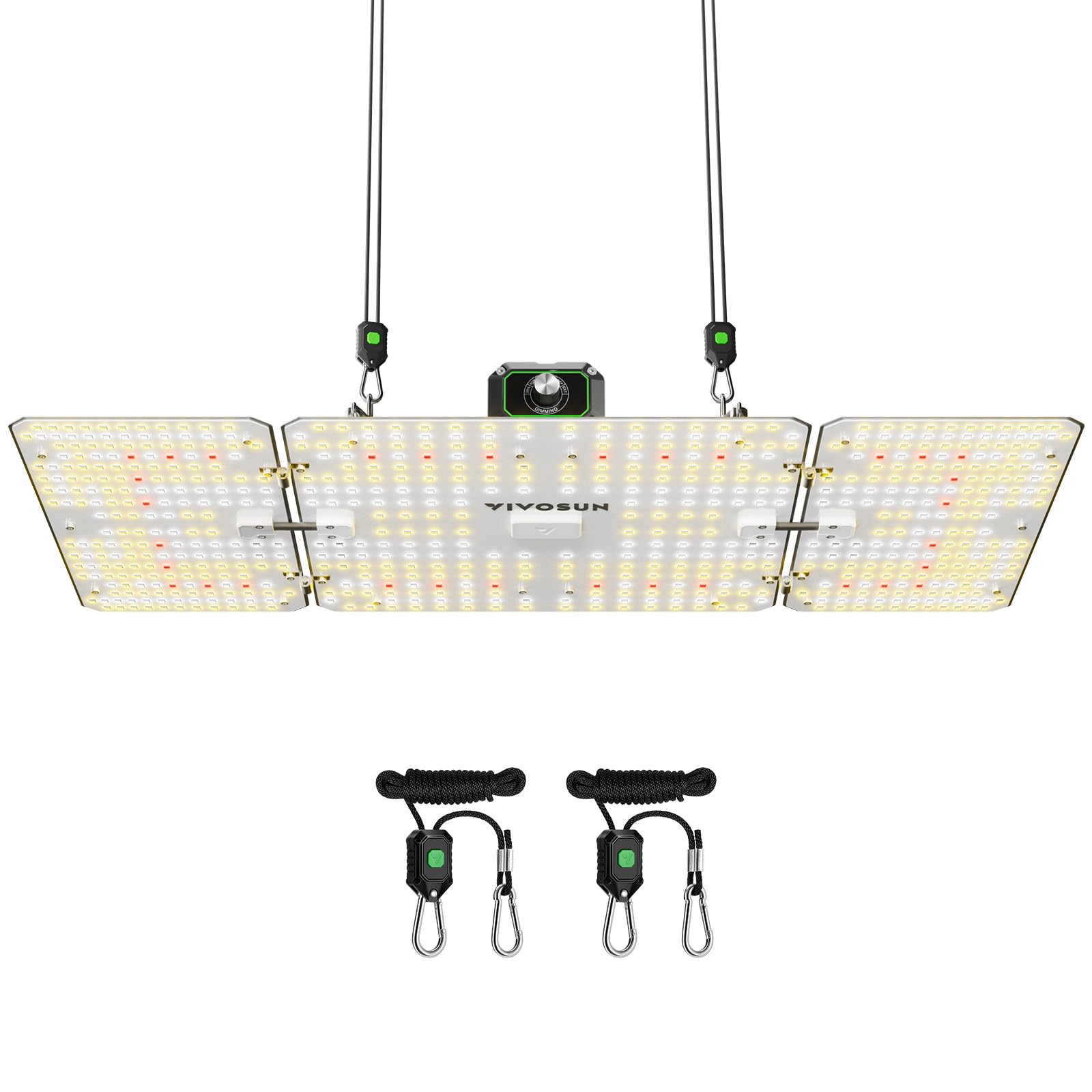
The VIVOSUN LumaLight 200W is the only pick with an IP65 waterproof rating and app control — built for serious 2×4 or 3×3 tent setups.
This is the premium pick for vegetable growers who want smart automation and a larger coverage area in a single fixture. At 23.5 x 11.8 inches, it is a long panel delivering 200W of power — the highest wattage in this roundup — with white, blue, red, and far-red LEDs (3000K, 5000K, 660nm, and 730nm) for true full spectrum from seedling to harvest. The IP65 rating means it is protected against dust and low-pressure water jets, so you can spray water or nutrients directly on it without damaging the electronics — a real advantage in high-humidity vegetable rooms where other fixtures risk corrosion.
Where it truly separates from the VIPARSPECTRA and MARS HYDRO is the smart dimming. Those units have manual knobs, but the VIVOSUN works with the Vivosun GrowHub (sold separately) and a mobile app to automate light schedules and adjust intensity from 25% to 100% across 4 levels. For a vegetable grower running 12-16 hour cycles daily, that automation simplifies your routine. The Q90 flux maintenance rate of up to 36,000 hours means the light stays at 90% of its original brightness for years. Even at 25% power, reviewers point out it lights up the whole house, and 100% is “too bright for a room.” The fixture also weighs 9 pounds — three times the SF600 — so your tent frame or shelf needs to be sturdy. For a single 10×20 tray, some reviewers felt it was overkill and too expensive; this light fits when you want to cover a full 2×4 or 3×3 tent with vegetables in later bloom stages.
Advantages
- 200W actual draw — highest in this list for dense, full-canopy vegetable flowering
- IP65 waterproof/dustproof for safe cleaning in wet tent environments
- Smart app control with GrowHub enables automated light schedules
Drawbacks
- 9 lb weight requires sturdy mounting; heavier than all other picks
- Could be excessive brightness for small shelves or single-tray setups
- Short power cord length noted by buyers as inconvenient
Choose this for: A dedicated 2×4 or 3×3 tent where you want high-wattage output, smart automation, and the ability to hose down the fixture without worry.
Pass if: You are working with a small wire shelf or a single tray — the brightness and bulk are unnecessary for small-scale seed starting.
5. 2 Pack Uallhome 200W Panel

For less than the cost of a single premium light, you get two full-spectrum panels from Uallhome to cover a 4×4 ft area.
If you are starting seedlings on a tight budget or need to cover multiple small trays, this 2-pack is the most wallet-friendly entry point. Each panel claims 200W equivalent with UV, IR, red, and blue LEDs covering basic veg and bloom stages. The panels are just 1 inch thick and lightweight, so you can hang them easily on a wire shelf with the included kit and 6-foot power cord. Shoppers say they are “great for tropical plants” and that a “variegated monstera grew new leaf in a week,” confirming adequate light for general indoor gardening.
The standout claim is 100,000 hours of lifespan — double the 50,000-hour rating of the Spider Farmer SF600. Keep in mind that Uallhome is a less established brand than Spider Farmer, MARS HYDRO, or VIVOSUN, so real-world diode degradation may vary. The panels use an E27 bulb base and a simple push-button controller with no dimming or timer. For starting greens and herbs in 3-inch trays, the output is enough, but you will not get the PAR density of the 150W units for fruiting plants. The hanging hardware is basic, and the cord weight can pull the panel off-angle, according to reviews. The lack of a timer means you need an external outlet timer (sold separately) for consistent 12-16 hour cycles. But for sheer value per dollar, you get two full-spectrum panels that the brand says cover a 4×4 ft area, making this a solid no-regret entry for a first-time vegetable grower.
Value wins
- Two panels for a very low entry price — covers more area than a single unit
- Ultra-thin 1-inch profile fits tight shelf gaps
- Long 100,000-hour lifespan claim reduces long-term replacement worry
Compromises
- No dimming or timer — requires external timer for reliable veggie cycles
- Lower PAR output than 150W units — not ideal for heavy fruiting
- Hanging hardware is basic; cord weight can pull the panel off-angle
Grab this when: Budget is the primary concern and you need to start seeds or grow herbs and greens under multiple shelves without spending much.
Skip when: You expect to grow tomatoes, peppers, or other fruiting vegetables to harvest — the PAR is too low for dense flower and fruit production.
Understanding the Specs
PAR (Photosynthetically Active Radiation)
PAR is the light your plant can actually use for photosynthesis, measured in µmol/m²/s (micromoles per square meter per second — a standard unit of plant-light intensity). For vegetables, aim for at least 300-400 µmol/m²/s for healthy growth and 500+ for fruiting. Compare PAR values at a set distance — a light listed as “747 at 13 inches” is much more intense than one at “400 at 12 inches.” More PAR means denser leaves and more fruit.
Actual Draw Wattage
This is the real power the light pulls from the wall, not the “equivalent” wattage. A light claiming “200W equivalent” may only draw 72W. Actual wattage matters because it determines electricity cost and heat output. For a 2×2 tent, 100-150W actual is adequate. For a 2×4 tent, 150-200W actual is better. Higher actual wattage generally means higher PAR output.
FAQ
What is the best light distance for vegetable seedlings?
Can I use a regular LED bulb instead of a grow light for vegetables?
How many hours per day should I run a grow light for vegetables?
What is the difference between full spectrum and blurple lights?
How do I know if my vegetable seedlings are getting enough light?
Will a 150W grow light work for a 3×3 ft tent?
What does IP65 waterproof rating mean for a grow light?
How long should a vegetable grow light last before replacement?
Do I need a dimmable grow light for vegetables?
Can I connect multiple grow lights together?
Final Thoughts: The Verdict
For the majority of shoppers, the best grow lights for vegetables is the VIPARSPECTRA XS1500 Pro because it delivers the highest verified PAR output in a compact, dimmable panel that supports both seedlings and heavy fruiting without breaking budget. If you want an easy wide-coverage bar for seed starting and leafy greens, grab the Spider Farmer SF600. And for a fully automated, waterproof 200-watt system in a 2×4 tent, the VIVOSUN LumaLight 200W is the most powerful and feature-rich option here.
How We Picked
We do not accept paid placement, and we did not hands-on test every unit. Instead, we match each pick to a real buyer and use-case by comparing the manufacturers’ published specifications against the patterns in verified customer reviews — so you get each pick’s real strengths and trade-offs instead of marketing copy.
Sources & Methodology
Specifications: manufacturer listings and product documentation. Review insights: verified customer reviews, as of July 2026. Pricing: not shown on this page (it changes often); check the current price via the retailer link.
As an Amazon Associate, Lawn Gear Lab earns from qualifying purchases. This does not affect which products we feature.