
Specs are compiled from manufacturer listings and verified buyer reviews and can change over time — please confirm the key details on the product page before buying.
You’re going out of town, or maybe your mornings are just too full to water a dozen thirsty plants one by one. The real question isn’t whether an auto watering pump saves you time — it’s which one delivers water evenly without flooding your ferns or leaving your succulents bone dry. The best models use simple dials or a phone app to keep plants thriving while you sleep, work, or travel.
I’m Rikta — the founder and writer behind Lawn Gear Lab. This guide is built by comparing the manufacturers’ published specifications and the patterns across verified customer reviews, so you get each pick’s real strengths and trade-offs instead of marketing spin.
The right auto water pump for plants eliminates daily watering chores and the risk of forgetting, whether you have one orchid or a balcony full of vegetables. With options that run on batteries, solar power, or Wi-Fi, the key is matching the features to your actual plant setup and how long you leave home.
Quick Picks
- LetPot Automatic Watering System for Potted Plants — Best Overall
- VIVOSUN Professional Automatic Drip Irrigation Kit — Top Performer
- RAINPOINT Large Display Automatic Plant Waterer Indoor (IK153) — Premium Pick
- Moistenland Automatic Watering System (WPS015) — Best Value
- RAINPOINT Easy-Setup Automatic Plant Waterer Indoor (ITP159) — Compact Pick
- HEKIWAY Solar Drip Irrigation System — Best for Travel
How To Choose The Best Auto Water Pump For Plants
Every auto watering system pumps water from a bucket or reservoir through tubes to your plants on a schedule. But the details determine whether your plants thrive or you come home to a mess. Here are the specs that separate a reliable system from a headache.
Hose length and the number of plants
The total hose length tells you how far you can reach from the pump to your farthest pot. A 32-foot hose is plenty for a shelf of houseplants against a wall, but a 49-foot hose is better for a long balcony or a grow tent in a garage. You also need enough drip emitters; most kits support watering 10 to 15 pots right from the start. If you have more plants, check whether you can buy extra tubing and emitters separately.
Timer simplicity vs. app control
Some pumps use two simple dials you twist by hand — one for how often to water (every 6 hours to 14 days) and one for how long each watering lasts (15 seconds to 20 minutes). These are straightforward and never need Wi-Fi. On the other hand, an app-controlled pump lets you set multiple schedules, adjust watering while you are on vacation, and get low-water alerts. The trade-off is that the app requires a stable Wi-Fi connection and a bit of initial setup.
Anti-siphon valves and water level
A siphon effect happens when the pump stops but water keeps flowing out of the tubes because the bucket sits higher than the plants. This can drain an entire reservoir overnight. An anti-siphon valve or a specific instruction to keep the bucket below the plants prevents this. Always check if a system includes an anti-siphon feature or if you must position the pump lower than the plants.
Power source: batteries, USB, or solar
Battery-powered pumps are the most common and are portable, but you need to replace or recharge the batteries every few weeks or months depending on how often the pump runs. Solar-powered systems charge a battery during the day and run the pump automatically, which is great for outdoor gardens with direct sun. Some pumps also accept a USB-C charger, which gives you the flexibility of a wall plug or a portable power bank.
Quick Comparison
On smaller screens, swipe sideways to see the full table.
| Model | Best For | Hose Length | Max Plants | Power Source | Amazon |
|---|---|---|---|---|---|
| LetPot Automatic Watering System | Smart control via Wi-Fi app | 33 ft (10 meters) | 10-20 pots | Plug-in (adapter) | Amazon |
| VIVOSUN Professional Drip Irrigation Kit | Grow tents & serious hobbyists | N/A | 8 pots | Plug-in (15W pump) | Amazon |
| RAINPOINT Large Display | Multiple pots with Cycle & Soak | Included (main + branch lines) | 10-15 pots | Battery (rechargeable) | Amazon |
| Moistenland Automatic Watering System | Budget-friendly USB/Battery option | 33 Feet | 15 pots | Battery & USB-C | Amazon |
| HEKIWAY Solar Drip Irrigation | Off-grid outdoor gardens | 49 ft (15 meters) | 15 pots | Solar + Type-C | Amazon |
| RAINPOINT Easy-Setup | Simple dials, beginner-friendly | 32.81 Feet | 10-15 plants | Battery & Plug-in | Amazon |
In‑Depth Reviews
1. LetPot Automatic Watering System for Potted Plants

The Wi-Fi system that lets you tweak watering schedules from your phone, anywhere.
You get remote control from your phone with the LetPot — the only pump here that pairs directly with a smartphone app. You can set up to 5 separate watering tasks, switch between intermittent or continuous drip, and receive a low-water alert before your plants go thirsty. It supports 10 to 20 pots from a single unit using its 10-meter (33-foot) water pipe. The upgraded 2.0 chip (the processor that manages Wi-Fi) keeps the connection stable, and the anti-backflow valve (a one-way valve) stops the siphon effect that can drain your reservoir.
Buyers report the pump is impressively quiet — one reviewer called it a “silent water pump” that works without disturbing a bedroom or living space. The included drippers let you adjust flow per pot, which is handy when you have a thirsty fern next to a succulent that barely needs a sip. The one trade-off: the tubing is stiff straight from the start and tends to hold its coil shape, making it tricky to position drippers exactly where you want them. Soaking the hose in warm water above 70 degrees Celsius before installation helps it bend more easily. If you want remote control and the confidence of app alerts, this is the most versatile system in the guide — but if you prefer a pump that works right from the start without any prep, you might find the stiff tubing frustrating.
Smart gardener’s choice: The LetPot wins on control and quiet operation — ideal for anyone who wants to dial in watering from a phone and hates noisy pumps.
Reach for this if: you want Wi-Fi scheduling, per-plant flow adjustment, and a pump that won’t wake the baby.
Look elsewhere if: you’d rather avoid an app and just twist a dial.
2. VIVOSUN Professional Automatic Drip Irrigation Kit

A powerful submersible pump built for serious growers using grow tents or multiple mediums.
The VIVOSUN kit is a step up in muscle — its 15W submersible pump delivers a maximum flow of 1000L/H, which is enough to irrigate 8 pots of soil, rockwool, coco coir, or clay pebbles. The noise level stays low at 30-40dB, so it won’t announce itself in a grow tent or indoor garden room. It supports up to 20 programmable irrigation sets, with both manual and automatic modes you can switch between. One reviewer noted that the pump cycles on for 2 minutes every hour reliably, which works well for typical feeding schedules.
Buyers strongly advise using the included drilling tool to poke a hole at the top of the bucket — this prevents the siphoning issue that causes leaks. However, real user reports also flag a weak point: one review found that only 5 of 8 irrigation lines had flow straight from the start, and after a month, only 2 nozzles were delivering water due to defective injection-molded splitters. While many reviews are glowing, this inconsistency means you should test every emitter before relying on the system for a long trip. It beats simpler dial-based pumps on raw pumping power and programmability, making it a strong pick for the hobbyist who wants precise nutrient delivery — but if you need every line to work reliably from day one, you may want to check each splitter carefully before a long trip.
Where it shines
- 1000L/H flow rate — enough to feed 8 pots of demanding plants.
- Low noise (30-40dB) won’t disturb a quiet grow room or living space.
- Supports 20 programmable irrigation sets for precise feeding schedules.
Watch out for
- Multiple reviews cite defective splitters that cause uneven or zero flow.
- Only 8-drip-emitter capacity — fewer than most other kits.
Go for it if: you need a high-flow pump for a grow tent and are comfortable checking each emitter before trusting the system.
Skip it if: you want a larger kit — 8 pots versus 15 pots on some competing kits.
3. RAINPOINT Large Display Automatic Plant Waterer Indoor (IK153)
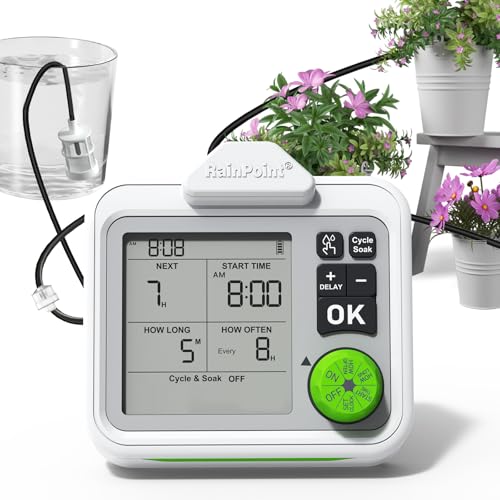
A large LCD screen shows your next watering time, so you never second-guess the schedule.
This RAINPOINT model stands out because of its Cycle & Soak mode — when you set a watering duration longer than 2 minutes, it breaks that time into shorter cycles with pauses in between. This helps water soak into the soil instead of running off the surface, which is especially useful for pots with dry or compacted mix. The large LCD displays the next scheduled watering time at a glance, and the saved schedule stays in memory even after the battery drains. You can water from every 8 hours to every 30 days. At 0.72 kilograms (about 1.6 lbs) versus the Moistenland system at 0.65 kilograms (about 1.4 lbs), that extra heft comes with a bigger interface and more features.
One limitation buyers flag: this unit is wonderful for a single plant but using T-splits to water multiple pots can lead to uneven watering. The reviews also mention that changing any setting — even the clock — resets the entire program, which is a frustrating quirk. The anti-siphon valve helps keep water distribution more even across pots, but if you need to water a dense collection of plants, the Moistenland system is a better fit. This is a great pick for someone who waters a few larger pots and is willing to work around the minor reset annoyance.
Best for a single large pot: The Cycle & Soak mode reduces runoff, and the LCD screen gives you confidence the schedule is set correctly. The catch is the reset bug — any setting change wipes your program.
Ideal for: a single large houseplant or a small number of pots where you want to see the next watering time clearly.
Not ideal for: rows of smaller plants that need individual drip adjustments.
4. Moistenland Automatic Watering System (WPS015)
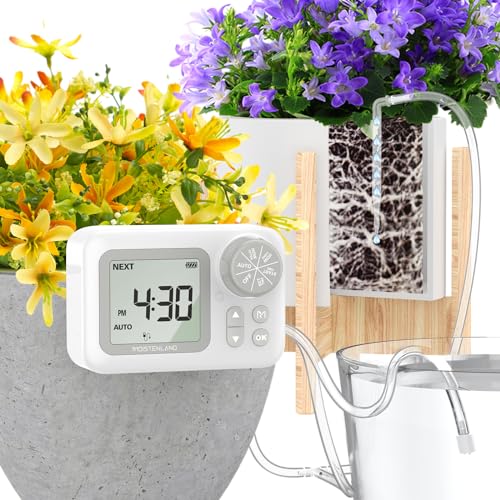
A USB-C and battery-powered kit that costs less but delivers a full 33-foot hose and 15 plant capacity.
At only 0.65 kilograms (about 1.4 lbs) versus the RAINPOINT Large Display at 0.72 kilograms (about 1.6 lbs), this is one of the lightest kits here, making it easier to carry around or pack for a vacation home setup. The 33-foot hose is the longest of the sub- options, and it includes enough T-connectors and emitters to water 15 potted plants. It runs on 4 AA batteries or a USB-C cord, and owners mention that batteries last through extended vacations. The digital display uses a simple analog knob for control, which reviewers found intuitive.
One owner reported they passed a 3-week vacation test: watered 7 plants consistently with no dry soil or overwatering. However, the pump does not include an anti-siphon valve, and the manufacturer explicitly warns that the water source must be placed below the plants — otherwise, water keeps leaking from the drippers after the timer stops. A few reviewers also noted that the LCD segments failed after a couple of weeks, making schedule adjustments hard to read. For the price, you get a dependable system with great hose length, but you must set it up with the bucket on the floor and pots on a surface above.
What you gain
- 33-foot hose — longer reach than most kits in the same tier.
- Lightweight (0.65 kg) and compatible with USB-C for flexible power.
- Supports 15 pots from the start.
What you trade
- No built-in anti-siphon valve — bucket must sit below the plants at all times.
- Several buyers experienced LCD failure within weeks.
Snag it for: a budget entry to drip irrigation that reaches a full room’s worth of plants — if you can keep the bucket low.
Pass if: you can’t guarantee the water source will stay below the pots, or you need a durable display.
5. RAINPOINT Easy-Setup Automatic Plant Waterer Indoor (ITP159)
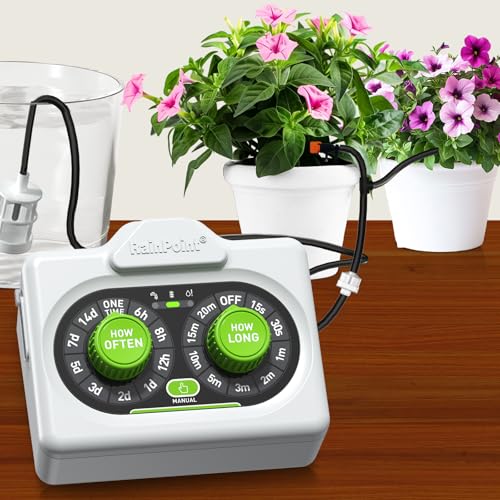
Two simple dials — one for timing, one for duration — and you are done in seconds.
If you want zero time spent learning an interface, this RAINPOINT is your pick. You twist the frequency dial (every 6 hours to 14 days) and the duration dial (15 seconds to 20 minutes), and the system does the rest. At 5.71 x 5.71 x 2.95 inches versus the Large Display model at 6.3 x 5.71 x 4.72 inches, it fits on a cramped shelf. The 32.81-foot hose is close to the Moistenland’s 33-foot hose, a difference that won’t matter in real use. It includes adjustable drip emitters, so you can give one plant a long drink and another just a spritz from the same pump. Customers note the setup is genuinely quick, and the low water auto shut-off prevents pump damage if the reservoir runs dry.
That said, one detailed review reported a serious anti-siphon failure: the pump drained 5 gallons overnight when the container was placed above the plants, an issue not clearly warned about in the manual. The same reviewer said the tubing is stiff, drip valves can pop off, and the pump does not have a real power button — the red light stays on even after the watering ends. For a simple system that just works when set up correctly, this is a solid entry-level choice, but you must follow the anti-siphon instructions closely and test everything before a long absence.
True set-and-forget: The dial interface is the most beginner-friendly of the bunch — no buttons, no app. Just watch that bucket placement or you could lose a whole reservoir overnight.
Get it when: you want the easiest possible programming and a compact pump for a small shelf.
Think twice if: you can’t keep the water container lower than the plants — that siphon failure is a real risk.
6. HEKIWAY Solar Drip Irrigation System

A solar panel powers the pump, so you can water an outdoor garden without plugging into anything.
You never need to plug this HEKIWAY system in — it is the only one here that runs on sunlight. A small solar panel charges the unit during the day, and the pump delivers up to 900ml/min (about 0.24 gallons per minute) through a 49-foot hose (15 meters) — the longest reach in this guide. It comes with 15 watering stakes and 15 T-joints, supporting the same number of pots as the Moistenland kit but over a much longer distance. It has 25 programmable timer modes, letting you set watering durations between 3 and 20 minutes and intervals from 12 to 96 hours. You can also charge it via a Type-C port (the same connector many phones use) for winter use when sunlight is limited.
Buyers emphasize that setup takes about 30 minutes and the system works well near a window or on a sunny patio. A smart alarm sounds a buzzer or flashes a light if the pump or filter is blocked or the water container runs empty. However, a few reviewers point out that the water level sensor is too sensitive and triggers false low-water alarms even when the bucket is full, and some units stopped working within 48 hours. The solar panel is not watertight — you should position the buttons facing down and seal the USB-C port. For a garden with no outdoor outlet nearby, this is the only cord-free option, but you may need to clean the sensor regularly to avoid false alarms.
Best for remote spots
- 49-foot hose — longest reach in the guide, ideal for a large patio or garden.
- Solar-powered with a Type-C backup — works off-grid in summer and indoors in winter.
- Smart alarm alerts you to a blocked pump or empty reservoir.
Watch for
- Water level sensor can be overly sensitive, causing frequent false alarms.
- Solar panel is not fully waterproof — needs protection from rain.
- Some units reported failure within 48 hours; reliability varies.
Choose this for: a balcony or garden without easy access to a wall outlet, especially if you have lots of pots spread far apart.
pass on it if: you need a reliably waterproof system or can’t risk the occasional sensor false alarm.
Understanding the Specs
Hose Length
This is the total length of tubing that comes with the pump. A longer hose means you can reach pots across a wider room, balcony, or garden without buying extra tubing. The difference between a 32-foot hose and a 49-foot hose is the difference between watering a window sill and covering a full patio.
Anti-Siphon Valve
An anti-siphon valve stops water from continuing to flow out of the drippers after the pump turns off. Without it, if your bucket or reservoir sits higher than the plants, gravity keeps pulling water through the tubes and can drain the entire bucket onto your floor. Some kits include this valve; others require you to place the bucket lower than the plants.
Timer Range / Frequency
This tells you how often the pump can water, typically from every few hours to every 14 or 30 days. A wider range gives you more flexibility — every 6 hours for thirsty summer tomatoes, or every 14 days for succulents that like to dry out completely.
Power Source
Battery-powered pumps are portable but need periodic battery changes. USB-C models let you plug into a wall adapter or a power bank. Solar-powered systems use a panel to charge an internal battery, ideal for gardens far from an outlet. A plug-in pump (like the VIVOSUN) delivers consistent power but ties you to a nearby socket.
FAQ
Will an auto water pump work with tap water or do I need distilled water?
How often do I need to refill the water reservoir?
Can I use the pump to water plants on a high shelf?
Do these pumps need Wi-Fi to work?
How do I clean the pump and tubing?
Can I add liquid fertilizer to the water reservoir?
What size reservoir fits these pumps?
How long do batteries last in a battery-powered pump?
Can I use the pump outdoors in rain?
What is the difference between continuous watering and Cycle & Soak mode?
Final Thoughts: The Verdict
For the majority of shoppers, the best auto water pump for plants is the LetPot Automatic Watering System because it pairs Wi-Fi app control with an ultra-quiet pump, anti-backflow protection, and capacity for up to 20 pots. If you want a simple dial system that needs no phone, grab the RAINPOINT Easy-Setup. And for a garden without an electrical outlet, the HEKIWAY Solar Drip Irrigation system delivers the longest hose and off-grid convenience.
How We Picked
We do not accept paid placement, and we did not hands-on test every unit. Instead, we match each pick to a real buyer and use-case by comparing the manufacturers’ published specifications against the patterns in verified customer reviews — so you get each pick’s real strengths and trade-offs instead of marketing copy.
Sources & Methodology
Specifications: manufacturer listings and product documentation. Review insights: verified customer reviews, as of July 2026. Pricing: not shown on this page (it changes often); check the current price via the retailer link.
As an Amazon Associate, Lawn Gear Lab earns from qualifying purchases. This does not affect which products we feature.