
Specs are compiled from manufacturer listings and verified buyer reviews and can change over time — please confirm the key details on the product page before buying.
A cracked or yellowed greenhouse panel is the fastest way to turn a season of careful planting into a season of weak, leggy seedlings. You are here because one panel gave out, or a hailstorm left a crater where your roof used to be, and you need a clear, tough sheet that lets the right light through without costing as much as a whole new frame. The replacements you pick need to handle UV without going brittle, shrug off a stray branch, and fit the slot you already have — ideally without a trip to the hardware store for a custom cut.
I’m Rikta — the founder and writer behind Lawn Gear Lab. This guide is built by comparing the manufacturers’ published specifications and the patterns across verified customer reviews, so you get each pick’s real strengths and trade-offs instead of marketing spin.
Below you will find the best greenhouse replacement panel options ranked by real-world durability, ease of sizing, and how well they keep your plants thriving through every season — no gimmicks, just the data that matters.
Our Picks at a Glance


How To Choose The Best Greenhouse Replacement Panel
Replacing a greenhouse panel seems simple until you realize the one you pulled off is a different thickness, the new sheet has a protective film you are supposed to peel, and you have no idea if “UV protected” means one side or both. Here are the three decisions that separate a five-minute swap from a frustrating afternoon.
Match the wall thickness to your climate
Thicker panels resist impacts and snow loads better but let slightly less light through. A thin 0.16″ panel is fine for a sheltered cold frame or a chicken coop windbreak. If your greenhouse sits exposed to hail, heavy snow, or high winds, step up to a 0.24″ or 0.32″ twin-wall sheet — the extra plastic is the difference between a dent and a crack.
Check the UV-coating placement
Most panels are UV-protected on ONE side only, and the protective film or a printed pattern tells you which side faces the sun. Installing a panel backwards means the UV stabilizer is on the inside, so the outdoor side degrades and yellows months early. If a product does not mark the UV side, plan to peel the film and verify before you fasten it down.
Measure twice, account for the tolerance
Manufacturers cut sheets with an industry-standard tolerance of plus or minus 0.19 inches. A panel listed as 48 inches may arrive at 47.8 or 48.2. Measure your frame opening width and height, then leave at least a quarter-inch of play for the panel to expand in summer heat and contract in winter cold.
Quick Comparison
| Model | Best For | Thickness | UV Protection | Light Transmission | Amazon |
|---|---|---|---|---|---|
| XISOCO 3-Pack★ Best Overall | Desert-strength durability | 0.24″ | 99.5% | High (Twin-Wall) | Amazon |
| Hotop 3-PackPremium Pick | Maximum rigidity | 0.32″ | Both Sides | Bright (Twin-Wall) | Amazon |
| DGSL 6-PackBest Value | Budget value in bulk | 0.16″ | Yes | 80% | Amazon |
| Tatuo 6-Pack | Harbor Freight retrofits | 0.16″ | Both Sides | High (Honeycomb) | Amazon |
| VOYAR 14-Pack | Large-area projects | 0.16″ | 99% | 89% | Amazon |
| Sinimaka 8-Pack | Commercial-grade strength | 0.24″ | 99.9% | 89% | Amazon |
| VEVOR 14-Pack | Extreme temperatures | 0.16″ | 98% | 80% | Amazon |
| FAHKNS 14-Pack | Goat-shed & barn windows | 0.24″ | Yes | 80% | Amazon |
In‑Depth Reviews
1. XISOCO 3 PCS 4′ x 2′ x 0.24″ Twin-Wall Polycarbonate Panels
Our pick — over 4.5★ from 150+ verified ratings; the strongest balance of quality and price.
The 0.24-inch panel that survives desert sun and blunt impacts without a hint of yellow.
This three-pack from XISOCO strikes the rare balance between enough heft to shrug off hail and enough clarity to keep your greenhouse bright. The twin-wall polycarbonate measures 48 inches long by 24 inches wide with a 0.24-inch thickness — providing a strong middle ground between flimsy economy sheets and the heavy 0.32-inch panels that are harder to cut. It is the crowd favorite, with ratings exceeding 4.7 stars.
The panel’s 99.5% UV protection is the standout spec here. Buyers report that “over a 6 months full sun and no discoloration” is typical, even in harsh conditions. The integrated co-extruded UV layer on one side prevents the yellowing and brittleness that plague untreated polycarbonate after a single season. Quality is the most-praised aspect, and sturdiness ranks second — reflecting real confidence in the material’s resilience against wind and accidental knocks.
One practical note: the panels include a protective film indicating which side faces outward. The manufacturer points out an industry-standard cutting tolerance of plus or minus 0.19 inches, so measure your frame and plan for a small trim. One buyer uses them as wall panels in a chicken coop, noting they block cold and rain while letting sunlight through — a versatile option well beyond just greenhouse roofs.
What owners love
- Superb UV resistance — no yellowing reported after six months in direct sun
- Strong enough for high winds and blunt impacts, yet trims cleanly with a utility knife
- Backed by a 10-year limited warranty, which is rare at this price tier
The honest trade-off
- UV protection is on ONE side only; install backwards and the panel degrades fast
- Cutting tolerance of ±0.19″ means you cannot count on a perfect fit without trimming
Reach for this if: You need a durable, medium-thickness panel that handles extreme sun and wind without breaking down — and you prefer a three-pack to test-fit before committing to a bulk order.
Think twice if: Your greenhouse frame requires a panel thinner than 0.24 inches, or you want a set that installs without any trimming at all.
2. Hotop 3 Pcs Polycarbonate Greenhouse Panels (0.32″)
The thickest panel in this guide at 0.32 inches — a beast for high-impact areas.
At double the thickness of the economy 0.16-inch sheets (a 2.0x gap), the Hotop panels are the most rigid option here. The double-layer density means this panel resists sagging under snow loads and handles a stray baseball or falling branch with no drama. The material is polycarbonate, so it will not shatter like glass, and the translucent finish diffuses light evenly across your plants. Ratings hold strong at 4.6 stars across hundreds of owners.
The nominal wall thickness of 0.32 inches is the defining spec. Quality and ease of cutting are the two most-discussed positive aspects — owners consistently remark that the material trims cleanly with a sharp blade despite its stiffness. The UV protection covers both sides, which eliminates the risk of installing it backwards, a common headache with cheaper single-side sheets. Water resistance also scores well, with buyers noting these panels keep rain out and minimize evaporation when used as aquarium lids.
The honest catch: the actual dimensions can run slightly under the advertised 48 by 24 inches. Owners mention actual measurements of 47.5 by 23.75 inches — enough of a gap to notice if your frame is a tight fit. The static electricity during cutting is strong enough to attract debris, so a clean workspace and a vertical cutting motion with a Plaskolite cutter help.
Where it shines
- Thickest panel in the lineup — 0.32″ resists snow loads and impacts best
- UV-protected on BOTH sides, so you cannot install it wrong
- Versatile: excellent as an aquarium lid, cold-frame cover, or greenhouse roof
Where to measure twice
- Arrives slightly undersized (47.5″ x 23.75″) compared to the 48″ x 24″ spec
- Strong static electricity during cutting attracts sawdust and debris
Grab this for: A greenhouse that gets heavy snow or sits in a high-wind area where panel rigidity is non-negotiable.
Skip it for: Frames that demand exact 48″ x 24″ dimensions — the 0.5-inch shortfall may require shimming.
3. DGSL 6 Pcs Polycarbonate Greenhouse Panels (0.16″)
The affordable six-pack that cuts like butter and fits small greenhouse frames perfectly.
This DGSL set delivers the lowest cost-per-panel in the mid-range tier by using a thinner 0.16-inch twin-wall sheet. At this thickness, the panels are noticeably lighter and more pliable than the 0.24-inch options — which is a strength if you need to cold-bend them for a curved roof or trim them with a fine-tooth saw blade. The material’s working temperature range of -44°C to 120°C means it handles freezing winters and scorching summers without cracking. It holds a solid 4.5-star rating with nearly 500 owner reviews.
The 80% light transmission is a key spec here — slightly lower than the 89% of premium panels, but plenty for healthy plant growth while keeping the interior from overheating. Quality is the top praised aspect, followed closely by ease of cutting. The panels are noted to work “perfectly for small greenhouse replacement panels” by owners who simply trimmed a fraction off the length for a custom fit. The shatterproof construction withstands severe weather and accidental falls that would crack glass.
Size is a recurring mixed topic, with some owners finding the panels smaller than expected. The sturdiness rating also shows mixed opinions — adequate for a protected cold frame or chicken run, but not as confidence-inspiring as a thicker sheet for a fully exposed roof. If your greenhouse experiences heavy snow, this panel may require additional support to prevent sagging.
Why it sells
- Six panels for the price of three thicker ones — great value for multi-panel projects
- Trims easily; owners describe cutting it “like butter” with a sawzall blade
- Wide temperature range (-44°C to 120°C) handles extreme climates
The honest downside
- At 0.16″, not rigid enough for heavy snow loads without extra framing
- Some panels arrive slightly smaller than the stated dimensions
Perfect for: Budget-conscious growers who need multiple panels for a small greenhouse, cold frame, or chicken run winter wrap.
Not for: A main greenhouse roof in a heavy-snow zone — step up to the 0.24-inch tier.
4. Tatuo 6 Pack Polycarbonate Greenhouse Panels (0.16″)

The Harbor Freight greenhouse owner’s go-to for a drop-in replacement that fits.
Tatuo’s six-pack uses a honeycomb multi-layer design that distinguishes it from standard twin-wall sheets — the internal structure adds insulation value without increasing the 0.16-inch thickness. UV protection is applied on both sides, so you can install these panels without worrying about orientation. The clear panels measure approximately 4 by 2 feet and cover up to 48 square feet in total. The rating sits at 4.4 stars with strong owner volume backing the verdict.
Quality and suitability as a replacement are the top positive aspects, with buyers specifically praising these as ideal for Harbor Freight greenhouse retrofits. One owner who replaced the roof of a 10×12 greenhouse noted the panels are “slightly wider than originals” and required trimming, but described them as thicker than the original 4mm panels. The honeycomb structure also helps with heat insulation — cooler in summer, warmer in winter.
Durability shows mixed results. While many owners find the panels sturdy, others report that in high-UV climates like Southwest New Mexico, the material “filled with dirt quickly, turned brittle in the sun, and started breaking after about 1.5 years.” Sealing the cut edges is essential to prevent dust and moisture ingress between the honeycomb channels — a step overlooked by many first-time buyers. The 0.16-inch thickness is adequate but not bulletproof for long-term exposed roofing.
What stands out
- Honeycomb core improves insulation over standard twin-wall design
- UV-protected on both sides — zero orientation confusion
- Commonly used as a direct replacement for Harbor Freight greenhouse panels
The fine print
- Durability is mixed; edges must be sealed to prevent dust and moisture ingress
- Some customers note brittleness and cracking after roughly 1.5 years in intense sun
Best for: A quick drop-in replacement for a known greenhouse brand, especially if you value dual-side UV convenience.
Skip if: You need a long-term, no-maintenance roof panel in a high-UV climate — consider a thicker 0.24-inch option instead.
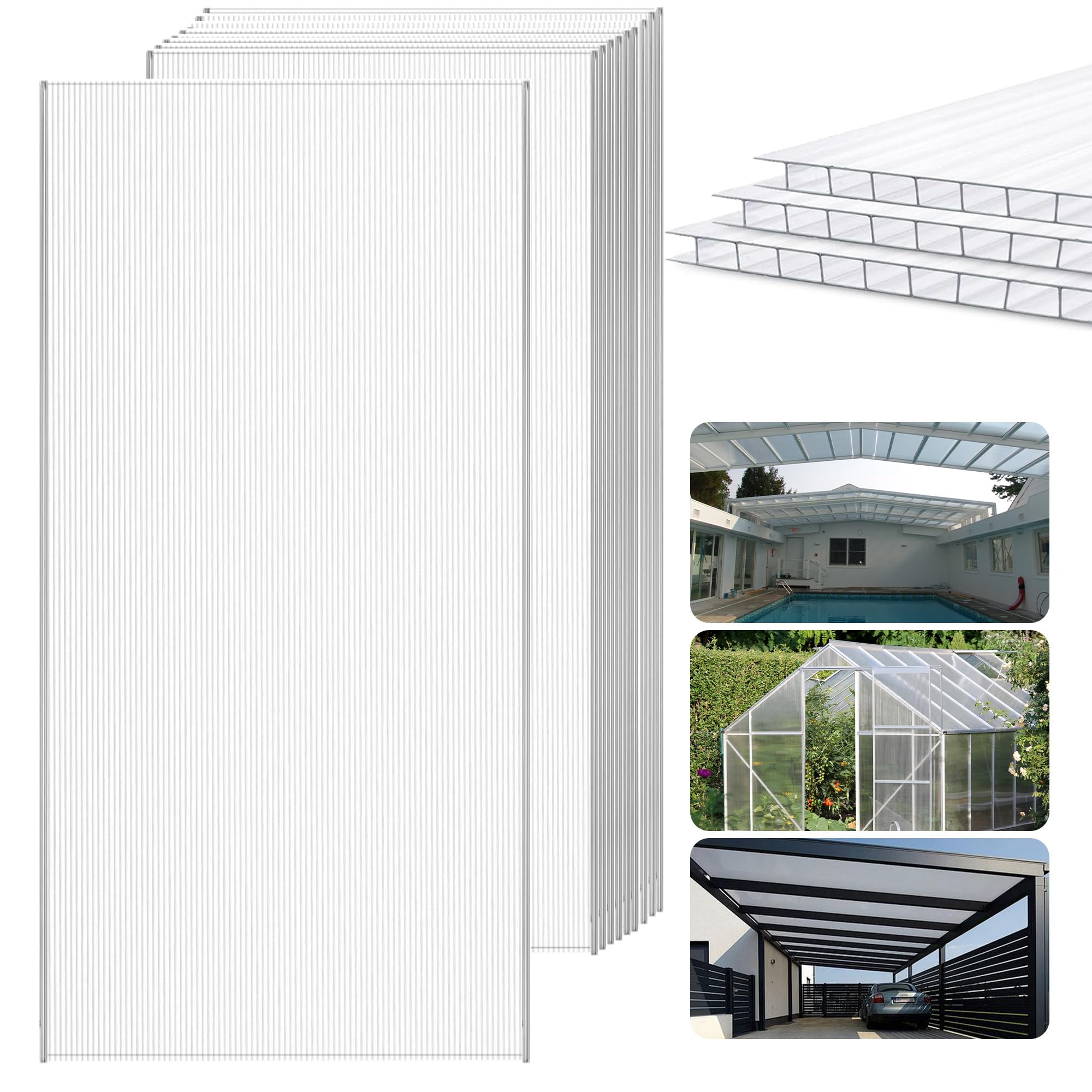
5. VOYAR 14 Pcs Polycarbonate Greenhouse Panels (0.16″)
A massive 14-panel bundle with high light transmission for serious growers.
VOYAR supplies 14 panels in one box, each measuring 48 by 24 inches with a 0.16-inch twin-wall construction. The standout spec is 89% light transmission combined with a 99% UV-blocking coating — one of the best transmission-to-protection ratios in this list. The material withstands extreme temperatures from -40°C to 120°C and handles hail, heavy snow, and strong winds. The rating is near-perfect at 4.8 stars, though the review count is lower than the more established brands.
The panels are notably easy to work with. Owners who replaced damaged existing panels report using a simple box cutter to trim them to size, noting they “slid right into place” with minimal resistance. The double-layer structure diffuses light softly, reducing harsh shadows that can stress young seedlings. Several buyers mention these are thicker and stronger than the original panels on their greenhouses, despite the same 0.16-inch nominal thickness — suggesting the material density or manufacturing quality is above average.
The real-world trade-off is the thinness. At 0.16 inches, these panels require careful handling during installation, as one buyer received a panel with a bent corner. Long-term durability is uncertain; the 4.8-star rating reflects early satisfaction rather than years of exposure. For a permanent roof replacement in a harsh climate, a thicker panel offers more confidence.
The big wins
- 14 panels cover a large area — up to 112 square feet of glazing
- 89% transmission + 99% UV block is a top-tier ratio for plant health
- Near-perfect owner satisfaction score (4.8 stars) for ease of cutting and fit
Watch out for
- Thin material requires gentle handling; one panel per pack may arrive with a bent corner
- Limited long-term data — high initial ratings but few reviews beyond a single season
Ideal for: Growers who need to cover a large greenhouse or shed in one order and want the best light transmission in the 0.16-inch class.
Not ideal for: A permanent roof replacement in a region with high winds or heavy snow — consider the thicker 0.24-inch Sinimaka panels below.
6. Sinimaka 8 Pack Polycarbonate Greenhouse Panels (0.24″)

Eight heavy-duty panels with 99.9% UV block — built for hurricane-location greenhouses.
The Sinimaka eight-pack steps up where the thinner economy panels fall short. At 0.24 inches thick with a twin-wall design, these sheets withstand hail, falling objects, and extreme weather from -40°C to 120°C without cracking. The impact resistance is commercial-grade — the brand lists it as suitable for hurricane windows. The 99.9% UV protection is the highest percentage in this guide, and the 89% light transmission keeps the trade-off small. The rating sits at 4.4 stars with strong consistency across 146 reviews.
Quality and value for money are the most-praised aspects, with owners describing the panels as “good panels for the money” and noting they slide into routed slots with no issues. The panels work excellently for winterizing chicken coops, with one buyer reporting their coop stayed warm through winter while letting in plenty of sun. The lightweight nature makes handling and installation easier than the heftier 0.32-inch Hotop panels, despite the similar thickness range.
The main frustration is the lack of UV-side marking. Reviewers point out being unable to tell which side of the panel has the UV coating — and since the product does not clearly indicate it, some buyers delay installation until they figure it out. Proper ventilation is also important; owners in hot climates like central California note the panels trap heat effectively, so a greenhouse without adequate venting can overheat quickly.
Why it ranks high
- 99.9% UV protection is the best in class — panels last longer without yellowing
- Commercial-grade impact resistance handles hail, hurricanes, and falling debris
- 8 panels cover up to 64 square feet; priced well below the 14-pack premium options
What to check before installing
- No clear marking indicating which side has the UV coating
- Heat retention is excellent — you need proper greenhouse ventilation in hot climates
Choose this if: You need a weather-proof, impact-resistant panel for a greenhouse, hurricane window, or chicken coop in a region with extreme weather events.
Look elsewhere if: You cannot risk guessing the UV side and want a panel with both sides protected (like the Hotop 0.32-inch above).
7. VEVOR 14 Pack Polycarbonate Greenhouse Panels (0.16″)
Affordability meets big coverage — 109.9 square feet of UV-protected roofing.
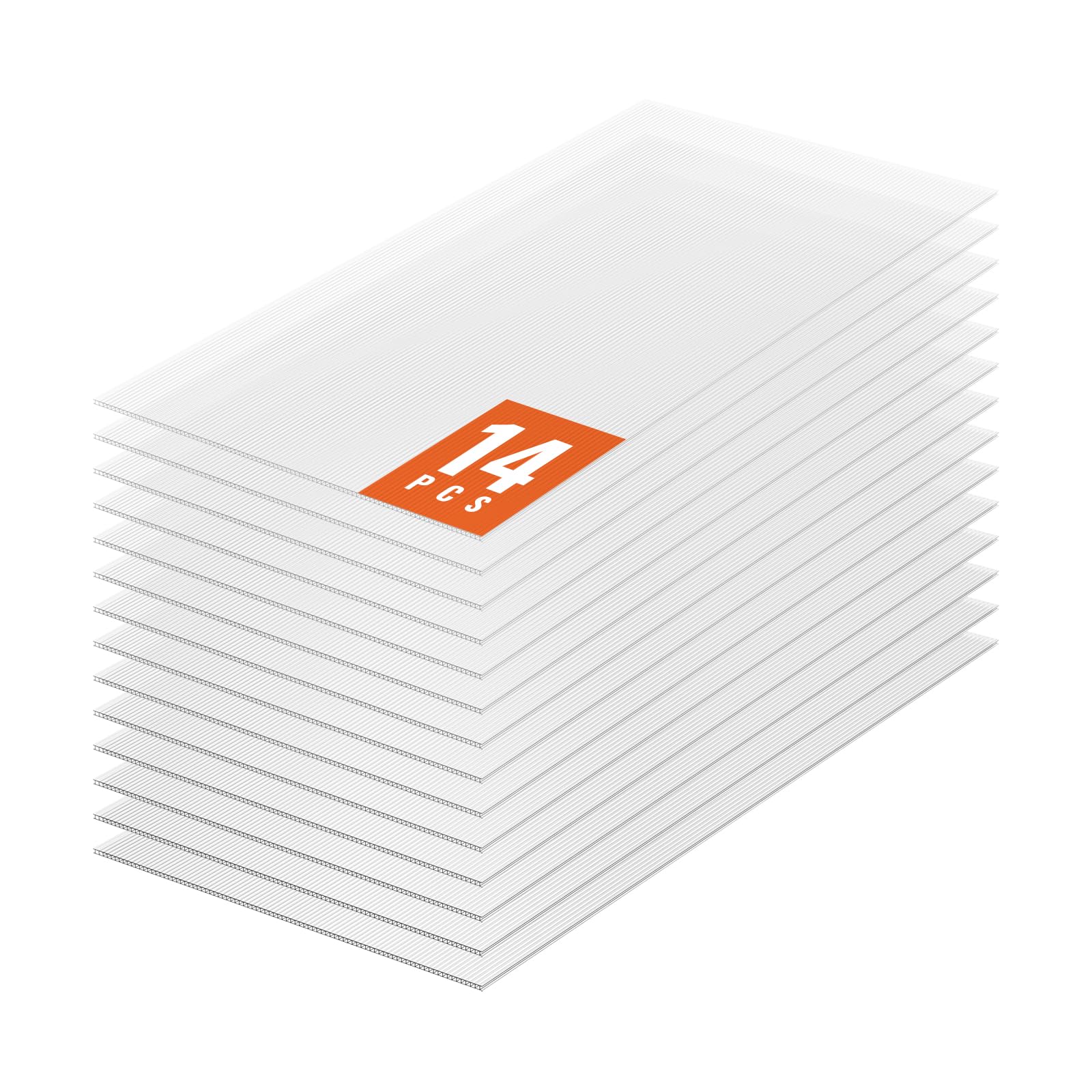
VEVOR’s 14-panel set covers a massive 109.9 square feet, making it the best per-dollar coverage option for a full greenhouse re-skin. The panels are 0.16 inches thick with a heavy-duty double-layer honeycomb design that adds rigidity without increasing weight — the material density is listed at ≥1.2 kg/m². The 80% light transmission and 98% UV-blocking are solid figures for a budget-tier product. The temperature tolerance spans -40°C to 120°C, matching premium panels at a fraction of the price. The rating holds at 4.5 stars from over 300 reviews.
Quality and durability are the most-praised aspects. One buyer who used these for a chicken coop in Indiana reported the panels raised the interior temperature by 10-15°F during winter — even at -7°F outside, the coop stayed between 28-32°F. Owners consistently find these panels easy to cut with a jigsaw and fine-toothed blade, and the panels fit well with screws and rubber washers. The 0.16-inch thickness is noticeably pliable, which helps when cold-bending for curved frames.
The mixed feedback centers on size accuracy. Some buyers find the panels measure slightly smaller than advertised, requiring additional support on edges. One owner noted the panels are “thin but sturdy with baffles” and recommended extra edge support for long-term installation. The protective film is on both sides; one side is white and the other clear — peel the white film off the sun-facing side and the clear film off the interior side for maximum clarity.
Value highlights
- 14 panels cover nearly 110 square feet — the largest coverage per dollar in this guide
- Proven winter performance: raised chicken coop temps by 10-15°F in sub-zero weather
- Honeycomb core adds rigidity and insulation without making the panels heavy or hard to cut
Cost-conscious caveats
- Measurements may run slightly under advertised; plan for edge support on wider spans
- The protective film on both sides must be peeled correctly for clarity (white = sun side)
Perfect for: A low-budget greenhouse rebuild, chicken coop winterization, or any project where covering a large area efficiently matters more than premium rigidity.
Not for: A roof-only installation in a heavy snow zone — the 0.16-inch thickness sags without additional framing.
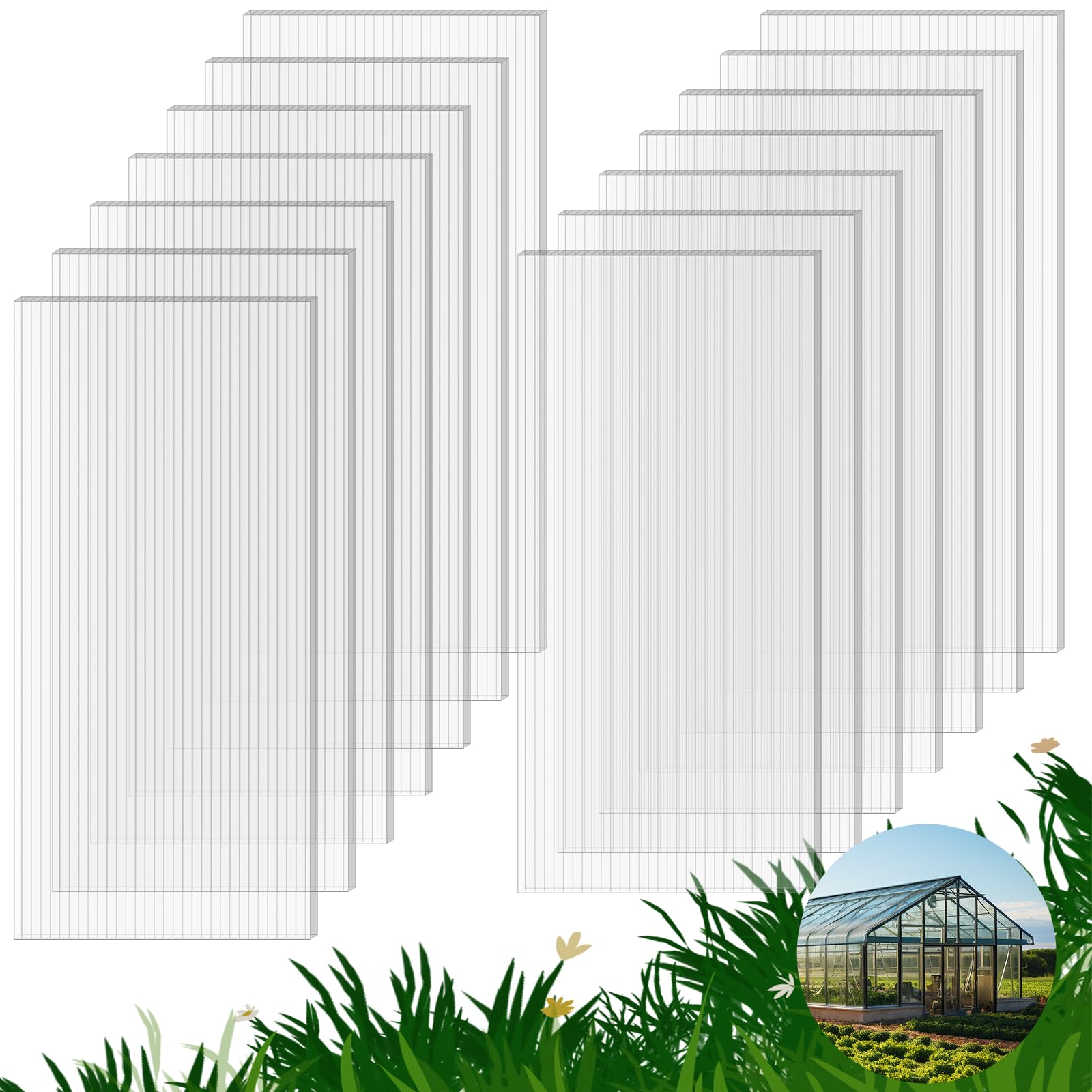
8. FAHKNS 14 Pack Polycarbonate Greenhouse Panels (0.24″)
Thick panels in bulk quantity — a practical choice for barn windows and goat houses.
FAHKNS delivers a rare combination: a thick 0.24-inch twin-wall panel in a 14-count bulk box. Most bulk packs at this count use 0.16-inch material to keep costs down, so this is a notable advantage for buyers who need both quantity and rigidity. The panels allow 80% light transmission with a working temperature range of -44°C to 120°C. The shatterproof polycarbonate is stronger than glass and better at insulating, keeping the greenhouse warm in winter and cool in summer. The rating is 4.4 stars from over a hundred owners.
Quality and ease of use are the top praised aspects. The panels require “very little trimming” for many greenhouse replacements, saving time during installation. One owner used them to repair wind-damaged roof panels and described the panels as “much more economical than replacing the entire greenhouse.” Another buyer cut them as windows for goat houses and noted they work great. The panels arrive with a thin protective film on both sides to prevent scratches during shipping — peel it off before installation.
The negative from some buyers is fogging during rain. One owner reported the panels fog up when wet, reducing visibility through them. This is a common trait with twin-wall polycarbonate when the internal channels are not sealed or when condensation forms between the walls. It does not affect the insulation value or plant growth, but if you need a perfectly clear view through your panels in wet weather, this is a consideration. The panel dimensions (48.4 by 25 inches) are slightly larger than the standard 48 by 24 inches, so double-check your frame width before ordering.
The bulk advantage
- 14 panels with 0.24″ thickness — a rare and valuable combination for big projects
- Shoppers say very little trimming needed for most greenhouse repairs
- Much stronger and more rigid than the original panels on many entry-level greenhouses
One honest note
- Panels can fog up during rain, which reduces visibility through the material
- Dimensions run slightly oversized (48.4″ x 25″) vs the standard 48″ x 24″ frame
Reach for this if: You need thick panels for a large greenhouse rebuild, barn windows, or animal shelter glazing — and you want the convenience of a single bulk order.
skip it if: Clear visibility through the panels during rain is important for your setup.
Understanding the Specs
Wall Thickness (0.16″ vs 0.24″ vs 0.32″)
This is the single most important number for a replacement panel. A 0.16-inch sheet is lightweight, easy to cut, and fine for vertical walls, cold frames, or chicken runs — but it will sag under heavy snow and flex in high winds. A 0.24-inch panel is the balance for most greenhouse roofs, offering good impact resistance without the weight and cost of the thickest option. The 0.32-inch panels are overkill for most home greenhouses but essential in regions with hailstorms, heavy snow loads, or where the panel spans a large unsupported gap.
Light Transmission vs UV Protection
These two numbers trade off against each other. High light transmission (80% to 89%) means more natural sunlight reaches your plants, which is critical for photosynthesis and strong growth. UV protection (98% to 99.9%) is a coating that prevents the polycarbonate itself from yellowing and turning brittle under the sun. A panel with 89% transmission and 99% UV block is the ideal combination — you get almost all the light you need with long-term durability. A panel with 80% transmission and 99.9% UV block will last even longer but produces a dimmer interior; this is fine for shade-loving plants or in very hot climates where too much light is a problem.
FAQ
Can I cut polycarbonate greenhouse panels with a utility knife?
Which side of the panel faces the sun — the UV-coated side?
Will these panels fit a Palram greenhouse?
What is the difference between twin-wall and honeycomb polycarbonate?
How do I seal the cut edges of a polycarbonate panel?
Can I bend twin-wall polycarbonate for a curved greenhouse roof?
Will these panels yellow or become brittle over time?
How do I remove the protective film from new panels?
What is the best thickness for a greenhouse roof with heavy snow?
Are these panels safe to use as aquarium lids?
Final Thoughts: The Verdict
For the majority of shoppers, the greenhouse replacement panel winner is the XISOCO 3-Pack because it delivers 0.24-inch thickness, 99.5% UV protection, and proven durability in harsh sun and wind — all backed by a 10-year warranty and a 4.7-star owner consensus. If you want maximum rigidity for snow-prone regions, grab the Hotop 0.32-inch 3-Pack with dual-side UV protection. And for a budget-friendly large-area project, the VEVOR 14-Pack is the one to reach for — covering nearly 110 square feet at an entry-level price point that makes a full greenhouse re-skin possible while staying affordable.
How We Picked
We do not accept paid placement. Every pick is matched to a real buyer and a real use-case; we do not hands-on test units.
Sources & Methodology
Specifications: manufacturer listings and product documentation. Review insights: verified customer reviews, as of July 2026. Pricing: not shown on this page (it changes often); check the current price via the retailer link.
As an Amazon Associate, Lawn Gear Lab earns from qualifying purchases. This does not affect which products we feature.