
Specs are compiled from manufacturer listings and verified buyer reviews and can change over time — please confirm the key details on the product page before buying.
If your lawn is a battlefield of dandelions, clover, and crabgrass, picking a single product that both kills the weeds and feeds the grass can feel like a gamble. The right combination saves you time and a second trip across the yard, while the wrong one might green up your weeds instead of your turf. We’ve broken down the specs and real owner experiences to find which formulas actually deliver on the dual promise.
I’m Rikta — the founder and writer behind Lawn Gear Lab. This guide is built by comparing the manufacturers’ published specifications and the patterns across verified customer reviews, so you get each pick’s real strengths and trade-offs instead of marketing spin.
Below, you will find seven of the top grass feed and weed killer products on the market, ranked by performance, coverage, and honest buyer feedback so you can match the right one to your yard’s specific weed problems and grass type.
Our Picks at a Glance

How To Choose The Best Grass Feed And Weed Killer
Not every weed and feed is the same. The biggest mistake is grabbing a bag without checking if it targets the specific weeds in your yard or is safe for your grass variety. Kill the wrong thing — or feed the wrong thing — and you are starting over.
Match the Active Ingredients to Your Weeds
The weed-killing power comes from the active ingredients. Look for listings like 2,4-D, Mecoprop, and Dicamba for broadleaf weeds such as dandelions and clover. If you have grassy weeds like crabgrass, many standard weed and feed formulas will not touch them — you will need a separate product for that.
Check Your Grass Type First
Some formulas can damage or kill certain lawn grasses. St. Augustine and centipede grass, for example, are sensitive to some herbicides. The product label will always list the grass types it is safe for. Ignoring this is the fastest way to a brown, patchy lawn.
Granules vs. Hose-End Spray — Which Fits Your Routine?
Granular products need a spreader and then watering in, which takes more physical effort but gives you even coverage on a large lawn. Hose-end sprayers are faster and easier for small to medium yards — just attach, spray, and you are done. The trade-off is that spray drift can be an issue on windy days.
Quick Comparison
| Model | Best For | Coverage | Item Form | Item Weight | Amazon |
|---|---|---|---|---|---|
| Scotts Turf Builder Weed and Feed 3★ Best Overall | Overall power & value | 5,000 sq. ft. | Granule | 14.3 pounds | Amazon |
| Spectracide Weed & Feed 20-0-0Maximum Coverage | Maximum coverage per bottle | 7,500 sq. ft. | Spray | 2.8 pounds | Amazon |
| Scotts EZ Feed Plus Weed ControlTop Performance | Ease of use & stubborn weeds | 4,000 sq. ft. | Spray | 2.1 pounds | Amazon |
| Bonide Liquid Weed & Feed 20-0-0 | Budget-friendly small lawns | 2,500 sq. ft. | Spray | 16 ounces | Amazon |
| Jonathan Green Green-Up Weed & Feed | Greening power & long feed | 5,000 sq. ft. | Granule | — | Amazon |
| The Andersons Premium Weed and Feed | Iron-rich deep greening | 5,000 sq. ft. | Granule | 18 pounds | Amazon |
| The Andersons Professional Surge | Professional-grade big lawns | 16,000 sq. ft. | Granule | 40 pounds | Amazon |
In‑Depth Reviews
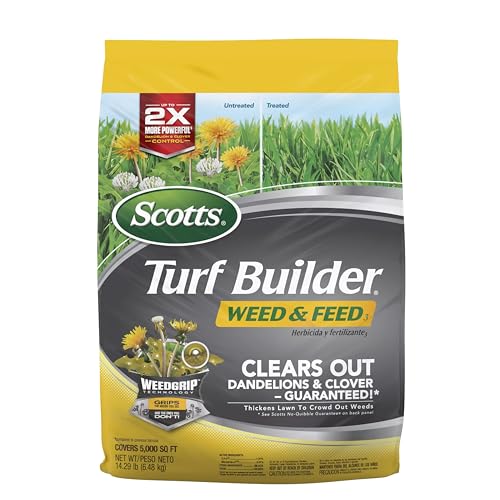
1. Scotts Turf Builder Weed and Feed 3, 5,000 sq. ft.
Our pick — over 4★ from 36,500+ verified ratings; the strongest balance of quality and price.
The crowd-favorite granule that hits hard on dandelions while thickening the lawn.
This is the most popular entry in the category for a reason — it covers 5,000 square feet and delivers a potent herbicide mix (1.220% 2,4-D and 0.081% Mecoprop) that tackles broadleaf invaders. The consensus among owners is that plantain, dollar weed, and clover are visibly dead inside a week, with tougher Japanese clover giving up in about two weeks.
The other half of the promise is the feed. The grass comes in thicker and greener, which crowds out new weeds trying to take hold. The critical timing tip from the most experienced users is to apply the granules onto wet weeds, then leave the lawn untouched for 2-3 days — no watering, no walking. Some bare spots may appear after the weeds die, needing a quick reseed, but the overall trade-off is a far healthier-looking yard.
The one honest gap is that it does not kill actively growing crabgrass, and the clover control gets mixed marks from some buyers. If your yard is infested with grassy weeds, this is not a one-and-done cure.
What makes it the top pick
- Weedgrip Technology hooks weeds you see and those you don’t yet
- Results visible in roughly one week on common broadleaf weeds
What to watch for
- Won’t kill actively growing crabgrass
- Japanese clover needs up to two weeks to fully die
- Keep pets and humans off treated areas for at least 24 hours
Your best bet if: you want one reliable product for dandelions, clover, and general broadleaf weeds, with a fertilizer boost that keeps the grass thicker and healthier.
Look elsewhere if: your main problem is crabgrass or other grassy weeds — this leaves those untouched.
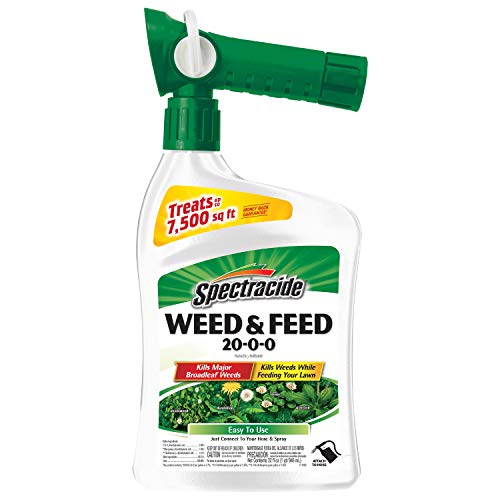
2. Spectracide Weed & Feed 20-0-0 (Ready-to-Spray), 32 fl oz
A single bottle that stretches further than anything else here — up to 7,500 square feet.
If you are covering a one-acre property, this is the one to reach for. The hero feature is the QuickFlip sprayer: grip, flip, and go with no mixing.
The 20-0-0 nitrogen formula gives the lawn a solid green-up, and buyers report that the weed killing (dandelion, chickweed, clover, plantain) shows within a couple of weeks — stubborn violets may need a third pass. The review pages note that it is “easy to use and works great,” and it is considered safe for St. Augustine grass, a big plus for southern lawns where many products cannot be used.
The trade-off is that on very large yards (one acre), expect to use 4-5 bottles per season. The sprayer connection is generally reliable, though a few owners had to check their hose fitting carefully.
The big draw: the lightest, widest-coverage spray option — 7,500 square feet from one 32-ounce bottle with a simple no-mix hose attachment.
The catch: very tough weeds like violets may need multiple applications, and the price has climbed noticeably in recent seasons.
Reach for this if: you have a large lawn (half an acre or more) and want the fastest, lightest, widest-coverage application with no mixing.
Think twice if: you have a very small yard — the bottle covers far more than you need, and a smaller product may be simpler to store.
3. Scotts EZ Feed Plus Weed Control, 32 fl. oz.
The spray that targets the tricky weeds cheaper formulas miss — creeping sedge and ground ivy.
At just 2.1 pounds, this is the lightest product in the lineup. The 32-ounce bottle covers 4,000 square feet on cool-season lawns and 6,000 on warm-season, and it goes after a broader weed list than most, including carpetweed, poison ivy, Virginia creeper, and wild onion. Owners mention it is especially effective against clover-like weeds (creeping sedge) that cheaper brands cannot handle.
The weed curl-up starts within days, though some hard-to-control types need a follow-up application in 3-4 weeks. It is safe on a wide range of grasses — bahia, Bermuda, centipede, zoysia, bluegrass, fescue, and ryegrass. On the downside, the aspect data shows effectiveness is genuinely mixed, and a significant number of owners had issues with the sprayer leaking at the hose connection or spraying back onto them. A few received units missing the cap.
Follow the instructions closely: attach firmly to a new garden hose, and the product works as intended.
Why it stands out
- Controls a longer weed list, including poison ivy and Virginia creeper
- Featherlight at 2.1 pounds — easy to carry anywhere
- Works on both warm- and cool-season grasses
Where it stumbles
- Sprayer connection quality is inconsistent — check the cap and seal before use
- Some weeds need a repeat application after 3-4 weeks
Your pick if: you have a mix of hard-to-control broadleaf weeds (ground ivy, wild onion, creeping sedge) that cheaper options leave behind.
Not for you if: you need a bulletproof sprayer right from the start — inspect the connector carefully on arrival.
4. Bonide Liquid Weed & Feed 20-0-0, 32 oz Ready-to-Spray

A solid, no-fuss entry-level spray that treats a small lawn without any mixing.
This one treats up to 2,500 square feet per 32-ounce bottle. The 20-0-0 ratio (20% nitrogen, zero phosphate and potash) gives a quick green-up while the weed control goes after a solid list: dandelion, clover, chickweed, plantain, oxalis, and ragweed among others.
The best feedback comes from owners who ditched expensive professional lawn services and switched to this. One reports applying it twice — once in spring and again toward the end of summer — and maintaining a plush, green, weed-free lawn. The ready-to-spray bottle has the sprayer built in; you just connect the hose and go.
The trade-off is coverage: at 2,500 square feet, it is really designed for small lawns or spot treatments. Owners also note that a summer heat wave can pause your application schedule, so timing matters.
The edge: a straightforward, no-mix hose-end spray that delivers solid weed control for a small property — a direct upgrade from paying hundreds for a service.
The limit: 2,500-square-foot coverage per bottle means larger lawns will need two or more.
Best for: small lawns or tight budgets where the priority is a simple, effective one-step spray with no extra equipment.
skip it if: your yard is larger than a quarter acre — you will burn through multiple bottles and be better off with a wider-coverage product.
5. Jonathan Green Green-Up Weed & Feed 21-0-3, 5,000 Sq. Ft.

A granular powerhouse that feeds for three months while claiming to control over 250 weed types.
The standout spec here is the 21-0-3 analysis, which provides a higher nitrogen content than most, plus a little potassium (the 3) for overall lawn health. The manufacturer says the slow-release formula feeds for up to 3 months — meaning fewer applications across the season. The weed killer claims to control over 250 broadleaf weeds, taking out dandelions, chickweed, thistle, poison ivy, and wild onions down to the root.
Dedicated owners who switched from big-box store brands report noticeably better results, calling it “the best fertilizer.” The fine particle size is designed for even coverage using a rotary or drop spreader. On the flip side, the customer data shows effectiveness is mixed — some owners watch the grass turn beautifully green while the weeds stay right alongside it. The bag is on the small side for its coverage claim, and some arrived with hard clumps inside.
The most important note: do not apply this product at the same time you are seeding a new lawn, as the weed killer will prevent the new grass seed from germinating.
The big plus
- 21-0-3 analysis feeds for up to 3 months — fewer reapplications
- Controls over 250 broadleaf weed species down to the root
- Fine particle size gives even coverage through a spreader
The honest trade-off
- Weed-killing effectiveness is mixed — some owners see the grass green up but the weeds persist
- Bag can arrive with clumps that are hard to break apart
- Cannot be used at the same time as overseeding
Choose this for: a long-season feeding approach where the primary goal is a deep green lawn and you are willing to manage stubborn weeds with a targeted follow-up.
Avoid if: your main priority is absolute weed eradication — the mixed reviews on weed control make this a gamble for heavily infested yards.
6. The Andersons Premium Weed and Feed 24-0-16, 5,000 sq ft (18 lb)

A premium granular that uses iron for extra deep greening and a dual-release nitrogen system.
The Andersons takes a different approach with a 24-0-16 ratio — very high nitrogen and a significant dose of potassium (the 16), plus added iron for what the maker calls “extra deep greening.” The nitrogen blend includes both quick-release and slow-release forms, so you get a fast green-up followed by extended feeding. It covers 5,000 square feet from an 18-pound bag.
Reviews consistently say it greens up the grass quickly and that the lawn looks healthier within a couple of weeks. One owner who switched from a big-box brand reports “way better than Scott’s.” The herbicide targets dandelions and over 250 broadleaf weeds. It is labeled for use on bahia, Bermuda, bluegrass, centipede, fescue, rye, St. Augustine, and zoysia.
The catch is that some weeds — particularly nutsedge — seem resistant to the formula, and a few owners found it did not slow the weeds even after two applications. It is also restricted from sale in New York, Florida, California, and Indiana.
Why it stands out: the combination of 24-0-16 NPK plus iron for a noticeably richer green color — a step up from standard 20-0-0 formulas.
The honest limit: nutsedge and some persistent weeds may require a separate, specialized killer.
Reach for this if: you want the deepest possible green color from your fertilizer and have a standard broadleaf weed problem.
Not the one if: you are battling nutsedge, or you live in NY, FL, CA, or IN where this product cannot be shipped.
7. The Andersons Professional Surge Weed and Feed 16-0-9, 40 lb
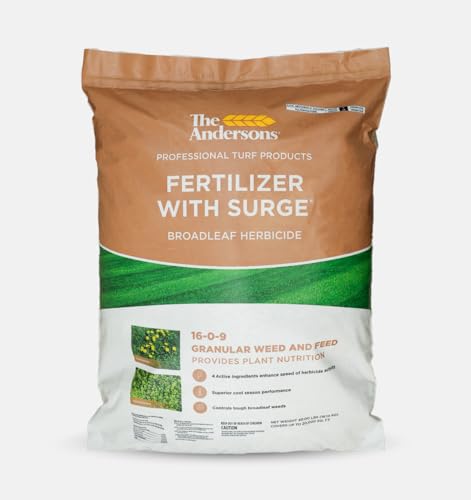
The heaviest hitter for the biggest lawns — a 40-pound bag that covers 16,000 square feet.
This is the professional-tier option in the lineup. A single 40-pound bag covers up to 16,000 square feet. The 16-0-9 formula delivers a balanced feed with potassium for overall turf health, and the four-way herbicide blend targets over 250 weeds including dandelions, clover, chickweed, and plantain.
The Andersons uses a small particle size for more granules per square inch, which they say leads to superior performance. Owners who switched from Scotts report being “super happy with it — killed the weeds fast.” One specific win is against creeping Charlie, a notoriously hard-to-kill ground ivy, with one owner noting it was the only product that actually worked.
The biggest honest caveat from the review data is that effectiveness is widely mixed — for some, the results are no better than cheaper brands, making the higher investment feel unjustified. The value-for-money score is the lowest aspect. It is also prohibited in New Hampshire and Washington, and cannot be used on Floratam St. Augustine grass or dichondra.
The big advantage: hands-down the largest coverage per bag — 16,000 square feet — making it the clear choice for owners of acre-plus properties.
The downside: mixed reviews on weed control relative to the premium cost; some owners saw no difference from their previous budget product.
Who it fits: large-property owners who want a professional-grade granule and are willing to invest in bag size and coverage area, especially if creeping Charlie is a target.
When to pass: if you have a small to medium yard — the 40-pound bag is overkill, and the mixed feedback on weed control makes the per-pound cost less appealing.
Understanding the Specs
NPK Ratio (The Feed Numbers)
The three numbers on the bag — like 20-0-0 or 24-0-16 — stand for Nitrogen (N), Phosphorus (P), and Potassium (K). Nitrogen is what makes your grass green and grow. A product with a zero in the middle (like 20-0-0) has no phosphorus, which is fine for established lawns. The third number (potassium) helps the grass handle stress from heat and drought. Higher nitrogen means a faster, more dramatic green-up.
Granule vs. Liquid Spray
Granules must be spread with a rotary or drop spreader, then watered in to activate the weed killer. This takes more physical effort but provides very even coverage. Liquid sprays attach directly to your garden hose, letting you cover ground quickly without dragging a spreader. The trade-off is that spray drift on a windy day can damage your flower beds or vegetable garden.
Active Ingredients — What Kills the Weeds
The herbicide is the part that kills the weeds. Common active ingredients are 2,4-D, Mecoprop, and Dicamba. These are selective herbicides — they target broadleaf weeds (dandelion, clover) while leaving your grass unharmed. Check the label to see if your specific weed (like ground ivy, creeping Charlie, or nutsedge) is on the controlled list. Not every weed and feed kills every weed.
Coverage Area — Don’t Underestimate
The coverage number tells you how many square feet one bag or bottle treats. A product covering 2,500 square feet is meant for a small yard or selective treatment. A product covering 7,500 or 16,000 square feet is for large properties. Buying a small-coverage product for a big yard means buying multiple units — check this number before you add to cart.
FAQ
Can I use a weed and feed on a newly seeded lawn?
How long does it take for a weed and feed to work?
Can I apply weed and feed in the summer heat?
How long do I need to keep kids and pets off the lawn after applying?
What is the difference between a pre-emergent and a weed and feed?
Will weed and feed kill crabgrass?
Is hose-end sprayer application as effective as granular?
Why do some products have a ‘not for sale in’ restriction?
Can I reseed after using weed and feed?
Final Thoughts: The Verdict
If you want one dependable pick, the grass feed and weed killer winner is the Scotts Turf Builder Weed and Feed 3 because it combines the highest owner satisfaction with proven performance on the most common broadleaf weeds (dandelion and clover) and a fertilizer that thickens the lawn naturally. If you want the absolute widest coverage per bottle for a large yard, grab the Spectracide Weed & Feed 20-0-0. And for tackling the stubborn weeds cheaper formulas leave behind — ground ivy, creeping sedge, wild onion — the Scotts EZ Feed Plus Weed Control is the one to reach for.
How We Picked
We do not accept paid placement. Every pick is matched to a real buyer and a real use-case; we do not hands-on test units.
Sources & Methodology
Specifications: manufacturer listings and product documentation. Review insights: verified customer reviews, as of July 2026. Pricing: not shown on this page (it changes often); check the current price via the retailer link.
As an Amazon Associate, Lawn Gear Lab earns from qualifying purchases. This does not affect which products we feature.