
Specs are compiled from manufacturer listings and verified buyer reviews and can change over time — please confirm the key details on the product page before buying.
Keeping your plants alive through a hard freeze depends on one thing: the greenhouse you choose. A kit that looks fine in spring can collapse under the first snow load or leak all its heat overnight, leaving you with frozen seedlings and wasted money. This guide cuts through the marketing to find the greenhouse kits actually built for winter — the ones with real insulation, sturdy frames, and ventilation that works when temperatures drop.
I’m Rikta — the founder and writer behind Lawn Gear Lab. This guide is built by comparing the manufacturers’ published specifications and the patterns across verified customer reviews, so you get each pick’s real strengths and trade-offs instead of marketing spin.
You will find honest breakdowns of the best greenhouse kits for winter that actually hold up to cold weather, including how their frames, panel thickness, and ventilation features translate into real protection for your plants.
Quick Picks
- Backyard Discovery Zalie 11′ x 7′ Cedar Wood and Polycarbonate Walk-in Greenhouse Kit — Premium Winter Fortress
- Jocisland 10×18 Ft Wood Greenhouse — Grand Cedar Walk-In
- Palram – Canopia 4×8 Lean-To Greenhouse — Smart Lean-To Design
- Jocisland 8×9.5×7.5 Ft Wooden Greenhouse — Fast Cedar Build
- WUKHG 8X10FT Greenhouses for Outdoors with Electronic Thermometers — Biggest Metal-Frame Footprint
- CABIHOME 6×7 FT Outdoor Greenhouse — Spec-Certified Winter Value
- FLY BY YAN 6×4 FT Polycarbonate Greenhouse — Compact Entry Point
How To Choose The Best Greenhouse Kits For Winter
Finding a winter-ready greenhouse means looking past the price tag and marketing photos. The wrong choice traps you with a structure that either freezes your plants or breaks under the first snow. Focus on these three factors to get a kit that actually works when the mercury drops.
Panel Material and Thickness
The panels are your first line of defense against the cold. Look for twin-wall polycarbonate panels (two-layer plastic sheets) that are at least 4mm thick. These double-layered sheets trap air between the walls, creating an insulating barrier that holds heat inside while blocking UV rays that can scorch plants. Single-layer plastic sheeting or thin polyethylene covers lose heat almost instantly on a cold night, making them useless for winter growing.
Frame Strength and Weather Ratings
Winter brings wind, snow, and ice that test every joint and beam. You want a frame that is either reinforced aluminum or solid cedar — both resist rust and rot. Check for specific wind-speed and snow-load ratings in the specs. A kit rated for 50mph winds and a 18psf (pounds per square foot) snow load, for example, gives you a real benchmark for what it can handle. Unrated frames are a gamble you should not take with winter weather.
Ventilation and Climate Control Features
Even in winter, a sealed greenhouse can overheat on a sunny day and then freeze by midnight. You need adjustable roof vents that let hot air escape during the day and close tight at night. Some premium kits include temperature-activated exhaust fans that automate this cycle. A built-in drainage gutter also matters — it channels rain and snowmelt away from the base, preventing ice buildup that can warp the frame.
Quick Comparison
| Model | Best For | Panel Thickness | Snow Load | Frame Material | Amazon |
|---|---|---|---|---|---|
| Backyard Discovery Zalie 11′ x 7′ | Ultimate Winter Protection | 4-wall PC | 4,400 lbs / 30 inches | Cedar | Amazon |
| Jocisland 10×18 Ft Wood | Massive Cedar Winter Space | Sunboard PC | — | Cedar | Amazon |
| Palram – Canopia 4×8 Lean-To | Lean-To Versatility | Twin-wall PC | — | Powder-coated Aluminum | Amazon |
| Jocisland 8×9.5×7.5 Ft Wood | Pre-Assembled Cedar Ease | Sunboard PC | — | Cedar | Amazon |
| WUKHG 8X10FT with Thermometers | Largest Mid-Range Footprint | 4mm twin-wall PC | — | Aluminum Alloy | Amazon |
| CABIHOME 6×7 FT Outdoor | Heavy-Duty Budget Value | 4mm twin-wall PC | 18psf | Reinforced Aluminum | Amazon |
| FLY BY YAN 6×4 FT | Compact Entry-Level Kit | 0.157inch twin-wall PC | — | Aluminum | Amazon |
In‑Depth Reviews
1. Backyard Discovery Zalie 11′ x 7′ Cedar Wood and Polycarbonate Walk-in Greenhouse Kit

The only kit here rated to hold 4,400 pounds of snow without breaking a sweat — that is 30 inches of snow load.
This is the heavyweight champion for year-round gardening in harsh winter climates. The commercial-grade 4-wall polycarbonate roof and window panels (plastic panels with four layers and three air gaps) improve heat retention by 30% compared to standard double-wall polycarbonate, so more of the warmth you generate stays inside during a deep freeze. It also comes with a temperature-activated exhaust fan that forces hot air out before the interior turns into a sauna, then shuts tight to keep the cold out at night — a feature none of the other kits here can match at this level of integration.
You get 86 square feet of interior space with 23 linear feet of foldable and fixed staging shelves, plus a built-in workstation that keeps your potting supplies organized. The patented PowerPort gives you 3 electrical outlets and 3 USB ports for running heaters, grow lights, or fans, and both exterior and interior hose hook-ups make watering convenient. One reviewer noted the BILT app made assembly manageable over several weekends, and the cedar frame is naturally resistant to rot and decay without chemical treatment — a key advantage over painted wood frames that can peel after a season. Buyers report the assembly takes time (expect about 21 hours solo), but the pre-cut, pre-drilled, and pre-stained pieces fit accurately. The 5-year warranty adds confidence for a big investment.
It costs more than any other kit here, but if you need a greenhouse that can shrug off a 30-inch snow load without failing, this is the one. Picking the CABIHOME or FLY BY YAN below means accepting frames and panels that cannot match this.
Winter Readiness Rating: The only kit specifically tested by Pro-Tect to withstand up to 4,400 pounds or 30 inches of snow load. If you live where winter is brutal, this is the clear choice.
Best for: Serious gardeners in heavy-snow regions who want a fully equipped, warranty-backed structure that handles extreme winter loads and includes active ventilation, power, and water hook-ups right from the start.
Consider first if: You are willing to invest both the budget and the assembly time (several weekends) for a greenhouse that will outlast every other kit on this list through years of harsh winters.
2. Jocisland 10×18 Ft Wood Greenhouse
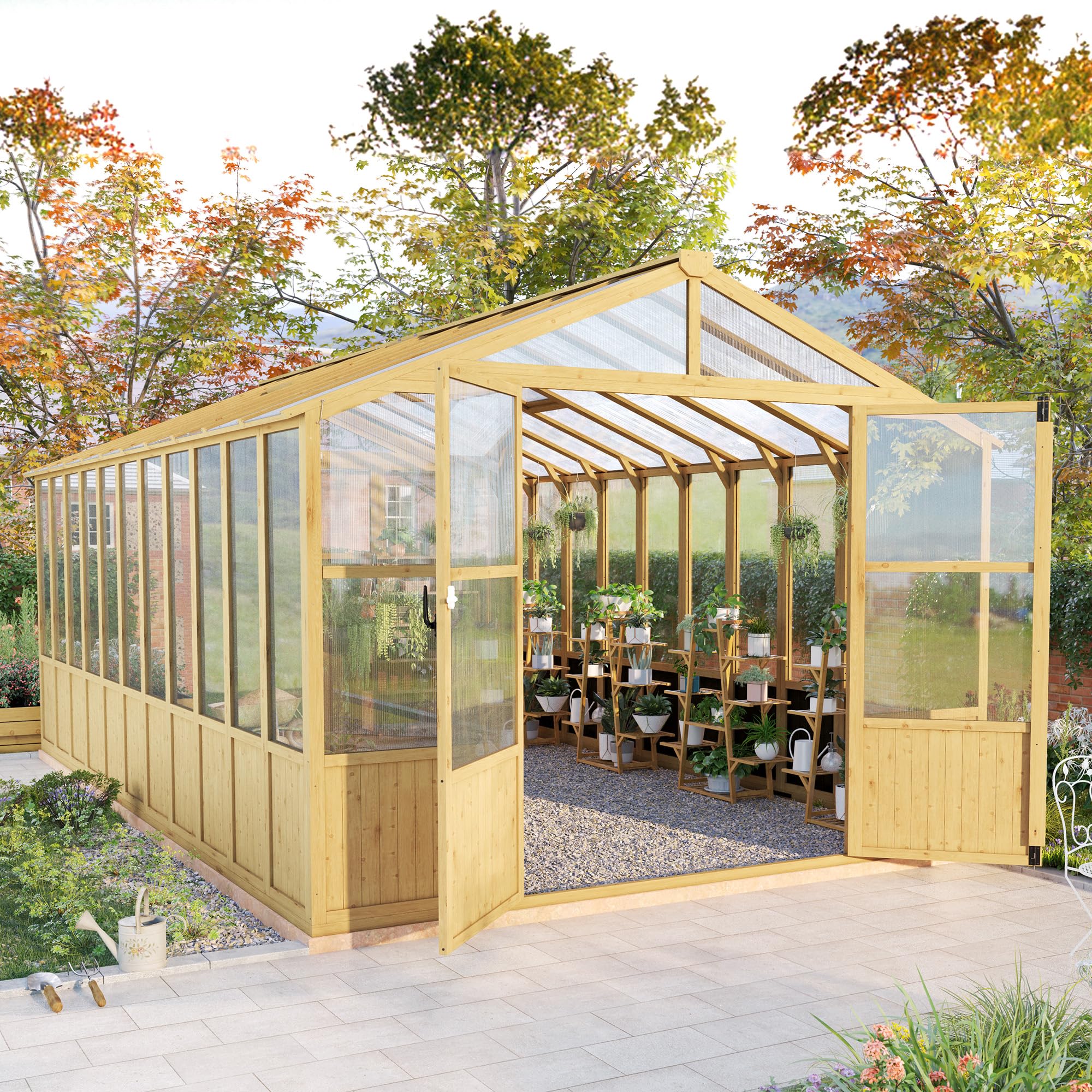
A cedar-framed giant with pre-assembled panels that saves you days of construction, with 180 sq ft versus 76 sq ft for the smaller Jocisland 8×9.5 model.
You get a huge 10×18 ft footprint with a peak height of 7.68ft (234cm) and wall height of 5.45ft (166cm), which means you can walk upright across the entire space. The high-quality sunboard (polycarbonate) panels provide heat insulation and UV protection without the shatter risk of glass, while the natural cedar frame resists decay naturally — no paint or chemical preservatives needed. Unlike the aluminum-framed kits like the CABIHOME, this wooden structure traps heat more effectively because cedar does not conduct cold the way metal does.
Two adjustable roof vents and two doors give you good cross-ventilation control. Owners mention the pre-assembled walls, doors, and windows mean assembly takes about 1.5 days, which is fast for a structure this size. Compared to the 8×9.5ft Jocisland below, this one gives you 180 sq ft versus 76 sq ft — a logical upgrade if your garden outgrows the smaller model. Reviewers mention the soft cedar wood can chip during handling, so take care during assembly. One owner noted the roof vent can be pushed down by strong wind and recommends upgrading the latch.
If you need a large walk-in cedar greenhouse for winter growing without the complex assembly of a metal-frame kit, this offers the best space-to-effort ratio among the premium options.
Why It Works for Winter
- Natural cedar frame provides better heat retention than aluminum in cold weather
- Pre-assembled panels make the build process faster than any metal-framed kit in this list
- Two roof vents and two doors give you flexible airflow control on sunny winter days
What to Watch Out For
- Soft cedar wood can chip or bend during shipping and assembly
- No published snow load rating, so you need to clear heavy snow manually
- Roof vent latch may need reinforcement against strong winds
Reach for this if: You need a massive cedar growing space and want to avoid the long, complex assembly of traditional kits — the pre-built sections cut setup time dramatically.
Look elsewhere if: Your winters bring heavy, wet snow that requires a published snow-load rating, or you prefer a metal frame that feels more rigid.
3. Palram – Canopia 4×8 Lean-To Greenhouse

Chosen by Better Homes and Gardens as the Best Overall Greenhouse Kit of 2024 — for good reason. It heats more efficiently because one wall touches your house.
Two types of polycarbonate panels give you a smart balance: the twin-wall roof panels (two-layer plastic sheets) protect plants from harsh sunlight while the crisp wall panels deliver over 90% light transmission. This means your plants get plenty of winter light without the risk of scorch through the roof. The powder-coated aluminum frame and galvanized steel base (a zinc-coated steel foundation) are rust-proof and built to last — one buyer mentioned using it for several years in Northeast winters after adding a tie-down package. The lean-to design lets you attach it to an existing wall, which gives you built-in wind protection and makes heating more efficient since one side is already warm.
The sliding panel assembly system is straightforward, and the lockable door with magnetic catch gives you flexibility for ventilation. A built-in gutter system channels rainwater away from the base. One downside: it is a lean-to, so you need a sturdy wall to anchor against. Customers note the plastic panels feel thinner than the 4mm panels on the CABIHOME kit, and solo assembly can be tedious because the instructions lack some detail. Reviewers point out that once it is bolted down, it feels surprisingly sturdy — one reviewer anchored it to a 4×6 wood base with lag bolts and noted it survived storms well.
If you have a south-facing wall and want a compact, well-designed winter greenhouse that uses the wall’s thermal mass to keep temperatures stable, this is a smart pick.
Design Verdict: The only lean-to in this list, which gives you a heat retention advantage by sharing a wall with your house. The twin-wall roof panels and clear wall panels create balanced light conditions that winter plants need, and the galvanized steel base adds structural stability most aluminum-only kits lack.
Ideal for: Gardeners with limited yard space who can attach a greenhouse to a house wall — the lean-to design makes winter heating more efficient and provides natural wind blockage.
Not ideal for: Anyone who wants a freestanding structure or needs heavy snow load ratings; the 4×8 footprint is modest and the panels lack the thickness of premium winter-focused kits.
4. Jocisland 8×9.5×7.5 Ft Wooden Greenhouse
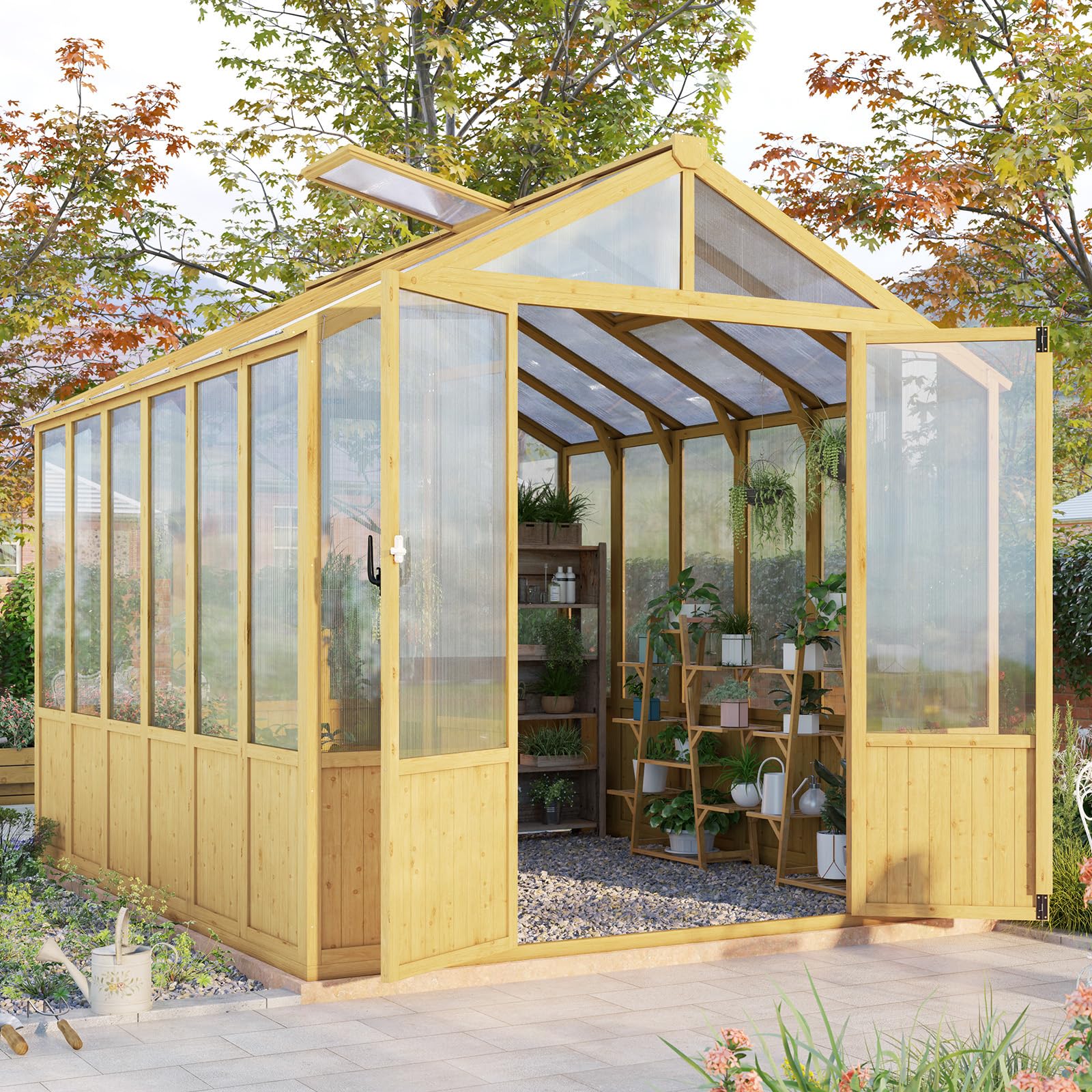
A mid-sized cedar greenhouse that goes from box to built in a single afternoon with 95% pre-assembled parts, plus a verified 625 lbs load capacity.
The walls, doors, and windows arrive already assembled, so you connect them with hardware rather than building from scratch. That is a huge time saver compared to the FLY BY YAN or CABIHOME kits below, which can take a full day or more and require drilling and panel sliding. The cedar frame is rated for 38-46 mph wind and has a maximum load capacity of 625 lbs — real numbers that tell you what it can handle. Polycarbonate sunboard panels (a single-layer or twin-wall polycarbonate sheet) provide heat insulation and UV protection, keeping temperatures stable during winter sunny spells and blocking harmful rays.
You get two adjustable roof vents and a lockable door for airflow control, and with a 5.38ft wall height and 7.45ft peak height, there is enough room to move around comfortably. Reviewers consistently mention the easy assembly — one person said they had it together in “a handful of hours” — and the seller offers responsive customer support. Compared to the Palram Canopia above, this gives you 76 sq ft versus 32 sq ft, but it lacks the published snow load rating that the Backyard Discovery carries. One owner noted the wood can be soft and prone to chipping during handling.
If you want a cedar greenhouse that sets up fast, has generous interior room, and gives you real wind and load ratings, this is a strong mid-range choice.
Setup Advantage
- Pre-assembled walls make this one of the fastest build kits among all winter-capable greenhouses here
- Cedar frame with published 38-46 mph wind rating and 625 lbs load capacity
- Two roof vents provide better heat escape than single-vent kits on sunny winter days
Winter Limitation
- No published snow load rating — you must clear snow manually after storms
- Soft cedar wood can chip or bend during assembly if handled roughly
- Roof vent may blow shut in strong winds and needs a more secure latch
Grab this if: You want a cedar greenhouse without spending days on assembly — the pre-built panels make this one of the quickest setups for a wooden structure.
skip it if: Your area regularly gets heavy snowfall that would require a rated snow load; the Backyard Discovery or a metal-framed kit is safer for deep snow zones.
5. WUKHG 8X10FT Greenhouses for Outdoors with Electronic Thermometers
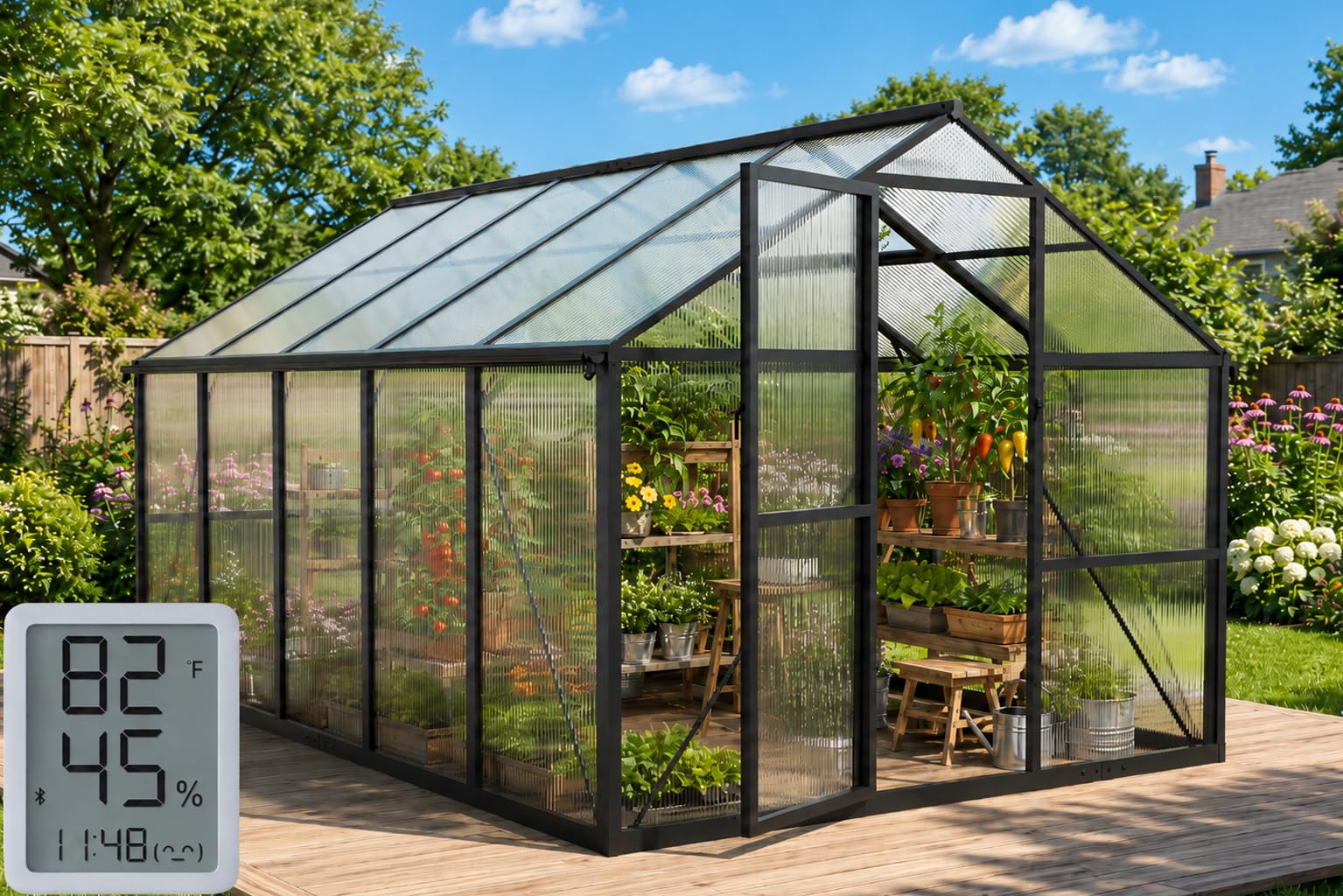
The only kit here that includes a digital thermometer (a temperature sensor) you can monitor from your phone, with ±0.54℉ accuracy.
With 2 vents, while the smaller FLY BY YAN and CABIHOME kits have 1 vent each, the WUKHG gives you better heat escape on sunny winter days — a real advantage because even in cold weather, a sealed greenhouse can hit dangerous temperatures by midday. The included electronic thermometer connects to an app for real-time monitoring, featuring a precision sensor with ±0.54℉/±0.3℃ temperature accuracy and ±3%RH (relative humidity) accuracy, refreshing every 2 seconds. You get access to 14-day data graphs and half-year data export, so you can track temperature swings and adjust your heating strategy.
The 4mm thick twin-wall polycarbonate panels (two-layer plastic sheets) and aluminum alloy frame are built to handle strong winds, heavy rain, and blizzards, according to the manufacturer. At 119.2 inches long by 97.2 inches wide, this is the largest metal-framed footprint in the mid-range; the FLY BY YAN 6×4 is 66.9 inches long. One buyer report noted the kit “heats to 100°F when 40°F outside, but cools to ambient by midnight,” meaning the panels hold heat during the day but you still need a supplemental heater for overnight frost protection. Assembly requires 3 people due to larger panel sizes and alignment challenges.
If you need a bigger space than the 6×4 or 6×7 options below and want the convenience of digital temperature monitoring, this offers the best size-to-features ratio at a mid-range price.
Smart Feature Highlight: The built-in electronic thermometer with ±0.54℉ accuracy and 14-day data graphing lets you see exactly how your greenhouse temperature behaves through the winter — a practical tool for deciding when to run a heater or open vents. No other kit in this price range offers this.
Best for: Gardeners who want a large metal-frame greenhouse with app-based temperature tracking, plus the ability to vent heat effectively with two roof vents.
Consider carefully: The panels and window hardware feel thinner than premium kits, and you will need a reliable heater for overnight frost protection — the panels alone will not keep temperatures above freezing through a cold night.
6. CABIHOME 6×7 FT Outdoor Greenhouse
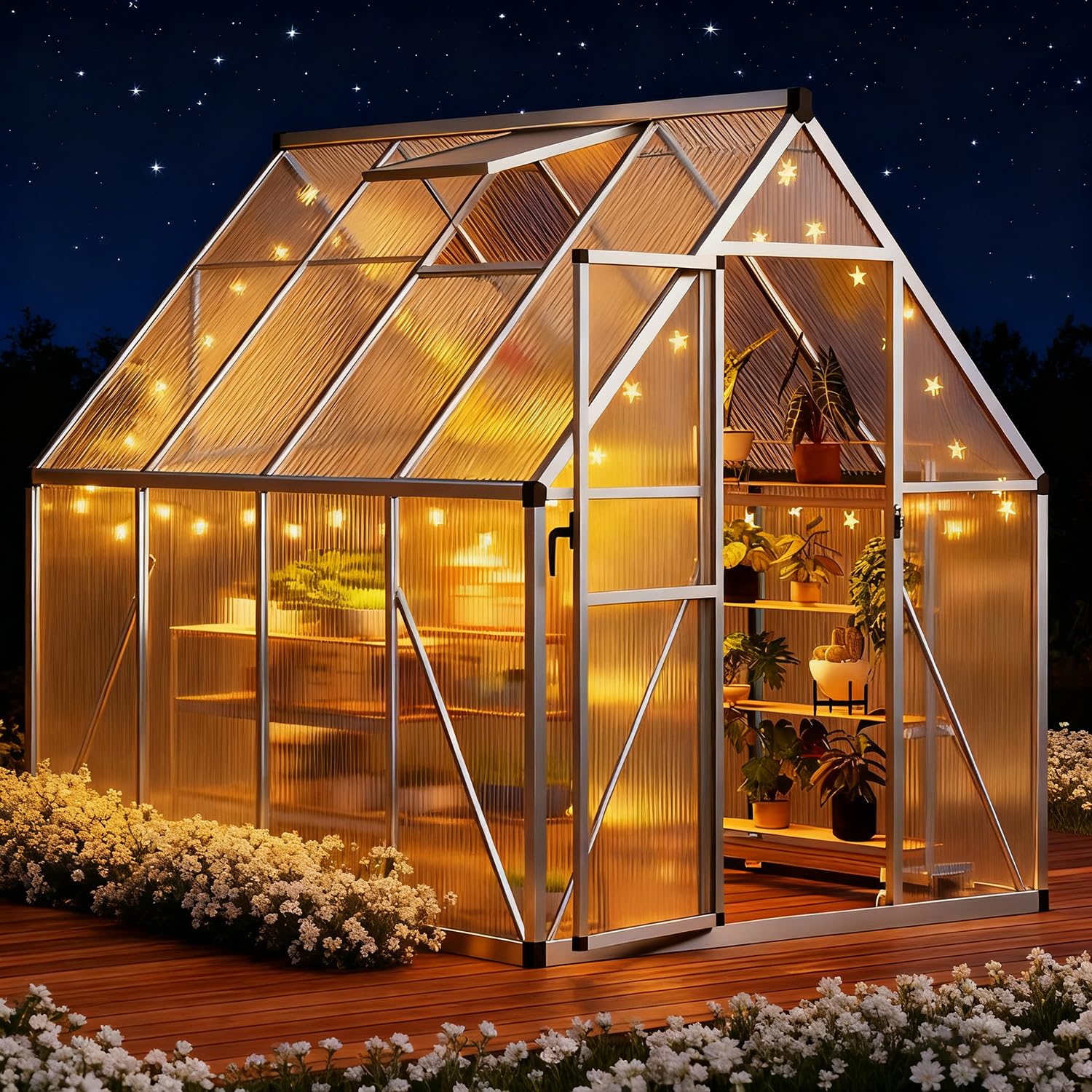
The only budget-friendly kit that publishes a real snow load rating — 18psf — and is certified for 50mph winds, unlike the unrated FLY BY YAN.
This is the standout choice if you want a metal-frame greenhouse with actual winter specs you can trust. The 4mm twin-wall polycarbonate panels (two-layer plastic sheets) block 99.9% of UV rays while retaining heat, and the reinforced aluminum frame is rated for 50mph winds and 18psf (40kg/sqm) snow load — numbers that give you a concrete benchmark for what it can survive. At 75.8 pounds versus 50.9 pounds for the FLY BY YAN 6×4, it reflects the beefier frame and thicker panels. Reviewers confirm it withstood 50mph winds in real use, with one buyer calling it “better than expected” after the panels held up to hail, rain, wind, and sun.
The adjustable roof vent helps manage the “gets very hot in sun” issue that multiple reviewers noted. Shoppers say that you can solo-assemble it in about 5 hours thanks to the quick-connect system and clearly labeled parts. One experienced gardener mentioned adding an automatic vent opener and caulking around the panels to prevent wind damage, which is a smart tip for long-term winter use. The lockable door and integrated gutter system round out the practical features. Compared to the FLY BY YAN below, this one weighs 75.8 pounds versus 50.9 pounds and comes with a published 18psf snow load rating that the smaller kit lacks entirely.
If you need a winter-ready greenhouse on a budget but refuse to gamble on unrated panels and frames, this is the middle ground that actually delivers on its promises.
Winter Specs You Can Use
- Published 50mph wind rating and 18psf snow load rating — real numbers, not marketing hype
- 4mm twin-wall polycarbonate with 99.9% UV protection for heat retention and plant safety
- Multiple reviewers confirm it survives real storms, including hail and 50mph winds
Installation Notes
- Panels can pop out in high winds unless you caulk or seal them, per reviewer tips
- Top vent works but some owners added an automatic opener for more consistent airflow
- Assembly manual had a wrong screw type in one reviewer’s kit, causing minor delay
Reach for this if: You want a budget-friendly greenhouse that gives you real, verified winter specs — the 50mph wind rating and 18psf snow load are unusual at this price and are backed by buyer reports of surviving actual storms.
Look elsewhere if: You need a larger footprint than 6×7 ft or want a wooden frame for better natural insulation.
7. FLY BY YAN 6×4 FT Polycarbonate Greenhouse
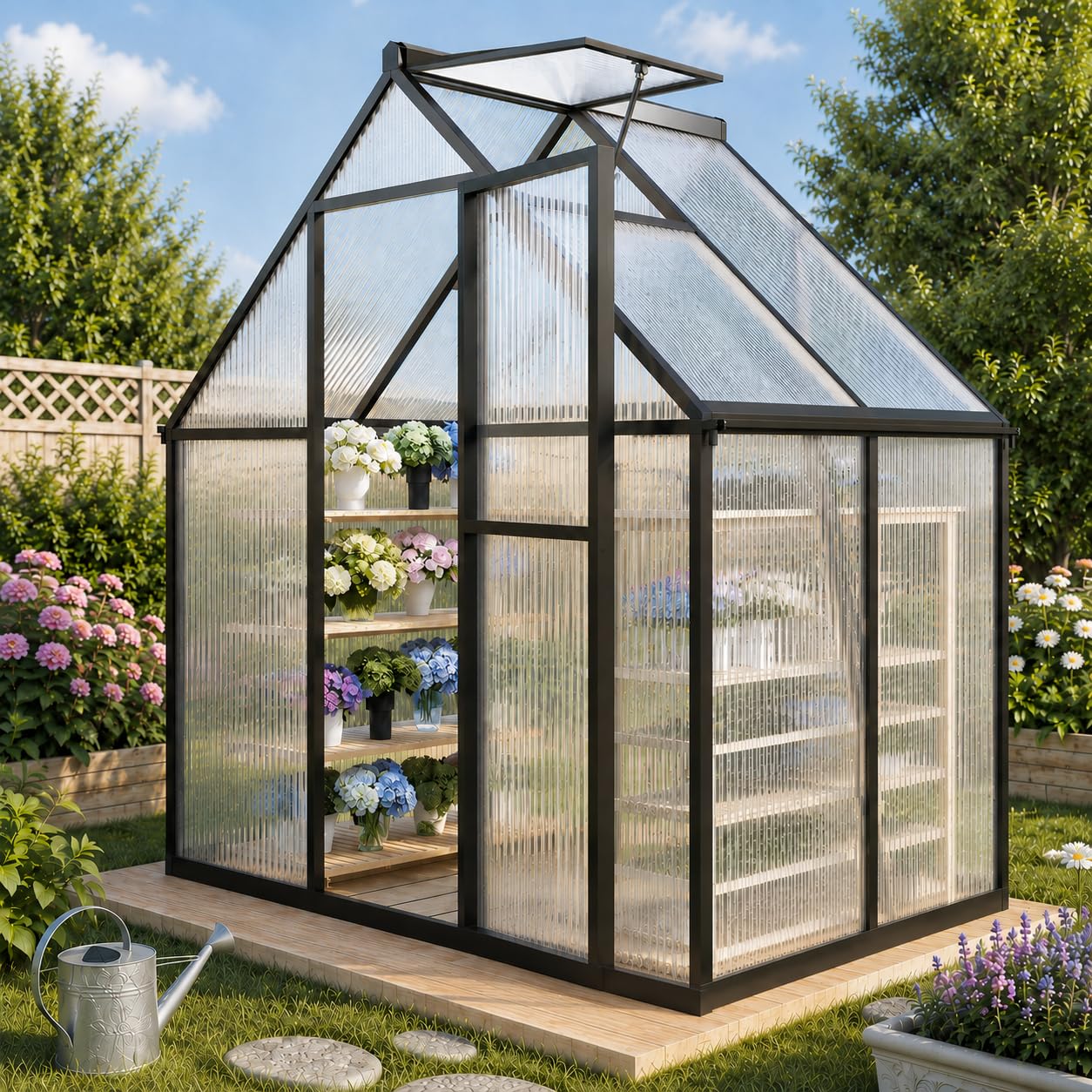
The most affordable entry into winter greenhouse gardening, if you know its limits. One owner reported it survived 60 mph winds with minor damage after proper anchoring.
At 66.9 inches long by 44.9 inches wide by 77 inches tall, this is the smallest footprint in the list, making it a good fit for tight backyards or first-time greenhouse owners. The charcoal black finish resists scratches and rust better than glossy options, and the 720g/m² twin-wall polycarbonate panels (two-layer plastic sheets) provide insulation and diffused light for even plant growth without the shatter risk of glass. The quick-install system promises a 40% faster setup and 35% enhanced stability, according to the manufacturer, though buyers report the reality is more complex — one reviewer completed solo assembly in 5 hours after organizing parts, while another struggled with misaligned roof panels.
The lockable door and single roof vent give you basic climate control, and the rain gutter system channels water away from the base. Owners mention that when properly anchored — one reviewer used treated wood on a brick foundation in zone 8a — the structure withstood wind and heavy rain impressively. Another noted the kit “survived 60 mph winds with minor damage,” which is impressive for an entry-level unit. The catch is that winter performance depends heavily on anchoring and sealing. Without it, one reviewer’s structure “flew 20-30 ft in wind” before being anchored down. Unlike the CABIHOME 6×7 kit above, this one lacks a published snow load rating.
If you are on a tight budget and want to dip your toes into winter greenhouse growing, this is the most wallet-friendly starting point — just plan for beefed-up anchoring and a separate heater.
Honest Take: This is a solid starter greenhouse that can handle winter if you anchor it properly and add a heater, but the assembly requires patience and the components lack the precision of higher-priced kits. The buyer report of surviving 60 mph winds shows the panels are tougher than they look.
Best for: First-time greenhouse buyers who want to test winter growing on a budget without investing in a premium kit — it works if you anchor well and provide supplemental heat.
Not recommended for: Gardeners in heavy snow zones or anyone who wants a quick, tool-free setup; the assembly is involved and the roof panel alignment can be frustrating.