
A sudden freeze in a greenhouse doesn’t just stress plants — it collapses the entire microclimate you fought to build. That’s why a true greenhouse heater must fight three enemies simultaneously: ambient cold, rising humidity, and the radiant heat loss that drafts cause. Without a unit built for damp, enclosed spaces with limited airflow, most heaters either short-cycle or shut down when you need them the most.
I’m Rikta — the co-founder and writer behind Lawn Gear Lab. I’ve spent weeks comparing thermal output specs, IPX ratings for moisture resistance, thermostat accuracy patterns, and the real-world failure reports from greenhouse owners who lost crops to heater glitches during the coldest nights of the year.
Whether you are overwintering tropicals, starting seedlings, or protecting delicate orchids from a hard frost, finding the right best greenhouse heater means balancing safe heat output against reliable temperature control in a wet, confined environment.
How To Choose The Best Greenhouse Heater
Selecting a greenhouse heater is not the same as picking a space heater for your living room. The environment inside a greenhouse is humid, often drafty, and packed with plants that react poorly to rapid temperature swings. You need a unit that can handle moisture without shorting out and maintain consistent warmth without cooking your seedlings.
Match Your Heater Type to Your Setup
Forced-air fan heaters (like the Bio Green PAL 2.0) circulate warm air quickly and prevent stagnant pockets of cold. They are excellent for larger greenhouses with good air circulation. Oil-filled radiant heaters (like the DREO) provide silent, even heat without drying out the air, making them ideal for smaller greenhouses or overnight use. PTC ceramic heaters (like the LHUKSGF) offer fast, self-regulating heat that adjusts output without overheating — a strong middle ground for most hobby greenhouses.
Prioritize Thermostat Reliability and Splash Protection
A heater with a faulty thermostat becomes a liability during a freeze — several customer reviews detail units that displayed “Err” or cycled erratically, dropping greenhouse temps below freezing. Look for models with a separate remote probe thermostat or a proven track record of accuracy. IPX4 splash protection is non-negotiable for a greenhouse environment where condensation and irrigation water are constant threats.
Calculate Wattage and Coverage Realistically
As a rule of thumb, a 1500-watt heater can maintain a temperature about 20-30°F above the outside temperature in a well-insulated 100-120 sq ft greenhouse. If your greenhouse is larger or has single-pane glazing, you may need supplementary heating or a unit with higher BTU output. Always add a small margin of safety — underpowering a heater on a freezing night is the fastest way to lose plants.
Quick Comparison
On smaller screens, swipe sideways to see the full table.
| Model | Category | Best For | Key Spec | Amazon |
|---|---|---|---|---|
| AC Infinity THERMOFORGE T7 | Smart PTC | Precision VPD control | 1000W / 10 PTC Levels | Amazon |
| Caframo True North | Forced Air | Reliable anti-freeze mode | 5200 BTU / 170 sq ft | Amazon |
| DREO Radiator Heater | Oil Filled | Silent overnight use | 1500W / 250 sq ft | Amazon |
| Bio Green PAL 2.0 | Fan Heater | Dedicated greenhouse units | 5120 BTU / IPX4 | Amazon |
| DR. INFRARED HEATER DR218 | Infrared | Frost protection | 1500W / 150 sq ft | Amazon |
| LHUKSGF PTC Heater | PTC Ceramic | Budget-friendly 3-mode | 40-108°F / IPX4 | Amazon |
| Heat Storm HS-1500-ILODG | Infrared Quartz | Large zone heating | 5200 BTU / 300 sq ft | Amazon |
In‑Depth Reviews
1. AC Infinity THERMOFORGE T7
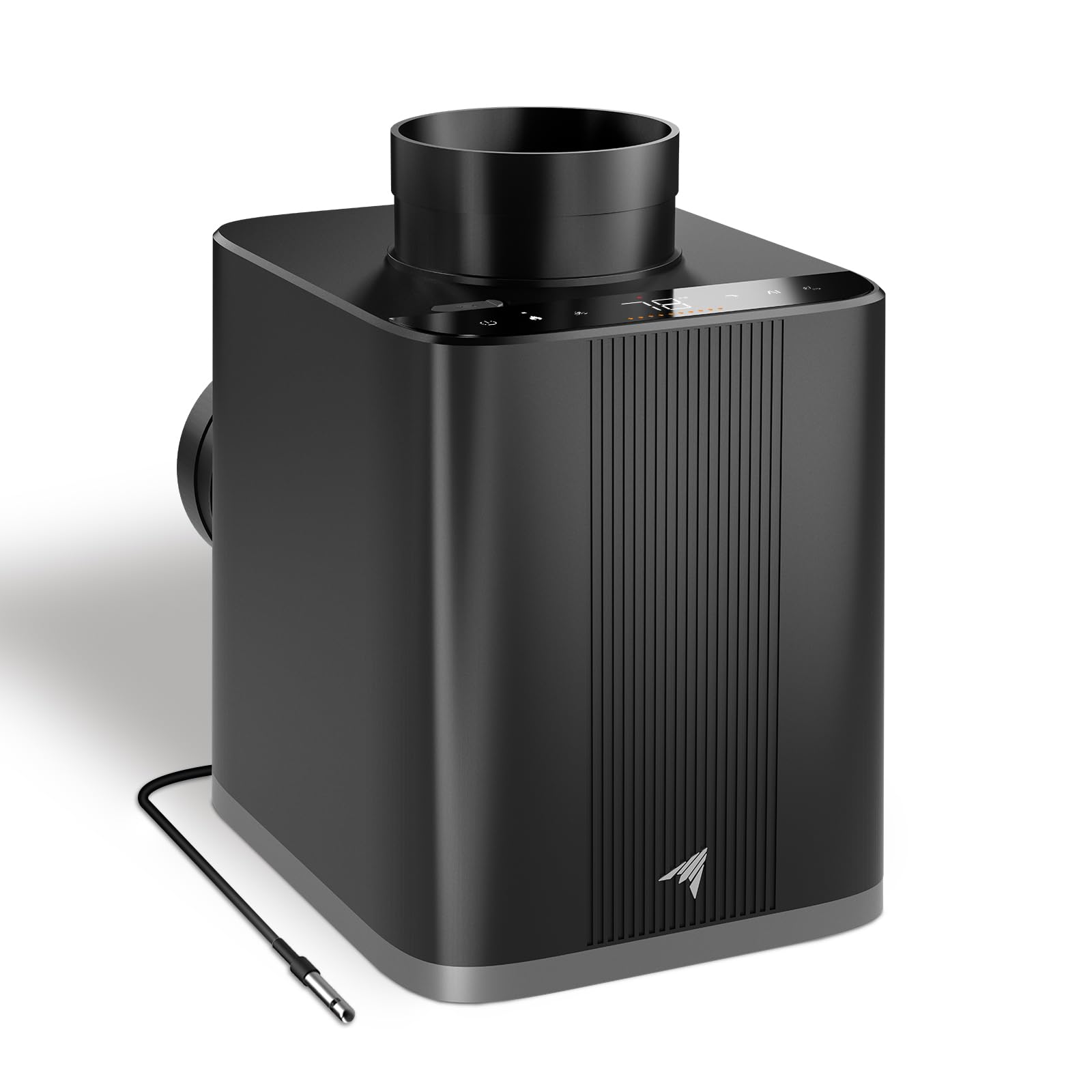
The AC Infinity THERMOFORGE T7 is the smartest unit in this roundup for a grow tent or greenhouse owner who wants precision climate control. Its 1000W PTC heating element is modulated by a PWM controller that delivers ten distinct heat levels, rather than the crude on-off cycling of most heaters. That means your temperature stays within a tighter band, which is critical for tropical plants and seedlings that stress under wide swings.
The dual-port design lets you duct heated air directly into your grow space or create a closed-loop recirculation setup, keeping the heat where it matters without bleeding into unheated zones. The wired temperature and VPD sensor probe sits at canopy level, not inside the heater housing, so the readings reflect the actual conditions your plants experience rather than the hot air recirculating near the unit.
Integration with AC Infinity’s UIS controllers unlocks WiFi app connectivity for data tracking and automations. The “Adaptive AI” label oversells what is essentially a well-tuned proportional controller, but the result — stable temperatures with minimal overshoot — is genuinely better than any thermostat-only unit in this category. For the serious grower, the THERMOFORGE T7 is the obvious pick.
What works
- True 10-level PWM modulation eliminates temperature swings
- Dual-duct design for closed-loop or directed heating
- Wired remote sensor measures actual canopy temp
What doesn’t
- Ducting not included with the unit
- App connectivity requires separate UIS controller purchase
2. Caframo True North Heater

The Caframo True North is built like a tank. Its solid steel housing and low-profile cabinet design (only 5 inches deep) make it nearly impossible to tip over, and the industrial-grade build quality earns it a five-year warranty from a Canadian manufacturer with a marine and RV reputation. The dedicated anti-freeze setting automatically turns the heater on when ambient temperature drops to 38°F, making it a set-and-forget solution for overwintering.
You get five settings: three heat levels (approx 560W, 780W, and 1195W at 120V) plus two fan-only modes, so you can circulate air without adding heat during milder weather. The forced-air method distributes warmth evenly across 170 sq ft, and the ultra-quiet operation means it won’t disturb you or the plants with constant fan noise. Multiple owners report using the same unit for over five years without failure.
One nuance: the internal thermostat can fail faster than the heating element itself — some users bypass it for an external thermostat and report another 2-3 years of reliable service. The over-temperature safety switch also trips if the bearings stiffen, which is a safe failure mode but requires a reset. Overall, the True North offers the best build quality and reliability for anyone willing to invest in a heater that lasts.
What works
- Dedicated anti-freeze setting kicks in at 38°F automatically
- Industrial steel build with five-year warranty
- Ultra-quiet forced-air operation
What doesn’t
- Internal thermostat prone to failure after extended use
- Higher cost than comparable wattage heaters
3. DREO Radiator Heater

The DREO oil-filled radiator heater produces absolutely silent heat — no fan noise, no clicking elements, just a gentle convection loop that warms the air without stirring up dust or drying out the humidity your plants need. Its eight M-shaped fins create 59.5% more dissipation area than straight fins, distributing 1500W of heat across up to 250 sq ft without reaching scalding surface temperatures.
The digital thermostat is accurate to within ±4% according to DREO’s spec, and the ECO mode dynamically adjusts wattage between 600W, 900W, and 1500W to maintain the set temperature efficiently. You can dial in any temperature from 41°F to 95°F in 1°F increments, and the 24-hour timer lets you preheat the greenhouse before sunrise without running the heater all night. The remote control adds convenience when the heater is placed in the far corner of a large greenhouse.
One important trade-off: radiant heaters heat the air slowly compared to forced-air units. The DREO is not a quick-recovery heater — if you open the greenhouse door on a freezing day, it takes time for the thermal mass of the oil to catch up. It works best as a constant-temp maintenance heater rather than a spot-defrost tool. The surface stays warm but safe to touch, and the tip-over plus triple overheat protection provide peace of mind.
What works
- Completely silent operation for overnight use
- Accurate digital thermostat with 1°F adjustments
- Safe surface temperature won’t burn plants or pets
What doesn’t
- Slow to raise temperature after door opens
- Heavier unit at 20.6 pounds without wheels
4. Bio Green PAL 2.0/US Palma
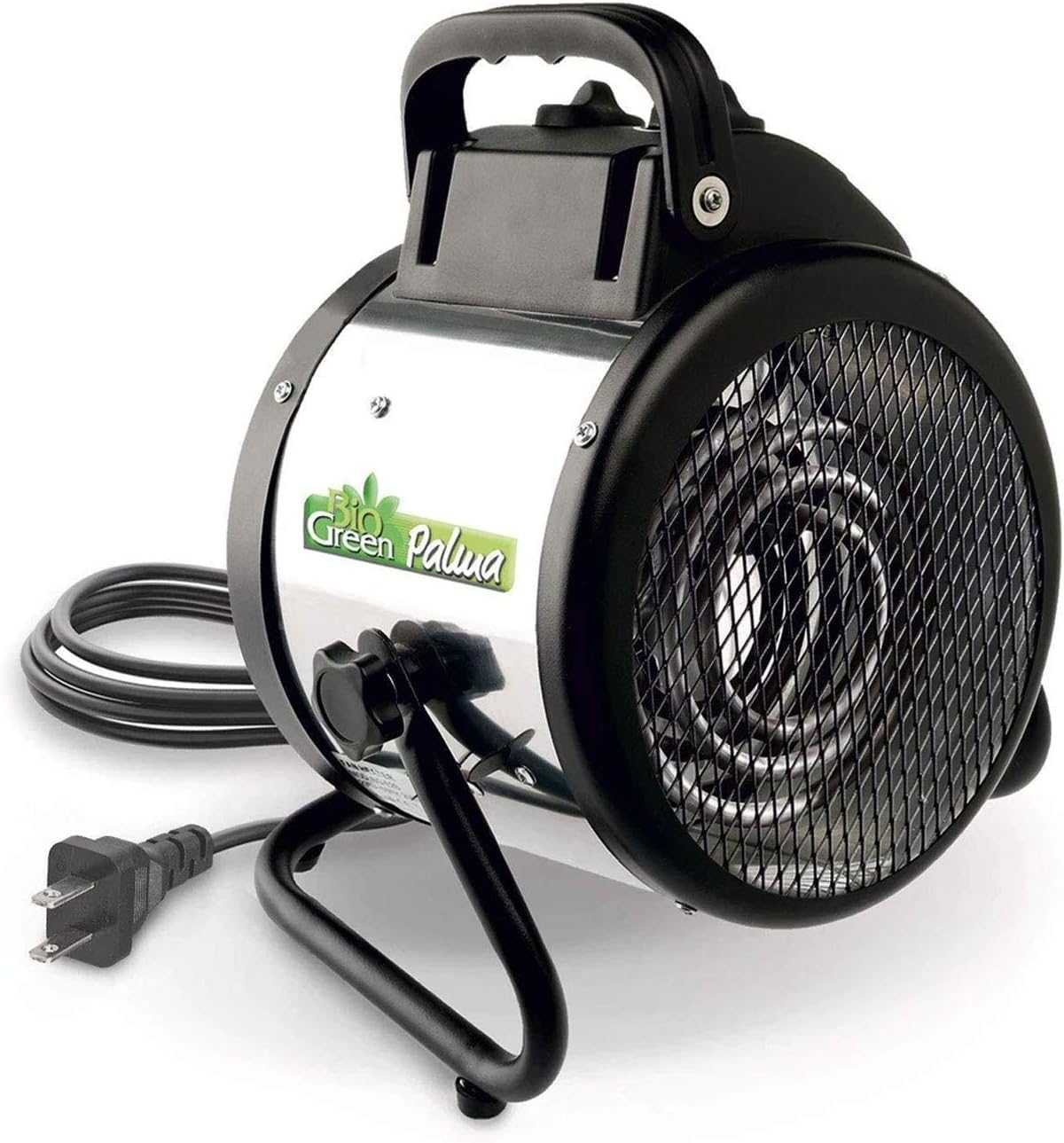
The Bio Green PAL 2.0 is one of the few heaters in this category purpose-engineered for greenhouse use, not adapted from a home space heater. Its IPX4 splashproof rating means it withstands condensation, rain splash, and even irrigation overspray without failing. The stainless steel housing resists corrosion in the humid environment where most residential heaters corrode their electrical contacts within two seasons.
Two separately adjustable heating elements let you choose between 2560 BTU and 5120 BTU output, covering a greenhouse up to 120 sq ft with 6.6-foot ceilings. The stepless thermostat has a range from 32°F to 185°F, which is unusually broad and includes a dedicated air circulation mode — the fan moves 4317 cubic feet of air per hour without any heat, preventing stagnant air pockets that encourage fungal diseases on foliage.
The catch is that the built-in thermostat is uncalibrated and may not hold precise temperatures. Several owners recommend setting the heater’s thermostat to maximum and using an external digital thermostat for actual temperature control, which adds cost but solves the accuracy issue. Also, the unit draws high amps — it tripped a 20A breaker for one user when running simultaneously with lights. Dedicate a circuit for best results.
What works
- IPX4 splashproof and corrosion-resistant stainless steel build
- Dual-5200 BTU elements with air circulation fan mode
- Broad thermostat range from 32°F to 185°F
What doesn’t
- Built-in thermostat is not calibrated accurately
- High amp draw may require a dedicated circuit
5. Heat Storm HS-1500-ILODG

The Heat Storm HS-1500-ILODG stands out for its patented HMS (Heat Management System) technology, which combines infrared quartz heat with humidity in the room to produce soft, oxygen-preserving warmth. That matters in an enclosed greenhouse where standard heaters can reduce humidity below the level tropical plants need. The infrared element heats objects and plants directly rather than just the air, which can help maintain leaf surface temperature even if a draft pulls away warm air.
A built-in calibratable temperature sensor is a rare feature at this level — you can adjust the displayed temperature reading up or down to match a reference thermometer, fixing the common problem of thermostats that read 4-5°F off. Owners report the unit maintains room temperature within 1°F of the set point after calibration, which is outstanding for a consumer heater. The unit covers up to 300 sq ft as a primary heat source in a well-insulated space.
Infrared quartz has a slower response time than forced air and works best as a zone heater that runs continuously rather than cycling on and off. The cabinet stays cool to the touch, making it safer in a greenhouse where children or animals might brush against it. At 10 pounds with an optional caster kit, it is easy to reposition. The Eco mode reduces draw from 1500W to 750W automatically when the set point is near.
What works
- Calibratable temperature sensor with ±1°F accuracy
- Cool-touch cabinet and safe infrared quartz heat
- Eco mode automatically reduces wattage to 750W
What doesn’t
- Infrared heats objects, not air — slower room response
- Not IP-rated for moisture; indoor use only
6. DR. INFRARED HEATER DR218-1500W

The DR. INFRARED HEATER DR218-1500W is a straightforward, no-nonsense forced-air heater that prioritizes simplicity over smart features. Its IPX4 structure means it can handle humid greenhouse conditions and occasional splashes without concern. Weighing very little and measuring 10 x 10 x 15 inches, it fits neatly on a shelf or greenhouse bench without taking up floor space.
The 1500W heating element generates 5120 BTU and covers about 150 sq ft — enough for an 8×10 or 6×8 greenhouse. Owners report it maintained 42-48°F inside during a 22°F freeze, which is adequate for frost protection but not active growing. The fan blows warm air rather than hot, reducing the risk of scorching nearby plant foliage. The single-setting operation keeps things simple: plug it in and the heater runs until the room warms up.
However, there is a documented reliability issue. Multiple customer reports describe units where the wiring from the thermostat burned up, causing the heater to catch fire. In both reported cases, the company replaced the unit, but the failure pattern — undersized wire gauge for 20A draw — is concerning. This heater is best suited for frost protection in an unheated garage or small greenhouse where you can monitor it regularly, not for unattended overnight heating.
What works
- IPX4 rated for humid greenhouse environments
- Compact and lightweight for easy placement
- Warm (not hot) air is safe for plant foliage
What doesn’t
- Documented wiring burnout hazard in multiple units
- Single heat setting with no variable control
7. LHUKSGF PTC Greenhouse Heater
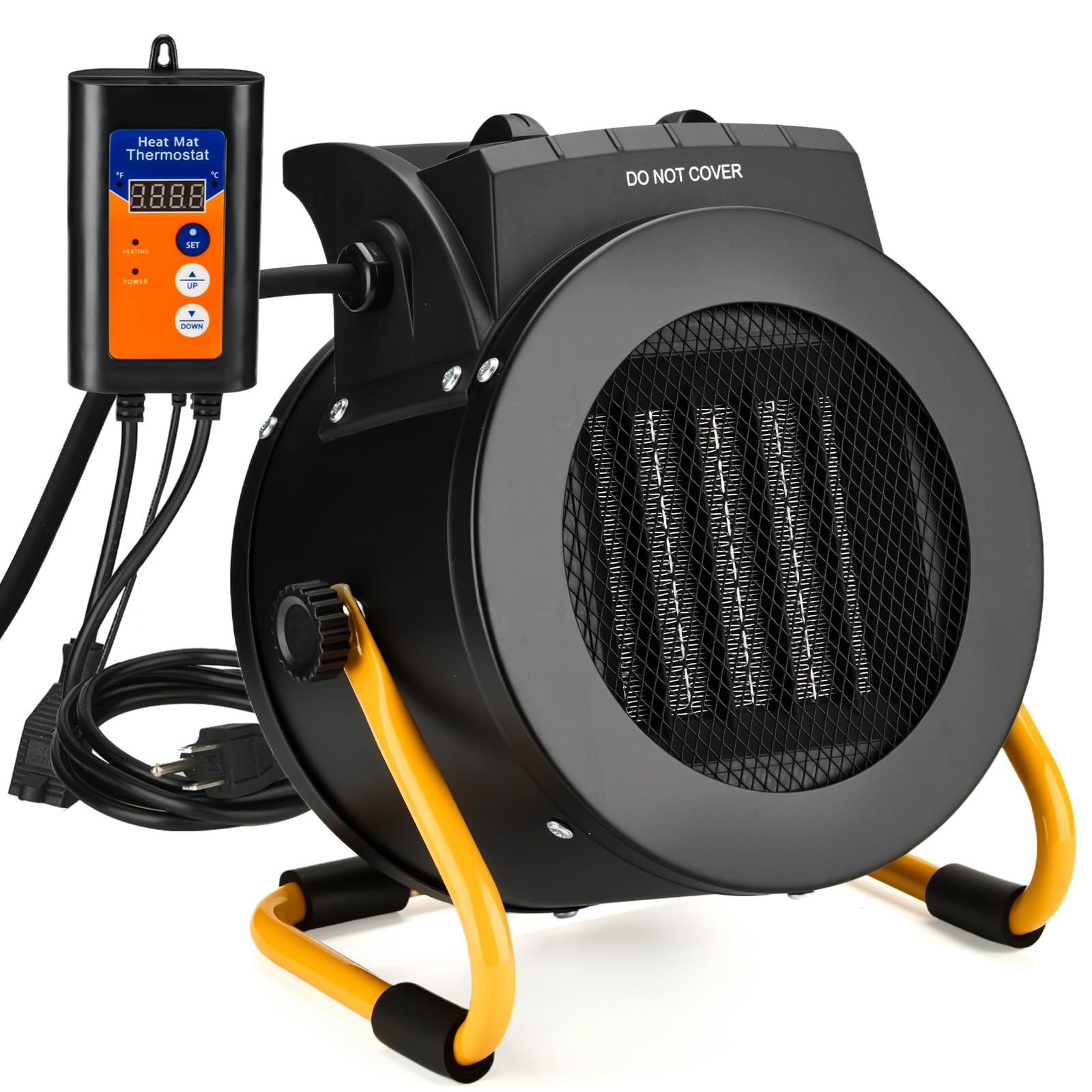
The LHUKSGF PTC heater delivers impressive value by combining three power modes (200W, 750W, and 1500W) with a digital thermostat that operates from 40°F to 108°F — all in a compact IPX4-rated housing that’s ready for greenhouse moisture. The PTC ceramic element self-regulates its temperature, reducing power draw as the target gets closer, which prevents overheating even if the heater is accidentally covered or placed near plants.
The digital display shows the current ambient temperature and the set point, and the on/off timer lets you schedule heating windows. The included hanging hook and floor base give you two mounting options: hang it from a greenhouse frame to keep floor space clear, or set it on a bench. The anti-corrosion exterior and IPX4 dust/water resistance mean it can survive years of damp greenhouse conditions without the metal housing rusting through.
The main drawback is the thermostat reliability. One reviewer reported the thermostat showing “Err” mid-freeze, which caused the heater to fail to maintain temperature — a potentially lethal failure for plants. Another owner had the separate remote thermostat break within the first week. Both found that bypassing the thermostat and using the heater’s manual control solved the problem, but that workaround defeats the purpose of a thermostat-controlled heater. For the price, the performance is strong if you are willing to monitor the thermostat or use an external controller.
What works
- Three power modes (200W/750W/1500W) for flexible heating
- IPX4 rated with anti-corrosion exterior
- Includes hanging hook and floor base for versatile mounting
What doesn’t
- Thermostat unit prone to error codes and early failure
- Manual operation defeats the auto-setback purpose
Hardware & Specs Guide
PTC vs. Infrared vs. Radiant
PTC (Positive Temperature Coefficient) ceramic elements self-regulate — as the temperature rises, resistance increases, automatically reducing power. Infrared quartz heats objects directly without warming the intervening air, which works well for targeted plant heating but cannot circulate air evenly. Oil-filled radiant heaters (radiator style) warm oil sealed inside fins, which then radiates heat silently and slowly. For a greenhouse, PTC offers the best balance of speed, safety, and self-regulation, while oil-filled is best for quiet overnight maintenance heating.
IPX4 Splash Protection
IPX4 means the heater is protected against water splashing from any direction — critical for a greenhouse environment where condensation drips, irrigation overspray, and hosing down benches are routine. An indoor-only heater (no IP rating) can short its electrical components within one season of greenhouse use. Always look for an IPX4 rating or higher in the product specifications if you plan to use the heater in any space where moisture is present.
BTU Output and Coverage Matching
BTU (British Thermal Units) measures heat output. 1500W equals about 5120 BTU. A heater with 5120 BTU is adequate for maintaining temperatures in a well-insulated greenhouse up to 150 sq ft during mild freezes. For a 300 sq ft greenhouse or one with single-pane glazing, look at 10,000+ BTU options or plan to run two units. Overestimating coverage leads to heaters that run continuously without ever reaching the set point, wasting electricity and stressing plants with uneven temperatures.
Thermostat Accuracy
Most greenhouse heater thermostats are simple bimetallic strips that can drift 5-7°F from the set point. Digital thermostats with ±1-4% error are far better for maintaining stable conditions. Some units allow calibration (you adjust the displayed temperature to match a reference thermometer), which is a major advantage for precision growers. Remote sensor probes that sit at plant canopy level provide far more accurate readings than sensors built into the heater housing, which are heated by the unit’s own output.
FAQ
Can I use a regular space heater in my greenhouse?
What size heater do I need for a 6×8 greenhouse?
Should I choose a fan heater or oil-filled radiator for plants?
Is PTC ceramic heating safe for a greenhouse?
Final Thoughts: The Verdict
For most gardeners, the best greenhouse heater winner is the AC Infinity THERMOFORGE T7 because its 10-level PWM PTC modulation and remote sensor probe eliminate temperature swings that stress plants. If you want silent overnight heat and precise digital thermostat control, grab the DREO Radiator Heater. And for a dedicated IPX4-rated unit built to survive humid greenhouse conditions year after year, nothing beats the Bio Green PAL 2.0.