
You have the seeds, the soil, and the ambition to garden from early spring straight through late fall. But a single late frost, a sudden hailstorm, or a persistent deer can erase weeks of work in an afternoon. A permanent structure changes that equation entirely. A dedicated greenhouse for backyard use creates a controlled microclimate that extends your growing season, shelters tender transplants, and lets you start seedlings weeks earlier than you could outdoors.
I’m Rikta — the co-founder and writer behind Lawn Gear Lab. I’ve spent months analyzing every dimension, panel thickness, and frame material in this market, cross-referencing owner feedback against the official specs to understand exactly which structures deliver real durability and which cut corners you will end up sealing with silicone yourself.
Whether you are protecting tomatoes from an unpredictable spring or overwintering herbs in a temperate zone, finding the right greenhouse for backyard comes down to frame rigidity, panel quality, and ventilation design — the three specs that separate a season-extending asset from a wind hazard.
How To Choose The Best Greenhouse For Backyard
Every backyard greenhouse buyer eventually discovers that square footage alone does not predict usability. A structure that handles your local wind load and retains heat without cooking your plants will serve you for years. Focus on three structural pillars before comparing prices.
Frame Material: Aluminum vs. Wood vs. Steel
Aluminum frames resist rust and keep the overall weight manageable, making them the most popular choice for mid-range kits. The trade-off is that aluminum flexes more than wood under lateral wind pressure. Cedar frames add natural decay resistance and a stiffer skeleton, but they weigh more and require occasional sealing. Fir frames are dense and strong but less rot-resistant without treatment. Steel frames offer the highest rigidity but add significant shipping weight and are rare in kits under the premium tier.
Polycarbonate Thickness and Wall Structure
Single-wall polycarbonate panels (roughly 4mm) transmit light well but provide minimal insulation. Twin-wall panels (roughly 4–6mm) trap a layer of air between sheets, improving heat retention by a measurable margin without sacrificing light. Four-wall panels (used in the premium tier) increase that air gap further, raising insulation by roughly 30% over twin-wall. Thicker panels also resist impact better — critical if your backyard sees hail, falling branches, or heavy snow accumulation.
Ventilation and Gutter Systems
Even in cool climates, an unvented greenhouse can reach 100°F on a sunny 40°F day. Adjustable roof vents create natural convection airflow that prevents heat stress on plants. A gutter system directs rainwater away from the base, reducing rot risk in wooden frames and preventing water pooling around the foundation. Models without gutters or with inadequate vent size will force you to add aftermarket exhaust fans or manual shade cloths.
Snow Load and Wind Rating
Your local climate dictates the structural demands. A budget polycarbonate greenhouse with thin panels and light aluminum framing may collapse under 10 inches of heavy snow. Premium kits from reputable manufacturers specify snow load capacities (some rated up to 2,800 pounds). Similarly, wind ratings above 50 mph require ground anchoring via stakes or concrete bolts — most lightweight kits are not engineered to survive a storm without those extra measures.
Quick Comparison
On smaller screens, swipe sideways to see the full table.
| Model | Category | Best For | Key Spec | Amazon |
|---|---|---|---|---|
| Backyard Discovery 9×6 | Premium Wood | Maximum durability & features | 2,800 lb snow load | Amazon |
| Yardenaler 8×10 | Fir Wood | Heavy four-season use | 6mm polycarbonate panels | Amazon |
| Jocisland Cedar 8×9.5 | Cedar Wood | Pre-assembled ease & aesthetics | Pre-assembled walls | Amazon |
| AirWire 6×8 Wooden | Pine Wood | Solid wood construction on budget | 6mm slide-in panels | Amazon |
| Sylviera 8×14 | Aluminum | Large aluminum footprint | 8×14 ft with hygrometer | Amazon |
| Jocisland 8×10 Aluminum | Aluminum | Tool-free assembly | Quick-connect frame | Amazon |
| YITAHOME 16×6 | Aluminum | Long narrow footprint | 16×6 ft sliding doors | Amazon |
| WUKHG 8×10 | Aluminum | App-connected monitoring | Electronic thermometer | Amazon |
| Outsunny 6×4 | Aluminum | Compact starter greenhouse | 6×4 ft footprint | Amazon |
In‑Depth Reviews
1. Backyard Discovery Willow 9×6
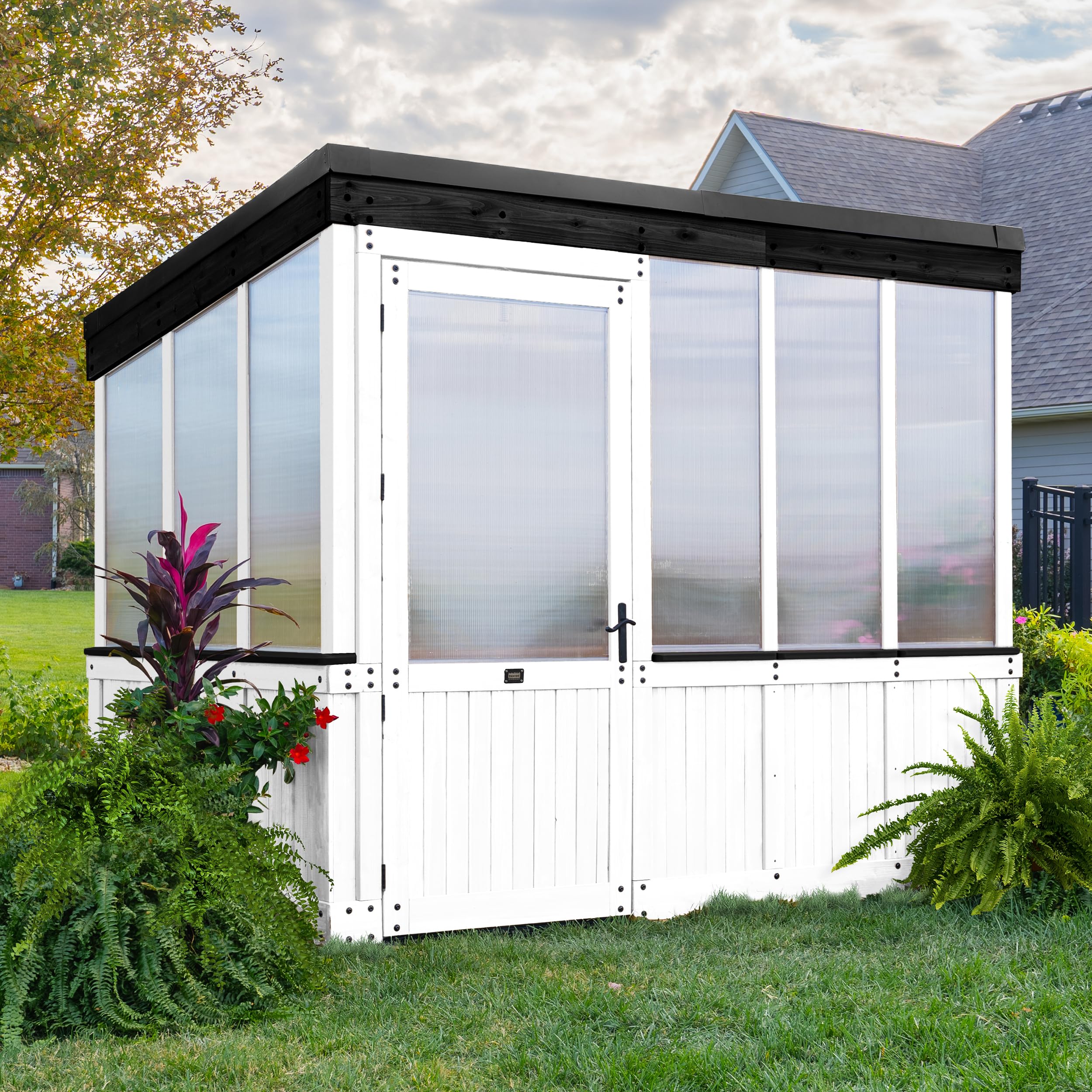
The Backyard Discovery Willow is the most feature-complete greenhouse in this roundup, and its Pro-Tect certification — tested to withstand 2,800 pounds of snow load and 100 mph winds — sets it apart from every other kit here. The 100% cedar frame resists decay naturally, while commercial-grade four-wall polycarbonate panels provide roughly 30% better heat retention than standard twin-wall panels. Owner feedback consistently highlights the integrated exhaust fan, PowerPort with three outlets and three USB ports, and both interior and exterior hose hook-ups as features that turn this structure into a true year-round gardening station.
Assembly takes a dedicated weekend — owners report roughly 20 hours for one person — but the pre-cut, pre-drilled parts and the BILT app instructions reduce the frustration common in other kits. The 54-square-foot interior includes 13 linear feet of fixed staging shelves and a built-in workstation, giving you immediate organization rather than empty floor space. The white stain finish adds weather resistance and a clean modern look that fits most backyards without clashing.
The price reflects the engineering and materials — this is not a budget impulse buy. The door panel shipped damaged in a small percentage of units, though the manufacturer replaced those panels quickly at no cost. If your budget allows and you want one greenhouse that handles snow, wind, and electrical accessories without modification, this is the clear choice.
What works
- Certified to survive 100 mph winds and 30 inches of snow
- Four-wall polycarbonate retains heat significantly better than twin-wall panels
- Built-in exhaust fan, PowerPort, and hose hook-ups eliminate aftermarket work
What doesn’t
- Assembly is a major multi-day project even with clear instructions
- Door panel occasionally arrives damaged during shipping
- Price is a serious investment for a casual gardener
2. Yardenaler 8×10
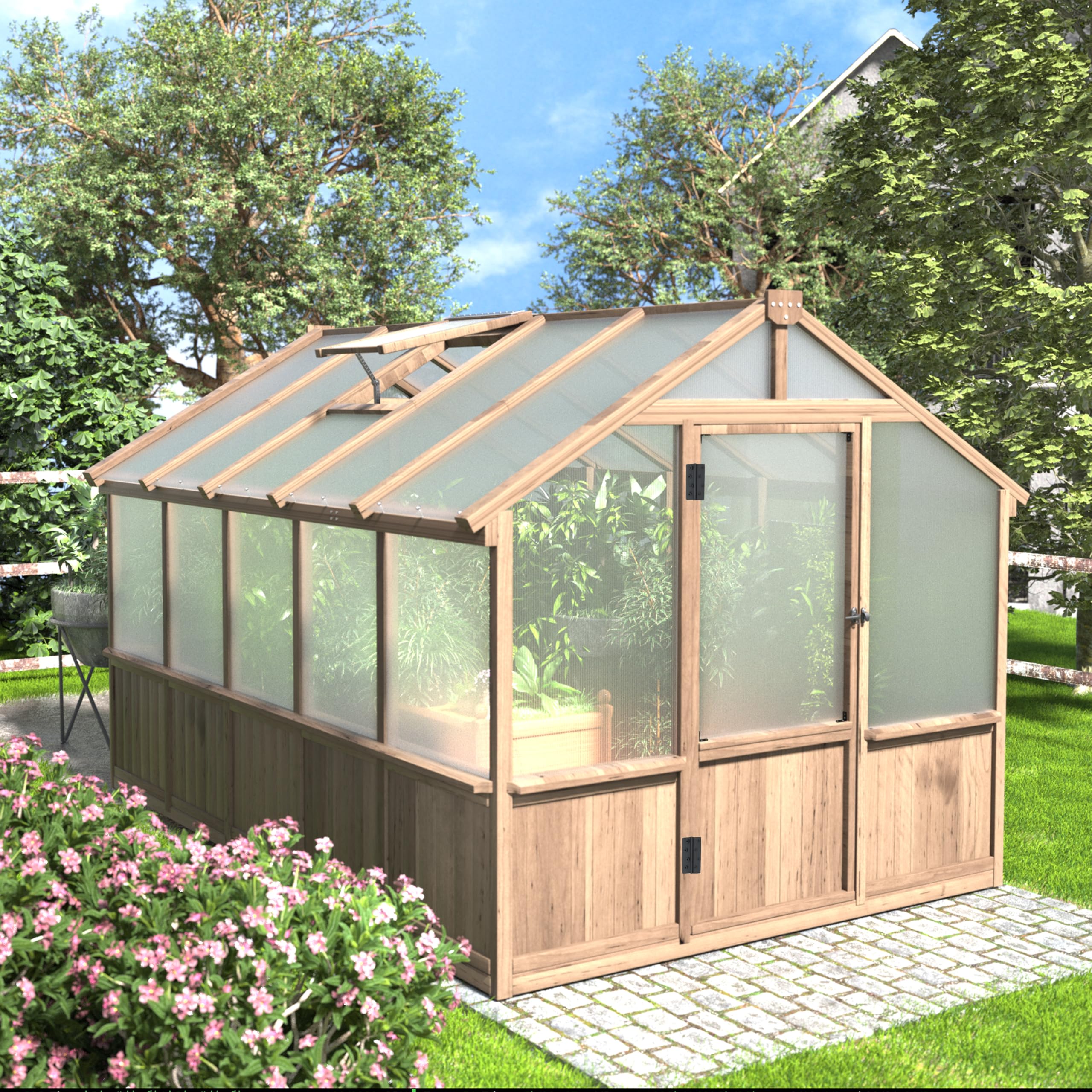
The Yardenaler 8×10 stands out for its 6mm multi-layer polycarbonate panels — a full 2mm thicker than the 4mm panels found in most mid-range aluminum kits. That extra thickness directly translates to better insulation and higher impact resistance, making this a strong candidate for climates with frequent hail or freeze-thaw cycles. The fir wood frame, reinforced with a sturdy base support, has held up against 50 mph winds and blizzards according to multiple owner accounts, and the 45-degree adjustable roof vent provides real control over internal temperature.
Assembly requires two people and a solid base — most owners recommend a 4×4 pressure-treated lumber foundation or gravel pad. The 8×10 footprint offers 80 square feet of interior space, enough for a small table, shelving, and a chair without feeling cramped. The wood frame delivers a natural aesthetic that aluminum kits cannot match, though the light mocha brown finish does require occasional sealing to maintain its appearance.
The main complaint involves the frosted film on the polycarbonate — it does not always adhere perfectly and can peel near the edges. The door and vent window require caulking at the seams to prevent leaks. For the money, you get a genuinely heavy-duty structure with thick panels, but expect to spend a day on assembly and an extra hour with a caulk gun.
What works
- 6mm polycarbonate panels provide superior insulation over thinner alternatives
- Fir frame is dense and handles strong winds and snow loads
- Adjustable roof vent with 45-degree angle for temperature control
What doesn’t
- Frosted film on panels can peel after exposure to weather
- Requires careful caulking at seams to prevent leaks
- Heavy structure needs a solid foundation and two people for assembly
3. Jocisland 8×9.5 Cedar
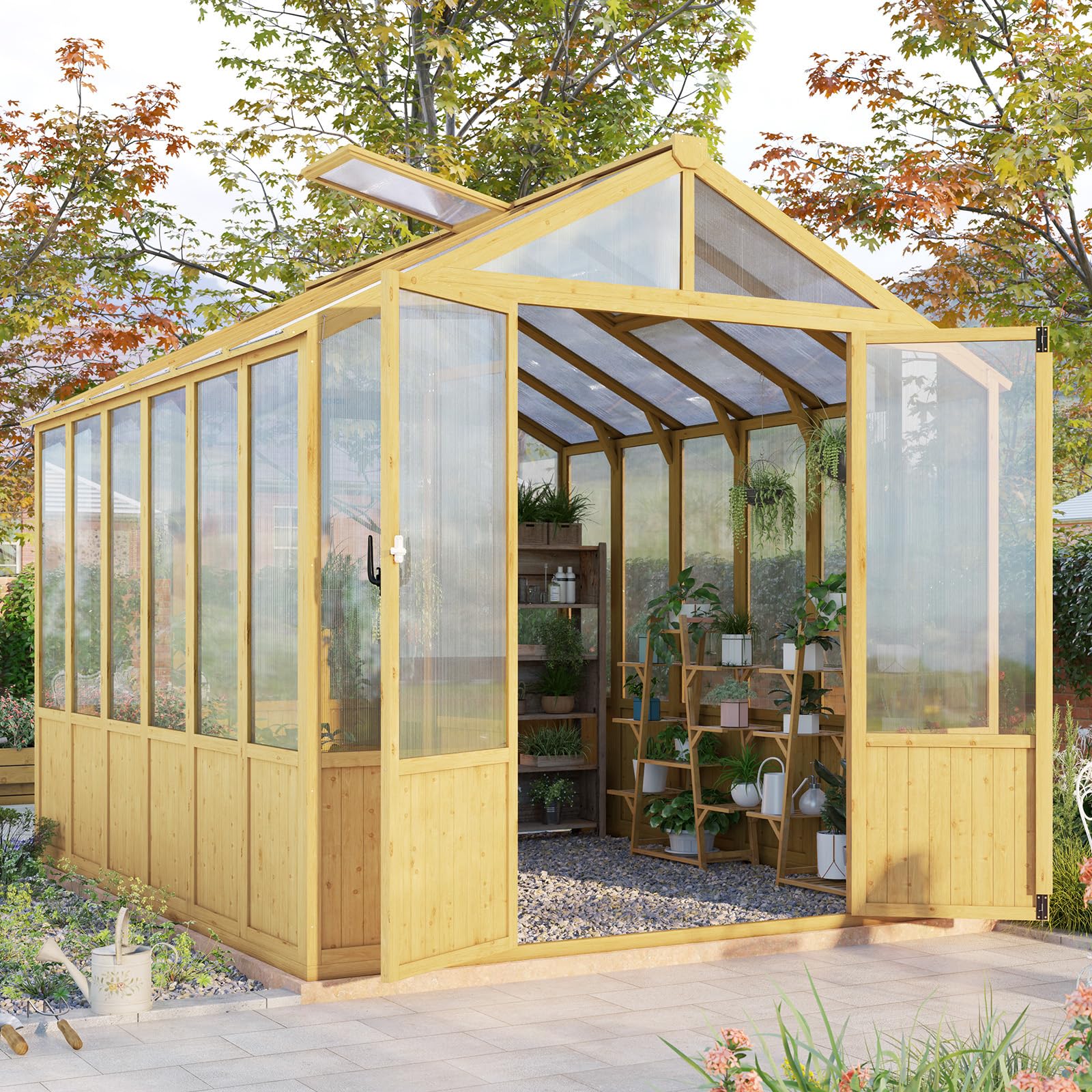
The pre-assembled wall panels of this Jocisland cedar greenhouse dramatically reduce build time compared to every other wood-frame kit on this list. Owners consistently report completing assembly in one afternoon — roughly 4 to 6 hours — because the walls, doors, and windows arrive already constructed. The cedar frame provides natural rot resistance and a warm appearance that blends into a garden setting better than silver aluminum. The wind rating of 38 to 46 mph with a maximum load capacity of 625 pounds covers most suburban backyard conditions.
At 8 feet by 9.5 feet with a 7.45-foot peak height, the interior feels spacious enough for a potting bench, shelving, and standing room. The two adjustable windows plus a swing door create good cross-ventilation, and owners praise the clear instructions and responsive customer service. The pre-assembled design also means fewer loose parts to sort and label, which eliminates the most tedious part of greenhouse construction.
The cedar wood is relatively soft — owners note it can bend or chip if over-tightened, and shipping damage is possible on the pre-assembled panels. The roof vent may close on its own in gusty wind unless you add a prop. For a gardener who wants a wood greenhouse without spending days on assembly, this is the best compromise between speed and quality.
What works
- Pre-assembled panels cut assembly time to a single afternoon
- Cedar frame offers natural decay resistance and an attractive appearance
- Spacious interior with enough height for standing and shelving
What doesn’t
- Soft cedar wood bends or chips if screws are over-tightened
- Roof vent does not lock in place and can blow shut
- Pre-assembled panels increase risk of shipping damage
4. AirWire 6×8 Wooden
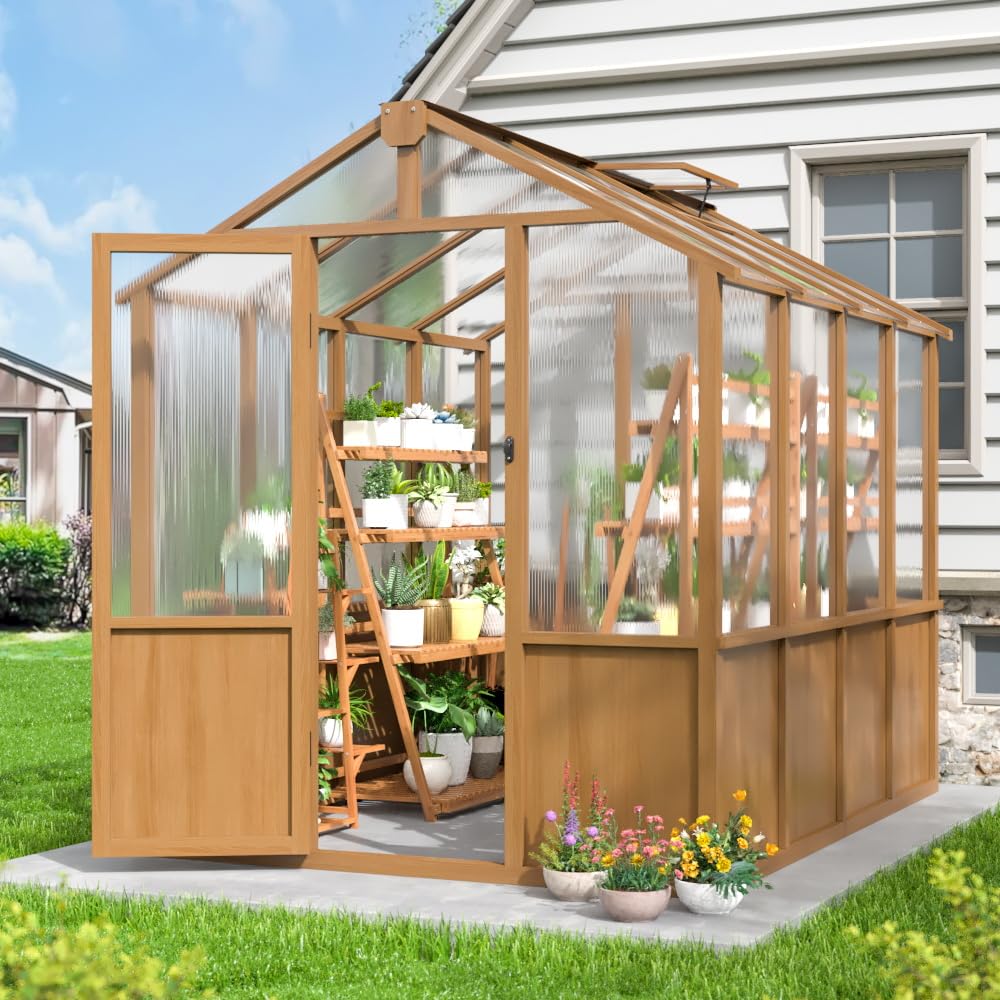
The AirWire 6×8 delivers a solid pine frame with 6mm slide-in polycarbonate panels at a price point that undercuts most other wood greenhouses. The slide-in panel system is genuinely faster to install than screw-in methods — owners confirm assembly is possible in a full day with two people. The 720g, 6mm-thick polycarbonate sheets include a UV coating that blocks 99.99% of harmful rays while still transmitting plenty of photosynthetically active light. The lockable door adds basic security, and the adjustable roof vent provides necessary airflow control.
Pine is less naturally rot-resistant than cedar, so this greenhouse benefits from a gravel or concrete base that keeps the frame off wet soil. Several owners anchored theirs to 80-pound pavers and reported no issues in 50 mph winds. The heat retention is impressive for the price — with a small heater, the interior can stay 20°F warmer than outside on a cold night. Owners using it as a home office or shelter confirm the build quality supports creative repurposing.
The assembly instructions have a minor labeling error (one part label swapped), and the roof vent panel can collect rainwater due to a slight design misalignment. The thin pine boards feel less substantial than cedar or fir, so adding cross-bracing for high-wind zones is wise. For budget-conscious buyers who want wood construction and thick panels, this is a strong option.
What works
- 6mm polycarbonate panels with 99.99% UV protection at a competitive price
- Slide-in panel system speeds up assembly compared to screw-in designs
- Excellent heat retention — stays 20°F warmer with a small heater
What doesn’t
- Pine frame requires a foundation that keeps wood off wet ground
- Minor labeling errors in assembly instructions
- Roof vent panel can collect rainwater due to misalignment
5. Sylviera 8×14
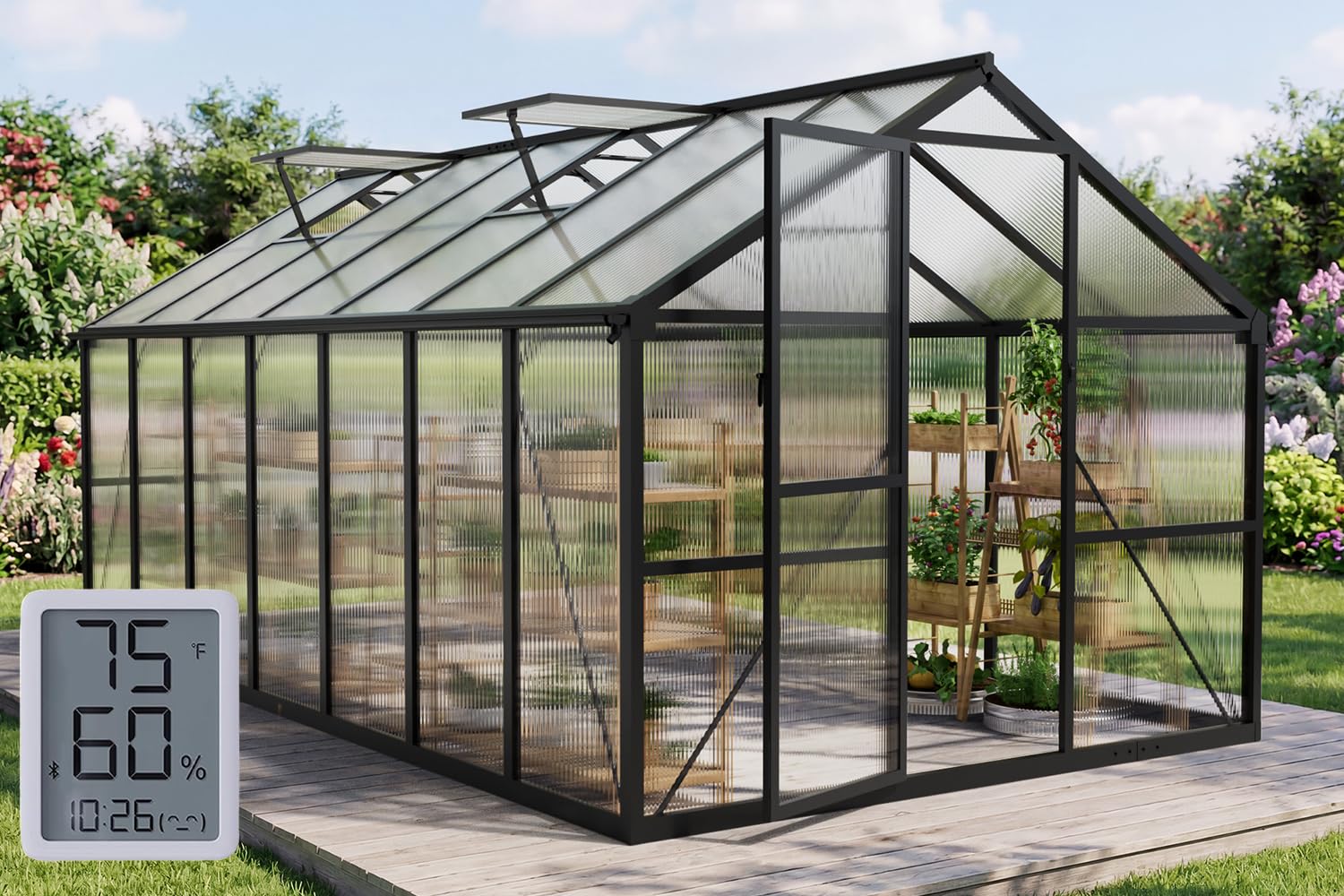
The Sylviera 8×14 provides one of the largest footprints in the aluminum-frame category, giving you 112 square feet of covered growing space. The reinforced aluminum alloy frame uses strengthened corner connectors that add torsional rigidity, and the 4mm twin-wall polycarbonate panels balance light transmission with heat retention. The included hygrometer connects to an app for remote temperature and humidity monitoring — a genuinely useful feature for tracking conditions when you are away from the backyard.
Assembly is a significant undertaking — owners report 8 to 10 hours with two people — but the labeled parts and included tools help offset the confusion common in budget kits. The adjustable roof vents and lockable door provide adequate airflow control, though the vent struts tend to detach unless secured with rubber bands. The frame has held up well against strong winds when anchored properly, and the interior space accommodates multiple shelving units and a small table without feeling crowded.
The polycarbonate panels are noticeably thinner than the 6mm panels on wood-frame competitors, which reduces insulation in extreme cold. Some owners also noted that the panels feel somewhat flexible and require careful handling during installation to avoid cracks. If your priority is maximum square footage within an aluminum budget and you can tolerate a lengthy build, this greenhouse offers excellent value per square foot.
What works
- Largest interior footprint in the aluminum category at 8×14 feet
- App-connected hygrometer for remote temperature and humidity monitoring
- Reinforced corner connectors improve overall frame rigidity
What doesn’t
- 4mm panels provide less insulation than 6mm alternatives
- Roof vent struts may detach in wind without aftermarket securing
- Assembly requires significant time and patience
6. Jocisland 8×10 Aluminum
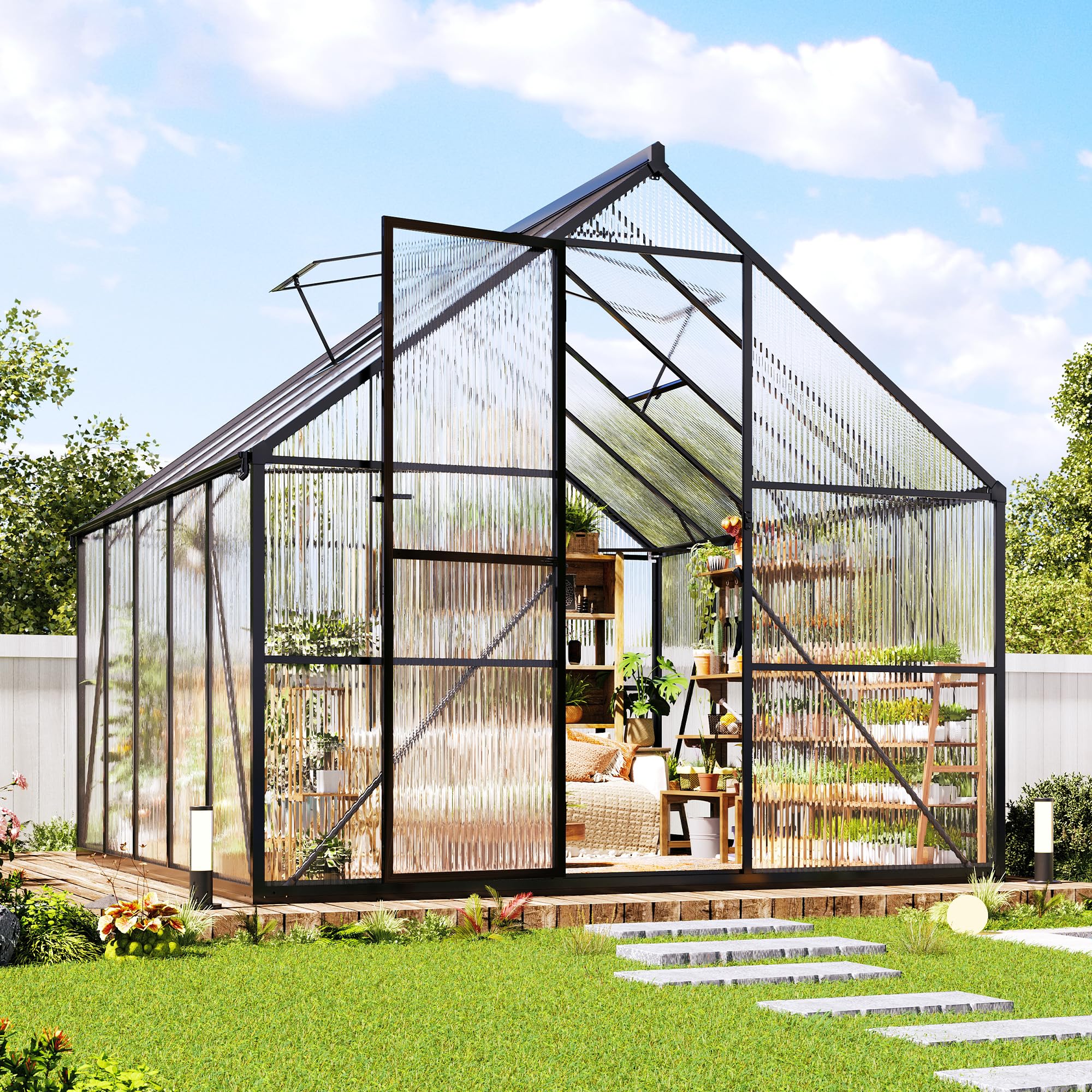
The Jocisland 8×10 aluminum greenhouse leans heavily into ease of assembly with quick-connect frame joints and triple-lock connectors that require no tools to install. Owners confirm a two-person team can complete the structure in 2 to 3 hours — substantially faster than the full-day commitment of most wood-frame kits. The cross beams, top braces, and corner supports create a structure that held up against high winds in multiple owner reports, and the 4mm polycarbonate panels block 99.99% of UV rays while transmitting ample light.
The gable roof design prevents water pooling, and the dual windows provide decent airflow for a greenhouse of this size. The swing door opens fully, though its 25-inch width and 6-foot-7-inch peak height mean tall users will need to duck when working near the center. The aluminum frame will not rust, making this a low-maintenance option for coastal or humid environments where wood might struggle.
Some parts arrived with mislabeled or slightly off-center holes, requiring minor adjustments during assembly. The vent windows do not stay open without a rubber band prop, and the included tools are essentially useless — you will need your own screwdrivers and wrenches. For a gardener who values speed of setup over maximum insulation, this kit minimizes the assembly headache better than most.
What works
- Tool-free quick connectors make assembly 2-3 hours for two people
- Aluminum frame is rust-resistant for humid or coastal climates
- Gable roof design prevents water pooling on the panels
What doesn’t
- Vent windows do not lock open and require a prop to stay raised
- Some panels have off-center holes that need filing or adjustment
- Included tools are low quality and should be replaced with your own
7. YITAHOME 16×6
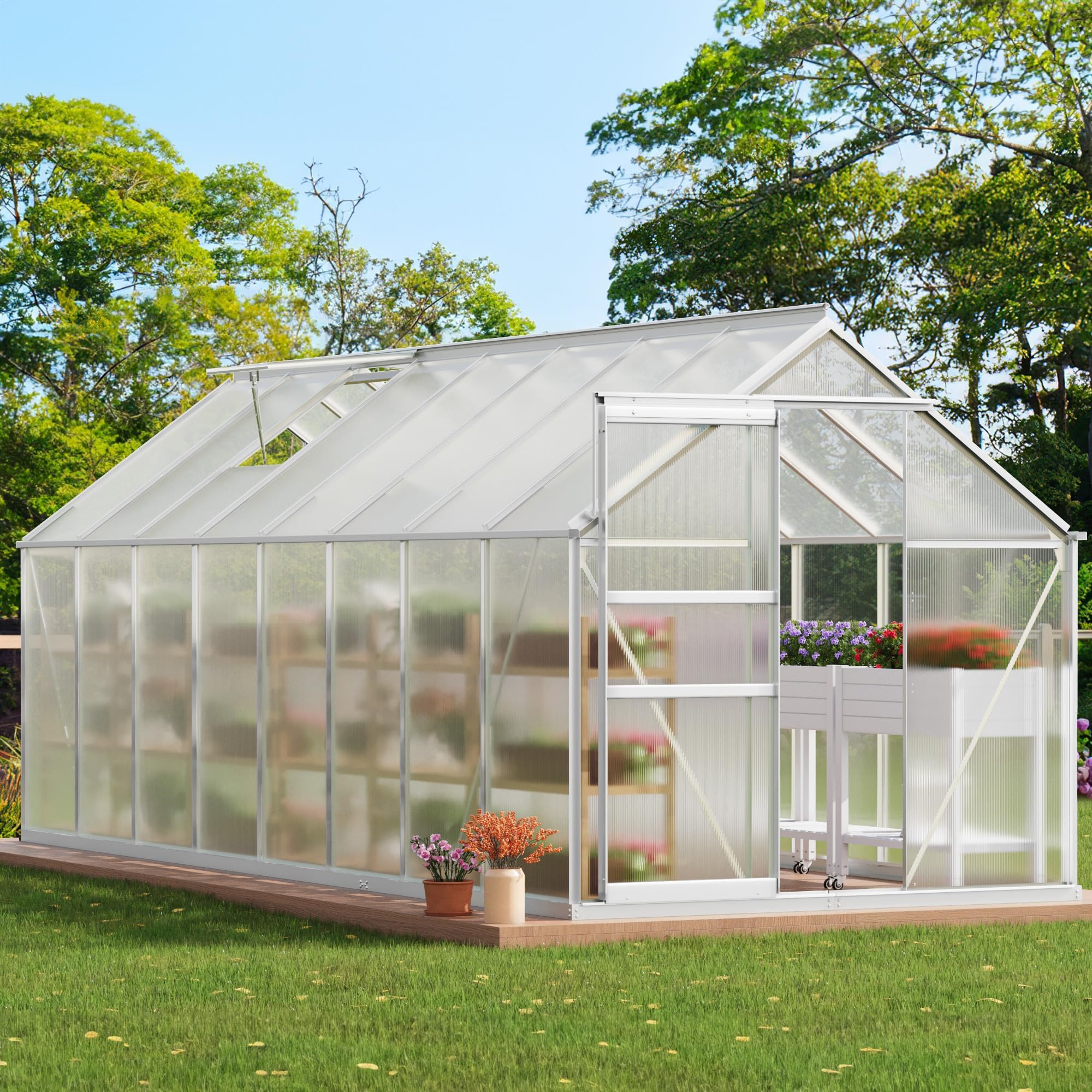
The YITAHOME 16×6 offers a unique long-and-narrow footprint that fits flush along fence lines or property edges where square or wide greenhouses would not. The reinforced aluminum alloy frame includes diagonal rod fixation and side reinforcements that improve load-bearing capacity, and the 4mm twin-wall polycarbonate blocks 99% of UV radiation. Two adjustable skylights with variable opening angles create good convection airflow, and the sliding doors save floor space compared to hinged doors that swing outward.
Owners report assembly taking roughly 2 hours solo, which is unusually fast for a greenhouse of this length. The 96 square feet of covered space works well for row planting or tiered shelving, and the interior temperature stays 10 to 15 degrees warmer than the outside air even without additional sealing. The expansion screws included for ground anchoring are a practical inclusion, though the instructions recommend also burying the bottom frame in a trench for maximum wind resistance.
The aluminum frame is not as rigid as a wood frame — some owners noted twisting in high winds even after anchoring. The polycarbonate panels are 4mm, which is adequate for season extension but insufficient for deep winter in freezing climates. A few units arrived with off-center pre-drilled holes that required drilling new ones. This greenhouse excels in long, narrow spaces where a standard 8×10 would not fit.
What works
- Long 16×6 footprint fits narrow yards and fence lines perfectly
- Sliding doors save interior space compared to swing doors
- Fast assembly — roughly 2 hours for one person
What doesn’t
- Aluminum frame can twist in high winds even when anchored
- 4mm panels provide limited insulation for winter growing
- Some units arrive with off-center holes that need correction
8. WUKHG 8×10
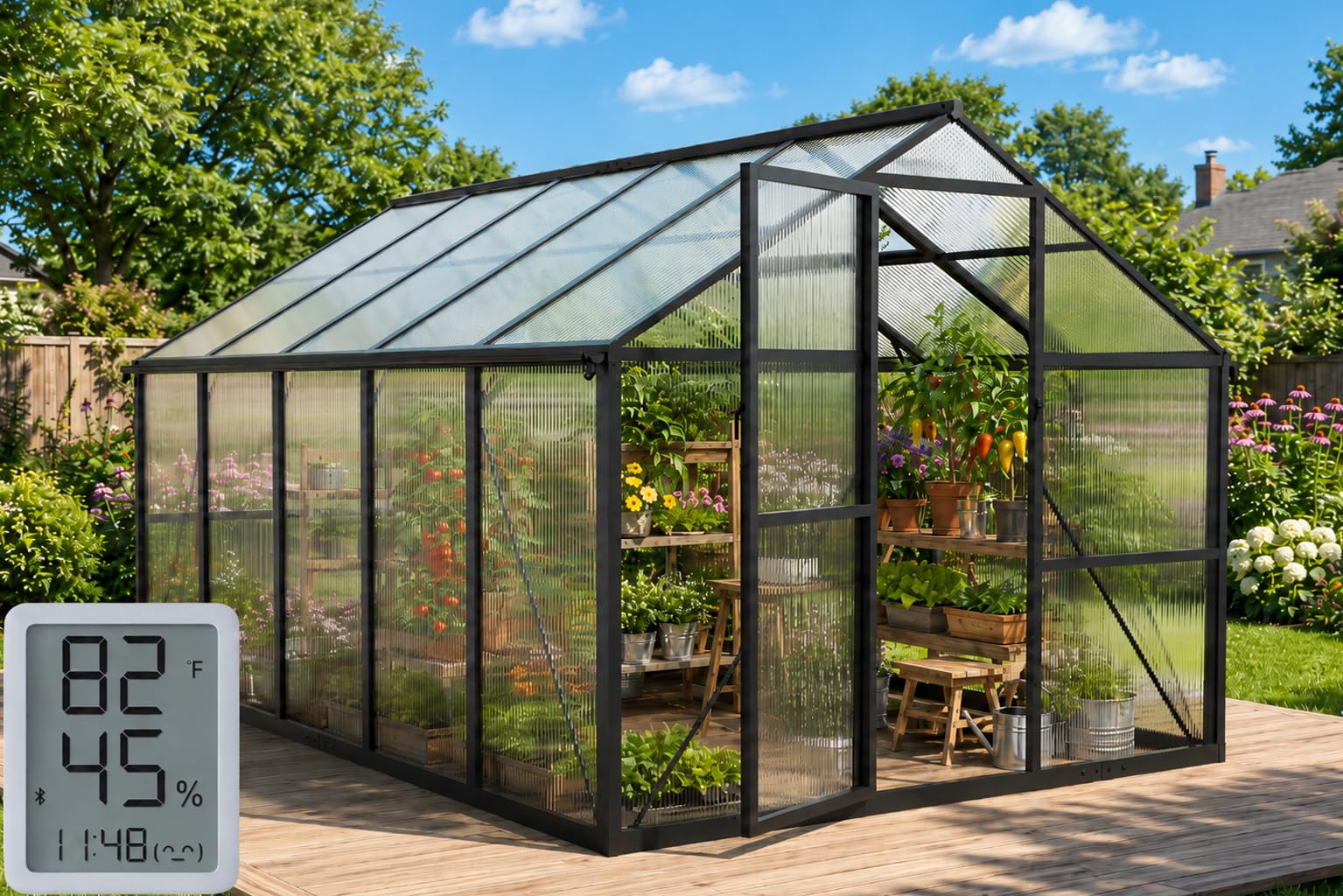
The WUKHG 8×10 brings an electronic thermometer with app connectivity into the mid-range aluminum category — a feature usually reserved for more expensive kits. The sensor claims ±0.54°F accuracy and refreshes every 2 seconds, with 14-day data graphing and half-year data export available through the app. The aluminum alloy frame and 4mm twin-wall polycarbonate panels provide a baseline of durability, and the gutter system channels rainwater away from the base efficiently.
Owners describe the structure as sturdy for its price bracket, with good light transmission and heat retention during spring and fall. The adjustable ventilation windows and lockable door give you control over airflow, though the roof window has a tendency to blow out on the first windy night unless very carefully secured. The 8×10 footprint offers enough interior space for multiple shelving units and a small staging table without feeling cramped.
The assembly instructions are picture-only and lack written dimensions, making it easy to misalign the base during construction. The panels are noticeably thin and some owners report them tearing loose in winds above 10 mph if not reinforced with additional silicone. The price puts this in the budget-friendly tier, and the electronic thermometer is a genuine differentiator, but the structural safety margins are narrower than the premium options.
What works
- App-connected thermometer provides real-time remote monitoring
- Gutter system channels rainwater away from the base effectively
- Good heat retention for spring and fall season extension
What doesn’t
- Picture-only instructions with no dimensions make alignment tricky
- Thin panels can tear loose in wind without extra silicone sealing
- Roof window may blow out on the first windy night
9. Outsunny 6×4
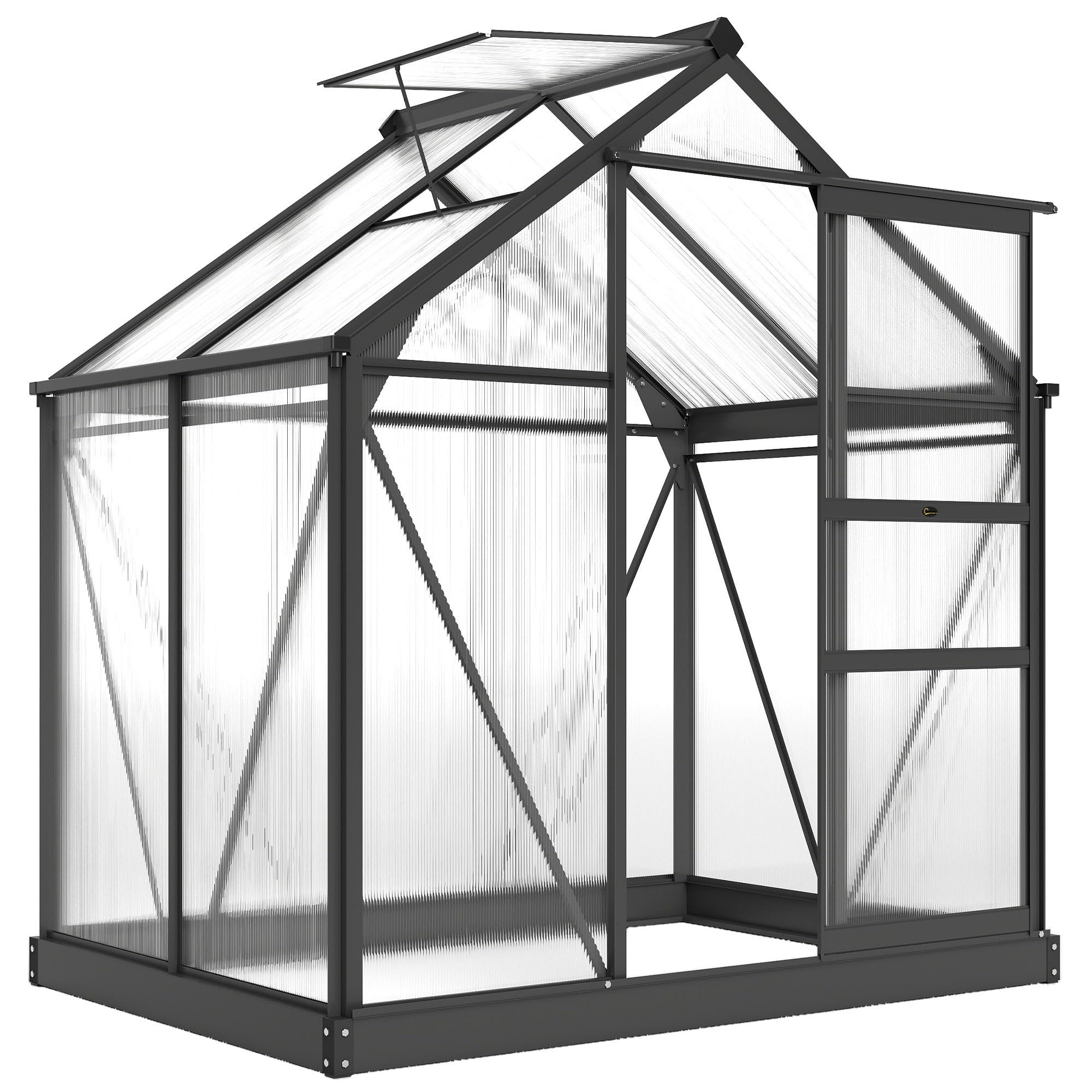
The Outsunny 6×4 is the smallest and most entry-level greenhouse on this list, designed for gardeners with limited patio or backyard space who want an affordable introduction to covered growing. The 24-square-foot footprint fits on a small patch of gravel or a balcony, and the sliding door allows access without requiring clearance for a swing-open door. The aluminum frame and galvanized steel base resist rust, and the included rain gutter collects water for hand watering.
Assembly takes a full day with two people, and the picture-only instructions require careful interpretation. The polycarbonate panels are thin — owners report they tear loose in winds above 10 mph and have blown out within weeks of installation. The structure reaches 95°F inside on a 69°F day, which means the single roof vent is insufficient to prevent overheating without supplemental shade. Multiple owners emphasize that anchoring is not optional; without stakes or post mix, the greenhouse becomes a house of cards.
The value proposition is clear — this is the lowest-cost way to get a rigid-framed greenhouse with real glass-like panels and a door. But the thin panels, limited ventilation, and questionable wind resistance make it a fair-weather structure best suited for mild climates and short-season use. If your budget forces you to this tier, plan on adding weather stripping, silicone sealant, and robust ground anchoring immediately.
What works
- Smallest footprint fits tight spaces and small patios
- Sliding door saves space and provides easy access
- Rain gutter collects water for convenient hand watering
What doesn’t
- Thin panels tear loose in winds above 10 mph without reinforcement
- Single roof vent is insufficient to prevent overheating on sunny days
- Requires extensive aftermarket sealing and anchoring for reliability
Hardware & Specs Guide
Polycarbonate Thickness (4mm vs. 6mm)
Thicker polycarbonate panels provide measurably better insulation and impact resistance. A 4mm twin-wall panel traps a single air layer, which reduces heat loss by roughly 40% compared to single-wall glass. A 6mm panel adds an additional air gap, improving insulation by roughly 20% over 4mm while still transmitting around 80% of visible light. In climates with regular freeze-thaw cycles or hail, 6mm panels are the safer long-term investment despite the higher upfront cost.
Frame Material: Aluminum vs. Wood
Aluminum frames are lightweight, rust-proof, and require zero maintenance beyond occasional tightening of fasteners. The trade-off is lower stiffness — an aluminum greenhouse can flex noticeably in 40 mph winds. Wood frames (cedar, fir, pine) offer superior rigidity and natural insulation, but they require a level foundation to prevent rot at ground contact points. Cedar is the most decay-resistant wood option, while fir offers higher density and strength. Pine is budget-friendly but needs the most protection from ground moisture.
Ventilation and Airflow Requirements
A greenhouse without adequate venting can exceed 100°F on a sunny day even when outdoor temperatures are below 50°F, which stresses plants and reduces yields. The minimum standard is one roof vent per 100 square feet of floor area, though two vents are preferable. Cross-ventilation — achieved by pairing a roof vent with an open door or lower louver — creates a natural convection cycle that pulls cool air in at the bottom and exhausts hot air at the peak. Temperature-activated automatic vent openers are a worthwhile upgrade for anyone who works away from home during the day.
Ground Anchoring and Foundation Options
Every greenhouse kit includes stakes or base bolts, but those alone are insufficient in high-wind zones. A pressure-treated lumber frame anchored to concrete footings provides the most stable foundation for both aluminum and wood greenhouses. Gravel pads with perimeter stakes work for mild climates but allow the structure to shift in strong storms. For permanent installations, consider a concrete slab with anchor bolts drilled into the greenhouse base rail — this eliminates shifting entirely and extends the usable life of the structure by years.
FAQ
What size greenhouse do I need for a typical backyard?
Should I choose a wood frame or an aluminum frame greenhouse?
Can a polycarbonate greenhouse survive winter snow loads?
How long does it take to assemble a backyard greenhouse kit?
Final Thoughts: The Verdict
For most gardeners, the greenhouse for backyard winner is the Backyard Discovery Willow 9×6 because its cedar frame, four-wall polycarbonate panels, and integrated exhaust fan handle harsh weather without aftermarket modifications. If you want pre-assembled walls for quick weekend setup, grab the Jocisland 8×9.5 Cedar. And for a long, narrow footprint that maximizes an edge-of-property space, nothing beats the YITAHOME 16×6.