
Pulling stray Bermuda grass from between your prized hostas is a losing battle — the roots snap off and regrow within days. A selective spray that targets grassy weeds without harming your ornamentals is the only practical solution for keeping flower beds clean all season long.
I’m Rikta — the co-founder and writer behind Lawn Gear Lab. I’ve spent hundreds of hours cross-referencing formulation data, analyzing active ingredient profiles, and working through verified owner feedback to identify which grass killers truly respect your blooms.
If you want to eliminate invasive grasses from your ornamental beds without damaging your flowers, shrubs, or ground covers, this guide to the best grass killer for flower beds will help you choose the right selective formula based on your specific landscape needs.
How To Choose The Best Grass Killer For Flower Beds
Using the wrong product in a flower bed is worse than doing nothing — a non-selective broad-spectrum spray will wilt your petunias as fast as it kills the crabgrass. Here are the key factors to anchor your decision.
Selective vs. Non-Selective Formulations
Selective grass killers contain active ingredients like fluazifop or sethoxydim that target the grass family (Poaceae) while leaving broadleaf ornamentals untouched. Non-selective products containing glyphosate or pelargonic acid kill everything green they contact. For flower beds, you must choose a selective formula or one labeled specifically for use around ornamentals.
Ready-to-Use vs. Concentrate
Ready-to-use (RTU) sprays are convenient for spot-treating individual grass clumps in tight bed spaces — no mixing, no measuring, and less risk of applying too strong a dose. Concentrates require a pump sprayer and careful mixing ratios, but they cover much larger areas at a lower cost per gallon. If your flower beds span more than a few hundred square feet, a concentrate typically makes more sense.
Response Time and Temperature Range
Some formulas show visible wilting within hours; others take up to two weeks to fully kill the root system. Fast-acting products often rely on contact-based ingredients that only kill above-ground growth, requiring reapplication. Slower systemic formulas travel to the roots for complete kill. Most selective grass killers work best when temperatures are between 60°F and 85°F — cool weather below 50°F can stall activity entirely.
Quick Comparison
On smaller screens, swipe sideways to see the full table.
| Model | Category | Best For | Key Spec | Amazon |
|---|---|---|---|---|
| Ortho Ln B-Gon | Selective RTU | Flower beds with ornamentals | Fluazifop active ingredient | Amazon |
| Ferti-lome Weed Free Zone | Broadleaf Concentrate | Broadleaf weeds in lawns | Dicamba + 2,4-D + MCPP | Amazon |
| Ferti-lome Over The Top | Selective Concentrate | Bermuda grass in shrubs | 8 oz makes 8 gallons | Amazon |
| Ortho Grass B Gon | Selective RTU | Small spot treatments | 24 oz twin-pack RTU | Amazon |
| Bonide Captain Jack’s | Non-selective RTU | Gravel paths and fences | 128 oz organic formula | Amazon |
| Pet’s Pal Natural | Natural RTU | Pet-safe around kids | 1 gal chloride formula | Amazon |
| OrganicMatters Natural | Natural RTU | Fast burn on sunny days | Vinegar-based non-selective | Amazon |
In‑Depth Reviews
1. Ortho Land B-Gon Grass Killer for Landscapes (4-Pack)

Ortho’s Land B-Gon uses fluazifop as its active ingredient, a selective grass herbicide that targets annual and perennial grassy weeds without harming broadleaf ornamentals, shrubs, trees, and ground covers. The ready-to-use spray eliminates mixing guesswork and is labeled safe around evergreens, dymondia, and non-bearing fruit crops — an unusually broad ornamental compatibility list for a grass-specific product.
Owner reports confirm it kills Bermuda grass, crabgrass, and fescue clumps emerging through flower beds without collateral damage to surrounding flowers or shrubs. The 4-pack provides 96 total ounces, enough for repeated spot treatments across medium to large bed areas. Results are visible within 5 to 7 days on actively growing grass, though response slows in cooler autumn weather.
The trade-off is that it works slowly on mature grass clumps over six inches tall — taller grass may only stunt and turn purple rather than die outright. It also does not target broadleaf weeds like clover or dandelion, so you will need a separate broadleaf herbicide for those. For pure grass elimination inside flower beds, this is the most selective and safest option available.
What works
- Selective fluazifop formula kills only grasses, not ornamentals
- Ready-to-use with no mixing required
- Works on Bermuda, crabgrass, and fescue in beds
What doesn’t
- Does not kill broadleaf weeds like clover or burweed
- Slow on grass taller than six inches
- Price per ounce is higher than concentrates
2. Ferti-lome Weed Free Zone (32 oz)
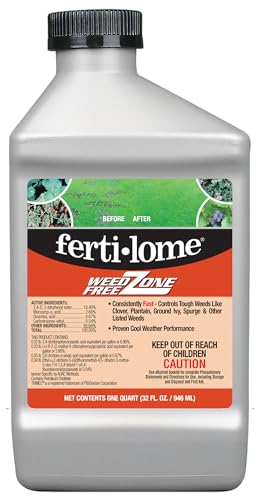
Ferti-lome Weed Free Zone is a three-way broadleaf herbicide combining dicamba, 2,4-D, and MCPP — a potent cocktail that controls over 80 broadleaf weed species including creeping Charlie, clover, spurge, chickweed, and thistle. It is labeled safe on Kentucky bluegrass, Bermuda, Bahia, and zoysia lawns, making it a strong fit for flower bed borders adjacent to turfgrass.
Owner feedback is emphatic about its effectiveness on creeping Charlie — many call it the only product that kills this stubborn weed overnight. The concentrate dilutes at roughly 1 to 2 ounces per gallon of water, and a 32-ounce bottle treats a large area. Adding a few drops of dish soap as a surfactant improves leaf adhesion dramatically on waxy weed leaves.
The major limitation is that this is a broadleaf killer, not a grass killer — it will not eliminate Bermuda grass or crabgrass in your flower beds. It also requires careful mixing; too strong a concentration can damage sensitive ornamentals like hostas and lilies, even though several owners report safe overspray at recommended rates. This is a specialist tool for broadleaf weed control in lawns, not for grass removal in beds.
What works
- Kills creeping Charlie and clover faster than any competitor
- Concentrate format covers large areas economically
- Safe on multiple common lawn grass species
What doesn’t
- Does not kill grassy weeds — only broadleaf species
- Requires careful mixing; overshoot risk with strong concentrations
- Higher price per bottle compared to single-active alternatives
3. Ferti-lome Over The Top Grass Killer (8 oz)

Ferti-lome Over The Top is a selective grass killer concentrate engineered specifically for use over the top of established ornamentals, shrubs, trees, and vegetables. The 8-ounce bottle makes 8 gallons of spray solution, covering roughly 2,000 square feet — exceptional value for large bed areas infested with Bermuda grass, crabgrass, or other grassy weeds.
Owner experiences consistently emphasize patience: this is a slow-acting systemic that requires 1 to 3 weeks for full root kill. Grass begins yellowing around day 7 and dies back completely by week 3. Taller grass over six inches only stunts rather than dies, so cutting grass down before application improves success. Many owners add a few drops of liquid dish soap as a surfactant to improve leaf coverage and penetration.
The biggest downside is that it will not work on grass that is dormant or stressed from drought — it requires actively growing plants for the systemic action to translocate to the roots. It also stains some foliage temporarily. For gardeners willing to wait two to three weeks for complete results, this is the most cost-effective selective grass killer on the market.
What works
- Selective formula safe for use over ornamentals and vegetables
- 8-ounce concentrate makes 8 gallons — covers large areas
- Systemic action kills roots, not just above-ground growth
What doesn’t
- Very slow — takes 1 to 3 weeks for visible results
- Ineffective on grass taller than six inches
- Requires actively growing grass; dormant grass resists absorption
4. Ortho Grass B Gon Garden Grass Killer (24 oz Twin-Pack)

Ortho Grass B Gon is a selective ready-to-use grass killer formulated to target grassy weeds including crabgrass, fescues, and Bermuda grass while leaving broadleaf ornamentals and shrubs unharmed. The twin-pack provides two 24-ounce spray bottles for a total of 48 ounces, making it a convenient spot-treatment solution for small to medium flower beds.
Verified owner reports confirm it kills grass growing through iris beds, daylilies, and other perennial plantings without damaging the flowers. The formula becomes waterproof within one hour of application, so a light rain shortly after spraying does not wash away effectiveness. Results typically appear within 3 to 7 days depending on temperature and grass maturity.
The main limitation is the small container size — heavy infestations covering large areas will exhaust both bottles quickly. Some owners reported the product did not work at all on certain grass varieties, suggesting variability in effectiveness depending on grass species and growth stage. For budget-conscious gardeners with limited bed areas, this is a solid entry-level selective spray.
What works
- Selective formula safe for use around flowers and shrubs
- Becomes waterproof after one hour
- Twin-pack gives flexibility for multiple applications
What doesn’t
- Small 48 oz total coverage — not for large beds
- Inconsistent results reported on some grass species
- Slower action on mature or tall grass clumps
5. Bonide Captain Jack’s Deadweed Brew (128 oz)

Bonide Captain Jack’s Deadweed Brew is an OMRI-listed organic herbicide approved for organic gardening, using a non-selective formula that kills both broadleaf weeds and grasses. The 128-ounce ready-to-use spray comes with a hose-end nozzle and works in temperatures as low as 40°F, making it a viable early-season option when other herbicides struggle.
Owner reports are sharply divided: many describe it as the fastest weed killer they have ever used, with visible wilting within one hour on bright, warm days. Others report that later batches appeared ineffective, with grass and weeds surviving heavy application. This inconsistency suggests batch variability or sensitivity to storage conditions — the active ingredient degrades faster than synthetic alternatives.
Because it is non-selective, you must avoid contact with ornamental plants in flower beds. The label explicitly states it kills any vegetation it touches, so careful spot-spraying or a shield is required near desirable plants. For organic gardeners willing to accept some inconsistency in exchange for OMRI certification, this gallon offers exceptional value per volume.
What works
- OMRI-listed for organic gardening
- Works in temperatures as low as 40°F
- Fast visible results — wilting in under one hour
What doesn’t
- Non-selective — will kill any plant it contacts
- Batches reported as inconsistent by some owners
- Sprayer nozzle struggles with large coverage areas
6. Pet’s Pal Natural Weed Killer (1 Gallon)

Pet’s Pal Natural Weed Killer markets itself as a pet-safe, kid-safe, bee-safe alternative to synthetic herbicides, using a chloride-based natural formula free of glyphosate. The ready-to-use one-gallon spray covers roughly 1,000 square feet and is labeled effective on broadleaf weeds and grassy weeds including dandelion, clover, ivy, chickweed, and crabgrass.
Owner feedback is split: many appreciate seeing results within hours and value the peace of mind of a pet-safe label. Others report the product did absolutely nothing to established weeds, with some claiming the weeds actually thrived after application. This variability likely depends on weed maturity, species, and temperature — natural contact herbicides require thorough leaf coverage and warm, sunny conditions to be effective.
The critical operational detail is that this is a non-selective formula — it will kill grass and flowers alike. You cannot spray it near petunias or marigolds and expect them to survive. For households with dogs that roam through flower beds, the safety profile makes this a reasonable trade-off, but the inconsistent efficacy means you may need multiple applications to achieve full control.
What works
- Glyphosate-free and pet-safe label
- Fast visual results in warm conditions
- Easy one-gallon ready-to-use format
What doesn’t
- Non-selective — kills all vegetation on contact
- Inconsistent results; some owners report zero effectiveness
- Requires full sun and warm weather to work
7. OrganicMatters Natural Weed Killer (128 oz)

OrganicMatters Natural Weed Killer is a vinegar-based non-selective herbicide that relies on acetic acid to burn off leaf tissue on contact. The one-gallon ready-to-use spray is marketed as non-toxic and safe for use around pets and children once the spray has dried. Many owners report weeds turning brown and dead by the next morning when applied on bright, sunny days with no rain forecast.
The product burns only the above-ground growth, leaving root systems intact — tough perennial weeds like dandelions and Bermuda grass will regrow within two to three weeks, requiring repeated application. The sprayer nozzle is a frequent complaint: it requires upside-down priming and is prone to clogging. Several owners noted that the company replaced faulty sprayers promptly, but the packaging design remains a weak point.
Because this is a non-selective contact killer, any drift onto flower bed ornamentals will burn their leaves and potentially kill annual flowers. The vinegar odor is strong during application but dissipates quickly. For gardeners who want a rapid, low-toxicity option for cracks, patios, and non-selective areas, this gallon delivers aggressive burn for the price, but it is not suitable as a selective grass killer in flower beds.
What works
- Fast visible burn — weeds brown by next day in sun
- Non-toxic and safe around pets once dried
- Large gallon coverage at entry-level price
What doesn’t
- Non-selective — burns any plant tissue it contacts
- Does not kill roots; requires reapplication for perennials
- Sprayer nozzle poorly designed and prone to failure
Hardware & Specs Guide
Active Ingredient Selection
The primary distinction between grass killers for flower beds is whether the active ingredient is selective (fluazifop, sethoxydim, clethodim) or non-selective (glyphosate, pelargonic acid, acetic acid). Fluazifop-p-butyl is the most common selective grass herbicide in consumer RTU sprays — it inhibits acetyl-CoA carboxylase in grass plants, causing lipid synthesis disruption and eventual death. Non-selective contact killers like vinegar (acetic acid) burn leaf tissue by denaturing proteins but do not translocate to roots.
Liquid Volume and Coverage Area
Ready-to-use sprays typically come in 24 oz to 128 oz containers. A 24 oz bottle covers roughly 100 to 200 square feet of spot treatment, while a 128 oz gallon can cover 800 to 1,000 square feet depending on spray technique. Concentrates like Ferti-lome Over The Top (8 oz makes 8 gallons) offer the best cost per coverage area but require a separate pump sprayer and precise mixing. Over-mixing concentrate damages ornamental plants; under-mixing reduces efficacy.
Temperature and Rainfast Timing
Selective grass killers with systemic action (fluazifop, clethodim) absorb through leaf tissue and require 1 to 4 hours of rain-free time to translocate effectively. Temperatures below 50°F stall metabolic activity in grass, reducing uptake. Contact killers like vinegar work fastest in temperatures above 70°F with full sun, as heat accelerates the desiccation process. Products labeled as waterproof after one hour contain adjuvants that improve rainfastness — useful for unpredictable weather regions.
Surfactant and Adjuvant Compatibility
Adding a non-ionic surfactant or a few drops of dish soap (Dawn) at 0.25% to 0.5% of spray volume improves droplet adhesion on waxy grass leaves. Many selective grass killers already contain built-in surfactants in RTU formulations, but concentrate users benefit from adding a compatible adjuvant. Over-using surfactant on non-selective formulas increases drift risk — smaller droplets are more likely to reach ornamentals. Always test a small area before full application.
FAQ
Will selective grass killer hurt my flowers?
How long does it take to see results from a grass killer spray?
Can I use grass killer in a vegetable garden bed?
Why does grass keep coming back after spraying?
Final Thoughts: The Verdict
For most gardeners, the grass killer for flower beds winner is the Ortho Land B-Gon Grass Killer 4-Pack because its fluazifop-based formula provides true selective grass control without harming ornamentals, in a convenient ready-to-use format. If you want a concentrated solution that covers larger areas at lower cost, grab the Ferti-lome Over The Top Grass Killer. And for pet owners who prioritize non-toxic ingredients above all, the Pet’s Pal Natural Weed Killer offers a glyphosate-free alternative — just expect variable results on established weeds.