
Nothing frustrates a homeowner more than watching stubborn crabgrass and dandelions reclaim a freshly cleaned flower bed or driveway crack just days after hand-pulling. The reality is that most common weeds have root systems extending six inches or deeper, and yanking the tops off only delays the regrowth. A properly chosen chemical solution stops the problem at the root zone, saving you hours of stoop labor and ensuring that patios, fences, and ornamental beds stay clean for the entire growing season.
I’m Rikta — the co-founder and writer behind Lawn Gear Lab. My approach to this guide involved cross-referencing active-ingredient concentrations, rain-fastness windows, and coverage-per-ounce ratios across seven leading formulas, then filtering those specs against hundreds of verified owner reports to separate fast-acting products from overhyped misses.
With that research in hand, here is a tight, spec-driven breakdown of the industry’s top performers so you can confidently pick the right grass and weed killer without wasting time or money on products that underwhelm.
How To Choose The Best Grass And Weed Killer
Walking into the herbicide aisle can feel overwhelming because every bottle promises to kill “roots” and work “fast.” The reality is that active-ingredient chemistry, application method, and coverage area are the only three variables that matter. Master these, and you stop guessing.
Active Ingredient: Glyphosate vs. Diquat vs. Triclopyr Blends
Glyphosate is the gold standard for total vegetation control because it translocates through the plant and kills the root system — expect 7–14 days for full necrosis. Diquat dibromide works as a contact killer that desiccates leaf tissue within hours, but it does not travel to the roots, making it ideal for annual weeds but weak on perennial vines and brush. Products that combine Triclopyr with Fluazifop-P-Butyl (like the Roundup Poison Ivy Plus formula) are purpose-built for woody species such as poison ivy and wild blackberry. Match the active ingredient to your worst weed type.
Rain-Fastness: The Timer You Cannot Ignore
A killer that washes off before it absorbs is worthless. The fastest formulas (Ortho GroundClear at 15 minutes, Spectracide at 15 minutes) let you spray even when scattered showers are forecast. The Roundup Dual Action and Poison Ivy variants hold at 30 minutes. Hi-Yield Killzall shows full rain resistance after drying — usually 1–2 hours on a sunny day. If you live in a humid zone with afternoon thunderstorms, prioritize a 15-minute rainfast claim.
Coverage Per Bottle: Concentrate Math
Standard 32 oz concentrate bottles range from 1,120 sq ft (Ortho GroundClear) up to 4,300 sq ft (Hi-Yield Killzall). The big 1-gallon Hi-Yield jug covers a massive 17,200 sq ft. Do not compare bottles by volume alone — look at the mixing ratio on the label. A 6 oz per gallon ratio means a 32 oz bottle yields only about 5 gallons of spray solution, while an 8 oz per gallon ratio yields 4 gallons. Lower mix ratios stretch your dollar further when treating large fence lines or vacant lots.
Quick Comparison
On smaller screens, swipe sideways to see the full table.
| Model | Category | Best For | Key Spec | Amazon |
|---|---|---|---|---|
| Hi-Yield Killzall 365 (1 gal) | Concentrate | Large-area bare-ground control | 17,200 sq ft coverage | Amazon |
| Roundup Dual Action | Concentrate | Kill + 4-month prevention | Rainfast in 30 min | Amazon |
| Control Solutions Eraser | Concentrate | Best value glyphosate | 41% Glyphosate | Amazon |
| Roundup Poison Ivy Plus | Concentrate | Woody brush & poison ivy | 3-active blend | Amazon |
| Ortho GroundClear Super Concentrate | Concentrate | Fast-acting all-purpose | Rainfast in 15 min | Amazon |
| Hi-Yield Killzall 365 (32 oz) | Concentrate | Mid-size total vegetation kill | 4,300 sq ft coverage | Amazon |
| Spectracide Weed & Grass Killer | Concentrate | Quick visual results | Visible in 3 hours | Amazon |
In‑Depth Reviews
1. Hi-Yield Killzall 365 (1 gal)
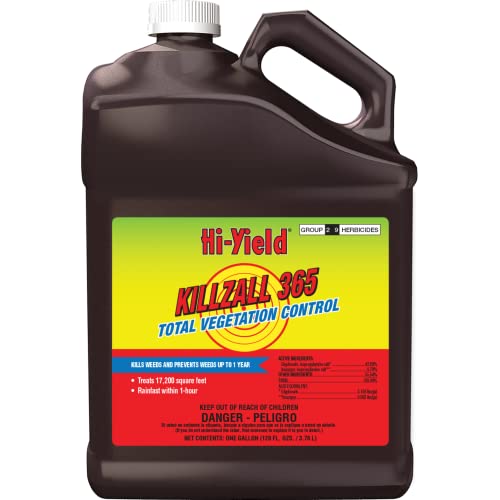
This gallon jug delivers the highest per-bottle coverage in the lineup — 17,200 square feet per container at a mixing ratio of 7.4 oz per 1 to 10 gallons of water. The active ingredient is a glyphosate-based formulation aimed at total vegetation control on non-crop areas, driveways, fence lines, and gravel paths. Owner reports consistently mention rain resistance even when a shower hits the day after application, which reduces the stress of timing your spray window.
Multiple users note that a single spring treatment keeps areas largely bare through the summer, though some persistent broadleaf species and moss may need a second spot pass. The 1-gallon size clearly targets owners of half-acre-plus properties who do not want to buy concentrate every month. Compared to buying four separate 32 oz bottles, this jug cuts the cost per square foot noticeably.
The main drawback reported is that the formula does not sterilize the soil for a full 365 days as the name implies — most users see regrowth starting around the 4- to 6-month mark, especially in warm, wet climates. That is still excellent longevity for a non-persistent herbicide, but do not expect a full calendar year of bare ground without a booster application.
What works
- Unmatched coverage-per-bottle for large properties
- Holds up well against rain the following day
- More cost-effective than buying multiple small bottles
What doesn’t
- Does not provide true 365-day bare-ground control
- Has no effect on established moss infestations
2. Roundup Dual Action Weed & Grass Killer Plus 4 Month Preventer

What sets this Roundup apart is the pre-emergent barrier that keeps new weeds from germinating for up to four months after application. You kill existing crabgrass and dandelions in roughly 6–12 hours and then the residual chemistry prevents a second wave — a genuine time-saver for mulched beds and gravel driveways where the same weeds pop up every few weeks. The concentrate mixes at 6 oz per gallon, covering about 1,600 square feet per 32 oz bottle.
Owner experiences highlight rapid knockdown on greenbriar, wild ivy, and Virginia creeper along fence lines, with many reporting visible wilting within 24 hours. The rain-fastness window of 30 minutes gives you a solid buffer on days with scattered showers. Users also praise the cost competitiveness — the Dual Action concentrate price per application often beats cheaper brands when factoring in the prevention effect that eliminates repeat sprays.
The catch is that the pre-emergent component prevents anything from growing in the treated zone for four months, so you cannot reseed or plant ornamental bedding in that area during that window. A few users noted that very thick, mature brush may require a second application because the contact dose is split between kill and prevention chemistry.
What works
- Kills existing weeds and prevents regrowth for months
- Visible results often appear within 24 hours
- Rainfast in 30 minutes — forgiving spray timing
What doesn’t
- Cannot plant anything in treated area for 4 months
- Thick brushy vines may need a follow-up spray
3. Control Solutions 82004318 Eraser & Grass Killer Concentrate
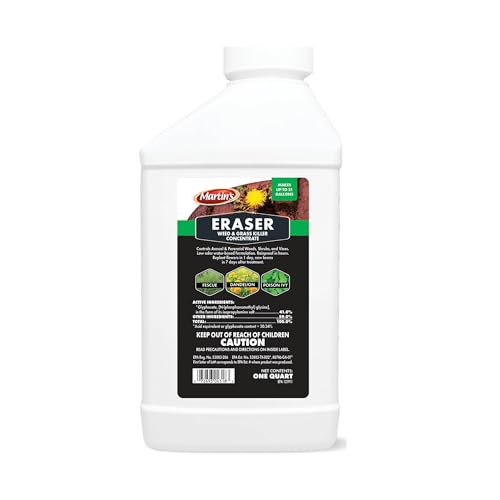
The Control Solutions Eraser packs 41% glyphosate — the same concentration found in premium consumer Roundup — at a significantly lower per-ounce cost. Mixing 8 oz per gallon yields a powerful systemic dose that kills the entire root system of annual weeds, perennial grasses, vines, and even small brush within 7 to 14 days. The water-based formula produces very little odor compared to emulsified concentrates, making it more comfortable to use around the house.
The low-odor characteristic is a standout — you can treat a fence line in the morning and still enjoy the patio in the afternoon without chemical smells lingering. The concentrate is rainproof within a few hours on a sunny day, though not as aggressively fast as Diquat-based competitors.
The trade-off is speed. Users coming from Diquat-based formulas (like Spectracide) often complain that Eraser shows no visible effect for 2–4 days. It works slowly because the glyphosate must translocate through the entire plant — yellowing starts around day 4, and full kill takes 7–14 days. Patience is mandatory.
What works
- High 41% glyphosate at a budget-friendly price point
- Low-odor formula — comfortable to apply
- Trusted by owners for 15+ years of reliable results
What doesn’t
- Slow visual results — takes 7–14 days for full kill
- Needs a surfactant for optimal performance on waxy leaves
4. Roundup Poison Ivy Plus Tough Brush Killer₂ Concentrate

Standard glyphosate killers often bounce off waxy poison ivy, poison oak, and wild blackberry leaves without penetrating the cuticle. This Roundup formula solves that by combining Triclopyr (2.50%), Fluazifop-P-Butyl (2.00%), and Diquat Dibromide (1.50%) — a triple-action blend that burns foliage on contact while the systemic components travel to the rhizomes. Users consistently report that species like greenbriar and kudzu die back completely within 10–14 days.
Owners with acreage or heavily wooded edges rate this as the only product that actually kills poison ivy without requiring multiple reapplications. The “hack and squirt” method — cutting the stem and spraying directly into the cut — works especially well for invasive trees and large vines. The concentrate covers about 1,500 square feet per 32 oz bottle when mixed at label rates, and rain-fastness kicks in after 30 minutes.
The formula is strong — several users emphasize wearing a respirator and full skin coverage because the chemical cocktail is significantly more aggressive than standard glyphosate. It also has a replanting interval of 1 to 30 days depending on the plant species, which requires reading the label carefully before adding new shrubs.
What works
- Triple-active blend penetrates waxy brush species
- Highly effective on poison ivy, blackberry, and kudzu
- Works with hack-and-squirt method for large vines
What doesn’t
- Strong chemicals require respirator and full protective gear
- Replanting interval varies — must check label for each species
5. Ortho GroundClear Weed and Grass Killer Super Concentrate1
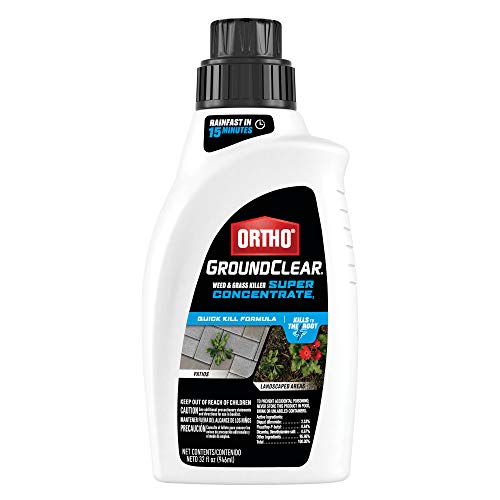
Ortho GroundClear Super Concentrate markets itself as a fast-acting, all-purpose killer for driveways, patios, and landscape beds, and it largely delivers. The active chemistry starts working immediately on contact and is rainfast in just 15 minutes — the shortest window among the non-Diquat formulas in this lineup. Users report that tall grass along fence lines shows clear yellowing by day three and is completely dead by day five.
The 32 oz bottle treats up to 1,120 square feet at the standard mix rate, and many owners stretch coverage by mixing slightly stronger ratios for tough weeds like silverleaf nightshade and horse nettle, which are notoriously resistant to weaker herbicides. The formula has very little odor during application, making it a good choice for spraying near patios or outdoor entertaining areas.
Some owners note that the concentrate does not perform as well on deeply established perennial weeds with large taproots unless you soak the foliage thoroughly. A few users also mentioned that the bottle runs through quickly if you need to treat a long fence line — consider the larger sizes or a higher-concentration option if your property exceeds a quarter acre.
What works
- Rainfast in just 15 minutes — best in class for spray scheduling
- Low odor, comfortable to use around the house
- Visible wilting in 3–4 days on most annual weeds
What doesn’t
- Struggles with large taproot weeds without thorough soaking
- Coverage (1,120 sq ft) is lower than some competitors
6. Hi-Yield Killzall 365 (32 oz)

This 32 oz bottle of Hi-Yield Killzall is essentially the same active formula as the gallon jug but in a smaller package that treats up to 4,300 square feet — significantly more area than the Ortho or Spectracide concentrates. The mixing ratio of 6 oz per gallon for spot control or 7.4 oz for bare-ground coverage makes it flexible for both fence-line touch-ups and larger driveway edges. Users consistently note that it provides reliable total vegetation kill with results visible in about a week.
The rain resistance is a highlight — multiple owners report that even if rain falls the day after application, the treatment still kills the weeds. This forgiving window makes it a strong choice for regions with unpredictable afternoon storms. The price per square foot is noticeably lower than many big-box alternatives, which explains why many users keep coming back to this brand season after season.
Like its larger sibling, the 32 oz version does not truly provide 365-day bare-ground control. Most owners find they need a second application around the 3–4 month mark in warm climates. Additionally, it has no effect on moss, so if your issue is more about moss than broadleaf weeds, you will need a separate moss-specific product.
What works
- Impressive 4,300 sq ft coverage per 32 oz bottle
- Rain-resistant even if showers arrive the next day
- Excellent cost per square foot
What doesn’t
- Does not deliver a full year of bare ground
- Ineffective against moss growth
7. Spectracide Weed and Grass Killer Concentrate with Accumeasure
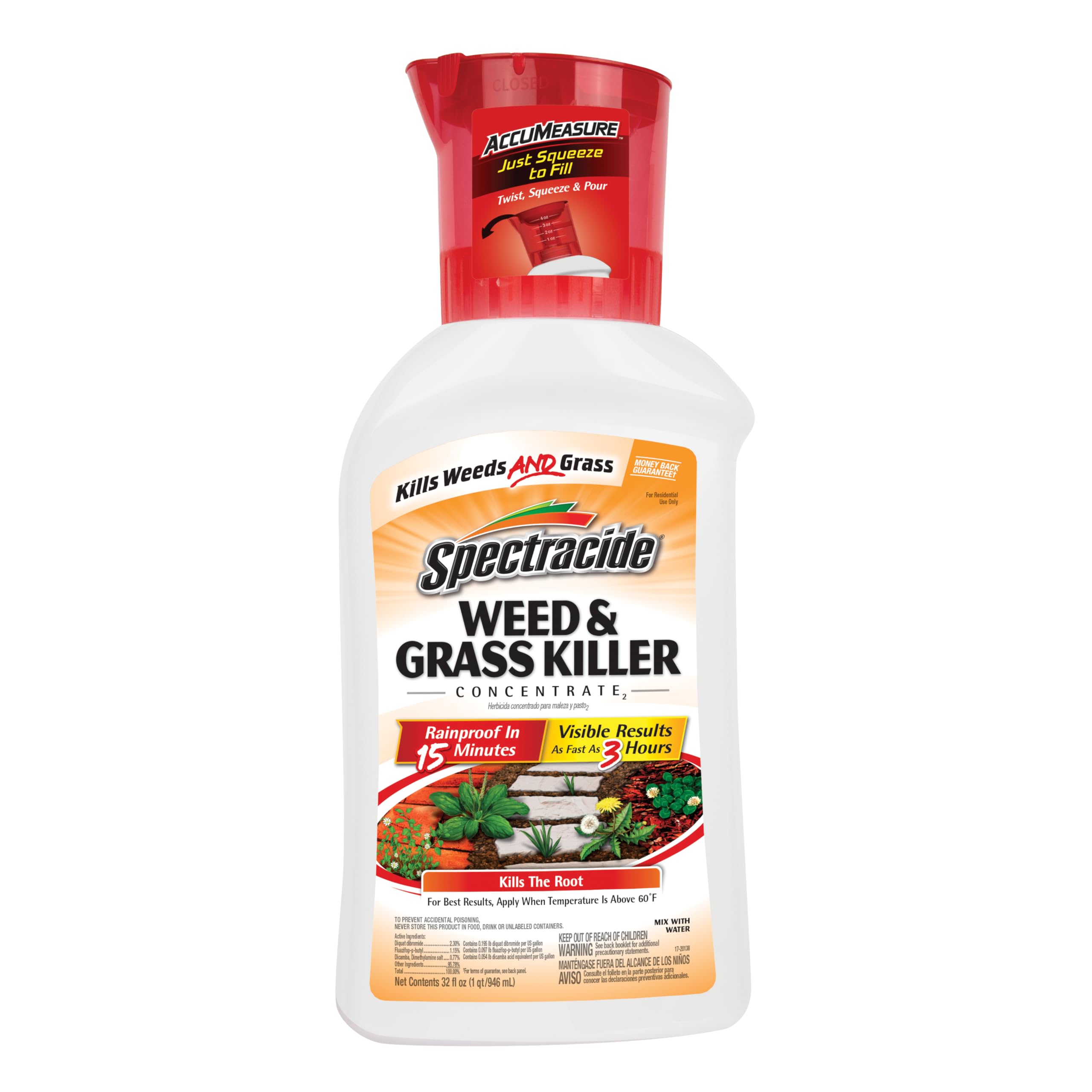
Spectracide is the quickest visual killer in this lineup. Powered by Diquat Dibromide, it desiccates leaf tissue within hours — users report visible wilting along curbs and driveways by the end of the same day. The 32 oz bottle treats roughly 1,350 square feet, and the Accumeasure cap is designed to simplify mixing, though many experienced users ignore it and use the cap from an older bottle because they find the measuring system finicky.
The speed advantage is real: if you need a driveway or patio edge to look clean for an upcoming event, Spectracide delivers results faster than any glyphosate-based product. The 15-minute rainfast claim holds up well, and the concentrate mixes easily in a standard 1-gallon pump sprayer. Owners replacing more expensive brands often mention that the performance is identical at a lower cost.
The downside is that Diquat is a contact killer with zero systemic movement, so it only kills the parts of the plant it touches. Perennial weeds with deep root systems will regrow from the roots within weeks. This makes Spectracide a maintenance tool rather than a eradication solution — ideal for keeping cracks clean but not for permanently removing established poison ivy or blackberry patches.
What works
- Visible results in hours — fastest turnaround in class
- Rainfast in 15 minutes, great for unpredictable weather
- Cost-effective compared to premium brands
What doesn’t
- Contact-only — roots survive and regrow on perennials
- Accumeasure cap is awkward; many users bypass it
Hardware & Specs Guide
Glyphosate Concentration
The percentage of glyphosate in the concentrate directly correlates with root-kill reliability. 41% glyphosate (found in Control Solutions Eraser and both Hi-Yield Killzall sizes) delivers the deepest systemic translocation, ensuring perennial weeds die from root tip to leaf tip. Lower-concentration formulas (<15%) may only suppress weeds temporarily, requiring multiple reapplications.
Diquat Dibromide Speed
Diquat is a contact desiccant that burns foliage within hours and is rainfast in as little as 15 minutes. Spectracide relies on this chemistry for instant visual gratification, but it does not kill roots. Use Diquat-based killers only for spot maintenance on annual weeds or when you need cosmetic clean-up before a weekend event — never for permanent removal of brush or deep-rooted perennials.
Pre-Emergent Additives
Roundup Dual Action contains a pre-emergent barrier that prevents weed seeds from germinating for up to 4 months. This makes it uniquely effective in mulched beds and gravel areas where the seed bank is high. The trade-off is a 4-month planting restriction — you cannot install new flowers or shrubs in the treated zone until the chemical degrades.
Coverage Math
Compare bottles by total square footage, not liquid volume. A 32 oz bottle of Hi-Yield Killzall covers 4,300 sq ft, while a same-size bottle of Ortho GroundClear covers only 1,120 sq ft. Big properties should prioritize Hi-Yield Killzall (1 gal at 17,200 sq ft) or the Control Solutions Eraser for large-scale glyphosate treatment.
FAQ
How long after spraying grass and weed killer can I plant flowers?
Does rain after application ruin the treatment?
Will a grass and weed killer kill my lawn if I accidentally spray it?
Why does my weed killer stop working after a few months?
Final Thoughts: The Verdict
For most gardeners, the grass and weed killer winner is the Roundup Dual Action because it combines immediate kill speed with a 4-month pre-emergent barrier that stops the regrowth cycle, saving you from repeat sprays all season. If you want maximum coverage for a large property, grab the Hi-Yield Killzall 1 gallon — it treats 17,200 sq ft and offers the best cost per square foot. And for woody brush and poison ivy eradication, nothing beats the Roundup Poison Ivy Plus triple-action concentrate.