
Goat head weeds don’t just ruin barefoot walks—their sharp, woody burrs puncture tires, embed in pet paws, and spread relentlessly across pastures, fence lines, and driveways. The right chemical formula, applied at the correct concentration and timing, stops their lifecycle before the next seed set.
I’m Rikta — the co-founder and writer behind Lawn Gear Lab. I’ve spent hundreds of hours cross-referencing herbicide active ingredients, reading through university extension bulletins on puncture vine control, and analyzing owner feedback to isolate which formulations actually deliver a knockdown when applied to mature goat head plants.
This guide evaluates seven concentrated herbicides based on their active ingredient profile, mixing ratios, and real-world speed of kill to help you find the best goat head weed killer for your property.
How To Choose The Best Goat Head Weed Killer
Puncture vine (Tribulus terrestris) has a taproot that can reach 2 feet deep, so foliar sprays must be systemic to kill the root system, not just the surface leaves. Three factors determine whether your application works or wastes time.
Glyphosate Concentration and Surfactant Load
Generic 41% glyphosate concentrate (the same active ingredient as Roundup Pro) delivers a predictable, non-selective kill that works on goat head at every growth stage. Products that include a built-in surfactant—like Albaugh Gly Star Plus—improve droplet spread across the hairy, waxy goat head leaf surface, reducing the need for a separate tank additive.
Triclopyr for Selective Pasture and Lawn Use
If goat heads are invading a grass pasture or lawn, a triclopyr-based herbicide (like Southern Ag Crossbow or Remedy Ultra) kills the broadleaf puncture vine without damaging desirable grass species. This selective approach is critical when you can’t afford bare soil, and it also suppresses woody brush that competes with grass.
Mixing Ratio and Coverage Volume
Most goat head infestations require a spray volume of 20 to 50 gallons per acre, depending on density. A 1-gallon concentrate that mixes at 2 to 4 ounces per gallon of water covers roughly 200 to 400 square feet per gallon of finished spray. Larger properties benefit from 2.5-gallon jugs that yield dozens of tank fills without repurchasing.
Quick Comparison
On smaller screens, swipe sideways to see the full table.
| Model | Category | Best For | Key Spec | Amazon |
|---|---|---|---|---|
| Southern Ag Crossbow | Selective | Pastures & lawns with grass | 2,4-D + triclopyr | Amazon |
| Remedy Ultra | Selective | Heavy brush & fence lines | Triclopyr concentrate | Amazon |
| Albaugh Gly Star Plus | Non-selective | Large bare-ground areas | 41% glyphosate + surfactant | Amazon |
| Control Solutions Eraser 1 Gal | Non-selective | Driveways & gravel lots | 41% glyphosate | Amazon |
| Hi-Yield Killzall II | Non-selective | Fast visual results | Glyphosate concentrate | Amazon |
| Control Solutions Eraser 32 oz | Non-selective | Small patches & spot treatment | 41% glyphosate | Amazon |
| Southern AG Brush Killer | Selective | Non-crop fence rows & stumps | Triclopyr concentrate | Amazon |
In‑Depth Reviews
1. Southern Ag Crossbow Specialty Herbicide

Crossbow combines triclopyr with 2,4-D for a selective broadleaf kill that leaves established grass intact—critical when goat heads are mixed into a pasture or fescue lawn. The blend attacks puncture vine’s leaf structure within 48 hours, with full root death occurring over one week. Users report visible wilting faster than straight glyphosate, especially on mature plants that have already produced burrs.
At a 1% solution (roughly 1.3 ounces per gallon), one gallon makes up to 96 gallons of finished spray, making it one of the most cost-efficient concentrates for properties covering a few acres. The 3-day soil half-life reduces residual risk, and the formula stays effective even when applied during moderate temperature swings typical of late spring.
Spray drift on windy days can damage nearby ornamentals due to the 2,4-D ester component. Use a low-drift nozzle and avoid application when wind speeds exceed 10 mph. Some users note the odor is stronger than glyphosate-only products, so a respirator is recommended for extended mixing sessions.
What works
- Selective formula spares grass while killing goat head
- Fast visual results within 48 hours on most broadleaf weeds
- Excellent value per finished gallon for large properties
What doesn’t
- Strong chemical odor during mixing and application
- 2,4-D ester can drift onto non-target plants in wind
2. Remedy Ultra Specialty Herbicide
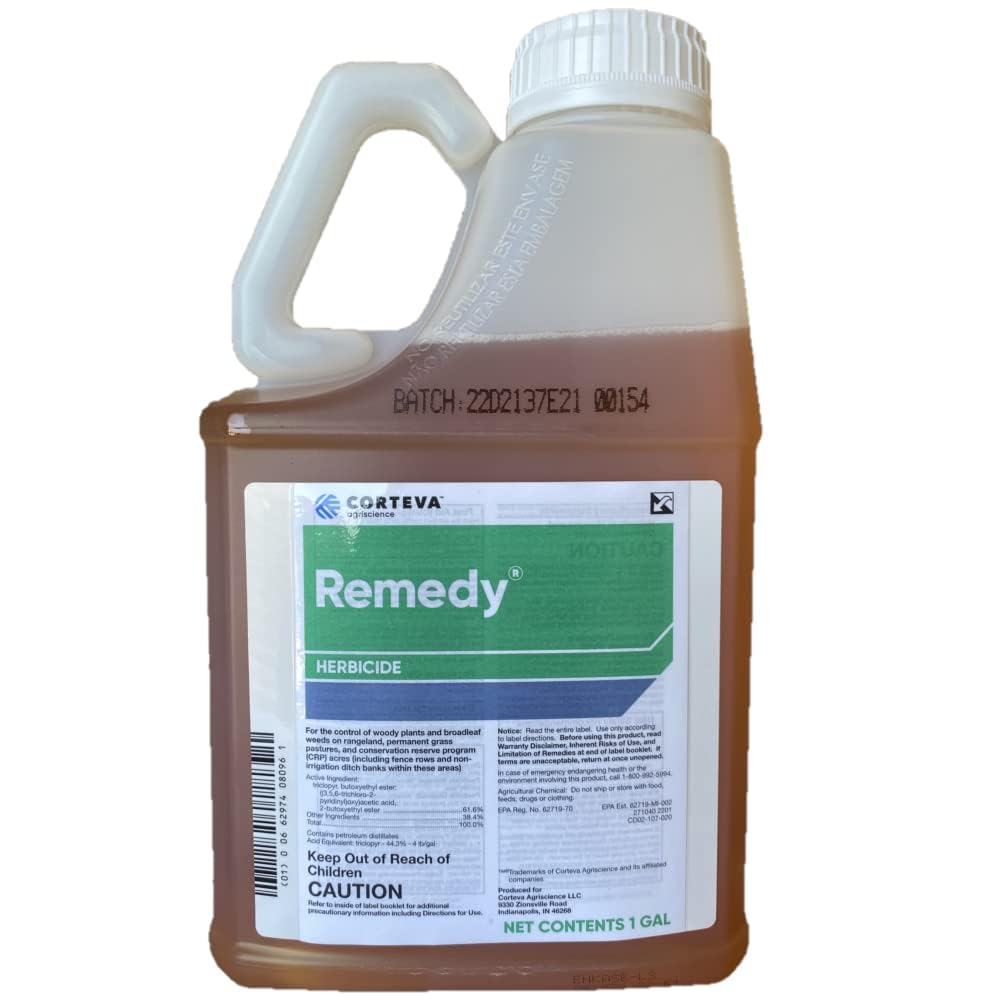
Remedy Ultra is a Dow AgroSciences triclopyr product built for the toughest pasture brush and woody vines, but its broadleaf activity makes it a strong weapon against dense goat head mats that have intertwined with blackberry, wild rose, or small trees. Mixed with diesel for basal bark application, it sterilizes the root base of multi-stemmed puncture vine clumps that have taken hold along fence lines.
The low-odor formulation is a practical upgrade for applicators who spray around livestock areas. Users report that a 1:3 mix with diesel on freshly cut stumps prevents resprouting entirely—a tactic that works when goat head vines climb up tree trunks and drop burrs from above. Waiting 2 to 4 weeks after application ensures the root system is fully dead before mowing or tilling.
Remedy Ultra is expensive per gallon compared to glyphosate concentrates, and it does not kill grasses—so if your goat head infestation is in a bare dirt driveway with no grass competition, a non-selective option may be more direct. The product label is long and must be studied carefully to match the correct mixing ratio for your target species.
What works
- Excellent on goat head mixed with woody brush and small trees
- Low odor compared to other triclopyr formulations
- Basal bark mix prevents root resprouting
What doesn’t
- Premium price per gallon compared to generic herbicides
- Not effective on grasses; requires separate product for mixed vegetation
3. Albaugh Gly Star Plus Herbicide

Gly Star Plus delivers a concentrated 41% glyphosate formula with a built-in surfactant package, matching the active ingredient strength of Roundup Ultra at a fraction of the per-gallon cost. The surfactant improves droplet retention on the waxy goat head leaf surface, reducing runoff and improving absorption even when the plant is stressed from heat or drought.
The 2.5-gallon jug (320 fl oz) is sized for serious property owners who spray fence lines, gravel drives, and pasture edges multiple times per season. At a standard 2.5-ounce-per-gallon mix rate, the jug yields over 128 gallons of finished spray—enough to blanket 4 to 5 acres of moderate infestation. Users note visible yellowing in 4 to 7 days and complete necrosis in 10 to 14 days.
This product is labeled for professional/commercial use only and is not sold to CA, MT, NV, OR, WA, or WY due to state restrictions. The non-selective nature means any desirable vegetation hit by drift will also die. Proper PPE—boots, gloves, goggles, and a mask—is essential because glyphosate exposure risks are real, as emphasized by multiple user reviews.
What works
- Built-in surfactant improves leaf adhesion on goat head
- Large 2.5-gallon size covers multiple acres per purchase
- Systemic action kills the deep taproot of puncture vine
What doesn’t
- Not available in several western states (CA, MT, NV, OR, WA, WY)
- Professional-use labeling may require additional credentials in some areas
4. Control Solutions Eraser Weed & Grass Killer Concentrate (1 Gal)
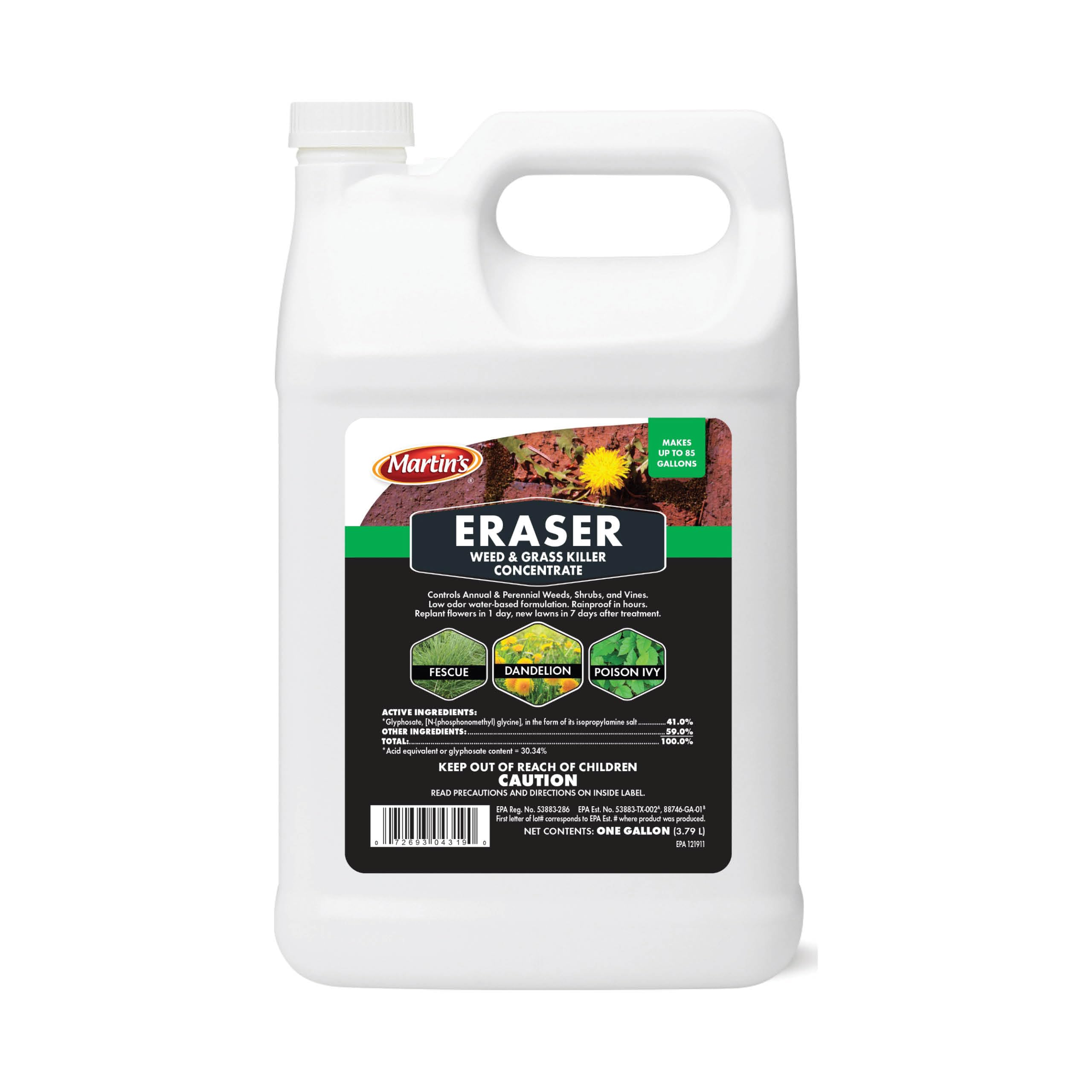
The Eraser 1-gallon jug is the same 41% glyphosate concentrate as the smaller quart bottle, scaled up for users who need more coverage without jumping to a 2.5-gallon container. At 8 ounces per 4 gallons of water, a single gallon yields roughly 21 gallons of ready-to-spray solution, making it a strong match for properties with 1 to 3 acres of scattered goat head.
Owners consistently report that mixed 8 oz per 4 gallons with a surfactant, the solution browns grass and weeds in 2 to 3 days, with stubborn puncture vine requiring a full week. The product has no soil residual activity, so bare ground can be reseeded or replanted within 7 days of application—a big advantage for those planning to sow competitive grass after eradication.
Some long-time users note that the formula seems slower than it was 5 years ago, with visible results taking up to 3 days instead of overnight. This may be due to improved regulatory compliance reducing adjuvant levels, so adding your own surfactant (like a non-ionic wetting agent) is recommended for goat head’s waxy foliage.
What works
- Great per-ounce value for medium-sized properties
- No soil residual allows quick re-planting after kill
- Consistent knockdown in 2-3 days with added surfactant
What doesn’t
- May require extra surfactant for fastest results on waxy leaves
- Some users report slower action compared to earlier batches
5. Hi-Yield Super Concentrate Killzall II

Killzall II is marketed as reaching the roots in 1 to 2 hours, with visible results in as little as 3 hours—an aggressive claim that appeals to impatient applicators fighting goat head before the burrs scatter. While the actual speed varies with temperature and leaf maturity, users confirm that treated puncture vine typically shows stress within 24 hours and complete browning within 5 days.
The 2.5-gallon tote is convenient for ATV-mounted sprayers: one user reports mixing it into a 16-gallon tank for fence-line spraying, covering long stretches of goat head without constant refills. The product is labeled for use in Roundup Ready crops, flower beds, driveways, and sidewalks, but explicitly not for lawns—so treat bare soil or non-turf areas only.
Because Killzall II is non-selective, it kills every plant it touches, including grass, flowers, and ornamental shrubs. Several reviewers emphasize the need for careful application on calm days to avoid drift. The concentrate is thick, so shake the jug thoroughly before measuring to ensure consistent mixing.
What works
- Fast initial symptoms visible within hours on young weeds
- Convenient 2.5-gallon tote for large sprayer tanks
- Systemic action kills the taproot of mature goat head
What doesn’t
- Non-selective; kills grass and ornamentals on contact
- Not labeled for lawn use; must be applied to bare soil only
6. Control Solutions Eraser Weed & Grass Killer Concentrate (32 oz)
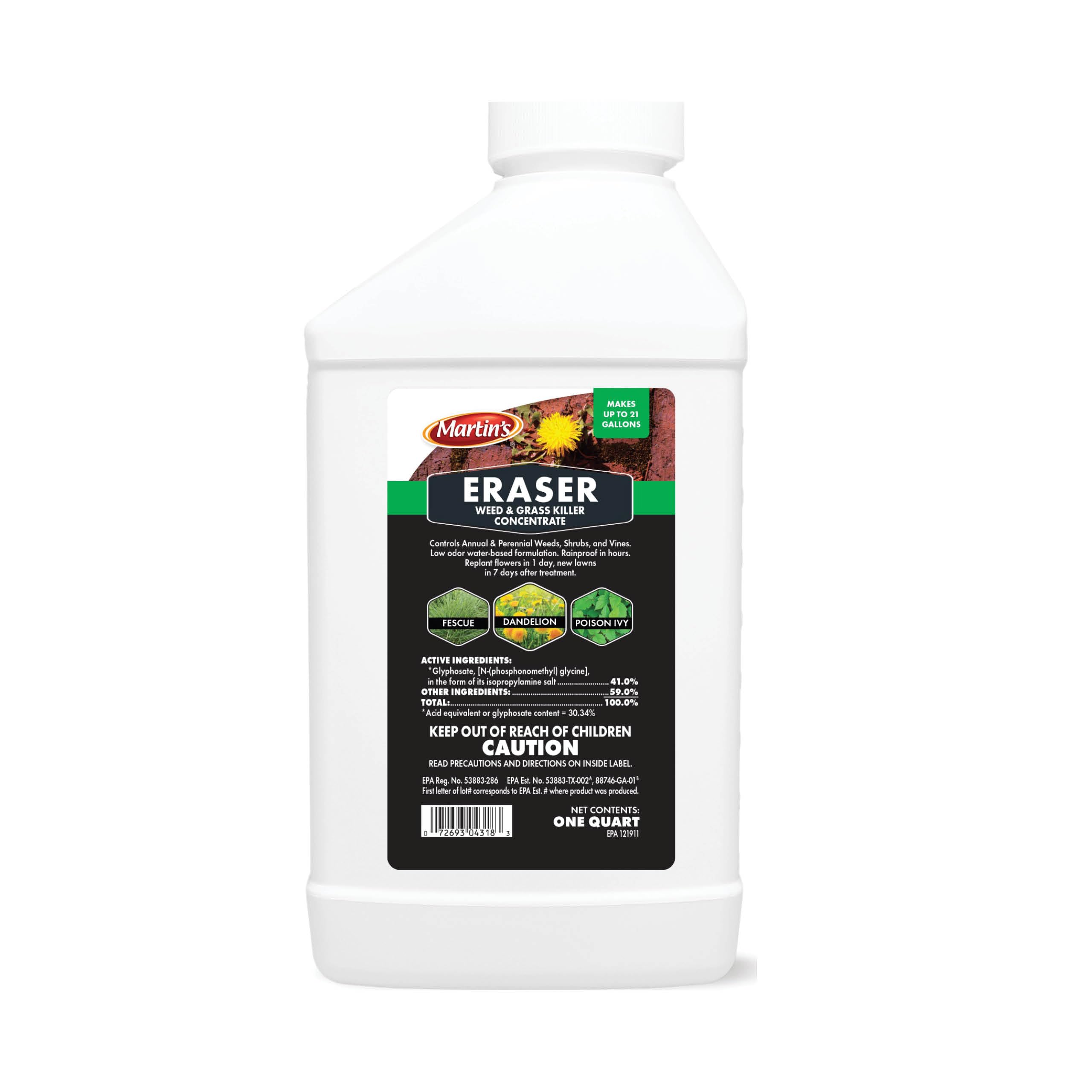
The quart-sized Eraser is an entry-level gateway to 41% glyphosate concentrate for homeowners tackling a small goat head patch in the driveway or along a short fence section. At 8 ounces per gallon, a 32-ounce bottle makes 4 gallons of spray—enough to cover roughly 800 to 1,200 square feet of dense puncture vine, which suits suburban lots with isolated infestations.
Users who switch from big-box store ready-to-use sprays notice dramatic savings: this concentrate costs less per gallon of finished spray than a single quart of premixed Roundup. The low-odor, water-based formula has no residual soil activity, so treated areas can be replanted with grass or ground cover within a week.
Speed is slower than selective triclopyr mixes—goat head typically shows yellowing at 4 to 7 days and full death at 10 to 14 days. Patience is required, and applying when rain is not expected for at least 6 hours improves results. The product instructions are vague on goat head specifically, so mixing at the upper end of the label rate (8 oz/gal) is recommended for mature plants.
What works
- Excellent starter size for small patches and spot treatment
- Significant cost savings over ready-to-use retail sprays
- No soil residual allows quick replanting
What doesn’t
- Slower visual results compared to triclopyr herbicides
- Vague label instructions; best results require higher mix rates
7. Southern AG Brush Weed Killer (32 oz)

Southern AG’s 1-quart brush weed killer uses triclopyr as its sole active ingredient, giving it selective activity against broadleaf plants like goat head while leaving grasses unharmed. The 32-ounce size is targeted at homeowners who need a few gallons of spray for fence rows, rangeland edges, or stump treatments rather than a multi-acre blanket application.
Users praise its effectiveness on tough brush species like strangler fig and multiflora rose, and the triclopyr chemistry translates well to puncture vine. When applied at the label rate, it prevents sprouting on clean-cut stumps, which is useful if goat head vines have climbed into tree trunks. Coverage is rated at 512 to 1,024 square feet per gallon, meaning the quart bottle covers 1,500 to 3,000 square feet of dense vegetation.
The small bottle runs out fast if you’re tackling anything larger than a half-acre infestation. For the same triclopyr chemistry at a better per-ounce price, the Southern Ag Crossbow (1 gallon) offers far more coverage. This bottle is best used as a spot-treatment complement to a larger herbicide program or for manual stump-dabbing.
What works
- Selective triclopyr chemistry spares grass near goat head patches
- Prevents sprouting on cut stumps and vines
- Effective on tough brush species that resist glyphosate
What doesn’t
- Small 32-oz size is high per-ounce cost vs. larger jugs
- Not suitable for large-area coverage without multiple bottles
Hardware & Specs Guide
Glyphosate Concentration (41% vs 18%)
The 41% glyphosate concentrates (Eraser, Gly Star Plus, Killzall II) provide the highest active ingredient load per ounce, translating to more gallons of finished spray per bottle. At 2.5 oz per gallon, 41% formula delivers roughly 1.3% glyphosate in the tank—enough to puncture the cell walls of goat head leaves within hours. Lower-concentration products (18% or 20%) require higher mixing rates and often lack built-in surfactants, making them less cost-effective for large infestations.
Triclopyr for Selective Broadleaf Control
Triclopyr mimics the plant hormone auxin, causing uncontrolled growth that kills broadleaf weeds like puncture vine without affecting grass. Products such as Southern Ag Crossbow (triclopyr + 2,4-D) and Remedy Ultra (triclopyr alone) are the go-to choice for pastures, lawns, and fence lines where grass retention matters. Triclopyr has a longer soil half-life than glyphosate (up to 30 days), so avoid over-application near tree root zones if planting sensitive ornamentals soon after treatment.
FAQ
Will triclopyr kill goat heads in my lawn without killing the grass?
Does 41% glyphosate need a surfactant to work on goat head leaves?
When is the best time of year to spray goat head weeds for complete kill?
How long after spraying can I safely let pets walk on treated goat head areas?
Final Thoughts: The Verdict
For most gardeners, the goat head weed killer winner is the Southern Ag Crossbow because it combines selective triclopyr chemistry with 2,4-D for fast knockdown on puncture vine without damaging grass. If you need a large-volume non-selective option for bare ground or gravel drives, grab the Albaugh Gly Star Plus. And for heavy brush-infested fence lines where goat heads have mixed with woody vines, nothing beats the Remedy Ultra applied via basal bark treatment.