
Fire ants build mounds that ruin the look of your turf and deliver painful, venomous stings to anyone who steps too close. A granular bait or contact killer that targets the queen is the only way to stop them from rebuilding, and choosing the wrong formula means wasted weekends and angry ants. The most effective solutions use a delayed-action poison the workers carry back to the colony, wiping out the source rather than just the visible surface fighters.
I’m Rikta — the co-founder and writer behind Lawn Gear Lab. I’ve spent countless hours cross-referencing active-ingredient concentrations, particle sizes, and coverage areas so you don’t have to guess which product actually delivers a dead colony.
After poring over dozens of owner reports, comparing application methods, and studying chemical profiles, I’ve narrowed the market down to the seven most reliable choices for your best fire ant killer for yard needs.
How To Choose The Best Fire Ant Killer For Yard
The difference between a product that wipes out a colony and one that just annoys the ants comes down to how the active ingredient works. Contact killers hit the ants you see, but bait granules take the poison inside the mound where it matters most.
Active Ingredient Strategy: Bait vs. Contact
Bait-based killers use a food attractant mixed with a delayed toxin. Worker ants carry the granules into the mound and feed the queen, collapsing the colony in days. Contact killers, usually sprays or dusts, eliminate only the ants that walk through the treated zone — the queen survives and the mound regrows. For total yard clearance, bait granules with Acephate or Indoxacarb are the proven path.
Granule Size and Coverage Rate
The particle diameter determines how far a spreader can throw the product and how well it penetrates the grass canopy. Smaller granules bury deeper into the thatch, making them more accessible to foraging ants. Larger granules can break apart on impact. Coverage rate (pounds per 1,000 square feet) directly governs how many bags you need for your lawn size — always check the label for your specific turf type.
Residual Duration and Weather Resistance
Some formulas degrade in direct sunlight or after heavy rain, requiring reapplication every few weeks. Season-long products use a microencapsulated active ingredient that releases slowly over three to four months. If you live in a hot, wet climate, look for a granular treatment labeled for 8–12 weeks of residual control to avoid constant retreatments.
Quick Comparison
On smaller screens, swipe sideways to see the full table.
| Model | Category | Best For | Key Spec | Amazon |
|---|---|---|---|---|
| Surrender Fire Ant 1lb | Spray | Fast knockdown on mounds | 1 lb ready-to-spray | Amazon |
| Acephate 97UP 1lb | Granules | High-concentration DIY | 97% Acephate powder | Amazon |
| Hi-Yield Fire Ant Control 8 oz | Granules | Small-area mound treatment | 8 oz Acephate granules | Amazon |
| Ortho Lawn Insect Killer 10 lb | Granules | Broad perimeter barrier | Treats 10,000 sq ft | Amazon |
| Terro T901-2 Ant Killer Plus | Granules | Fast-acting spot treatment | 3 lb shaker bags (2-pack) | Amazon |
| Advion Insect Granular Bait 1 lb | Granules | Colony elimination via bait | 0.22% Indoxacarb bait | Amazon |
| BioAdvanced Complete 20 lb | Granules | Large-lawn season-long | Treats 25,000 sq ft | Amazon |
In‑Depth Reviews
1. Advion Insect Granular Bait 1 lb

Syngenta engineered this granular bait with 0.22% Indoxacarb, a non-repellant active that triggers the MetaActive effect only after ingestion. Worker ants transport the granules directly into the mound without detecting the poison, which means the queen consumes a lethal dose before the colony realizes anything is wrong. Owner reports from Southern Louisiana confirm that even deep fire ant hills went silent within a week of application.
The 1-pound shaker bottle treats a standard residential perimeter with ease, covering both spot mound treatments and a continuous band around the house foundation. The granules are small enough to settle into thatch but large enough to resist bouncing off a hand spreader. Users note a faint odor that temporarily deters pets and birds from the area, though the label confirms the product is safe once the granules are watered in.
Compared to Acephate-based killers, Indoxacarb delivers a slower but more thorough colony kill because the bait cycle takes a few days to reach the queen. Multiple verified buyers who battled fire ants for years called this the only product that kept mounds from returning. For homeowners who want a single treatment that truly ends the colony, this represents the most effective formula on the market.
What works
- Colony-killing bait cycle reaches the queen reliably
- Non-repellent formula avoids triggering ant avoidance behavior
- Lightweight shaker bottle allows precise mound-targeted application
What doesn’t
- Kill time is 3–7 days, not instant knockdown
- Small 1 lb bag covers only moderate-sized lawns
2. BioAdvanced Complete Brand Insect Killer for Lawns 20 lb
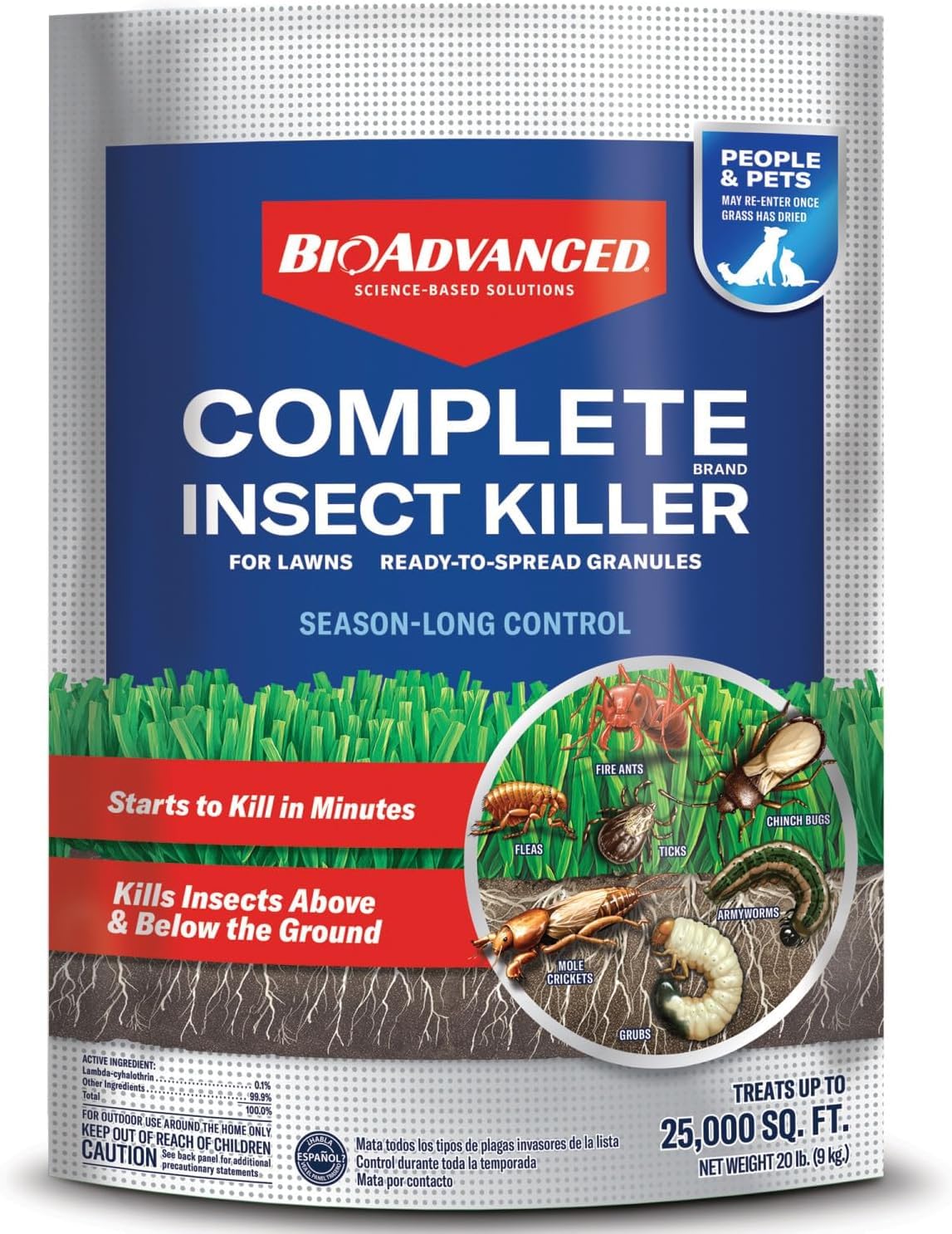
The 20-pound bag covers up to 25,000 square feet, making it the strongest option for owners with sprawling properties or multiple acres. The dual-action formula kills listed ants, fleas, ticks, chinch bugs, and mole crickets on contact while also providing season-long residual control — verified owners in South Florida reported three months of protection even under heavy afternoon rain.
Application requires a broadcast or drop spreader, but the granules are uniform enough to avoid clogging or uneven distribution. The active ingredient stays active in the soil layer where foraging ants travel, intercepting new infestations before they can establish visible mounds. The label explicitly covers fire ant mound treatment as well as perimeter barrier use, so one bag handles both strategies.
Some users mention that the product did not eliminate moles because the insects they eat survived deeper in the soil. For fire ant control specifically, the contact-and-residual combination works best when applied as a whole-lawn broadcast in early spring before mounds become visible. Homeowners who want a set-it-and-forget-it season-long solution will appreciate the raw coverage this bag provides.
What works
- Massive 20 lb bag covers very large lawns in one pass
- Residual control lasts roughly 3 months in warm climates
- Effective on multiple insect species beyond fire ants
What doesn’t
- Requires a spreader — not suitable for spot hand treatment
- Does not kill stink bugs despite broad-spectrum claim
3. Hi-Yield Fire Ant Control with Acephate 8 oz
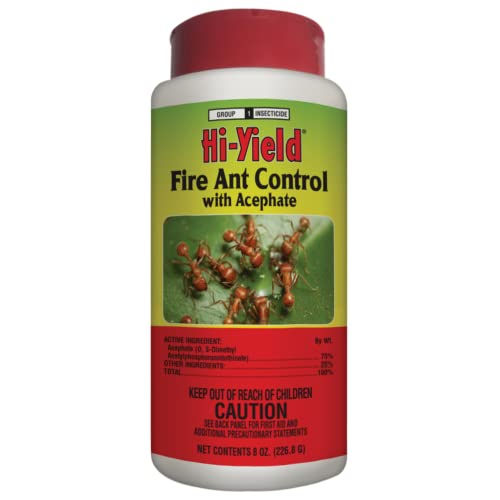
Hi-Yield packs 0.04% Bifenthrin into an 8-ounce granular format designed specifically for fire ant mounds on residential turf, commercial lawns, and non-crop areas. A single 1–2 teaspoon sprinkle per mound is enough to collapse the colony within 48 hours, according to user reports from Texas and the Southeast. The small container size is ideal for homeowners who have a few mounds rather than a full-yard infestation.
The granules work best when applied in early morning or late afternoon when ants are actively foraging near the surface. Multiple verified buyers confirmed that the product also eliminated German roaches in garages and outdoor sheds, with residual protection lasting 8–10 weeks on concrete surfaces. The mild odor is faint compared to Acephate dusts, and users report no staining on patios or walkways.
One caveat is the small 8-ounce volume — if your lawn has dozens of mounds, you may need multiple containers per season. Recent buyer reviews also noted batch-quality issues where the product smelled off and performed inconsistently, suggesting the formula may degrade in storage. For targeted spot treatment on a manageable number of mounds, this remains a reliable, low-cost entry point.
What works
- Very fast knockdown — mounds go quiet within 48 hours
- Good residual on hard surfaces like patios and driveways
- Low odor compared to concentrated Acephate products
What doesn’t
- Small 8 oz container runs out quickly on larger lawns
- Occasional batch variation reported in recent reviews
4. Terro T901-2 Ant Killer Plus 3 lb Bags (2-Pack)

Terro’s signature fast-acting granules claim to kill ants, fire ants, cockroaches, and fleas within 24 hours, and the resealable shaker bag eliminates the need for a spreader. The 2-pack provides 6 pounds of product total, enough for repeated spot treatments or a perimeter band around a medium-sized home foundation. Verified owners in the Mid-Atlantic region reported zero ant activity for an entire season after a single application.
The granules work as a spot treatment directly on ant hills or as a band treatment along the foundation line. The shaker top allows precise control, so you avoid wasting product on grass that doesn’t show activity. Users note the smell is mild compared to concentrated Acephate, though the product label advises keeping pets and children off the treated area until the granules are watered in.
Performance consistency appears to vary by batch: one buyer in a recent season reported seeing more ants after the second bag, suggesting the product may lose potency if stored in extreme temperatures. For homeowners who prefer a spreader-free, targeted application on a modest lawn, the 2-pack offers good value if you use it promptly.
What works
- Fast 24-hour knockdown on visible ants and mounds
- Convenient shaker bag — no spreader needed
- Two 3 lb bags provide good quantity for medium lawns
What doesn’t
- Potency may degrade in older stock
- Less effective for deep colony elimination than bait
5. Acephate 97UP 1lb Bag
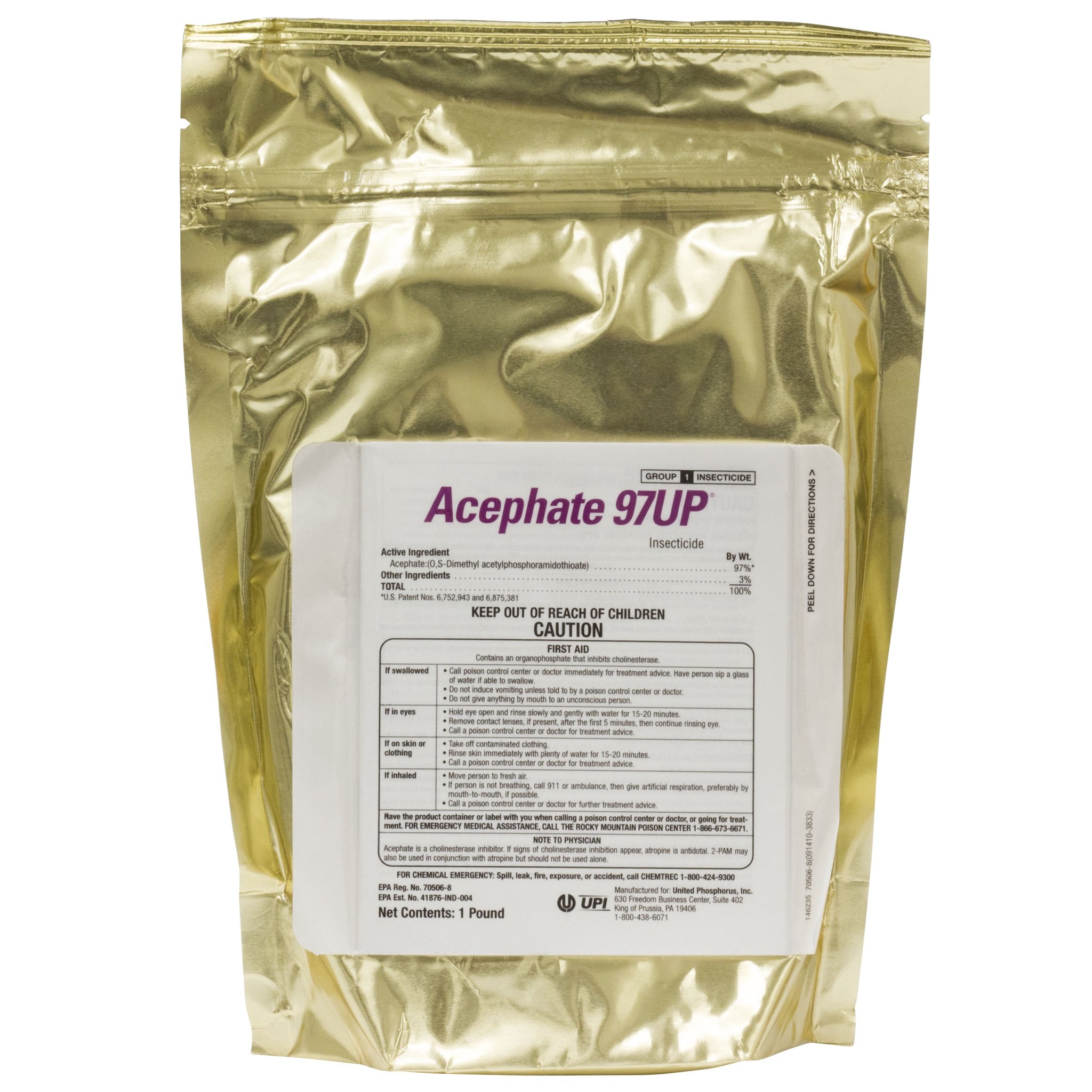
This 97% Acephate powder is the most concentrated fire ant killer in this comparison, intended for experienced users who mix their own spray or drench solutions. A single pound can be diluted to cover dozens of mounds, making it extremely cost-effective for large properties or hay fields. Verified owners report eliminating field ants in agricultural settings after just one dry application on mounds.
The raw powder emits an intense sulfur-like odor that buyers describe as spoiled kimchi or rotten eggs, detectable up to 30 feet downwind from the sealed pouch. It requires protective gloves, a respirator, and careful handling because the smell transfers to skin and clothing. Diluted solutions in water have a faint, tolerable odor, but the dry concentrate demands respect during mixing.
Users report excellent results on lace bugs, scale insects, spider mites, and over 125 listed pests in addition to fire ants. The 97% concentration also means a small amount goes a long way — about half a cup per gallon of water for a mound drench. For anyone comfortable handling a technical-grade insecticide, this is the most versatile and potent option available.
What works
- Extremely high 97% Acephate concentration for maximum potency
- Controls over 125 insect species beyond fire ants
- One-pound bag lasts many applications when diluted properly
What doesn’t
- Powerful odor requires full protective gear and outdoor mixing
- No spreader-friendly format — must mix into spray solution
6. Surrender Fire Ant 1lb
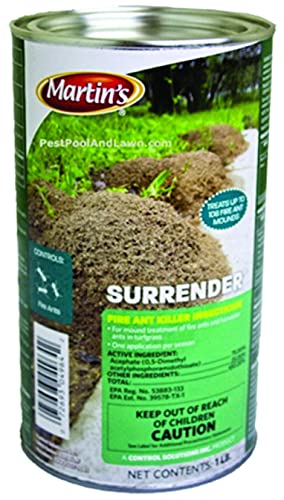
Surrender is a ready-to-spray liquid insecticide that kills fire ants on contact, making it the best choice for instant knockdown when you need to clear a high-traffic area like a play zone or walkway. Verified buyers in Florida report that one application was sufficient to eliminate aggressive fire ant mounds, and the product works against spiders and other household pests as well. The 1-pound container connects directly to a garden hose for fast, even coverage.
The formula has a strong rotten-egg smell that lingers for a day or two, but users confirm the odor is a sign the active ingredient is working. Several longtime buyers keep this product in their regular rotation, noting that it outperforms cheaper sprays that only kill surface-level ants. The spray reaches deep into the mound, hitting the queen if the drench is applied thoroughly.
One limitation is that the contact-only mechanism means it does not prevent new mounds from forming later in the season. For homeowners who want an immediate fix to a visible problem, this delivers instant results — but it should be paired with a bait program for long-term colony prevention.
What works
- Instant contact kill — ants die within minutes
- Easy hose-end sprayer requires no mixing or measuring
- Effective on Florida-grown fire ants in one application
What doesn’t
- Strong rotten-egg smell persists for 24–48 hours
- No residual bait — new mounds can return later
7. Ortho Lawn Insect Killer Granules 10 lb

Ortho’s 10-pound bag treats up to 10,000 square feet, making it a solid entry-level choice for homeowners who want a simple granular spreader application. The formula kills ants, spiders, fleas, ticks, and grubs both above and below ground, providing three months of residual control. Verified buyers report that a single bag completely eliminated fleas in a 200-by-40-foot dog run and kept ticks away for months.
The granules require thorough watering after application, then the area must dry completely before people and pets re-enter. Users with battery-powered hand spreaders found the coverage even and consistent, with no clumping or bridging in the hopper. The product is odorless after watering, which is a significant advantage for families with sensitive noses or small children.
While Ortho works well as a broad-spectrum lawn insecticide, it is not a targeted fire ant bait. Multiple reviews note that ants may still form new mounds in the treated area if the queen was not eliminated. For general yard insect suppression at a budget-friendly price, this delivers reliable coverage — but for dedicated colony destruction, a bait product is a better fit.
What works
- Odorless formula after watering — safe for sensitive households
- Treats up to 10,000 sq ft for broad perimeter coverage
- Effective at eliminating fleas and ticks from grass
What doesn’t
- Not a bait — does not specifically target the queen
- Ant mounds may reappear later in the season
Hardware & Specs Guide
Active Ingredient Concentration
The percentage of the killing agent in the product directly determines how much you need per treatment. Acephate 97UP contains 97% pure Acephate — roughly 40 times stronger than a typical 2.5% consumer granule. Low-concentration baits like Advion (0.22% Indoxacarb) rely on the bait mechanism rather than raw potency, so the gram dosage per mound is much lower even though colony kill rates are high.
Carrier Particle Size
Granule diameter influences how the product lands and stays in the grass. Ortho and BioAdvanced use medium-sized particles that pass through standard spreader settings without bridging. Terro’s shaker bag uses finer granules that settle into thatch more effectively but can drift in wind if broadcast. Acephate 97UP is a wettable powder, meaning it must be dissolved in water before application as a drench.
FAQ
How long do granular baits take to kill a fire ant colony?
Can I use Acephate 97UP powder as a dry granule on mounds?
Will rain wash away granular fire ant killer?
Final Thoughts: The Verdict
For most gardeners, the best fire ant killer for yard winner is the Advion Insect Granular Bait because the Indoxacarb bait cycle guarantees colony-wide elimination in one treatment. If you want an instant knockdown spray for visible mounds, grab the Surrender Fire Ant 1lb. And for large-lawn season-long coverage that keeps multiple insect species in check, nothing beats the BioAdvanced Complete 20 lb.