
Specs are compiled from manufacturer listings and verified buyer reviews and can change over time — please confirm the key details on the product page before buying.
Using a fertilizer with too much nitrogen makes succulents grow leggy and pale instead of staying tight and colorful. You need a low-nitrogen, high-phosphorus, and high-potassium formula that also adds trace minerals and beneficial microbes without burning roots. This guide finds the real bottles and packets that deliver thicker leaves, stronger roots, and vibrant color.
I’m Rikta — the founder and writer behind Lawn Gear Lab. This guide is built by comparing the manufacturers’ published specifications and the patterns across verified customer reviews, so you get each pick’s real strengths and trade-offs instead of marketing spin.
You get seven distinct fertilizers for succulents, from a liquid concentrate that makes 32 gallons (121 liters) to an organic powder with slow-release microbes. This is your straightforward look at the best fertilizer for succulents you can actually count on.
Quick Picks
- HiThrive 16oz Succulent Fertilizer — Best Overall
- Grow Queen Organic Cactus & Succulent — Slow-Release Power
- Growth Technology GT Succulent Focus — Premium Precision
- Baby Bio Succulent Food — Drip-Bottle Ease
- Espoma Organic Cactus! Plant Food — Pet-Safe Organic
- Schultz Cactus Plus 2-7-7 Liquid Plant Food — Ultra-Concentrated
- TPS Nutrients Succulent Fertilizer — Compact Growth Focus
How To Choose The Best Fertilizer For Succulents
Succulents do not need much, but they will not thrive on neglect alone. The right fertilizer gives them the nutrients they need without pushing weak, rapid growth. Here is what to look for.
NPK Ratio and Nitrogen Control
The most important number on any succulent fertilizer is the N-P-K ratio (the percentage of nitrogen, phosphorus, and potassium). You need lower nitrogen — usually a ratio like 1-2-2 or 2-7-7 — to prevent stretching and keep leaves compact and firm. Too much nitrogen, found in standard all-purpose houseplant food, makes them grow leggy and weak.
Liquid Concentrate vs. Slow-Release Powder
Liquid fertilizers give you precise control and fast results. You mix them with water and apply every other watering. Organic powders and slow-release formulas feed over weeks or months without the risk of over-fertilizing. Your choice depends on how hands-on you want to be. Powders are forgiving for busy plant parents, while liquids let you adjust the dose for each plant.
Trace Minerals and Beneficial Microbes
Beyond the main nutrients, look for calcium, magnesium, and zinc. These trace minerals (micronutrients that plants need in tiny amounts) strengthen cell walls and deepen color. Some organic fertilizers also contain beneficial soil microbes that improve root health and nutrient uptake without the salt buildup that can burn roots over time.
Quick Comparison
| Model | Best For | Form | Volume | Mixing Ratio | Amazon |
|---|---|---|---|---|---|
| HiThrive 16oz Succulent Fertilizer | Best Overall Value | Liquid | 16 fl oz | ¼ tsp per quart | Amazon |
| Grow Queen Organic Cactus & Succulent Fertilizer | Slow-Release Organic | Powder | 7 Servings | 1 packet per gallon | Amazon |
| Growth Technology GT Succulent Focus | Premium Precision | Liquid | 8.5 fl oz | 3-5ml per liter | Amazon |
| Baby Bio Succulent Food | Measured Drops | Liquid | 5.9 fl oz (3-Pack) | 5 drops per pint | Amazon |
| Espoma Organic Cactus! Plant Food | Organic & Pet-Safe | Liquid | 8 fl oz (2-Pack) | ½ cap per quart | Amazon |
| Schultz Cactus Plus 2-7-7 | Ultra-Concentrated | Liquid | 4 fl oz (2-Pack) | 1 tsp per gallon | Amazon |
| TPS Nutrients Succulent Fertilizer | Compact Growth | Liquid | 32 fl oz | 1:200 | Amazon |
In‑Depth Reviews
1. HiThrive 16oz Succulent Fertilizer
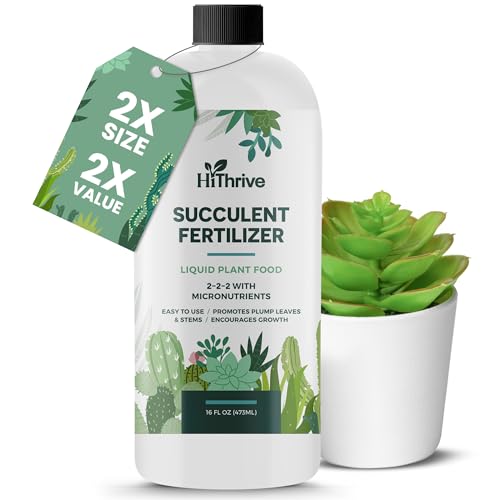
The biggest bottle that makes the most gallons without the premium price tag.
This liquid concentrate makes 32 gallons (121 liters) of ready-to-use plant food from a single 16-fluid-ounce bottle. The mixing ratio is ¼ teaspoon per quart of water. It delivers nitrogen for leaves, phosphorus for roots, and potassium for resilience, plus trace minerals (calcium, magnesium, and zinc) to keep colors vibrant and leaves plump. One buyer reports that “it has made my agave plant grow and look great!” Another says their collection showed “better growth and healthy leaves.” The formula covers Aloe Vera, Jade Plants, String of Pearls, Zebra Haworthia, and Burro’s Tail.
The trade-off is that you must remember to apply it every other watering. It does not have the low-maintenance nature of a slow-release powder. The liquid format also requires measuring small ¼ teaspoon doses. If you want a lot of food per dollar and like mixing fresh each time, this is the bottle to pick over the Grow Queen below.
What Stands Out
- Makes 32 gallons from a single 16 fl oz bottle
- Includes calcium, magnesium, and zinc for deep color
- Works for all common indoor succulents
What to Keep in Mind
- Requires consistent every-other-watering schedule
- Liquid format measures in small ¼ tsp doses
Reach for this if: you want the most concentrated value and are comfortable mixing fresh food every watering cycle.
Look elsewhere if: you tend to forget weekly feedings and prefer a one-time application that lasts months.
2. Grow Queen Organic Cactus & Succulent Fertilizer
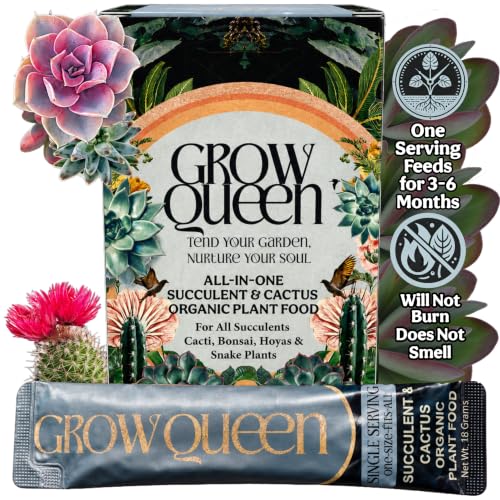
One packet feeds six small succulents for up to two months with no measuring.
Each single-serving powder packet covers up to 1 gallon (3.8 liters) of soil or 6 small succulents. The time-release formula feeds for 2 to 8 months from a single application. It is OMRI-listed organic (certified for organic gardening), vegan, pet-friendly, and non-toxic. The powder also contains living beneficial soil microbes that strengthen the immune system of your plants over time. One reviewer drove two Christmas cactus cuttings across the country in a Ziploc bag and applied this in late September. They reported that “the stems and stalk are now strong and vibrant and the blooms are miraculously abundant and gorgeous.” Another buyer noted: “I often forget to feed my houseplants and succulents, and now they’re getting the nutrients they need without me stressing.”
The catch is that each box gives you only 7 servings, so it goes quickly for a big collection. The living microbes can create a white film on the soil surface — the manufacturer says this is healthy, but you may want to mix it into the top layer. For anyone who wants organic, low-effort feeding that builds long-term soil health, this is the standout over the HiThrive liquid you need to mix.
Perfect for busy owners: one packet, 20 seconds to apply, and the smart-release does the rest for months.
A great match for: plant parents who forget to feed and want an organic, burn-proof solution.
skip it if: you need a large volume for many plants — 7 servings run out fast for a big collection.
3. Growth Technology GT Succulent Focus
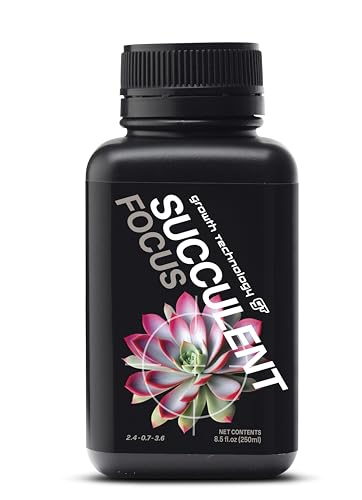
A pH-buffered blend of all 12 essential minerals for serious succulent collectors.
GT Succulent Focus contains all 12 essential minerals, including calcium, in a pH-buffered concentrate (the acidity is balanced so every nutrient stays available). The mixing ratio is 3–5 ml per liter for soil and 5–7 ml per liter for hydroponic setups. The formula is lower in nitrogen and phosphorus to match the slow growth rate of succulents while still feeding leafy varieties like Euphorbias. One reviewer who uses it for hydro plants says, “my plants grow like weeds with it.” Another noted healthier foliage and more vibrant leaves. The bottle is free from sodium, chlorides, urea, cobalt, and nickel.
The downsides are a small 8.5-fluid-ounce volume relative to the bottle weight of 15 ounces, and a couple of users noted the original bottle can leak. Compared to the HiThrive, the GT Succulent Focus is more expensive per ounce and makes less total volume, but its complete mineral profile and pH buffering support healthier long-term growth in a mixed collection of succulents and tropicals.
Why It Excels
- pH-buffered formula keeps all 12 minerals available
- Works for both soil and hydroponic succulents
- Safe, plant-friendly ingredients with no sodium or urea
A Minor Frustration
- Bottle can leak if not stored upright
- Small volume relative to the bottle weight
Choose this when: you want lab-grade precision and complete mineral nutrition for a mature collection.
Pick something else if: you only have a few basic succulents and do not need the extra mineral complexity.
4. Baby Bio Succulent Food
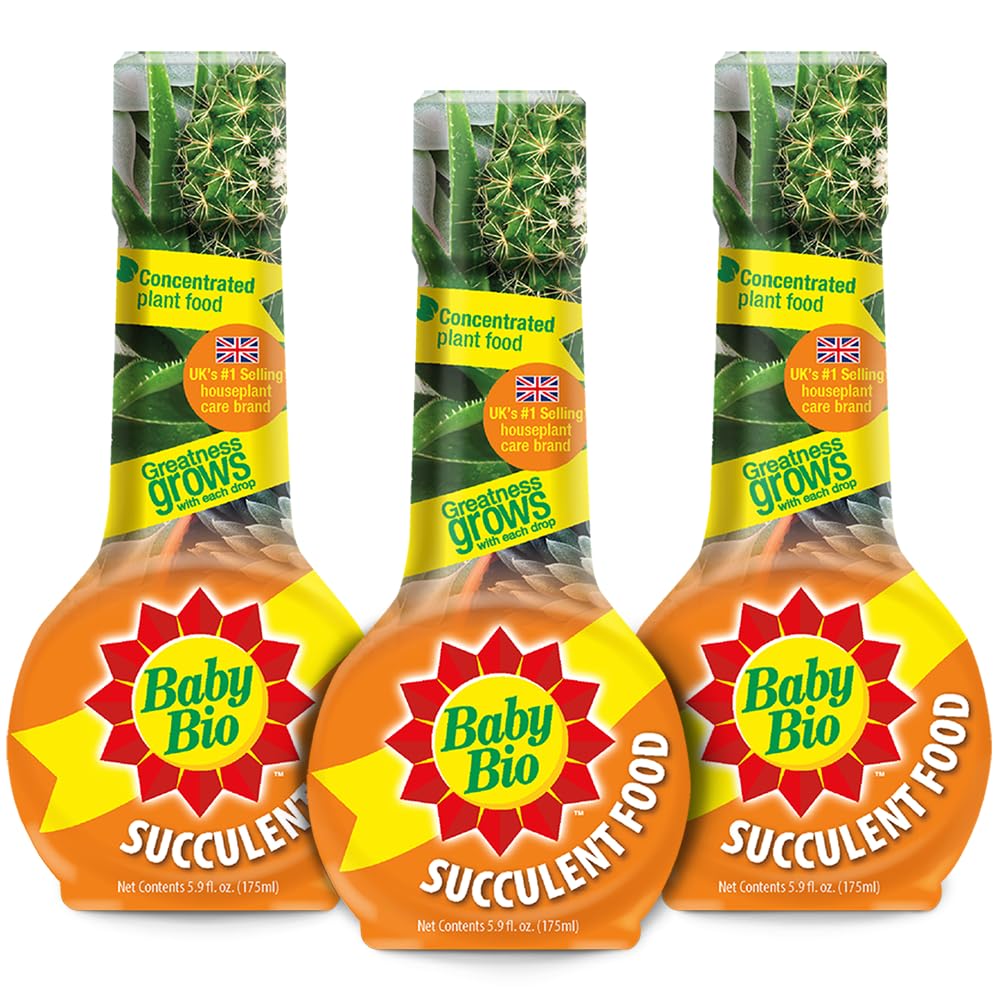
A dripper bottle that lets you feed succulents in precise 5-drop increments.
The dripper bottle makes over-feeding nearly impossible. The mixing ratio is 5 drops per pint of water — a tiny dose that the dropper makes simple to use. This 3-pack contains three 5.9-fluid-ounce bottles (total 17.7 fl oz). The item weight of 1.5 pounds makes it 1.5 pounds versus the HiThrive at 1.2 pounds, so the packaging is sturdier. Buyers report “visible improvement in houseplants within weeks: healthier leaves, richer color, new growth.” Users also note it is economical and mixes easily. It works for both indoor and outdoor Mammillaria, Sempervivum, Aloe, and Christmas Cacti.
The obvious advantage compared to the Schultz liquid below is the dropper — no measuring spoons needed. However, the individual bottles are small, so a large collection goes through them faster than a single 16-ounce bottle like the HiThrive. One reviewer noted that “bio” in the name misleadingly implies organic when the formula is actually synthetically derived. If you require certified organic plant food, look at the Grow Queen or Espoma options instead.
What Works
- Dropper bottle for precise 5-drop dosing
- Noticed visible improvement within weeks
- Great for both soil-based and hydroponic succulents
What Does Not
- Small individual bottles go quickly
- Not an organic fertilizer despite the name
A solid pick for: anyone who hates measuring and wants a simple, consistent dropper dose.
Better options exist for: certified organic gardeners or those with a large collection to feed.
5. Espoma Organic Cactus! Plant Food

Organic liquid feed that is safe around kids and pets, with results in hours.
Espoma’s Cactus! Plant Food is an organic liquid concentrate with an NPK ratio of 1-2-2, designed specifically for cacti and succulents. You get a 2-pack of 8-fluid-ounce bottles (16 total ounces). The mixing ratio is ½ cap per quart of water, and the manufacturer recommends using it every 2-4 weeks during the growing season. Owners mention that it “resuscitated my succulents” and that “Aloe Vera is glowing.” One buyer mentioned the concentrate smells like manure when undiluted, but when mixed at the recommended ratio, it has almost no smell and works wonders. Another verified buyer says it is the “best succulent fertilizer found” and that it yields beautiful cacti and blooms year-round.
Compared to the Schultz 2-7-7, this has a higher nitrogen ratio, which is better for faster-growing succulents like Adenium and Fockea but less ideal for slow-growing cacti. The smelly concentrate is the main annoyance, but the results speak for themselves. If you have kids or pets and want an organic fertilizer you can trust, this is the safest bet here.
Why It Stands Out
- Certified organic and safe around kids and pets
- Shows visible results within hours for some users
- Comes in a 2-pack for value
The Catch
- Concentrate smells like manure before dilution
- Higher nitrogen ratio better for fast growers, not slow cacti
Get this if: you need an organic, pet-safe liquid that works quickly on faster-growing succulents.
pass on it if: you primarily have slow-growing cacti that need a lower-nitrogen 2-7-7 formula.
6. Schultz Cactus Plus 2-7-7 Liquid Plant Food
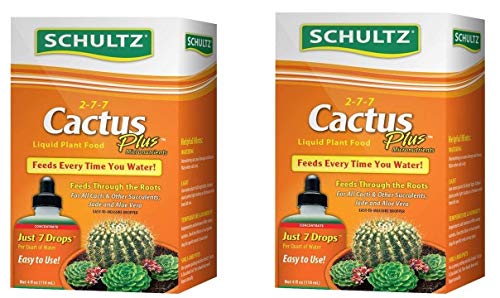
The strongest concentration here — a small 4 oz bottle makes a huge amount of food.
Schultz Cactus Plus has the most extreme concentration in this roundup. Each of the two bottles contains 4 fluid ounces, and the mixing ratio is just 1 teaspoon (5 ml) per gallon of water. That means a single 4-ounce bottle makes 24 gallons (91 liters), and the two-pack makes a total of 48 gallons (182 liters). The NPK ratio is 2-7-7 — very low nitrogen, high phosphorus and potassium. This is the ideal profile for slow-growing cacti because it prevents stretched growth while supporting strong roots and blooming. Customers note it is “good value due to high concentration” and that “the small bottles last a long time.”
The downsides are the tiny 4-ounce bottles and the need for careful measuring. Compared to the HiThrive, the Schultz makes more total gallons per dollar on a concentrate basis, but the bottle is physically much smaller and easier to lose in a tool drawer. It is the choice for cactus specialists who want the lowest nitrogen ratio available here.
What Shines
- Ultra-concentrated — a 2-pack makes up to 48 gallons
- Ideal 2-7-7 ratio for slow-growing cacti and blooming
- Proven results over years of use by verified buyers
What Holds It Back
- Small 4 oz bottles are easy to misplace
- Requires precise measuring for small pots
Best choice when: you grow mostly cacti and want the lowest nitrogen ratio to keep them compact and blooming.
Not ideal if: you dislike measuring tiny doses or want a single larger bottle to keep on the shelf.
7. TPS Nutrients Succulent Fertilizer
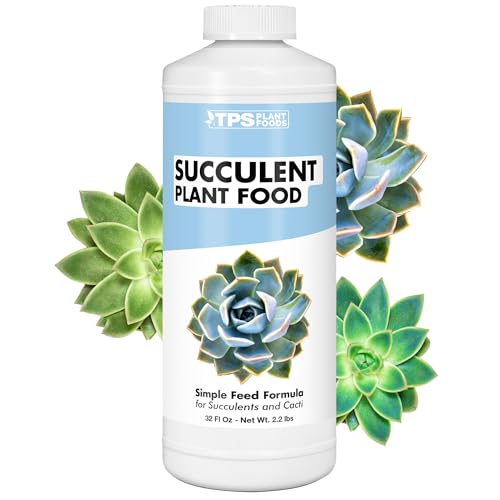
The biggest single bottle in the lineup, formulated to prevent leggy stretching.
TPS Nutrients offers the largest single container at 32 fluid ounces, making it the bulk option for owners with many plants. The mixing ratio is 1:200 (about 2.5 ml per liter of water), which keeps the dose gentle and safe for frequent use. The formula is designed to prevent “leggy” succulents (the weak, stretched growth caused by too much nitrogen or too little light) by providing balanced nutrients for steady, compact growth and thicker leaves. Reviewers point out that after three feedings, “all of them have greened up beautifully” and that the bottle “makes feedings super easy.” One owner uses it for succulents, a snake plant, and pothos. The product is made in the USA.
It comes in a large, simple bottle with no measuring cap — you will need a separate measuring tool. It is also the heaviest option at 32 ounces by weight. Compared to the Schultz concentrate, this is less concentrated but much easier to dose because the ratio is so simple. For anyone with a large succulent collection who wants a single bottle that lasts all season, this is the most straightforward pick.
Perfect for big collections: one huge 32 oz bottle keeps a shelf of succulents fed for months with no reordering.
Grab this if: you have many plants and want the biggest ready-to-use bottle with a simple 1:200 ratio.
Look elsewhere if: you prefer a dropper or ultra-concentrated format that takes less shelf space.
Understanding the Specs
NPK Ratio
The three numbers on a fertilizer label stand for Nitrogen (N), Phosphorus (P), and Potassium (K). For succulents, you want a ratio with low nitrogen, like 1-2-2 or 2-7-7. High nitrogen forces fast, weak growth, while higher phosphorus and potassium support root health, blooming, and compact, firm leaves. An all-purpose 10-10-10 or 20-20-20 houseplant food will make your succulents stretch and lose their shape.
Liquid vs. Powder
Liquid fertilizers give immediate results and let you control the exact dose each time you water. Powder or slow-release formulas feed over weeks or months with a single application. The right choice depends on your routine: liquids work well if you water and feed on a schedule, while powders are forgiving for forgetful plant parents. Organic powders also contain beneficial microbes that improve long-term soil health.
Mixing Ratio
The mixing ratio tells you how much concentrate to add to water. A ratio like ¼ teaspoon per quart means you need to measure carefully, while a dropper bottle or pre-measured packet removes the guesswork. Over-fertilizing burns roots, so always follow the mix ratio exactly. A more concentrated formula (like 1 teaspoon per gallon) gives you more total gallons from a small bottle, but requires more precise measuring.
Trace Minerals and Organic Certification
Beyond the main NPK numbers, look for calcium, magnesium, and zinc. These trace minerals (micronutrients that plants need in tiny amounts) strengthen cell walls and deepen natural color. Organic certification, such as OMRI listing, means the fertilizer is made from natural materials and is safe for edible plants and the environment. Organic formulas are also gentle enough to avoid burning roots, even if you accidentally apply a little too much.
FAQ
How often should I fertilize my succulents?
Can I use regular houseplant fertilizer on succulents?
What is the best NPK ratio for succulents?
Can I over-fertilize my succulents?
Should I fertilize succulents in winter?
How do I mix liquid succulent fertilizer?
What is the difference between liquid and slow-release fertilizer for succulents?
Can I use succulent fertilizer on my Christmas cactus?
Is organic or synthetic fertilizer better for succulents?
What does “beneficial soil microbes” mean in fertilizer?
Final Thoughts: The Verdict
For most buyers, the best fertilizer for succulents winner is the HiThrive 16oz Succulent Fertilizer because it makes 32 gallons from one bottle and includes calcium, magnesium, and zinc for deep color and plump leaves. If you want an organic, hands-off solution that feeds for months, grab the Grow Queen Organic Cactus & Succulent Fertilizer. And for precision feeding of a prized collection with a complete mineral profile, go with the Growth Technology GT Succulent Focus.
How We Picked
We do not accept paid placement. Every pick is matched to a real buyer and a real use-case; we do not hands-on test units.
Sources & Methodology
Specifications: manufacturer listings and product documentation. Review insights: verified customer reviews, as of July 2026. Pricing: not shown on this page (it changes often); check the current price via the retailer link.
As an Amazon Associate, Lawn Gear Lab earns from qualifying purchases. This does not affect which products we feature.