
Rhododendrons demand a specific soil chemistry and nutrient balance that generic all-purpose fertilizers simply cannot provide. Using the wrong feed often results in chlorotic yellow leaves, stunted growth, and a disappointing lack of blooms.
I’m Rikta — the co-founder and writer behind Lawn Gear Lab. I’ve spent countless hours comparing the NPK ratios, sulfur content, and organic certifications of dozens of acid-specific fertilizers to help you cut through the marketing noise.
The right formula delivers deep green foliage and spectacular flower clusters. This guide breaks down the top contenders to help you find the best fertilizer for rhododendrons that matches your soil conditions and gardening style.
How To Choose The Best Fertilizer For Rhododendrons
Selecting a rhododendron fertilizer goes far beyond grabbing the first bag with a pretty flower on it. You need to consider the specific nutritional ratios, the sulfur content for pH management, and whether the release mechanism fits your feeding schedule.
NPK Ratio: Nitrogen vs. Phosphorus vs. Potassium
Rhododendrons are not heavy feeders, but they require a balanced or slightly higher middle number (phosphorus) to encourage blooming. A ratio around 4-3-4 or 5-4-3 is ideal, while formulas with excessive nitrogen will produce lush green leaves at the expense of flowers. Avoid ratios where the first number is significantly higher than the second and third.
Sulfur Content and Soil Acidity
These shrubs thrive in acidic soils between pH 4.5 and 6.0. A quality rhododendron fertilizer will often contain elemental sulfur or sulfur-coated compounds to gently lower soil pH. If your soil is neutral or alkaline, look for a product with at least 5% sulfur to ensure nutrient uptake, especially iron and manganese, preventing chlorosis.
Synthetic vs. Organic Formulas
Synthetic options like water-soluble powders provide a quick nutrient jolt, making them excellent for rescuing stressed plants or giving a rapid green-up. Organic granular fertilizers release nutrients slowly over months, feeding soil microbes and improving long-term soil structure. Your choice depends on whether you need immediate results or prefer a low-maintenance, soil-building approach.
Quick Comparison
On smaller screens, swipe sideways to see the full table.
| Model | Category | Best For | Key Spec | Amazon |
|---|---|---|---|---|
| Espoma Organic Holly-Tone | Organic Granules | Long-term soil health | 4-3-4 NPK, 5% Sulfur | Amazon |
| True Organic Azalea, Camellia & Rhododendron Food | Organic Granules | Twice-yearly feeding | 5-4-3 NPK, 5% Sulfur | Amazon |
| GARDENWISE 8-4-8 | Slow-Release Granules | Magnolia & berry plants | 8-4-8 NPK, Iron-Rich | Amazon |
| Fertilome Azalea, Camellia, Rhododendron Food | Granules | High phosphorus bloom boost | 9-15-13 NPK | Amazon |
| Miracle-Gro Water Soluble Plant Food | Water-Soluble Powder | Quick green-up & rescue | Water-soluble formula | Amazon |
| Earth Science Fast Acting Sulfur | Sulfur Supplement | Lowering soil pH fast | Elemental Sulfur only | Amazon |
| Dr. Earth Acid Lovers Fertilizer | Organic Granules | Non-GMO & pet-safe needs | 0.3-0.4-3 NPK, OMRI | Amazon |
In-Depth Reviews
1. Espoma Organic Holly-Tone 4-3-4

The Espoma Holly-Tone has been the industry standard for acid-loving plants since 1929, and its 4-3-4 NPK ratio combined with 5% sulfur hits the exact sweet spot rhododendrons need. The Bio-tone formula provides a steady nutrient release that won’t burn shallow roots, feeding the soil biology as much as the plant itself.
Users consistently report reviving rhododendrons that had not bloomed for several years after just two applications, applied in fall and spring. The 18-pound bag covers up to 2,500 square feet, making it an economical choice for large shrub borders or multiple plantings.
The slow-release organic granules require patience, as results build over several months rather than appearing overnight. Some users note the bag seal can be finicky, so transferring to a sealed container is recommended for storage.
What works
- Proven track record of reviving non-blooming rhododendrons
- Organic Bio-tone formula supports long-term soil health
- Excellent coverage value for the price
What doesn’t
- Large bag can be cumbersome to store
- Results require consistent use over two seasons
2. True Organic Azalea, Camellia & Rhododendron Food
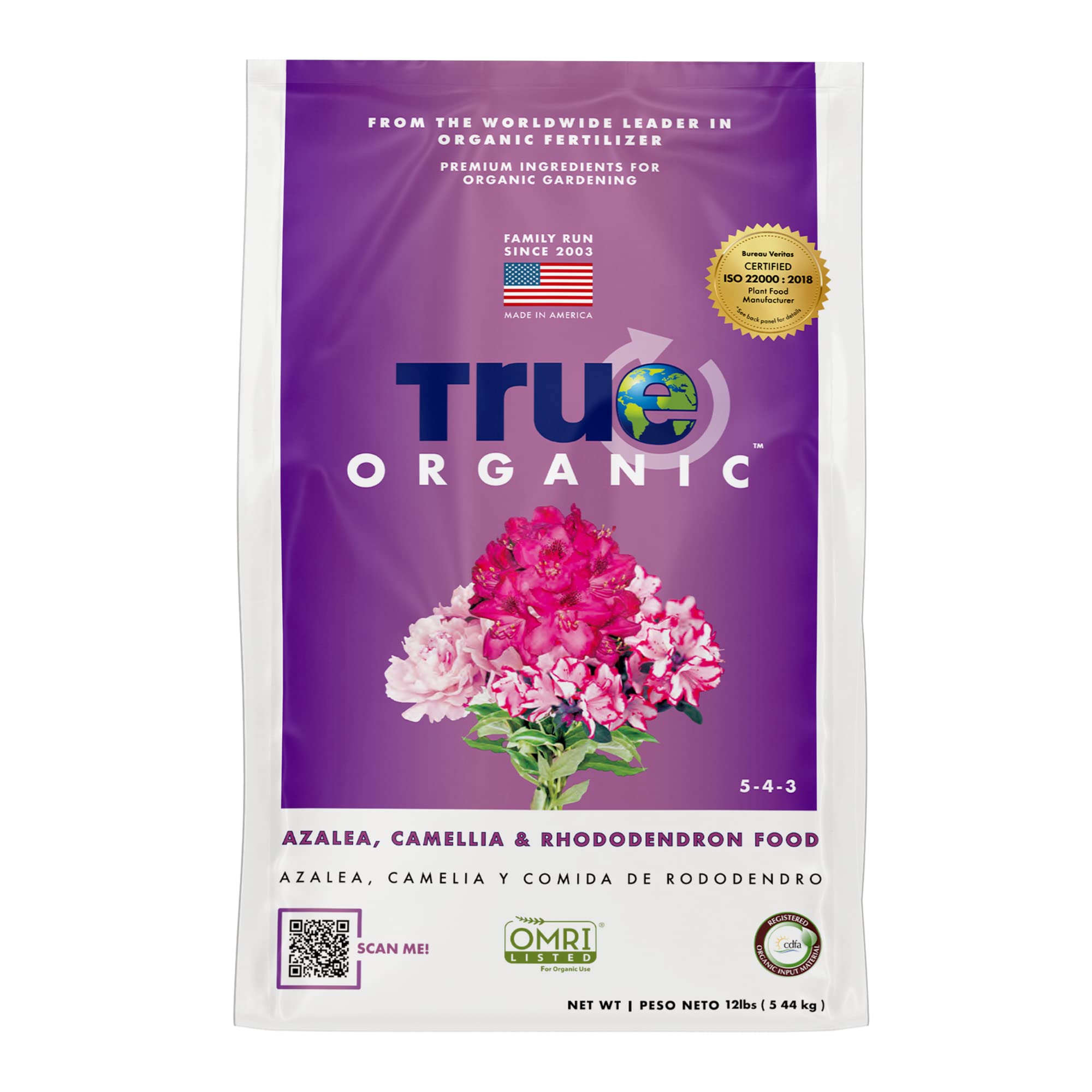
This True Organic formulation delivers a 5-4-3 NPK ratio with 5% soil sulfur, specifically designed to lower pH and unlock nutrient availability. The inclusion of seabird guano and shrimp and crab shell meal provides a diverse spectrum of trace minerals and organic matter that synthetic blends lack.
Growers appreciate the twice-yearly application schedule, which simplifies maintenance. The 12-pound bag covers up to 261 square feet, making it suitable for established shrub beds. The natural ingredients create an earthy smell that gardeners find reassuring compared to chemical fertilizers.
Some users have noted the granular texture can be slightly dusty during application. While it works well for acid-lovers, its specialized nature means it shouldn’t be used on vegetables or neutral-soil plants.
What works
- High-quality organic ingredients with diverse mineral content
- Effective sulfur content for natural pH reduction
- Low-maintenance twice-yearly feeding cycle
What doesn’t
- Granules can create dust during pouring
- Not suitable for neutral or alkaline-loving plants
3. GARDENWISE 8-4-8 Acidic Fertilizer
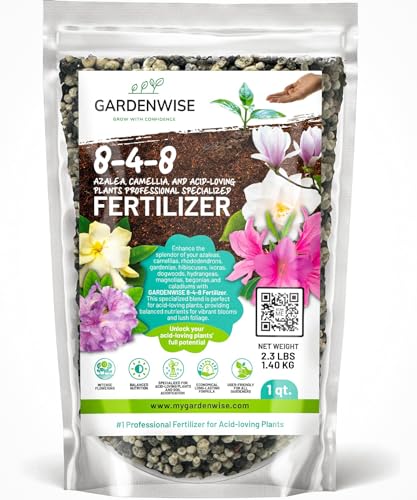
The GARDENWISE 8-4-8 formula takes a different approach by providing a higher concentration of nutrients than typical rhododendron-specific blends. Enriched with iron, manganese, and magnesium, it directly combats chlorosis while the slow-release granules need only three feedings per year for sustained results.
Customer feedback highlights dramatic transformations, with one user’s magnolia doubling in leaf count and producing a blossom within a week. Rhododendron owners report greener leaves and significantly more blooms after a single season of use. The microbial-rich bio-solid base also improves soil structure over time.
The 8-4-8 ratio has a higher potassium content than most rhododendron formulations, making it better suited for plants that also need fruit or berry production support. Users should be careful not to over-apply given its concentrated nature, especially on smaller rhododendron varieties.
What works
- Iron and manganese directly target chlorosis
- Only three applications needed per year
- Rapid visible results on stressed plants
What doesn’t
- High concentration requires careful measuring
- Potassium-heavy ratio not ideal for all rhododendrons
4. Fertilome Azalea, Camellia, Rhododendron Food 9-15-13
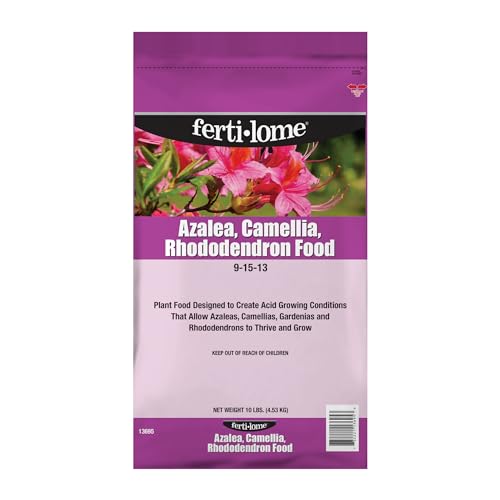
The Fertilome 9-15-13 formulation deviates from balanced ratios by emphasizing phosphorus, the middle number, to aggressively encourage flower production. This makes it a targeted option for rhododendrons that have healthy foliage but refuse to bloom. The higher nitrogen content supports foliage growth as well.
Gardeners have successfully used it to revive rhododendrons that hadn’t flowered in nearly three years, with new leaves appearing within a month. The 10-pound bag is a convenient size for home gardens without requiring large storage space. The product is designed to be applied in early spring, after blooming, and again in the fall.
The synthetic nature of this formula means it doesn’t contribute to long-term soil organic matter. Some users may find the 9-15-13 ratio too high in phosphorus for soils that already have adequate levels, potentially leading to nutrient lockout of other elements.
What works
- High phosphorus content stimulates reluctant bloomers
- Visible leaf and flower improvement within weeks
- Convenient three-feed annual schedule
What doesn’t
- Not organic; does not build soil health
- Excess phosphorus can interfere with nutrient absorption
5. Miracle-Gro Water Soluble Azalea, Camellia, Rhododendron Plant Food

Miracle-Gro’s water-soluble formula is the go-to option for gardeners who need immediate results. Mixed with water and applied every 7-14 days, it provides a direct nutrient injection that greens up yellowing foliage and encourages new growth within the first week. It is safe for all acid-loving plants including hydrangeas, hollies, and gardenias.
The mixing ratio is straightforward: one tablespoon per gallon for outdoor plants. Users report dramatic recovery in stressed rhododendrons, with one reviewer noting their shrub looked stunning by mid-summer after regular applications. The powder dissolves easily in both watering cans and hose-end feeders.
The water-soluble formula requires consistent reapplication, making it more labor-intensive than slow-release granules. The bag’s resealable closure is also notably poor, forcing most users to transfer the powder to an airtight container to prevent moisture damage.
What works
- Visible greening and growth within one week
- Easy to mix and apply with standard watering equipment
- Versatile for many acid-loving plant species
What doesn’t
- Requires frequent reapplication every 1-2 weeks
- Bag closure system is ineffective for storage
6. Earth Science Fast Acting Sulfur Granules

This product is not a complete fertilizer but a soil pH amendment that works alongside your chosen rhododendron feed. The elemental sulfur granules begin working immediately to lower soil pH, which is critical if your soil tests above 6.0. It helps plants absorb iron and manganese, directly preventing the yellowing that plagues rhododendrons in alkaline conditions.
Users have successfully used it to revive hydrangeas, azaleas, and rhododendrons suffering from pH-induced nutrient lockout. The Nutri-Bond Technology helps the sulfur granules stay in place, reducing runoff. It is safe for people and pets immediately after application.
The granules can take multiple waterings to fully dissolve, so it is not truly “fast acting” in the sense of a liquid. It should be used as a soil amendment rather than a standalone plant food, as it provides no nitrogen, phosphorus, or potassium.
What works
- Directly addresses chlorosis by lowering soil pH
- Pet and people safe with no waiting period
- Patented Nutri-Bond reduces environmental runoff
What doesn’t
- Not a complete fertilizer; must be paired with a balanced feed
- Granules dissolve slowly despite the name
7. Dr. Earth Acid Lovers Azalea, Camellia, Rhododendron & Maple Fertilizer

Dr. Earth’s Acid Lovers formula is the only Non-GMO Project Verified fertilizer in the US market, handcrafted from human and feed grade ingredients. Its 0.3-0.4-3 NPK ratio is extremely low in nitrogen and phosphorus, focusing instead on humic acids, trace elements, and beneficial microbes that condition the soil.
Users have reported remarkable turnarounds, including a rhododendron that had not bloomed in two years producing huge pink flowers shortly after application. The formula is also effective on gardenias, azaleas, and camellias, making it a versatile choice for mixed acid-loving plant beds. It is OMRI and CCOF certified for organic production.
The low NPK numbers mean it provides less direct nutrition per pound compared to synthetic alternatives, requiring more frequent or heavier applications for severely deficient plants. The 4-pound bag covers a smaller area than the larger competitors, which may be a consideration for extensive shrub borders.
What works
- Highest purity standards with Non-GMO Project verification
- Humic acids and trace minerals improve soil biology
- Safe for pets and children around treated areas
What doesn’t
- Very low NPK numbers require more product per application
- Small bag size limits coverage for larger gardens
Hardware & Specs Guide
NPK Ratio Decoded
The three numbers on a fertilizer bag represent Nitrogen, Phosphorus, and Potassium. For rhododendrons, a lower first number (Nitrogen) prevents excessive leafy growth at the expense of flowers. A ratio of 4-3-4 or 5-4-3 is ideal, providing balanced nutrition without overstimulating foliage.
Sulfur Content and pH Management
Sulfur is the primary agent for lowering soil pH in rhododendron feeds. Products with 5% elemental sulfur are effective at gradually acidifying the root zone. Without adequate sulfur, even a perfect NPK ratio cannot prevent chlorosis in alkaline soils, as iron becomes unavailable above pH 6.5.
Release Mechanism: Granules vs. Water-Soluble
Slow-release granules break down over weeks to months, feeding the plant steadily and reducing the risk of root burn. Water-soluble powders provide an immediate nutrient spike that is ideal for rescuing stressed plants, but require frequent reapplication every 7-14 days during the growing season.
Organic Matter and Soil Biology
Organic fertilizers like those containing seabird guano, crab shell meal, or bio-solids feed soil microbes that convert nutrients into plant-available forms. Over time, these inputs improve soil structure, water retention, and root zone aeration, creating a more resilient environment for rhododendrons.
FAQ
How often should I fertilize established rhododendrons?
My rhododendron has yellow leaves; is it a fertilizer problem?
Can I use regular all-purpose fertilizer on rhododendrons?
What NPK ratio is best for rhododendron blooms?
Should I use organic or synthetic fertilizer for my rhododendrons?
Final Thoughts: The Verdict
For most gardeners, the fertilizer for rhododendrons winner is the Espoma Organic Holly-Tone because its 4-3-4 NPK, 5% sulfur content, and organic Bio-tone formula deliver consistent results without the risk of burning sensitive roots. If you need a rapid green-up for a struggling shrub, grab the Miracle-Gro Water Soluble Plant Food. And for soil pH corrections before planting, nothing beats the Earth Science Fast Acting Sulfur.