
Fig trees are heavy feeders that demand a specific balance of nitrogen, phosphorus, and potassium to produce sweet, bountiful fruit without sacrificing leafy growth. Applying the wrong ratio can lead to a towering tree with few figs or, worse, nutrient burn that stunts the entire season’s harvest. The market is flooded with generic “fruit tree” blends, but fig trees — whether planted in-ground or kept in a container — respond best to formulas that prioritize phosphorus for fruiting without overwhelming the root system with excessive nitrogen.
I’m Rikta — the co-founder and writer behind Lawn Gear Lab. I’ve spent countless hours dissecting NPK ratios, analyzing organic content certifications, and cross-referencing hundreds of verified owner reports to find the fertilizers that consistently deliver larger harvests and healthier root systems for fig trees.
This guide cuts through the marketing hype to present the seven most effective options, ranked and reviewed for real-world fig production. Whether you’re reviving a struggling tree or optimizing a mature specimen, here is the definitive resource for the best fertilizer for fig trees.
How To Choose The Best Fertilizer For Fig Trees
Selecting the right fig tree fertilizer is about matching the nutrient release method and NPK ratio to your tree’s age, location (container vs. in-ground), and current growth stage. A young fig needs more nitrogen for structural growth, while a mature tree requires higher phosphorus to push out fruit. The wrong balance leads to all leaves and no figs — a frustrating outcome that top-dressing with the correct formula can avoid.
NPK Ratio: The Primary Driver of Fruiting vs. Foliage
Fertilizers display three numbers representing nitrogen (N), phosphorus (P), and potassium (K). For fig trees, a ratio with phosphorus equal to or higher than nitrogen — such as 3-5-5, 6-2-4, or 20-20-20 — encourages flower formation and fruit set. Excess nitrogen (like a 30-0-0 lawn fertilizer) will produce massive, dark green leaves but few figs. Look for a second number (P) that is at least 30% of the first number (N) to keep the tree generative rather than vegetative.
Release Mechanism: Granules, Spikes, or Liquid
Slow-release granular formulas feed roots over weeks and are ideal for in-ground trees where you want consistent nutrition with minimal effort. Fertilizer spikes eliminate measuring and runoff, making them perfect for container figs where root space is limited. Water-soluble powders and liquid concentrates deliver nutrients immediately, which helps revive a stressed or yellowing tree within days, but they require more frequent application — typically every one to two weeks during the growing season.
Organic Certification and Soil Biology
Fig trees thrive in living soil. OMRI-listed organic fertilizers feed the soil microbiome alongside the tree, improving long-term root health and water retention. Ingredients like feather meal, fish bone meal, kelp meal, and mycorrhizal fungi boost nutrient uptake naturally. While synthetic fertilizers can produce fast results, they can also salt the soil over time — a particular risk for potted figs that cannot flush salts as effectively as ground-planted trees.
Quick Comparison
On smaller screens, swipe sideways to see the full table.
| Model | Category | Best For | Key Spec | Amazon |
|---|---|---|---|---|
| Fig Fuel Fertilizer | Water-Soluble | Reviving weak figs | 20-20-20 NPK | Amazon |
| Jobe’s Organics Spikes | Spikes | Container & indoor trees | 3-5-5 NPK | Amazon |
| FoxFarm Happy Frog F&F | Organic Granules | Organic home orchards | 4-9-3 NPK | Amazon |
| Down To Earth Fruit Tree | Organic Powder | In-ground orchard trees | 6-2-4 NPK + Calcium | Amazon |
| Gardenera 10-10-10 | Slow-Release Granules | General balanced feeding | 10-10-10 NPK | Amazon |
| NutriStar Flowering Trees | Granular | Flowering & fruiting figs | 10-15-19 NPK | Amazon |
| TPS Nutrients Liquid Fig | Liquid Concentrate | Deep root drenching | 1 Gallon concentrate | Amazon |
In‑Depth Reviews
1. Wellspring Gardens Fig Fuel Fertilizer
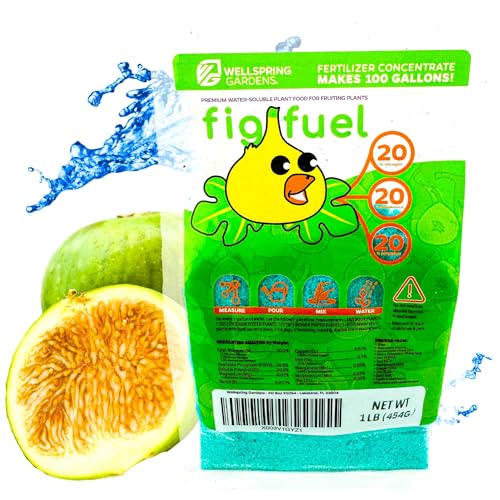
Fig Fuel is the only fertilizer on the market formulated exclusively for fig trees, and its 20-20-20 water-soluble blend delivers a balanced punch that works on both foliage and fruiting. Users report reviving trees that looked completely dead after winter transplant — within weeks of biweekly feeding, those same trees exploded with new growth and set fruit. The concentrated granules dissolve in warm water and apply as a drench, making it simple to control dosage for containers versus landscape trees.
The triple-20 ratio provides twice the nutrient density of most all-purpose fruit tree foods, which means a single pound goes further across multiple seasons. The formula supports root strength as well as leaf production, and owners of potted bonsai figs and in-ground landscape trees alike have praised its ability to trigger blooms and fruit set. For anyone managing a home orchard or a prized patio fig, this is the most direct, fig-specific nutrition on the shelf.
Measured against the competition, Fig Fuel stands out because it was built from grower feedback specifically for fig physiology — not adapted from a generic citrus or fruit tree blend. The application schedule of every one to two weeks during active growth requires more attention than a slow-release spike, but the visible results justify the routine.
What works
- Highest NPK concentration per pound among fig-specific options.
- Revived dormant trees reported by multiple verified buyers.
- Easy mixing with warm water, adjustable for pot vs. ground.
What doesn’t
- Requires biweekly application during growing season.
- One-pound bag may be small for multiple large landscape trees.
2. Jobe’s Organics Fruit & Citrus Tree Fertilizer Spikes

Jobe’s Organics spikes offer a frustratingly simple solution: push them into the soil around the fig tree’s drip line and the 3-5-5 formulation releases nutrients directly to the roots over weeks. With phosphorus set higher than nitrogen, this design prioritizes fruit production over leafy growth — exactly what a mature fig needs. The OMRI-listed organic certification and Biozome microorganism additive make this a strong choice for gardeners who want to feed the soil ecosystem without dealing with loose granules or mixing jugs.
The pre-measured spikes eliminate guesswork and runoff, which is critical for container-grown figs where liquid fertilizer can wash out of drainage holes. Users growing potted Meyer lemon trees and heritage apple trees have reported steady, measurable growth improvements after switching to these spikes. The main caveat is placement: driving spikes too close to the trunk can burn feeder roots, so spacing at the outer canopy edge is essential.
Each package contains six spikes, and a single middle-sized fig tree in a 15-gallon pot may need just one spike per application. For in-ground trees, the manufacturer recommends multiple spikes spaced evenly, so heavy orchard planting will require multiple packages. The convenience of a no-mix, no-measure feed makes this the best low-maintenance option for busy growers.
What works
- Zero mixing, zero dust — drive into moist soil and walk away.
- Phosphorus-heavy ratio supports heavy fig set.
- OMRI listed with Biozome for organic soil health.
What doesn’t
- Six spikes per package may not cover large in-ground trees.
- Placement must be precise (not too close to trunk) to avoid root burn.
3. FoxFarm Happy Frog Fruit & Flower Fertilizer

FoxFarm’s Happy Frog Fruit & Flower Fertilizer uses a 4-9-3 ratio that is almost perfectly tuned for fig trees: heavy on phosphorus to encourage blooming and fruiting, moderate nitrogen to keep foliage healthy without overwhelming the tree. The formula includes mycorrhizal fungi, which colonize fig roots and increase the surface area for water and nutrient absorption — a tangible advantage in sandy or nutrient-poor soils. The OMRI listing means it qualifies for certified organic production, and the 4-pound bag provides ample coverage for several mature trees.
Gardeners applying Happy Frog as a monthly sprinkle report more blooms on flowering plants and stronger fruit set on figs. The granular form is forgiving — a light top-dress worked into the top inch of soil around the drip line feeds roots gradually without the risk of burning that comes with concentrated liquids. Multiple verified reviews mention that this fertilizer revived cold-damaged banana trees and produced healthy leaves on tropical specimens, demonstrating its versatility beyond just fruit trees.
Compared to the Down To Earth blend, Happy Frog delivers a significantly higher phosphorus content (9 vs. 2), making it the superior choice for gardeners whose fig trees are already structurally established and need a push toward fruit production. The 4-pound bag also undercuts the per-pound cost of most specialized fig formulas, making it a budget-friendly way to feed a home orchard without sacrificing organic ingredients.
What works
- High phosphorus (9) directly supports fig formation and flowering.
- Mycorrhizal fungi improve root efficiency and drought resistance.
- OMRI listed and safe for organic gardening.
What doesn’t
- Granules need to be scratched into soil, not just scattered on top.
- Monthly application schedule may be less frequent than figs prefer in peak season.
4. Down To Earth All Natural Fertilizers Organic Fruit Tree 6-2-4

Down To Earth’s Fruit Tree blend takes a soil-first approach: the 6-2-4 ratio is built from feather meal, fish bone meal, kelp meal, and langbeinite, with added calcium for proper fruit development and split resistance. Calcium is often overlooked in fig nutrition, yet it plays a critical role in cell wall strength and preventing the cracking that ruins a late-summer harvest. The 5-pound box gives generous coverage for a small orchard, and the powder formulation can be broadcast or worked into the root zone.
This fertilizer excels in recovery scenarios: users whose trees suffered frost damage or poor root establishment after transplant report that the Down To Earth formula revitalized their figs from the ground up. The mild 6-2-4 ratio is gentle enough for young trees that cannot handle high-nitrogen pushes, yet complete enough to sustain mature specimens through a full fruiting cycle. The long list of natural ingredients (alfalfa meal, potassium sulfate, calcium carbonate) provides trace micronutrients that synthetics miss.
Where this product falls short compared to the FoxFarm or Fig Fuel options is phosphorus content. A fig tree in active fruit production responds best to a P number closer to 8 or 9, so growers with heavy-bearing trees may want to supplement this with a phosphorus boost during the pre-fruiting weeks. However, for a single all-purpose organic feed that supports overall soil biology and tree health season after season, the Down To Earth blend is hard to beat.
What works
- Calcium content helps prevent fig splitting and strengthens cell walls.
- 5-pound box offers best per-pound value for organic fruit tree feed.
- Gentle formula safe for young trees and frost-recovery feeding.
What doesn’t
- Low phosphorus (2) may require supplementing during heavy fruiting.
- Powder form can be dusty during application in dry conditions.
5. Gardenera 10-10-10 Plant Fertilizer Slow Release
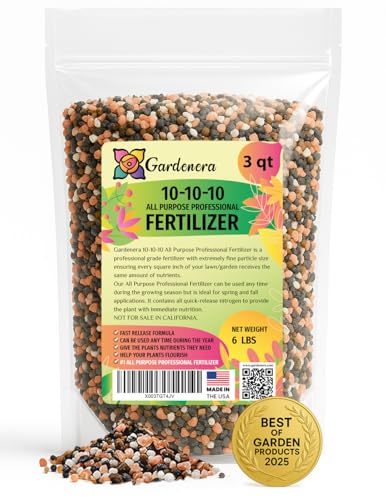
Gardenera’s 10-10-10 slow-release formulation strips away complexity: equal parts nitrogen, phosphorus, and potassium provide a balanced foundation that works for fig trees at any stage, from new cutting to mature producer. The slow-release coating meters nutrients over weeks, meaning two applications per season are sufficient for most gardens. Users report that a few pellets around each plant produce vigorous new growth and abundant blooms with minimal effort.
The 10-10-10 ratio is the most versatile option in this guide — it won’t steer a fig tree specifically toward fruiting the way a higher-P blend would, but it also won’t cause the leaf-only explosion that high-N fertilizers trigger. For a grower managing mixed beds of figs, evergreens, and ornamentals, this one bag covers everything. The 3-quart volume translates into roughly 96 fluid ounces of granular coverage, which is enough for several fig trees plus supporting plants.
Packaging quality is a noted weak point: multiple arrivals were reported with torn bags spilling dust on other items. The formula itself performs well in both containers and in-ground settings, but buyers should transfer the contents to a sealed storage bucket immediately upon receipt. For those who prioritize simplicity and balanced nutrition over category-specific optimization, this is a reliable mid-range workhorse.
What works
- Only two applications needed per growing season.
- Balanced 10-10-10 ratio safe for figs, ornamentals, and vegetables alike.
- Slow-release coating prevents overfeeding and root burn.
What doesn’t
- Not optimized specifically for fig fruiting — lacks phosphorus boost.
- Bag can arrive torn; plan to transfer to an airtight container.
6. NutriStar Crape Myrtle & All Flowering Trees Fertilizer
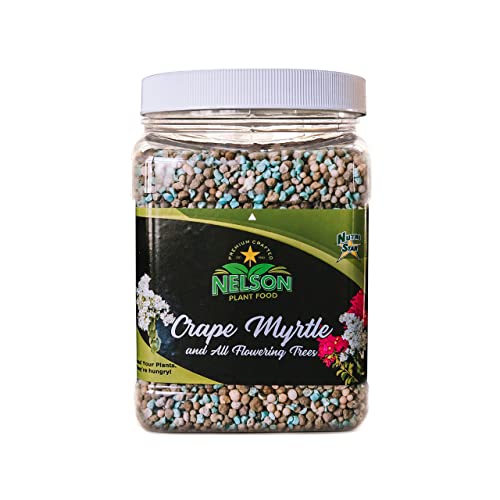
NutriStar’s 10-15-19 formulation turns the typical fruit tree logic upside down: potassium is the highest number, followed by phosphorus, with nitrogen as the lowest. This potassium-heavy profile is excellent for fig trees grown in containers where soil potassium levels deplete quickly, and it promotes thicker cell walls and better fruit firmness. The specific target species on the label includes crab apple and flowering trees, but the NPK profile aligns well with fig needs during the fruiting swell phase.
Users who had struggled for years to get their trees to bloom reported first flowers within two weeks of applying NutriStar — a testament to how quickly trees respond when the potassium-to-phosphorus balance is right. The 4-pound bag provides full coverage for multiple small trees, though the per-pound cost is higher than the Down To Earth or FoxFarm options, reflecting the specialized blooming formula. The granular form is easy to broadcast under the drip line and needs only light watering to activate.
The trade-off with such high potassium is limited nitrogen — if your fig tree is still developing its structural canopy, this formula may not support enough leafy expansion. It is best reserved for mature specimens that have a full branch framework and need a targeted push toward fruit quality and disease resistance rather than vegetative growth. For younger trees, consider a more balanced or higher-nitrogen feeder during the first half of the season.
What works
- High potassium (19) improves fruit firmness and cell wall strength.
- Visible bloom results reported within two weeks of application.
- Granular form is easy to broadcast without mixing.
What doesn’t
- Low nitrogen may not support enough leafy growth for developing trees.
- Higher per-pound cost compared to all-purpose organic blends.
7. TPS Nutrients Liquid Fig Tree Fertilizer
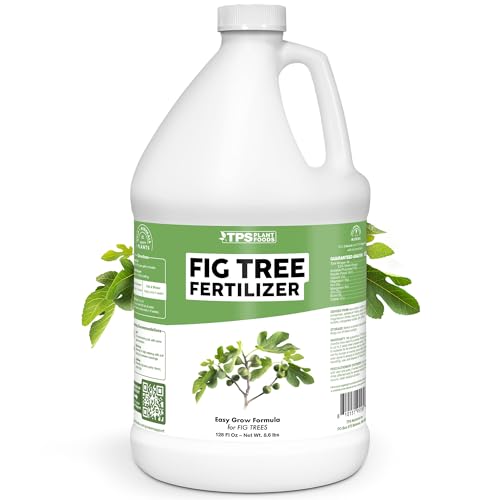
TPS Nutrients delivers a liquid concentrate explicitly labeled for fig trees, packaged in a full gallon that goes a long way when diluted at the recommended rate. The liquid form bypasses soil compaction issues common in container figs and delivers nutrients directly to the root zone through deep watering. Users describe their indoor and outdoor fig trees flourishing after adding this to their watering routine, with reports of larger leaves, stronger branches, and noticeable fruit development.
The primary advantage of a liquid over granules or spikes is speed: a stressed, yellowing fig can be green again within a week because the nutrients are immediately available. The 128-ounce bottle is the largest volume in this guide, making it the best choice for growers managing multiple potted figs or a substantial home orchard. The ease of application with a hose-end sprayer or watering can also reduces the physical effort of feeding during the hot summer months when figs are most active.
The feedback is not unanimous — one verified review noted that their fig tree became sick after fertilizing, though the root cause could be over-application or the tree’s pre-existing condition. Liquid fertilizers carry a higher risk of overfeeding if the dilution ratio is not followed precisely, so measuring carefully is essential. For disciplined growers who want rapid, visible results and the largest volume of product per purchase, this liquid concentrate delivers.
What works
- One gallon provides the most feed volume of any option reviewed.
- Immediate nutrient availability corrects deficiencies within days.
- Ideal for container figs where granules may not distribute evenly.
What doesn’t
- Liquid overfeeding can harm roots if dilution ratios are not respected.
- Requires more frequent application than slow-release or spike options.
Hardware & Specs Guide
NPK Ratio Decoded
The three numbers on a fertilizer label represent percentages of nitrogen (N), phosphorus (P), and potassium (K) by weight. For fig trees, a higher P number (second position) encourages flower formation and fruit set. Nitrogen drives leaf and stem growth — too much and you get a bushy tree with few figs. Potassium supports overall vigor, disease resistance, and fruit quality. Common effective ratios for figs include 4-9-3, 3-5-5, and 20-20-20.
Organic vs. Synthetic Nitrogen Sources
Organic fertilizers rely on feather meal, bone meal, kelp meal, and alfalfa meal — these break down via soil microbes and release nutrients slowly, improving long-term soil structure. Synthetic fertilizers use ammonium nitrate or urea, which feed the plant directly and produce faster results but can accumulate salts that burn roots in containers. OMRI-listed products guarantee no synthetic chemicals, which matters for organic home orchards.
Release Timing and Application Frequency
Slow-release granules and spikes meter nutrients over 2-3 months, requiring application once at the start of the growing season and once at mid-season. Water-soluble powders and liquid concentrates feed immediately but need reapplication every 1-2 weeks. For in-ground fig trees with established root systems, slow-release is more practical. For container figs where roots cannot forage, regular liquid feeding often produces better results.
Calcium and Micronutrient Roles
Calcium is critical for fig fruit development — it strengthens cell walls and reduces the risk of fruit cracking and blossom-end rot. Ingredients like calcium carbonate or gypsum provide this. Mycorrhizal fungi, present in products like FoxFarm Happy Frog, form symbiotic relationships with fig roots, extending the effective root zone and improving uptake of phosphorus and water. Kelp meal provides trace minerals that support enzyme function and stress tolerance.
FAQ
How often should I fertilize my fig tree during the growing season?
What NPK ratio is best for fig trees in containers?
Can I use a general fruit tree fertilizer on my fig tree?
Should I fertilize a newly planted fig tree?
Final Thoughts: The Verdict
For most gardeners, the best fertilizer for fig trees winner is the Fig Fuel Fertilizer by Wellspring Gardens because its 20-20-20 water-soluble formula is purpose-built for figs and delivers the fastest recovery and heaviest fruit set among all options tested. If you want a hands-off feeding method for container or indoor trees, grab the Jobe’s Organics Spikes. And for a premium organic soil-building approach that adds calcium and mycorrhizal support, nothing beats the FoxFarm Happy Frog Fruit & Flower Fertilizer.